December 21, 2017

by Todd Shaver | Dec 21, 2017 | Monthly Newsletter Daily 12pm if new
The Weekly Summary
Star Wars ‘The Last Jedi’ topped $100 million on opening weekend, only the second film to do it, the first being Star Wars ‘The Force Awakens’. Americans are feeling good right now watching movies and buying Christmas gifts, as all-time high equity markets have their portfolios in great shape. Mergers and acquisitions are popping off with Disney buying assets from Fox and several other big-name deals announced this week. These are great times. It has been an incredible bull market. In fact, they say this past year was the least volatile on record in a hundred years. From the depths of the Financial Crisis to today marks an amazing journey for the markets. We can’t help but keep stressing that it won’t always be this good.
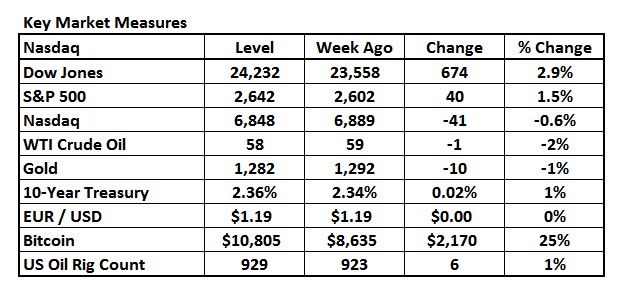
We’re not worried – just watching. We heard a presentation from a research specialist from Citibank on Thursday and he talked about and gave us charts on where the market is historically. He said the PE of the market (S&P 500) is 26, way above the historical average of 16. He said the VIX (^VIX) is sitting at about 10, way below the historical average of 14 or so. And he said the market ALWAYS REVERTS TO THE HISTORICAL MEAN. We took this all in, have thought about it for days and much before that and we must say that we effectively agree with this analysis. Remember the phrase “the new normal”? They said this about Internet stocks in 1999-2000 – remember what happened. They said that about the bull market leading up to 2008. Remember what happened. And they are saying that about this bull market and the low interest rate environment that we have seen for decades, with the 10-year Treasury still at historic lows of 2.35%.
Again, we’re not worried – but we are watching. We think this bull can run for another two years at a minimum.
No matter what is happening out there, there is always a bull market here at The Bull Market Report! This week we highlight some of our favorite stocks where we think you can still make good money, including: Bristol-Myers Squibb, Nutanix, Annaly, Tesla, Twilio and asset managers (Blackstone, BlackRock, and Carlyle Group).
SPECIAL HOLIDAY OFFERING
Get The Bull Market Report for just $199 for the entire year. It is published Weekly on Sunday evenings and we send you News Flashes during the week. We have six portfolios with over 40 stocks that we follow. Some are up 25%; some are up 50%; a few are up over 100%. And in our High Yield Portfolio we have stocks paying 6%, 8% and 10%.
Give a GIFT TO YOURSELF or a loved one or a good friend. It will be the best Christmas present EVER.
Go here now:
https://www.bullmarket.com/subscription/
BMR Companies & Commentary
Asset Managers:
Blackstone (BX: $33)
BlackRock (BLK: $517)
The Carlyle Group (CG: $22)
Asset managers sure look like a compelling place to put money to work. We highlight some of the key data points about current market conditions. The strong fundamentals point to more and more money being made on Wall Street, which means more money for asset managers, and in turn more money for the investors in asset managers, meaning you of course.
Investment banking data were mixed in the week. Equity underwriting volume was 12% above the 4Q17 weekly average, and announced M&A volume was 67% above the 4Q17 weekly average, while completed M&A and debt underwriting were 45% and 20% below the 4Q17 weekly average, respectively; debt underwriting is steady.
Equity trading volume was 8% above the 4Q17 weekly average level, while equity option volume was 10% below the 4Q17 weekly average.
Corporate bond trading volume was steady. The 10-year Treasury yield increased 1 bp to 2.38% (up 4 bps quarter to date (QTD)), the Bank of America U.S. High yield increased 3 bps (up 32 bps QTD), and MBS securities yields (15-year and 30-year) declined 3 bps and 0 bps, respectively (up 14 bps and up 4 bps QTD, respectively).
Equity fund outflows (on a one-week lag) persisted, totaling $3.6B ($36B QTD), while bond fund inflows (also on a one-week lag) continued, totaling $4.3B ($52.0B QTD). This is certainly not good and amazing that the stock market has been able to absorb this negative news and rally like it has.
BMR Take: Take your pick between Blackstone, BlackRock, and The Carlyle Group, or own them all. These companies make money from all of the fees, deals, and rising asset prices. They are a center of profits. We see opportunity for meaningful stock price appreciation if current fundamental trends persist, as we believe it will. They are WAY UNDERVALUED in our opinion.
-------------------------------------------------------------------
Bristol-Myers Squibb (BMY: $61)
Bristol-Myers Squibb has licensed a phase 1 immuno-oncology drug from Japan’s Ono in a $40 million upfront pact. This geographically complex deal, which builds on a collaboration the pair have had for a number of years now, sees Bristol-Myers solely responsible for the development, manufacturing and commercialization of Ono’s selective Prostaglandin E2 receptor 4 antagonist. This program is aimed at targeting immuno-suppressive factors in the tumor microenvironment.
To improve long-term outcomes for more patients with cancer, Bristol believes more immuno-oncology-based combinations may be required, and they are pleased to continue the long-standing collaboration with Ono with this focus in mind. This new program offers the potential to develop targeted therapies that counteract the effects of an immunosuppressive tumor microenvironment. Researching Prostaglandin E2 receptor antagonists in combination with the oncology portfolio has the potential to result in an enhanced response in a broad range of tumors.
BMR Take: Bristol is going to generate $3.00 of EPS this year and around $3.25 next year, then growing toward $4.50 by 2020 as the immune-oncology drugs gain traction. That means the stock is dirt cheap and now is a great entry point. Remember, activist investor Carl Icahn is in the stock and we could see him push for a sale of the company resulting in a huge M&A premium some day in the future.
-------------------------------------------------------------------
Nutanix (NTNX: $35, up 3% last week)
Wow, Nutanix has doubled in recent months. Got your attention now? Let’s review what’s happening.
Nutanix started out as a hyperconverged (HCI) vendor. Starting in 2009, they created the market for HCI. They thought that HCI was a step in the journey to where organizations were headed, which was around becoming truly enterprise cloud software companies. This is what you hear and see Nutanix focusing all their energy on. Nutanix customers are looking at HCI as a critical step in this new era journey. They're looking at Nutanix as a full stack offering that allows them to build this platform, above, that's beyond storage and compute and includes virtualization. It helps them with networking, security, but most importantly now helps them with the transition that's happening in the market around the world of multiple clouds, where customers are trying to figure out how to handle a hybrid cloud environment, where customers want to put some of their workloads in the public cloud, but they also have a private cloud infrastructure that gives them the security that actually is probably even more cost effective for their enterprise apps like SAP, Microsoft and Splunk.
BMR Take: Look, we can’t explain all the finer details around the inner workings of HCI. However, we know that tech-savvy people are thrilled about what is going on at Nutanix. The company is on track to swing from losses to over $1 of EPS in 2021. The company’s customer base has doubled. The stock has doubled. We see all the elements of success and continue to like the stock at this level.
-------------------------------------------------------------------
Annaly Capital Mortgage (NLY: $12.01, up 2%)
The Fed raised rates and guess what, Annaly’s stock went up. What? The company is going to be able to navigate the interest-rate environment just fine. In fact, the Chairman of the Board just bought 125,000 shares this week at $12. At the end of the day, it’s been proven by numerous studies, that following insider buying from key business leaders is a way to make money in the markets. People sell stocks for all sorts of reasons, but they only buy stocks with one thought in mind, “I am going to make money on this purchase.” When that buyer is the Chairman of the Board with all that insight and industry expertise, you have to assume either this guy is a reckless idiot with his money or he is on to something.
Who is Denahan J. Wellington? She is Chairman of the Board of Directors and Executive Chairman of Annaly. Ms. Denahan is a co-founder of Annaly and has over 20 years of financial services experience. She was one of the co-founders of Annaly in 1994 and has been with the firm all this time. Ms. Denahan holds a B.A. in Finance from Florida State University and is the third-highest paid female CEO making over $26 million a year.
BMR Take: We see value in Annaly shares which are trading just above book value of $11.20 with a dividend yield of 10%. We think placing your capital alongside Ms. Denahan is a smart move. We have to say we love this company. We’ve loved them for about 20 years through high interest rate environments, through bull and bear equity markets, through negative naysayers both personally and on the Street, and they just keep coming through year after year. Sorry for gushing!
-------------------------------------------------------------------
Tesla (TSLA: $329, up 9%)
Tesla looks to be catching a break in Congress, as electric vehicle tax breaks appear to be maintained in the current legislation.
House and Senate negotiators have agreed to spare the electric-vehicle tax credit and wind production tax credit in their compromise package, according to a Republican familiar with the process. As part of the $1.5 trillion House tax bill, the $7,500 electric-vehicle tax credit would have been eliminated and the wind production tax credit would have been curtailed. The Senate bill didn’t do either, and that is part of the package set for release.
The vehicle tax credit, adopted as part of the 2009 stimulus bill, helps automakers from Detroit to Yokohama bet big on an electric future with plans to spend billions of dollars on new pure-electric models to be rolled-out in the coming years despite limited sales of the vehicles to-date. Availability of the credit has been capped at the first 200,000 qualifying vehicles sold by each manufacturer. No automaker has reached that cap yet. Tesla sold about 127,000 Model S sedans and Model X sport utility vehicles through August.
BMR Take: The tax credit is a nice incentive for sales of Tesla vehicles. More sales means more cash flow. More cash flow means a greater franchise value on the stock. We like what we see happening with Tesla, from innovation to DC policies. Keep this stock tucked away in your portfolio (but know that is one of your most speculative holdings.)
-------------------------------------------------------------------
-------------------------------------------------------------------
Economic Calendar
Initial Claims
Thursday, December 21st, 10 AM
Period: 12/16
Actual: N/A
Consensus: 235,000
Prior: 225,000
New Home Sales
Friday, December 22nd, 10 AM
Period: November
Actual: N/A
Consensus: 655,000
Prior: 685,000
-------------------------------------------------------------------
Update on Twilio (TWLO: $25, up 3%)
Twilio hosted its first-ever investor day two weeks ago. Despite many quarters of strong results, the stock has remained under pressure.
Twilio aims to be the "future of communications," the way other cloud platforms like AWS has reshaped compute infrastructure and Stripe has revolutionized payments.
Twilio addresses a huge marketplace and has the potential to scale into a much larger company than it is today. The company continues to grow at a 40% rate, even as it approaches a $500 million run-rate.
Twilio's gross margin is much lower than most software companies due to its position of being a "middleman" between developers and telecom networks. The rise of possible competition from services like AWS is a concern.
Based on research from Gartner, the leading software industry analyst, Twilio believes its opportunity in communications to be 40% of the global IT market ($3.6 trillion).
Twilio also reminded investors that its sales model is unique among enterprise software companies by focusing on software developers rather than enterprise CIOs, attributing to its lower spending on sales and marketing. In its most recent quarter, it spent just 23% of its revenues on sales and marketing. This is low compared to the majority of high-growth software companies, that can typically spend upwards of 50% of revenues on sales and marketing.
Twilio also plans to greatly expand its count of quota-carrying reps (QCRs). At the end of 2016, Twilio's sales organization only had 23% of its headcount as QCRs - indicating that the bulk of the company's new sales hires weren't fully ramped yet to the $1.5-$2 million in revenue that the typical QCR brings in. At the end of 2017, however, Twilio estimates that 46% of its sales organization will be QCRs. This will drive further growth in the company.
Revenue guidance calls for $104 million, a strong 25% growth rate. More good news is that active developer accounts are up 35% over last year, and customer retention rate is literally close to 100%.
The company has generated 56% in gross margins year-to-date, the company believes it can attain gross margins of up to 65% in the long term. Twilio is operating at near-breakeven now, but the company expects to attain an operating margin of at least 20% in the future.
BMR Take: We are hanging tough with this great company. Patience will win out in the end, as revenues drive all.
-------------------------------------------------------------------
-------------------------------------------------------------------
Cryptocurrency Update
Bitcoin (BTC-USD, $15,100 – prices change by the minute and trade 24-7)
The bitcoin boom is raging. It’s being discussed on every news network, in every paper, and even in questions asked to the Chairman of the Federal Reserve. The bitcoin rage is best exemplified by the following tale, which is a true story. Erik Finman invested a $1,000 cash gift from his grandmother into bitcoin six years ago. He was 12 years old. Erik is now a millionaire at 18. There are dozens and dozens of these situations being reported. Bitcoin has turned into a full-blown frenzy. It is said that the wealth created in bitcoin has served as an economic stimulus for millennials. Many feel that it going much higher The future of digital gold is here. The end of government controlled fiat money manipulation is upon us. That is what they are saying. But some more cautious investors are saying we will look back and call this the obvious bitcoin bubble. Will we? Only time will tell. Either way the frenzy is an exciting dynamic rarely seen in the markets. Place your bets wisely on the future of cryptocurrencies.
If you wish to learn more about bitcoin and other cryptocurrencies, go to www.Bitcoin.com and sign up for their daily newsletter. Also, www.CoinTelegraph.com has a great one. For info on the 1300 ICOs – Initial Coin Offerings – go to www.CoinMarketCap.com.
-------------------------------------------------------------------
A Word from Gary Jefferson
Jefferson Financial Group
First Vice-President, Investments
UBS Financial Services, Inc.
The year is basically over and we will leave it with the following comments on what may lie ahead. The only thing we can be sure of next year is that the vast majority of predictions or forecasts will end up missing the mark to one degree or another, as the market never follows a predictable pattern or does what everyone, especially the experts, expect. The bottom line to all the following information is simply this - Investors should not get all worked up about the numbers or economic forecasts for 2018. We believe the single most important economic fact that investors need to know is that the world is doing OK.
The current UBS "technical" forecast:
[Be prepared for some serious technical jargon.]
“It is remains our contention that the confusion within the US equity markets, pitting the bulls against the bears, lies in the lack of understanding by investors and traders about the significance of the two current powerful but competing market trends. That is, there is a maturing/aging cyclical bull trend (March 2009) operating within a newly confirmed structural bull trend (secular bull markets last an average of 8 to 20 years in length) that began in earnest in May 2013 via a breakout above 1,576/1,600, which was further validated in 2016 by a positive outside year. As with all cyclical trends, the current 9-year cyclical bull will likely end as early as the second half of 2018 and possibly into early 2019. This will be followed by either a deep correction (10–20%) or by a cyclical bear decline (20–30%) rather than by another structural bear decline (30%-plus). Since the current structural bull trend is only four years old, this long-term trend can sustain for another four years (2021) and possibly extend for another 16 years under ideal conditions. This would imply that the S&P 500 may quickly achieve our technical target of 2,850 as early as the first half of 2018 and possibly overshooting to 3,000 before sustaining a major drawdown. Under the backdrop of a structural bull trend, the S&P 500 can reach an optimistic technical target as high as 3,685 in the years ahead."
Thus, under a worst-case scenario where this new secular bull market which began in 2013 only lasts the minimum 8 years instead of the maximum 20 years - therefore lasting another four years - the technicians are forecasting the S&P 500 could reach 3685 over that 4 year period. This would equate to about 40% upside or 10% annually. However, trying to time this projected correction or cyclical bear decline in later 2018 or the first half of 2019 (or reaching the level of 2994-3045) will be nearly impossible, and could cause timers to miss an important move higher.
Keep in mind that this is a "technical" forecast based on charting and technical historical patterns. It is one of many tools used by money managers in reaching their final investment strategy and asset allocation decisions.
The UBS "fundamental" forecast also offers a positive outlook:
“US stocks rarely experience a sustained downturn outside of economic recessions. In fact, since 1960, the median S&P 500 calendar year total return is 15% in non-recession years. While gains in 2018 are unlikely to match the advance of this past year, US equities should continue to rise and outperform bonds as the US and global economic expansion continues. Historically, stocks rise 88% of the time in non-recession years.
2017 review: Solid S&P 500 EPS growth of 10% underpinned US equities in 2017. Market gains were amplified by higher valuations driven by strengthening and synchronized global growth and inflation generally undershooting market expectations.
2018 outlook. We forecast 2018 S&P 500 EPS to rise another 8% to $141 if tax reform is not passed. With expected tax reform benefits, profits could get an additional 6-10% boost. Solid and steady economic growth and still-low interest rates should continue to support above-average market valuations, although we are not assuming further multiple expansions. Putting it all together, we expect that the S&P 500 will end 2018 between 2,850 and 2,950 if tax reform legislation is enacted. Should tax reform efforts fail, 2,600-2,700 is a more likely base case."
At this point we are going to assume that tax reform happens. Thus, the read we get on the economy is overwhelmingly positive. Maybe it's the Christmas Spirit, but it seems there’s so much going on right now that investors should celebrate. We just had two consecutive quarters of 3%+ GDP growth. We have historically low interest rates which make it cheaper for consumers and businesses and the government to borrow and spend. Inflation, which is a great enemy of both bond and stock investors, has been kept in check through many things such as demographics and technology innovation. We have cheap energy thanks to the technological revolution in fracking and horizontal drilling, and, most importantly, we have rising corporate profits. Ultimately, as they have for all of history, share prices will follow earnings.
So, if you look at this confluence of events: strong economic growth, strong corporate profit growth, low inflation, low interest rates, cheap energy – it’s almost ideal. Several noted stock "gurus" even refer to it as a “Goldilocks economy” where things could hardly be much better. We remain positive about 2018.
-------------------------------------------------------------------
The High Yield Corner
By Michael Foster
We need to spend this week discussing one our favorites - Pimco.
For nearly two years, The Bull Market Report has recommended PIMCO Dynamic Income Fund (PDI: $30, down -3%) for two reasons. The first and most important is the income. The Dynamic Fund has a sustainable 8.9% dividend yield, and it has earned that dividend solidly for as long as the fund has been around. Such a high-income stream is hard to find anywhere - but finding one that is as sustainable and high as this is near impossible. So there has always been good reason to buy and hold the fund.
The second reason to hold this fund is the underlying trends that are good for the main asset class in this fund: mortgage-backed securities. Without getting into a slew of data, the U.S. economy is improving and Americans are paying their mortgages on time more frequently than they did a decade ago. That has translated into a solid run-up for MBSs, many of which were bid down to absurdly cheap levels shortly after the housing crisis in 2007-2009. That, by the way, is what caused Pimco to start the Dynamic fund in the first place; they saw a ton of attractive assets in the mortgage market that were discounted to as little as pennies on the dollar, and they knew those mortgages were a lot safer than the market expected. So they launched the fund to capitalize on that unusual inefficiency in the market, and the Dynamic fund has benefitted healthily since then. It’s up 18% per year on average since its IPO nearly 6 years ago.
That massive run-up is the result of two things: strong income from the portfolio and capital gains from the value of the bonds in the portfolio. In years past, one or the other caused extra upside. In 2017, the upside was from capital gains: the value of the bonds went up. Income, on the other hand, did not exceed expectations. The reasons for that are complicated, but it largely is the result of the MBS market getting crowded. Back in 2011-2013, many people were so terrified of the MBS market that they wouldn’t touch it with a 10-foot pole. Yet it was the absolute bottom of the market. Pimco realized this, and bought when the assets were cheap. They were cheap because the market was expecting net investment income (NII) to be a lot lower on those bonds, but in reality, the income turned out to be higher because defaults were going down. Pimco benefitted handsomely in excess NII.
Closed End Funds tend to return excess NII to investors in the form of a year-end dividend. That’s why at the end of 2016 there was a special $1.45 dividend payout. The fund paid an extra $1.00 in 2015. In 2013? An eye-watering $5.00 in extra income! The special payout in 2013 was so high because the market just wasn’t expecting MBSs to be as safe as they were, so the yield on those bond prices was extremely high. Over time, MBSs in the fund’s portfolio have matured, and Pimco has been buying MBSs at a higher price and lower yield. So NII has declined - but there is still less demand in the MBS market than an equilibrium would assume, so there are still NAV gains in the Pimco fund.
It’s a little complicated, but the moral of the story is this: 2017 saw the Dynamic Fund's NAV total return at 21% and an 18% total price return. PDI’s fundamentals are still outperforming the stock, which is very good. It also means PDI’s NAV is going up. NAV started 2017 at $25.90 and it’s now at $28.70 (11%). The Dynamic Fund is both an appreciating asset and a sustainable high yield asset - both things that The Bull Market Report looks for in its high yield portfolio.
There is just one problem: The lower NII means there isn’t extra income to pass out to investors in the form of a special dividend. We had been saying earlier this year that we did not expect PDI to pay out a special dividend, and it looks like we’re right. Last week on Friday, the company announced that one of its other funds would issue a small special dividend, and the Dynamic Fund would issue no extra dividend at all. This means its yield is going to stay at 8.9% instead of the huge double-digit yields we’ve seen in the past. But the normal dividend is going to remain, and NAV gains could continue throughout 2018 and beyond.
Is it time to sell? No. Although the fund’s special dividends may have come to an end, and with it the near 18% annualized returns, this fund is still good for 10% or more annualized for at least a few years. There will come a day when the MBS market is overbought and it’s time to sell this fund. That day has not come yet. The lack of a special dividend might be a slight disappointment now, but the long-term gains this fund has provided are not going to stop. Enjoy the 8.9% yield and sleep well at night knowing it’s not going to get cut anytime soon.
Good Investing,
Todd Shaver
Founder and CEO
The Bull Market Report
Since 1998
December 17, 2017
by Todd Shaver | Dec 17, 2017 | Weekly Newsletter 7pm Sunday
The Weekly Summary
Star Wars ‘The Last Jedi’ topped $100 million on opening weekend, only the second film to do it, the first being Star Wars ‘The Force Awakens’. Americans are feeling good right now watching movies and buying Christmas gifts, as all-time high equity markets have their portfolios in great shape. Mergers and acquisitions are popping off with Disney buying assets from Fox and several other big-name deals announced this week. These are great times. It has been an incredible bull market. In fact, they say this past year was the least volatile on record in a hundred years. From the depths of the Financial Crisis to today marks an amazing journey for the markets. We can’t help but keep stressing that it won’t always be this good.
We’re not worried – just watching. We heard a presentation from a research specialist from Citibank on Thursday and he talked about and gave us charts on where the market is historically. He said the PE of the market (S&P 500) is 26, way above the historical average of 16. He said the VIX (^VIX) is sitting at about 10, way below the historical average of 14 or so. And he said the market ALWAYS REVERTS TO THE HISTORICAL MEAN. We took this all in, have thought about it for days and much before that and we must say that we effectively agree with this analysis. Remember the phrase “the new normal”? They said this about Internet stocks in 1999-2000 – remember what happened. They said that about the bull market leading up to 2008. Remember what happened. And they are saying that about this bull market and the low interest rate environment that we have seen for decades, with the 10-year Treasury still at historic lows of 2.35%.
Again, we’re not worried – but we are watching. We think this bull can run for another two years at a minimum.
No matter what is happening out there, there is always a bull market here at The Bull Market Report! This week we highlight some of our favorite stocks where we think you can still make good money, including: Bristol-Myers Squibb, Nutanix, Annaly, Tesla, Splunk, and asset managers (Blackstone, BlackRock, and Carlyle Group).
BMR Companies & Commentary
Asset Managers:
Blackstone (BX: $31, down 2%)
BlackRock (BLK: $512, down 1%)
The Carlyle Group (CG: $22, up 3%)
Asset managers sure look like a compelling place to put money to work. We highlight some of the key data points about current market conditions. The strong fundamentals point to more and more money being made on Wall Street, which means more money for asset managers, and in turn more money for the investors in asset managers, meaning you of course.
Investment banking data were mixed in the week. Equity underwriting volume was 12% above the 4Q17 weekly average, and announced M&A volume was 67% above the 4Q17 weekly average, while completed M&A and debt underwriting were 45% and 20% below the 4Q17 weekly average, respectively; debt underwriting is steady.
Equity trading volume was 8% above the 4Q17 weekly average level, while equity option volume was 10% below the 4Q17 weekly average.
Corporate bond trading volume was steady. The 10-year Treasury yield increased 1 bp to 2.38% (up 4 bps quarter to date (QTD)), the Bank of America U.S. High yield increased 3 bps (up 32 bps QTD), and MBS securities yields (15-year and 30-year) declined 3 bps and 0 bps, respectively (up 14 bps and up 4 bps QTD, respectively).
Equity fund outflows (on a one-week lag) persisted, totaling $3.6B ($36B QTD), while bond fund inflows (also on a one-week lag) continued, totaling $4.3B ($52.0B QTD). This is certainly not good and amazing that the stock market has been able to absorb this negative news and rally like it has.
BMR Take: Take your pick between Blackstone, BlackRock, and The Carlyle Group, or own them all. These companies make money from all of the fees, deals, and rising asset prices. They are a center of profits. We see opportunity for meaningful stock price appreciation if current fundamental trends persist, as we believe it will. They are WAY UNDERVALUED in our opinion.
-------------------------------------------------------------------
Bristol-Myers Squibb (BMY: $62, flat)
Bristol-Myers Squibb has licensed a phase 1 immuno-oncology drug from Japan’s Ono in a $40 million upfront pact. This geographically complex deal, which builds on a collaboration the pair have had for a number of years now, sees Bristol-Myers solely responsible for the development, manufacturing and commercialization of Ono’s selective Prostaglandin E2 receptor 4 antagonist. This program is aimed at targeting immuno-suppressive factors in the tumor microenvironment.
To improve long-term outcomes for more patients with cancer, Bristol believes more immuno-oncology-based combinations may be required, and they are pleased to continue the long-standing collaboration with Ono with this focus in mind. This new program offers the potential to develop targeted therapies that counteract the effects of an immunosuppressive tumor microenvironment. Researching Prostaglandin E2 receptor antagonists in combination with the oncology portfolio has the potential to result in an enhanced response in a broad range of tumors.
BMR Take: Bristol is going to generate $3.00 of EPS this year and around $3.25 next year, then growing toward $4.50 by 2020 as the immune-oncology drugs gain traction. That means the stock is dirt cheap and now is a great entry point. Remember, activist investor Carl Icahn is in the stock and we could see him push for a sale of the company resulting in a huge M&A premium some day in the future.
-------------------------------------------------------------------
Nutanix (NTNX: $36, up 3%)
Wow, Nutanix has doubled in recent months. Got your attention now? Let’s review what’s happening.
Nutanix started out as a hyperconverged (HCI) vendor. Starting in 2009, they created the market for HCI. They thought that HCI was a step in the journey to where organizations were headed, which was around becoming truly enterprise cloud software companies. This is what you hear and see Nutanix focusing all their energy on. Nutanix customers are looking at HCI as a critical step in this new era journey. They're looking at Nutanix as a full stack offering that allows them to build this platform, above, that's beyond storage and compute and includes virtualization. It helps them with networking, security, but most importantly now helps them with the transition that's happening in the market around the world of multiple clouds, where customers are trying to figure out how to handle a hybrid cloud environment, where customers want to put some of their workloads in the public cloud, but they also have a private cloud infrastructure that gives them the security that actually is probably even more cost effective for their enterprise apps like SAP, Microsoft and Splunk.
BMR Take: Look, we can’t explain all the finer details around the inner workings of HCI. However, we know that tech-savvy people are thrilled about what is going on at Nutanix. The company is on track to swing from losses to over $1 of EPS in 2021. The company’s customer base has doubled. The stock has doubled. We see all the elements of success and continue to like the stock at this level.
-------------------------------------------------------------------
Annaly Capital Mortgage (NLY: $12.24, up 2%)
The Fed raised rates and guess what, Annaly’s stock went up. What? The company is going to be able to navigate the interest-rate environment just fine. In fact, the Chairman of the Board just bought 125,000 shares this week at $12. At the end of the day, it’s been proven by numerous studies, that following insider buying from key business leaders is a way to make money in the markets. People sell stocks for all sorts of reasons, but they only buy stocks with one thought in mind, “I am going to make money on this purchase.” When that buyer is the Chairman of the Board with all that insight and industry expertise, you have to assume either this guy is a reckless idiot with his money or he is on to something.
Who is Denahan J. Wellington? She is Chairman of the Board of Directors and Executive Chairman of Annaly. Ms. Denahan is a co-founder of Annaly and has over 20 years of financial services experience. She was one of the co-founders of Annaly in 1994 and has been with the firm all this time. Ms. Denahan holds a B.A. in Finance from Florida State University and is the third-highest paid female CEO making over $26 million a year.
BMR Take: We see value in Annaly shares which are trading just above book value of $11.20 with a dividend yield of 10%. We think placing your capital alongside Ms. Denahan is a smart move. We have to say we love this company. We’ve loved them for about 20 years through high interest rate environments, through bull and bear equity markets, through negative naysayers both personally and on the Street, and they just keep coming through year after year. Sorry for gushing!
-------------------------------------------------------------------
Tesla (TSLA: $343, up 9%)
Tesla looks to be catching a break in Congress, as electric vehicle tax breaks appear to be maintained in the current legislation.
House and Senate negotiators have agreed to spare the electric-vehicle tax credit and wind production tax credit in their compromise package, according to a Republican familiar with the process. As part of the $1.5 trillion House tax bill, the $7,500 electric-vehicle tax credit would have been eliminated and the wind production tax credit would have been curtailed. The Senate bill didn’t do either, and that is part of the package set for release.
The vehicle tax credit, adopted as part of the 2009 stimulus bill, helps automakers from Detroit to Yokohama bet big on an electric future with plans to spend billions of dollars on new pure-electric models to be rolled-out in the coming years despite limited sales of the vehicles to-date. Availability of the credit has been capped at the first 200,000 qualifying vehicles sold by each manufacturer. No automaker has reached that cap yet. Tesla sold about 127,000 Model S sedans and Model X sport utility vehicles through August.
BMR Take: The tax credit is a nice incentive for sales of Tesla vehicles. More sales means more cash flow. More cash flow means a greater franchise value on the stock. We like what we see happening with Tesla, from innovation to DC policies. Keep this stock tucked away in your portfolio (but know that is one of your most speculative holdings.)
-------------------------------------------------------------------
Splunk (SPLK: $83, up 2.5%)
Kaminario, a leading all-flash storage company, announced a partnership with Splunk to demonstrate compelling performance gains for customers running Splunk Analytics on the Kaminario K2 storage platform. The K2 Splunk Enterprise app provides users with actionable insight into real-time operational infrastructure.
It is imperative for enterprise customers to gain real-time insight into their infrastructure and turn machine-generated data into usable intelligence to stay competitive, with information automatically streamed and visualized into dashboards, alerts and reports,
Additionally, by supercharging Splunk on the K2 platform, organizations have the ability to meet modern information technology infrastructure needs. Splunk has a modern architecture that can leverage next-gen hardware to eliminate bottlenecks for Splunk’s heavy machine-learning-based processing.
With the Internet of Things and connected devices gaining in popularity, companies have to process and analyze the mountain of machine-generated data super-fast and in real time. This collaboration will allow customers using Splunk and K2 to gain critical insight from their infrastructure backed by the industry’s best performing all-flash array, further enhancing the capabilities to run an autonomous and intelligent datacenter.
BMR Take: Splunk is right at the center of the hottest trend in tech - the Internet of Things. EPS is set to explode from $0.57 this year to over $2.00 by 2021. Grab your share of this stock.
-------------------------------------------------------------------
-------------------------------------------------------------------
Economic Calendar
Housing Starts
Tuesday, December 19th, 10 AM ET
Period: November
Actual: N/A
Consensus: 1,240,000
Prior: 1,290,000
Initial Claims
Thursday, December 21st, 10 AM
Period: 12/16
Actual: N/A
Consensus: 235,000
Prior: 225,000
New Home Sales
Friday, December 22nd, 10 AM
Period: November
Actual: N/A
Consensus: 655,000
Prior: 685,000
-------------------------------------------------------------------
Update on Twilio (TWLO: $25, up 3%)
Twilio hosted its first-ever investor day two weeks ago. Despite many quarters of strong results, the stock has remained under pressure.
Twilio aims to be the "future of communications," the way other cloud platforms like AWS has reshaped compute infrastructure and Stripe has revolutionized payments.
Twilio addresses a huge marketplace and has the potential to scale into a much larger company than it is today. The company continues to grow at a 40% rate, even as it approaches a $500 million run-rate.
Twilio's gross margin is much lower than most software companies due to its position of being a "middleman" between developers and telecom networks. The rise of possible competition from services like AWS is a concern.
Based on research from Gartner, the leading software industry analyst, Twilio believes its opportunity in communications to be 40% of the global IT market ($3.6 trillion).
Twilio also reminded investors that its sales model is unique among enterprise software companies by focusing on software developers rather than enterprise CIOs, attributing to its lower spending on sales and marketing. In its most recent quarter, it spent just 23% of its revenues on sales and marketing. This is low compared to the majority of high-growth software companies, that can typically spend upwards of 50% of revenues on sales and marketing.
Twilio also plans to greatly expand its count of quota-carrying reps (QCRs). At the end of 2016, Twilio's sales organization only had 23% of its headcount as QCRs - indicating that the bulk of the company's new sales hires weren't fully ramped yet to the $1.5-$2 million in revenue that the typical QCR brings in. At the end of 2017, however, Twilio estimates that 46% of its sales organization will be QCRs. This will drive further growth in the company.
Revenue guidance calls for $104 million, a strong 25% growth rate. More good news is that active developer accounts are up 35% over last year, and customer retention rate is literally close to 100%.
The company has generated 56% in gross margins year-to-date, the company believes it can attain gross margins of up to 65% in the long term. Twilio is operating at near-breakeven now, but the company expects to attain an operating margin of at least 20% in the future.
BMR Take: We are hanging tough with this great company. Patience will win out in the end, as revenues drive all.
-------------------------------------------------------------------
-------------------------------------------------------------------
An Update on iShares US Energy ETF (IYE: $38, flat)
This is an ETF that owns a basket of 20 or 30 Energy stocks. If you want to own Energy you should own this stock. It holds about $1 billion of these stocks and is paying a dividend of just less than 3%. 40% of the fund is in two stocks – Exxon and Chevron, which together are worth almost $600 billion.
But it certainly has gone nowhere fast. We added the stock in September last year and it up a whopping 2%. Our Target is $44 which we believe to be in reach, if crude where to move higher from here. But even with the strength in crude of the past few months the stock has been flat. But it is up from the low of $34 in August.
BMR Take: Again, if you want to be in Energy, this is an easy place to be instead of trying to pick one of the many Energy companies out there. Energy will come back some day, of that there is no doubt. But when is the ultimate question and that is something The Bull Market Report can’t tell you!
-------------------------------------------------------------------
Cryptocurrency Update
Bitcoin (BTC-USD, $19,000 Sunday – prices change by the minute and trade 24-7)
The bitcoin boom is raging. It’s being discussed on every news network, in every paper, and even in questions asked to the Chairman of the Federal Reserve. The bitcoin rage is best exemplified by the following tale, which is a true story. Erik Finman invested a $1,000 cash gift from his grandmother into bitcoin six years ago. He was 12 years old. Erik is now a millionaire at 18. There are dozens and dozens of these situations being reported. Bitcoin has turned into a full-blown frenzy. It is said that the wealth created in bitcoin has served as an economic stimulus for millennials. Many feel that it going much higher The future of digital gold is here. The end of government controlled fiat money manipulation is upon us. That is what they are saying. But some more cautious investors are saying we will look back and call this the obvious bitcoin bubble. Will we? Only time will tell. Either way the frenzy is an exciting dynamic rarely seen in the markets. Place your bets wisely on the future of cryptocurrencies.
If you wish to learn more about bitcoin and other cryptocurrencies, go to bitcoin.com and sign up for their daily newsletter. Also, CoinTelegraph.com has a great one. For info on the 1300 ICOs – Initial Coin Offerings – go to CoinMarketCap.com.
-------------------------------------------------------------------
A Word from Gary Jefferson
Jefferson Financial Group
First Vice-President, Investments
UBS Financial Services, Inc.
The year is basically over and we will leave it with the following comments on what may lie ahead. The only thing we can be sure of next year is that the vast majority of predictions or forecasts will end up missing the mark to one degree or another, as the market never follows a predictable pattern or does what everyone, especially the experts, expect. The bottom line to all the following information is simply this - Investors should not get all worked up about the numbers or economic forecasts for 2018. We believe the single most important economic fact that investors need to know is that the world is doing OK.
The current UBS "technical" forecast:
[Be prepared for some serious technical jargon.]
“It is remains our contention that the confusion within the US equity markets, pitting the bulls against the bears, lies in the lack of understanding by investors and traders about the significance of the two current powerful but competing market trends. That is, there is a maturing/aging cyclical bull trend (March 2009) operating within a newly confirmed structural bull trend (secular bull markets last an average of 8 to 20 years in length) that began in earnest in May 2013 via a breakout above 1,576/1,600, which was further validated in 2016 by a positive outside year. As with all cyclical trends, the current 9-year cyclical bull will likely end as early as the second half of 2018 and possibly into early 2019. This will be followed by either a deep correction (10–20%) or by a cyclical bear decline (20–30%) rather than by another structural bear decline (30%-plus). Since the current structural bull trend is only four years old, this long-term trend can sustain for another four years (2021) and possibly extend for another 16 years under ideal conditions. This would imply that the S&P 500 may quickly achieve our technical target of 2,850 as early as the first half of 2018 and possibly overshooting to 3,000 before sustaining a major drawdown. Under the backdrop of a structural bull trend, the S&P 500 can reach an optimistic technical target as high as 3,685 in the years ahead."
Thus, under a worst-case scenario where this new secular bull market which began in 2013 only lasts the minimum 8 years instead of the maximum 20 years - therefore lasting another four years - the technicians are forecasting the S&P 500 could reach 3685 over that 4 year period. This would equate to about 40% upside or 10% annually. However, trying to time this projected correction or cyclical bear decline in later 2018 or the first half of 2019 (or reaching the level of 2994-3045) will be nearly impossible, and could cause timers to miss an important move higher.
Keep in mind that this is a "technical" forecast based on charting and technical historical patterns. It is one of many tools used by money managers in reaching their final investment strategy and asset allocation decisions.
The UBS "fundamental" forecast also offers a positive outlook:
“US stocks rarely experience a sustained downturn outside of economic recessions. In fact, since 1960, the median S&P 500 calendar year total return is 15% in non-recession years. While gains in 2018 are unlikely to match the advance of this past year, US equities should continue to rise and outperform bonds as the US and global economic expansion continues. Historically, stocks rise 88% of the time in non-recession years.
2017 review: Solid S&P 500 EPS growth of 10% underpinned US equities in 2017. Market gains were amplified by higher valuations driven by strengthening and synchronized global growth and inflation generally undershooting market expectations.
2018 outlook. We forecast 2018 S&P 500 EPS to rise another 8% to $141 if tax reform is not passed. With expected tax reform benefits, profits could get an additional 6-10% boost. Solid and steady economic growth and still-low interest rates should continue to support above-average market valuations, although we are not assuming further multiple expansions. Putting it all together, we expect that the S&P 500 will end 2018 between 2,850 and 2,950 if tax reform legislation is enacted. Should tax reform efforts fail, 2,600-2,700 is a more likely base case."
At this point we are going to assume that tax reform happens. Thus, the read we get on the economy is overwhelmingly positive. Maybe it's the Christmas Spirit, but it seems there’s so much going on right now that investors should celebrate. We just had two consecutive quarters of 3%+ GDP growth. We have historically low interest rates which make it cheaper for consumers and businesses and the government to borrow and spend. Inflation, which is a great enemy of both bond and stock investors, has been kept in check through many things such as demographics and technology innovation. We have cheap energy thanks to the technological revolution in fracking and horizontal drilling, and, most importantly, we have rising corporate profits. Ultimately, as they have for all of history, share prices will follow earnings.
So, if you look at this confluence of events: strong economic growth, strong corporate profit growth, low inflation, low interest rates, cheap energy – it’s almost ideal. Several noted stock "gurus" even refer to it as a “Goldilocks economy” where things could hardly be much better. We remain positive about 2018.
-------------------------------------------------------------------
The High Yield Corner
By Michael Foster
We need to spend this week discussing one our favorites - Pimco.
For nearly two years, The Bull Market Report has recommended PIMCO Dynamic Income Fund (PDI: $30, down -3%) for two reasons. The first and most important is the income. The Dynamic Fund has a sustainable 8.9% dividend yield, and it has earned that dividend solidly for as long as the fund has been around. Such a high-income stream is hard to find anywhere - but finding one that is as sustainable and high as this is near impossible. So there has always been good reason to buy and hold the fund.
The second reason to hold this fund is the underlying trends that are good for the main asset class in this fund: mortgage-backed securities. Without getting into a slew of data, the U.S. economy is improving and Americans are paying their mortgages on time more frequently than they did a decade ago. That has translated into a solid run-up for MBSs, many of which were bid down to absurdly cheap levels shortly after the housing crisis in 2007-2009. That, by the way, is what caused Pimco to start the Dynamic fund in the first place; they saw a ton of attractive assets in the mortgage market that were discounted to as little as pennies on the dollar, and they knew those mortgages were a lot safer than the market expected. So they launched the fund to capitalize on that unusual inefficiency in the market, and the Dynamic fund has benefitted healthily since then. It’s up 18% per year on average since its IPO nearly 6 years ago.
That massive run-up is the result of two things: strong income from the portfolio and capital gains from the value of the bonds in the portfolio. In years past, one or the other caused extra upside. In 2017, the upside was from capital gains: the value of the bonds went up. Income, on the other hand, did not exceed expectations. The reasons for that are complicated, but it largely is the result of the MBS market getting crowded. Back in 2011-2013, many people were so terrified of the MBS market that they wouldn’t touch it with a 10-foot pole. Yet it was the absolute bottom of the market. Pimco realized this, and bought when the assets were cheap. They were cheap because the market was expecting net investment income (NII) to be a lot lower on those bonds, but in reality, the income turned out to be higher because defaults were going down. Pimco benefitted handsomely in excess NII.
Closed End Funds tend to return excess NII to investors in the form of a year-end dividend. That’s why at the end of 2016 there was a special $1.45 dividend payout. The fund paid an extra $1.00 in 2015. In 2013? An eye-watering $5.00 in extra income! The special payout in 2013 was so high because the market just wasn’t expecting MBSs to be as safe as they were, so the yield on those bond prices was extremely high. Over time, MBSs in the fund’s portfolio have matured, and Pimco has been buying MBSs at a higher price and lower yield. So NII has declined - but there is still less demand in the MBS market than an equilibrium would assume, so there are still NAV gains in the Pimco fund.
It’s a little complicated, but the moral of the story is this: 2017 saw the Dynamic Fund's NAV total return at 21% and an 18% total price return. PDI’s fundamentals are still outperforming the stock, which is very good. It also means PDI’s NAV is going up. NAV started 2017 at $25.90 and it’s now at $28.70 (11%). The Dynamic Fund is both an appreciating asset and a sustainable high yield asset - both things that The Bull Market Report looks for in its high yield portfolio.
There is just one problem: The lower NII means there isn’t extra income to pass out to investors in the form of a special dividend. We had been saying earlier this year that we did not expect PDI to pay out a special dividend, and it looks like we’re right. Last week on Friday, the company announced that one of its other funds would issue a small special dividend, and the Dynamic Fund would issue no extra dividend at all. This means its yield is going to stay at 8.9% instead of the huge double-digit yields we’ve seen in the past. But the normal dividend is going to remain, and NAV gains could continue throughout 2018 and beyond.
Is it time to sell? No. Although the fund’s special dividends may have come to an end, and with it the near 18% annualized returns, this fund is still good for 10% or more annualized for at least a few years. There will come a day when the MBS market is overbought and it’s time to sell this fund. That day has not come yet. The lack of a special dividend might be a slight disappointment now, but the long-term gains this fund has provided are not going to stop. Enjoy the 8.9% yield and sleep well at night knowing it’s not going to get cut anytime soon.
Good Investing,
Todd Shaver
Founder and CEO
The Bull Market Report
Since 1998
December 6, 2017
by Todd Shaver | Dec 6, 2017 | 7am News Flash
Square (SQ: $38, up $1) had a good day yesterday, after a rough week last week. We wish we could say the same about Twilio (TWLO) which was down 2% to $25. These are two of our favorites (plus Nutanix, makes three) and Square has been a home run while Twilio has been a strike out. We still believe in Twilio but the market is telling us another story. We can’t quite believe it as revenues for the past few years have been stellar. We saw $90 million in 2014, $165 million in 2015 and $280 million in 2016. And they did $100 million in the 3rd quarter of 2017. We don’t get it. Revenues always win in the end, but Wall Street is making us suffer for the time being.
As to Nutanix (NTNX: $34), the stock is up $2 from where it was at the beginning of November. Yes, it had a run to $38 on Friday, but the stock was at $23 in the beginning of October for heaven’s sake. We’re not worried in the slightest.
Apple and Facebook are doing just fine, with both hovering around the $170 mark. Apple was at $151 in late September, just a little over two short months ago. Facebook was at $148 in July. Things are really quite OK out there.
But if you are afraid of the world at large and concerned about your investments (and not willing to climb a wall of worry with the rest of the market) then take some profits and put your money to work in Annaly Capital Management (NLY) paying over 10% or Government Properties Income Trust (GOV) paying over 9%. Or Pimco Dynamic Income Fund (PDI) paying 8.6%.
Relax – It’s almost Christmas!
December 3, 2017
by Todd Shaver | Dec 3, 2017 | Weekly Newsletter 7pm Sunday
The Weekly Summary
Before we tell you the big news for the week. Let’s just remember: The politicians in our country still have a lot of room for improvement. Let’s not praise them for accomplishing something they should be doing. With that said, Senate Republicans narrowly approved the most sweeping rewrite of the U.S. tax code in three decades, slashing the corporate tax rate and providing temporary tax-rate cuts for most Americans. It was a close vote of 51-49 that was placed just before 2 AM Saturday. Trump expects to sign the bill before Christmas but before that, there are a number of discrepancies to resolve, which could cause a lot of commotion in the weeks ahead. All in all, tax reform is a major milestone and had this not happened we could have seen a jolt to the markets. But the Bull Market remains alive and well!
No matter what is happening out there, there is always a bull market here at The Bull Market Report! This week we highlight some of our favorite stocks where you can still make good money, including: WageWorks, Blackrock, PayPal, Square, Nutanix, and Annaly.
BMR Companies & Commentary
WageWorks (WAGE: $64, up 2%)
WageWorks is catching a bid as they say, when a stock starts to work. What is happening recently? Well, the company has published its latest update for “The Definitive Guide To HSAs”. This is the best blueprint on the planet for how to run your business for your employees. Most employees are not prepared to handle unexpected medical expenses. A recent survey from Aflac found that 65% of respondents have less than $1,000 to pay for out-of-pocket expenses related to an unforeseen illness or injury. So, how do you offset rising healthcare costs, while keeping employees happy and healthy? For many organizations, the answer is a high-deductible health plan (HDHP) paired with a Health Savings Account (HSA). All of this detail is covered in the updated guide just published. The key takeaway is that December is the point in the year where all of WageWorks’ clients renew and many new clients come onto the platform. Revenue will be strong, and we will get an updated client count in the next earnings release, which will give us great visibility into just how good business will be in 2018.
BMR Take: The consensus EPS is currently $1.80 this year heading to almost $2.00 next year. We expect upside to next year’s EPS estimate to be evident on the upcoming earnings call, as the company announces a number of new client wins during this year’s selling season.
---------------------------------------------------------------------------------
BlackRock (BLK: $502, up 5%)
BlackRock and Citibanamex, a subsidiary of Citigroup, announced a definitive agreement for BlackRock to acquire the asset management business of Citibanamex. The two companies will also enter into a distribution agreement to offer BlackRock asset management products to Citibanamex clients in Mexico. Through its network of 1,500 branches in Mexico, Citibanamex provides wealth management products and services to more than 20 million clients. The transaction involves approximately $31 billion in assets under management of Citibanamex, across local fixed income, equity and multi-asset products, primarily for retail clients. The transaction is part of Citi’s emphasis on expanding access to best-in-class investments products, rather than on manufacturing proprietary asset management products. BlackRock’s business in Mexico currently focuses mostly on institutional clients, offering international investment and risk management products and services across asset classes, strategies and geographies.
BMR Take: This is why we like BlackRock. The company’s reach globally is unbelievable and getting bigger. Consensus calls for EPS to grow from $22 this year toward $33 in 2020. This ride is just getting started.
---------------------------------------------------------------------------------
PayPal (PYPL: $75, down 4%)
PayPal has had to suspend operations and that has weighed on the stock. PayPal announced an update on the suspension of operations of TIO Networks (TIO), a payment processor PayPal acquired in July 2017. A review of TIO's network has identified a potential compromise of personally identifiable information for approximately 1.6 million customers. The PayPal platform is not impacted in any way, as the TIO systems are completely separate from the PayPal network, and PayPal's customers' data remains secure. As announced on November 10th, PayPal suspended the operations of TIO to protect customer data as part of an ongoing investigation of security vulnerabilities of the TIO platform. This ongoing investigation has identified evidence of unauthorized access to TIO's network, including locations that stored personal information of some of TIO's customers. As a result, PayPal is taking steps to protect affected customers.
BMR Take: While this isn’t great, we applaud PayPal’s swift and serious preventative measures. So many other companies, like Equifax, have done it all wrong. This is why PayPal is a market leader in payments as they set the example. With EPS set to grow from $1.90 this year to over $3.00 by 2020 there is more room to run in PayPal’s stock, unreal considering how much the stock has already appreciated.
---------------------------------------------------------------------------------
Square (SQ: $38, down 22%)
Square has been red hot, moving straight up from below $10 since the summer of 2016. We added the stock at $17 in March of this year and are still up over 120% even after last week. We saw a big pullback last week but are not overly concerned. One of the reasons was that an analyst at BTIG (who?) came out with a Sell rating on the company saying the bitcoin rally was speculative, overdone, and ripe for a correction. (The company created a buzz announcing the Square Cash app that will buy and sell bitcoin.) It is not optimal or correct for the company’s fortunes to be tied to cryptocurrency. This is just a small experiment which we applaud, but if it doesn’t work out we’re not worried and it certainly won’t impact the company materially. Shares dropped about 16% on the release of this report. All in all, we like what Square is doing.
BMR Take: The major takeaway is not getting caught up in the volatility of cryptocurrency, but that Square is pioneering payments in a manner not seen at its major peers. This makes Square the innovation leader in the space and a must-own stock for the long haul, like a Tesla or Amazon, where it’s not that the numbers don’t matter, but just not yet and won’t for a long time. Revenues are growing dramatically and ultimately the Street believes in revenues first and then profits.
---------------------------------------------------------------------------------
Nutanix (NTNX: $36, up 5%)
Nutanix absolutely crushed the quarter and the stock went flying higher. Revenue of $276 million grew 46% year-over-year. Billings of $315 million grew 32% year-over-year. The loss per share of $0.39 compares to a loss of $1.89 a year ago, but recall that if the company stopped marketing heavily tomorrow, EPS would increase over $1.00. We don’t want this to happen as we want long term marketing investments for future revenue growth. The cash balance ended the quarter at $365 million, a healthy figure. Nutanix ended the first quarter of fiscal 2018 with 7,800 customers, adding over 760 during the quarter. First quarter customer wins included ConocoPhillips; Toyota Motor North America, and Trek Bicycle Corporation. Nutanix increased the number of $1 million+ deals in the quarter, up 36% from last year.
BMR Take: Nutanix delivered a great quarter. The stock is a great investment opportunity and we have seen a massive move since we added the position to our portfolio in May at $17. From here, we look for more steady revenue performance in 2018 and believe this can continue to push the stock higher. We see the company clearing the $1.0 billion revenue milestone for the first time next year! Revenues for the past three years ending July were $765 million last year, $445 million in 2016 and $240 million the year before. Now that’s called growth! At $6 billion in market cap the company has reached the medium-time (in other words not the big-time! Yet.) but they are moving swiftly in the right direction. Of course, the company remains a buy-out candidate as $6-10 billion is chump change for the big boys. Now wouldn’t it be nice to have this one bought out at $50 a share sometime next year. Our Target is $42, recently raised, but we sure wouldn’t mind raising this Target to $50 if the stock hits $40 in the next few months.
Upgrades this week: Nutanix price target raised to $51 from $39 at Maxim and kept their Buy rating after this week’s earnings beat. The company's latest guidance looks to improve the sales productivity metric from 32% to 39% in FY19.
Nutanix price target raised to $40 from $34 at Oppenheimer saying the company reported another strong quarter ahead of expectations. The "clear highlight" was management's commitment to a software-focused model going forward. The research company is bullish on the transition and looks forward to a "large gross margin boost over time." He maintains an Outperform rating on Nutanix.
Nutanix price target raised to $40 from $28 at Piper Jaffray saying the company's transition to a software model highlighted its "solid" Q1 results. The transition will result in "significant" gross and operating margin expansion, and should ultimately drive a "re-rating of the multiple." They have an Overweight rating on the stock.
---------------------------------------------------------------------------------
Annaly (NLY: $11.80, flat)
Annaly is worth a close look right here. The company is a leading diversified capital manager. The yield on the stock right now is greater than 10%. They are the largest Mortgage REIT in the world with a market cap of almost $14 billion, which is 20x the market cap of the median Mortgage REIT. Their diversified business model has them investing in agency loans, residential credit, commercial real estate, and middle marketing lending. Let’s review these:
--- The Agency group invests in agency Mortgage Backed Securities collateralized by residential mortgages which are guaranteed by Fannie Mae or Ginnie Mae. These are the safest government bonds around, but do carry interest rate risk.
--- The Residential Credit group invests in non-agency residential mortgage assets. This area is more complex because there is no government guarantee, but the opportunity for enhanced investment returns is greater.
--- The Commercial Real Estate group originates and invests in commercial mortgage loans, securities, and other commercial real estate debt and equity investments, which is a great way to pick-up real estate exposure in your portfolio.
--- The Middle Market Lending group provides financing to private equity-backed middle market businesses across the capital structure, which can be quite lucrative. The company is very well run, in fact the best in the industry, and the Board of Directors appointed Chief Executive Officer and President Kevin G. Keyes as Chairman effective January 1, 2018.
BMR Take: With a 10% dividend yield, and sturdy fixed income investments across asset classes, we see compelling value in the stock. If we see a volatile equity market, their portfolio of mortgage-backed securities should provide steady income to support the $1.20 dividend that is covered by earnings. Higher interest rates could cause some near term volatility, but Annaly will be able to reinvest at the higher rates ultimately driving higher dividends that should appeal to any high income seeking investor.
---------------------------------------------------------------------------------
---------------------------------------------------------------------------------
Upcoming Economic Calendar
Factory Orders
Monday, December 4th, 10 AM ET
Period: October
Actual: N/A
Consensus: -0.40%
Prior: 1.4%
Trade Balance
Tuesday, December 5th, 8:30AM
Period: October
Actual: N/A
Consensus: -$47.0B
Prior: -$43.5B
Consumer Credit
Thursday, December 7th, 3:00 PM
Period: OCT
Actual: N/A
Consensus: $16.5B
Prior: $20.8B
Unemployment Rate
Friday, December 8th, 8:30 AM
Period: November
Actual: N/A
Consensus: 4.1%
Prior: 4.1%
---------------------------------------------------------------------------------
---------------------------------------------------------------------------------
A Word from Gary Jefferson
First Vice-President, Investments
Jefferson Financial Group
UBS Financial Services, Inc
I remember riding as a kid over the desolate highways in west Texas and every now and then you would see a great big billboard with the ominous message "The End Is Near". Well, as investing goes in the year 2017, the end really is near, except the message thus far is extremely positive - although it still contains a slightly menacing element. We haven't had the almost obligatory 5-10% market correction after such a strong run-up. That's because through today, there is still a little bit more than just "hope" that tax reform will happen. Should tax reform fail, then we would be in the shock-and-awe camp if the market treated it as a non-event. Whatever the result, the year-end should be a net positive one.
As we approach the new year, we do not see a scenario that would involve making major changes to our asset allocations or investment strategies. First and foremost, we don't see a recession anywhere on the horizon. It is just the opposite – we see continued expansion in both US and global corporate earnings. It is that simple and we don't see any reason to try and make it any more complicated. We will certainly keep an eye out for the accepted early warning signs of potential trouble ahead such as an inverted yield curve or runaway inflation. And, there is always the proverbial geopolitical risk and the energy wild card. At this time, however, the energy card looks to be fairly stable, as do the Mideast and North Korean tensions.
We think Technology will still be a leader because we are right in the heart of the 4th Industrial Revolution and it is all about technology – artificial intelligence, augmented reality, the Internet-of-Things, the "Cloud", driverless cars, e-commerce and the list goes on and on. The first Baby Boomer is only 71 and 10,000 people turn 65 every day now, which will continue for another 10 years. Healthcare can't help but be a tremendously important sector for years to come because of its unstoppable momentum. While we continue to like these two sectors, we also see a lot of potential in many other areas. That is why we continue to use diversification as the cornerstone of our investment strategy. For several years the large-cap S&P 500 stocks were about the only positive area in worldwide markets and diversified portfolios lagged their performance. Today, however, Europe, Asia, Emerging markets, small caps and alternatives are finally participating in the overall success of global markets, allowing traditional diversification to reward investors. We, along with most major firm analysts, expect this broad-based positive performance to continue into 2018, albeit at a lesser pace than this year's torrid rate.
One thing we are sure of is that a market correction will happen – we just don't have any idea as to the timing (nor does anyone else, so run away as fast as you can whenever you hear someone specify the time and date). Unless the fundamentals that got us here collapse, we will view a correction as a normal market event, not as a reason to panic but rather more likely as an opportunity to seize. Bearing that in mind, while the "end is near" for investing in 2017, we think of it as a useful billboard alerting us to plan and prepare for investing in 2018. Diversification, with some emphasis on Technology and Healthcare, remain solid portfolio choices.
---------------------------------------------------------------------------------
Amazon (AMZN: $1162, down 2%) price target raised to $1,525 from $1,430 at Wells Fargo to reflect increased outer-year estimates for Web Services as well as a higher sum-of-the-parts valuation. The research firm highlighted the "very successful" five-day Amazon Wed Services conference in Las Vegas, "record-breaking" early holiday sales data, and another Healthcare industry development with CNBC reporting* the company is in talks with generic manufacturers Mylan (MYL) and Novartis (NVS). They see an increasing likelihood that Amazon "ultimately becomes a disruptor" in Healthcare, with generics representing a potential point of entry. The Wells Fargo Healthcare team sees generics as a "simple entry point" in Pharma as it involves many players with ready supply and a price competitive market. They keep an Outperform rating on Amazon.
* CNBC reports that Amazon has held preliminary talks with generic drug companies, including Mylan and Novartis' Sandoz, regarding the ecommerce giant's possible entry into the pharmacy market. It is unclear whether Amazon is planning to enter the space as a drug wholesaler or as a retailer but Sandoz said it does not expect the move, which could potentially disrupt the drug distribution industry led by McKesson (MCK), AmerisourceBergen (ABC) and Cardinal Health (CAH), and which could have a "major impact' on its business.
---------------------------------------------------------------------------------
Visa (V: $111, down 1%) remains solid as a rock. This company is BIG, at $250 billion in market cap. The dividend is not worth mentioning, but the company is all about growth. Revenues the last three years were $14 billion in fiscal 2015 (ending September), $15 billion in 2016 and $18.4 billion in 2017. With after-tax income of $6.7 billion, this company is a cash machine. 36% after tax? Simply astounding. The company has $10 billion in cash and $16 billion in long-term debt, a good ratio. We sure would like to see a higher dividend, but we’ll settle for our Target Price of ….. Wait a second. It just hit our Target of $110. So we hereby raise it to $123. Our Sell Price is: We would not sell Visa. Invest in this puppy for the grandkids. They'll be happy you did.
---------------------------------------------------------------------------------
The High Yield Report
By Michael Foster
There are a couple of big-picture items to talk about. One kinda big and one really, really big.
Let’s start with the kinda big item. Pimco. The Bull Market Report has recommended the PIMCO Dynamic Income Fund (PDI: $30, up 1%) for nearly two years now, and in that time the fund’s distributions have remained constant. But what really has pushed this fund over that period has been its special distributions. In late 2016, this fund gave out an extra $1.45 in a special end-of-year payout that boosted its annual dividend to over $4, which makes the return a whopping 13% on stock. And the fund’s net assets have actually grown while paying those distributions. This kind of performance is the thing dreams are made of.
Now we’ve come to the end of 2017, and we’re wondering if that same lightning will strike again. If you were reading our columns last year, you know that we were expecting an end-of-year payout of over $1, and Pimco crushed our expectations with nearly 50% more cash to shareholders than what we were hoping. So what about this year?
Unfortunately, this is the weirdest year in the history of this fund. Keep in mind that the Dynamic Income Fund specializes in mortgage-backed securities (MBS’s), which are one of the few asset classes to be Hollywood famous. In the movie-adaptation of Michael Lewis’s The Big Short (and, if we may say, the book is much better than the movie and definitely worth a read), the public was given an insight into these derivative investments that, frankly, were one of the primary weapons of the 2007-2009 financial crisis.
That big crash is, paradoxically, why Pimco spun off this fund in 2012 and why it’s done so well since. With a focus on MBS’s, the fund looked to find assets in the marketplace that were trading at absurd discounts to their NAV. Pimco found MBS’s that had been discounted to trade for 20 cents on the dollar, and then they did an analysis to see if more than 20% of the underlying mortgages would avoid defaulting. If so, they bought the MBS.
They did a lot of this in 2012 and 2013, which was really the bottom of the MBS market. Since then, Pimco has been collecting the income from those mortgages, and that massive interest payment (since those assets were bought at a huge discount) has resulted in a high yield for investors.
It’s been a decade since the crisis began, which means the total number of distressed mortgages has declined as a result of payoffs, refinancing, and so on. That means there are fewer distressed mortgage-backed securities in the market. At the same time, more investors have realized how oversold the MBS market was in the aftermath of the financial crisis, and a lot of competition to buy these assets began in 2013. That has heated up extremely in 2017, which means the Dynamic Income fund has been buying fewer and fewer MBS’s at those big discounts and buying more at much smaller discounts.
As a result, the Dynamic Income fund has been earning a lower yield on its investments - but its dividend has remained constant. That has translated into a lower dividend coverage ratio that actually fell below 100% in 2017 for the first time in years.
This has worried a lot of investors, but it shouldn’t. We are still years and years away from this fund being a sell. It does mean that it is harder to earn the massive income stream that it has had in the past, but it is still very easy to earn capital gains by identifying underpriced MBS’s in the market. Pimco is particularly good at this, so the fund is seeing its NAV rise at a faster pace than any other time since 2012.
But all of this puts the special dividend at risk. Will Pimco give out a special distribution from capital gains? We simply don’t know. In the past, the fund has paid out a special distribution from investment income, which makes sense (this is the structure many Closed End Funds and mutual funds follow). PDI can choose to give a special distribution from capital gains or not give a special distribution at all. No one knows whether they’ll choose to give a special distribution from cap gains or no special at all.
So, sadly, we cannot predict an end-of-year payout this year. It could be anywhere from $0 to $2.00 (the amount the fund’s price has gone up in 2017). Personally, we would like to see Pimco offer no special dividend and use that cash to get better returns - but, then again, investors would’ve been well-served had Pimco done that in previous years, and they didn’t. So the future of the fund’s special dividend is in question.
The normal dividend is not in question, however, and the NAV growth is strong enough to keep holding the fund in your portfolio.
The second really big issue is a lot bigger but also a lot simpler: the tax code.
Municipal bond funds Nuveen AMT-Free Municipal Credit (NVG: $15.31, down 1%) and Invesco Municipal Trust (VKQ: $12.30, down 1%) have taken a hit alongside all municipal bond funds on the uncertainty of municipal bond tax credits. Specifically, there is worry that the new tax plan will remove the tax-free status of “private activity bonds,” or PABs, which tend to be used by local governments to provide funding for private entities that will develop a new building or piece of infrastructure that has a broader public use (for instance, a new hospital). There remains uncertainty as to whether munis will maintain their tax-free status. The tax plan from Congress eliminates their tax-free status, and the Senate retains them. That split indicates to us that this is a battleground for quid-pro-quo politics, and we may see a last-minute reversal as a result of a back-door deal.
Nonetheless, the municipal market is assuming this is just plain bad for municipal bonds. The reality is much less clear. This may result in fewer bonds in the market, and that would mean higher prices for bonds (especially older bonds). That would be very good for existing muni bond funds. But it really depends on the final legislation, which no one knows yet.
We don’t believe munis will be stripped of their tax-free status. We see this as a buying opportunity for municipal bonds, since the potential upside is something the market isn’t focusing on. The market is too big and too important for such a major change to occur.
Good Investing,
Todd Shaver
Founder and CEO
The Bull Market Report
Since 1998
November 19, 2017

by Todd Shaver | Nov 19, 2017 | Weekly Newsletter 7pm Sunday
The Weekly Summary
The big story this week was the sale of a Leonardo da Vinci painting for $450 million. Leonardo da Vinci’s Salvator Mundi went to auction Wednesday night at Christie’s in New York and the selling price broke sales records. Watching the top part of the market is an interesting tell. It is noticeable when the luxury art market hits fresh highs. We further note that luxury apartment prices in New York City are down 10% to an average of $8.1 million this month compared to a year ago.
Construction is under way setting new height records of high-rise buildings in cities like Los Angeles and Philadelphia. What does this mean? Things are good, though often new peaks signal a top. We must watch very closely. When the luxury market starts hitting new records, you have to step back and realize trees don’t grow to the sky, and that this bull market is not guaranteed to last forever.
Don't get us wrong. We're still very bullish and expect a strong earnings year in 2018. But it never hurts to be a bit cautious.
No matter what is happening out there, there is always a bull market here at The Bull Market Report! This week we highlight some of our favorite stocks/funds where we think you can still make good money, including: VMware, Annaly, Shopify, Tesla, Nutanix, and Celgene.
BMR Companies & Commentary
VMware (VMW: $123, up 1%)
Singaporean communications company M1 Limited and software and services provider VMware announced a new cloud offering made for digital start-ups, and small-and-medium enterprises. The service will enable budding tech businesses to develop software-based products quickly in addition to growing their business without an expensive infrastructure expenditure.
M1 said it is improving its next-generation software-defined data center, which is powered by the VMware cloud provider program, with shipping support from Pivotal Container Service. The new cloud offering provides advanced technology that allows businesses to run faster and introduce new products quicker.
BMR Take: It is great to see new product development! VMware is expected to produce earnings of $5 per share this year and $6 by 2020. With such a solid market presence and brand, we see additional upside in the stock.

----------------------------------------------------------------
Annaly (NLY: $11.49, up 2%)
CEO & President Kevin Keyes bought 300,000 shares of stock this week in the open market. There is nothing like insider buying to signal a stock is a good buy. Who is Mr. Keyes?
Kevin Keyes serves as President and Chief Executive Officer of Annaly and is a member of the Board of Directors. Prior to joining Annaly in 2009, Mr. Keyes worked for 20 years in senior Investment Banking and Capital Markets roles in the Real Estate and Financial Institution Industries among others. From 2005-2009, Mr. Keyes served in senior management and business origination roles in the Global Capital Markets and Banking Group at Merrill Lynch. Prior to that, he worked at Credit Suisse First Boston from 1997-2005 in various Capital Markets Origination roles and Morgan Stanley from 1990-1997 in the Mergers and Acquisitions Group and Real Estate Investment Banking Group. Mr. Keyes holds a B.A. in Economics and a B.S. in Business Administration from the University of Notre Dame.
BMR Take: Mr. Keyes is a smart businessman. Annaly is currently producing earnings of about $1.20 and pays this out in a dividend yielding over 10%. Follow the smart money here. The company has been successful over 20 years through bull markets and bear. With a market cap of $13 billion, this stock is rock steady.
----------------------------------------------------------------
Shopify (SHOP: $105, up 5%)
Shopify is just not the ‘short’ some of the naysayers say. The best way for the company to prove it and crush the shorts is by building the underlining business. The truth is that while the stock market is a voting-machine in the short-term, over the long-term it is a weighing machine. You build a great business with earnings and the stock goes higher, every time. This is just what Shopify is doing.
Just in time for the holiday season, UPS and Shopify are unveiling a platform integration that make UPS's premium services available to small businesses. Shopify’s hundreds of thousands of small U.S. business customers will now receive competitive, pre-negotiated domestic and international rates that save on list prices, along with a streamlined shipping and fulfillment solution.
By embedding UPS natively into Shopify’s platform, merchants will get the breadth and reliability of UPS’s services to more than 220 countries and territories, while easily managing all aspects of shipping and fulfillment in one place
BMR Take: The consensus outlook calls for Shopify to put up EPS of $0.05 this year, $0.27 next year, $0.75 the following year, and over $2.00 in 2020. Look up “earnings growth” in your financial dictionary. We suspect you might find a picture of Shopify’s logo!
We wonder if Andrew Left knows when to throw in the towel? Remember, Mr. Big Short has to BUY BACK his stock to get out of the positions. MY OH MY we can’t wait to see him get SQUEEZED with this amazing company.
----------------------------------------------------------------
Tesla (TSLA: $315, up 4%)
Tesla made a huge announcement this week. Electric semi-trucks. They go 500+ miles and cost $1.26/mile to operate, and can haul 80,000 pounds. It might even one day drive itself. Companies like Walmart, JB Hunt, and UPS all immediately placed orders. This is going to be huge and change the entire infrastructure of the trucking industry.
Environmentally, the impact is massive. Every truck you move with electricity instead of diesel has an outsize effect on the health of the planet and everything living on it. Eighteen-wheelers are the ultimate force multiplier. This green effect is worth real money to the world.
BMR Take: Yes, Tesla is losing money. Specifically, they will lose almost $9 per share this year. But recall that the list of other companies down this path include Amazon and Netflix. Elon Musk will go down in history as a visionary. Let the man build a better world. There will be surreal profits for shareholders over the course of time.
ANOTHER TAKE ON TESLA
In case you missed it, here are a couple of views of the new Tesla semi-truck. Gorgeous! Unbelievably awesome features!
https://www.tesla.com/semi - Just view and scroll down for a brief video and beautiful photos.
This one is a 9 minute condensation of the 51 minute presentation. It shows all the outrageously wonderful features of the truck.
https://www.youtube.com/watch?v=5n9xafjynJA
And how about the new Roadster that they announced with speeds of just 1.9 seconds for 0 to 60 and 4.2 seconds for 0 to 100. It can handle a quarter-mile in 8.9 seconds. And it’s only $200,000!
(Funny – Porsche announced the new 911 two days before Tesla had this big PR event and said their Porsche was super-fast, going from 0 to 60 in 2.9 seconds. And then Tesla comes out and blows them away!)
This will be the fastest production car ever produced.
Check this out here:
https://techcrunch.com/2017/11/16/tesla-unveils-the-new-roadster
BMR Take: Are these new vehicles going to help the bottom line this year? No. How about next year? No. Is a lot of these new announcements hype until they actually start producing these new vehicles? Yes. But if you believe in Elon Musk it may just make you want to own more stock in this amazing company. We personally believe he will make it work. The losses will be stemmed next year as the Model 3 is delivered (500,000 orders are on the books. At $45,000 each, that’s $22 billion in revenue for just the orders on the books. Can you imagine the new orders they will receive when your best friends get one delivered and they RAVE about it?)
Is this stock an investment for the conservative investor? Not really. But for money that you can afford to lose, some say Tesla could be worth $1000 a share by 2020.
----------------------------------------------------------------
Nutanix (NTNX: $29, up 1%)
This stock is on fire. Let’s review why.
Nutanix closed its fiscal year with a bang recording 62% Q4 revenue growth year over year, exceeding analyst expectations. For the 2017 fiscal year, Nutanix grew revenue 72% from 2016. Other notable highlights from the most recent quarter include a record number of large deals, 75% growth in adoption of the AHV hypervisor product that is the future, and 875+ new customers added. The company guidance for its fiscal 1Q18 was above Wall Street expectations.
Other notable metrics highlighted:
• 96% increase in software-only bookings in fiscal 2017
• Closed the quarter with a strong balance sheet with approximately $350 million in cash and NO debt
• 4th year in a row with a customer satisfaction score of 90+
• Total customers of 7,000+, with enviable repeat purchase metrics of 4.1x for all customers greater than 18 months, and 8.1x for the Global 2000 greater than 18 months
• 404 customers that have purchased greater than $1 million lifetime to date; 39 customers that have purchased greater than $5 million; and 11 customers with greater than $10 million in business lifetime.
BMR Take: Nutanix could be the stock of the next decade. The company could cut marketing expenses and deliver earnings of over $1.00 per share tomorrow versus $0.05 expected by analysts. But why do that when you are adding new customers like mad and generating 50% revenue growth? Invest in the future with this company. One of our favorites.

----------------------------------------------------------------
Celgene (CELG: $104, up 2%)
Scripps Research Institute hopes for a royalty windfall from the potential blockbuster drug, ozanimod. If the new drug achieves blockbuster status, it could generate tens of millions of dollars a year in royalties for Scripps, and provide relief from the ongoing financial challenges facing the nonprofit lab. Scripps won't say how much it stands to receive from sales of this drug, a drug that slows brain atrophy in patients with multiple sclerosis. Scripps discovered the drug, then partnered with Celgene to shepherd the medicine through clinical trials. Celgene expects to begin marketing the drug to multiple sclerosis patients in late 2018.
The drug is expected to generate sales of $4 billion, all but 2% of that would go to Celgene. Dr. Hugh Rosen, a Scripps researcher who's the co-inventor of ozanimod, said the institute's agreement with Celgene calls for royalty payments through 2033.
BMR Take: Don’t lose faith in Celgene. This business is a core part of the Healthcare sector and is not going anywhere. The company will continue to find big opportunities as highlighted above. Celgene is still likely to double revenue and deliver over $12 of earnings by 2020. Look out - this stock can roar back!
----------------------------------------------------------------
----------------------------------------------------------------
Upcoming Economic News
Leading Indicators
Monday, November 20th at 10:30 AM Eastern
Period: October
Consensus: 0.80%
Prior: -0.20%
Existing Home Sales
Tuesday, November 21st at 10:30 AM
Period: October
Consensus: 5,440K
Prior: 5,390K
Durable Orders
Wednesday, November 22nd at 8:30 AM
Period: October
Consensus: 0.30%
Prior: 2.0%
Initial Claims
Thursday, November 23rd at 8:30 AM
Period: 11/18
Consensus: 240,000
Prior: 249,000
----------------------------------------------------------------
A Word from Gary Jefferson
Jefferson Financial Group
First Vice-President, Investments
UBS Financial Services, Inc.
In the UBS 2018 Market Outlook report we discuss "What worries us the most?" UBS answer: "Inflation - a sudden return that is independent of growth (e.g. persistent oil-price spike,
supply-side bottlenecks) is one worry. We show that, at least in the context of labor-market dynamics, this risk is still reasonably low. The flip side of the same coin reflects the risk of policy "overtightening" despite stale inflation. Low inflation, however, allows policy makers the optionality to reverse course and stabilize markets……"
As we mentioned last week, there seems to be a lack of broad-based inflation with respect to the sizable gains in stock valuations and the rise in earnings growth rates. Yet, UBS believes the markets need to worry for two reasons: first, a sudden surge in inflation without matching earnings growth, and secondly, a lack of inflation accompanied by continued Fed rate hikes. While UBS rates the inflationary risks as low, we believe the bond markets (and yield curves) will help alert the markets to the occurrence of any substantial inflationary problems on the horizon.
Meanwhile, the good news is that UBS believes that the markets still have room to grow in 2018.
With that said, bonds are not signaling "full speed ahead." When President Trump was elected, the yield on the 30-year Treasury bond surged from 2.60% to almost 3.20%. This was probably because the bond market reassessed the likely influence this political shock would mean for the markets.
As a reminder, there were three key pieces to the accelerating economic growth argument: Increased infrastructure spending, deregulation (mainly the repeal of Obamacare), and most importantly, tax reform.
Unfortunately, the once-in-a-lifetime Republican trifecta is 0-3, and right now the 'smart money' in the bond market is not impressed with how things are going in both D.C., and the broader US economy.
The 30-year yield has retraced almost all its post-election move higher and is now only slightly higher than it was pre-election, and the 10-year yield curve has flattened rather than steepened.
Meanwhile, progress on tax reform, the real engine behind the stock rally, has been pretty slow. As we have said numerous times, the market needs tax reform to happen or we can expect a correction. At this moment in time, our best guess on tax reform getting passed isn't any better than a coin flip.
Bottom line, while stocks climb to new highs due to optimism about tax reform and the subsequent improving uptick in growth, the bond market continues to display doubts about the health of the economy and the general outlook for risk assets, both medium and longer term. Maybe that's another wall of worry that the market likes to climb. It is, however, very much worth monitoring.
For now, though, most stock gurus still give the benefit of the doubt to the stock bulls based on momentum alone. Today, the stock market is in the hands of tax reform. But tomorrow, next year, and as it always is for the long-term, it will be in the hands of earnings growth.
----------------------------------------------------------------
PayPal (PYPL: $76, up 3%) Gets a Target Upgrade
Jefferies ups PayPal’s target. After rolling forward their valuations to reflect 2019 estimates, Jefferies raised their price target for PayPal to $86 from $80. The market cap is now $92 billion. Most people have no idea this company is so big. With the stock setting a new all-time high Friday we are going to jump on the band wagon and raise our Target. Wait. They are jumping on OUR band wagon as we added the stock in January of last year at $31, so we are up 145% on the stock. We hereby raise our Price Target to $87.

----------------------------------------------------------------
Square (SQ: $44, up 13%) Gets Some Target Upgrades
What a week for our favorite payments company, Square. Wait a minute – what about PayPal? Ah yes, we love them both. But Square is a pipsqueak compared to PayPal. Just $17 billion (up from $10 billion a few short months ago.) Jefferies raised its target for Square to $47 from $44
The Square price target was raised to $48 from $45 at Nomura Instinet saying the company is "well underway to becoming a major disruptor in the payments ecosystem." After speaking with Sarah Friar, Square's CFO, the company raised its long-term estimates for the company. They see Square's revenue and profits being lifted by its "intuitive and cohesive software ecosystem."

----------------------------------------------------------------
The High Yield Corner
By Michael Foster
After tons of big news stories coming at us hard and fast, it was nice to have a bit of a quiet week with little news relating to The Bull Market Report’s High Yield portfolio. A lot of picks remained flat over the week as a result, such as Nuveen AMT-Free Municipal Credit (NVG: $15.43), Welltower (HCN: $68), and Government Properties Income Trust (GOV: $18.85).
Government Properties’ dull week was a bit of a sea change. We wrote about the intense reaction to the REIT’s slightly disappointing earnings results a few weeks ago, predicting a recovery. We’re now at price levels we saw in mid-October, so it seems that the market has realized its initial shock was overblown. Furthermore, growing stability in the credit market and the realization that REITs are already positioned for next year’s interest rate hikes has also helped this and other REITs stabilize. For instance, Apollo Commercial Real Estate (ARI: $18.41, up 1%) had a healthy albeit somewhat quiet week, and we fully expect the market to slowly pour back into REITs in the coming weeks thanks to a better understanding of the robustness of the balance sheets throughout the sector. This is a good time to sit back and wait for capital gains to continue to roll in.
Of course, there are exceptions to the quiet in REIT-land. Most notably, Omega Healthcare Investors, Inc (OHI: $27, down 3%) continued its protracted sell-off. This was partly to be expected. As we wrote a couple of weeks ago, the market is going to panic about this company’s cash flow in the short run until they realize their mistake in the long run (probably in early 2018 after the company’s next earnings report).
This is a good buying opportunity, and staging into the fund if you have cash on the sidelines would be a great way to secure this stock’s now 9.6% dividend yield. We’re approaching 10% yields - an unthinkable feat, but not impossible. We can’t imagine the market being that horrified about a company that is out-earning its dividend by a large margin. But the market’s short-term irrationality has surprised us before.
Another Healthcare REIT handpicked by The Bull Market Report did a bit better, but still didn’t do great: Ventas (VTR: $64, down 1%) dipped again slightly for a simple and silly reason: contagion. The worries about Omega Healthcare Investors is spreading to other REITs in the sector, because Omega’s problem stems from the fact that skilled nursing facilities (SNFs) are struggling to generate revenue and thus pay their rent. We’ve already discussed how Omega has positioned themselves to weather that storm, so let us discuss Ventas. Long ago, Ventas saw the dangers in the SNF sector and slowly but steadily worked to get out. They did so by diversifying into life science research facilities and medical office buildings. These buildings have a higher rent tolerance threshold, which is good for Ventas.
What we mean is that they can easily push rent hikes over time, because their revenues are significant thanks to growing demand and the deep pockets of the tenants. Universities have big endowments, and doctors have large profit margins from expensive short-term visits from patients. Both put Ventas in a very financially healthy position. In fact, the company’s dividend coverage ratio is 134%, which is above our 130% threshold. This remains a solid hold, and we dismiss the slight downturn this week as noise due to an irrational fear of the SNF market, which affects Ventas less and less over time.
Another REIT with a bit of a bad week was Digital Realty Trust (DLR: $118, down 2%), which has been a fascinating stock to track over the year. Almost all of those losses happened on Friday on little news, but we suspect the sell-off is a result of the continued fear that server space demand is going to decline over time as servers themselves get smaller, which in theory should mean less square footage will be necessary to hold those smaller servers. We discussed this weeks ago when the controversy first came up over a Silicon Valley investor’s vague prognostications, but let us reiterate the most important point: demand for server space is growing at a breakneck pace. All those Millennials uploading selfies to Instagram, sending short videos on Snapchat, and having political debates on Twitter increase the demand for server space. So we are not worried in the slightest.
We’ve also seen a growing trend in social media away from deleting previous data to lower storage space. Instead, these companies realize that more data gives them advantages they cannot ignore. Hence more demand for server space. Can this growth outstrip the technological advancements that make servers smaller? So far it has, and there’s no semiconductor or other tech development lately to suggest this trend will end anytime soon. For that reason, Digital Realty is a great buy on weakness, although we want to see dividend hikes increase radically next year.
Finally, let’s discuss AstraZeneca (AZN: $33, up 2%). A ton of news has hit the company since it beat revenue and earnings expectations on November 9th. This week, the FDA approved expanded use of the company’s new breast cancer medicine Faslodex and approved its asthma medicine Benralizumab. The company is also presenting to medical experts on clinical trials for its cancer drugs at a conference in Singapore this weekend. Little news has come out about those presentations so far, but if they are strong enough we could see the market react on today, Monday. Holding this stock remains advisable considering its tremendous and improving track record when it comes to research and development. We’re already sitting on 23% price gains in the last year. More is likely to come.
Good Investing,
Todd Shaver, CEO, Founder and Editor
The Bull Market Report
Since 1998
