November 19, 2017

by Todd Shaver | Nov 19, 2017 | Weekly Newsletter 7pm Sunday
The Weekly Summary
The big story this week was the sale of a Leonardo da Vinci painting for $450 million. Leonardo da Vinci’s Salvator Mundi went to auction Wednesday night at Christie’s in New York and the selling price broke sales records. Watching the top part of the market is an interesting tell. It is noticeable when the luxury art market hits fresh highs. We further note that luxury apartment prices in New York City are down 10% to an average of $8.1 million this month compared to a year ago.
Construction is under way setting new height records of high-rise buildings in cities like Los Angeles and Philadelphia. What does this mean? Things are good, though often new peaks signal a top. We must watch very closely. When the luxury market starts hitting new records, you have to step back and realize trees don’t grow to the sky, and that this bull market is not guaranteed to last forever.
Don't get us wrong. We're still very bullish and expect a strong earnings year in 2018. But it never hurts to be a bit cautious.
No matter what is happening out there, there is always a bull market here at The Bull Market Report! This week we highlight some of our favorite stocks/funds where we think you can still make good money, including: VMware, Annaly, Shopify, Tesla, Nutanix, and Celgene.
BMR Companies & Commentary
VMware (VMW: $123, up 1%)
Singaporean communications company M1 Limited and software and services provider VMware announced a new cloud offering made for digital start-ups, and small-and-medium enterprises. The service will enable budding tech businesses to develop software-based products quickly in addition to growing their business without an expensive infrastructure expenditure.
M1 said it is improving its next-generation software-defined data center, which is powered by the VMware cloud provider program, with shipping support from Pivotal Container Service. The new cloud offering provides advanced technology that allows businesses to run faster and introduce new products quicker.
BMR Take: It is great to see new product development! VMware is expected to produce earnings of $5 per share this year and $6 by 2020. With such a solid market presence and brand, we see additional upside in the stock.

----------------------------------------------------------------
Annaly (NLY: $11.49, up 2%)
CEO & President Kevin Keyes bought 300,000 shares of stock this week in the open market. There is nothing like insider buying to signal a stock is a good buy. Who is Mr. Keyes?
Kevin Keyes serves as President and Chief Executive Officer of Annaly and is a member of the Board of Directors. Prior to joining Annaly in 2009, Mr. Keyes worked for 20 years in senior Investment Banking and Capital Markets roles in the Real Estate and Financial Institution Industries among others. From 2005-2009, Mr. Keyes served in senior management and business origination roles in the Global Capital Markets and Banking Group at Merrill Lynch. Prior to that, he worked at Credit Suisse First Boston from 1997-2005 in various Capital Markets Origination roles and Morgan Stanley from 1990-1997 in the Mergers and Acquisitions Group and Real Estate Investment Banking Group. Mr. Keyes holds a B.A. in Economics and a B.S. in Business Administration from the University of Notre Dame.
BMR Take: Mr. Keyes is a smart businessman. Annaly is currently producing earnings of about $1.20 and pays this out in a dividend yielding over 10%. Follow the smart money here. The company has been successful over 20 years through bull markets and bear. With a market cap of $13 billion, this stock is rock steady.
----------------------------------------------------------------
Shopify (SHOP: $105, up 5%)
Shopify is just not the ‘short’ some of the naysayers say. The best way for the company to prove it and crush the shorts is by building the underlining business. The truth is that while the stock market is a voting-machine in the short-term, over the long-term it is a weighing machine. You build a great business with earnings and the stock goes higher, every time. This is just what Shopify is doing.
Just in time for the holiday season, UPS and Shopify are unveiling a platform integration that make UPS's premium services available to small businesses. Shopify’s hundreds of thousands of small U.S. business customers will now receive competitive, pre-negotiated domestic and international rates that save on list prices, along with a streamlined shipping and fulfillment solution.
By embedding UPS natively into Shopify’s platform, merchants will get the breadth and reliability of UPS’s services to more than 220 countries and territories, while easily managing all aspects of shipping and fulfillment in one place
BMR Take: The consensus outlook calls for Shopify to put up EPS of $0.05 this year, $0.27 next year, $0.75 the following year, and over $2.00 in 2020. Look up “earnings growth” in your financial dictionary. We suspect you might find a picture of Shopify’s logo!
We wonder if Andrew Left knows when to throw in the towel? Remember, Mr. Big Short has to BUY BACK his stock to get out of the positions. MY OH MY we can’t wait to see him get SQUEEZED with this amazing company.
----------------------------------------------------------------
Tesla (TSLA: $315, up 4%)
Tesla made a huge announcement this week. Electric semi-trucks. They go 500+ miles and cost $1.26/mile to operate, and can haul 80,000 pounds. It might even one day drive itself. Companies like Walmart, JB Hunt, and UPS all immediately placed orders. This is going to be huge and change the entire infrastructure of the trucking industry.
Environmentally, the impact is massive. Every truck you move with electricity instead of diesel has an outsize effect on the health of the planet and everything living on it. Eighteen-wheelers are the ultimate force multiplier. This green effect is worth real money to the world.
BMR Take: Yes, Tesla is losing money. Specifically, they will lose almost $9 per share this year. But recall that the list of other companies down this path include Amazon and Netflix. Elon Musk will go down in history as a visionary. Let the man build a better world. There will be surreal profits for shareholders over the course of time.
ANOTHER TAKE ON TESLA
In case you missed it, here are a couple of views of the new Tesla semi-truck. Gorgeous! Unbelievably awesome features!
https://www.tesla.com/semi - Just view and scroll down for a brief video and beautiful photos.
This one is a 9 minute condensation of the 51 minute presentation. It shows all the outrageously wonderful features of the truck.
https://www.youtube.com/watch?v=5n9xafjynJA
And how about the new Roadster that they announced with speeds of just 1.9 seconds for 0 to 60 and 4.2 seconds for 0 to 100. It can handle a quarter-mile in 8.9 seconds. And it’s only $200,000!
(Funny – Porsche announced the new 911 two days before Tesla had this big PR event and said their Porsche was super-fast, going from 0 to 60 in 2.9 seconds. And then Tesla comes out and blows them away!)
This will be the fastest production car ever produced.
Check this out here:
https://techcrunch.com/2017/11/16/tesla-unveils-the-new-roadster
BMR Take: Are these new vehicles going to help the bottom line this year? No. How about next year? No. Is a lot of these new announcements hype until they actually start producing these new vehicles? Yes. But if you believe in Elon Musk it may just make you want to own more stock in this amazing company. We personally believe he will make it work. The losses will be stemmed next year as the Model 3 is delivered (500,000 orders are on the books. At $45,000 each, that’s $22 billion in revenue for just the orders on the books. Can you imagine the new orders they will receive when your best friends get one delivered and they RAVE about it?)
Is this stock an investment for the conservative investor? Not really. But for money that you can afford to lose, some say Tesla could be worth $1000 a share by 2020.
----------------------------------------------------------------
Nutanix (NTNX: $29, up 1%)
This stock is on fire. Let’s review why.
Nutanix closed its fiscal year with a bang recording 62% Q4 revenue growth year over year, exceeding analyst expectations. For the 2017 fiscal year, Nutanix grew revenue 72% from 2016. Other notable highlights from the most recent quarter include a record number of large deals, 75% growth in adoption of the AHV hypervisor product that is the future, and 875+ new customers added. The company guidance for its fiscal 1Q18 was above Wall Street expectations.
Other notable metrics highlighted:
• 96% increase in software-only bookings in fiscal 2017
• Closed the quarter with a strong balance sheet with approximately $350 million in cash and NO debt
• 4th year in a row with a customer satisfaction score of 90+
• Total customers of 7,000+, with enviable repeat purchase metrics of 4.1x for all customers greater than 18 months, and 8.1x for the Global 2000 greater than 18 months
• 404 customers that have purchased greater than $1 million lifetime to date; 39 customers that have purchased greater than $5 million; and 11 customers with greater than $10 million in business lifetime.
BMR Take: Nutanix could be the stock of the next decade. The company could cut marketing expenses and deliver earnings of over $1.00 per share tomorrow versus $0.05 expected by analysts. But why do that when you are adding new customers like mad and generating 50% revenue growth? Invest in the future with this company. One of our favorites.

----------------------------------------------------------------
Celgene (CELG: $104, up 2%)
Scripps Research Institute hopes for a royalty windfall from the potential blockbuster drug, ozanimod. If the new drug achieves blockbuster status, it could generate tens of millions of dollars a year in royalties for Scripps, and provide relief from the ongoing financial challenges facing the nonprofit lab. Scripps won't say how much it stands to receive from sales of this drug, a drug that slows brain atrophy in patients with multiple sclerosis. Scripps discovered the drug, then partnered with Celgene to shepherd the medicine through clinical trials. Celgene expects to begin marketing the drug to multiple sclerosis patients in late 2018.
The drug is expected to generate sales of $4 billion, all but 2% of that would go to Celgene. Dr. Hugh Rosen, a Scripps researcher who's the co-inventor of ozanimod, said the institute's agreement with Celgene calls for royalty payments through 2033.
BMR Take: Don’t lose faith in Celgene. This business is a core part of the Healthcare sector and is not going anywhere. The company will continue to find big opportunities as highlighted above. Celgene is still likely to double revenue and deliver over $12 of earnings by 2020. Look out - this stock can roar back!
----------------------------------------------------------------
----------------------------------------------------------------
Upcoming Economic News
Leading Indicators
Monday, November 20th at 10:30 AM Eastern
Period: October
Consensus: 0.80%
Prior: -0.20%
Existing Home Sales
Tuesday, November 21st at 10:30 AM
Period: October
Consensus: 5,440K
Prior: 5,390K
Durable Orders
Wednesday, November 22nd at 8:30 AM
Period: October
Consensus: 0.30%
Prior: 2.0%
Initial Claims
Thursday, November 23rd at 8:30 AM
Period: 11/18
Consensus: 240,000
Prior: 249,000
----------------------------------------------------------------
A Word from Gary Jefferson
Jefferson Financial Group
First Vice-President, Investments
UBS Financial Services, Inc.
In the UBS 2018 Market Outlook report we discuss "What worries us the most?" UBS answer: "Inflation - a sudden return that is independent of growth (e.g. persistent oil-price spike,
supply-side bottlenecks) is one worry. We show that, at least in the context of labor-market dynamics, this risk is still reasonably low. The flip side of the same coin reflects the risk of policy "overtightening" despite stale inflation. Low inflation, however, allows policy makers the optionality to reverse course and stabilize markets……"
As we mentioned last week, there seems to be a lack of broad-based inflation with respect to the sizable gains in stock valuations and the rise in earnings growth rates. Yet, UBS believes the markets need to worry for two reasons: first, a sudden surge in inflation without matching earnings growth, and secondly, a lack of inflation accompanied by continued Fed rate hikes. While UBS rates the inflationary risks as low, we believe the bond markets (and yield curves) will help alert the markets to the occurrence of any substantial inflationary problems on the horizon.
Meanwhile, the good news is that UBS believes that the markets still have room to grow in 2018.
With that said, bonds are not signaling "full speed ahead." When President Trump was elected, the yield on the 30-year Treasury bond surged from 2.60% to almost 3.20%. This was probably because the bond market reassessed the likely influence this political shock would mean for the markets.
As a reminder, there were three key pieces to the accelerating economic growth argument: Increased infrastructure spending, deregulation (mainly the repeal of Obamacare), and most importantly, tax reform.
Unfortunately, the once-in-a-lifetime Republican trifecta is 0-3, and right now the 'smart money' in the bond market is not impressed with how things are going in both D.C., and the broader US economy.
The 30-year yield has retraced almost all its post-election move higher and is now only slightly higher than it was pre-election, and the 10-year yield curve has flattened rather than steepened.
Meanwhile, progress on tax reform, the real engine behind the stock rally, has been pretty slow. As we have said numerous times, the market needs tax reform to happen or we can expect a correction. At this moment in time, our best guess on tax reform getting passed isn't any better than a coin flip.
Bottom line, while stocks climb to new highs due to optimism about tax reform and the subsequent improving uptick in growth, the bond market continues to display doubts about the health of the economy and the general outlook for risk assets, both medium and longer term. Maybe that's another wall of worry that the market likes to climb. It is, however, very much worth monitoring.
For now, though, most stock gurus still give the benefit of the doubt to the stock bulls based on momentum alone. Today, the stock market is in the hands of tax reform. But tomorrow, next year, and as it always is for the long-term, it will be in the hands of earnings growth.
----------------------------------------------------------------
PayPal (PYPL: $76, up 3%) Gets a Target Upgrade
Jefferies ups PayPal’s target. After rolling forward their valuations to reflect 2019 estimates, Jefferies raised their price target for PayPal to $86 from $80. The market cap is now $92 billion. Most people have no idea this company is so big. With the stock setting a new all-time high Friday we are going to jump on the band wagon and raise our Target. Wait. They are jumping on OUR band wagon as we added the stock in January of last year at $31, so we are up 145% on the stock. We hereby raise our Price Target to $87.

----------------------------------------------------------------
Square (SQ: $44, up 13%) Gets Some Target Upgrades
What a week for our favorite payments company, Square. Wait a minute – what about PayPal? Ah yes, we love them both. But Square is a pipsqueak compared to PayPal. Just $17 billion (up from $10 billion a few short months ago.) Jefferies raised its target for Square to $47 from $44
The Square price target was raised to $48 from $45 at Nomura Instinet saying the company is "well underway to becoming a major disruptor in the payments ecosystem." After speaking with Sarah Friar, Square's CFO, the company raised its long-term estimates for the company. They see Square's revenue and profits being lifted by its "intuitive and cohesive software ecosystem."

----------------------------------------------------------------
The High Yield Corner
By Michael Foster
After tons of big news stories coming at us hard and fast, it was nice to have a bit of a quiet week with little news relating to The Bull Market Report’s High Yield portfolio. A lot of picks remained flat over the week as a result, such as Nuveen AMT-Free Municipal Credit (NVG: $15.43), Welltower (HCN: $68), and Government Properties Income Trust (GOV: $18.85).
Government Properties’ dull week was a bit of a sea change. We wrote about the intense reaction to the REIT’s slightly disappointing earnings results a few weeks ago, predicting a recovery. We’re now at price levels we saw in mid-October, so it seems that the market has realized its initial shock was overblown. Furthermore, growing stability in the credit market and the realization that REITs are already positioned for next year’s interest rate hikes has also helped this and other REITs stabilize. For instance, Apollo Commercial Real Estate (ARI: $18.41, up 1%) had a healthy albeit somewhat quiet week, and we fully expect the market to slowly pour back into REITs in the coming weeks thanks to a better understanding of the robustness of the balance sheets throughout the sector. This is a good time to sit back and wait for capital gains to continue to roll in.
Of course, there are exceptions to the quiet in REIT-land. Most notably, Omega Healthcare Investors, Inc (OHI: $27, down 3%) continued its protracted sell-off. This was partly to be expected. As we wrote a couple of weeks ago, the market is going to panic about this company’s cash flow in the short run until they realize their mistake in the long run (probably in early 2018 after the company’s next earnings report).
This is a good buying opportunity, and staging into the fund if you have cash on the sidelines would be a great way to secure this stock’s now 9.6% dividend yield. We’re approaching 10% yields - an unthinkable feat, but not impossible. We can’t imagine the market being that horrified about a company that is out-earning its dividend by a large margin. But the market’s short-term irrationality has surprised us before.
Another Healthcare REIT handpicked by The Bull Market Report did a bit better, but still didn’t do great: Ventas (VTR: $64, down 1%) dipped again slightly for a simple and silly reason: contagion. The worries about Omega Healthcare Investors is spreading to other REITs in the sector, because Omega’s problem stems from the fact that skilled nursing facilities (SNFs) are struggling to generate revenue and thus pay their rent. We’ve already discussed how Omega has positioned themselves to weather that storm, so let us discuss Ventas. Long ago, Ventas saw the dangers in the SNF sector and slowly but steadily worked to get out. They did so by diversifying into life science research facilities and medical office buildings. These buildings have a higher rent tolerance threshold, which is good for Ventas.
What we mean is that they can easily push rent hikes over time, because their revenues are significant thanks to growing demand and the deep pockets of the tenants. Universities have big endowments, and doctors have large profit margins from expensive short-term visits from patients. Both put Ventas in a very financially healthy position. In fact, the company’s dividend coverage ratio is 134%, which is above our 130% threshold. This remains a solid hold, and we dismiss the slight downturn this week as noise due to an irrational fear of the SNF market, which affects Ventas less and less over time.
Another REIT with a bit of a bad week was Digital Realty Trust (DLR: $118, down 2%), which has been a fascinating stock to track over the year. Almost all of those losses happened on Friday on little news, but we suspect the sell-off is a result of the continued fear that server space demand is going to decline over time as servers themselves get smaller, which in theory should mean less square footage will be necessary to hold those smaller servers. We discussed this weeks ago when the controversy first came up over a Silicon Valley investor’s vague prognostications, but let us reiterate the most important point: demand for server space is growing at a breakneck pace. All those Millennials uploading selfies to Instagram, sending short videos on Snapchat, and having political debates on Twitter increase the demand for server space. So we are not worried in the slightest.
We’ve also seen a growing trend in social media away from deleting previous data to lower storage space. Instead, these companies realize that more data gives them advantages they cannot ignore. Hence more demand for server space. Can this growth outstrip the technological advancements that make servers smaller? So far it has, and there’s no semiconductor or other tech development lately to suggest this trend will end anytime soon. For that reason, Digital Realty is a great buy on weakness, although we want to see dividend hikes increase radically next year.
Finally, let’s discuss AstraZeneca (AZN: $33, up 2%). A ton of news has hit the company since it beat revenue and earnings expectations on November 9th. This week, the FDA approved expanded use of the company’s new breast cancer medicine Faslodex and approved its asthma medicine Benralizumab. The company is also presenting to medical experts on clinical trials for its cancer drugs at a conference in Singapore this weekend. Little news has come out about those presentations so far, but if they are strong enough we could see the market react on today, Monday. Holding this stock remains advisable considering its tremendous and improving track record when it comes to research and development. We’re already sitting on 23% price gains in the last year. More is likely to come.
Good Investing,
Todd Shaver, CEO, Founder and Editor
The Bull Market Report
Since 1998
November 12, 2017
by Todd Shaver | Nov 12, 2017 | Weekly Newsletter 7pm Sunday
[Note that the formatting is not up to our normal layout. We are having some editing issues. Next week should be better.]
The Weekly Summary
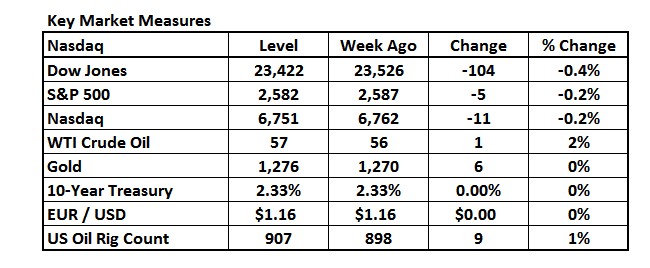
The big story right now remains central banks. The reversal of easy central bank monetary policies across the globe has begun to reverse. Quantitative easing had a meaningful favorable impact to asset prices to the upside. The removal of this stimulus will work in reverse. Accordingly, investors should be prepared for more volatility in the months ahead. Major central banks say they want to normalize monetary policy, which suggests higher interest rates and the eventual end of nearly a decade of quantitative easing. As widely expected, the US Federal Reserve said in September that it would begin the multiyear process of reducing its $4.5 trillion portfolio of US Treasury and mortgage-backed bonds. But it also confirmed that another interest-rate hike is likely in December and we could see three more hikes in each of 2018 and 2019. By this time next year, investors will be staring at a completely different market environment.
No matter what is happening out there, there is always a bull market here at The Bull Market Report! This week we highlight some of our favorite stocks and one not so favorite including: First Solar, Opko Health, Apple, CBRE Group, Twilio, and Andeavor.
BMR Companies & Commentary
First Solar (FSLR: $62, up 3%)
First Solar designs and manufactures solar modules using a proprietary thin film semiconductor technology that is one of the lowest cost in the world. The firm’s objective is to reduce the cost of solar electricity to levels that compete on a non-subsidized basis with the price of retail electricity in key markets throughout the world. What a lofty goal and an exciting opportunity!
What is the most recent progress to report? First Solar has confirmed that PlantPredict, the company’s solar photovoltaic energy prediction software, has been used to generate the reference energy predictions in the sale of three utility-scale projects totaling more than 350 MW.
PlantPredict is a sophisticated solar energy modeling tool designed to develop energy estimates for utility-scale solar PV installations. Easy to use with advanced modeling options, PlantPredict reduces uncertainty to generate more accurate energy predictions. More than 500 companies have already used PlantPredict to model energy predictions for their solar sites.
The transactions demonstrate that the cloud-based modeling tool has gained acceptance by lenders and asset owners as a bankable primary resource in analyzing and predicting performance of utility-scale solar projects.
This is a lot of jargon. What it means is that there remains big demand out there for solar.
BMR Take: First Solar is doing $3 billion in sales and $2 of EPS right now. Looking down the road, we think there is plenty of room in the overall market opportunity for sales and EPS to double. Now that is the kind of growth we love to find.
----------------------------------------------
Opko Health (OPK: $5.50, down 16%)
Opko took an unfortunate nose dive on its earnings report this week. Revenue of $264 million badly missed the consensus for $319 million and was down from $298 million a year ago. OPKNet loss was $46 million compared to a loss of $15 million for the comparable 2016 period.
What the heck happened?
Rayaldee commercial activities continued to progress, but just not as much as expected. Total prescriptions for Rayaldee, as reported by IMS, increased 66% during the three months ended September 30th compared to the three months ended June 30th. Opko expanded its sales force from 35 to 71 as of October 1st. The commercial and medical science liaison teams now total more than 80 professionals.
BMR Take: Many are saying to be patient; that Rayaldee still has big time long term potential and this is just one of multiple opportunities in front of Opko; that revenue is forecast to double from $1.0 billion to $2.0 billion by 2020. Some say that if we see this top line growth, profitability is going to come quickly, and when that happens, the stock is off to the races.
Well, we say hogwash. We are VERY DISAPPOINTED in this company. They have one of the biggest hype machines out there and we have fallen for it. We have waited and waited, being very patient, as the stock goes down down and down.
Look, if you wish to stay in an wait another year, more power to you and I hope the company crushes from here and the stock goes to $15.
But we are OUT. We added the stock 14 months ago at $10 and exit Monday at $5.50. Not happy about this one.
----------------------------------------------
Apple (AAPL: $175, up 2%)
Augmented reality (AR) is a big theme in the markets. The technology is going to shake things up. This means some people are going to make money and some people are going to lose money. Apple is on the right side of the trend.
Apple is working on a augmented reality display. In the company’s most recent financial results conference call, Apple CEO Tim Cook once again made it clear that AR is at the top of his agenda, saying it will “change the way we use technology forever.”
Of the new iPhones and a new version of iOS just released, all boast augmented reality as a selling point. Apple says the A11 Bionic chip inside both the iPhone X and the iPhone 8 series is specifically designed for AR.
At least 13 brokerages raised their price targets on the stock, with Citigroup making the most bullish move by raising its price target by $30 to $200.Of the 37 analysts that track the stock, 31 had a “buy”, or higher rating. None had a “sell”. With the latest brokerage actions, at least nine Wall Street analysts now have target prices that put Apple’s market value above $1 trillion. Drexel Hamilton is still the most bullish raising their target price further to $235.
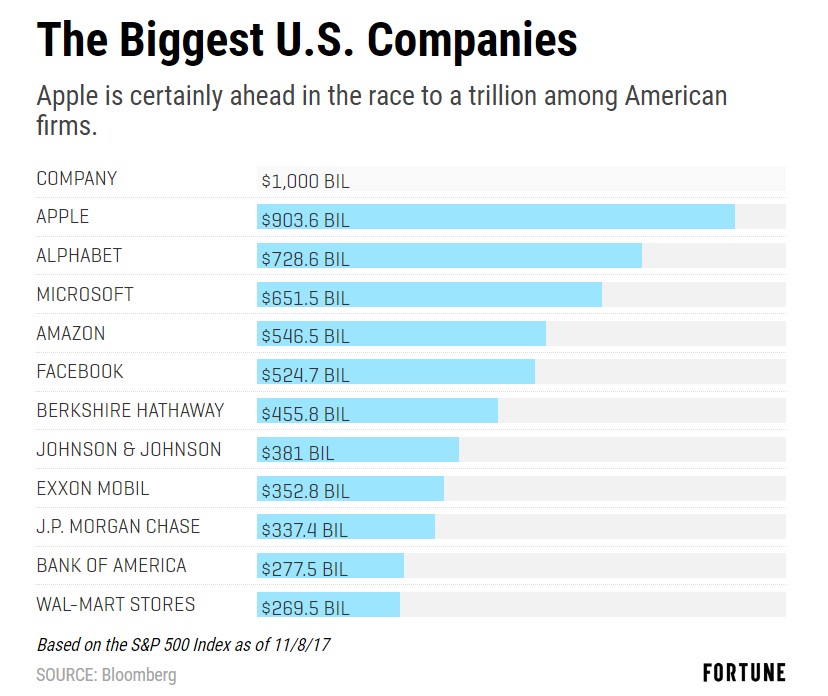
Apple has 5.17 billion shares outstanding and could reach the $1 trillion-dollar market cap level if its shares rose to $194.
Apple is already the largest market cap stock in the S&P 500 and made up 4.5% of the index's market cap as of Friday's close. If Apple's market cap rose to $1 trillion, the stock would be 4.75% of the S&P 500's market cap, ranking Apple ninth when looking at the stocks with the largest percentage of the S&P's market cap at year-end since 1980. IBM holds the top four spots with AT&T taking the next two and Exxon and Microsoft (in 1999) rounding out the top eight.
If Apple's stock can reach the $1 trillion market cap some on Wall Street say that it validates the belief that Apple is not just a smartphone business but a platform.
BMR Take: Apple did $9.21 of EPS this year and estimates call for greater than $11 next year. AR technology is the future and Apple’s ability to participate supports EPS growth continuing on like we are seeing now for a long time ahead. Apple set a new all-time high last week and since the stock has passed our Target of $170, we hereby raise our target to the level to which the market cap will reach $1 trillion. That number is $194. Our Sell Price remains: “We would not sell Apple.”
CBRE Group (CBG: $41.50, up 4%)
Never higher. CBRE has never been higher. CBRE is arguably the leading real estate company on the planet. As a highlight of how locked in the company is, look at CBRE Research’s 2017 Tech-30 report that was just published where they demonstrated exceptional expertise. The company ranked the strength of tech job growth across 30 North American office markets, which is creating stability and demand-driven performance through occupancy gains and rent premiums. Four key points are highlighted below.
--- Tech jobs grew four times faster than the national average. San Francisco was the top high-tech job growth market for the sixth year in a row.
--- Eighteen markets added more tech jobs over the past two years than the prior two-year period.
--- Tech’s share of major leasing activity has nearly doubled to 19% over the past five years, resulting in strong occupancy and net absorption gains.
--- Desirable tech submarkets are priced at a premium, while emerging submarkets often offer discounts. The overall average asking rent of tech submarkets is priced at a 16% premium.
BMR Take: We are staring at the company’s EPS power closing in on $3. This stock remains a compelling value at the current level. We don’t see the company doing anything but maintaining and growing its leading market share for the foreseeable future.
----------------------------------------------
Twilio (TWLO: $25.50, down 15%) on Earnings Report
Revenue reported was strong, and you know how we feel about revenue. We will tell you what happened, and let’s stay focused on the long term.
The company lost $0.08 versus $0.04 a year ago. Revenue was $101 million versus $72 million a year ago. The good news is that revenue beat the consensus of $93 million. Moreover, the company guided to a better outlook for the remainder of the year.
So what the happened here? Uber.
While total revenue growth of 41% was strong, we believe it is important to look at the underlying growth of Twilio’s core business. In particular, we consider base revenue excluding Uber, which came in at $87 million, up 63% from a year ago. Revenue from Uber hit $14 million in 4Q16 and came in at $5 million in 3Q17, down 53% y/y. Management expects a modest sequential decline in Uber revenue in 4Q17. The loss of Uber business continues to weigh on results.
Total revenue rose to $100 million from $71 million. Management itself had called for a net loss of $0.08 per share on sales near $92 million. The adjusted loss was right in line with that forecast, but Twilio crushed its own sales expectations.
For the upcoming quarter, Twilio expects an adjusted loss per share of 6 cents and revenue of $103 million. Analysts are predicting an adjusted loss per share of 6 cents and revenue of $99 million.
Jeff Lawson, Twilio’s Co-Founder and Chief Executive Officer said, “We hit a number of exciting milestones in Q3, including our first $100 million revenue quarter, our first enterprise license agreement for our higher level software products, and the launch of Twilio Studio. With Twilio Studio, the visual builder for Twilio, we can accelerate our customers’ roadmaps and help an even larger set of users build on our platform. We are excited by the size, scale and diversity of what new and existing customers are creating with Twilio.”
Recent Business Highlights – released by the company:
46,500 Active Customer Accounts compared to 34,400 a year ago. Twilio Studio was introduced in the third quarter, giving clients a simple drag-and-drop tool to simplify and accelerate their production efforts. Twilio already offers separate production tools for popular platforms such as Android and iOS, but the new Studio streamlines the development process in ways that had not been available before.
Announced our commitment to meet the new GDPR (General Data Protection Regulation) requirements coming from the EU, using this as an opportunity to raise the bar for data protection worldwide for all of our customers.
Expanded the reach of our Super Network by announcing the availability of Twilio phone numbers in more than 100 countries.
Average revenue per user rose 18% to $8,000.
Cash position strong: Twilio held $284 million of cash equivalents at the end of the third quarter, down from $289 million in the second quarter and $306 million by the end of fiscal year 2016.
Guidance: – released by the company:
Full year ending December 31, 2017:
Total Revenue - $387 million
Loss from operations (millions) $22.0 to $23.0
Net loss per share - 0.22 to 0.23
BMR Take: The good news is Twilio continues to innovate and add net new customers at a remarkable clip (3,100 in 3Q17), which is driving strong underlying revenue growth. The company remains one of the fastest top line growers in all of cloud computing.
This company is one the most frustrating that we follow. With another stellar report like we describe above, any normal stock would be up 10%. Not Twilio. Down 15%, now well below our Sell Price of $29. We are going to stay the course but you might get tired of waiting and sell in order to redeploy these assets into something better like Nutanix or Square. With that said, we believe Twilio should be a $50 stock, a long way from where it is today. But again, top line growth will win in the end. Do you and we have enough patience to endure these losses? That is the ultimate question.
----------------------------------------------
Andeavor (ANDV: $107, down 3%)
Could oil breech $80 before Christmas? Some options traders think so. With oil trading near its highest level in two years, some traders are betting that the price rise could have more room to run.
A total of 48,000 option contracts traded over the last few days that would profit most if crude spikes before Christmas, including several large individual trades. They all expire on Dec. 21.
Oil prices have rallied in recent weeks as OPEC supply cuts help to rebalance an oil market plagued by oversupply. More recently, growing tensions between Saudi Arabia, OPEC’s largest oil producer, and some of its neighbors helped prices break above $60 a barrel for the first time since 2015.
Andeavor Reported Third Quarter 2017 Results on November 8th.
Earnings of $550 million, or $3.50 per share; results included the following pre-tax items
Returned $345 million to shareholders including $252 million in share repurchases; they expect to repurchase $300 million of shares in 4Q17
Total retail and branded stations up 27% year-over-year to over 3,100 stores
On October 30th, Andeavor closed its $1.7 billion acquisition of Western Refining Logistics
New totals for Andeavor
Number of Refineries: 10
Refining Capacity: 1.2 million bpd
Employee Count: More than 13,000
Retail Sites: More than 3,100
Barrels of Storage Capacity: More than 46 million
Miles of Pipelines: More than 5,300
Marine, Rail and Storage Terminals: 40
Natural Gas Processing Complexes: 6
States where they operate: 18
BMR Take: Higher oil prices above $80 could be a huge positive for many companies including our beloved refiner Andeavor. Recall, Andeavor’s net asset value is $120 and the stock still trades an unwarranted discount. We think more stable energy markets are the first step needed for good sentiment to return to the oil patch stocks like Andeavor. And we’re certainly on the way with crude being so strong of late.
----------------------------------------------
Upcoming Economic News
PPI ex-Food & Energy
Tuesday, November 14th, 8:30 AM Eastern
Period: October
Consensus: 2.2%Prior: 2.2%
Retail Sales ex-Auto Wednesday, November 15th, 8:30 AM
Period: October
Consensus: 0.20%
Prior: 1.0%
Initial Claims
Thursday, November 16th, 8:30 AM
Period: 11/11
Consensus: 235,000
Prior: 239,000
Housing Starts
Friday, November 17th, 8:30 AM
Period: October
Consensus: 1,193,000
Prior: 1,127,000
----------------------------------------------
A Word from Gary Jefferson
Jefferson Financial Group
First Vice-President, Investments
UBS Financial Services, Inc.
The markets seem to be firing on all cylinders. Is there anything that could derail it before year-end? About all we can see is the Russian investigation (none and no chance), the tax-cut drama (possibly, but more likely to cause a correction rather than a derailment), a government shutdown (slim if any chance at all) or a major Fed rate hike (little to no chance).
A couple of things have caught our attention, however. What usually derails a bull market is a recession. At this point, we don't see the usual suspects that signal a coming recession, such as widening credit spreads, deteriorating market internals, collapsing commodity prices, falling new orders or falling earnings. In fact, it is just the opposite.
However, two things are not making sense from a historical perspective. First, with near full employment and accelerating worldwide growth, inflation remains stubbornly low. This is usually not the case. Inflation signals rising prices and continued rising earnings. It should be readily apparent but it simply isn't expressing itself even at this stage of the earnings growth cycle.
Secondly, if there is one warning signal for an approaching recession that is more reliable than all the others, it might be an inverted yield curve. Since January, the spread between the 10-year Treasury and the 2-year Treasury has fallen from about 1.30% to 0.75%. In our experience, whenever we have seen accelerating revenue growth, rising earnings, potential tax cuts – i.e. so many positives – the yield curve should be steepening, not flattening. Maybe we are experiencing a "new norm" in the markets, or it "is different this time" (the four most dangerous words in our industry), or this is going to be normal as part of the 4th Industrial Revolution we have supposedly entered (artificial intelligence, augmented reality etc.). In any event, we are going to closely follow the lack of inflation and the yield curve because neither is "confirming" this bull market rally as each would normally do if one looks back at the history of the market.
----------------------------------------------
Square (SQ: $39, up 6%) Continues to Shine
A few Wall Street firms had some new announcements on Square this week. The target raised to $38 from $34 at Stephens. They believe the stock "can grind higher" following the company's Q3 report. They still sees Square as likely to change the game for Small and Mid-sized business payments and thinks the likelihood of it achieving true "platform for small business" status gets more likely every quarter.
Square price target raised to $33 from $23 at Craig-Hallum
Square price target raised to $35 from $24 at SunTrust. SunTrust said that it is entering a period requiring heavier investment which will weigh on margin expansion. They said that Square trades at a significant premium of about 60-times FY18 EBITDA relative to 13-times for its peer group.
GoDaddy (GDDY: $48) announced two new integrations with Square that help small businesses thrive with online and offline selling and payment capabilities. By collaborating with Square, GoDaddy is making this an easy reality for tens of millions of people building small businesses. Integrating GoCentral Online Store and Square online payments enables small businesses to easily sell their products and services online and in person through a single Square account and GoDaddy website. The second integration provides service-based businesses, such as personal trainers, hair stylists and photographers, the ability to book client appointments online, sync calendars using GoCentral, and get paid using Square. Payment transactions can be processed online, in-person or both without switching accounts.
Square target raised to $41 from $31 at Cantor Fitzgerald citing accelerating revenue growth. The firm expects Square's "rapid growth" to continue and further margin expansion going forward. He notes that Gross Payment Volume growth remained above 30% in the quarter.
Square target raised to $41 from $31 at RBC Capital. The firm says the Q3 beat and raise for 2017 outlook is indicative of the company's ability to drive its products into existing partners and expanding to larger merchants.
BMR Take: This one has a long way to go on the upside.
----------------------------------------------
Options Corner – All about Square
From time to time we like to bring you an interesting options trade. We like to do long-term bullish trades on stocks, unless we find one that is going to go bankrupt in which case we can design a trade to profit from the demise of a firm using puts.
Square has been knocking the cover off of the ball of late. We added the stock at $17 in March of this year and it is now $39, setting a new all-time high on Friday, so we are up 130% in 8 months, giving us an annualized return of ……. Well, you get the point! A great stock pick. A great stock. Better yet: A great company. With a market cap of $15 billion now, it is moving into the big leagues. We have said quite a few times that Square would be a great buyout candidate for one of the big boys (Amazon, Microsoft, Apple, etc.) but they better move fast before the stock hits $20 billion.
And in fact, we think a $20 billion valuation is quite possible next year. That would equate to a $52 stock. Can that happen here with Square? We certainly think so.
An options trade can produce much bigger returns than this 33% increase, if it were to happen. But guess what? OPTIONS ARE RISKY! Please repeat after us. Options are very risky.
OK. Let’s get started.
We love long term options called LEAPS. They expire in January as long as they have at least six months of life. So the January 2018 options aren’t called LEAPs any more. But the Jan 2019 options are. And soon we should see the Jan 2020 options start trading. We can’t wait.
We like to buy options that are in the money. With the stock at $39, the 35s are $4 in the money. Better yet the 30s are $9 in the money. They are worth $9 but they trade for $13. Why is that? The $4 is the TIME PREMIUM. And note that that time premium will go to zero eventually as it approaches the end of its life in January 2019.
In order to pay for the time premium we like to SELL calls against the long LEAP to recoup this time premium and also to help us get our cost down on the option that we bought. Let’s look at some real numbers.
Buy the Jan 2019 30 LEAPs for $13,Sell the June 45 call for a little less than $6.
The cost of this trade is now $7 for an option WORTH $9. Do you understand this? If not, go back to the top of this article and re-read. These options discussions are confusing the first time, but It WILL come to you if you re-read this 3-4 times. We are serious.
Now, let’s say the stock goes up a bit and is selling at $45 in June. Your June option is going to expire worthless (great) and now you SELL a January 2019 call, say the 50 call, for approximately $7. (We are not sure of these numbers because it is so far into the future but we think this is about right -- we hope you get the point.) The cost of the trade is now zero. You are in this trade for zero dollars. (Gosh, we love this trade!)
Now, let’s tally up. If the stock goes to $50 or higher by January 2019, you will be left with an option worth $20 ($50-$30). If you had bought 10 options for $7,000, they are now worth $20,000, almost a triple (185%), with a stock that went from $39 to $50 or 28%. If you had put $25,000 in this trade (the equivalent of buying 640 shares of Square) you would now have $75,000 and that’s real money.
This options trade will more than likely take lots of tweaking of your position and the return could be better or worse depending on where the stock goes. No one is going to hand you a triple without a little bit of work. But it could be a super trade IF the stock heads to $50.
The downside is that the stock goes down to $30. You will lose money but if you religiously sell calls against your position, you can get your cost down to close to zero, thus minimizing your losses.
Note that if this all-options trade is too risky or confusing to you, you can just do a normal covered call trade by buying the stock and selling calls against it. If you were to buy 1000 shares at $39 for $39,000 and the sell the calls as described above, you would bring in $6000 for the June $45 call and $7000 for the January $50 call giving you a purchase price of $26,000. If the stock goes to $50 you have a $50,000 position, and a return of 92%. Not bad.
But, again, lots of “ifs” in these scenarios. Invest with caution.
----------------------------------------------
The High Yield Corner
By Michael Foster
Last week, AstraZeneca PLC (AZN: $33, down 5%) reported strong revenue and earnings above expectations, but that wasn’t enough to keep the stock from being the biggest loser of the week for the Bull Market Report’s high yield portfolio. A deeper dive into the results can explain what happened—and why this isn’t really a cause for concern.
To start with: revenues rose 9.3% on a year-over-year basis in the third quarter to $6.23 billion with solid EPS of $0.54, which was a little shy of expectations: analysts were expecting just 55 cents per share in earnings. In their press release, the company highlighted weak sales in the U.S. as a cause of the weaker earnings, while also pointing out that weakness was offset by major growth elsewhere: emerging markets were up 5%, China was up 12%, and Japan was up 3%. Those numbers were all higher on a constant currency basis.
But the U.S. weakness is a large part of the stock decline. AstraZeneca pointed to continued weakness in Symbicort as a cause for the weakness; the asthma drug’s challenges have been a major issue for this company, which analysts see as being heavily reliant on for future sales. Nonetheless, a closer look at the drug pipeline indicates there are other sources of growth to come.
More specifically, AstraZeneca highlighted that Lynparza, a breast cancer drug, has received priority reviews in America and Japan, while Imfinzi, a lung cancer drug, has received the same in America while also getting regulatory acceptance in the EU and Japan. A total of 7 drugs got new regulatory approvals as of the end of the reporting period, including two type-2 diabetes drugs that will obviously have tremendous appeal for this widespread ailment.
So the company’s pipeline looks fine. The focus on Symbicort unquestionably overlooks that fact, and provides a buying opportunity at this current price—provided the pipeline remains healthy.
Elsewhere in high yield investing, we saw a really mixed week despite the market’s weakness towards the end of the week. This is pretty unusual—high yield tends to be more volatile in REITs, high yield bonds, and BDCs, but we didn’t see that happen yet. That could mean more aggressive selling is yet to come in late 2017, especially as tax-loss harvesting becomes more commonplace, but that doesn’t change the fundamental strength and attractiveness of many high yield assets.
There are exceptions, however. Municipal bonds were relatively untouched by last week’s jitters, possibly as risk-averse investors were adding to municipal allocations as a result of what they saw in the stock market. Invesco Municipal Trust (VKQ: $12.34, flat) saw little movement on strong volume while Nuveen AMT-Free Municipal Credit (NVG: $15.36, up 1%) gained slightly. Both remain high-quality municipal bond funds with above-average yields and excellent management teams. Neither looks significantly overpriced right now.
Bigger news came from the REIT world, but the news had little effect. Welltower (HCN: $68, up 2.5%) had strong earnings, with FFO per share of $1.08 a 2 cent jump from the prior quarter and NOI up 4.1% on same-store senior housing operations. RevPAR also gained by 3.9%, which helped the company’s revenue rise nearly 1% to $1.1 billion for the quarter. FFO was a 3 cent beat over expectations, and higher earnings guidance (the company now expects normalized FFO per share of $4.19 to $4.25 for the full year) make Welltower’s valuations even more attractive, especially after the stock price remained stuck for the week. Defying negativity in the skilled nursing facility world, Welltower’s massive size and market penetration are proving stores of value and investor safety; the stock is a better buy now than it’s been for most of this year.
*Revenue per available room
That’s it for earnings news this week, but a lack of major news didn’t stop Government Properties Income Trust (GOV: $18.76, up 2%) from having a strong week, thanks in small part to the continued recovery from last month’s anxiety that the company’s earnings results at the end of October proved to be a paranoid non-issue. However, protracted worries about Omega Healthcare Investors, Inc (OHI: $28, down 1%) and their very disappointing earnings are keeping shares down and the yield up at the 9% level. That more than compensates for the risks, which makes this a very appealing option for investors who accept that the dividend growth is likely going to end in 3-5 years’ time. The market is discounting a cut to dividend growth much sooner, making this an irrational price and a good bargain right now.
Elsewhere, we are seeing growing anxiety in Collateralized loan obligations (CLO) and high yield corporate bonds, but that hasn’t stopped AllianzGI Equity & Convertible (NIE: $21, unch.) and PIMCO Dynamic Income Fund (PDI: $30, up 1%) from proving resilient. That’s in no small part thanks to the high-quality management teams of each, which have wisely avoided the more exotic high-yielding CLO markets and shifted towards much safer MBS’s and away from the riskiest junk bonds. The market is rewarding both with price stability. That may not last - after all, irrational selling is still very much a thing in modern markets - but that just means a buying opportunity will open up. Neither fund shows any indication of weakness despite the broader worries growing in the credit sectors.
Good Investing,
Todd Shaver, Founder and CEO
The Bull Market Report
Since 1998
(Again, sorry about the crazy formatting this week.)
October 29, 2017
by Todd Shaver | Oct 29, 2017 | Weekly Newsletter 7pm Sunday
The Weekly Summary
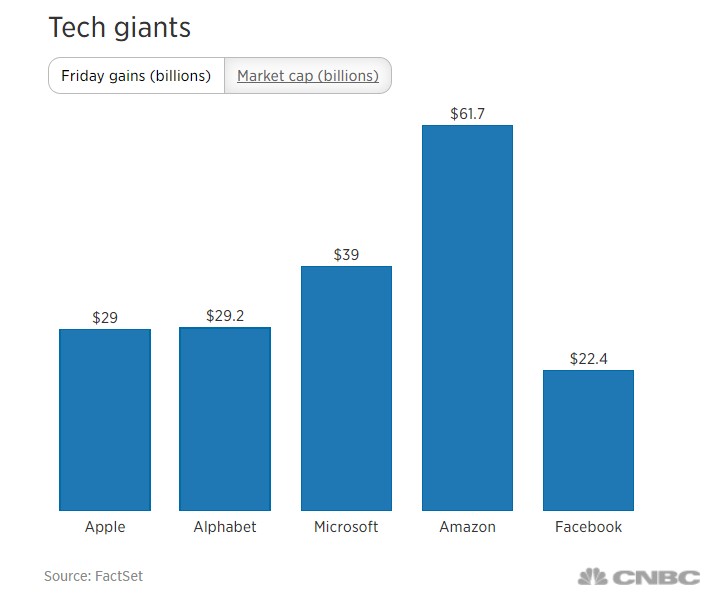
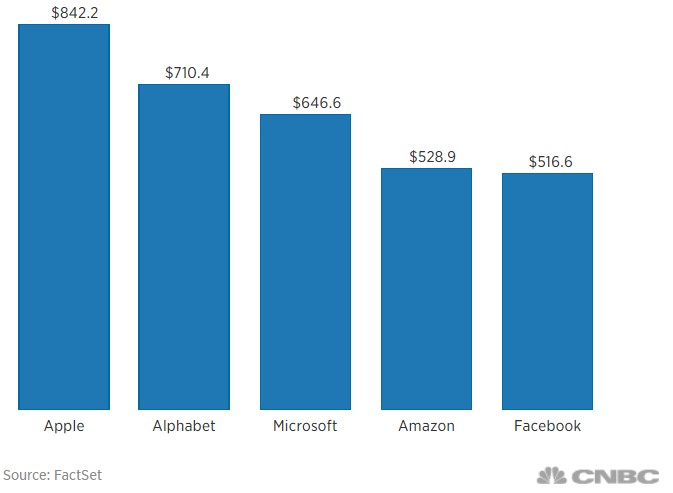
US equities finished the week higher on Friday again. There was a notable rally in Tech with several mega-cap names hitting all-time highs after earnings. Apple, Alphabet, Microsoft, Amazon and Facebook, the world's five most valuable public companies, added $180 billion to their combined market value on Friday. Investors piled into the group a day after Alphabet, Microsoft and Amazon reported better-than-expected earnings. For the stock market, it was more of the same. Those five companies have gained almost $900 billion in market cap over the past year.
Shares of Amazon and Google both surged past the $1,000 mark and approached all-time highs, with Amazon closing above $1100. To many people’s surprise, we continue to see favorable broad market trends with US equities seeing $14 billion of inflows over the last three weeks.
Friday's Gains:
Market Caps:
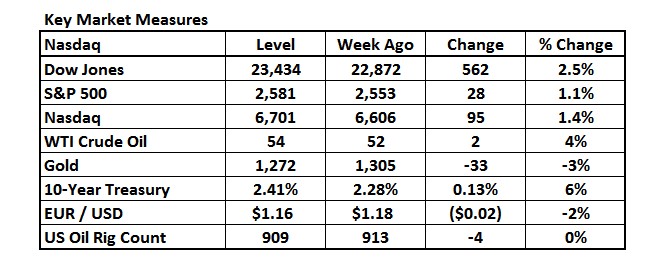
There was nothing particularly incremental on tax overhaul this week, as the House narrowly adopted the Senate budget, paving the way for release of initial tax legislation next week. Trump is leaning toward Powell for Fed chair, and the official announcement is expected next week.
No matter what is happening out there, there is always a bull market here at The Bull Market Report! This week we highlight some of our favorite stocks where you can still make good money, including: Apple, Microsoft, Amazon, Celgene, Bristol-Myers, and UPS and a few others.
BMR Companies & Commentary
Apple (AAPL: $163, up 4%)
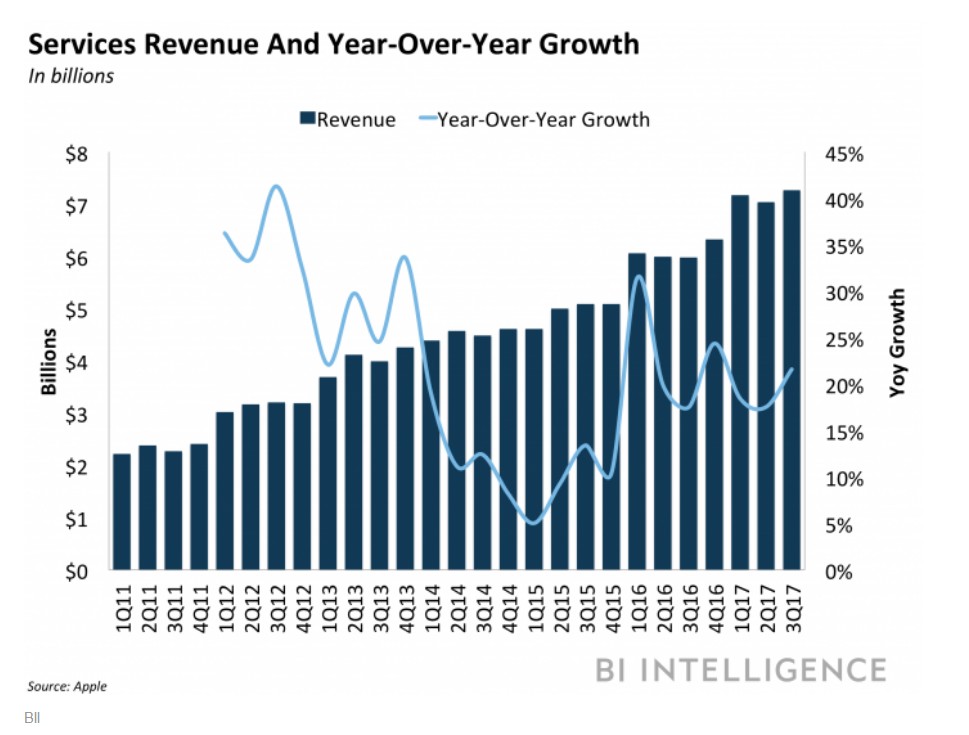
Well, Apple has still got it! Apple sold out iPhone X pre-orders. Thousands of Apple fans from around the world flooded the website to lock in their pre-orders for the iPhone X. Apple sold out pre-orders for the phone to arrive on the November 3rd launch day in 17 minutes, and the wait time has grown to five to six weeks.
Apple said, "We can see from the initial response, customer demand is off the charts. We're working hard to get this revolutionary new product into the hands of every customer who wants one, as quickly as possible."
Why is this so important? Despite major concerns over manufacturing the deluxe iPhone, and the high price of $999, demand is not lacking at all. This finding bodes well for the stock and future prospects.
BMR Take: Apple sold 41 million iPhones last quarter and will sell over 200 million this year. The holiday quarter is the busiest season of the year, of course, and this year Apple is projected to sell over 80 million iPhones in the Christmas quarter, a new record. With iPhone sales fueling great than 10% EPS growth, we continue to see bright prospects for the stock.
Microsoft (MSFT: $84, up 6%)
Microsoft crushed the quarter. Revenue of $24.5 billion increased 12% from a year ago and beat expectations for $23.5 billion. EPS of $0.84 increased 17% from a year ago and smashed expectations for $0.71.
Earnings rose to $6.6 billion, or 84 cents a share, from $5.7 billion, or 72 cents a share, a year earlier. They are still making 27% profits on sales, AFTER TAX! The strength was broad based.
Analysts were most impressed by momentum in cloud that pushed Commercial Cloud above the company's $20 billion targeted goal they set two years ago approximately three quarters ahead of schedule.
Microsoft’s Azure's cloud revenue increased 90% in the period and has exceeded Amazon’s AWS growth for at least eight straight quarters, but Microsoft has yet to break out the unit's sales. AWS controls 34% of the market while Azure has 12%. However, Microsoft is picking up high-profile clients as it adds features, lowers prices and expands data center capacity around the world.
Amazon’s AWS brought in $4.6 billion in sales, which represents an annualized run rate of $18.3 billion. So you heard it here first, Microsoft is leading Amazon in the world of cloud.
Microsoft continues to increase its share in overall IT spending, and momentum in its results was a clear theme this quarter. Margin performance and free cash flow generation also stood out in the quarter.
BMR Take: With the cloud business tracking way ahead of plan, free cash flow per share forecasts now closing in on $5, and with so many other great things happening at Microsoft we continue to view this stock as a core tech holding for any portfolio. The stock blew through our Target of $78 to a new all-time high, so we hereby adjust it to $92. Our Sell Price remains “We would not sell Microsoft.”
Amazon (AMZN: $1,100, up 13% - $129 a share on Friday!)
Revenue: $43.7 billion growing 34% from last year, but only $1.3 billion in sales included from Whole Foods, which Amazon acquired in late-August. North American sales were $25.4 billion, up 35% from last year, while international sales grew 29% to $13.7 billion. Amazon gave fourth quarter guidance in the range of $56-60 billion. Wow.
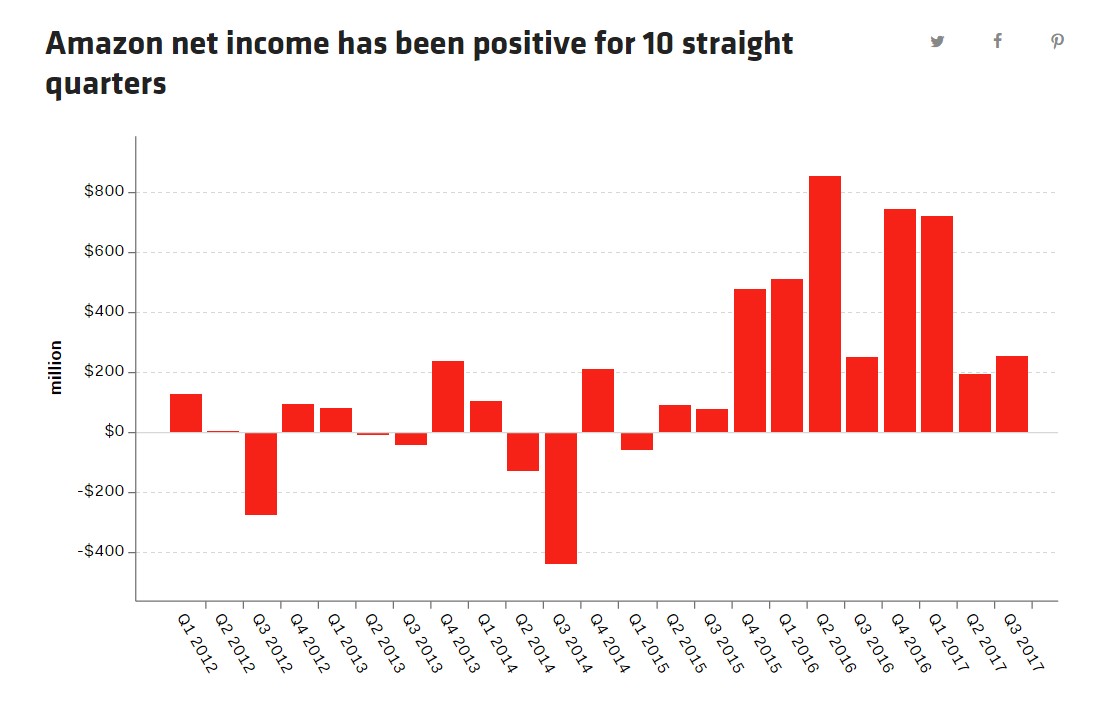
The company’s net income was $256 million, or 52 cents a share. Analysts on average expected earnings of 2 cents a share. (Now THAT is funny. 2 cents a share expected and they report 52 cents! Gotta love this company.

Here we go again! Another industry is about to get “Amazon-ed”. This should be fun to watch and great for the stock:
Pharmacies and Healthcare Distributors continue to trade lower following news that Amazon eying the space. The St. Louis Post-Dispatch reported that Amazon has received approval for wholesale pharmacy licenses in at least 12 states. The topic was discussed further on Amazon’s earnings conference call with the company noting that hospitals and labs were among the areas that could be served under its Amazon Business initiatives. Both distributors and pharmacies are reacting negatively to the perceived threat.
And one potential competitor has jumped the gun by looking to buy a Healthcare company. CVS Health is offering to buy Aetna (AET: $173, down 3% Friday) for more than $200 per share, which would value the company at more than $66 billion. Aetna rallied 12% after the reports. According to the WSJ sources, the merger proposal was spurred by expectations that Amazon might enter the pharmacy business. A tie-up between a retailer like CVS and a health insurer like Aetna may seem surprising on the surface. But experts say both parties need to make strategic moves to address the changes in the sector, including the possible threat from Amazon.
While the above news stole the news headlines this week, keep in mind the core business delivered stellar results.
Revenue beat across all three segment. AWS revenue grew 42% - matching Q2's growth rate, assuaging fears of a deterioration, and beating consensus AWS income by $130 million.

BMR Take: Amazon didn’t just hit smash $1,000 again, the stock rolled right on to $1,102, closing up $128 a share to a new all-time high. With the potential entry into pharmacy, the “innovation machine” called Amazon is alive and well. We see EPS heading to $20 taking the stock much higher over time. We hereby raise our Target of $1100 which it will hit Monday morning, to $1300. Our Sell Price is raised from $970 to $1030.
Celgene (CELG: $98, down 19%)
Celgene had the biggest drop in 17 years on Thursday. Celgene has stumbled, but now is the time to stick with it and accumulate. Why?
Let’s take out all the noise. The fact is the company’s long-term EPS guidance was hardly cut at all from $13 to $12.50. We are still looking at greater than 20% EPS growth through 2020 as revenue explodes from $13 to $20 billion. Specifically, consensus EPS currently resides at $7.30 in 2017, $8.80 in 2018, $10.50 in 2019, and $12.60 in 2020.
Admittedly, it may take a while and we must be patient. There is all sorts of debate about how R&D expenses could disappoint and there are no major catalysts on the drug development front foreseeable in the next 12 months. Then there is also a camp out there that believes that any day now management could make a transformation acquisition that re-ignites excitement about the prospects for the business.
BMR Take: Celgene is the 7th largest component of the Healthcare sector and a $77 billion market cap juggernaut. You have to trust that the franchise is viable and will learn and progress past this current point of disappointment. This looks to us like a classic case of Wall Street exuberance on the downside with this out-of-favor sentiment swing. Take advantage of the drop and accumulate the stock down here.
Bristol-Myers Squibb (BMY: $60, down 7%)
Oh Bristol-Myers. Thou shalt no longer disappoint us at The Bull Market Report. Overall third-quarter revenue rose 7% to $5.25 billion, meeting Wall Street estimates. Earnings rose to $845 million, or 51 cents a share, from $385 million, or 24 cents a share, a year earlier.
Bristol said its gross margin as a percentage of revenue fell to 70% from 73.5% a year earlier due to product mix and higher costs, including a $70 million write-off of inventory for hepatitis C products.
Sales of cancer immunotherapy Opdivo rose 39% to $1.27 billion, in line with the average estimate of $1.21 billion, while sales of blood thinner Eliquis rose 38% to $1.23 billion, matching analyst estimates.
Bristol’s Chairman & CEO had this to say, “We had a good quarter, demand for Eliquis and Opdivo was strong and we advanced our portfolio with important clinical and regulatory milestones, including exciting data for kidney cancer patients with Opdivo + Yervoy. Looking forward, our focus is on continuing to deliver strong commercial performance, advancing our pipeline and ensuring our resources are applied to priority areas of our portfolio for sustainable, long-term growth.”
That said, there remains plenty of merger and acquisition talk, so we are sticking around for what could be a one-day 20-30% premium or higher.
BMR Take: Remember, activist investor Carl Icahn who has a stellar long-term track record is in the stock as one of the largest shareholders. He believes the business is suspect to being taken over and such a sale could unlock tremendous value for shareholders overnight. Stay the course!
The quarter looked pretty good to us. We wouldn’t worry about it too much. The stock may sell off for a few weeks, but we expect it to slowly start to move higher by Christmas.
UPS (UPS: $121, up 1%)
UPS forecasts record holiday delivery of about 750 million packages globally in the 25 days between Thanksgiving and New Year’s Eve. The record-breaking seasonal global delivery volume is about 5% above last year’s season. Of the 21 holiday delivery days before December 25th, 17 are expected to exceed 30 million delivered packages. Mind boggling!
With the launch of UPS Saturday ground pickup and delivery service, customers in nearly 4,700 cities and towns across the country will benefit from five additional ground pickup and delivery days between Thanksgiving and Christmas.
Online and mobile commerce has transformed the retail industry, and UPS is ideally positioned to serve both consumer and business customers during even these busiest of times.
According to the National Retail Federation, retail sales in November and December are forecast to increase 4%, reaching between $680 billion. During the busy holiday shipping season, UPS flexes its global delivery network to process nearly double the regular daily volume of 19 million packages and documents.
UPS continues to invest in the operational and consumer technologies and facility improvements that enable the company to deliver the holidays for customers. Enhanced customer visibility tools, increased consumer convenience, and the availability of the new Saturday ground delivery and pick-up services are all part of the expanding solutions UPS is providing customers, to take full advantage of the holiday season.
This peak season, UPS plans to employ 95,000 temporary seasonal workers, including drivers, delivery helpers who ride with drivers, package sorters, and loaders. Candidates for seasonal jobs can apply on UPSjobs.com. This holiday work often is an entry point for future permanent jobs and career advancement. Almost 35% of those hired seasonally over the last three years now have permanent jobs with the company.
BMR Take: It is crazy to think about just where our country would be without UPS. This business is the backbone of our culture and our economy. It is a must-own in any portfolio. With EPS on track to crack $20 in a few years, the stock remains a good value.
Upcoming Economic News
Personal Income
Monday, October 30th, 8:30 AM
Period: September
Consensus: 0.40%
Prior: 0.20%
Consumer Confidence
Tuesday, October 31st, 10:00 AM
Period: October
Consensus: 121.0
Prior: 119.8
ADP Employment Survey
Wednesday, November 1st, 8:15 AM
Period: October
Consensus: 200,000
Prior: 135,000
Total Light Vehicle Sales
Thursday, November 2nd, 8:00 PM
Period: October
Consensus: 17,500,000
Prior: 18,500,000
Update on Tesla (TSLA: $321, down 7%)
Tesla had a rough week in the markets, dropping $24. We uncovered some information about how the firm is doing in China. It looks like Tesla is making great progress in the difficult China market after all. Elon is great! 🙂
Tesla is moving to begin manufacturing in China. The firm won agreement with Shanghai's government to build a wholly-owned factory in the city's free-trade zone, the first arrangement of its kind in China for a foreign auto maker. Generally, the government makes firms partner with a Chinese company. They didn’t require that in this case with Tesla.
The deal would help Tesla slash its production costs as it would bring down shipping costs and the final price on its electric cars. More significant, it would give Tesla a base from which to export to the rest of Asia. Beijing has mandated a dramatic increase in production of electric vehicles.
BMR Take: The ride with Tesla has its bumps in the road for sure. This week is a further indication of that. They are close to starting substantial deliveries of the Model 3 this year, as they hold cash deposits for almost 500,000 cars. But just as they get closer, production snafus are leaking out from the company and the stock gets hit.
You should only be an investor in this company if you are breathing the happy gas that Elon Musk is sending out. Again, the stock can go to $500 from here, or $200. We’re just not sure which will come first.
A Word From Gary Jefferson
Jefferson Financial Group
First Vice-President, Investments
UBS Financial Services
What's Right with the Market?
As we mentioned last week there had to first be a move to get 51 votes or "it was all just a waste of time". Well, the Senate did pass a budget bill which sets the stage for tax legislation later this year. The significance of the budget passage is that it allows the Senate to now pass their tax legislation with a simple majority of 51 votes rather than the needed 60 votes without one. And since literally no Democrats appear willing to vote for the plan, this was a crucial step for the administration to get their plan approved. The President's plan to cut corporate and individual taxes and to make other business-friendly changes to the tax code have helped to push stocks higher. And, under this potential first major overhaul in about 30 years, corporations would see their top tax rate cut from 35% to 20% - which should obviously be a continuing tailwind for shareholders.
[BMR: Of course, whether this happens or not is certainly not clear. But we will say this: If it doesn’t happen, we are going to see a lower stock market.]
Some thoughts about the length of this bull market and stock overvaluations.
When Treasuries are paying less than 3%, certificates of deposit (CDs) less than 2% and cash less than 1%, it makes quite a bit of sense to continue to use stocks in a portfolio, and not pile into bonds that are tied to the fate of a bond market where when rates rise, bond prices fall.
Anything else right with the market?
Yes. Earnings season started strong and consumer sentiment hit a 13-year high. Companies have started releasing their 3rd quarter earnings reports, and so far, 78% of them beat bottom-line expectations. Corporate earnings have been strong since 4Q16, and this quarter will likely continue that trend, although it may come in a little light due to all the natural disasters. And, the University of Michigan's consumer sentiment poll for September revealed that consumers held positive perspectives overall - across income, age, and political spectrums. Last month's reading reported the highest consumer sentiment since 2004.
One final note – don't get faked out by another 1000 point move in the Dow. That’s because, as the market rises, each 1,000-point advance becomes smaller in percentage terms. For example, the rally between 10,000 and 11,000 in 1999 was, of course, a 10% rise, while the climb from 20,000 to 21,000 for the Dow marked a 5% rise. It's still a good thing, but a 1,000 points is not what it used to be.
That said, next year we may have to get concerned about extended valuations if earnings don't keep up, the length of this bull market if the yield curve inverts, the bearish tendencies of midterm election years, and the ever present Geopolitical risk (N. Korea). Thus, there will still be a wall of worry for the market to climb ……..but this is a good thing. For now, at least, we can enjoy the fact that the "trend is your friend".
Ventas (VTR: $62.50, down 1%)
The company owns more than 1200 healthcare properties in the United States, Canada and the United Kingdom. They are paying a 5% dividend (just raised 6%) and the firm just keeps humming along.
The real estate investment trust, based in Chicago, said it had funds from operations of $373 million, or $1.04 per share, in the period. Funds from operations takes net income and adds back items such as depreciation and amortization. The company had net income of $615 million, or $1.71 per share, on revenue of $900 million in the period.
Ventas expects full-year funds from operations in the range of $4.13 to $4.16 per share.
“We delivered yet another strong quarter for our shareholders. With positive earnings and property growth, improved financial strength and recognition of over $500 million in gains from our ongoing divestiture of our skilled nursing assets, we are in an excellent position,” said Debra A. Cafaro, Ventas Chairman and Chief Executive Officer.
Note that Cafaro was recognized by the Harvard Business Review as one of “The Best-Performing CEOs in the World.” She is one of 23 CEOs named to the Harvard Business Review list for four consecutive years and one of only two women on this year’s list. Ventas’s financial performance ranked 32nd of 900 companies globally for Ms. Cafaro’s tenure, which exceeds 18 years.
During and immediately following the quarter, Ventas sold properties and received final repayments on loans receivable for proceeds of $630 million, with gains exceeding $500 million, consisting principally of the Company’s completed sales of 29 of its Kindred Healthcare skilled nursing facilities (“SNFs”) for proceeds of approximately $570 million. The Company continues to expect total aggregate proceeds of $700 million from sales of its 36 Kindred SNFs in 2017, representing a 7% yield on cash.
The Company has excellent liquidity with $2.9 billion of available borrowing capacity and over $100 million of cash on hand.
BMR Take: We have a Target of $72 so we have a ways to go, but we are happy collecting the dividend and looking for a move to the upper 60s when the world finally wakes up to what a great company this is. Our Sell Price is $58. If you are nervous about the stock market as a whole (and we are not) then moving assets from the Tech sector to Ventas would be a smart move. Big, solid, growth.
From: Trent Thompson [mailto:Trent@xxxxx.com]
Sent: Wednesday, October 25, 2017 2:23 PM
To: info@bullmarket.com
Subject: Options on Nutanix
Hi Mr. Shaver,
I have profited nicely from Nutanix. I have also done well on options strategies as recommended by Bull Market for both Twitter and Microsoft.
I am wondering if you can propose a simple bullish option strategy for Nutanix.
Thanks, Trent.
PS - I very much appreciate your newsletter especially the weekly and ad-hoc reports!
Trent Thompson wanted to see an options strategy for Nutanix (NTNX: $28, up 5%) in his letter above. Good idea, Trent.
So here it is:
Dear Trent:
[Note that this is a RISKY STRATEGY – check with your broker or advisor.]
I like to buy in-the-money LEAPS if I can and if they exist (some stocks don’t have LEAPS.) The reason is that you are not paying as much time premium for the LEAP. Time premium always goes away – it disappears over time and you can be left with losses.
I also like to sell calls against the long LEAP in order to get that time premium back. It’s like selling a covered call but using the LEAP instead of the stock.
The 2020 LEAPs exist, so that is good, but note that the spread is high (bid-ask) so that makes the numbers a little tougher. We are looking for the stock which is currently $28 to go to $40 or higher by January 2020, over two years from now. If this happens we have a home run.
You can buy the 20 LEAP for about $14. With the stock at $28 that means that $8 is the intrinsic part of the price of the option and $6 is the time premium. In order to get some of the time premium back you can sell some options against it. I like to go out 3-6 months to sell the calls and when they expire, just do it again. You can sell the January 30s for about $2 and if the stock stays below $30 they will expire worthless, lowering your price of the LEAP by that $2, to $12. (If it goes over $30, that’s a good thing and you can just buy back the 30 call and sell a 35 call or another option.) You could also sell the April 35 for $2 if you don’t want to get too close to stock price. Or you could sell the April 30 for $3. There are lots of choices!
If the stock is at $30 or below in January, you then sell the June 35s for another $2, lowering the cost basis to $10. Then in June if the stock is at $30 or $35, you sell the January 35 or 40 for another $3-4, lowering your cost basis to $6. NOW WE’RE TALKING! Now you have an option you paid $6 for that is worth $15 if the stock is at $35 and $20 if the stock is at $40.
Obviously this is a very movable strategy and you have to watch the stock and move in and out of the short calls. Plus it is very risky, as the stock could go below $20 and you would lose all of your money. Some of you don’t like to have to watch things so closely, in which case this is not for you. But if you pay attention you can get the cost basis close to zero and if the stock goes to $35 or $40 in two years your return can be very, very big. Did someone say infinity?
With that said, good luck to you, Trent! (And all of our readers.)
Todd Shaver, CEO
The Bull Market Report
I use this site for my pricing, but there are others.
https://finance.yahoo.com/quote/NTNX/options?p=NTNX&date=1579219200
Letter from a Subscriber about Cloudera (CLDR: $14.90, down 8%)
From: Robert Jolliffe [mailto:rjolly1@xxxxxx.com]
Sent: Thursday, October 26, 2017 1:41 PM
To: The Bull Market Report
Subject: Re: News Flash for October 26, 2017: Celgene Lowers 2020 Guidance – Stock Gets Killed
I feel your pain and feel the same with Cloudera. They beat as well and have been falling like a rock the last couple of weeks. I've looked everywhere and can't find anything negative about Cloudera. In fact they just picked up Hitachi as a customer*. WTF! I doubled down here and hope no bad news comes out in the near future.
Our Answer:
I can’t agree more, Robert. What can we do now when we like a company so much, but the market is not cooperating? We can have faith, buy more down here and hope there are no skeletons in the attic.
Look what Nutanix has done lately. And Shopify. And Square. Square has been AWESOME. (Nutanix too.)
Even little old Opko Health. Eventually good companies win out in the end ESPECIALLY when they have GOOD REVENUES. Last quarter saw revenues of $89 million up from $64 million in the year ago quarter, a 39% jump.
Todd Shaver, CEO
The Bull Market Report
* Earlier in the month, Cloudera announced a strategic partnership with Hitachi to offer customers advanced services, support, and training to strengthen adoption of Cloudera Enterprise, the leading machine learning and analytics platform. "Developments in Cloudera's sweet spots - such as machine learning and IoT - are already starting to transform businesses across Asia Pacific and Japan," said Mark Micallef, Vice President, Asia Pacific and Japan at Cloudera. "Partnering with Hitachi is a critical milestone in our journey to simplify the creation of IoT, machine learning, and analytic solutions. It offers a great deal of promise to global enterprises looking to use data to generate new business models and revenue sources, enrich the customer experience and innovate industries."
Some Research from the Street on Shopify (SHOP: $107, up 5%)
We uncovered a research report on Shopify from a big-name Wall Street firm. We found it timely in that the company has been under attack from a firm called Citron, run by Andrew Left. He has made a name for himself by shorting various stocks including Valeant Pharmaceuticals. That was his big winner, but he has had losers too. He shorted Nvidia at $108 in December and it is now at $195. And he has had others.
From the research report we gathered the following:
We expect Shopify to deliver strong 3Q results with revenue and operating income exceeding Barclays and consensus estimates when it reports earnings on October 31. Shares of SHOP have pulled back by 15% in the last month (vs. S&P 500 up 3%) after bearish reports on the company's customer acquisition strategies but are still trading up 130% YTD (S&P 500 up 8%) despite FY18 revenue estimates only increasing by 25% YTD. At 10x FY2 revenues, SHOP's valuation is still a significant premium to peers. We are bullish on SHOP's competitive position in the Small Business ecommerce platform space and the opportunity with Shopify Plus in mid-market category.
Key Metrics for 3Q17: In terms of key metrics, we are modeling total revenue of $166m (+67% y/y), in-line with consensus, near the high-end of company guidance. SHOP has exceeded the high-end of its revenue guidance by an average of 6% over the last five quarters.
FY17 Guidance: Despite the recent pullback, expectations are high for SHOP to raise its FY outlook on 3Q earnings. We forecast FY17 revenues of $650 million, near the high-end of SHOP's current guidance, but we think buy-side expectations are higher.
Subscription Services: We are modeling subscription revenue of $80m in 3Q, up +61% or 5-pt deceleration on 2-yr basis.
BMR Take: We’ve been saying the same thing for a long time. We sure hope the company doesn’t disappoint on Halloween when they report earnings. Because if they do, the stock is going to the 80s. If they produce, like they have been for the past few years, the stock will stay at its current level and may even shoot higher as Mr. Manic, Andrew Left, will have to BUY BACK HIS STOCK. We love short sellers!
But – note what we just said above. The stock could get sacked or it might shoot higher. This stock is not for the faint of heart. If you don’t like the story here then you have two days to sell. You can always get back in.
The Carlyle Group (CG: $22.40) was down 8% this week due to the changeover in leadership. We’re really not concerned and in fact think it was a good move as the founders have reached their late 60s (that’s really young if you know what I mean) and they have outlined the management progression plan that investors are always concerned with. Here’s the gist of the announcement this week:
The Carlyle Group Names New Executive Leadership Team
Glenn Youngkin and Kewsong Lee to Become Co-CEOs
Peter Clare to Become Co-CIO Alongside William Conway
Global alternative asset manager The Carlyle Group announced the following executive leadership changes, effective January 1, 2018: Kewsong Lee and Glenn A. Youngkin will become Co-Chief Executive Officers of The Carlyle Group. Peter J. Clare will become Co-Chief Investment Officer alongside current CIO William E. Conway, Jr.
Carlyle’s current Chairman Daniel A. D’Aniello will become Chairman Emeritus and continue to serve on the Carlyle Board and Executive Group
Current Co-CEOs David M. Rubenstein and William E. Conway, Jr. will become Co-Executive Chairmen of the Board and continue to serve on the Carlyle Executive Group
Glenn, Kewsong and Peter will join the Carlyle Board of Directors
Carlyle Co-Founders Conway, D’Aniello and Rubenstein said, “These promotions ensure continuity in our leadership and maintain the investment processes that have driven our success for 30 years. “As Founders, we are passionate about Carlyle. We will continue to be actively engaged at Carlyle. We are fully committed to and confident in the firm’s future and will continue to be substantial investors in Carlyle funds for years to come.”
BMR Take: This stock is vastly undervalued. We would back up the truck. The dividend is 5.3% and the Chairman of the Board, David Rubenstein, is not selling a share until it hits $30.
The Carlyle Group was founded in 1987 and is based in Washington, DC with additional offices in 33 countries across six continents (North America, South America, Asia, Australia, Europe, and Africa). Carlyle is a global alternative asset manager with $170 billion of assets under management across 300 investment vehicles
Our Price Target is $28 and our Sell Price is moved up from $13 to $20. It’s hard for us to like a stock more.
The High Yield Corner
By Michael Foster
It was a really busy week for The Bull Market Report's High Yield portfolio, with earnings releases and other news events causing a lot of excitement. But at the end of the week, the numbers actually didn’t move all that much.
Of course, there are exceptions. Digital Realty Trust, Inc. (DLR: $117, down 5.5%) saw a sharp decline over the week after reporting earnings that were far above expectations on both the top and bottom lines. The company saw 12% year-over-year revenue growth and FFO growth of 5%. At $1.51 per share, FFO is covering dividends at an even higher rate, which again indicates the need for aggressive dividend increases as we have mentioned over the last few weeks.
Dividend increases should be extremely easy to fund if the company meets its pretty modest guidance. Digital Realty is looking for full-year FFO at $6.00-$6.10, which is about a 3 cent increase from previous guidance. Revenue guidance also bumped up to $2.4-$2.5 billion for the full year.
So why did the stock get hammered so much?
The devil is always in the details, and this time is no different. Digital Realty announced a 4% decline in lease renewals as a result of a 11% decline in Turn-Key Flex renewals (see explanation below.) That was offset by increases for colocation and Powered Base Building products, which combined are slightly more in square feet than Turn-Key. But the massive size of Turn-Key as part of Digital Realty’s entire operations inspired a lot of panic.
So why were the renewals down? It has to do with falling prices. Keep in mind that the decline is in dollar terms, so what happened is a lot of companies renewed at lower prices, driving total revenue for the Turn-Key services lower.
So what exactly is this Turn-Key Flex? Simply put, it’s a 5-year old product that allows renters to design their own server space - meaning electrical, cooling, and other control systems are custom made before the customer moves in. This is different from colocation services, where you simply rent out offsite data facilities without bothering to design the space.
You might be able to see the problem. Turn-Key Flex is obviously a really big ticket item for really big spenders. It’s the kind of white glove service that companies paying 7 or 8 figures are going to demand. And these big customers, who are also dominating tech as the sector gets more consolidated (think Amazon destroying little competitors like Blue Apron), are demanding more discounts as they expand.
That means low sales growth or dollar sales declines, which is what we’ve seen for Digital Realty. But this is hardly a bad thing - it means big clients are spending more with Digital Realty and, as a result, are negotiating lower prices. It’s an understandable trend and actually a good one for Digital Realty.
Note that the company’s data center experts have designed, developed and currently manage over 3.6 million square feet of enterprise-quality data center space throughout the U.S., Europe and Asia Pacific, with over 500,000 square feet of additional, fully improved data center space under construction.
Digital Realty's customers include domestic and international companies across multiple industry verticals ranging from information technology and Internet enterprises, to manufacturing and financial services. Digital Realty's 157 properties comprise approximately 26 million square feet. Digital Realty's portfolio is located in 33 markets throughout Europe, North America, Singapore and Australia.
Elsewhere in earnings news, we saw Ventas (VTR: $63) fall slightly on the week thanks to a Friday recovery on earnings. Revenues rose 4% to beat expectations slightly, but $1.03 FFO was a slight 1 cent miss from expectations. That wasn’t really enough to hurt the stock by the end of the week, and definitely isn’t enough to adjust our expectations for this company.
Again, the details are key. Ventas announced it is expanding its university-based life science operations, meaning the firm is continuing to focus renting space for university research. This is incredibly good, because its mainstay in senior housing is not a growth industry. As paradoxically as it seems, the aging American demographic trend hasn’t actually been as good for senior housing as expected, partly because a lot of aging boomers don’t want to live in senior facilities. But much more importantly, there is a structural reason: seniors can’t afford massive rent raises, which limits organic growth for a senior housing provider.
Seeing this problem, Ventas has diversified into research facility rents, where growth is easy. Why? Because university tuitions keep going up and up, and universities have an incentive to spend as much as they can on research facilities without the market discipline of being cost conscious. In many cases, the signaling benefit of renting shiny new research facilities far outweighs expense concerns for universities struggling to compete in prestige, so that’s a nice profitable business to be in. And Ventas is getting more and more into it, which should result in better margins and a brighter future for Ventas shareholders.
While most of the High Yield portfolio was flat or down 1%, we did see municipal bond funds slide. This is not going to stop anytime soon. Nuveen AMT-Free Municipal Credit (NVG: $15.17, down 2%) and Invesco Municipal Trust (VKQ: $12.33, down 2%) are down largely as a result of selling in anticipation of end-of-year tax-loss harvesting and retail investors taking bets off bonds because of the December interest rate hike that seems a given by the market. While investors could sell these funds to save a possible 1-2% decline in the coming weeks, an even better long-term strategy would be to buy more and more of these funds over the next couple weeks as their yields get closer to 6%. Municipal bonds remain a great place for tax-free income, and the fears of muni regulations changing to remove that tax-advantaged status have dissipated entirely. Washington can’t touch munis. As a result, demand for munis is going to trickle in, especially from the start of 2018. Why not get ahead of that and buy now?
Good Investing,
Todd Shaver
CEO, Editor and Founder
The Bull Market Report
Since 1998
October 8, 2017
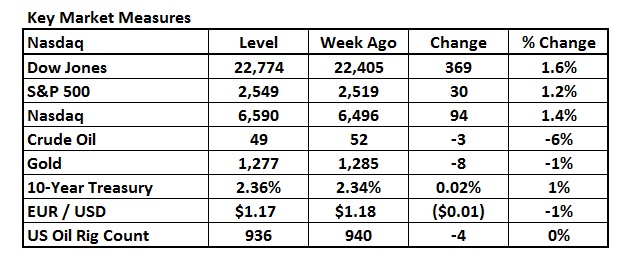
by Todd Shaver | Oct 8, 2017 | Weekly Newsletter 7pm Sunday
The Weekly Summary
It’s market mania for assets around the world! Financial markets posted fresh records this week, as the upswing in global manufacturing added fresh legs to the relentless rally in equity and credit markets around the world. The most eye-catching: The U.S. stock market’s volatility gauge set an all-time low Thursday while the S&P 500 Index jumped to a fresh high, its sixth consecutive record close -- a feat last repeated back in 1997. Global stocks posted new record highs amid strong economic data. Credit premiums hit fresh post-crisis lows. Let the good times roll.
No matter what is happening out there, there is always a bull market here at The Bull Market Report! This week we highlight some of our favorite stocks where we think you can still make good money, including: Celgene, PayPal, Google, WageWorks, VMware, and Blackrock.
BMR Companies & Commentary
Celgene (CELG: $139, down 5% - all prices herein are for the week)
Celgene entered into a long-term strategic alliance with Nimbus Therapeutics (private) centered on autoimmune disorders.
Nimbus’s preclinical programs target central mediators of inflammation. Nimbus competes in this area against Bristol-Myers and Gilead. But given Nimbus’s demonstrated track record of success and the promising nature of the targets, the consensus view this alliance as particularly encouraging and indicative of Celgene’s dedication to expanding its presence in immunology and inflammation. Awesome!
Celgene will be given an option to acquire each program. Nimbus will receive an upfront payment and potential milestone payments per program that Celgene chooses to acquire. In the interim, Nimbus will retain full control of R&D activities for each program. Financial terms will be disclosed only in the event that Celgene chooses to acquire a program.
BMR Take: We remain bullish on Celgene as total revenues are expected to rise from $13 billion this year to $21 billion by 2020. We expect Celgene’s four blockbuster drugs (Revlimid, Abraxane, Otezla, and Pomalyst) to drive the revenue growth, while the recent acquisitions of Receptos and Delinia as well as investments in collaborators like Acceleron, Epizyme, Agios, and others will ensure growth from 2017 and beyond. We continue to view Celgene as a top large-cap pick in Healthcare.
PayPal (PYPL: $66, up 3%)
Mastercard and PayPal announced a significant expansion of their longstanding partnership into Canada, Europe, Latin America and the Caribbean, and the Middle East and Africa, to make Mastercard the clear payment option within PayPal across the globe. With the addition of these markets – and following the recent expansion of their partnership into the U.S. and Asia Pacific – Mastercard and PayPal have now reached a global agreement.
Similar to previous agreements, the global expansion will create a number of joint growth opportunities that will advance Mastercard and PayPal’s shared vision to offer consumers greater choice and flexibility to manage and move their money.
For example, PayPal will have the opportunity to expand its presence at the point of sale by utilizing services from Mastercard, allowing consumers to use their Mastercard in their PayPal Wallet to make in-store purchases at more than 6.5 million contactless-enabled locations across the globe. Consumers will also have the ability to quickly cash out funds held in their PayPal accounts to a Mastercard debit card.
BMR Take: People everywhere know and trust the familiar Mastercard brand, whether they’re paying in the physical or digital world. The expanded partnership with PayPal affirms the attractive growth outlook for PayPal’s users could go from the current 200 million to upwards of 1 billion, in our view. This should take the stock much higher.
Google (GOOG: $979, up 2%)
Google parent Alphabet’s internet-by-balloon Project Loon tweeted that they hoped to bring emergency connectivity to Puerto Rico after Hurricanes Irma and Maria left more than 90% of the island without cellphone coverage. Just 7 days later, the Federal Communications Commission Friday gave the company a green light to fly 30 balloons over Puerto Rico and the US Virgin Islands for up to 6 months.
If all goes to plan, Alphabet's balloons will soon help replace the thousands of cellphone towers knocked down by hurricane-strength winds. The balloons would provide voice and data service through local carriers to users’ phones.
Alphabet has previously deployed Loon to provide emergency phone service in Peru following flooding there earlier this year. They had already been working closely with a local wireless network, Telefonica, to coordinate spectrum use and prepare handsets to work with its balloons.
Project Loon was born in Alphabet’s moonshot X division, with the aim of serving the half of the world’s population that is still without internet access. It has launched several successful pilot projects, but Loon has yet to be deployed commercially on a wide scale.
BMR Take: This is such a cool innovative initiative to see from one of the US’s leading tech companies. They are truly improving the world. Companies that do that tend to improve the performance of your portfolio. We remain bullish on Google. We see EPS heading to $60 over the next 3-5 years pushing the stock much higher.
We have been reminding you that this stock was cheap in March at $815 and after setting highs in June, got cheap again in July at $900. It has been on one of these slow Google rolls lately, moving up $3-6 a day for weeks now. We sure hope you have some of this great company. And if you don’t it is NOT too late to buy. It is within a whisker of an all-time high at $988 and we can see it breaking four figures and moving much higher from there.
WageWorks (WAGE: $63, up 4%)
WageWorks cares about people and wants to empower everyone - employers, employees, and their families - to lead healthier, happier, and more productive lives. The company simplifies the complex world of Consumer-Directed Benefits. They make benefits programs easier to understand and use so that everyone can take advantage of pre-tax savings and focus on what matters most.
The latest new development is a partnership with none other than Uber! WageWorks and Uber are revolutionizing your commute, giving you more options on how to get to and from work.
WageWorks has entered into a first-in-market partnership with Uber, the world’s leading rideshare company, to offer you the convenience of using a WageWorks Commuter Prepaid MasterCard, WageWorks Visa Prepaid Commuter Card and TransitChek QuickPay Prepaid Visa Card to pay for uberPOOL rides. This new partnership gives the customer the flexibility to use his or her pre-tax funds to pay for uberPOOL rides when they commute.
What does this mean? Customers can now save up to 40% when they rideshare to work via uberPOOL. That’s more money back in their pocket every month. Use of WageWorks commuter benefits with Uber is currently available in the following markets: Atlanta, Boston, Chicago, Denver, Las Vegas, Los Angeles, Miami, New York, Philadelphia, San Diego, San Francisco, Seattle, Washington D.C., and the state of New Jersey. And this will expand dramatically in the coming year.
BMR Take: WageWorks is on track to generate $1.75 of EPS this year. We see a sizeable market opportunity where earnings can double over the next 5 years. WageWorks serves a unique market niche and is an off-the-radar business many people have never heard of, making this name a unique opportunity to outperform the S&P500
VMware (VMW: $112, up 2%)
VMware announced that it is helping Partner Communications (PTNR: $5.20) implement a novel approach to network functions virtualization (NFV) that has resulted in a rapid conversion to NFV and a reduction in cost-per-customer to deliver network services.
What does this mean? First, we will give you the technical jargon. Then, we’ll break it down, as we do best.
Partner Communications, a leading Israeli Telco group, selected Cloudify and VMware to launch its new solution called V-NET. V-NET is delivered through a unique, cloud-based approach to network service orchestration using an incremental approach referred to as "orchestration first."
In layman’s terms, NFV is fundamentally changing the way communications services are provided. The Partner V-NET platform creates intelligent management of communications networks, services and cloud access, enabling IT managers to have direct access to any point or branch of the management interface, while saving significant manpower, time, hardware and money.
BMR Take: VMware has been a solid performer since we started covering the name. We see EPS settling in at around the $5-$6 level. We will continue to scan the opportunities in front of the company for reasons to reassess our EPS outlook higher. This deal above, is just another small reason for the great success of this not-so-small $46 billion market cap company. Remember Dell Technologies owns 83% of VMware. It’s only a matter of time before they make an offer for the 17% it doesn’t own.
We added the stock in January at $83 and currently have a $120 target. We see no reason why this can’t be reached later this year if the stock market stays steady.
BlackRock (BLK: $463, up 4%)
BlackRock is in discussions to invest in financial technology company Capital Preferences to help bolster its focus on retail investors.
Capital Preferences gathers data to help wealth managers understand the risk tolerance and preferences of clients, allowing firms to create portfolios suited to investors’ needs. The talks, which are preliminary, include determining ways of incorporating the company’s software into BlackRock’s existing technology offerings.
The world’s largest asset manager is investing in technology in part to diversify revenue as investor money flows into cheaper passive strategies. BlackRock is also using technology to indirectly expand its reach to retail investors, who are typically charged higher fees than institutions.
BlackRock, which manages $5.7 trillion in assets, has made several strategic investments in startups in recent years with the aim to eventually acquire some. It owns FutureAdvisor and has participated in a funding round for iCapital Network, an online marketplace that offers ultra-wealthy investors and their financial advisers alternative investments.
CEO Larry Fink has recently said that he hopes technology will account for 30% of revenue in the next five years up from 7% currently. BlackRock is counting on its risk management system, known as Aladdin, to help push it toward that goal.
BlackRock's Rob Goldstein, the chief operating officer of BlackRock, thinks there are a lot of misconceptions around one of the biggest trends overtaking Wall Street. BlackRock. One, for instance, is the name.
"We actually believe one of the greatest misnomers is this word “passive” because we don't believe any investment decision is a passive decision."
Passive investing, which means tracking a market-weighted index rather than actively trading single stocks, has steadily eaten away at active-investment management over the past several decades. Index investing has been revolutionary for investors, allowing them to bypass high-fee investment managers, many of which have not performed well. The firms that specialize in index investing and exchange-traded funds, another form of passive investing, have become giants of the industry.
BlackRock is one of them. They pulled in more money into its ETF arm in the first half of this year than all of last year.
And Goldstein added this:
My sales pitch is very simple: BlackRock is a growth company. BlackRock is a growth technology company and we're growing our technology functions. We have a very ambitious plan that we call "Tech 2020." And as part of that, we are looking to extend the 2,000-plus technologists we already have within BlackRock. And we're really excited about the opportunity to take BlackRock, which is already at the forefront of technology in its industry, and keep expanding that.
BMR Take: BlackRock is among the best-positioned companies in investment management, owning the top Exchange Traded Fund franchise (iShares), that is growing rapidly due to “passive” investing, as well as an increasing product portfolio of technology. Recall, there are several top hedge funds on the list of shareholders in BlackRock. With EPS set to approach $30 over the next 3 years, this stock is among our favorites. What a great week the stock had, and we expect much more of the same. Don’t be put off by the high stock price. Think Google at $980 a share!
Upcoming Economic News
JOLTS Job Openings
Wednesday, October 11th,10:00 AM
Period: August
Consensus: 6,170,000
Prior: 6,170,000
PPI ex-Food & Energy
Thursday, October 12th, 8:30 AM
Period: September
Consensus: 2.0%
Prior: 2.0%
Retail Sales ex-Auto
Friday, October 13th, 8:30 AM
Period: September
Consensus: 0.80%
Prior: 0.20%
Update on Shopify
We were able to get our hands on a report from Morgan Stanley recently. Here are some excerpts from it.
Shopify (SHOP: $98, down 16%) Trading at roughly 18 times its forward sales estimate and having never turned a profit, Shopify certainly looks expensive. The company has delivered impressive sales growth so far, but even then, investors are paying a premium for the promise of its business. That tends to be a risky proposition, but sometimes it's one worth pursuing. With that in mind, we think Shopify's momentum and expansion potential actually make the stock cheap, even as it currently trades at all-time highs.
For those unfamiliar with the company, Shopify provides e-commerce platforms as a service -- allowing sellers to quickly launch and conveniently maintain online sales portals. It mostly caters to small- and medium-sized businesses. However, it also counts some larger brands, including Budweiser and Red Bull, among its customers. All told, the company provides service to over 500,000 merchants worldwide -- up from 165,000 roughly two years ago. That's an impressive reach for a young company, but it still leaves lots of room for expansion.
Last quarter saw revenues climb 75% year over year, and the company is doing a good job of growing sales relative to expenses even as it prioritizes expansion over near-term earnings. With Shopify's current customers more or less locked in, reducing its advertising and marketing expenses could quickly shift the company to profitability.
While Shopify is not cheap by the established guidelines of value investing, ownership involves a greater degree of speculation than some investors will be comfortable with. However, Shopify's current price could look like an absolute steal five years from now.
BMR Take: This report was written before this ridiculous Andrew Left started shorting the stock and making a fool of himself on Bloomberg TV and elsewhere. We believe he is wrong and we believe the market will prove him wrong. He is “winning” at the moment as the stock dropped $13 on Wednesday when he went public with his diatribe, $3 on Thursday and $3 on Friday. It had hit $93 on Thursday, so it came back sharply. But he will lose in the end. Remember, he has to BUY BACK his short position at some time, pushing the stock up when he does.
We have to say that the stock was quite strong in the weeks leading up to this Wednesday. This maniac had been shorting the stock in a big way, putting downward pressure on the stock, and yet the stock was moving higher and higher since the middle of August when it was at the $95 level. That tells us there is buying power out there, and as soon as this blows over we expect the stock to start moving back up again. We could easily just bow out of the stock, since we added it in the spring at $73 and thus have a nice gain. But we are going to stay with it because we believe in the company, plus their revenue growth is huge – on the order of 75% last quarter. And you know what we are going to say here: Revenues always win out in the end.
Here is some more from Morgan Stanley:
With Shopify declining 16% this week following circulation of a short report, investors have been digging into details on the company's model. We continue to believe that Shopify has a strong core business model and highlight several of the more frequent questions asked, along with responses:
--- How does Shopify's model compare to a pyramid marketing model?
Answer: Shopify has a success-based model where its revenue is reliant on the success of its merchants. Unlike some pyramid models, there is typically little upfront investment required by merchants on the Shopify platform with no annual commitment required. If a merchant is not successful on SHOP's platform, it can exit the platform with little cost of failure. Historically, we believe churn has been high but Shopify's growth has been supported by the growth of its successful merchants which have outweighed the cost of those that have failed on its platform.
--- How does the company's affiliate marketing platform work?
Answer: Shopify has over 13,000 ad agencies, consultants, and partners that support its marketing efforts with over 500,000 merchants now on its platform. When a partner refers business into Shopify, they can be eligible to receive a bounty. Where bounties are paid, Shopify may continue paying fees associated with referred merchants while they remain on the platform. Affiliate marketing models are not uncommon among small to medium sized web services vendors.
--- How much revenue does Shopify generate from its business exchange?
Answer: Shopify rolled out a myriad of new products and services for its merchants this year. The company's exchange was rolled out this summer and, like other services, is in its early stages and its size is not yet disclosed. We do not believe the company has generated a meaningful amount of revenue from this platform yet. Last quarter, 47% of the company's revenue was generated from Subscription Solutions (subscriptions, themes and apps).
The remainder of the company's revenue (53% of total) can be attributed to its Merchant Solutions business which is primarily payments driven and benefited from approximately $5.8 billion sold over the platform.
--- How much do bloggers contribute to the company's customer acquisition?
Answer: Shopify does not disclose this number. However, the company has stated that most of its merchants are introduced to the platform organically. Paid advertising is the second most meaningful source of new merchants followed by partners, of which bloggers are a subset.
--- To what extent do non-Plus merchants contribute to revenue growth?
Answer: We do not have a breakout of total revenue by merchant category but for Subscription Solutions, management stated that Shopify Plus merchants accounted for over 18% of total monthly recurring revenue last quarter compared to 13% for 2Q16, implying approximately 127% growth for Shopify Plus and 55% for non-Plus business. On the Merchant Solutions side, the company has disclosed that Advanced and Shopify Plus merchants are responsible for over 50% of volume processed over its platform.
Update on Tesla’s Delivery “Problems”
Excerpted from a BusinessInsider article
Tesla has over-promised and under-delivered ever since the company was founded. But investors continue to believe in the genius who runs the company.
Tesla does not benefit from being normal. The company is organized around being special, different, extraordinary. You don't change the world by restraining yourself. And Wall Street doesn't care. Over the past two years, Tesla's stock is up over 1,200% since the company's 2010 IPO.
Tesla's third-quarter delivery numbers were both impressive and depressing. The carmaker is on pace to sell 100,000 vehicles this year for the first time in its 14-year history. But it's also far, far behind with the production of its new Model 3 sedan, the vehicle that's supposed to bring Tesla to the masses and spell the beginning of the end for gas-powered cars.
Getting to 20,000 in monthly production by December now seems like a hopeless expectation, as does CEO Elon Musk's prediction that Tesla will be manufacturing 500,000 vehicles annually by the end of 2018. But the markets are unconcerned. Tesla stock is still up 65% in 2017 and the brand has lost none of its captivating aura.
But it's also obvious that for a car maker that's been around as long as Tesla, they aren’t good at building vehicles.
So why is Tesla struggling to build the Model 3 on its own admittedly ambitious schedule?
1. The Model 3 is all-new production.
Tesla is reasonably good at manufacturing its expensive, luxurious Model S sedans and Model X SUV. Production of these vehicles was designed around a run-rate of about 100,000 per year, and Tesla will hit that mark most likely in 2018.
Of course, the Model X endured "production hell," as Musk memorably put it, during its roll-out in 2016. The Model S also endured early production issues that were later corrected. And Musk declared that production hell would be back for the Model 3.
Musk talks about Model 3 production in terms of an "S curve," with a very slow ramp rapidly speeding up before leveling off at a desired point. But Tesla also has a second S curve, related to learning. It doesn't know, exactly, how to build the Model 3. Established automakers build cheaper cars in volume all the time; Tesla never has.
2. Tesla enjoys endless patience from everybody.
Tesla's brand equity is probably its most valuable asset. And Tesla knows it. Yes, we aren't going to make our goals — but we also aren't going to lose focus on the big picture, which isn't to sell more cars, but rather to save the planet.
3. Tesla isn't actually mass-producing the Model 3 yet.
Even if Tesla had hit its goal of 1,500 Model 3s in September, it would still be a long way from the levels of production needed to meet demand. The low numbers, which the company chalked up to production "bottlenecks," suggest that the ramp to just pre-mass-production is taking longer than expected.
If Tesla hadn't fallen so short of its own run-rate for September, we could assume some bobbles, but unfortunately, it looks more like the decision to forego the process of testing out the Model 3 assembly line before trying to accelerate the production ramp isn't working out.
4. The Model 3 looks simpler then the Model S and Model X — but is it?
The Model X is complicated. The Model 3 is supposed to be simple. Tesla designed the Model 3 to be easier to build than the Model S and Model X, but compared with electric cars that have now been in production for a while - the Chevy Bolt and the Nissan Leaf, for example - there's a lot of "clean slate" to the newest Tesla.
To build an EV that they can get to market quickly, build easily, and price below $40,000, other manufacturers are just adapting existing gas-car platform to the task. The Bolt doesn't feel all that futuristic inside, and the Leaf has a fairly conventional interior. Neither car is dramatic to look at on the outside.
Tesla has eliminated as much dashboard instrumentation as possible with the Model 3, going for a very clean, minimalist vibe that stars a single, horizontal touchscreen. Although that might sound like it makes everything easier, it doesn't necessarily because it's a major departure from how cars are currently put together.
Ultimately, Tesla's plan to simplify will pay off, but in the short term, negotiating the learning curve could slow them down.
BMR Take: As we’ve said many times, this company is speculative. But it sure is fun being on the ride with them.
A Word from Gary Jefferson
Jefferson Financial Group
First Vice-President, Investments
UBS Financial Services
Some good news – bad news. According to Stock Trader's Almanac (STA), October is the last month of the “Worst Six Months” for DJIA and S&P 500 and the last month of Nasdaq’s “Worst Four Months”. The bad news is that in post-election years, the DJIA has been up 11 times in 17 years with an average gain of 0.7%, but in the last three years ending in “7,” October has been trouble. In 2007, the bull ended and the financial crisis began, in 1997 the Dow plunged 12% and in 1987 the market crashed on "Black Monday", a day we will never forget. [We don’t buy these types of things at The Bull Market Report.]
The good news is that, looking back through history, a big upside move of over a 5% gain on the S&P 500 during the Worst Six Months (or the “Sell in May” period) from May through October has usually been followed by great gains in the overall market. Thus far, that 5% gain has happened. There is just one month left in the Worst Six Months. So if the market can pick up further gains in October and not succumb to the historical and often self-fulfilling prophecy of "Octoberphobia" – and particularly the curse of the 7th year - that would be, according to STA, a solid indication for stronger gains over the next Best Six Months (November to April) and 2018.
We understand the argument that this bull market is way long in the tooth. However, there is another maxim of Wall Street that says, "Bull markets don't die of old age; they die because of recessions or policy mistakes". We see nothing on the horizon indicating we are headed for a recession. The Fed could overplay its hand by hiking interest rates too high and too fast. However, we think if the Fed errs it will be on the side of "too little" rather than "too much" because, so far, it has been very conservative in its approach to normalizing both its balance sheet and interest rates. We do think it will be a "policy mistake" for Congress not to pass meaningful tax reform – the market is 100% counting on this happening and if it doesn't, good earnings might keep the market afloat, but probably won't be enough of a catalyst to produce meaningful gains until some of the PE multiple expansions are digested. Bottom line: Tax cuts are now the most credible and legitimate “bullish” or “bearish” wildcard remaining for the markets in 2017.
From a bullish standpoint, real tax cuts could easily push the S&P 500 up another 4% or 5% because that will increase expected 2018 EPS to a conservative $145/share.
From a bearish standpoint, while tax cuts aren’t quite yet "fully" priced into stocks, there is the expectation they will get done, especially regarding foreign profit repatriation. If tax cuts, like healthcare, fail, then we’re now sitting with a market at 18X next year’s earnings and no identifiable future growth catalyst (and a Fed raising rates). We believe that will cause investors to reduce exposure and, if we had to make a guess based on these fundamentals, we would expect a potential pullback in the 5-10% range should Congress fail to enact promised tax reforms, compared to anticipated 5-10% gains over the next Best Six Months if reforms are passed.
An Update on Teva Pharmaceuticals
The FDA approves Mylan's generic Copaxone, Teva shares lower
Shares of Mylan (MYL; $38, up 23%) are 18% higher while shares of Teva Pharmaceuticals (TEVA: $15.94, down 9%) drop sharply following the FDA's approval of Mylan's generic Copaxone: Glatiramer Acetate Injection. Teva management followed up the announcement with a press release estimating the impact of the two launches to its Q4 earnings of at least $0.25/share and while they have planned for the introduction of eventual generic competition and remain confident in Copaxone, but that it is too soon to officially comment on any change to their full year business outlook.
Most analysts see it as a clear negative for Teva as the generic approval comes earlier than expected with most firms anticipating a 1Q18 arrival. That said, this is a long anticipated event and firms estimated the impact to shares should be closer to the 5% range with some preferring to see the news as removing an overhang on shares that could clear the deck for management.
For Mylan, analysts call it a significant win/positive, given the process was a long drawn out 7-year pursuit and Mylan landed the first approval with potential exclusivity.
The firms suggest that any generic entry may take some time and/or over a protracted period, which could make the opportunity for Mylan quite long-tailed with high margins and thus quite negative for Teva.
This is the day that TEVA investors have dreaded for many years. We believe the bulk of the downside from the loss of Copaxone sales is already priced into TEVA shares.
This news comes earlier than Teva expected and some investors had thought possible. Given the potential $0.25 impact per quarter and applying this to full year 2018, it is possible Teva's new 2018 guidance could fall well below $3.00.
BMR Take: We’ve had it. We have put up with a lot of negatives with this company. What’s next? What will they disappoint us with next?
We’re out. We added the stock in May at $29 and it has gone straight down. Bad choice on our part. We are truly sorry.
If you want to stay in and wait, you can. These suggestions of ours are just that. It is always up to you depending on your own goals. More than likely the stock will stay at this level for months and if things go well, will slowly inch back up. We say this is likely, but if things get worse, we could see $13 at this time next year.
The High Yield Corner
By Michael Foster
For a long time, the market simply didn’t believe the Federal Reserve would hike rates three times in 2017. The probability of a rate hike in December, as calculated by Treasury futures markets, was far below 30% for a long time. Then in September Janet Yellen made it very clear that a rate hike was coming. Even through the fog of “Fed speak,” the Fed’s intentions are incredibly clear, and futures markets responded accordingly. As of this time of writing, the futures market is implying an 89% probability of rates going up.
We’ve been here before. In 2015, the market reacted swiftly to Yellen’s public statements, and we saw a lot of carnage in the high yield world as a result. If you were in the market back then, you remember seeing just about anything with a big yield, from BDCs to municipal bonds and everything in between, falling hard at the end of the year. Several analysts (myself included) rightly called this a buying opportunity of a lifetime. Since the start of 2016 to now, many high yield investments, including those recommended by The Bull Market Report, rose by double digits not including dividends. That’s big.
Yet with this reversal in market expectations, the high yield market has remained mostly unfazed. Traders and investors have learned their lesson: A sudden collapse in yield just means a buying opportunity, because the income stream from these investments remains largely sound and trustworthy. This is why the recent Fed announcements haven’t caused as much of a buying opportunity as they did two years ago.
There are, however, exceptions. Unsurprisingly, those exceptions tend to be very popular with retail investors who are somewhat risk averse and tend to sell off too aggressively in times of caution. This is why we’re seeing a pretty big hit among some high yielding REITs, although there’s been virtually no news to suggest there’s any problem with any of these companies.
Among Bull Market Report picks, Welltower (HCN: $68, down 3%) was hit the hardest last week. While there hasn’t been any news that has any material impact on the REIT, Welltower shares continued a protracted slide that began in mid-September and has been aggravated by the Fed’s comments. Nothing has changed in the company’s business operations, and its FFO still exceeds payouts by a healthy margin (although, it must be admitted, not the healthiest). Now shares are yielding 5%, the highest yield since March of this year. And just like March was a great buying opportunity, so is right now, although we may see yields climb up to 5.5% before the stock bottoms, as we saw happen in November 2016 when, you guessed it, investors sold off in a panic over rising interest rates.
Considering the stock is similar to Welltower in many ways, it is not surprising to see Ventas (VTR: $63, down 3%) react similarly. At a 4.6% yield, Ventas’s recent slide also brings it to its lowest point since March, although there’s no news to indicate the firm is facing any new hardships. In fact, one of the exciting things about Ventas is that it’s been diversifying aggressively into the medical office space, where capitalization rates can often grow faster than with skilled nursing facilities. Additionally, medical offices are less exposed to the whims of regulators and Medicare funding. The market isn’t rewarding this shift - at least not yet. Instead, traders are focusing on interest rate issues. Considering Ventas’s size gives it a relatively low borrowing cost, its 0.56 debt-to-asset ratio is conservative in the REIT sector. It’s clear that the selling pressure on this stock is unjustifiable. That doesn’t mean it won’t go lower in the coming weeks, but it does mean the stock is quite likely to go higher after the rate hike and the market realizes this actually didn’t hurt their balance sheet.
Elsewhere in the REIT space, we saw a lot of dull action. Digital Realty Trust (DLR: $118) and Apollo Commercial Real Estate Finance (ARI: $18.20) ended the week flat, despite both REITs’ relative price outperformance throughout 2017. Similarly, we saw Nuveen AMT-Free Municipal Credit Fund (NVG: $15.43) and Invesco Municipal Trust (VKQ: $12.72) stay flat for the week. While comparing muni funds to REITs is very much apples to oranges, in this case the comparison is illuminating. Here we’re seeing a trend that encompasses much of the high yield universe - the market is largely shrugging off Yellen’s rate hike talk. In part that’s because municipal bonds, especially after the recent hurricanes, and these REITs in particular (thanks to their cloud computing and complex financial structure, respectively) are less popular with retail investors right now and more popular with institutional investors, who tend to react less aggressively to upcoming rate hikes.
What, then, should high yield investors do? Right now, there’s no reason to sell anything in The Bull Market Report portfolio. What’s more, the more aggressively sold-off REITs are becoming increasingly attractive. What we are seeing is a buying opportunity more than a cause for concern. Sadly, it’s not as good of an opportunity as late 2015, but we should be grateful for whatever we can get in this incessant bull market.
Good Investing,
Todd Shaver
CEO, Founder and Editor
The Bull Market Report
Since 1998
September 10, 2017

by Todd Shaver | Sep 10, 2017 | Weekly Newsletter 7pm Sunday
The Weekly Summary
Sloane Stephens beat Madison Keys to win the woman’s United States Open Tennis Championship and Rafael Nadal faced off against Kevin Anderson (who?) for the men’s title Sunday. World class tennis looks a lot like the market these days. Lots of long rallies. Excitement. Unexpected turn of events.
The primary news right now is all the hurricanes. Florida and Texas are taking the brunt of the unfortunate weather. We are seeing disruption across industries, from cruise lines to power generation to real estate.
The North Korea crisis lingers. Trump continues to say to China that you handle this. China keeps looking right back at Trump saying, well, you got it. While the US and China agree that North Korea needs to be rid of nuclear weapons, the lack of agreement on how best to achievement that goal has created a stalemate and a lingering overhang on the markets.
Another major event that has sure caught your attention recently was the Equifax data breach. Sensitive data on two of every five Americans was exposed in the cyberattack, making it one of the largest ever recorded. The future of online crime presents serious threats to the economy and the markets. We must keep an eye on these events as they could serve as a sell-off if they all gang up on each other.
If you wish to know what to do about the Equifax issue, here are two articles from The Washington Post and the Chicago Tribune:
https://www.washingtonpost.com/news/the-switch/wp/2017/09/09/after-the-equifax-breach-heres-how-to-freeze-your-credit-to-protect-your-identity/?utm_term=.af2b2f7fb8f8
http://www.chicagotribune.com/business/ct-equifax-consumer-protection-0910-biz-20170908-story.html
No matter what is happening out there, there is always a bull market here at The Bull Market Report! This week we highlight some of our favorite stocks where we know you can still make good money, including: Andeavor, Square, Eli Lilly, Shopify, Home Depot, Cloudera and Celgene.
BMR Companies & Commentary
Andeavor (ANDV: $102, flat)
Andeavor recently announced that it has officially begun operating in Mexico and has successfully opened the first ARCO station in Tijuana, Mexico. Andeavor and ProFuels have an established wholesale marketing agreement and have outlined plans to expand the ARCO brand to achieve a leading market position in the Mexico. Opening the first ARCO station in Northwest Mexico is a natural and strategic link for West Coast operations and the company’s integrated value chain, which furthers marketing integration in a growing market.
This first station marks the beginning of growth to include an anticipated 200 to 400 ARCO stations over the next several years. ProFuels also intends to grow the ARCO brand through supply contracts with independent owners and operators of existing and new gas stations that are interested in marketing fuel under the ARCO brand.
BMR Take: This is a nice catalyst for growth ahead for Andeavor. The company currently trades at 18x this year’s anticipated EPS of $5.60. But the EPS outlook is heading to $7.50-$8.00 next year, which should push the stock price higher. Our Price Target is $110 and our Sell Price is $95.
Square (SQ: $27, up 6%)
Square is applying for a US banking license, signifying the beginning of the firm’s long-speculated push into financial services.
The bank should help bolster Square Capital, the firm’s business lending segment. The bank will be focused squarely on merchants, not consumers. Square Financial Services (SFS) won’t extend consumer loans or house services like Square Cash, but will rather focus on the extension of Square Capital.
And it should help Square grow its burgeoning lending business. Square Capital has posted consistent, steady growth, issuing $1.8 billion in loans to over 140,000 merchants since its launch. SFS could improve that offering by bringing operations in-house, which could increase efficiency and allow the firm to grow or diversify its portfolio and offerings.
BMR Take: Square is among the most exciting companies in all of payments. They are sparking change across the ecosystem and now integrating a bank into their model is just the latest example. Consensus calls for nearly $1 billion of revenue this year with growth running 30% for the foreseeable future. It’s hard to find this kind of growth in the market today making Square a gem. Our Price Target is $29 and we are up 54% on the stock since March. Not bad in six months. But this Square story is just in Chapter One.
Eli Lilly (LLY: $83, up 3.5%)
Eli Lilly recently presented data showing their clinical trial drug lasmiditan significantly reduces pain in patients with migraine. This was very well received by the market. The company presented key primary and secondary endpoint data for lasmiditan, an oral, first-in-class molecule for the acute treatment of migraine, which demonstrated statistically significant improvements compared to placebo in the Phase 3 study. Detailed results were highlighted at the 18th Congress of the International Headache Society (IHC) in Vancouver. Lilly plans to submit a new drug application for lasmiditan to the FDA in the 2nd half of 2018.
BMR Take: Lilly is a healthcare powerhouse. Sales this year will exceed $22 billion. This new drug is just another piece of the story. Hopefully it can contribute $1+ billion of annual revenue when it hits full potential. With many drugs like this, Lilly has a well-diversified portfolio making the stock attractive to us at 20x this year’s consensus EPS estimate of $4.25. Our Target is $88 and we would love to see this by the end of the year.
Shopify (SHOP: $114, up 10%)
Shopify announced the winners of Inaugural Build, a business competition. Winners receive a one-of-a-kind, eight-day entrepreneurship experience, including mentorship from some of the world’s most successful entrepreneurs - Tony Robbins, Daymond John, Debbie Sterling and more.
From March to July 2017, Build a BIGGER Business competitors were asked to grow or scale their businesses using traditional and non-traditional strategies and tactics. To help with this growth, competitors were given access to the exclusive Build a BIGGER Business online academy, including immersion sessions with mentors on topics ranging from organizational leadership to how to optimize your sales funnel. The Build a BIGGER Business Competition attracted applicants from 70 different countries, spread over 750 different cities. Over the course of five months, competitors generated over 8 million orders, resulting in more than half a billion dollars in gross merchandise volume (GMV).
The average growth for the businesses participating in the competition was 14% during the competition period. The Top 10 participants with the highest percentage growth increased their GMV by an average of over 500%. The Top 50 participants with the highest percentage growth increased their GMV by an average of over 100%. To enter the Build a BIGGER Business competition, participants needed to have an existing business on the Shopify Platform with sales between $1 million and $50 million.
BMR Take: You might be saying why do I care about some business competition? Well, you should. Just think about how many businesses took interest in Shopify due to the competition and what the results looked like. It’s proof of the Shopify business model. The whole situation is a genius marketing event by the company and reaffirms why we like the stock. With $650 million of revenue expected this year growing at a rate of greater than 50%, and over 400,000 customers and growing, Shopify is the next best thing to Amazon in eCommerce.
We’re up 56% on this one since late March and our Price Target is $115. We hereby raise our Target to $125 and our Sell Price from $93 to $105. The stock set a new all-time high Friday and is worth $11 billion. That’s a big number for the founders and employees, but a tiny number for the big boys* that are on the lookout for acquisitions. If it were taken out it would have to be $125 to $135 a share.
* Facebook, Amazon, Microsoft, Apple, Google. But you knew that!
Home Depot (HD: $160, up 7%)
Shop from Home Depot with just your voice thanks to the Google Assistant. Really? Sweet!
Need something from The Home Depot? Just ask the Google Assistant. The Home Depot will join Google Express this fall, adding the ability for its customers to shop through voice with the Assistant on Google Home, making it more convenient than ever for customers to shop however they want.
The Home Depot offers customers flexibility with its 2,282 stores and digital endless aisle. Later this fall, customers will have an additional way to purchase innovative products - with the Assistant on Google Home or on the Google Express website or app.

BMR Take: There is a lot going on out there impacting Home Depot. Obviously, the floods could boost sales as repair efforts begin. Beyond this seasonal event, we think it is important to keep an eye on the long term core part of the business, technology. We are really excited to see Home Depot focused on digital. At 22x this year’s EPS of $7.25, we continue to think the stock is a compelling buy.
The stock set a new all-time high on Friday and is now worth almost $190 billion. The company knows what it is doing. Our Target of $160 has GOT TO GO. We hereby raise it to $170, leaving our Sell Price at $150.
Cloudera (CLDR: $21, up 9%)
Cloudera is acquiring Fast Forward Labs, a startup that gives companies the latest information on how to apply machine learning and AI to their businesses, as well as consulting.
Cloudera specializes in operating on top of open-source technology, looking to deliver an enterprise-grade product for larger organizations. The enterprise is more excited about machine learning and applied artificial intelligence than ever. Collecting that kind of expertise is going to be critical as it looks to woo enterprises into paying for additional support and services on top of open-source software.
Cloudera’s business can be a tricky one. Cloudera has to show companies that it can build a better product than they might be able to implement themselves, or simply make it much easier to deploy by paying the company, so it’s another thing those companies don’t have to worry about. This acquisition really helps toward this end.
BMR Take: With $360 million of sales this year growing 40%, Cloudera is an emerging growth stock worth keep an eye on. With acquisitions building out the product suite and accelerating revenue growth, momentum is undeniably picking up. Still under $3 billion in market cap, this company is a pipsqueak in the world of commerce. But given its high growth rate, in 2-3 years, the firm will be a major factor (if the company doesn’t get taken out by the big boys.)
Upcoming Economic News
JOLTS Job Openings
Tuesday, September 12th, 10:00 AM ET
Period: July
Consensus: 6,000,000
Prior: 6,160,000
PPI ex-Food & Energy
Wednesday, September 13th, 8:30 AM
Period: August
Consensus: 0.20%
Prior: -0.10%
CPI
Thursday. September 14th, 8:30 AM
Period: August
Consensus: 0.30%
Prior: 0.10%
Retail Sales
Friday, September 15th, 8:30 AM
Period: August
Consensus: 0.10%
Prior: 0.60%
Celgene (CELG: $140, up 1%)
This company has been a big winner for us here at The Bull Market Report. We added the stock at $95 last summer and it is up almost 50% now. The firm is worth a staggering $110 billion. They have $10 billion in cash and just $14 billion in long-term debt. Revenues for the past three years are $7.7 billion, $9.2 billion and $11.2 billion. That’s what we call growth. We would love to see more profitability as they reported $2 billion last year, the same as in 2014. But 2Q17 hit $1.06 billion in earnings, so our wishes are being answered.
Celgene discovers, develops, and commercializes therapies to treat cancer and inflammatory diseases worldwide and they are firing on all cylinders. If you want to be invested in cancer research, this is the place to be. Our Target is $150 and our Sell Price is $125.
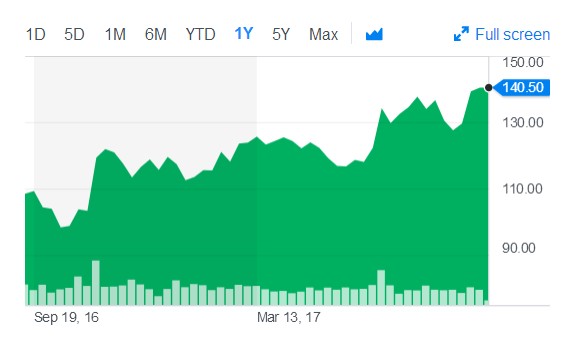
A Word from Gary Jefferson
Jefferson Financial Group
First Vice-President, Investments
UBS Financial Services, Inc.
If there is going to be a real market pullback (5% to 10%), history shows us that the Sept-Oct period is the most likely time for it to happen. So, we thought this would be an opportune time to get on the Market Jet, climb to 30,000 feet, and look down at the current "Big Picture". Here is the view from above:
The market has been good to us. We have been in a real bull market since 2009. Until 2015, most experts we respect were split, with one group believing we were still in a secular bear market which began in 2000 and that the bull market beginning in 2009 is only a cyclical bull still within the overall larger secular bear market; i.e. when this 2009 bull ends, the market will reverse course so that we end up back at the year 2000 levels. The other group believes the secular bear market ended in 2013, and that we are now in the 4th year of a new secular bull market. Secular bull markets historically last from 8 to 20 years – in other words we have between 4 and 16 years left for this bull market to run. (The last secular bull market ran from 1982 to 2000). Relying on dozens of experts as well as our 30+ years of experience, we believe we are in a new secular bull market with higher highs to be made over the next 4 to 16 years. We should expect to see a cyclical bear market at some point within the bull market run, but in the "big picture", investors should do well over the coming years.
Several other "big" things are going on. While the DOW and S&P 500 have hit new highs – because the economy is posting GDP growth of 2.5%-3.0% (finally!) – the Utility index hit a new high last week, while copper prices also hit a 3-year high. This is way out of whack. Historically, high copper prices have always signaled higher world growth. Higher growth in turn signals higher interest rates and inflation – all bad news for utilities. What seems to be happening in the "big picture" is that investors are frustrated and tired of waiting for interest rates to rise so they are chasing anything with yields- i.e. utilities. What this is really signaling, however, is that institutional money is buying in to the belief that interest rates are going to remain low for an extended time. Investors cannot ignore the bond market, and when it tells us it believes in lower rates for longer, it bodes well for the bull market hypothesis.
Again, looking at the "big picture" of the overall stock market, it is clear that the market is shrinking big-time. According to CNN Money "America's Stock Market is Shrinking", the number of public US stocks peaked at 7,600 in 1988. By 2015, there were just 3,800 US public companies. Obviously, there are more companies exiting than entering the market. It is shrinking because of an increase in mergers, companies going private and a slowdown in IPO's. Thus, please consider the math – there is a lot more money today chasing a lot fewer stocks. In the big picture, this is also a favorable trend for the stock market.
Finally, the big picture is a little less clear on the subject of taxes. What is obvious is that tax cuts and real tax reform will be great for individuals, businesses and the overall economy. A simple formula would be: Lower taxes = higher profits, more money in consumer pockets, higher spending, higher dividends, more stock buybacks = higher stock prices. Unfortunately, at 30,000 feet or 3 feet, it's impossible to see through the swamp. The only thing that could derail this part of the bull market movement is politicians.
For those worried about the end of the bull market, Barron’s recently put out a new article warning that it may be looming. The piece describes several scenarios for how the bull market might end. There are seven different factors which it identifies as possible catalysts to ending the bull run: a Fed mistake, inflation, China, antitrust, the end of QE, geopolitics, local politics. It does, however, make the point that longevity, high prices, and bad politics are usually not enough to cause a bear market. Recession is what usually causes it, and it makes the further point that the first four catalysts could trigger a recession. The fed mistiming rate hikes could cause big issues, as could a collapse in China, or a big antitrust movement against large tech companies.
These things are all possible, of course, but we believe Barron's should have made their argument in the context of secular bull and bear markets. A secular bear market historically lasts from 8 to 20 years, with intermittent cyclical bull markets within it. We may see a cyclical bear market (normally lasting from a few months to one or two years) inside the current 4-16 year bull move we see ahead of us, but that would not be anything similar to a long term secular bear. Understanding the difference between cyclical and secular market moves is important to being able to see the "big picture". Those that jumped out of the market in 1987 when the bear "crash" (a cyclical bear market) occurred, missed the rest of the move up in the most recent 1982-2000 secular bull market.
The High Yield Investor
By Michael Foster
Part of The Bull Market Report Team
It was another mixed week for stocks and another strong week for The Bull Market Report High Yield portfolio. We saw REITs mostly deliver strong returns, municipal bond funds rise, and a big boost from Pharma.
Let’s start with REITs. Omega Healthcare Investors (OHI: $32, up 0.5%) had another solid week of gains that were neither too extravagant nor disappointing. We’ve seen a lot of investors question the durability of Omega Healthcare’s dividend growth trend, and the doubts have increased lately as a result of one very simple (and, to our mind, naive) hypothesis. The thinking goes like this: Omega focuses on skilled nursing facilities (SNFs), and those facilities are losing popularity among Americans. This is quite surprising, considering America’s demographics: the country is aging rapidly, so expectations of growing demand for SNFs has been somewhat baked into Healthcare REITs’ stock prices for a long time.
Again, that’s the theory, but it’s not quite accurate. While it’s true that SNFs are seeing a decline in demand, it isn’t actually impacting Omega as much as a lot of critics would suggest. Yes, revenue has been challenged by the trend, and a lot of Omega’s tenants have seen more disappointing demand than they were expecting. Nonetheless, again this is all baked into Omega’s stock price. Keep in mind that Omega’s current price point is at the exact same spot where it was 4 and ½ years ago despite the substantial growth in Omega’s operations since then. The reason for this is simple; the disappointing SNF market growth has been priced into Omega’s stock price for a long time.
That’s why this has been a particularly good REIT to buy on dips, especially when it yields 8% or more. We’re at 8% right now, so it’s a strong buy in our book for the reasons mentioned above and for its tremendous income stream. And the income is not under threat. As we’ve mentioned in the past, Omega’s dividend coverage ratio is on the higher end for Healthcare REITs, despite its higher yield. That combination makes this a perfect buy and hold.
Elsewhere in the Healthcare REIT sector, Welltower (HCN: $75, up 1%) ended the week up nicely. Now might be a good time to talk about how this company is different from Omega and why we recommend both. Omega is about 16 years old and has been rapidly growing over the last decade. Welltower started in 1970 and has been an S&P 500 component for years. It also has a tremendous dividend growth track record thanks to improving net income and steady, higher-than-average occupancy rates. In part, that’s because of Welltower’s more diversified approach. While Omega focuses on the riskier SNF sector, Welltower offsets that risk with investments in post-acute care facilities, medical office buildings, and senior housing facilities. As a result of that diversification and longer track record, it is considered more seasoned and conservative and thus their dividend yield is almost half of Omega’s, at less than 5%.
But we still maintain owning both, because the lower volatility in Welltower’s stock can help you offset the psychological impact of temporary dips in Omega’s stock, as we’ve seen in the past. Additionally, there’s a lot more capital gains upside potential with Welltower. The stock isn’t up much over the last 5 years - just about 25% - but that’s a lot better than Omega’s flat pricing. Additionally, we’ve seen Welltower climb steadily throughout 2017 despite the more jittery market demand for Omega. The steady but low-yielding holdings in one offset the more volatile but opportunity-yielding pricing of the other.
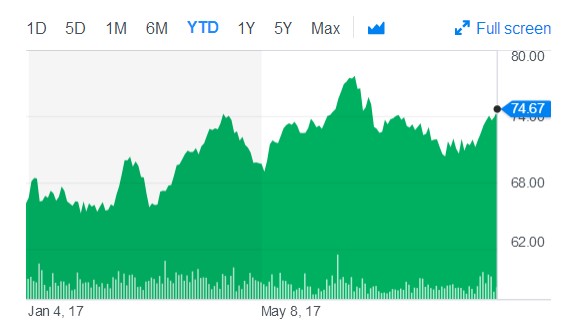
Welltower Chart from the beginning of the year
On the subject of healthcare, let’s jump into AstraZeneca (AZN: $32, up 4%) and its wonderful week. We’ve been watching this one with intense amusement, because a number of bears have come out of the woodwork to attack the company’s product pipeline - ironic, considering the firm’s pipeline looks stronger than ever, with recent trial successes that indicate its R&D department is still yielding a lot of fruit. AstraZeneca scientists are busy presenting on Imfinzi (durvalumab) and Tagrisso (osimertinib) at a lung cancer congress in Europe, and the feedback remains solid enough to drive shares sharply higher. Ignore the bears, because, frankly, they just don’t know enough about the science behind AstraZeneca’s pipeline.
Finally, let’s turn to municipal bonds. A number of Wall Street analysts are noticing that municipal bonds were a sleeper winner in 2017, with modest price gains that were often ignored because of the obsessive focus on the so-call Trump rally. That’s helped Nuveen AMT-Free Municipal Credit (NVG: $15.77, up 1%) and Invesco Municipal Trust (VKQ: $13, flat) recover nicely from their 2016 lows, when The Bull Market Report first recommended these funds. It’s nice to see the mainstream pick up on the quality of this asset class, but we also need to acknowledge how late they are to the party.
Unfortunately, there is a bit of a gray cloud for munis that we need to think about. Inflation trends are weakening and expectations of a third interest rate hike from the Federal Reserve in 2017 are dwindling. A longer path towards raising interest rates is bad for municipal bond closed-end funds, which depend on leverage to extend returns and maintain high yields for investors. The spread between the rate that funds borrow at and the rate that funds can earn through munis has been narrowing. This means dividend cuts might be on the horizon.
We don’t expect the cuts to be massive or come soon, but we do expect the income from these funds to decline slightly (and by slightly we mean less than 5%) in the next few months. I don’t think this is going to impact the pricing of these funds - muni funds often cut dividends without getting a hit to their stock. But keep in mind that the dividend stream from these funds is going to be a bit uneven. That doesn’t mean 5% annualized total returns won’t still come in if we average over a long period of time, but it does mean short-term returns from dividends will be a bit meeker than we’ve seen in the last few months. But that’s ok - we’re up way more than 5% in the last few months alone from both of these funds.
Good Investing,
Todd Shaver
CEO, Editor and Founder
The Bull Market Report
Since 1998