September 4, 2017
by Todd Shaver | Sep 4, 2017 | Weekly Newsletter 7pm Sunday
The Weekly Summary
We sadly observed Hurricane Harvey devastate Texas this past week. 52,000 people are in shelters as thousands of homes are flooded. The state of Texas ranks as the 2nd largest contributor to GDP in the US trailing only California and ahead of New York. So the economic impact has yet to be fully seen. Real estate portfolios caught without flood and business disruption insurance may be seriously in trouble. Auto sales are already seeing a sizeable dip. Chemical plants are shut down. We could go on and on. What an unfortunately troublesome situation to watch and one with the potential for lingering negative impacts for months to come.
In other news, lawmakers decide to give bipartisanship a shot on healthcare. The Senate Health Committee will turn its attention to bipartisan legislation aimed at shoring up Obamacare markets for 2018. The drift toward compromise follows high profile repeal failures, but still faces an uphill battle as many Republicans have spent years railing against the health law. Staff has been working on it over the summer break and there is general agreement that insurer payments will continue, though specifics are sparse.
Separately, we have yet to see formal action following Trump’s opioid emergency declaration. No formal paperwork has been filed and no new policies have been announced. This appears to be new territory for the government as the national emergency designation is typically used for relief of temporary issues like natural disasters rather than chronic problems like opioid abuse. In addition, administration officials seem to have been caught off guard by Trump's statement. The White House has indicated that it is considering all options for action. Why should we care? This is a big deal for labor force participation, which is at historical lows. If we can get everybody back to work contributing to our economy and off drugs, that is the path to 3.0% GDP growth versus where we are now at 1-2%.
No matter what is happening out there, there is always a bull market here at The Bull Market Report! This week we highlight some of our favorite stocks where we think you can still make good money, including: Apple, Gilead, Bristol-Myers, Amazon, and PayPal.
BMR Companies and Commentary
Apple (AAPL: $164, up 1.5%, all prices are for the week)
Apple has officially scheduled its first-ever event in the company's Steve Jobs Theater, a September 12th invitation-only press conference expected to reveal the latest iPhones and possibly a revamped Watch and Apple TV. The company emailed invitations Thursday that read "Let's meet at our place," with an picture of an Apple logo in red, white and blue. The event, hosted at the company's new spaceship-style Apple Park headquarters is scheduled to start at 1 PM ET. For several years, Apple has revealed its latest iPhones in September, in time to promote them for the holiday season. This year, 10 years after the first iPhone hit the market, Apple is widely expected to reveal the iPhone 8, and the rumor mill has already churned out reports that the device will have a larger OLED* screen and a virtual home button. There are also reports Apple will reveal a Watch that has its own cellular connection and an Apple TV that adds 4K UHD. This is likely it—the big event for Apple’s new iPhone launch! We will all be watching closely.
* Organic light-emitting diode. An OLED display works without a backlight; thus, it can display deep black levels and can be thinner and lighter than a liquid crystal display (LCD). In low ambient light conditions (such as a dark room), an OLED screen can achieve a higher contrast ratio than an LCD.
The main risk to keep an eye on is prices. The argument is that costs are getting so high on new smartphones that customers will not be willing to keep paying up to get them. If this is so, we will see margin compression and perhaps fewer sales by Apple.
Apple Consensus on the Street
Apple was upgraded by analysts at Cleveland Research from a “neutral” rating to a “buy” rating in a report released on Tuesday, and they raised their price target to $197.
On the Street there are 10 Hold Ratings, 39 Buy Ratings, 1 Strong Buy Rating
9/1/2017 Royal Bank Of Canada Target: $180
8/29/2017 Cleveland Research Target: $197
8/24/2017 Bank of America Target: $180
8/24/2017 Drexel Hamilton Target: $208
8/22/2017 Canaccord Genuity Target: $180
8/14/2017 Sanford C. Bernstein Target: $175
BMR Take: Remember the big story for Apple is their services business. They have all these iPhones out there in use by a huge customer base. Can they now get more money from these customers through services? The iPhone 8 is a key part of the strategy. We note that Apple has $260 billion in cash now, which is the equivalent of $50 a share, and greater than 30% of the stock price. This is UNPRECEDENTED in the history of Wall Street. Apple remains an exciting investment opportunity. The services business is projected to double in revenue to $50 billion over the next several years. The Services business is much more profitable than hardware so the impact to earnings is even better. Don’t sell a share. We believe Apple has a lot more room to go on the upside.
Gilead Sciences (GILD: $84)
We removed Gilead from our Healthcare portfolio in February after holding them for a year with poor results. Things have changed dramatically since that time as management has tackled various issues head-on, so we give you an update as things have changed even more this past week.
Gilead announced a big acquisition. Gilead will acquire Kite Pharma for about $12 billion in cash; it was unanimously approved by both the Gilead and Kite Boards of Directors and is anticipated to close in the fourth quarter of 2017. The transaction will provide opportunities for diversification of revenues, and is expected to be neutral to earnings by year three and accretive thereafter.
The acquisition of Kite establishes Gilead as a leader in cellular therapy and provides a foundation from which to drive continued innovation for people with advanced cancers. We are greatly impressed with the Kite team and what they have accomplished, and believe they are on the cutting edge of cell therapy that will be the cornerstone of treating cancer. The field of cell therapy has advanced very quickly, to the point where the science and technology have opened a clear path toward a potential cure for patients. The two company’s similar cultures and histories of driving rapid innovation in order to bring more effective and safer products to as many patients as possible make this an excellent strategic fit.
BMR Take: Gilead is losing two major drugs this year with big revenues due to the expiration of their patents and was the reason we removed the stock earlier this year . Over the past several years they were among the largest sellers in the history of Healthcare so replacing them will be a tough uphill climb. Could Kite provide a way to do it? We will see.
Bristol-Myers Squibb (BMY: $60, up 3%)
This week Bristol-Myers will announce more than 60 presentations, including seven late-breaking abstracts, from its Oncology portfolio featured at the European Society for Medical Oncology 2017 Congress in Spain. Presentations of data from company-sponsored studies, clinical collaborations and research will explore the potential role of Opdivo (nivolumab) as monotherapy and in combination with Yervoy (ipilimumab) and with relatlimab, a fully human monoclonal antibody that targets lymphocyte activation gene-3 (LAG-3); or with chemotherapy in 13 types of cancer.
All this news matters a lot because healthcare investors love new data! We are seeing the stock pick up some momentum getting ready for what is likely to be a wave of good news.
BMR Take: We are still optimistic Bristol-Myers could be a take-out candidate. Activist investor Carl Icahn is in the stock and pushing for change. We believe we could see a 25-50% premium from today’s price if a sale gets done. Further supporting our view, we note Jana Partners is now also building a position in the stock. Jana had a big stake in Whole Foods, and was taken out by Amazon this past week as you know.
Amazon (AMZN: $978, up 4%)
Amazon announced 3,000 more jobs coming to Ohio. This follows news a few weeks ago about doing a major facility in New Jersey. We continue to highlight the Amazon machine because this single company alone is now a major driving force behind the economy.
The internet retailer received approval on Wednesday for state tax incentives for two distribution operations in Ohio. The project approved by the Ohio Tax Credit Authority will create 2,000 jobs. The company said it will invest $100 million at the site, which eventually will result in a 855,000 square-foot facility. The second distribution-center project, will result in an estimated 1,000 jobs if the company goes ahead with the project. Amazon had no presence in the state until recently.
BMR Take: The Amazon powerhouse is steamrolling the real economy and the stock market. With over $20 of EPS potential by 2020 according to analyst consensus estimates, we see a lot of potential ahead.
We noticed that the stock is on a little roll lately. The stock hit a closing high of $1052 a month ago in late July and then proceeded to drop over $140 to the low 900s. But this week the stock was up a little bit every day until Friday when it took a breather. We have watched these high-priced stocks for years and many times it is human nature to not be able to bring yourself to buy a stock that is almost $1000 a share. But we always mentally build in a stock split. Say 10-1 in Amazon’s case. If the stock were a $98 stock, would you buy 100 shares? Sure you would. So we just look to buy 10 shares for $980. Same difference. If you think the stock is going to $2000 a share in the future like we do, 10 shares here, 20 shares there, and 30 shares beyond, adds up to real money.
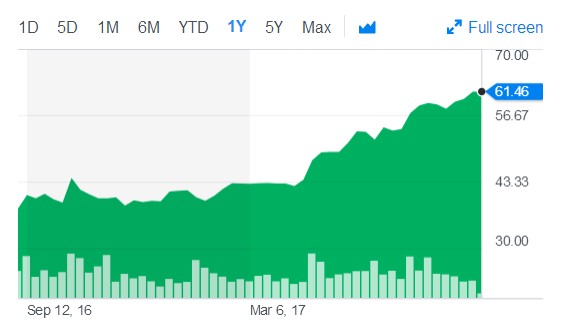
PayPal (PYPL: $61, up 2.5%)
PayPal customers in the U.S. can now earn cash back on every purchase online and in stores with the recent launch of the new PayPal Cashback Mastercard issued by Synchrony Bank. The PayPal Cashback Mastercard, designed exclusively for PayPal members, offers cardholders 2% cash back every day, on every purchase – everywhere Mastercard is accepted.
Unlike other rewards credit cards, there is no annual cash back limit, no minimum redemption amount, no restriction on how to spend cash rewards and no expiration. The PayPal Cashback Mastercard offers all the security and convenience expected from PayPal, plus all the traditional benefits of a Mastercard. All accounts are automatically added to the member’s PayPal wallet to simplify checkout and provide peace of mind.
The introduction of the PayPal Cashback Mastercard with Synchrony Bank continues PayPal’s commitment to provide customers with rewarding product experiences and a range of innovative credit options. By providing a simple way for people to earn cash rewards for the shopping they’re already doing, the PayPal Cashback Mastercard will give consumers yet another reason to shop with PayPal.
BMR Take: PayPal has 200 million customers on the way to over 1 billion longer-term (after all, Facebook has over 2 billion, showing the possibilities for a global internet-based business model). With EPS closing in on $3 by 2020, and EPS growth moving along in the mid-teens, we see growth at a reasonable price here in the stock and like it a lot!
Nutanix (NTNX: $22, flat)
We reported via News Flash on Friday on the stellar earnings report the company issued on Thursday. The stock shot higher on Friday, hitting $24, but settled at $22, flat for the week. We’re not traders as you know, but long term investors, and we have seen this many times in our career. We are going out on a limb here and will say that the stock will move higher from here over the coming weeks and months.
We mentioned the high level of sales that were booked but not reported as revenues – the backlog. Management indicated that billings growth was 40% year over year and that the company continued to build up a significant backlog of deals that booked but did not ship in the quarter. The sales transition toward large enterprise is progressing nicely. Management's next quarter guidance implies billings growth of 25% YoY compared to consensus of 17%, due to the significant backlog build.
To recap:
Fiscal 4Q 2017 Financials
Revenue: $226 million, up 62% year-over-year from $140 million in 4Q16
Net Loss: $50 million, compared to a net loss of $47 million in 4Q16
Operating Cash Flow: $6 million, compared to $2.5 million in 4Q16
Cash and Short-term Investments: $350 million, up 90% from 4Q16
Deferred Revenue: $525 million, up 77% from 4Q16*
Free Cash Flow: $(6.5) million, compared to $(6.5) million in the fourth quarter of fiscal 2016
Billings: $289 million, growing 40% year-over-year from $207 million in 4Q16
BMR Take: We added the stock in May at $17.45 and have a Target of $30. Our Sell Price at $14 is way too low, so we hereby raise it to $19. This was a great quarter and if Wall Street doesn’t wake up to the potential of this company, we would be very surprised.
Upcoming Economic News
Domestic Auto Sales
Monday, September 4th, 8:00 AM ET
Period: August
Consensus: 4.6 Million
Prior: 4.5 Million
Trade Balance
Wednesday, September 6th, 8:30 AM
Period: July
Consensus: -$44.5 billion
Prior: -$43.6 billion
Initial Claims
Thursday, September 7th, 8:30 AM
Period: 09/02
Consensus: 240,000
Prior: 236,000
Consumer Credit
Friday, September 8th, 3:00 PM
Period: July
Consensus: $15.0 billion
Prior: $12.4 billion
A Word from Gary Jefferson
Jefferson Financial Group
First Vice-President, Investments
UBS Financial Services, Inc.
Over the previous weekend, these were the economic headlines:
--- Robust Retail Sales
--- Disappointing Durable Goods
--- Strong Business Inventories
--- Uneven Industrial Activity
--- Mixed Housing Data
Economic data suggests that things are good, but not great.
Fed Chair Janet Yellen's signaling of continued restraint on monetary policy at Jackson Hole triggered another rally in US stocks last week. This extends the current bull market to 102 months, surpassed in length only by the 113-month run leading up to the dotcom crash. Skepticism over valuations is even higher now with a record 46% of investors believing equities are overvalued.
While the bull market may be entering the later stages of the cycle, UBS strategists believe it can run further based on these observations:
--- The earnings yield on the S&P 500 is 4.8% compared with a yield of 2.17% for 10-year Treasuries.
--- At 18x, current market PE ratio is near long-term averages. Historically when valuations have been in an 18x to 23x range, the MSCI AC World Index has returned 6% over the subsequent six months (versus an overall average of 5%). And relative valuations of equities also suggest long-term outperformance versus bonds.
--- Corporate earnings growth remains robust, at 12% in the US and around 10% in the Eurozone in the last quarter. Synchronized global growth should continue to support this, with all 45 OECD economies on track to expand this year.
There are, however, some caution flags appearing here and there. We prefer to look at price-to-sales ratios rather than PE's, and they haven't been this high since the peak of the dotcom bubble in 1999. This means that new investors are paying more for every dollar of sales than at almost any time since the dotcom bust. However, if sales continue to grow as expected this ratio will normalize to some degree. Put another way, stocks are priced almost to perfection and if the earnings growth story were to falter, it could cause some real volatility.
VMware (VMW: $107, up 5%) Has 500,000 Customers
BMR Take: Think about this. Half a million customers. Can you imagine? We think this is just fabulous. We’re up 30% since we added them in January at $83. What a great company. Our Target is $108 which it hit Friday, an all-time high (not counting the euphoria 10 years ago when they went public). With a market cap of $44 billion, and Dell Technologies being the principal owner (80%+) we think very highly of this company. So we hereby raise our Target to $120 and raise the Sell Price from $90 to $100.
The Blackstone Group (BX: $33, up 4%) had its Target Price set at Credit Suisse Group at $45
A Few Wall Street research firm targets
8/30/2017 Credit Suisse Group $45
7/25/2017 Morgan Stanley $40
7/21/2017 Deutsche Bank $33
7/14/2017 Keefe, Bruyette & Woods $37
7/14/2017 Oppenheimer Holdings $38
5/28/2017 Citigroup $41
Blackstone Considers IPO of Gates Corp.
Blackstone Group is considering an initial public offering of Gates Corp. that could value the auto-parts maker at as much as $9 billion. Its products include belts, hoses, industrial power transmission, fluid power, and automotive. The company was founded by Charles Gates in 1911 and is headquartered in Denver. In 2014, the company was acquired by Blackstone in a deal worth $5.4 billion.
The private-equity giant is in the early stages of laying the groundwork for the possible offering, according to people familiar with the matter. The business could be worth $8 billion to $9 billion, one of the people said. It isn't clear whether that includes debt.
BMR Take: We can’t tell you how good this company is. Well, maybe we can: This company is great! Look at the wealth being created by this firm. In 3-4 years in this one deal alone, they have created $3-4 billion of equity. Absolutely amazing. Our Target is $35 but we are dying for the stock to hit this price so we can raise it to $42. This is a value stock like no other.
The High Yield Corner
By Michael Foster
Significant news came this week from AstraZeneca (AZN: $30, up 3%), helping the shares rise solidly by the end of the week. The biggest news is the company’s presentations at a conference in Spain that will demonstrate the company’s phase-3 study of imfinzi for non-small cell lung cancer and tagrisso for. EGFR cancers.* The science is complex and far for non-specialists to understand without a lot of deep reading, but the market is a great place because it prices in that knowledge instantaneously, which is why AstraZeneca shares rose 2% on the news.
* EGFR is short for estimated glomerular filtration rate. The EGFR is a number based on your blood test for creatinine, a waste product in your blood. It tells how well your kidneys are working.
Another intriguing tidbit from AstraZeneca: the company announced on Tuesday that it was recruiting Takeda Pharmaceutical to work on an antibody for Parkinson’s disease treatment. Again, more exciting developments that prove the mega-pharma company’s pipeline is very healthy. Remember a year ago when this was a primary concern on the company and thus the stock? Those concerns are gone now; instead, investors have finally realized that there is tremendous value in this company and it is still innovating; thus it’s no surprise shares are up 10% in 2017 so far. Paying a solid 3.1% dividend, we can see some dividend increases in the months and years ahead. We’ve got a $42 Price Target on the stock and would hope to see this level sometime next year.
Elsewhere in The Bull Market Report High Yield portfolio we see green across the board. There’s only one exception: Invesco Municipal Trust (VKQ: $12.93), which ended the week flat. No surprise; municipal bonds are a low volatility asset class, and there’s not really any news in the municipal bond market to warrant a massive jump. That includes the latest tragedy in Texas. While large storms and ecological disaster might intuitively seem like they will hurt municipal bond markets (lower economic activity should mean lower government revenue and thus higher default risks), it’s important to remember that this “common sense” is actually false. (Often, the common sense view doesn’t quite work in finance.) In reality, credit agencies do not downgrade bond issuers faced with economic disasters; furthermore, the lower revenue may make the state’s budget tighter in the short term, but the risk of that hurting municipal bonds is negligible. Additionally, natural disasters rarely result in massive new bond issuances to fund repairs, so it’s not like existing bonds will get priced out by new issues.
We saw Nuveen AMT-Free Municipal Credit Fund (NVG: $15. 64, up 1%) have a solid showing. Also a nice surprise from Nuveen this week: the company announced dividends for all of its closed-end funds, but did not lower dividends on NVG - although many other funds did see their distributions decline slightly. Again, good news for municipal bond investors long this fund.
The Bull Market Report’s other closed-end fund picks also ended the week in the green and announced distributions that were in-line with previous dividends. AllianzGI Equity & Convertible Fund (NIE: $20, up 1%) announced that its 38 cent quarterly dividend would continue at the same level, and PIMCO Dynamic Income Fund (PDI: $30, up 1%) also announced its monthly dividend would stay at the same level. These funds are paying 8% in income, year-in and year-out, while also seeing their share prices rise. Closed-end funds are typically income vehicles that aren’t often traded for short-term capital gains, but both funds have given investors that opportunity this year. AllianzGI is up 10% year-to-date and Pimco Dynamic is up 14% year-to-date - extremely impressive returns for such diversified funds. And the income does not look to be threatened anytime soon, so investors can continue to hold them with confidence.
Now, let’s turn to REITs. Digital Realty Trust (DLR: $118, flat) announced that its COO was leaving the company in September. Markets shrugged; while he obviously has done well for the company in the past, there’s no reason to assume he’s irreplaceable. We’re sure that his replacement will be skillful.
Despite little news elsewhere affecting REITs, we saw price gains for Omega Healthcare Investors (OHI: $32, up 3%), Government Properties Income Trust (GOV: $18.50, up 1%), Apollo Commercial Real Estate (ARI: $18.18, up 2%), Ventas (VTR: $69, up 1%), and Welltower (HCN: $74, up 2%).
Also, there wasn’t any real news on Kimco Realty (KIM: $20, flat), but it’s interesting to note that this retail-focused REIT has had a bit of a resurgence lately thanks to the surprising strength in retail. (Note that we removed Kimco from our portfolio in May, but we wanted to give you an update.) If you remember, several weeks ago in this column we wrote at length at how the “death of retail” cliché was really more about shock financial journalism trying to get clicks from disaster-starved readers and had little to do with the reality of our economy. Well, we were right. In addition to beats from Macy’s, Dollar General, Target, Wal-Mart, and several other retailers, even the near-death dogs like Sears Holdings and Abercrombie & Fitch impressed the market with their quarterly results, beating expectations. Retail is not the healthiest sector on Earth, but it isn’t dead or dying. But Kimco was priced for a dying retail sector. So what does that mean? Kimco shares are up 11% in the last three months.
We want to go on record with another prediction that drives bullishness on retail REITs like Kimco. Amazon’s recent acquisition of Whole Foods and their price drop at the supermarket is going to drive retail sales for two reasons. Firstly, Amazon Prime members will be incentivized to leave their computers and shop in person more. Secondly, more people can now afford Whole Foods and will shop there. That also means people are going to spend more time shopping at auxiliary stores adjacent to Whole Foods. This is a rising tide that is going to lift many boats, which is why buying retail REITs right now makes a lot of sense. Check back in after about six months and see if we’re right.
Good investing,
Todd Shaver, CEO, Founder and Editor
The Bull Market Report
Since 1998
August 27, 2017
by Todd Shaver | Aug 27, 2017 | Weekly Newsletter 7pm Sunday
The Weekly Summary
What a week. So much for a quiet end to the summer. Yellen made perhaps her final speech in Jackson Hole. Trump is battling a debt ceiling to fund The Wall. And the markets are partying like it’s 1999!
Federal Reserve Chair Janet Yellen, speaking in Jackson Hole, Wyoming, on Friday, issued her broadest defense so far of the government’s response to the 2008 financial-market meltdown while outlining some areas that regulators could review to improve efficiency in the financial system. “Any adjustments to the regulatory framework should be modest and preserve the increase in resilience at large dealers and banks associated with the reforms put in place in recent years,” Yellen said, in what could be her final speech as Fed chair at the annual gathering of central bankers. Her term expires in February.
President Donald Trump is spoiling for a fight with Congress over funding a border wall with Mexico, but he’ll have a hard time waging that battle because of a looming deadline to avert a U.S. debt default. Some of the president’s advisers consider a tough stand on border wall funding crucial to Trump’s credibility, two White House officials said. Some say that failure to make progress on the border wall -- or at least go to the mat on the issue -- may fracture what has been a solid political base for the president.
In 1999, then-Federal Reserve Chairman Alan Greenspan kicked off the central bank’s annual Jackson Hole symposium by highlighting the impact of rising stock prices on an economy that was then enjoying low inflation and low unemployment. Now today, eerily similar, buoyant asset prices and low unemployment argue for Yellen to press ahead with interest-rate increases -- or even accelerate them. Weak inflation suggests she might even want to consider providing more stimulus, not less. That would mimic the tack Greenspan took 18 years ago, when, faced with a frothy stock market, he continued to hike rates until May 2000. The result was a disaster for the stock market -- the technology-heavy Nasdaq Composite Index plunged by 78% over a 2.5 year period from its peak as the dotcom bubble deflated -- but was not all that bad for the economy. Gross domestic product did contract during 2001, but the fall was so small that former Fed Vice Chairman Alan Blinder has called it a “recessionette.” And inflation remained contained. “There are a lot of similarities,” between the late 1990s and today, said Laurence Meyer, who was a Fed governor from 1996 to 2002.
No matter what is happening out there, there is always a bull market here at The Bull Market Report! This week we highlight some of our favorite stocks/funds where we think you can still make good money, including: high yield equities like Annaly or larger caps like Amazon, Facebook, First Solar, Google, Microsoft, and Netflix, as well as small caps like Nutanix.
BMR Companies & Commentary
Amazon (AMZN: $945, down 1%, (for the week))
Amazon Announces New Online Teaching curriculum TenMarks Writing. TenMarks Writing is a new online curriculum designed for teachers to help their students improve their writing skills by using scaffolding, an instructional technique in which students learn step-by-step how the writing process builds.
TenMarks Writing incorporates natural language processing technology to provide students with automatic, personalized feedback and helps teachers deliver differentiated comments as students work through their compositions. It is available for $4 per student for an entire year.
BMR Take: This is just the latest example of another new innovative effort by Amazon. We call Amazon the innovation machine for a reason. Hardly a week goes by without something new and creative coming out from the company. We all know about their entry into food (Whole Foods is part of Amazon as of Monday) and now education. Will this be a major push by the firm? We shall see.
Facebook (FB: $166, flat)
Facebook Usage Growth May Slip among Teens, Young Adults. According to eMarketer's latest forecasts, usage rates for Facebook, Instagram and Snapchat are running roughly in parallel between the US and UK, with Instagram and Snapchat expected to rise by double digits. However, Facebook will see its user growth continue to slow in both countries as lessening usage among teens and young adults drags down overall user growth. Monthly Instagram usage in the US will grow 24% in 2017 to 85 million, also higher than previously forecast.
BMR Take: Do not be alarmed. We repeat. Do not worry. This news of “lowered estimates” and all the talk on TV of slowing engagement for Facebook means very little. It sounds bad. But the reality is engagement is healthy and the bigger factor is new user growth, which remains robust.
First Solar (FSLR: $47, down 1%)
First Solar Sells California Project. This week First Solar announced it completed the sale of the 280 Megawatt (MW) California Flats Solar Project in Monterey County to global private asset manager Capital Dynamics. Terms of the deal were not disclosed.
Located on approximately 2,900 acres of ranch land within the Jack Ranch owned by the Hearst Corporation near the San Luis Obispo and Monterey County borders, California Flats comprises two phases. The 130 MW first phase is expected to be commissioned in 4Q17, and is fully contracted under a long-term Power Purchase Agreement (PPA). The 150 MW second phase, which is currently under construction, is expected to be commissioned by the end of 2018, and is fully contracted under a long-term PPA.
BMR Take: We like this. We understand the cash is going to be reinvested in part of the business with much greater growth prospects. This is just want we want to see from the management teams running the companies we follow.
Google (GOOG: $915, up 1%)
Google and Walmart partner on Voice Shopping. Now people who own a Google Home will be able to order things by voice from Walmart. Cool! But this is copying Amazon Alexa, to be frank. If you can’t beat them join them.
The companies will also participate in the Google Express shopping marketplace, for which Google will eliminate the $95 annual membership fee. Shipping for orders through Google Home or Google Express will be $5 per order, or free if the order reaches a certain level. Costco, Walgreens, and PetSmart already sell via Google Home.
BMR Take: Good news for Google. Amazon is trailblazing the way forward with new innovations by spending tons of money. But there are competitive factors and various stakeholder conflicts, which creates room for companies like Google to jump in with little upfront capital investment, creating great investment opportunities. This could be the start of something big.
We've noticed that Google is lagging the rest of the market. After hitting $980 a month ago, the stock has faded a bit. It seems like a lot, but it's like a $98 stock dropping to $92, not really a big deal. So what do you do from here. You sit back and realize that the market is giving you a huge buying opportunity. Repeat after us: The market is giving you an opportunity to buy the stock a lot cheaper than its all-time high of $988 in June.
Microsoft (MSFT: $73, flat)
Microsoft Acquires Cycle Computing to Accelerate Big Computing in the Cloud. From finding a cure for cancer to making vehicles safer to fulfilling the promises of artificial intelligence, today’s complex problems require the ability to harness massive amounts of computing power. For too long, Big Computing has been accessible only to the most well-funded organizations. Microsoft believes that access to Big Computing capabilities in the cloud has the power to transform many businesses and will be at the forefront of breakthrough experimentation and innovation in the decades to come. Thus far, Microsoft has made significant investments across infrastructure, services and partner ecosystems to realize this vision.
As a further step in this direction, Microsoft recently acquired Cycle Computing, (no price details given), a startup specializing in helping companies perform heavy-duty computing. That includes crunching data for developing new drugs and analyzing risk in the financial services industry. This will make it easier than ever for customers to use High-Performance Computing and other Big Computing capabilities in the cloud. The cloud is quickly changing the world of Big Compute, giving customers the on-demand power and infrastructure necessary to run massive workloads at scale without the overhead. Your compute power is no longer measured or limited by the square footage of your data center.
BMR Take: We’ve already seen explosive growth on Microsoft Azure in the areas of artificial intelligence, the Internet of Things and deep learning. As customers continue to look for faster, more efficient ways to run their workloads, Cycle Computing’s depth and expertise around massively scalable applications make them a great fit for customers. We expect big growth ahead and see Microsoft’s business in a very healthy place.
Netflix (NFLX: $166, flat)
We are not afraid to tell you the good, bad, and the ugly. We know you count on it. We unfortunately have to report that Netflix will lose Disney content in 2019. Disney will end Netflix's film distribution deal as it launches its own streaming services starting with an ESPN service in 2018 and a Disney/Pixar service in 2019. Netflix had inked a deal with Disney to stream films and content just a year ago.
Netflix's stock traded lower on the news as investors see the premature end of the distribution deal as a loss of popular exclusive content. Some have compared the deal termination to the Starz (another Disney property) refusal to renew with Netflix in 2011 and see the move as another example of increasing license renewal risk and streaming competition.
BMR Take: The future of content creation is the holy grail of the media business. While Netflix can survive this one lost deal, the question is how much more of this will we see in the future. There is a long way to go until it is a big problem. But we are worried. Our Target is and has been $165. The stock was higher in July as it rocketed from $146 to $189 but it has fallen since. With a market cap of $72 billion and a PE of a ridiculous 215, we believe it is time for us to put this one to bed. We hereby remove the stock from our Stocks for Success portfolio with a gain of 65% since early 2016. There are lots of better places for your money at this time.
Have you taken the time to go onto the BullMarket.com website? Check out the six portfolios – you’ll find some interesting ideas here for the profits from Netflix.
Nutanix (NTNX: $22, flat)
Cisco Systems announced its intent to acquire Springpath, a leader in hyperconvergence software, for $320 million in cash, with the transaction expected to close in 1Q18. Springpath has developed a distributed file system purpose-built for hyperconvergence that enables server-based storage systems, and Cisco believes the acquisition will allow it to continue to deliver next-generation data center innovation to its customers.
In terms of Cisco, the acquisition was not a surprise, as the two companies have a relationship that goes back to Springpath's 2012 founding and Cisco previously making an investment in the company with an option to acquire it. That said, it is still a bummer for Nutanix. Analysts believed Cisco was a potential acquirer of Nutanix.
BMR Take: Hyperconvergence software is an exploding market. We expect Nutanix to do great things and generate big growth. The stock is hovering our Sell Price and we have had tons of calls and letters about whether we would “sell” the stock. First of all, we don’t own the stock. We don’t buy any of our recommendations as we want to remain clear of any conflict of interests. Secondly, the Target and Sell Prices are there for YOU to decide what to do with your investment. All of you are different. Some have multiple millions and some of you are just getting started. So you have to weigh every investment as it affects you and your family.
With that said, we believe Nutanix will be a big, big winner. Revenues are strong with last quarter coming in at $192 million vs. $115 million the year before. This is HUGE. But remember, this is a small cap stock – tiny in comparison to a Facebook or Google. The market cap is just $3.3 billion. So watch and wait and make a decision for yourself and your family. We think the company is a potential great one, but the market is stretching our patience.
We found this interesting too:
Firsthand Technology Value Fund, a publicly traded venture capital fund that invests in technology and cleantech companies, disclosed that its top five holdings as of July 31, 2017, included Nutanix. The fund’s investment in Nutanix consisted of 460,000 shares of common stock and represented approximately 7% of the fund’s total.
Upcoming Economic News
Consumer Confidence
Tuesday, August 29th, 10:00 AM ET
Period: August
Consensus: 120.0
Prior: 121.1
ADP Employment Survey
Wednesday, August 30th, 8:15 AM ET
Period: August
Consensus: 180,000
Prior: 177,700
Personal Consumption Expenditure
August 31th, 8:30 AM ET
Period: July
Consensus: 0.40%
Prior: 0.10%
Apple Has Debt Too
A few of you have written us and given us grief because we only report Apple’s cash position and don’t report the debt levels. Our internal excuse has always been that Apple’s debt is at very low interest rates. Here are some examples of Apple’s debt:
Apple 2.4% 5/03/2023 $5.5 billion
Apple 1.0% 5/03/2018 $4.0 billion
Apple 4.65% 2/23/2046 $4.0 billion
Apple 3.25% 2/23/2026 $3.25 billion
Apple 2.85% 5/06/2021 $3.0 billion
Apple 3.85% 5/04/2043 $3.0 billion
Apple 2.25% 2/23/2021 $3.0 billion
Apple 3.45% 5/06/2024 $2.5 billion
Here is some more detail:
From their latest financial reports, the last three yearly balance sheets ended September have shown that debt has risen from $29 million in 2014 to $53 million in 2015 and to $75 billion in 2016. At the same time cash has risen from $154 billion to $206 billion to $236 billion, reaching $260 billion in their last quarterly report on July 1st.
So: Big cash. And big debt. The NET CASH position at year-end September 2016 was approximately $160 billion. (And much higher now.)
We’ll take it.
Opko Health (OPK: $6.13, flat) Two weeks ago, the company reported earnings for 2Q17. Total revenues of $314 million were down 12% year over year from $357 million. Revenues included a $10 million payment associated with the commercial launch of Varuby in Europe in comparison to the $50 million payment related to a Rayaldee license in the same quarter in 2016.
Research and development expenses totaled $33 million, up 4%, while selling, general and administrative expenses amounted to $128 million, up 9% year over year. Consequently, loss from operations came in at $4 million, highlighting a significant decline from an operating income of $55 million in the prior-year quarter. The decline can be attributed to a rise in operating expenses owing to the company’s significant investments associated with the commercial launch of Rayaldee along with consistent investments in the pharmaceutical pipeline.
The company has $130 million in cash, unchanged from the quarter before.
This is a biotech company in an industry that is known for companies with years and years of little or no progress (and revenues) and then a big announcement of great success. Luckily Opko isn’t in the camp of no revenues. Revenues as you know are over $1 billion.
Chairman and CEO Frost On the Impact of Opko’s 4Kscore
Released in 2014, the 4Kscore Test is the only blood test that can accurately identify a patient's risk for aggressive prostate cancer, Opko claims. As calls to reduce health care costs across the United States grow louder, 4KScore is as a cost-effective alternative to biopsies, Frost said.
About 30 million tests are done each year to measure men’s prostate-specific antigens, or PSA. Of those, 4 million identify elevated PSA levels and typically would require biopsies.
“If you do the test after the elevated PSAs, you can avoid 50% of all biopsies,” Frost said. “This is the type of thing that if you wanted to be able to cut healthcare costs in this country, this has to be the easiest thing in the world to do.”
On why he continues to buy thousands of OPKO shares
“I always believe in investing in things that I know about rather than things I don’t,” Frost said.
BMR Take: Opko Health is a relatively small biotech firm with great potential. Many times “great potential” results in “no results.” This $3.4 billion market cap company is poised for success, but remains the most speculative stock in our six portfolios.
Splunk (SPLK: $65, up 10%)
Splunk had a great week. They reported earnings on Thursday after the close and they were stellar. This is what we have been waiting for. Revenue rose to $280 million from $213 million a year ago, for a percentage gain of 31%. Huge quarter. Adjusted earnings were $11 million or 8 cents a share.
Guidance is solid with next quarter revenue of $308 million. Operating margins are projected to be approximately 8%.. Growth in yearly revenues has been spectacular. For the last three years we have seen $450,000,000, $670,000,000 and $950,000,000. For fiscal year 2018, ending this coming January, revenue is now expected around $1.21 billion.
Billings in the quarter grew 32% year over year to $303 million. They again increased full fiscal-year 2018 guidance to call for billings of $1.45 billion.
Splunk has been ranked number one in worldwide IT Operations Analytics (ITOA), as well as Event and Log Management software market shares for 2016 by International Data Corporation. Splunk said that these two markets have witnessed the highest growth rates within the overall IT market, with ITOA seeing an increase of 33%, and Event and Log Management growing 23%. This is the third consecutive year that Splunk took the top spot in the ITOA software market, beating the competition of IBM, Microsoft, Hewlett Packard Enterprise and VMware.
More than 500 new customers were added during the quarter, including Athenahealth, Carnival Cruise Lines, the Department of Homeland Security, Harvard Business School, Shutterfly, Uber, and Verizon.
Splunk appears quite dominant in its machine data analytics niche. And the company's market opportunity is growing as its software, traditionally used for IT operational intelligence, gets adopted for security, fraud-detection, app analytics and other use cases.
BMR Take: Great quarter. Looking for continued growth for years to come. Our Target is $75 and our Sell Price remains $60. Note that Splunk has exceeded guidance for 11 straight quarters.
VMware Has a Strong Quarter
VMware ($103, up 7%) had a great week after reporting $1.9 billion in revenues up from $1.7 billion last year with net income of $335 million up from $265 million, $1.19 a share up from $0.97. Huge. Total cloud management bookings rose by a 13% year over year, and the company closed 10 deals valued at over $10 million. Network Virtualization (NVX) revenues were again strong, at over a 40% increase.
The company guided for the year: Revenue of $7.83 billion, EPS of $5.06, and free cash flow of $2.7 billion. These are big numbers.
VMware raised $4 billion earlier this month in a debt offering, mostly overseas, with coupons of 2.3% to 3.9%. Note that Dell Technologies owns 82% of VMware.
Take a look at this chart:
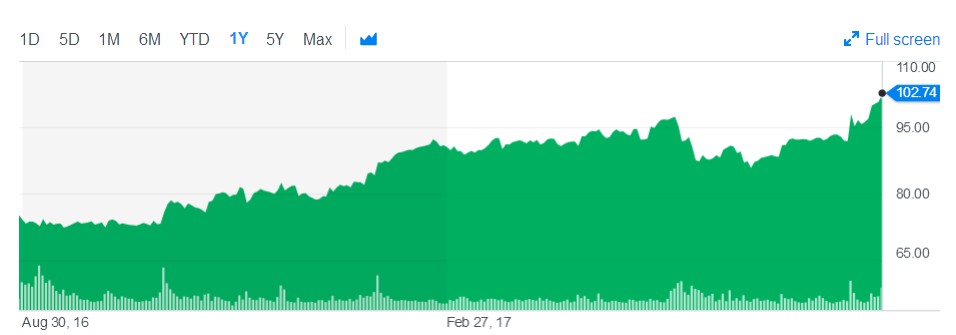
BMR Take: We think you get the drift!
A Word from Gary Jefferson
Jefferson Financial Group
First Vice-President, Investments
UBS Financial Services, Inc.
As Alfred E. Neuman might say, "What – me worry?" ……as in why care about things such as 1) When will the Fed hike rates again and how many hikes can we expect? 2) Has the 2nd quarter economic rebound already been priced into stocks? 3) Are tax cuts still possible or has the pro-growth agenda been totally derailed by swamp politics? 4) Will we have a trade war with China? 5) Will we go to war with North Korea? 6) Are we headed into a recession?
Sure, we care and everyone else should care about getting tax relief. We have the worst tax system in the world if you don't count dictatorships. But we've lived in the current system for decades and so, while it would be a whole lot better if we got tax reform, investors and the stock market will survive if we don't. We also admit that of course we would care if we had a war. That is highly unlikely however, because none of the large powers has any desire to start WW III. Otherwise, worrying about all of the above is not a good idea - or, as Mom used to say, "If you worry too much, you'll worry yourself to death." So, we are adding a little bit of Alfred's advice to our medicine cabinet and are just going to go on about our business and not worry too much.
Business as usual with all these worries hanging around (stocks love to climb a wall of worry) generally means an investor should expect more volatility. We expect just that. We know stocks tumble way faster than they go up. Thus, we know not to panic - and that is a huge plus for every investor. Or, we might have a little cash to buy into any sale that may come along. Or, we have dividend stocks that will reinvest into more shares whenever they go on sale. And finally, we aren't going to worry about a recession now because the facts simply don't support it. We've looked at inflation, housing starts, retail sales, industrial production, oil prices -- there just isn't any "big trouble" in the economy today.
Not only that, it wasn't that long ago when the US economy seemed like the only regional power heading in the right direction. Europe had record joblessness and was teetering on the edge of recession. Japan was in its 20th year of malaise and China was headed for a hard landing if not a total crash.
Today, all of these regions are showing signs of renewed strength. European markets are doing better than expected. Japan also recently impressed with a +4% GDP growth rate - well above estimates - and China has emerged from a soft patch with a string of positive economic readings. With 40% of US corporate profits coming from abroad, all of the above is then a simple equation pointing to more earnings growth and share price appreciation ahead.
T. Rowe Price once said, "No one can see ahead three years, let alone five or ten." So, we aren't forecasting that conditions won't change in the immediate or distant future. But for the time being, we still see the glass as half full.
A Little Unsettling News
We follow the trends in cash flows into and out of mutual funds. We remember well, back in the 2004-2007 time frame the cash inflows into the stock market were consistent, month after month as cash poured into the market. But we noticed recently that cash outflows are continuing these past few months. U.S. equity funds suffered their longest streak of outflows in 13 years as growing signs of political deadlock in Washington cast doubt on a rally that has taken the S&P 500 Index to record highs.
Investors pulled $2.6 billion from U.S. stock funds in a 10th consecutive week of outflows. That takes total outflows since late June to $30 billion, which covered the week to Aug. 23.
BMR Take: This is serious stuff in our book. We’ve watched these stats for over 30 years and we have found it to be a strong indicator of future prices. We’re watching this one closely.
The High Yield Report
By Michael Foster
Senior Writer
The Bull Market Report
This week could best be described as dull. High yield investments neither enjoyed the euphoria that some assets enjoyed earlier this year, nor continued the panic that we saw in recent weeks due to political noise.
This is not terribly surprising; as we’ve said repeatedly in this column, the fundamentals are strong and there’s little reason to expect a selloff anytime soon. At the same time, however, there is little reason to believe the strong bull run of previous months is going to continue - a lot of the upside is already priced in. That puts us in the rather boring “hold and collect income” position, but when that income is 8% or more on high yield assets, that dullness is quite enriching.
So let’s get specific on a few of our high yield investments in this dull week. A number of Bull Market Report recommendations moved through the week quietly, including several REITs. Omega Healthcare Investors (OHI: $31, up 1%), Apollo Commercial Real Estate (ARI: $17.84, flat), and Ventas (VTR: $68, up 3%). These REITs suffered some volatility earlier this year but have had a much better long-term performance. Much more importantly for us, their dividends remain safe as ever - the recent market turmoil and even more recent market calm have not impacted the income streams of these funds.
Omega in particular is worth a close look because of its high yield and aggressive dividend growth policy. Its 8.2% dividend yield implies a lot of risk, but its dividend coverage ratio over the last twelve months is 134% - far higher than many comparable REITs, and even higher than a lot of lower-yielding REITs. We’ve pounded the table on Omega several times this year for this reason, and with good reason. There os just too much safety in this dividend relative to its yield; if you don’t already own Omega, ask yourself why you aren’t enjoying a growing 8.2% dividend that is more covered by FFO than several 3-4% yielding REITs? And if you have a good answer to that question, let us know, because we can’t imagine there is one.
Elsewhere, municipal bond funds had a quiet week, with both Nuveen AMT-Free Municipal Credit (NVG: $15.49) and Invesco Municipal Trust (VKQ: $12.94) ending the week flat. To understand this, let’s talk a bit about Treasury yields. A big reason why muni bonds fell so heavily in mid-2016 (which is why we waited to recommend them until the end of the year) is that the market was pricing in steep interest rate increases throughout 2017. While we’ve had two rate hikes so far and a third expected in December, (although the probability of even that is declining), that’s less than the Fed had hinted at in 2016. That’s good for municipal bonds, which is why muni bonds have had a strong showing in 2017. For instance, the Nuveen fund we’ve recommended is up 7.2% year-to-date on price alone - that’s less than 200 basis points less than the S&P 500, despite muni bonds’ much lower risk profile and the fund’s 5.6% dividend yield!
The reason for this strong run up in muni bonds - and their relative quiet last week - has to do with interest rates. The market priced into munis a fast pace of rate hikes in 2017, but the reality is that the rate hike schedule is getting longer and longer - meaning the value of munis isn’t going to go down as much as was previously expected. Since the downside was 100% priced in, the lesser downside means these assets were priced too cheaply. And so they’re going up in 2017. It’s also partly why muni bonds have seen relative volatile price movements both up and down in the last couple of years.
Is it still a good time to buy munis? Maybe - it isn’t as clear of a good buy as, say, Omega Healthcare, but holding these funds and collecting their tax-free income stream right now makes a lot of sense.
And there are other interesting options out there, such as the strong performing Digital Realty Trust (DLR: $118, up 3%) and AstraZeneca (AZN: $29, flat). Both of these names are riding a strong wave of momentum thanks to growth in the companies’ fundamental businesses. AstraZeneca was far underpriced last year due to fears of regulations that obviously are not coming anytime soon. Additionally, the drug pipeline is as strong as ever. Similarly, endless demand for server space has made Digital Realty Trust a no-brainer at almost any price. The only problem is that the price growth has lowered their yields - Digital Realty is yielding 3.2% and AstraZeneca is down to 4.8%. It’s becoming clearer and clearer that these two names really should be considered growth or value investments rather than high yield investments. If your goal is to secure a high rate of current income, these names aren’t exactly for you. However, if you appreciate companies with growth potential that haven’t had their future growth fully priced in, but have decent dividends, both names are definitely worth serious consideration.
In any case, the last few weeks have given us a very clear lesson again: Short-term panics based on political headlines are not reasons to sell investments, while fundamental trends in terms of economic demand and dividend coverage are. Financial considerations tell us there’s really nothing to worry about right now.
Good Investing,
Todd Shaver, CEO, Founder and Editor
The Bull Market Report
Founded 1998
July 9, 2017
by Todd Shaver | Jul 9, 2017 | Weekly Newsletter 7pm Sunday
Climbing A Wall Of Worry
At the moment, everyone’s focus is on Trump’s G20 meeting as well as his first sit down with Vladimir Putin. Why care? Well… The G20 is comprised of the world’s wealthiest nations, so it is quite a powerful platform for business discussion. The big takeaway from the meeting was leaders like China’s Xi Jinping promoting an open world economy that contrasts Trump’s nationalist push. Trump believes in fair trade as opposed to free trade. Global trade policy has a huge potential impact on the bull market so watch closely.
Trump also sat down with Putin for their first face to face meeting. The two confronted issues over election meddling in addition to a variety of topics. Everybody is on guard about Russia and North Korea starting another war, so again this is really important stuff, in terms of watching out for the next Recession. But for now, the outlook is bright and the bull market continues to climb a wall of worry, which it has done for 100 years. In fact, there are no good old days. The market wakes up every day and worries about something. And the market generally goes higher, decade after decade.
There is always a bull market here at The Bull Market Report! This week we highlight the following stocks: Tesla, Shopify, Apple, Facebook, Square, and PayPal.
Highlights From The Past Week
Concerns over falling oil prices just won’t go away. After rig count falling for the first time this year last week, Baker Hughes reports US oil rig count rose once again for the 23rd week in the last 24. To support prices in the mid-$50s, OPEC would need to lower production by another 200,000-300,000 barrels a day and extend the output agreement to the end of 2018. We find this unlikely. OPEC cuts have had a tough impact on the oil market, driving prices much lower. Based on current trends, the oil market will be oversupplied again in 2018. Accordingly, we are likely to see the U.S. rig count steady to lower to keep oil output from flooding the market in the next 12-18 months. Ouch! More pain for oil ahead!
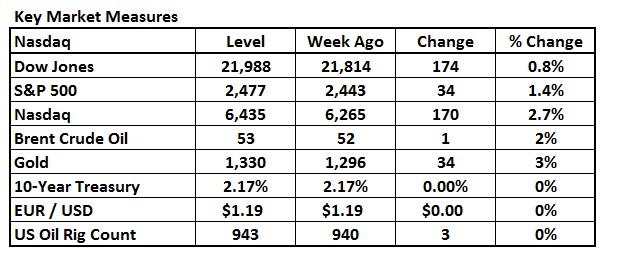
Second quarter numbers are in. The Nasdaq was up 4%, the Dow was up 3%, and the S&P 500 was up 2.6%. Not a bad quarter. So despite the Tech falloff since June 9th, the Nasdaq outshone the overall market. What will the third quarter bring? Well wouldn’t you like to know! We are not telling. We know, but aren’t telling. Well – not really. No one knows of course, but we think the Tech selloff will blow over as the FAAMG* stocks report fabulous earnings and the buying resumes.
* FAAMG – Facebook, Apple, Amazon, Microsoft and Google. Over $2.8 trillion in market cap.
Are central banks blowing bubbles? Wall Street strategists are calling attention to how central banks policies around the world are promoting inequality through Wall Street inflation coupled with Main Street deflation. In other words, the rich get richer from low interest rates spurring asset price bubbles, and the poor struggle against lackluster real economic growth. Now central banks need to quickly and painlessly undo their error. There are only two ways to cure inequality - you can make the poor richer or you can make the rich poorer. What a mess. They need to get GDP growth actually going again and normalize interest rates. So far not much progress to report.
This week we observed that the Swiss government could have issued a 50-year bond at a negative yield. Does this make any sense? If so, feel free to send us your money here at The Bull Market Report along with some interest and we are sure to be happy to hold onto it for you and return it in 50 years!
Tech titans could trigger rewrite of antitrust rules. Investors have spotted a vulnerability in the giant companies like Alphabet, Facebook, and Amazon. Since June 26 - the day before European regulators fined Google a record $2.7 billion in an antitrust case - the search giant’s stock has fallen 5%, versus a flat performance for the S&P 500. That works out to more than $30 billion in market value erased. Europe regulators have challenged the monopolistic business models Silicon Valley is printing money with. Well, stay tuned. There is a bunch of talk these tech titans will soon fight back. This may be the beginning of a big buying opportunity in Tech.
BMR Companies & Commentary
Tesla (TSLA: $313, down 11%)
After a week full of abysmal news for Tesla, the weekend couldn't come fast enough for Elon Musk. Tesla registrations in the country fell 10% in April from a year ago, based on IHS Markit data. The latest report showing a plateau for Tesla's products comes amid both investor concerns that demand for Tesla's luxury Model S sedan is waning ahead of the mass market Model 3 launch. With the sales of its Model X actually declining. Tesla may likely have to kiss its aggressive growth forecasts goodbye. Then again, they may not. There is lot going on here at the company and the future is wide open.
Tesla said that second-quarter global deliveries rose 53% from a year earlier, to just over 12,000 of the Model S and over 10,000 of the Model X. Musk blamed battery pack production problems for holding back vehicle output in the second quarter until early June, even though Tesla produced 2,000 more cars than it sold.
BMR Take: Things don’t always go right. That’s life. That’s business. But Elon Musk has been here before. This is what he does best. He solves problems. He innovates. He overcomes. It’s a controversial mood in the stock market for Tesla. But that creates a buying opportunity. While the company is losing money now, the Street consensus is for $12 in 2020, making this situation very interesting. As we have said many a time, this stock is not for the faint of heart. It could go to $250 or $200 before it goes to $400 or $500. But if you can handle the volatility, we believe it can get to $500 and beyond in the years ahead.
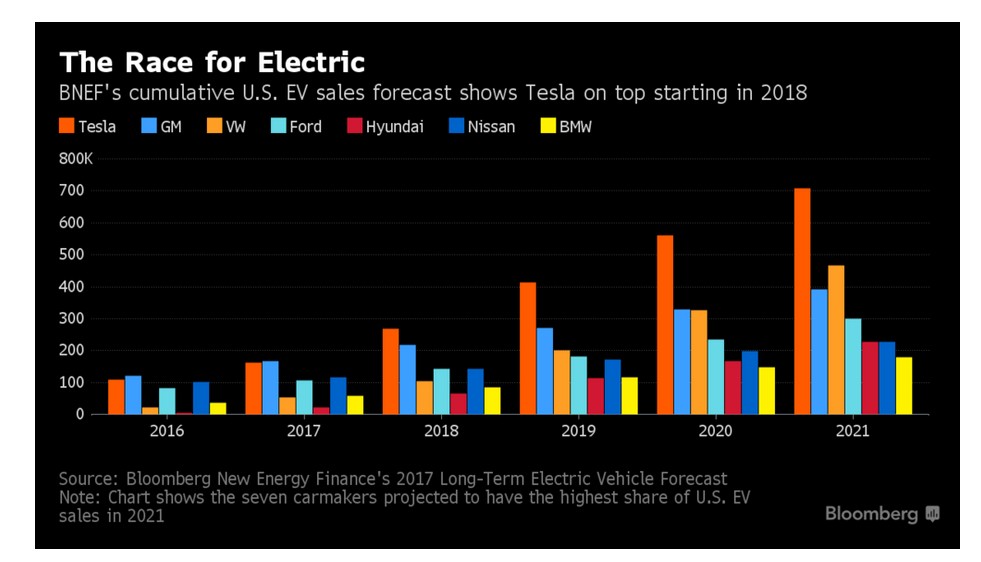
We saw a pretty good article from Bloomberg recently. The headline was “Tesla Projected to Win U.S. Electric-Car Race.” More than a dozen automakers are jostling to lead the U.S. electric-car race, but Bloomberg New Energy Finance (BNEF) sees a clear winner separating from the pack: Tesla.
BNEF expects Toyota’s Prius Prime plug-in hybrid to be the exception and hold the title of best-selling electrified vehicle in the U.S. this year. Tesla will get off to too late of a start with its Model 3 to catch up, with Musk planning to hold a handover party for its first 30 sedan customers on July 28. The company is aiming to ramp-up production to a rate of 20,000 cars per month in December.
“In the long term, we see battery electric vehicles winning because of the battery cost curve,” Bloomberg said.
Shopify (SHOP: $89, up 2%)
This past week, as you logged in to Shopify to check your sales or fulfill orders, you noticed a change: Shopify has had a makeover. The new look and feel is part of a broader effort to build the future of Shopify and supporting apps with one design mind, using the same set of guidelines. The improved design is now live in every Shopify store.
Why does it matter? Change can be hard sometimes, but these changes were actually designed to simplify the day-to-day navigation. The fresh look brings consistency across Shopify products, helps pages load faster, and makes content and menus easier to find and read.
BMR Take: Shopify is among the most exciting growth stories in the market today. EPS is expected to go from negative this year to $1.25 by 2020 starting what is expected to be a long term trail of sustainable EPS growth.
Apple (AAPL: $144, flat)
Apple has declined 7% from its all-time closing high of $156.10 in May, but the recent selloff represents yet another buying opportunity as investors turn their focus to the iPhone 8 launching this fall. Apple's quarterly results will be less important this summer as investors focus on the iPhone 8 this fall, along with the company's increased dividends and stock buybacks, lower valuation and new innovations as showcased at Apple’s Worldwide Developers Conference.
The upcoming iPhone cycle is setting up Apple to reach fresh all-time highs in the next 12 months, which would value the iPhone maker at over a trillion dollars. Apple's current market capitalization is around $750 billion. Wow!
There has long been an expectation that the next high-end version of the iPhone would have a new type of screen called an OLED (organic light-emitting diode). OLED screens boast more vivid colors and improved battery life. But they are also more difficult to produce, particularly at the levels that Apple requires for the iPhone. We believe that Apple will introduce this screen in the iPhone 8.
BMR Take: Apple remains among the most underappreciated stocks in the world. We looking at about $9 of EPS this year heading toward $11 in the next 1-2 years, giving it a forward PE of 13. Very low in our opinion.
Facebook (FB: $151, flat)
Facebook is building a village that will include housing, a grocery store and a hotel. Billions of people spend a lot of time living their lives on Facebook's social network. Now Facebook wants to try its hand at creating a community in the real world. In short, Facebook wants to build its own town.
Facebook unveiled plans on Thursday for the massive new construction project at its Menlo Park, California corporate campus, which is part of Facebook's plans to expand its home base. The 56-acre site, which Facebook bought in 2015 for $400 million, is located directly across the street from Facebook's headquarters. It will offer 1.6 million square feet of housing, or 1,500 units.
In a blog post announcing the plans, Facebook described the future development as a "mixed-use village" that will provide residents, many of which will be Facebook employees, with housing, transportation services and other amenities.
It will take roughly a decade to build. The initial phase of the project, which will include the housing and a grocery store, will be wrapped up in the first half of 2021. The subsequent phases will be completed every two years.
BMR Take: What can we take from this? The company is pretty confident in their 10-year plan and the outlook for their business to be making these kinds of internal investments. This year’s EPS of $5 is expected to double by 2020. With 2 billion users now, don’t miss being involved in this adverting giant’s success.
Mark Zuckerberg was quoted in the past week: “Give people the power to build community and bring the world closer together." Zuckerberg called the statement an extension of the company's original mission of making the world "more open and connected."
Facebook's unprecedented reach can be a powerful tool for tackling global problems and democratizing access to people and knowledge. "We feel like our responsibility is expanding, especially around passing this milestone of 2 billion people in the community," he said. "We’ve been thinking about what our responsibility is in the world and what we need to do."
We’re with you, Zuck!
PayPal (PYPL: $54, flat)
PayPal launched a campaign to reward freelancers in India. PayPal India has launched two new campaigns - Shopping Buddy and Go Global. The new campaigns will encourage Indian consumers and freelancers to buy and sell across outside of the country. Both campaigns will work on the concept of referrals. Available in more than 200 markets around the world, the PayPal platform, including Braintree, Venmo and Xoom, enables its over 200 million users to receive money in more than 100 currencies, withdraw funds and hold balances in their PayPal accounts.
Why did PayPal design the campaigns specially for the Indian market? India is the 2nd largest freelancer market outside of the US. India is also a hub for software exports, hence software and web related services constitute a significant portion of the freelancing business. Additionally, skilled women who have taken a break from their careers to manage the household, and retired professionals also contribute to this growing number in India.
BMR Take: PayPal is quietly emerging as a global payments power. India is so important to winning this battle and the above news is a great step in the right direction and a demonstration of the company being locked in on what needs to be done. With greater than 20% EPS growth as far as the eye can see, how can you not be involved here?
Square (SQ: $24, up 1%)
Payment-processing stocks had a hot week after a $10 billion deal between two industry players was announced. The news that Vantiv was buying London-based Worldpay for $10 billion has investors suddenly thinking about other combinations. Square shares rose 4% on Wednesday as result and finished the week strong.
For Square investors, consolidation in the payments industry is encouraging, because it means the fast-growing company could also be thought of as an acquisition target. PayPal is a much larger company than Square, with a market value of $66 billion, compared to $9 billion for Square, and it’s less likely a target. In fact, it’s a company that likes to acquire.
However, you look at it, the market is quickly realizing that the world is migrating to eCommerce and Square is as best-positioned as anybody.
BMR Take: Square is currently growing revenue at a 30% clip. Takeout valuations could be anywhere over a 20% premium to the current stock price. A compelling opportunity.
Upcoming Economic News
Consumer Credit SA
Monday, July 10, 3:00 PM
Period: MAY
Actual: N/A
Consensus: $13.3B
Prior: $8.2B
Note: Federal Reserve Statistical Release G. 19, Consumer Credit, reports most short- and intermediate-term credit extended to individuals, excluding loans secured by real estate.
JOLTS Job Openings
Tuesday, July 11, 10:00 AM
Period: MAY
Actual: N/A
Consensus: 5,975K
Prior: 6,044K
Note: Part of the US Bureau of Labor Statistics, the Job Openings and Labor Turnover Survey (JOLTS) program produces a monthly study that has been developed to address the need for data on job openings, hires, and separations. With the release of May 2003 data, the JOLTS program began publishing industry estimates based on the North American Industry Classification System (NAICS).
PPI ex-Food & Energy
Thursday, July 13, 8:30 AM
Period: JUN
Actual: N/A
Consensus: 0.10%
Prior: 0.30%
Note: The Producer Price Index (PPI) for all items less food and energy, often referred to as Core PPI, excludes the two most volatile components of the overall PPI for Finished Goods.
Manufacturing Production M/M
Friday, July 14, 9:15 AM
Period: JUN
Actual: N/A
Consensus: 0.10%
Prior: -0.39%
Note: Manufacturing production index measures real output in manufacturing. According to the NAICS, manufacturing relates to the mechanical, physical, or chemical transformation of materials, substances, or components into new products. Data is percentage change in relation to the last month.
An Update on Government Properties Income Trust (GOV: $17.90, down 2%)
This is what we said a week ago Wednesday, June 28th:
“First Potomac Realty Trust (FPO) is being acquired in a $1.4 billion deal announced today. The stock of Government Properties (GOV) is down 7% this morning to $20.25. First Potomac is a REIT with 11 million square feet of office space in and around Washington, DC. Government Properties, at a market cap of $1.4 billion, will now have an opportunity to prove its worth and assimilate the properties. This is creating a buying opportunity if you believe that management can turn around this company We believe they can and would be buyers of the stock here at the $20 level.”
Then last week we wrote this:
“Government Properties Income Trust (GOV: $18, down 19%)
“Don’t fall over in your chair! The stock got crushed this week, but it was because of an acquisition. Let us explain.
“First Potomac Realty Trust (FPO) will be acquired by Government Properties. To finance the deal, the company sold 25 million shares in a secondary at $18.50, raising over $450 million. They had to knock the stock lower to get the funds they needed. This is typical. We believe the deal will work out well, and that we will see a full recovery and then some.
“And the underwriters have been granted a 30-day option to purchase up to an additional 3,750,000 common shares. Two things: These overallotments are exercised about 99% of the time so expect to see another $65 million of cash in the bank. And expect to see the stock stay around this level for a month. Then there is a great likelihood that the stock will move back into the low 20s.
“You should be excited. The acquisition of First Potomac Realty Trust enables Government Properties to expand its business strategy to include the acquisition, ownership and operation of office properties leased to both government and private sector tenants in the metropolitan Washington, D.C. market area. The metropolitan Washington market area is one of the largest office markets in the U.S. and the nation’s largest beneficiary of spending by the U.S. government. Outside of the metropolitan Washington market area, Government Properties will continue to focus on acquiring, owning and operating office properties that are majority leased to government tenants.
“In addition to this transaction providing Government Properties with new potential growth opportunities, management expects to realize approximately $11 million of annual general and administrative expense savings compared to First Potomac Realty Trust on a standalone basis.
“Management is very pleased that they were able to achieve an attractive per share purchase price. Their preliminary estimates call for meaningful accretion and more detail will be forthcoming.
“BMR Take: NAV was $20.90 prior to raising some equity at $18.50. We don’t see any reason for the stock to trade at a discount to the lower level of $18.50. This is a buying opportunity for sure. Why do you think institutional investors just took down 25 million shares at $18.50? Get on board and put new money to work at a 9.4% yield right here in this name!”
Here’s our Take this week:
There have been no changes in the situation since the announcement. The stock is down 2% this past week, which is just noise, but we see that the stock has stabilized here at the $18 level, and in our opinion the only move the stock can make from here is up. The stock is paying a 9.6% dividend which is a bit too high historically, and thus a higher stock price will lower the dividend to the 8-9% ranges which we believe is quite sustainable. We are holding here and await the move back to the $20 level in the next few months.
A Word from Gary Jefferson
Jefferson Financial Group
First Vice-President, Investments
UBS Financial Services, Inc
An old stock market adage is "Calling a market top is a fool's errand." A Wall Street research firm wrote last week that calling a market top in today's market is just such a fool's errand because there is simply too much empirical evidence against it. First, the employment picture is pretty good from the standpoint of new jobs creation. (Of course, "if" new job numbers begin to substantially decline, it would be a red flag). Secondly, the latest Consumer Confidence Board report topped expectations. This indicates that consumers (70% of our economy is consumerism) are going to continue to consume. This is the engine that drives earnings. Lastly, the usual red flags that signal a major top just aren't visible – things like an inverted yield curve, a major technical breakdown (Nasdaq plunging below its 50 or 100-day moving averages), or, on a global basis, a major event such as a default by Italy or an economic collapse in China.
This is by no means to say that the market won't have a "top" in the sense of a "10% correction". It can happen even when nothing has really changed the fundamentals of the corporate earnings picture or for no real reason except media-hyped panic. There are many things happening in the market today that historically signal the possibility of a pullback in the 3-7% range. But long-term investors don't sweat the small stuff. It just isn't worth the aggravation and mental stress to try to time market corrections other than to possibly raise a little cash or to have some ready cash available to buy the dip. This is because it is nearly impossible to exit a stock, watch it drop 10% and then get back in before it jumps back up 5% before the opening bell one morning. It is literally impossible for anyone to successfully employ this kind of strategy.
The greatest risk ahead now seems to be what happens in Washington over the next few months, which is unfortunate. These events could either cause a market melt-up or a worse than average pullback – neither of which is predictable. Regardless of current conditions, in 90% of any market environment it makes sense to dollar-cost average large cash positions over several months as opposed to going all-in. That's because (quoting Ben Bernanke), "…….the 'market' is a very difficult subject. I've compared it to trying to learn how to repair a car when the engine is running…." It is difficult, but a long-term investor who is diversified and in quality assets will be just fine.
The High Yield Corner
By Michael Foster
Special to The Bull Market Report
The week was a bit harsh to many high yield investments, but a quick glance at The Bull Market Report picks shows that this is the result of a weak and temporarily frightened market The fundamentals, however, remain as strong as ever.
Starting with REITs, we saw Welltower (HCN: $73) fall 2% for the week, with those losses occurring almost entirely on Thursday. The marketwide weakness we saw did not leave REITs alone, so the decline was particularly pronounced here. However, Welltower shareholders should not despair; they’re up 9% year-to-date including the current near 5% dividend yield thanks to a dividend increase earlier this year. And dividend increases are very likely to continue. Over the last 12 months, Welltower has earned Funds from Operations (FFO) of $4.45, which gives the company a 130% dividend coverage ratio. As a rule of thumb, anything over 120% in REITs is healthy and anything over 125% indicates that the current schedule of dividend increases is likely to continue. For Welltower, that means a once-yearly pay raise is likely to continue.
This is a pretty big relief because higher borrowing costs in recent months have not been offset by higher rents for many REITs. That’s caused a lot of panicked selloffs throughout the sector, and Omega Healthcare Investors (OHI: $32) is no exception. The stock has been pretty heavily range bound after falling significantly in late 2016 - it's down 5% from a year ago - as it has been several times in 2017. Fortunately, the stock is up 3% from the start of the year so the bearish trend is clearly over even if we haven’t seen a breakout.
The interesting thing with Omega Healthcare is that investors frequently fret over the company’s dividend coverage. Omega’s management increases the dividend by a penny per share every quarter - and that is attractive to shareholders while also threatening the dividend coverage ratio. The only way Omega can cover those higher payouts is to aggressively expand. That causes frequent panics and a lot of anxiety, but a quick look at the numbers shows how silly those worries are. For the last four quarters, Omega’s FFO of $3.45 is far above the $2.50 annualized payouts at the current dividend rate and still higher if we assume penny-per-quarter payouts for the next four quarters. Either way, we’re talking about a dividend coverage ratio in excess of 130%, indicating that the dividend is absurdly safe despite the 8% yield that the stock currently offers.
In addition to the dividend payout growth fears, Omega has suffered from worries about uncertainty in Healthcare and the future funding of Medicare. Of course, Omega isn’t the only REIT suffering from this concern. Sabra Health Care REIT (SBRA: $23) fell 4% in the last week at a much higher rate than the marketwide decline in REITs. Fortunately, however, Sabra has been doing extremely well for a long time, meaning this selloff has little significant for long term shareholders. The stock is up over 12% from a year ago excluding its 7% dividend payout. And, as with Omega, the dividend is being covered by strong FFO - over the last 12 months the dividend coverage ratio for Sabra has been 130%, which is extremely solid, as with Omega. But investors fret over politics more often than they should, meaning Sabra isn’t getting the buy-in from investors that it deserves. That will change when the market goes back into risk-on mode*.
* When the market goes back to having an appetite for things like growth stocks, junk bonds, and REITs, instead of plowing into Treasuries.
Finally, Ventas (VTR: $67) is The Bull Market Report’s third Healthcare REIT pick that is known for its longer history and reliable dividend payments. As such, its yield is 4.6% following the near 3% price decline for the week. But as with our other Healthcare picks, Ventas is up for 2017 - up a solid 7% since the start of the year. The panicked Healthcare REIT selloff of late 2016 has been correcting itself in recent weeks and that is likely to restart again in the future as soon as this week’s hysterical fear ceases. No one knows when that will come, but it surely will; we’ve seen the market freak out suddenly several times since President Trump’s election, but the selloffs tend to be very brief and very shallow.
An interesting question to ponder is how this selloff and fear-based selling impacts municipal bonds, a safe haven for risk-averse investors. So far, 2017 has been pretty good for the asset class after a brutal 2016 selloff thanks to risk-hungry investors shifting to stocks. So far for the year, Invesco Municipal Trust (VKQ: $12.69) is up 4% - but the stock is still down 10% from a year ago. That gives the fund plenty of room to run in 2017, especially when we consider the fact that the fund is trading at a 6% discount to its net asset value. Similarly, Nuveen Municipal (NVG: $15.15) is up 5% for the year but is down 7% from a year ago. Like the Invesco fund, this is trading at a 6% discount to its NAV, providing another opportunity for gains as the market gets more excited about municipal bonds as a viable and lower-risk alternative to stocks and Treasuries, especially given the extra value that late 2016’s selloff provided. We are at the beginning of a trend in that direction, and it is likely to continue for quite some time.
Good Investing,
Todd Shaver
Founder, CEO and Editor
The Bull Market Report
June 4, 2017
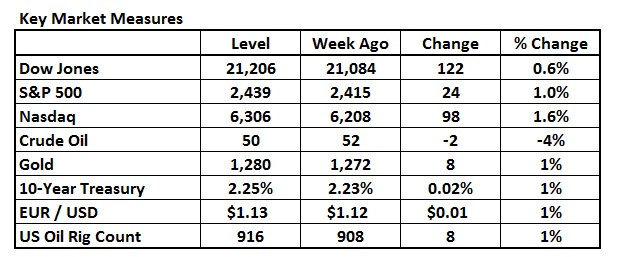
by Todd Shaver | Jun 4, 2017 | Weekly Newsletter 7pm Sunday
The Week Ahead
Skepticism mounts for a post-June rate hike at the Fed. While Janet Yellen and her Federal Reserve colleagues are poised to raise interest rates at their meeting this month, investors increasingly doubt the central bank’s projection for additional hikes following soft reports on U.S. employment and inflation. Goldman Sachs pushed back its forecast for a third rate increase this year to December from September. Investors are now pricing in less than one rate hike in 2018 for the first time since the eve of the U.S. elections in November. What does it all mean? As long as the Fed is accommodative with low interest rates, we see the bull market continuing.
There is always a bull market here at The Bull Market Report! This week we highlight the following stocks: Nutanix, VMware, Microsoft, Tesla, Tesoro and Splunk.
Highlights From The Past Week
"It's Not Just Wages" - Workers Without College Degrees Face "More Instability" If you believe San Francisco Fed President John Williams, the US labor market has almost never been more robust than it is today. Of course, middle- and working-class Americans who are struggling with levels of financial uncertainty that would be unfamiliar to their parents’ generation don’t necessarily care that the official unemployment rate is 4.3%. They’re too busy struggling to make ends meet when real wages have been stagnant for decades and economic growth is expected to slouch along at 2% for the foreseeable future. While researching their new book “The Financial Diaries,” Jonathan Morduch and Rachel Schneider followed more than 200 working and middle-class families around for a year and tracked “every dollar of their financial lives." They found that millions of workers without college degrees, especially those who are paid hourly, or who are paid by commission, experience what they call “income variability” - when their pay fluctuates by 25% above or below their average. Perhaps some of us can relate to facing "income variability" challenges, which is why you look to The Bull Market Report for good investment ideas to help supplement your future financial plans.
Stockman Warns Trump "Not a Chance of Reaching 4% Growth" Stuart Varney, the Fox Business economic host, recently interviewed David Stockman, the former Director of Office of Management & Budget under Ronald Regan. Stockman said that, during Reagan’s tax cut policy ranging from 1983 until Reagan’s exit in 1989, the U.S economy grew at an annual rate of 4.8%. However, he went on to say that there is no way we get to that level under Trump. To do so will require Trump-style inflation first, or “Trumpflation”. Doing so might not even be a good idea, he reminded the audience, by pointing out that Reagan’s greater than 4% growth was followed by a massive and deep recession in 1991 and 1992.
Central Bank Cash Flood Spurring Borrowing The good news for investors is that riskier assets will probably keep rallying in the near term. Companies and consumers have substantially boosted their leverage in the past few years as central bankers worldwide flood the market with cash to suppress borrowing costs. Though one thing to watch out for is lower recoveries in the future. In other words, companies and consumers that eventually become insolvent will have fewer assets available to repay their growing mountain of obligations. This is already happening on a small scale in the U.S. Auto industry, which has been suffering recently from falling sales and lower used-car values. Consumers borrowed more money than they could repay to buy new cars and trucks and are now defaulting on those loans at an increasing pace. Ultimate recoveries have declined to levels not seen since 2009.
BMR Companies & Commentary
Note: We would like to reiterate a part of our philosophy of investing here at The Bull Market Report. First of all, we primarily pick and follow stocks from this country. We don’t really have any great interest in Chinese companies. There are a few exceptions, but there are plenty of stocks to look at in this country, without worrying about what’s happening in Europe or Asia.
OK, on to the BMR Company section.
Nutanix (NTNX: $18.58, -5% - net changes in this newsletter are for the week)
Nutanix is a United States-based company that is an enterprise cloud platform that converges servers, virtualization and storage into an integrated solution.
Dheeraj Pandey, founder, chairman and CEO of "hyper-converged" technology vendor Nutanix is going up against all the old guard of tech, including Cisco. Hewlett Packard, Dell and VMware. He is undaunted, explaining his views on how companies and people evolve to new circumstances. He was recently interviewed and some of the excerpts are below.
Will Nutanix ever go all software? Is there are time when Nutanix will be all software, and stop making its own hardware appliances? Not anytime soon, he suggests. "Customers want a consistent experience, and the appliance will always be important for us. So, it’s very early to say that, for at least the next three to five years, it’s still an important part of our strategy” to have hardware. One reason is that some customers might want a “low-end” appliance. Pandey has noticed that other companies that were all software stumbled when they tried to meet such demands because it hit their high profit margins. “It’s about how we use the software gross margins to do a better job,” he says. "Oracle has done a good job of this, with their appliances. They started in software, and for us it’s the other way around. But think about how our software balances out the total company profit."
What about cloud computing? Doesn’t it constrain Nutanix’s growth? Not in Pandey’s view. In fact, he quickly rattles off the figures about Amazon’s AWS cloud service that he has committed to memory. When it was at $8 billion in annual sales, it was growing 84% per annum. When it reached $13 billion the slowed to 43%. "At $30 billion annually, they will be maxed out,” he says. "When we started this company, combined we had a $35 billion incumbency we were up against,” he says, referring to Cisco, privately held Dell, EMC, and the many other enterprise companies. In other words, $30 billion of AWS is not unlike the $35 billion of entrenched vendors Nutanix has already taken on. Then he adds, "What is the overall TAM [total addressable market] of computing? It’s about $215 billion, between servers and storage and networking. But OPEX [operating expenses] is over $400 billion annually." “So, it's more than a $600 billion market that needs to be addressed."
BMR Take: We feel Nutanix is undervalued, trading at 2.6x the consensus 2018 estimated sales forecast with Nutanix growing revenues 52% faster than peers.
VMware (VMW: $95, -2%)
Founded in 1998 and headquartered in Palo Alto, CA, VMware is the leading provider of virtualization solutions. Its virtualization solutions separate the operating system and application software from the underlying hardware, resulting in improvements in efficiency, availability, flexibility, and manageability, while lowering IT costs. In recent years, VMware has expanded beyond virtualization to include Software-Defined Data Center, Hybrid Cloud Computing, and End-User Computing.
The company reported strong F1Q18 results, with EPS of $0.99 (consensus $0.95) on revenue of $1.74 billion (consensus $1.71 billion) and also raised guidance for the year.
Overall, a number of things are going well for VMware, including: 1) its new products like NSX and vSAN, which grew license bookings 50%+ and 150%+ y/y, respectively; 2) its partnership with Dell, which is beginning to yield revenue synergies; and 3) perhaps most interestingly, the VMware Cloud on Amazon Web Services (AWS) seems to have relieved CTOs of some cloud transition anxiety and unlocked spending on VMware solutions.
In terms of the tech spending environment overall, CEO Pat Gelsinger made two key points. First, he simply said, “From the macro sense, we feel good.” Second, he argued that VMware is a beneficiary of the concept of digital transformation. In particular, as “every business is becoming a tech business,” VMware is “uniquely positioned to benefit from many of those trends” with its cloud offerings and software-driven offerings.
VMware said that it “made great progress with Dell this quarter.” In particular, Dell “grew well and performed a bit better” than VMware had expected in F1Q18. Management cited a number of key product areas that are benefiting from that partnership. In addition, VMware expects roughly $250 million of the $1 billion of revenue synergies from the partnership to be materialized in FY18.
BMR Take: We see VMware as a compelling value trading at just 18-19x the consensus 2018 earnings of $5.25, compared with $4.75 for 2017. Fundamentals are strong, revenue growth is in double-digits, and the new partnership with Dell brings excitement and much promise.
Microsoft (MSFT: $72, +3% - a new all-time high)
Microsoft is an American multinational technology company headquartered in Redmond, Washington, that develops, manufactures, licenses, supports and sells computer software, consumer electronics and personal computers and services. As we all know!
[Follow us here closely, as this discussion is about to get technical.] Microsoft Azure is a growing collection of integrated cloud services that developers and IT professionals use to build, deploy, and manage applications through the company’s global network of datacenters. With Azure, customers get the freedom to build and deploy software, using the tools, applications, and frameworks of the their choice. Azure modernizes IT applications. [For those of you more technically savvy folks, below is some of the specifics on how. For those of you who are bored by this, skip down to BMR Take, below.]
Microsoft will soon be delivering the Azure Stack capabilities that will provide Azure cloud services to customer and partner data centers. Combining current Azure cloud capabilities with the Azure stack will position Microsoft as the market leader in true hybrid platform and solutions which meet customers where they are, based on their current cloud adoption maturity. This hybrid approach translates into increased Microsoft hybrid platform adoption regardless of their current cloud maturity but more importantly secures an organization's future modern IT growth on the Microsoft hybrid platform.
A key reason Microsoft can leapfrog competitors is that its hybrid solution will allow customers to maintain their current Microsoft investments (e.g. platform, identity, infrastructure, tools, and resource skills) and extend their IT experience across cloud, hybrid, and on-premise.
It also overcomes connected and disconnected scenarios and data sovereignty limitations that limit many customer’s abilities to develop modern IT applications and accelerate their movement to hybrid models that best meet their risk and data requirements. Also, most Azure marketplace solutions will work on Azure Stack without modification driving more ISVs to promote their cloud-only offerings to on-premise opportunities expanding their potential revenue stream.
A key driver for Azure Stack adoption will also be the hardware and chip companies that can sell a full solution combining their hardware and Microsoft services for on-premise solutions. This will incent hardware manufacturers like Intel, HP, Lenovo to promote an Azure stack solution to maximize their hardware margins. It will also increase Microsoft hybrid adoption by customers driven by hardware partners.
Microsoft is best positioned to maintain its current on-premise customer base and to accelerate further Microsoft Azure adoption through unified development and operations capabilities and by Hardware and Cloud Software providers that want to take advantage of on-premise scenarios.
BMR Take: Microsoft Azure is one of the best assets in cloud technology and is fueling a new wave of growth for the company. While Microsoft is at all-time high, set Friday, the valuation of just 18x the ability to generate $4 of EPS with healthy dividends and buybacks, culminates in what we believe to be a compelling value.
Splunk (SPLK: $63, flat)
Splunk is an American multinational corporation based in San Francisco, that produces software for searching, monitoring, and analyzing machine-generated big data.
Splunk sold off quickly following Q1 earnings 10 days ago. However, most of the Q1 metrics in terms of revenue, billings and operating cash flow were solid. Furthermore, the revenue guide for Q2 and 2018 were raised a bit relative to consensus. The negative reaction towards Q1 results stemmed from License revenue and current product billings metrics that were soft and were attributable to Cloud revenue contribution and Europe region revenue under-performance.
The European results may have been related to deal-timing issues. Field contacts indicate that demand generation events have been well attended by prospects and sales activity in that region has been robust. Nevertheless, the shortfall in Q1 is going to necessitate that Splunk make organizational changes to get that region back on track.
Post Q1 checks indicate the Cloud business continues to enjoy momentum. AWS established a Quick Starts deployment option for Splunk this past February which could facilitate additional business on the AWS platform. Splunk continues to get tremendous leverage from the AWS platform.
Splunk has over 745 active partners globally, and the company wants to grow that number carefully, as we have seen other IT Security vendors suffer from being over distributed.
BMR Take: After a strong performance in the seasonally weakest quarter of the year, we would be buyers of Splunk on any weakness. Despite more than tripling revenue between FY:2014 to FY:2017 and consistently beating analyst expectations, the stock is 37% below the peak made in 2014. Now is a great time to take a closer look if you have not already.
Upcoming Economic News
United States - Total Light Vehicle Sales
Sunday, June 4 8:00 PM
Period: MAY
Actual: N/A
Consensus: 17.0M
Prior: 16.8M R
Unit: Millions of Vehicles
Institute for Supply Management (ISM) - Non-Manufacturing
Monday, June 5, 10:00 AM
Period: MAY
Actual: N/A
Consensus: 57.0
Prior: 57.5
Unit: Index
Notes: The Non-Manufacturing ISM Report on Business is based on data compiled from monthly replies to questions asked of more than 370 purchasing and supply executives in over 62 different industries representing nine divisions from the Standard Industrial Classification categories. A reading above 50 indicates that the non-manufacturing economy is expanding; below 50, that it is declining.
JOLTS* Job Openings
*Job opening and labor turnover survey – Janet Yellen’s favorite
Tuesday, June 6, 10:00 AM
Period: APR
Actual: N/A
Consensus: 5,725K
Prior: 5,743K
Unit: Thousands of Units
Notes: Part of the US Bureau of Labor Statistics, the Job Openings and Labor Turnover Survey (JOLTS) program produces a monthly study that has been developed to address the need for data on job openings, hires, and separations. With the release of May 2003 data, the JOLTS program began publishing industry estimates based on the North American Industry Classification System (NAICS).
Consumer Credit
Wednesday, June 7, 3:00 PM
Period: APR
Actual: N/A
Consensus: $15.0B
Prior: $16.4B
Initial Unemployment Claims
Thursday, June 8, 8:30 AM
Period: 6/03
Actual: N/A
Consensus: 240K
Prior: 248K
United States - Wholesale Inventories
Friday, June 9, 10:00 AM
Period: APR
Actual: N/A
Consensus: -0.3%
Prior: -0.3%
Notes: The Monthly Wholesale Trade Survey provides monthly estimates of sales and inventories of wholesale trade industries. .
A Word from Gary Jefferson
Jefferson Financial Group
First Vice-President, Investments
UBS Financial Services, Inc.
Well, finally, the market broke out and set a new all-time high, with the Dow closing above 21,200. This was despite some concerning bad economic news. New Home Sales for April fell 11%. The Richmond Fed Manufacturing Index for May fell off a cliff. The headline number declined from 20.0 to 1.0 and it was the first time in five months to be in single digits. New orders fell from 26 to zero. Order backlogs dropped from 4.0 to -15. The shipments component fell from +25 to -1. This suggests the post-election optimism in manufacturing sector is crashing. Another troubling component was shopper traffic that fell from 27 to 7 and expected demand fell from 96 to 73. Inventories fell from 24 to 1.
As we have said repeatedly, earnings fundamentals, of course, are ultimately the key in determining the price or value of a stock. Numerous research articles have shown that companies receiving upward earnings estimate revisions outperform the market while companies receiving downward earnings estimate revisions underperform the market. That's pretty much just plain old common sense. The fact remains that earnings estimate revisions are still the most powerful force impacting stock prices. Therefore, earnings, not other economic data, carried the day. Earnings are going to be the key that determines where the market ends up this year – i.e., they need to stay on track for the market to remain above 2400 and continue to move higher (2436 now.) And there was some good news to counter the weak numbers listed above which was found in the most recent GDP numbers:
GDPNow released it estimate at +3.7% for Q2 estimates and the Blue Chip economist consensus was at +3.1%. After eight years of sub 2%, these are very good numbers.
There are a couple of questions which need answering in order to get more clarity on the future of earnings. These include:
1) How many rate hikes will we get this year? Most analysts expect two more. The bigger question may be what the Fed will do to its balance sheet – if they decide to reduce it, this could create some issues for earnings and stocks.
2) Are current earnings growth estimates without a tax cut already priced into today's market? We think so. The question is raised whether tax cuts are still even possible or whether Trump's pro-growth agenda is completely derailed by a dysfunctional Congress caught up in all the political drama. It still seems to us that the market wants tax reform and wants the economic stimulus that will be provided by tax cuts, repatriation and infrastructure programs. As long as these things are still possible, we think the market will grind higher.
And, there are always the wild cards of 1) oil prices 2) an acceleration in the recent bond rally (bonds still compete with stocks) and 3) the overall world economy, in particular China. The bottom line at this juncture: The market is still signaling that it expects the current expansion to continue.
More on VMware (VMW: $95, down 1%)
VMware set a new all-time high on Thursday at $98 before settling a bit on Friday in a calm market. Here’s an update.
There are 34 Wall Street analysts that follow the stock:
18 Hold Ratings, 16 Buy Ratings
Targets:
5/31/2017 Royal Bank of Canada $110
5/31/2017 Robert W. Baird $115
5/25/2017 Cowen and Company $98
What are analysts saying about VMware stock?
Here are some recent quotes from research analysts:
"VMware’s revenues continue to register strong growth driven by its innovative product offerings. The company continues to benefit from its strength in the virtualization and hybrid cloud market. Its innovative product pipeline, strategic partnerships, frequent contract wins and robust international sales are expected to drive overall results.”
Drexel Hamilton: "VMware delivered a better than expected 4Q16 and we are pleased with the outlook for FY18. Moreover, VMware authorized an additional $1.2 billion stock repurchase program. As such, we are raising our price target to $105 from $90 and reiterate our BUY rating."
Robert W. Baird: "VMware posted a good Q4 and F18 guide. Its public cloud strategy is actually beginning to make sense, and we believe Dell has a better chance of driving revenue synergies than EMC.”
Jefferies Group: "Midway through an earnings season when many infrastructure software companies either reported soft results, guidance, or both, VMW reported one of its best quarters in years and gave very strong guidance that easily exceeded expectations.”
Note that VMware's management team includes the following:
Michael S. Dell, Chairman of the Board
Patrick P. Gelsinger, Chief Executive Officer, Director
Zane C. Rowe, Chief Financial Officer, Executive Vice President
Ownership of the company.
VMware's stock is owned primarily by Dell Technologies at 82%.
VMware declared that its board has authorized a share repurchase program in April, which allows the company to repurchase $1,2 billion in shares.
Cash and Debt
The company has $8 billion in cash and just $1.5 billion in debt. We like these numbers.
BMR Take: VMware is a fabulous company and we are seeing the rewards of the past few years as the company continues to tweak its business model and management continues to improve. With Michael Dell in control now, we expect even bigger things in the future. We wouldn’t be surprised if he decided to buy out the small interest in the company that he doesn’t already own. We added the stock at $83 and our Target is $95. The stock shot through our target recently so we hereby raise our Price Target to $108, and our Sell Price to $90 from $80. With the bull market continuing we expect to see the Target reached this year.
Tesla CEO and the Paris Climate Accord
Elon Musk had vowed to leave President Donald Trump’s advisory councils if the president were to pull the U.S. out of the Paris climate accord. Tim Cook of Apple placed a call to the White House on Tuesday with the same message. 25 companies, including Intel and Microsoft, have signed on to a letter that ran as a full page advertisement in the New York Times and Wall Street Journal on Thursday. A television ad ran Wednesday showed CEOs of top U.S. companies backing the pact.
To many of Musk’s fans, it’s about time. The accord was decades in the making, involving more than 200 nations representing almost the entirety of humanity.
He said Wednesday via Twitter before the announcement on Thursday:
“Don’t know which way Paris will go, but I’ve done all I can” to convince Trump to stick with U.S. commitments made under his predecessor, Barack Obama. Asked what he’d do if Trump decides to leave, the chief executive said he “will have no choice but to depart councils.”
Well, guess what? Trump ruled that we leave. Musk stuck to his word and left.
Tesla Motors (TSLA; $340) had another amazing week on Wall Street. The stock was up 5% to a new all-time high set Thursday. The company is worth $56 billion now.
The founder of Tesla and SpaceX angered many of his supporters earlier this year when he started meeting with Trump and joined the president’s business and manufacturing advisory councils. Some customers even canceled their $1,000 reservations for Tesla’s upcoming Model 3 electric car and posted their refunds on Twitter. Musk continued to advise Trump even as Uber CEO Travis Kalanick succumbed to similar pressure to step down. Musk insisted that it was his chance to ensure the president was hearing from people who take the threat of climate change seriously. Obviously, Trump doesn’t listen to the top minds of the world.
The only nations that haven’t signed on are Nicaragua and Syria.
Tesoro (TSO: $84.50, up 1%)
Tesoro is an independent petroleum refining, logistics and marketing company. The Company operates through three segments. The Refining operating segment refines crude oil and other feedstocks into transportation fuels, such as gasoline and gasoline blendstocks, jet fuel and diesel fuel, as well as other products, including heavy fuel oils, liquefied petroleum gas and petroleum coke for sale in bulk markets to a range of customers within its markets. The Logistics segment includes crude oil and natural gas gathering assets, natural gas and natural gas liquids processing assets, and crude oil and refined products terminaling, transportation and storage assets acquired from third parties. The marketing segment sells transportation fuels through branded and unbranded channels.
On the Street there are 19 firms that follow the stock.
There are 3 Hold Ratings and 16 Buy Ratings
Here are the Targets that a few firms have on the stock
5/30/2017 Morgan Stanley $110
5/19/2017 Credit Suisse Group $100
4/27/2017 Royal Bank of Canada $98
4/22/2017 Citigroup $104
4/19/2017 Jefferies Group $94
BMR Take: We’ve been saying for quite some time now that Tesoro is undervalued. But it’s been frustrating waiting and waiting. As you can see above, the Street has a strong following and high hopes for the company. Our Target remains at the high end as well at $110.
The Weekly High Yield Corner
By Michael Foster
AstraZeneca (AZN: $35, up 4%) had another strong week to help the stock reach a 52-week high, bringing the stock’s 1-year return to 18% excluding dividends. AstraZeneca has been an interesting company for a while, because it suffered both from market worries about pharmaceutical regulation and worries about British companies following Brexit. Both concerns have so far failed to materialize, with both the British economy showing consistently strong numbers and threats of pharma regulation having little bite in a Trump administration.
Instead, pharma is having something of a renaissance. FDA drug approvals have doubled from a year ago. At the same time, AstraZeneca’s pipeline is looking extremely strong. The company has unveiled new products on top of three recently released cancer-fighting drugs, bringing the firm halfway to its 2020 target to release six new medications for a variety of cancers. Ovarian cancer and lung cancer drug studies are so far looking good, with new drugs in Phase 2 and Phase 3 testing. That indicates a continually strong pipeline.
That, in turn, has made the stock more expensive in more than one way. Not only is the price up, but the stock’s PE ratio has risen to over 26. With new drugs in the works, this higher valuation is not unsurprising. It also means that Bull Market Report readers who bought this stock when it was down big got in at a much better valuation and are now better positioned to profit from the future earnings that drug pipeline will deliver.
Our Target has been $37 and our Sell Price has been $29. We raise both to $42 and $32 respectively. The all-time high of $39 set in 2014 is within reach.
More diversified Bull Market Report picks had a less strong but still good showing in the last week, with Invesco Municipal Trust (VKQ: $12.80) and Nuveen AMT-Free Municipal Credit Income Fund (NVG: $15.15) rising over 1% each in the last week. These funds are still delivering a 5%+ tax-free income stream and have delivered modest capital gains since the start of 2017. Both are also offering modest discounts to their net asset values (i.e., the value of the total assets in the fund if sold at market price and immediately distributed to shareholders).
Since Nuveen’s early 2017 dividend cut, the fund’s net investment income has been exceeding distributions on average and the fund is clearly better positioned to have a more sustainable dividend payments in the future. In fact, many municipal bond funds, following dividend cuts in the last five years or so, have been showing greater dividend sustainability in recent months. Why is this? Well, in part it’s because of the weakness in municipal bond markets last year. When muni bond prices go down, their yields rise, and that is actually a good thing for municipal bond funds like these. At the recent higher interest rates paid by already-issued municipal bonds, these funds can buy more aggressively by increasing leverage and/or by buying higher yielding bonds after older bonds in the portfolio are called away or expire. Since both the Nuveen and Invesco funds have loaded their portfolios with lower-duration municipal bonds (that is, bonds that expire in the next 3-4 years) over the last half decade, they have been in a prime position to buy more bonds.
If this sounds complicated, rest assured: These guys know what they’re doing. Nuveen and Invesco have seen their bond funds attract significant capital this year. They have the market experience and knowledge to take advantage of the recent weakness in the municipal bond market.
Now let’s talk REITs. We have been recommending Omega Healthcare Investors (OHI: $31) for a long time, which is why the early 2017 bump in the stock was a welcome sign that the market had caught on to our point of view. In fact, in April and May we came across several articles on various websites pounding the table on Omega Healthcare, arguing that demographic tailwinds, a sound and growing income stream, and an absurdly cheap valuation made this a great stock to buy.
We couldn’t agree more, as we have been saying this for over a year. And at the start of 2017, it seemed the market as a whole had accepted this way of thinking. Then, in the last few weeks something odd has happened with Omega. On May 25, the stock tanked for no clear reason. Again, exactly a week later, the stock tanked again - but recovered slightly to end this past week flat. After all of this, the stock is down over 3% from a year ago excluding dividends that yield 8% at the current price (and note those dividends have gone up every quarter). So no one who owns Omega should be crying just yet. In fact, it would make sense to buy at these current levels. The stock remains very well-valued considering its recent funds from operations report (think of it as EPS for REITs).
Elsewhere, we’ve seen Digital Realty Trust (DLR: $120, up 2%) continue to soar. The stock is now up over 21% year to date. That sounds like a heady number, but keep in mind that the stock was up a similar amount from the year before that. Why? We’re anniversaring the big REIT run-up of 2016, which was both great for Digital Realty and something of a curse in the late months of the year. Of course, that wasn’t a curse for us, since The Bull Market Report continued to recommend buying aggressively as the stock fell. Investors who did that in late 2016 are now sitting on more than 20% gains in a few months on top of the 20%+ gains from two years ago in June, 2015. Granted, the big price run-up means Digital Realty doesn’t really qualify as a “high yielder”, and one may question whether its 3% yield really prices in the risks of the data center rental space. That means the risks of buying at these levels are greater than before, and one may prefer to just hold the stock.
Let’s look at our Target and Sell Prices. We added the stock at $85 in early 2016 so we are up 41% not counting the dividend. The Target is currently $120 and the Sell Price is $89. We always hate to sell stocks that are doing well because of a previously picked Target Price. After all, the stock might go higher. So we will do this. We are going to set the Target at $125 but move the Sell Price up to $115. If it hits $115 we are out.
Good Investing,
Todd Shaver
Founder, Editor and CEO
The Bull Market Report
Since 1998
May 21, 2017
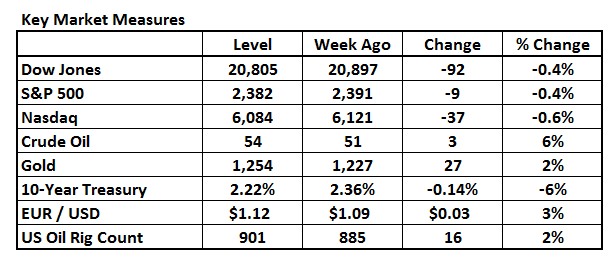
by Todd Shaver | May 21, 2017 | Weekly Newsletter 7pm Sunday
Let's Get Started
The President took Air Force One for an international tour to promote peace, justice, and stability. His first stop is in Saudi Arabia to meet with over 50 Muslim leaders to discuss a shared fight against radical beliefs and terrorism. He will make his way next to Jerusalem and Bethlehem to re-build relationships that deteriorated under the last administration. Thereafter, he will spend time with the Pope at the Vatican strategizing on how Christian beliefs can bring about more peace in the world. We learned Saturday morning that Trump was greeted on his first stop in Saudi Arabia with $110 billion of deals for US companies in the region, in particular for General Electric and Halliburton. This one of the reasons why America voted for the man? But we’ll see if anything comes of it.
There is always a bull market here at The Bull Market Report! This week we highlight the following stocks: Athenahealth, Home Depot, Amazon, Facebook VMware, and Kinder Morgan.
Highlights From The Past Week
Why have stocks bounced? We see no one specific factor behind a stock market bounce that followed the biggest selloff since last September on Wednesday. Some are focused on the pervasive buy-the-dip mentality since the financial crisis bottom in 2009. The initial flurry of Trump impeachment talk following the Comey memo leak seems overdone. Trump heading overseas may shift some of the focus away from recent controversies toward foreign policy (and dampen his more combative tone). A stabilizing influence is Robert Mueller’s appointment as special counsel in the Russia investigation which brings credibility amid the chaos. Despite all the talk about the threat to Republicans’ legislative agenda, policy expectations have already been meaningfully dialed back. There is little change in a fairly upbeat fundamental narrative that has revolved around expectations for an upswing in global growth. In addition, central banks are still in an easy money stance.
Bullard says Fed’s path may be “overly aggressive”. At an address at Washington University, St Louis Fed President James Bullard noted that in the wake of the Fed’s March rate hike, financial markets saw declining long-term yields and weakening inflation expectations. He observed that this may suggest that the FOMC’s contemplated policy rate path is overly aggressive relative to actual incoming data on US macroeconomic performance. Bullard noted that labor market improvements have slowed over the last two years, and that inflation and inflation expectations have surprised to the downsize in recent months. Note that Bullard has been quite dovish in the past relative to rates, saying in January that there was no reason to move rates dramatically and standing by his forecast for a single rate hike in 2017. In statements following his presentation, Bullard reiterated his call that the Fed should shrink its balance sheet to gain policy space, and said the central bank should retain the option for future quantitative easing should it be necessary.
Oil supported by deal extension headlines. Oil posted a nice gain this week on growing expectations exporters will extend output cuts to curb a persistent glut in inventories at next week’s OPEC meeting. This follows headlines earlier this week that Saudi Arabia and non-OPEC Russia agreed to a 9-month extension. Reuters, citing OPEC sources, said the cartel’s panel reviewing scenarios for the 25-May meeting is looking at the option of deepening and extending the deal to reduce oil output. No agreement has been made on final scenarios. Some say a deeper cut in output is an option depending on estimated growth in supply from non-OPEC producers and US shale oil.
BMR Companies & Commentary
Athenahealth (ATHN: $130, +19% - all price changes are for the week)
Top-notch hedge fund Elliott Associates disclosed a 9.2% stake in Athenahealth this week sending the stock soaring.
Elliot believes the company operates in a highly strategic area at the intersection of technology and healthcare with a disruptive value proposition, a leading competitive position, and a compelling product set, the value of which is not reflected in the company's current market value. Interpretation: The stock is cheap. Elliot believes that there are numerous operational and strategic opportunities to maximize shareholder value. Elliot will engage in a dialogue with the company's board regarding these matters.
Elliot may consider and develop plans and make proposals with respect to operations and management, and all types of other changes that will add value to the stock.
Looking at the software landscape, IBM and Inuit have expressed a desire to break into Healthcare. Reports have also speculated that Aetna and UnitedHealth may also be interested.
BMR Take: Elliot Associates is the real deal as highlighted by Athena’s 19% move higher last week. We hit our Target of $125, having added the stock at $101 in November, so we are up 30% in six months. Not bad. We definitely would stick around to see what happens here. We could see another big move higher should the company be sold. We hereby Raise the Target Price to $140, and the Sell Price which was originally at $90, is now at $105, to $125. We don’t want to lose any of these massive gains.
Home Depot: (HD: $156, down 2%, but up from $144 a month ago)
Home Depot just blew earnings out of the water while the rest of Retail keeps falling apart. With mall retailers such as Sears and J.C. Penney seemingly on their deathbed, Home Depot once again proves why it pays to sell lumber and nails.
Last week, the home improvement retailer delivered first quarter results. EPS of $1.67 beat consensus of $1.61 on revenue of $23.9 billion versus consensus of $23.7 billion. Management reaffirmed full year sales growth guidance of +5% and lifted expectations for EPS growth 11% to $7.15. In February they announced an increase to $15 billion in the stock buyback program.
All merchandise departments delivered sales increases. Sales from contractors were stronger than those from typical consumers. Online sales surged 23%. "The housing market is very strong", Home Depot CFO Carol Tome said, adding that sales in May have been "very good."
So far, the U.S. housing market has withstood the rising interest rate environment (which we see as very insignificant). In turn, home improvement retailers such as Home Depot have continued to thrive as existing homeowners renovate their homes -- which are rising in value -- and builders try quickly to bring on badly needed supply.
Home improvement spending still remains healthier than most areas in retail. Trends remain strong as building materials, hardware and garden supply sales have grown 6.4% year over year.
BMR Take: Stick with this blue chip. Many analysts see the EPS outlook as conservative. Despite its impressive $95 billion sales base, Home Depot has ample opportunity to grow, especially in eCommerce. The company will continue to benefit from healthy home improvement spending, market share gains, and strong execution. The home improvement sector remains well-positioned to benefit from continued modest GDP growth, home price appreciation, and solid household formation. Our Target is $160 – getting close. We can’t wait to raise the Target soon.
Amazon (AMZN: $960, flat)
Amazon cut the price of the Echo to the lowest level in 2017. For a limited time users can purchase two Amazon Echos with the promo code ECHO2PACK effectively dropping the price to $140 each. The normal price is $180.
Why do we care?
Echo is Amazon’s ticket into a massive Home Services Market. It lets Amazon gather data for what is happening in the house as it records everything. It also provides a door for instant on-demand ordering. We have one and we love it!
Amazon, which launched its Home Services unit in 2015, now offers 1,200 services in more than 50 U.S. cities. Customers can select assembly or installation services, which will compete against those offered by retailers like Home Depot or Best Buy, in addition to other services like house cleaning, home repair and yard work, which will compete with Angie’s List. Throughout its 20-year history, Amazon has continued to explore areas of commerce that it believes it could disrupt and this is one ripe for disruption. In March, Amazon estimated that the on-demand Home Services market was valued between $500 and $700 billion.
BMR Take: Amazon is a serial monopolist company that picks markets to enter, disrupts them entirely, and runs away with market share. Home Services looks like the next target. Amazon is really expensive at 145x this year’s earnings, but Amazon doesn’t trade like a normal company. Bezos has said profits will come in due time. Lately they have been knocking out much bigger profits and the Street is content to wait and wait as the stock goes up and up. There remains a ton of upside to Amazon long term as the company is investing massively for growth and future earnings power more than supports the current valuation.
Facebook (FB: $148, -1.5%)
Facebook and Major League Baseball struck a deal to live stream games. The move is the latest initiative by Facebook to expand into the world of live programming. Facebook said that it would stream one game a week beginning immediately and the broadcasts would be available to everyone on Facebook in the U.S.
What does this mean? More engagement. More engagement means more advertising opportunities and more revenue. It’s great news.
MLB Commissioner Rob Manfred said at a news conference in New York, "Probably the most important single announcement is we've done an agreement with Facebook. It's really important for us in terms of experimenting with a new partner in this area. We are really excited about this."
"It's pretty cool," Ian Desmond of the Rockies said. "It's an opportunity to provide the game to everybody. That's what we're trying to do -- expand the game and make it more diverse. It's a step in the right direction. They're doing a good job with that."
BMR Take: The stock is having a great year so far, and we see so much more potential still. Consensus estimates call for EPS near $10 by 2020. At the current PE multiple or 27 where the stock is today, this implies shares can double.
VMware (VMW: $93, -1%)
VMware, a global leader in cloud infrastructure and business mobility, announced it will deliver VMware Horizon Cloud on Microsoft Azure. The integration helps customers accelerate the move to Windows 10 and brings VMware virtual desktops and applications to the increasing global presence of Azure in the enterprise -- available in 38 regions globally.
This is a great news item! Microsoft Azure is connected to so many of the world’s enterprises (large, medium and small) it is mind boggling. By becoming integrated with Microsoft Azure, VMware is now able to tap into all of these customer relationships. What a revenue opportunity.
BMR Take: The addition of a major cloud platform such as Microsoft Azure to VMware’s customer database has the potential to accelerate the growth of the company. VMware is expected to generate $5-6 of EPS consistently for the foreseeable future. Putting it all together, the outlook suggests the stock should continue to do well. We have a Target of $95 on the stock. We can’t wait to raise this Target when hit.
Kinder Morgan (KMI: $20, -2%)
Kinder Morgan had a rough week on some news about more obstacles surfacing. The Alberta Securities Commission is reviewing an environmental group’s request to halt a $1.28 billion share sale that Kinder Morgan needs to help finance the expansion of its Trans Mountain pipeline.
Earlier this month, Greenpeace Canada sent a letter to the Alberta commission, saying Kinder Morgan may have used outdated oil projections in its IPO prospectus. The Alberta commission acknowledged receiving the challenge and will give it "consideration.”
Kinder Morgan had been running a dual-track process, exploring both an IPO and a joint venture to finance the Trans Mountain expansion. In a regulatory filing earlier this month, the company said it was no longer looking into a joint venture.
BMR Take: Kinder Morgan needs to get this together and do so fast. With EPS in recovery mode from $0.66 this year back to $1.00 by 2020, this coincides with more normalized earnings levels prior to the recent drop in oil prices. We don’t need any hiccups to the business plans that push out earnings, especially as oil prices remain volatile.
You know what? The more we think about this company the more we think it is time to move on. $1.00 of earnings (previous paragraph) by 2020? That’s a long time to wait. We’ve got a LOT BETTER places to put our money than this one. Just take a look at any one of our High Yield portfolio stocks, or the REIT portfolio. We are just tired of waiting and waiting – it’s been over a year. We added the company in early 2016 at $18 and exit here at $20.
Upcoming Economic News
Tuesday, May 23, 2017 10:00 AM
New Home Sales
Period: APR
Consensus: 610,000
Prior: 620,000
Wednesday, May 24, 2017 10:00 AM
Existing Home Sales
Period: APR
Consensus: 5,650,000
Prior: 5,710,000
Thursday, May 25, 2017 08:30 AM
Initial Jobless Claims
Period: 5/20
Actual: N/A
Previous: 232,000
Consensus: 237,000
Friday, May 26, 2017 08:30 AM
GDP
Period: Q1
Actual: N/A
Consensus: 1.9%
Prior: 1.9%
A Word from Gary Jefferson
Jefferson Financial Group
First Vice-President, Investments
UBS Financial Services, Inc.
Friday the 12th marked the 13th straight day in which the S&P 500 failed to move more than 0.5% in either direction on a closing basis, the longest such streak since 1995.
Q1 results from 95% of S&P 500 members show earnings are up +14% from the same period last year on +8% higher revenues, with 72% beating EPS estimates and 66% beating revenue estimates. The proportion of companies beating both EPS and revenue estimates is 52%.
Importantly, the growth performance is broad-based and not narrowly concentrated. We had the leadership from the Finance space earlier in the reporting cycle, but the baton has since shifted to Tech and other areas, including Industrials, Basic Materials, and Energy. The big disappointment – you guessed it: brick and mortar retail stores. While brick and mortar stores may be ailing, however, online sales are doing great.
Here is the important takeaway: When looking at the last three quarters, the overall strong Q1 showing represents a notable acceleration in the growth momentum. We have never seen a bad market during a period when it was in the midst of an accelerating growth trend. It could happen of course as wild cards such as oil or geopolitical risks are always present, but if there was ever a silver bullet for the market, it is an accelerating earnings momentum. We do not expect to have a slew of 2nd quarter earnings revisions to the downside begin cropping up over the next few weeks. Rather, with any kind of good news from D.C. such as healthcare reform, tax reform or infrastructure programs, we expect the growth momentum to continue to accelerate on a year-over-year comparison.
Bottom line: Earnings are strong, rates should rise in conjunction with a tightening labor market and we believe stocks still offer greater upside than bonds or cash. Here are the numbers that we feel support this opinion:
The Q1 earnings season was better than expected, and it’s resulted in 2018 S&P 500 earnings estimates bumping up $1 from $134 to $137. (Source UBS) At the higher end of that range, the S&P 500 is trading at 17X next year’s earnings. That’s high historically to be sure, but it’s not "crazy" as some of the doom and gloomers are arguing, especially given low Treasury yield levels and expected macro-economic fundamentals. On the downside, if the S&P 500 were to drop to 2300, then the market would be trading at 16.7X 2018 earnings. In this environment (low yields, stable macro environment), the market could easily be considered fairly valued and a buying opportunity.
Right now, it’s more likely earnings expectations get revised higher in the future, not lower, and that will make the market cheaper.
Sectors which have strong momentum currently include Financials, Healthcare, Technology (including cyber security, which is in the forefront as "ransomware" attacks go worldwide) and Energy.
Square Announces a Debit Product
Square Cash, the mobile peer-to-peer (P2P) payment offering from Square, will launch a physical prepaid debit product. The card is funded by customers’ Square Cash balance, and can be used anywhere that accepts Visa.
Square (SQ: $20, flat) wants to get a bigger piece of the P2P space. Mobile P2P payments are growing fast. That’s increasing competition in an industry where no one player holds a true market majority. Square Cash is an important player, but it's not as well-positioned as market leader Venmo, owned by PayPal (a Bull Market Report favorite) or Zelle, which will have access to up to 85 million customers and is backed by Bank of America, U.S. Bank, and Wells Fargo and 17 other banks. Zelle Network Banks Processed 170 million P2P Payments, Totaling $55 billion in 2016. The market is BIG!
Cash and checks have historically dominated the P2P world. But as smartphones become a primary computing device, top digital platforms, like Venmo and Google Wallet, have enabled customers to turn away from cash and make those payments digitally with ease. A shift to mobile payments across the board and increased spending power from the digital-savvy younger generation will cause the mobile P2P industry to skyrocket.
Consumers want mobile P2P services, and they’re turning to them. As smartphones are increasingly used as computing devices, these consumers look to such services for fast and easy ways to pay.
Monetizing P2P is more important than ever. As volume grows and user bases scale fast, finding ways to monetize quickly should be a priority for firms looking to stay ahead. We believe Square has a good shot of winning a good piece of this market.
In-store card payments are still substantially more popular than any form of P2P transfer. A physical card could help Square stand out. Gaining access to a traditional card could help users form habits and encourage customers to run a Square Cash balance, thus engaging them more with the product and increasing volume.
Our Target is $24. We can see this getting hit and our having to raise the Target to $34 and beyond. Square could be a big one.
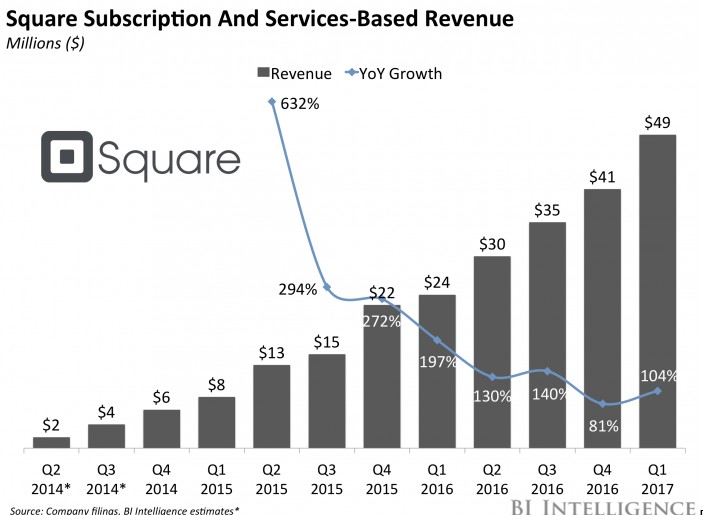
And this just in:
Washington, D.C., is enlisting Square’s help as its taxi commission tries to help the city’s cabbies compete with Uber drivers. By the end of August, all of the taxis in Washington have to tear out their traditional meters and start using smartphones or tablets. The Department announced that Square will process the payments going through those mobile devices.
Wow – that’s good news. Our takeaway is that this is a great PR move that will get more and more people to use Square. We use it. We love it. You will too. And the more customers the better. AND a higher stock price.
Annaly Keeps Chugging Along
Annaly Capital Management (NLY, $11.50) was up 2% this week and showed us a nice bounce back from recent lows after trading in the high 11s in early May. We have said this many times – the stock has its ups and downs and they are not anything to be worried about. The “interest-raising-talk” will accelerate in the press in the next few weeks, as the Fed prepares to raise in June or July, so buckle up your seat belts and sit back and watch Annaly handle all the bumps in the air. We are not worried. We’re quite content to sit back and collect the fabulous 10.4% yield.
Mazor Keeps Chugging Along
Mazor (MZOR: $43) had a stellar week, closing up 7%. Pretty volatile little stock, isn’t it? It hit $45 on Thursday and closed at $43. Crazy. We think it better to watch this stock on a weekly basis instead of daily!
Amazon Keeps Chugging Along
Amazon (AMZN: $960) was flat for the week, even after dropping $22 on nasty Wednesday. It bounced right back on Thursday. Love this company. Are you still hung up on the stock PRICE? Well, don’t be. Get some shares on Monday. On May 22, 2018 you will be ONE HAPPY CAMPER!
The High Yield Corner
By Michael Foster
The financial press was particularly amusing this week. On Wednesday we had a market correction that was called a disaster, a sign of turmoil, and a harbinger for a market crash. What caused the crash? Depends on who you read. We’ve seen explanations range from algorithmic trading going haywire, bank unwinding, bad earnings (really?), and, of course, geopolitical turmoil because of the Russia scandals. None of these really make any sense, and some are just plain wrong (earnings growth has accelerated, making S&P 500s forward P/E ratio relatively low), but the media keeps clutching for a narrative.
What are the facts? [No FAKE NEWS here at The Bull Market Report!] The Fed announced industrial production rose 1% in April, the largest gain since 2014 and near its all-time high. Unemployment claims fell to 232,000, maintaining levels lower than what we saw in the 1990s and early 2000s. Mortgage rates also fell to less than 4% (mortgage rates have been falling for a few weeks), and some analysts expect this to go lower. [We do.]
This is all good news and better than expected. Macroeconomically, there’s little to worry about in the U.S. And that may explain why the VIX dipped into single-digit territory, which created its own kind of paradoxical panic as many fretted that people aren’t scared enough. But the slew of good news indicates there is little to be afraid of.
That brings us to the most important but most controversial data point: household debt and credit. The Federal Reserve’s Household Debt and Credit Report announced that total household debt reached its highest point since 2008 ($12.7 trillion). While this may ring alarm bells to debt conscious individuals, from a macroeconomic perspective this is a good thing.
Here’s why. American consumers, for the most part, will take on credit only when they feel reasonably confident in their ability to earn money in the future. That’s not to say people are innately responsible with credit, but rather that they will to a certain extent take credit only when they feel confident about their own personal economies. The massive decline in debt following the 2008 crisis is an indication of this, especially when you look into the details. It wasn’t just mortgage debt that fell during the housing crash - it was credit card debt, auto loan debt, and personal loan debt. People just stopped borrowing money during the crisis. This was partly because banks stopped lending, of course, but not entirely. For a large part of America, it was time to tighten belts and weather the storm.
What did this mean for companies? Declining sales. Weaker profits. The need to cut costs, which often meant layoffs which in turn meant more belt tightening and thus even lower sales and weaker profits. This is the "deflationary spiral” economists warn about, and it is the reason why government stimulus is used during a recession.
The opposite of this deflationary spiral is a winding up of credit across the board. Americans are confident of their ability to pay back loans, so they borrow more, and then use that money to spend more. That results in higher sales and bigger profits for U.S. firms. That, in turn, results in firms hiring more people, thus creating a cycle of spending begetting spending and helping GDP rise across the board.
This has several implications for all kinds of investors. For stocks broadly, the news is good: it means higher sales and higher earnings (the S&P 500 has already reported both for the start of 2017). For other sectors, the news is also good but for different reasons.
For business development corporations (BDCs), it’s good because it means small and medium-sized businesses will have much higher demand for credit as they expand operations. This is partly why BDCs have been on a tear for the last couple of years - the market anticipated this expansionary climate. So the UBS BDC ETF (BDCS: $22) is up 10% from a year ago.
There’s just one problem: BDCs aren’t actually better investments.
The distributions that this ETF pays out have fallen in the past year as a result of yields on loans falling for individual BDCs. We’ve seen both NAVs and distributions fall for many BDCs, both big and small, over the last few months. As a result, the BDC ETF is down year to date and the BDC sector is by no means as attractive as it seemed a year ago. But if the macroeconomic climate is better for BDCs, why is this happening?
As we’ve said repeatedly at The Bull Market Report, BDCs are getting squeezed because of the better environment. This is attracting more competition from banks and leveraged lending firms. We’re also seeing smaller BDCs set up shop and compete with big guys like Main Street Capital Corporation (MAIN: $38), making its 70%-ish premium to NAV untenable. That’s why we cut Main Street from the Bull Market Report High Yield portfolio a few months ago, and that decision is finally getting vindicated: Main Street is now 7% off its all-time high reached just a few weeks ago at $41 and is down for the week. We are keeping a close look on the BDC sector and are looking for a company that has a reasonable market price and a strong income-producing portfolio. Until that shows up, we recommend caution.
Better options exist in municipal bonds for income. This sector has lost market favor for a very long time due to its more risk-hungry approach, and that’s caused yields on many muni funds to rise. Bull Market Report favorites Invesco Municipal Trust (VKQ: $12.64, flat) and the Nuveen AMT-Free Fund (NVG: $14.81, up 1%) are now yielding near 6%, tax free. These funds have risen slightly (about 3%) in 2017 but remain down from a year ago. There is still time to jump into these funds, although it appears that the window to get munis at a discount is shrinking.
Over the coming weeks we are going to get more macroeconomic data to determine exactly where we are in the economic cycle. During that time, holding high yield investments and doubling down on munis makes a lot of sense for income-hungry investors. There is a strong chance that the Federal Reserve will raise interest rates next month, and we may see second quarter GDP numbers that are strong. Neither of these are bad for high yield investments, because both signal a market in which people are spending and companies and municipalities can repay their loans. While the market is obsessed over a one-day drop on Wednesday, we will keep our eyes focused on the data to tease out what is really going on beyond popular distractions.
Good Investing,
Todd Shaver, Founder, CEO and Editor
The Bull Market Report
Since 1998
