May 7, 2017
by Todd Shaver | May 7, 2017 | Weekly Newsletter 7pm Sunday
The Week Ahead
Well, it’s graduation week. Class of 2017 graduates are hitting the stage to accept their diplomas, listen to a keynote speech, make one last party, and then head out into the great big world. What will they find? GDP growth moving to 4% or stalling out around 2%. Will geopolitical tensions escalate as early as this year or find a sustainable comfort zone? Can equity prices hold? How bad will rising rates hurt the bond market? Everybody from the newest participant in the labor force to the most experienced must wrestle with these questions in the year ahead. We at The Bull Market Report hope to help you with some good insights about what to make of it all—week in and week out.
There is always a bull market here at The Bull Market Report! This week we highlight the following securities: Eli Lilly, Home Depot, Netflix, Splunk, PayPal, and VMWare. And a few others!
Highlights From The Past Week
Federal government expanding investigation of Fox News. The aggression against the media continues. Current and former Fox News employees have been interviewed, as authorities try to determine how settlement payments for sexual-harassment allegations were structured and which executives played roles in the payments. One source tells the WSJ that the investigators seem to be interested in intimidation tactics that former CEO Roger Ailes signed off on. The investigators are in the securities unit of the US attorney’s office, and no prosecution will necessarily follow. What does this all mean? You need to find trusted sources of information in this world. We strive to make The Bull Market Report a reliable and honest source of information for you to rely on.
It's the strangest thing: A hedge-fund manager apologizing for bad calls. Wellington Management Sr. VP Nick Adams isn't just apologizing for his mistakes on Silicon Valley venture deals -- which differ from the bank stocks he has a proven record with -- he's refunding fees. Adams, who has lost money two out of the past three years, put hundreds of millions of dollars into Mozido and Powa Technologies, which are both financially distressed. Adams has promised he won't ever invest in similar private deals in his flagship fund again. People familiar with the firm's finances say that after investors including Blackstone (BX) withdrew their cash, Adams's portfolio at the start of 2017 was $6 billion, down 40% from 2014. Adams has now returned to investing in traditional lenders like Bank of America and Citi, and his main fund rose 12% in Q1. We think there are lots of lessons to learn from this situation. For instance, if you ever wonder why many of The Bull Market Report’s stock picks are in household names that are often large cap stocks, well, now you know why. Traditional investing is a proven money maker and we try to take you where you can make money.
Don't assume the Healthcare industry will be fine. We think the market is right to assume that the Republican replacement for Obamacare won't be passed in its current version, but anything that hurts earnings for the sector could bring prices down, and the failure to pass any sort of healthcare reform may make a tax reform harder to achieve, which will be a negative for stocks more broadly. We all must keep an eye on this important event unfolding in Washington in the weeks ahead.
BMR Companies and Commentary
Eli Lilly (LLY: $83, +0.5% - All changes are for the week) Eli Lilly has more growth drivers than all its peers, but its continued pledge of "at least 5% annual sales growth" for 2015-20 is being called into question because a big portion of growth comes from two drugs - Jardiance and Trulicity - that have recently faced setbacks. We think Eli Lilly is a topnotch franchise in Healthcare and will overcome these hurdles.
Jardiance is a drug for type 2 diabetes. Johnson & Johnson has a competing drug called, Invokana, which is set to release new trial data in June. Everybody is saying that if Johnson & Johnson’s drug has good data, then there will be more pricing competition in 2018 for Eli Lilly’s drug. We think this risk is widely known, already factored into the numbers, and not a reason to not own Eli Lilly’s common stock.
Trulicity is also used for type 2 diabetes. It faces risks from the FDA's decision last August on Novo Victoza, specifically that this drug had problematic heart effects. Will the FDA say the same thing about Trulicity? We will find out in 2018. For now, it is overly pessimistic to assume Trulicity faces serious FDA challenges.
Note that Lilly's drug unit accounted for 83% of 2016 sales, with the balance coming from animal health, so the story is not just all about drugs. Also, Eli Lilly's operating margin trails most of its peers, except Bayer, and by leveraging new-drug launches, it aims to reduce R&D and SG&A expenses to 50% or less of sales in 2018 versus 56% in 2015. This target is achievable by Pharma standards as Jardiance's new heart label drives growth and Trulicity, an established product, continues to add to margins.
Lilly investors may be relieved by the good set of results in 1Q following recent drug setbacks. Older drugs, such as Cymbalta and Strattera, beat consensus, lifting margins and feeding through to the 2% EPS beat. Diabetes was strong with both Trulicity and Humalog beating consensus, while Jardiance missed by a little. Jardiance is a key driver of growth and while the miss raised eyebrows we say stay the course.
BMR Take: Eli Lilly is a top franchise in Healthcare boasting a market cap of $91 billion. On track to clear $5 of EPS, the stock is a good value.
Home Depot (HD: $156, flat)
A lingering debit/credit card breach has kept a lid on shares of Home Depot. The bad news is that it is so sad to see some large-scale breaches at US companies like Target and now Home Depot. The good news is Home Depot has taken strong steps to remedy the situation. In any case the stock is $1 from an all-time high, fast approaching $200 billion in market cap.
Companies hit by data breaches often face class action complaints filed by consumers. They also face lawsuits from shareholders looking to thwart future breaches and restore financial stability to companies in which they have invested. Home Depot's willingness to take meaningful but financially limited remedial mitigating action achieves a mutually beneficial resolution that companies facing any kind of data breach lawsuits, such as Yahoo, may rely on to improve their corporate data governance.
Under the proposed settlement, Home Depot will change many of its cybersecurity corporate governance policies. Home Depot agreed to document the duties and responsibilities of the chief information security officer; conduct table top exercises; monitor computer networks; maintain a “Data Security and Privacy Governance Committee;” hire a “dark web mining service;” receive reports on the company's information technology budget; join an information sharing program; and authorize the board to retain its own IT and data security professionals. Home Depot also agreed to pay $1.1 million in attorney’s fees and and $1.5 million to the shareholder representatives. They agreed to the settlement because it saw the attorneys’ fees as a minimal money issue and it believed the actions “would restore trust” in the company.
BMR Take: Home Depot is on track to deliver $10 of EPS and $100+ billion of sales. Don’t sweat the small stuff. Sorry to see the cyber breach, but the core business is doing great.
Netflix (NFLX: $157, +3%)
What could be more exciting than a Netflix merger with Apple? The world continues to talk about the prospects. Let’s break down the potential reality.
There may be as good as 40% odds that Apple acquires Netflix. The research arm of the investment bank Citi released a report with seven potential merger and acquisition targets for Apple. Tops on the list is Netflix. Elon Musk's Tesla, on the other hand, is only 5% likely. The full list of acquisition targets includes three media firms, three game developers, and, of course, one car manufacturer. Disney and Hulu are the media firms joining Netflix, while Activision, Electronic Arts, and Take-Two are the gaming companies.
Netflix makes a ton of sense, of course, as the company dominates streaming media both domestically and abroad. Disney has a strong list of properties as well, but slightly more oriented to traditional media consumption, whereas Netflix is well-positioned to take advantage of the continuing trend to cut the cord (cord-cutting has jumped 5x). Plus, Disney is worth $177 billion, whereas Netflix is worth $67 billion.
BMR Take: The future of TV consumption swings in the balance as the world moves away from traditional cable to the internet. Netflix is the powerhouse making the company a coveted asset in media. On track to do $10 of EPS by 2020 we see compelling value in the shares as a standalone entity even at current levels. A take-out could offer huge upside.
PayPal (PYPL: $49, +3%)
The PayPal network effect is working like charm. Investors in PayPal had plenty of reason to cheer last week when the company reported earnings. Nearly every metric was up by a better-than-expected percentage, surpassing expectations of all but the most bullish on the company.
More exciting to long-term investors, however, was the account growth and increase in user engagement with the company's core platform. Six million active accounts were added during the quarter, increasing the total to 203 million for the digital payments company. These active accounts now average almost 32 transactions per year, a 12% increase year over year. More customers using the company's platforms more often was a winning combination that the market liked.
PayPal's growth is beginning to fuel a powerful network effect opening a new window for the company. The beauty of this type of growth is that it drives itself. The more users that sign up for the platform the more important the service becomes for retailers to adopt it and the more places that accept it, the more attractive it becomes to new users. Get it?
At the end of March, 16 million retailers were accepting PayPal's core platform as a method of payment. Management is well aware of this virtuous cycle. During the conference call, CEO Dan Schulman stated: “Our powerful two-sided network engages both consumers and merchants, and the larger our scale, the stronger our network effect becomes. We made meaningful progress in advancing merchant adoption of PayPal in the quarter. At the end of March, the number of active merchant accounts on our platform increased to 16 million. The size of our merchant base is a formidable competitive advantage and is extraordinarily difficult for others to replicate.”
BMR Take: We think PayPal is in the middle of a decade-plus growth cycle that will deliver real value for shareholders. Stick around. They are already closing in on $3 of EPS.
Splunk (SPLK: $67, +4%)
Progress at Splunk is happening. Splunk, a provider of the leading software platform for real-time Operational Intelligence, recently announced support for SaaS Contracts in AWS Marketplace. Working with Amazon is a big deal!
The new globally available API capability* enables seamless procurement and deployment of Splunk® Cloud. The automated and accelerated purchasing process for Splunk Cloud via AWS Marketplace ensures fast time-to-value for customers leveraging Splunk solutions to gain real-time security, operational and cost management insights across their Amazon Web Services (AWS) and hybrid environment.
* Application program interface (API) is a set of routines, protocols, and tools for building software applications
The University of San Francisco is home to an innovative academic community of more than 12,000 students, faculty and staff. “As a higher education institution, USF prides itself on being at the forefront of technology, which is why we turned to Splunk and AWS,” said the vice president of information technology and chief information technology officer, University of San Francisco.
BMR Take: Working with Amazon gives Splunk big growth potential. The EPS outlook calls for great than 3x growth from $0.41 of EPS in 2017 to $1.35 of EPS in 2020. Ride this growth wave!
VMware (VMW: $94, flat)
VMware is out with some good news. The company is the first mobile application management provider to manage and secure hundreds of Oracle business applications and custom applications. As such, enterprise IT organizations can manage their Oracle application suite on a single unified platform together with their other business-critical applications and devices. Users who count on Oracle's business applications to make better decisions, reduce costs and increase performance can benefit by being able to access these applications through a simple digital workspace environment – be it from a mobile device, laptop or desktop – with VMware Workspace ONE and AirWatch.
What does that mean? VMware is continuing to make end roads in the lucrative cloud business, where growth is driving real results for stockholders.
The Chief Operating Officer, customer operations, said: "Mobilizing critical business processes is at the core of both of our organizations' DNA and this collaboration will help us advance this shared vision for our customers and their end users alike. We're proud to come together with Oracle to make it easier for IT administrators to secure and manage these critical mobile apps and help their end users seamlessly access them from any endpoint.” VMware Workspace ONE is the industry's only integrated platform for application and access management and unified endpoint management that enables simple enterprise secure access to any app from any device, accelerating adoption of digital workspaces.
BMR Take: The company is working. EPS is on track for $4.90 this year with growth upside to $6 in the next few years led by the cloud business and partnerships like the one described above serving Oracle.
Economic Outlook for the Coming Week
Monday, May 08, 2017 10:00 AM ET
United States - Labor Market Conditions
Period: APR
Actual: N/A
Consensus: N/A
Prior: 0.40
Labor market conditions index is derived from a dynamic factor model that extracts the primary common variation from 19 labor market indicators. It measures the changes of condition in the labor market. We expect to continue to see signs of a healthy labor market.
Tuesday, May 09, 2017 6:00 AM ET
United States - NFIB Small Business Index
Period: APR
Actual: N/A
Consensus: N/A
Prior: -$176B
NFIB Research Foundation has collected Small Business Economic Trends data from a sample of members from the National Federation of Independent Business (NFIB). Data from quarterly surveys since 1973 is based on 10 survey indicators. We expect to see an improving small business economy.
Tuesday, May 09, 2017 10:00 AM ET
United States - JOLTS Job Openings
Period: MAR
Actual: N/A
Consensus: 5,750K
Prior: 5,740K
Part of the US Bureau of Labor Statistics, the Job Openings and Labor Turnover Survey (JOLTS) program produces a monthly study that has been developed to address the need for data on job openings, hires, and separations. With the release of 2003 data, the JOLTS program began publishing industry estimates. We expect to see the JOLTS figures reveal a healthy labor market.
Wednesday, May 10, 2017 2:00 PM ET
United States - Treasury Budget NSA
Period: APR
Consensus: $166B
The monthly U.S. government surplus/deficit is published in the Monthly Treasury Statement (MTS). The MTS is assembled from data in the central accounting system. The major sources of data include monthly accounting reports by Federal entities and disbursing officers, and daily reports from the Federal Reserve banks. These reports detail accounting transactions affecting receipts and outlays of the Federal Government and off-budget Federal entities, and their related effect on the assets and liabilities of the U.S. Government. It is very critical what happens with Trump now negotiating the government budget and we are excited to see if he can get it under control and address the national debt.
Friday, May 12, 2017 08:30 AM ET
United States - Retail Sales ex-Auto
Period: APR
Actual: N/A
Consensus: 0.45%
Prior: 0.0%
Retail and food service sales data excluding motor vehicle are included in the Advance Monthly Sales for Retail and Food Service report, which provides an early indication of sales of retail and food service companies. We are keenly concerned about brick and mortar Retail sales declines and look to this economic release to assess the damage and potential impact.
MORE COMMENTARY ON BULL MARKET REPORT STOCKS
First Solar (FSLR: $35, up 17%) reported first-quarter earnings of 25 cents a share. The Street was looking for a loss of 13 cents.
Revenues hit $890 million in the quarter destroying the estimate of $700 million. (Who are these analysts anyway?) Revenues grew slightly from last year, up 2%. Profit was $84 million, down from $275 million a year ago. Ouch, but expected.
First Solar has $1.65 billion in cash, up from $1.35 billion at the end of the previous quarter. Long-term debt is $265 million at the end of the first quarter.
The big news is guidance. The company raised its revenue guidance to $2.9 billion from $2.85 billion. This is minuscule, but the Street liked it, pushing the stock up big. Gross margins guidance was moved to 13.5% from 12%.
Full-year earnings are now expected in the range of 25−75 cents per share, compared with the prior guidance of a breakeven to 50 cents.
We’ve said many times that this company is innovative and successful and that the turnaround will take time. This is the first positive information we have seen publicly that good things are actually happening. If you have patience, stick with First Solar. If you don’t, now is the time to take it off the table after this nice 17% run-up.
Facebook (FB: $150, flat)
Monthly active users totaled 1.94 billion while daily active users hit 1.28 billion. Expectations were for these numbers to hit 1.90 billion and 1.26 billion, respectively.
Facebook reported earnings of $2.5 billion or $1.04 per share on revenue of $8.03 billion. Expectations were for earnings of $0.87 on revenue of $7.83 billion. Huge beat. “We had a good start to 2017,” Mark Zuckerberg, Facebook founder and CEO, said. “We’re continuing to build tools to support a strong global community.”
Mobile is big at the company, as advertising revenue on mobile represented 85% of total advertising revenue, up from 82% a year ago. Ad revenue grew 51% over last year to $7.85 billion.
As of the end of the first quarter, the company had $32 billion in cash, and had almost 19,000 employees, up 38% from last year.
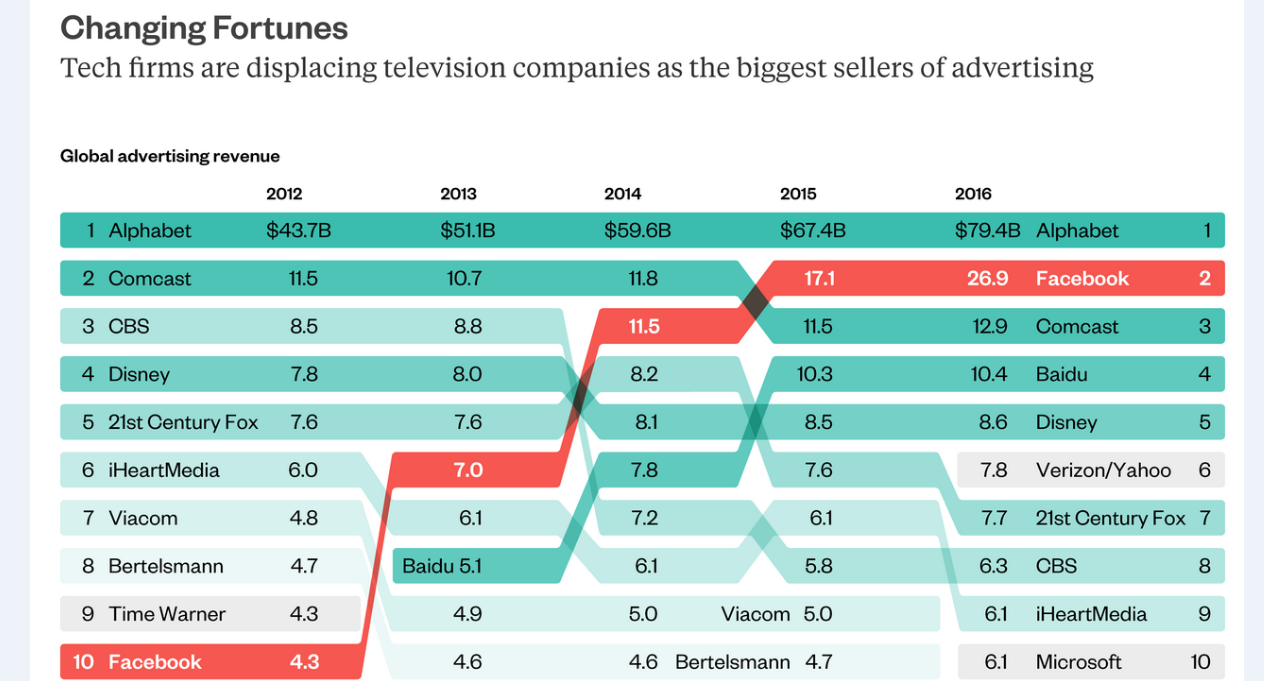
As Facebook nears the 5-year anniversary of its initial public offering, note this: In 2012, Facebook was the world's 10th-biggest seller of ads behind a bunch of traditional media companies such as CBS and 21st Century Fox. It has trounced almost all of them to rise to number two in the rankings, surpassed only by Alphabet, the Google parent that dominates search ads. Together, these two companies controlled 20% of the $550 billion spent on ads last year, up from 10% in 2012.
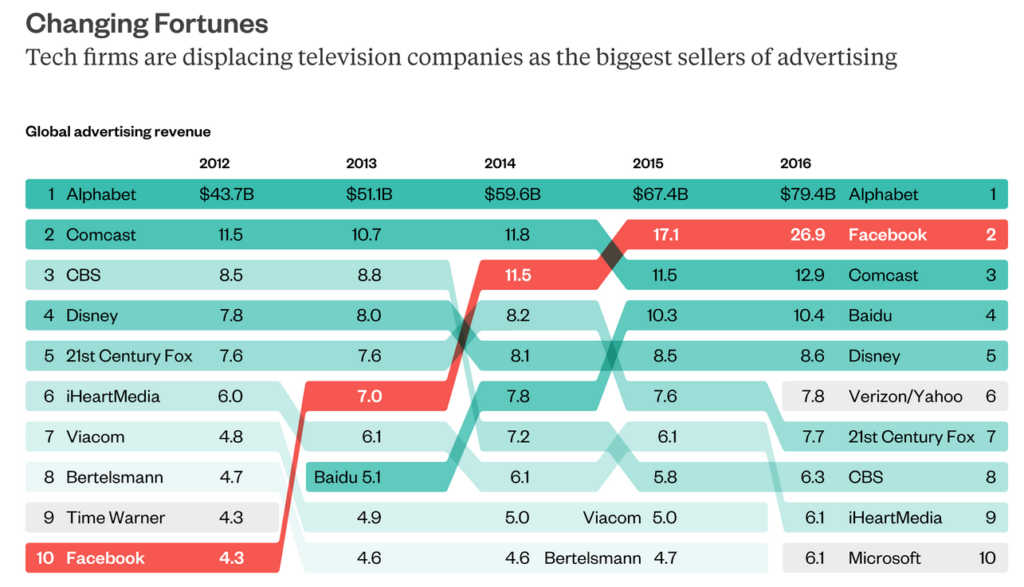
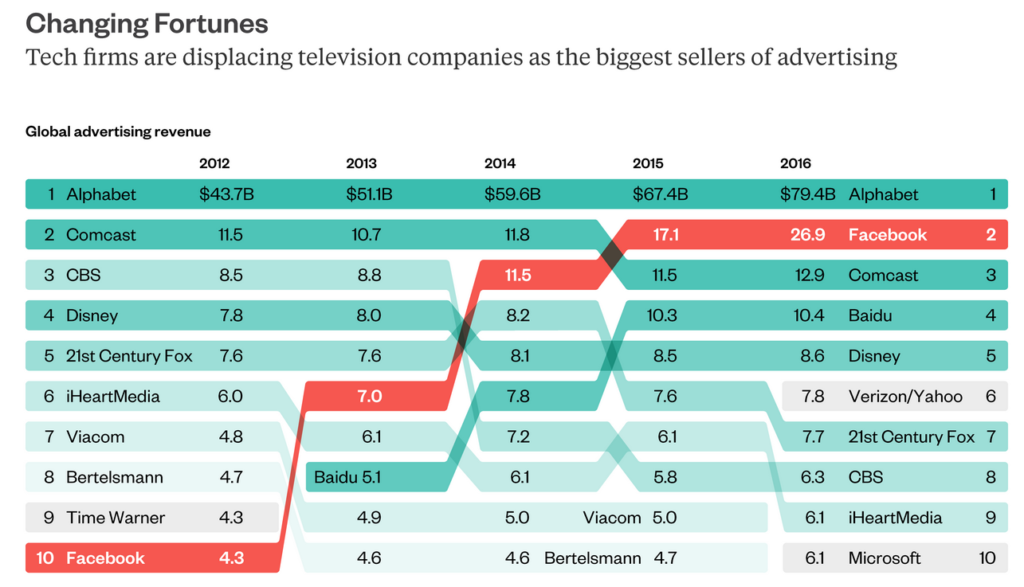
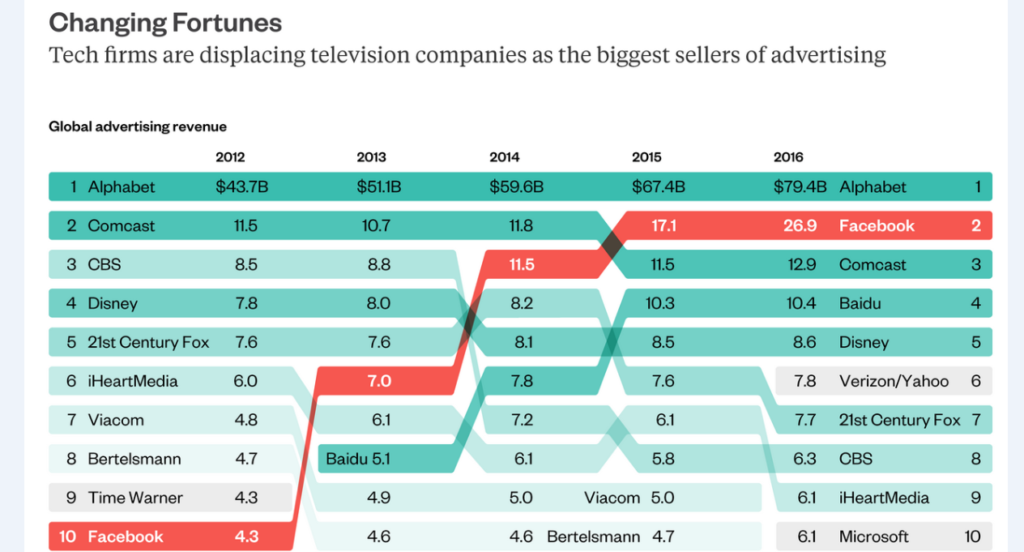
Source: Zenith Media
Jefferies hiked its price target on Facebook to $192 from $175, JPMorgan to $182 from $170, RBC Capital to $185 from $175, and Cowen to $170 from $156.
BMR Take: Our Target is in reach at $165. We would add to our positions at every opportunity. Wait until they hit 2 billion users. There will be fireworks and articles about the company galore and we just might see this as early as July. When this happens we can predict new all-time highs hit left and right.
Shopify News
We Tweeted this out on Friday:
“Shopify is on fire! All-time high at $86, up 5%. Stock was $73 a week ago. STRONG REVENUES will do it! Will eBay make an offer?” [The stock closed at $86 on Friday, up 13% for the week!]
The stock (SHOP) closed at $86 on Friday. We’re up 18% since we added the stock a little over a month ago. Our Target is $90. We can’t wait for it to hit so we can raise it to $100 or higher. And wouldn’t it be nice to see a stock split soon? What ever happened to stock splits? The markets in the 80s and 90s LOVED splits. We could see a 10-1 split for Amazon, bringing the price down to $93, and Google could split 20-1 bringing the price down to $46. Now wouldn’t THAT shake things up on Wall Street! The market would go wild.
Square (SQ: $19.78, up 8%) had a super good week. Square makes credit-card readers that plug into mobile phones and tablets and we were happy to see Square swing to a profit in the first quarter and raise full-year revenue guidance.
Led by Twitter Chief Executive Jack Dorsey, the company posted a quarterly loss of 4 cents per share on a revenue jump of 22% of $460 million. Analysts had expected a loss of 8 cents per share on revenue of $450 million, so of course the market liked what they saw. Square has predicted 2017 total revenue of $2.14 billion.
The company's gross payment volume - the total dollar amount of all credit card payments processed by sellers - jumped 33% to about $14 billion. We like numbers like this.
Another subsidiary, Square Capital, which offers loans to customers in exchange for a fixed percentage of their daily card sales, originated $250 million in loans in the first quarter of 2017, up 64% from a year earlier. We like large percentage increases like this. (We sound like a broken record…)
Square continues to move towards bigger customers. They said that 44% of the money flowing through its systems came from merchants that have over $125,000 in volume on the company’s platform, up from 39% a year ago. CFO Sarah Friar said: “That ongoing shift is good to see because those folks are not new to the payments world.”
Citigroup upped its price target on Square to $23 from $21, and Pacific Crest to $21 from $19.
BMR Take: We’re looking for $24, and hereby raise our Sell Price from $14 to $17.
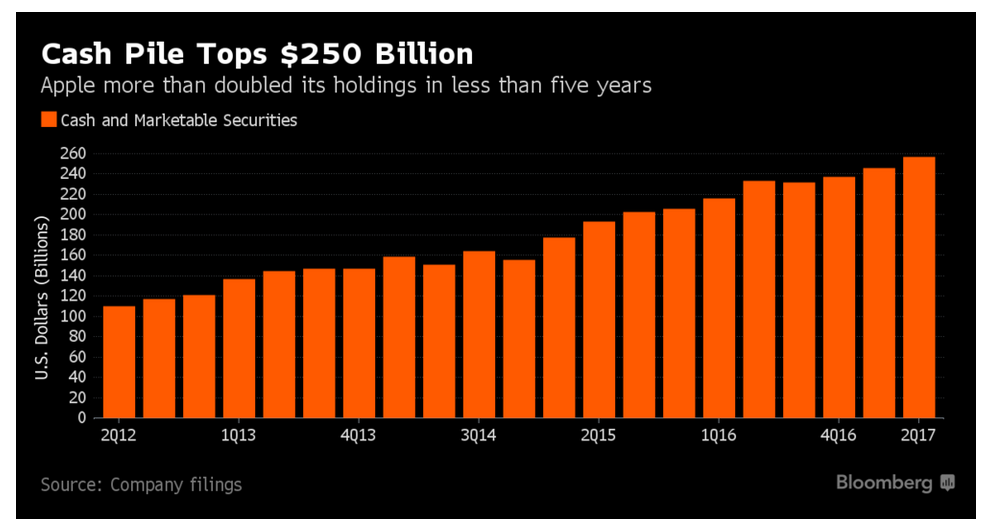
Apple (AAPL: $148, up 4%) announced that it has $257 billion in cash as of the end of the quarter. They added $10 billion in the quarter which equates to about $800 million a week, or over $150 million per work day! Repeat: $150 million per work day. The company said it will return more of that to shareholders, announcing $50 billion in new stock buybacks and a 63-cent quarterly dividend. The company had already announced $175 billion in repurchases, helping maintain the stock price in lulls between new products, so the upcoming total is now $225 billion. Take a look at this chart of their cash buildup over the years:
Twilio (TWLO: $24, down 27%) We reported via News Flash on Tuesday that despite strong revenues the market didn’t like the results. The biggest knockoff was the fact that one of their big customers, Uber, has decided to go it alone. Uber provides 12% of total revenue for the company, but Twilio grew revenue by 60% not including Uber. So ultimately, we are not that worried about future revenues. We believe they will continue strong. (We think they will come back to Twilio at some point.) WhatsApp, owned by Facebook is also a large customer, so some people are worried about this large concentration of revenue in one customer. We’re not. There is no word as to whether they are considering leaving. We would suggest that they are quite happy with the service they receive. And again, note that the company added 4,000 customers in the quarter – amazing really – giving them more than 41,000 customers, up from 29,000 at this time last year.
We had a letter from a reader about Twilio and we said this to him:
Bob -- Be prepared for anything that might happen. We could see $20 before we see $30. I hope this is not the case, but it could happen. Uber is slowly leaving as a customer and they had 12% of revenues. So, this will take some time to work out. They did add 4000 customers last quarter and are now over 40,000. They normally add 2800 a quarter. But unfortunately, like First Solar, this is going to take some time.
The Options Corner
We had mentioned in our News Flash about Twilio that we would do a column about options if anyone was interested. Well, we had a strong show of support for this. So here you go.
There are myriad of options strategies if you want to maintain a position in Twilio and you believe it will come back like we do. Of course, most options trades are risky except for selling covered calls, which are still risky but less so than buying options outright. The premiums on Twilio options are relatively high so that usually points to two types of options trades: doing covered calls, and selling naked puts or calls. The latter two are very dangerous.
Selling covered calls: Selling covered calls on Twilio is fairly straight forward. With the stock at $24 you can get about $1.80 for the January $30 call. If you have 1000 shares, you can sell 10 options and receive $1800 in your account that day. The downside is that you would be obligated to sell your stock at $30 if it goes higher than that. But, you can always buy back the option if the stock goes above $30. Depending on how long it takes the stock to get there will determine the price at which you have to buy back the options. If the stock goes to say $32 by January, then you could buy them back for about $2, losing about 20 cents, or $200. But with the stock at $32, you would feel good about that. The downside is that if someone buys Twilio out at $40 a share, you would be forced to sell your stock at $30. Not pretty.
If the stock stays below $30 until January, then you can turn around and sell another out-of-the-money option for a few dollars and wait for the stock to move higher and each time you do this you put cash into your account.
As you can see there are lots of scenarios that can happen so you have to watch carefully. Make sure you have the advice of your broker.
Buying options: If you think the stock can get to the $40 level or higher by say January 2019, you can buy out-of-the-money options inexpensively. But you could lose all of your money if the stock doesn’t reach the strike price that you choose. For example, you can buy 10 options, controlling 1000 shares, at a strike price of $40 expiring in January 2019 for about $2,300. If the stock goes to $45, these options would be worth at least $5,000. If it goes to $50, the options would be worth $10,000.
Or you could buy the January 2019 50s for about $1400 and if the stock goes to $55 they would be worth $5,000. BUT, if the stock doesn’t get to your strike price, they expire worthless.
Selling naked puts: YOU SHOULD ONLY DO THIS IF YOU WISH TO BUY THE STOCK and if you have the money to do so. You could sell the January 2019 $25 put for about $7, or $7,000 for 10 options. That would obligate you to buy the stock at some point between now and the expiration date at $25, BUT you got $7 per share so your net price is $18. You could do the same thing with a $20 put and get $4.30 per share, obligating you to buy the stock for a bit below $16. We like this latter strategy. Suffice it to say that selling naked puts on stocks you want to buy at a lower price, is a good thing. Again – very risky. Why? What if the stock goes to $10. You would be forced to buy the stock at $18 or $16 as described above. Not fun.
Send us your questions and comments please! Info@BullMarket.com.
Tesoro (TSO: $80, up 1%) moves in the wind with crude oil. Crude got down to $45 early Friday and bounced back to $46 by the close. We like the company but can’t be part of it if crude is headed to $40. If you know where crude is headed you’ll know what to do with your position in this fabulous refiner. Unfortunately, we don’t. If we knew, we could make $1 million trading crude oil futures. We added the stock at $85 in November and have a Sell Price of $75. But we would hate to have the stock go that low, so we are hereby raising our Sell Price to $78, which is two dollars below the current price. So, if Tesoro closes below $78 we are out.
Carlyle Group (CG: $18.10, up 2%) posted first quarter earnings that handily beat expectations on Wednesday, in line with its peers, after a strong stock market last quarter lifted investment returns. Carlyle's peer Blackstone Group (BX: $30, down 2%), a Bull Market Report favorite, reported first-quarter earnings that surpassed expectations.
Carlyle said it earned economic net income (ENI)* of $365 million after taxes, more than six times what it earned a year earlier. That translated into $1.09 EPS, well above analyst forecasts for 38 cents per share and the second-highest on record since the fourth quarter of 2013.
* ENI is a crucial performance measure for U.S. private equity firms as it accounts for unrealized gains or losses in investments.
Carlyle said its private equity investments appreciated 9% in the first three months, better than a 5% gain in the S&P 500 index in the same period. Carlyle Co-CEO William E. Conway, Jr. said, “We deployed capital at a strong pace in the first quarter, with $4.4 billion of capital invested despite a difficult environment. We believe we are well-positioned to continue this strong pace. We have already announced substantial new investments and almost $4 billion of exits that we expect to close in the coming quarters.”
BMR Take: Carlyle is still way undervalued but is paying you 4% while you wait. We’re waiting patiently for the market to recognize this situation. We are up 12% since March, but we sure would like to see our Target hit of $20.
The High Yield Corner
By Michael Foster
It’s finally started.
It’s a bit late, but we’re finally seeing a correction in the BDC world. The UBS BDC ETF (BDCS: $23, down 3%) got hammered in a week that was pretty humdrum for high yield and not bad for the stock market as a whole, despite a lot of drama. Yet BDCs are back to underperforming, as they should. Overstretched valuations and high premiums to NAV were unjustifiable before this week. Now that many companies have reported lackluster earnings, those premiums are even less justifiable.
Ironically, however, this isn’t hurting the most overvalued BDC of them all: Main Street Capital Corporation (MAIN: $40, up 1%), which closed the week strong as investors sighed relief following the company’s earnings. Net interest income rose 9% from a year ago to 61 cents per share and the company’s NAV rose nearly 2% to $22.44. There are two big implications for this: firstly, the company’s dividend coverage is 109% and there’s room for years of dividend growth to continue. We have a feeling Main Street management has the ultimate goal of becoming the first BDC Dividend Aristocrat*. We’ve still got about two decades until they can qualify, so it won’t be easy. But if that is their goal, Main Street is easily the best managed and most long-term focused BDC in the world.
* The Dividend Aristocrats are a select group of 51 S&P 500 stocks with 25+ years of consecutive dividend increases.
That doesn’t mean you should go out and buy. We at The Bull Market Report were happy with our pick and happy to see it rise. But we are not happy to pay an 80% premium to net asset value. Consider this: if you considered Main Street to be the best BDC in the world, you wouldn’t want to compare its premium valuation to the valuation of other BDCs. You’d probably want something safer, like a megabank like Bank of America, which not only lends to small and medium sized banks but also mega-corps and governments while diversifying in other banking activities like M&A advisory, retail deposits, and so on. Or at least you’d want your BDC valuation to be less than the valuation of these banks, right? But if you compare Main Street’s valuation to the price-to-book valuations of these big banks, Main Street is overvalued by 40% at a minimum. This just isn’t good enough for a very well-run but extremely undiversified asset.
The market has begun to realize just how silly BDC valuations were getting, but the market has made an exception for main Street largely due to the fact that just about every other BDC reported awful earnings. Net investment income fell for almost all BDCs that have reported so far, with Hercules Capital (HTGC: $13) seeing NII down 33% from the prior quarter. The dividend is now less than 100% covered. NAV fell a bit as well (over 1%). What happened? The market dumped shares, which fell over 16% in a week. This used to be considered one of the safest and best specialty BDCs out there, but the market can turn very quickly on this asset class. We’re not saying anything similar will happen to Main Street anytime soon, but it is a serious risk.
Then there’s Goldman Sachs’s BDC (GSBD: $24), which fell 3% this week due to a decline in net investment income and virtually flat NAV. The stock is still up 3% year-to-date so you’re paying a higher premium for shares, though. Now you’re paying 32% over what the underlying assets are worth. Of course, this BDC is up big over the past year, thanks in part to the secular bull market in BDCs and thanks in part to the Goldman brand. But, as we’ve written here previously, there is a complicated conflict of interest going on with this BDC that makes us extremely cautious. Goldman Sachs’s management is not duty bound to restrict their deal making just to this BDC, and so there’s a chance (although no evidence this is the case) that management can select better deals for the parent company and keep lesser deals for the BDC business. Without clearer governance resolutions, this makes us extremely cautious. And, at the end of the day, this demonstrates one of the structural problems with many BDCs: management and investors’ interests do not align.
Some of the BDCs in the business were loved for avoiding this trap. The big Ares Capital Corporation (ARCC: $16.60, down 6%) is a good example. But this stock tanked as well, after reporting earnings fell 50% from a quarter ago and NAV rose less than 1%. We don’t need to emphasize how bad those results are, and how they deserve a discounted valuation. But Ares is still trading at a slight premium to NAV.
Obviously, a bigger correction in the BDC market is coming, so where else can we look? REITs and municipal bonds remain our favorite corners of the high yield market. The iShares S&P National AMT-Free Municipal Bond Fund (MUB: $109, flat) remained sleepy due to the risk-on nature of the market encouraging more investors to avoid the asset class, despite the growing number of undervalued bonds and great opportunities to get low risk yield for fund managers. Bull Market Report favorites remained flat for the week, Invesco Municipal Trust (VKQ: $12.69, flat) and The Nuveen AMT-Free Fund (NVG: $14.79, flat) Buying more of either fund at this juncture would make a lot of sense.
And then as REITs go, the SPDR Dow Jones REIT ETF (RWR: $92, down 1%) fell slightly with investor apathy hitting the asset class on little news. This again is resulting in plenty of good deals among REITs, and The Bull Market Report continues to have high conviction for long-term sustainable yields from Digital Realty Trust (DLR: $114, down 1%), Omega Healthcare Investors (OHI: $32, down 2%), and Care Capital Properties (CCP: $27, flat) in particular. Looking forward, we will be looking closely at how REIT earnings results and more market responses from the BDC market causes a reset in high-yield land that offers an opportunity to rebalance the portfolio.
Good Investing,
Todd Shaver, Founder
The Bull Market Report
CEO and Editor in Chief
Founded 1998
April 17, 2017
by Todd Shaver | Apr 17, 2017 | Monthly Newsletter Daily 6am if new
The Week Ahead
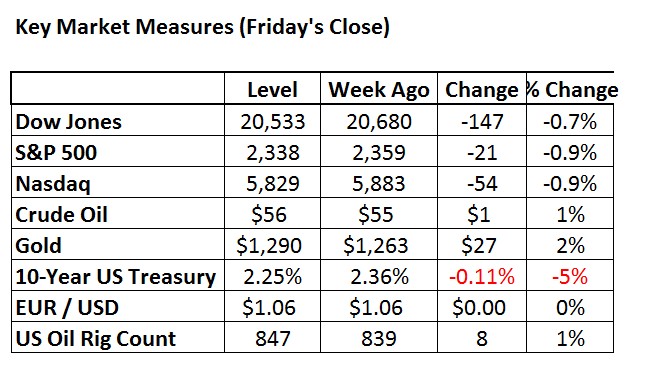
What did the Easter Bunny bring this April to the markets? Much lower interest rates! The 10-year dropped 11 bp to 2.25%. Who says interest rates are going up this year? Not us, for sure. Geopolitical worries are the primary culprit. North Korea, Syria, the Middle East, all the regular actors are to blame. The 10-year Treasury now rests around 5 month lows. Everyone will look to the Fed for guidance about where the markets are going. Interestingly, Trump is now praising Yellen in a public call for Fed consistency, which contradicts his accusations on the campaign trail that she was artificially manipulating the economy in a detrimental way. Hmmm…does Trump see an opportunity to take advantage of low borrowing costs for his $1 trillion infrastructure plan? His Treasury Secretary Steven Mnuchin has publicly expressed interest in doing big time deals for 100 year bonds. And we applaud this. We’ll have to wait and see.
There is always a bull market right here at The Bull Market Report! This week we highlight the following securities: Shopify, VMware, Amazon, Annaly, Apple, and Tesla.
Highlights From The Past Week
Watchful Eye On North Korea. US officials are saying the Trump administration is focusing its North Korea strategy on tougher economic sanctions, possibly including and oil embargo, banning its airline, intercepting cargo ships, and punishing Chinese banks doing business with Pyongyang. According to one official, US President Donald Trump has approved a preliminary broad approach on North Korea and asked his national security team to craft a more detailed framework for new international sanctions and other actions. The official said the administration is considering an array of stiffer sanctions that could be applied on a "sliding scale," proportionate to North Korean actions. Some steps could be applied unilaterally, with others through the United Nations.
Business Returning to the Center Stage in the USA. Business leaders are gaining more and more influence in Trump's White House. Most recently, Jared Kushner, the president's son-in-law, is trying to orchestrate more power for National Economic Council Director Gary Cohn while dampening the influence of chief strategist Steve Bannon. It is quiet the change in scenery to see Washington acting as a friend to business led by accomplished business people. All good news for the markets.
Infrastructure Bill On The Horizon. One of Trump's top policy advisers said the timing of the President's $1 trillion infrastructure package is still up in the air as the administration considers its best path forward. D.J. Gribbin, special assistant to the president for infrastructure policy, said the timeline will hinge on whether it moves as a standalone measure or if it is attached to another legislative priority. It adds that they are still crafting the infrastructure measure. Transportation Secretary Chao said the package could be unveiled as soon as next month. We can’t wait.
BMR Companies and Commentary
Shopify (SHOP: $71, +4%, all price changes in this report are for the past week)
Shopify had a solid week as talks of a takeover swirled. If true, we could see some very nice upside in the near-term. If not, that’s fine with us, as we still like the company’s fundamentals and prospects. Bottom line, Shopify still has room to run whether there is a takeover. Let’s re-visit why.
One can hardly kick back on the couch and watch CNBC or browse through your favorite financial publication these days for more than a few minutes before you come across a discussion of Amazon, as the online Retail juggernaut has skyrocketed to become an American business behemoth. And rightfully so.
For investors who want to capitalize on the undeniable secular growth trend of eCommerce, but who either missed the boat on Amazon or are wary of its nosebleed valuation, is there another road less traveled that they could embark on to get exposure to the eCommerce tidal wave? One that has impressive momentum and an ascendant stock price, but just not as frothy of a gain as Amazon? Yes there is. That’s Shopify.
Shopify not long ago announced its full-year financial results for 2016, and boasted 90% revenue growth and 99% growth in gross merchandise volume, (a term used in online retailing to indicate a total sales dollar value for merchandise sold through a particular marketplace over a certain time frame.) As an added bonus, Shopify's “Sell on Amazon” integration was made generally available to merchants in December. This mean Shopify now seamlessly connects store owners to the millions of customers searching for products to buy on Amazon, and merchants can now conveniently manage their product catalog for their eCommerce website, retail store, Amazon store, and other sales channels all in one place. This is big time! Since this integration just took place in December, we are only at the tip of the iceberg in terms of benefits and synergies from the move for Shopify.
BMR Take: The consensus calls for Shopify to more than double revenue from $600 million this year to $1.4 billion by 2020. This kind of explosive growth could cause the stock to double over the same period.
Amazon (AMZN: $884, down 1%)
A new week; Another big move brewing for Amazon. It is said that the eCommerce giant considered internally whether Whole Foods would help invigorate its nearly decade-long push into groceries. That is, Amazon kicked around the idea of buying the grocery chain!
Whole Foods has long been seen as a buyout target. Activist investor Jana Partners set off a new wave of speculation this week when it acquired a stake and urged the company to evaluate a sale. With a market valuation of $11 billion, the ailing organic-food retailer would be a powerful acquisition for Amazon -- dwarfing its 2009 purchase of online shoe retailer Zappos for about $1.2 billion. But the deal would turn Amazon into a grocery giant overnight and help it sideline Instacart, a startup that delivers grocery orders from Whole Foods stores in more than 20 states.
Jana has called for Whole Foods to overhaul its operations and brought in retail and food experts to help foster a turnaround. It also urged the company to consider a sale. A list of potential bidders includes Amazon, as well as traditional grocery chains such as Kroger and Albertsons. Whole Foods remains an attractive asset, even after a sales slump and the loss of market share to mainstream supermarkets, because the brand is strong and could be leveraged into something big.
BMR Take: Amazon and CEO Jeff Bezos are winning at everything. Why not grocery? Current Street earnings estimates call for $27 per share by 2020. With so much growth and strong earnings potential, the shares are compelling here.
Annaly Capital Management (NLY: $11.63, +5%)
Looking for yield in this market? Look here! Annaly Capital Management is a top pick in the Mortgage REIT sector.
Let’s review some of the reasons to like Annaly. Home price gains were up 6% in latest report from Case-Shiller, showing acceleration in home price increases. Tight supplies and rising prices may be deterring some people from trading up to a larger house, further aggravating supplies because fewer people are selling their homes. This is a good trend for Annaly. Annaly owns mortgages so rising home prices means the credit risk of owning the bonds is safer.
Annaly has a broad exposure across the US unlike other competitors more narrowly focused on only a particular market like New York. Yet another reason to like Annaly.
BMR Take: With a yield of 10.6% and a track record of over 20 years doing this, we continue to pound the table on Annaly. Look at this stock – up from $10.12 in mid-January in the midst of a strong interest rate rise with EVERY pundit saying that Annaly will be impacted sharply with the higher rates. Boy oh boy where they ever wrong. And boy oh boy were we ever right. Of course we’ve been saying this since we founded The Bull Market Report in 1998!
Apple (AAPL: $141, -2%)
Apple to buy Disney? Now that’s exciting! It could be more realistic than you think. Apple has the cash to pull off a $200 billion-plus takeover of Disney — creating a company worth $1 trillion with “almost limitless opportunities in content and technology.
A combined Apple-Disney would create an instant competitor to Netflix that would take advantage of the Mouse House’s content and Apple’s user base. Other benefits include: integrating Apple consumer tech as experiences in Disney’s theme parks; and landing global streaming sports rights for ESPN via Disney and Apple distribution and a strong balance sheet. Content is a major focus for Apple, target size is not an issue, and Disney offers an avenue to diversify away from hardware without diluting the strong Apple brand.
The M&A rumor mill got new grist last fall, when Apple chief Tim Cook told analysts that he was “open to acquisitions of any size.” In addition, Apple execs met with Time Warner honchos in 2015 in a discussion that raised the possibility of a merger - before AT&T moved on its $85 billion bid for Time Warner,
Per one analyst’s estimates, the merger of Apple and Disney would be highly accretive to earnings, to the tune of a 15%-20% increase in earnings per share based on the presumed 40% premium deal price and Disney’s low debt load. Nice!
BMR Take: We say it every week and we’ll say it again. Apple is really cheap compared to the current EPS outlook for this year of nearly $9. And all that cash put to good use through buying a storied franchise like Disney could be an exciting catalyst/prospect for the company.
Tesla (TSLA: $306, flat)
Tesla is a new entrant into the automobile, solar and battery storage businesses. Since Tesla’s current revenue is roughly 99% automobile related and, due to the Model 3 introduction and projected sales, this ratio will likely remain similar for quite some time. Thus, Tesla is an auto manufacturer, plain and simple. Panasonic supplies Tesla with batteries. Other companies provide Tesla with electric motors, tires, wheels, etc. Thus, with a few extraneous business lines, Tesla designs and assembles cars. Until Tesla’s battery storage business and solar equipment business become majority contributors, it will remain viewed as an auto company.
The good news is that’s okay!
Tesla CEO Elon Musk says his company will unveil its electric tractor-trailer truck this September, calling the vehicle “seriously next level” and praising the Tesla team for doing “an amazing job.” He also revealed that Tesla will show off an electric pickup truck in 18 to 24 months. Awesome innovation.
BMR Take: Street estimates call for sales growth from $7 billion last year to $11 billion this year to $33 billion in 2020. This is an exciting time for the business and the stock.
Note that Tesla was upgraded by Piper Jaffray from a "neutral" rating to an "overweight" rating last week. They now have a $368 price target on the stock, up previously from $223. We have a $325 Price Target on the stock.
Netflix (NFLX:$143, flat) had its price objective hoisted by Cowen from $165 to $170 in a research note released on Tuesday. Our Price Target is $165.
Upcoming Economic News
FRIDAY, APRIL 14 (Yes, this was on Friday – Good Friday)
Consumer Price Index
For March
Forecast: -0.1%
Actual: -0.1%
The Consumer Price Index was forecast to fall 0.1% in March following a 0.1% gain in February and 0.6% increase in January. It did. This was the first decline in the CPI since February 2016. Energy prices were a net drag on the CPI in March. The CPI for food and beverages rose 0.2% in February, the strongest since September 2013.
Retail Sales (This too was announced on Friday the 14th.)
For March
Forecast: -0.3%
Actual: -0.2%
Consensus expected retail sales to have dropped 0.3% in March following a 0.1% gain in February and 0.6% increase in January. Results were slightly better than expected. We believe weather was likely a small negative for sales. Non-store sales (online) have been contributing more to growth in retail sales recently. Already released data showed that unit vehicle sales dropped 5.5% in March and shaved 0.4% off total retail sales growth.
Tuesday, April 18th
Housing Starts
Period: March
8:30 AM
Consensus: 1,245,000
Prior: 1,288,000
Housing starts should continue to signal a healthy economy. The data reveals the number of housing units started in the United States. The U.S. Census Bureau's New Residential Construction release provides statistics on the construction of new privately-owned residential structures in the United States.
Thursday, April 20th
Leading Indicators
Period: March
10:00 AM
Consensus: 0.3%
Prior: 0.6%
This one is interesting to watch. Everybody is so focused on trying to figure out what direction the markets are heading. This is one of the key metrics that tells us. Leading indicators are economic series that tend to change direction ahead of shifts in the business cycle. There are 10 components of the U.S. Leading Composite Indicator published by The Conference Board. The index is constructed by averaging the individual components in order to smooth out a good part of the volatility of the individual series. Historically, the cyclical turning points in the leading index have occurred before those in actual economic activity.
Facebook Adds a Million Advertisers in 7 Months
There is a big move going on in the digital marketing world that many are not aware of. More than 5 million businesses are advertising on Facebook each month, Reuters reports. That is up from 4 million monthly advertisers in September 2016, and the 3 million monthly advertisers it had in March 2016. Significant upside remains as Facebook’s 5 million advertisers are less than 10% of the 65 million businesses that are active on the network.
Facebook is one of two undisputed leaders in digital advertising. Alongside Google, the company is expected to generate about half of online ad spend in 2018. Facebook generated close to $27 billion, and Google close to $80 billion, in ad revenue last year.
Small and midsize brands are flocking to advertise on Facebook. Big brands may drive the bulk of revenue in advertising markets, but there is still ample opportunity for growth with the smaller brand advertisers. The sheer volume of advertisers on Facebook reflects the company’s success in attracting these smaller firms its platform.
A few industries are generating the bulk of Facebook ad spend. E-commerce and Retail, and Entertainment and Media are the biggest industries represented in Facebook's advertiser base.
Facebook is doing a great job at building its advertising base overseas - over 75% of advertisers are outside of the US. India, Thailand, Brazil, Mexico and Argentina are the fastest-growing markets.
Mobile is big, as you know. Almost 50% of advertisers create ads on mobile devices. More than 90% of Facebook users access the network via mobile. And mobile advertising accounts for 85% of ad revenue. Creating mobile-first experiences is particularly key in emerging markets.
The biggest users of Facebook are the US at 220 million; India at 210 million; Brazil at 120 million; Indonesia at 75 million and Mexico at 65 million.
Our Take on SNAP
Snap (SNAP: $20) went public at $17 in early March and promptly opened at $24. They raised $3.4 billion making it the largest IPO since Alibaba went public in 2014, raising $20 billion. The market cap is now $23 billion and all of this for a company with no revenue in 2015, $400 million in 2016 and losses of $500 million in 2016. Ouch. More losses than revenues. Not a good business model.
Snapchat has grabbed the attention of a generation of younger smartphone users, who post and share photos and videos on the app that can disappear after a set amount of time. The app - developed by Stanford University students, two of whom are still executives at Snap had 160 million daily active users as of December 2016,
BMR Take: We are steering clear of this one. One might compare this a bit to Facebook, but Facebook had huge revenues and real earnings when it went public, and the growth since then has been phenomenal as you know. The Snap IPO has invigorated the IPO market and Wall Street is generally pleased, but for this company to get to $40 or $50 a share, we will have to see revenues of 10-20 times current levels, and big profitability, both of which may never materialize. We are steering clear.
The High Yield Report
By Michael Foster
Special to The Bull Market Report
It was a short week, but an eventful one. Already we’re seeing tons of articles about how the stock market is in crisis. Looking at volatility, there seems to be reason to think this; we went from a VIX of about 10 to nearly 16 in days. This means there is more caution in the market, and expectations of a short-term downturn. However, those expectations will disappear as they always do and the bull market will return as it always does.
We can already see pockets of optimism in the high yield world. In fact, We’d go so far as to say we’re beginning to see a sector rotation among investors that is benefitting parts of the high yield universe.
Before we get into that, though, let’s look at who is not winning. The UBS BDC ETF (BDCS: $23, down 1%) saw a soft week that was no worse than the broader market, but definitely was not good. This move is actually not that bad, considering that BDCs have had a massive run-up for months and has driven the entire sector higher. One well-known BDC analyst recently pointed out that the sector has beaten the S&P 500 since the start of 2014. This kind of cherry-picking time series doesn’t tell us much, but it does remind us that BDCs had an extremely vicious decline in 2013 and have been recovering for years since then as the market readjusts its understanding of what a rising rate environment means for these assets. It also means that the bargains in this odd corner of the business lending universe have dried up. That’s a shame, because The Bull Market Report is eagerly awaiting adding a BDC to the high yield portfolio, but this week’s 1% decline isn’t enough for us to do it. In fact, the recent decline may indicate that weaker prices might be just on the horizon, indicating a need to buy some BDCs when the price is right. Stay tuned as we keep focusing on this story.
So if BDCs aren’t benefiting from the fall in stocks this week, who is?
The answer is obvious: REITs. The SPDR Dow Jones REIT ETF (RWR: $94) was mostly flat for the last four days but is up 1% from last Friday - and comparing REITs to a week ago is really key here, because the momentum in REITs really started to kick off on Monday and has stayed strong with the many REITs in the Bull Market Report portfolio.
Let’s start with Kimco Realty (KIM: $22, up 4%), which shot up at the start of the week and has maintained its higher price level. Kimco is expected to report earnings by the end of this month, and analysts’ expectations are strong. Despite expectations of a 1% revenue decline, FFO expectations put Kimco’s dividend coverage in the 140% range. This means that Kimco is expected to far cover its dividend and have room to increase payouts. That should mean the company should be a low yielder, but this company’s 5% dividend yield indicates market expectations of risk are growing. Why the disconnect?
Simple: the decline in Retail.
Long story short, shopping malls are collapsing. The high-profile news of bankruptcies at Sears and JCPenny are making investors grow increasingly confident that the Retail sector is an apocalypse that no investor should come near. Of course these people are forgetting just how strong things are for Whole Foods, upscale outlet malls, Apple stores, and several other corners of the retail market that Kimco just happens to be focused on. In fact, Kimco’s tenants tend to be the most well-heeled and revenue-safe firms in the Retail landscape, so this collapse has little impact on them. Their occupancy rates have remained near 99% throughout. And although these issues are now high profile, they’ve been top of mind for Kimco management for a decade - and management has addressed these issues both in their strategic decisions and in their earnings calls.
In short, Kimco is not affected by the slowdown of the suburban American shopping mall.
Investors don’t know this, of course, so they’re throwing out the baby with the bathwater. That means now is a buying opportunity unlike no other. In fact, Kimco looks like one of the most attractive options for high yield investors. Of all our picks, Kimco looks like one of the most undervalued.
A similar story hit Government Properties Trust (GOV: $22, up 3%) over the past week, making it one of the top performers in a well-performing sector. Government Properties is heavily exposed to federal government tenants, and lower government spending has been seen as a real risk for the company. As a result of this fear, the company has looked to diversify by investing in office space that would be more insulated from the expected weaker demand in government properties. That has created a swiftly diversified portfolio that also has firm dividend coverage, but the market never really saw it that way. Instead, Government Properties is always seen as a risky option, which is why it often traded at an 11% yield. That’s what the stock was yielding when we first recommended it, and now it’s trading at less than an 8% yield, thanks entirely to capital gains. Sadly, that means buying more of Government Properties isn’t the greatest idea right now, but it does remain a solid hold thanks to its capital gains. The last week’s recent 3% jump is likely just the beginning; this company has a much safer income stream than its yield would indicate, meaning price gains are likely to come. We recommend staying in the stock to enjoy those gains as demand for REITs continues to rise.
Our other REITs did well this week too. Digital Realty Trust (DLR: $110, up 1%), Omega Healthcare Investors (OHI: $34, up 1%), and Care Capital Properties (CCP: $27, up 1%) all saw modest gains largely as a result of the continuation of a recent trend. CCP and OHI have been recovering recently from an oversold situation in healthcare REITs - in short, the market sold way too many of these because they thought a variety of risks (interest rates, cuts to Medicaid and Obamacare, etc.) would damage these firms permanently. These were considered long-tail risks not priced into the stocks, and yet these companies are doing fine and the risks the market has perceived are not materializing. In fact, they may never be real concerns for the companies. As a result, the stocks have no place to go but up. While we’re sitting on double-digit gains for Care Capital, we see more room to grow and thus recommend holding tight on these firms.
Finally, a word on municipal bonds. The iShares S&P National AMT-Free Municipal Bond Fund (MUB: $110, flat) didn’t move much this week although our muni bond picks did. Invesco Municipal Trust (VKQ: $13, up 1%) and the Nuveen AMT-Free Fund (NVG: $15, up 1%) outpaced the market, and we expect further gains in the municipal bond market to drive both of these funds higher. What’s going on is quite simply secular demand for munis returning to the market, largely a result of the higher uncertainty and fear that is driving stocks lower. In short, many retail investors are getting skittish and feel a need to pull out of risk and get lower risk assets.
This is driving a broad base of investors to demand more municipal bonds, driving up their value and in turn driving up the net asset values of these and other municipal bond funds. Since munis are far undervalued again due to risks that were feared but are not materializing, there is a lot more room for these funds to rise in price before they’re fairly valued. Thus muni fund holders should enjoy the gains they’re getting now but shouldn’t sell yet; if the market stays afraid these funds are destined to rise considerably. If the market gets more courageous, these funds are still destined to rise (although perhaps at a slower pace) because they have been massively undervalued due to ridiculous fears about muni bonds that aren’t materializing. Either way, the direction is clear: Keep and hold these funds and wait for their pricing to better match their real value.
Good Investing,
Todd Shaver
Editor, Founder and CEO
The Bull Market Report
Since 1998
April 16, 2017
by Todd Shaver | Apr 16, 2017 | Weekly Newsletter 7pm Sunday
The Week Ahead
What did the Easter Bunny bring this April to the markets? Much lower interest rates! The 10-year dropped 11 bp to 2.25%. Who says interest rates are going up this year? Not us, for sure. Geopolitical worries are the primary culprit. North Korea, Syria, the Middle East, all the regular actors are to blame. The 10-year Treasury now rests around 5 month lows. Everyone will look to the Fed for guidance about where the markets are going. Interestingly, Trump is now praising Yellen in a public call for Fed consistency, which contradicts his accusations on the campaign trail that she was artificially manipulating the economy in a detrimental way. Hmmm…does Trump see an opportunity to take advantage of low borrowing costs for his $1 trillion infrastructure plan? His Treasury Secretary Steven Mnuchin has publicly expressed interest in doing big time deals for 100 year bonds. And we applaud this. We’ll have to wait and see.
There is always a bull market right here at The Bull Market Report! This week we highlight the following securities: Shopify, VMware, Amazon, Annaly, Apple, and Tesla.
Highlights From The Past Week
Watchful Eye On North Korea. US officials are saying the Trump administration is focusing its North Korea strategy on tougher economic sanctions, possibly including and oil embargo, banning its airline, intercepting cargo ships, and punishing Chinese banks doing business with Pyongyang. According to one official, US President Donald Trump has approved a preliminary broad approach on North Korea and asked his national security team to craft a more detailed framework for new international sanctions and other actions. The official said the administration is considering an array of stiffer sanctions that could be applied on a "sliding scale," proportionate to North Korean actions. Some steps could be applied unilaterally, with others through the United Nations.
Business Returning to the Center Stage in the USA. Business leaders are gaining more and more influence in Trump's White House. Most recently, Jared Kushner, the president's son-in-law, is trying to orchestrate more power for National Economic Council Director Gary Cohn while dampening the influence of chief strategist Steve Bannon. It is quiet the change in scenery to see Washington acting as a friend to business led by accomplished business people. All good news for the markets.
Infrastructure Bill On The Horizon. One of Trump's top policy advisers said the timing of the President's $1 trillion infrastructure package is still up in the air as the administration considers its best path forward. D.J. Gribbin, special assistant to the president for infrastructure policy, said the timeline will hinge on whether it moves as a standalone measure or if it is attached to another legislative priority. It adds that they are still crafting the infrastructure measure. Transportation Secretary Chao said the package could be unveiled as soon as next month. We can’t wait.
BMR Companies and Commentary
Shopify (SHOP: $71, +4%, all price changes in this report are for the week)
Shopify had a solid week as talks of a takeover swirled. If true, we could see some very nice upside in the near-term. If not, that’s fine with us, as we still like the company’s fundamentals and prospects. Bottom line, Shopify still has room to run whether there is a takeover. Let’s re-visit why.
One can hardly kick back on the couch and watch CNBC or browse through your favorite financial publication these days for more than a few minutes before you come across a discussion of Amazon, as the online Retail juggernaut has skyrocketed to become an American business behemoth. And rightfully so.
For investors who want to capitalize on the undeniable secular growth trend of eCommerce, but who either missed the boat on Amazon or are wary of its nosebleed valuation, is there another road less traveled that they could embark on to get exposure to the eCommerce tidal wave? One that has impressive momentum and an ascendant stock price, but just not as frothy of a gain as Amazon? Yes there is. That’s Shopify.
Shopify not long ago announced its full-year financial results for 2016, and boasted 90% revenue growth and 99% growth in gross merchandise volume, (a term used in online retailing to indicate a total sales dollar value for merchandise sold through a particular marketplace over a certain time frame.) As an added bonus, Shopify's “Sell on Amazon” integration was made generally available to merchants in December. This mean Shopify now seamlessly connects store owners to the millions of customers searching for products to buy on Amazon, and merchants can now conveniently manage their product catalog for their eCommerce website, retail store, Amazon store, and other sales channels all in one place. This is big time! Since this integration just took place in December, we are only at the tip of the iceberg in terms of benefits and synergies from the move for Shopify.
BMR Take: The consensus calls for Shopify to more than double revenue from $600 million this year to $1.4 billion by 2020. This kind of explosive growth could cause the stock to double over the same period.
VMware (VMW: $91, -1.6%)
VMware made some waves this week announcing intentions to acquire Wavefront, the leading metrics monitoring service for cloud and modern application environments. Terms were not disclosed. The transaction is expected to close in calendar Q217. VMware does not expect this transaction to have a material impact on its 2017 operating results. But don’t write off the deal as not important just because the financial impact isn’t going to be seen in the near-term.
Digital enterprises face challenges of a new order of magnitude when monitoring modern applications -- consisting of hundreds of microservices in containers with lifespans of seconds -- spread across private and public clouds. To identify and fix operational issues in these dynamic cross-cloud environments, developers need new instrumentation for their applications, and teams require sophisticated real-time analytics on their high-scale distributed systems to adapt to problems before they impact the business.
Wavefront provides metrics to optimize clouds and modern applications by delivering operational insights using millions of data points per second in real-time. Operators and developers can interrogate real-time data streams to discover new ways to address problems, identify bottlenecks, and test algorithms and hypotheses. A cloud-hosted service, Wavefront ingests, stores, visualizes, and alerts on streaming data from clouds and modern applications enabling superior operational performance. The service can measure, correlate, and analyze data across servers, devices, applications, end-user behavior, multiple public cloud and data center attributes, and business metrics. (Now that’s a mouthful.)
This is big news for the underlying story at VMware, which is most exciting given the company’s increasing presence in the cloud marketplace. For seven-plus years, VMware has invested in solutions featuring advanced metrics and analytics to help customers simplify and automate how they manage, monitor and troubleshoot services in dynamic virtual and cloud environments. As all these investment start paying off, we see VMware as a top pick for Technology investors.
BMR Take: The company is currently generating $5-6 of EPS annually. The current valuation seems like a bargain considering all the progress with the cloud business. Our Price Target is $95 which would be a 2-year high and a more than double from the $44 low it hit in February last year. If the stock hits $95, we are moving our Price Target up into triple-digits, especially if revenues continue to soar. You know what we say about revenues and earnings: Revenues first, then earnings.
Amazon (AMZN: $884, down 1%)
A new week; Another big move brewing for Amazon. It is said that the eCommerce giant considered internally whether Whole Foods would help invigorate its nearly decade-long push into groceries. That is, Amazon kicked around the idea of buying the grocery chain!
Whole Foods has long been seen as a buyout target. Activist investor Jana Partners set off a new wave of speculation this week when it acquired a stake and urged the company to evaluate a sale. With a market valuation of $11 billion, the ailing organic-food retailer would be a powerful acquisition for Amazon -- dwarfing its 2009 purchase of online shoe retailer Zappos for about $1.2 billion. But the deal would turn Amazon into a grocery giant overnight and help it sideline Instacart, a startup that delivers grocery orders from Whole Foods stores in more than 20 states.
Jana has called for Whole Foods to overhaul its operations and brought in retail and food experts to help foster a turnaround. It also urged the company to consider a sale. A list of potential bidders includes Amazon, as well as traditional grocery chains such as Kroger and Albertsons. Whole Foods remains an attractive asset, even after a sales slump and the loss of market share to mainstream supermarkets, because the brand is strong and could be leveraged into something big.
BMR Take: Amazon and CEO Jeff Bezos are winning at everything. Why not grocery? Current Street earnings estimates call for $27 per share by 2020. With so much growth and strong earnings potential, the shares are compelling here.
Annaly Capital Management (NLY: $11.63, +5%)
Looking for yield in this market? Look here! Annaly Capital Management is a top pick in the Mortgage REIT sector.
Let’s review some of the reasons to like Annaly. Home price gains were up 6% in latest report from Case-Shiller, showing acceleration in home price increases. Tight supplies and rising prices may be deterring some people from trading up to a larger house, further aggravating supplies because fewer people are selling their homes. This is a good trend for Annaly. Annaly owns mortgages so rising home prices means the credit risk of owning the bonds is safer.
Annaly has a broad exposure across the US unlike other competitors more narrowly focused on only a particular market like New York. Yet another reason to like Annaly.
BMR Take: With a yield of 10.6% and a track record of over 20 years doing this, we continue to pound the table on Annaly. Look at this stock – up from $10.12 in mid-January in the midst of a strong interest rate rise with EVERY pundit saying that Annaly will be impacted sharply with the higher rates. Boy oh boy where they ever wrong. And boy oh boy were we ever right. Of course we’ve been saying this since we founded The Bull Market Report in 1998!
Apple (AAPL: $141, -2%)
Apple to buy Disney? Now that’s exciting! It could be more realistic than you think. Apple has the cash to pull off a $200 billion-plus takeover of Disney — creating a company worth $1 trillion with “almost limitless opportunities in content and technology.
A combined Apple-Disney would create an instant competitor to Netflix that would take advantage of the Mouse House’s content and Apple’s user base. Other benefits include: integrating Apple consumer tech as experiences in Disney’s theme parks; and landing global streaming sports rights for ESPN via Disney and Apple distribution and a strong balance sheet. Content is a major focus for Apple, target size is not an issue, and Disney offers an avenue to diversify away from hardware without diluting the strong Apple brand.
The M&A rumor mill got new grist last fall, when Apple chief Tim Cook told analysts that he was “open to acquisitions of any size.” In addition, Apple execs met with Time Warner honchos in 2015 in a discussion that raised the possibility of a merger - before AT&T moved on its $85 billion bid for Time Warner,
Per one analyst’s estimates, the merger of Apple and Disney would be highly accretive to earnings, to the tune of a 15%-20% increase in earnings per share based on the presumed 40% premium deal price and Disney’s low debt load. Nice!
BMR Take: We say it every week and we’ll say it again. Apple is really cheap compared to the current EPS outlook for this year of nearly $9. And all that cash put to good use through buying a storied franchise like Disney could be an exciting catalyst/prospect for the company.
Tesla (TSLA: $306, flat)
Tesla is a new entrant into the automobile, solar and battery storage businesses. Since Tesla’s current revenue is roughly 99% automobile related and, due to the Model 3 introduction and projected sales, this ratio will likely remain similar for quite some time. Thus, Tesla is an auto manufacturer, plain and simple. Panasonic supplies Tesla with batteries. Other companies provide Tesla with electric motors, tires, wheels, etc. Thus, with a few extraneous business lines, Tesla designs and assembles cars. Until Tesla’s battery storage business and solar equipment business become majority contributors, it will remain viewed as an auto company.
The good news is that’s okay!
Tesla CEO Elon Musk says his company will unveil its electric tractor-trailer truck this September, calling the vehicle “seriously next level” and praising the Tesla team for doing “an amazing job.” He also revealed that Tesla will show off an electric pickup truck in 18 to 24 months. Awesome innovation.
BMR Take: Street estimates call for sales growth from $7 billion last year to $11 billion this year to $33 billion in 2020. This is an exciting time for the business and the stock.
Note that Tesla was upgraded by Piper Jaffray from a "neutral" rating to an "overweight" rating last week. They now have a $368 price target on the stock, up previously from $223. We have a $325 Price Target on the stock.
Netflix (NFLX:$143, flat) had its price objective hoisted by Cowen from $165 to $170 in a research note released on Tuesday. Our Price Target is $165.
Upcoming Economic News
FRIDAY, APRIL 14 (Yes, this was on Friday – Good Friday)
Consumer Price Index
For March
Forecast: -0.1%
Actual: -0.1%
The Consumer Price Index was forecast to fall 0.1% in March following a 0.1% gain in February and 0.6% increase in January. It did. This was the first decline in the CPI since February 2016. Energy prices were a net drag on the CPI in March. The CPI for food and beverages rose 0.2% in February, the strongest since September 2013.
Retail Sales (This too was announced on Friday the 14th.)
For March
Forecast: -0.3%
Actual: -0.2%
Consensus expected retail sales to have dropped 0.3% in March following a 0.1% gain in February and 0.6% increase in January. Results were slightly better than expected. We believe weather was likely a small negative for sales. Non-store sales (online) have been contributing more to growth in retail sales recently. Already released data showed that unit vehicle sales dropped 5.5% in March and shaved 0.4% off total retail sales growth.
Tuesday, April 18th
Housing Starts
Period: March
8:30 AM
Consensus: 1,245,000
Prior: 1,288,000
Housing starts should continue to signal a healthy economy. The data reveals the number of housing units started in the United States. The U.S. Census Bureau's New Residential Construction release provides statistics on the construction of new privately-owned residential structures in the United States.
Thursday, April 20th
Leading Indicators
Period: March
10:00 AM
Consensus: 0.3%
Prior: 0.6%
This one is interesting to watch. Everybody is so focused on trying to figure out what direction the markets are heading. This is one of the key metrics that tells us. Leading indicators are economic series that tend to change direction ahead of shifts in the business cycle. There are 10 components of the U.S. Leading Composite Indicator published by The Conference Board. The index is constructed by averaging the individual components in order to smooth out a good part of the volatility of the individual series. Historically, the cyclical turning points in the leading index have occurred before those in actual economic activity.
Notes at the Margin
By Phil K. Verleger, Jr.
Former Director of the Office of Energy Policy
at the United States Department of Treasury
This item published by Platts Global Alert first caught my eye: “The Permian Basin [in Texas] is going to become the largest oil field in the world, surpassing the legendary Ghawar field of Saudi Arabia,” Bill Marko, managing director of Jefferies, said on the sidelines of the conference.
The basin holds an estimated 210 billion barrels of oil that will become economically recoverable in the future, or 325 billion barrels of oil equivalent when oil and natural gas liquids are counted, he said.
The 210 billion barrel estimate caught my attention. After all, Saudi Arabia’s reserves are put at “only” 260 billion barrels per the BP Statistical Review of World Energy. It is hard to believe that one US field has oil reserves equal to 80% of Saudi reserves.
The US Energy Information Administration recently published a short-term outlook predicting an 8% increase in US production from 8.8 million barrels per day in December 2016 to 9.5 million barrels per day in December 2017. Given recent trends, the estimate will likely need to be revised again, perhaps to 10 million barrels per day or more.
BMR Take: Phil – Knowing you the way I do, this is your way of jumping up and down and waving your arms like a madman. This is certainly big news. We have seen it coming to a certain extent but when you put it in writing the way you do, this is making us stand up and take notice. There are big changes afoot in the energy world. We would venture to say that $100 oil is not going to be seen for a long, long time to come. Prepare accordingly.
A Word from Gary Jefferson
Jefferson Financial Group
First Vice-President, Investments
UBS Financial Services, Inc.
They honored Arnold Palmer this past weekend at the Masters Golf Tournament. He was one of the few greats who turned the game into a hugely popular spectator's sport. One of his best known quotes is: "Golf is deceptively simple and endlessly complicated."
As words of wisdom go, we can't think of a quote that could be any more applicable to the stock market. As simple as "buy low, sell high," to as complicated as the blackboard full of equations in Einstein's office. Our formula for investment success has always been "Success = preparation, recognition of value and proper seizing of opportunity." Preparation is fairly simple in the sense that it's mostly reading. But it takes a lot of reading and research on an endless basis. The complicated part is filtering out all the "noise" and learning what resources you can rely on and trust. Overall, we are believers in the KISS principle when applying our formula because we have learned over the years that the more complicated the investment process becomes, the harder it is to stay on track.
If you want to keep it as simple as possible, just think of one word - earnings. Good earnings signal a rising stock market. Weak earnings are normally a forecast of a weak or falling market.
That's where we are today. First quarter earnings season kicked off last week with several big banks reporting. First quarter earnings growth is expected to be 10%, the best since 2014. Sales growth, a laggard in the financial recovery, is expected to grow by 7.5% - its best pace since 2011! (Source: Thomson Reuters)
In addition to corporate earnings, investors will also likely monitor the economic calendar to be sure there is no unexpected deterioration in important statistical areas. And if you want to complicate it just a bit, throw in the fact that investors will probably just continue to wait for word from Washington on their pro-growth agenda. When that will actually be announced, and how long it takes to pass, are currently unknown and unknowable. So, while we may be stuck in a trading range pending the agenda results, earnings should provide a simple-to-understand reason to expect that the market will eventually work its way to a higher level.
Facebook Adds a Million Advertisers in 7 Months
There is a big move going on in the digital marketing world that many are not aware of. More than 5 million businesses are advertising on Facebook each month, Reuters reports. That is up from 4 million monthly advertisers in September 2016, and the 3 million monthly advertisers it had in March 2016. Significant upside remains as Facebook’s 5 million advertisers are less than 10% of the 65 million businesses that are active on the network.
Facebook is one of two undisputed leaders in digital advertising. Alongside Google, the company is expected to generate about half of online ad spend in 2018. Facebook generated close to $27 billion, and Google close to $80 billion, in ad revenue last year.
Small and midsize brands are flocking to advertise on Facebook. Big brands may drive the bulk of revenue in advertising markets, but there is still ample opportunity for growth with the smaller brand advertisers. The sheer volume of advertisers on Facebook reflects the company’s success in attracting these smaller firms its platform.
A few industries are generating the bulk of Facebook ad spend. E-commerce and Retail, and Entertainment and Media are the biggest industries represented in Facebook's advertiser base.
Facebook is doing a great job at building its advertising base overseas - over 75% of advertisers are outside of the US. India, Thailand, Brazil, Mexico and Argentina are the fastest-growing markets.
Mobile is big, as you know. Almost 50% of advertisers create ads on mobile devices. More than 90% of Facebook users access the network via mobile. And mobile advertising accounts for 85% of ad revenue. Creating mobile-first experiences is particularly key in emerging markets.
The biggest users of Facebook are the US at 220 million; India at 210 million; Brazil at 120 million; Indonesia at 75 million and Mexico at 65 million.
Our Take on SNAP
Snap (SNAP: $20) went public at $17 in early March and promptly opened at $24. They raised $3.4 billion making it the largest IPO since Alibaba went public in 2014, raising $20 billion. The market cap is now $23 billion and all of this for a company with no revenue in 2015, $400 million in 2016 and losses of $500 million in 2016. Ouch. More losses than revenues. Not a good business model.
Snapchat has grabbed the attention of a generation of younger smartphone users, who post and share photos and videos on the app that can disappear after a set amount of time. The app - developed by Stanford University students, two of whom are still executives at Snap had 160 million daily active users as of December 2016,
BMR Take: We are steering clear of this one. One might compare this a bit to Facebook, but Facebook had huge revenues and real earnings when it went public, and the growth since then has been phenomenal as you know. The Snap IPO has invigorated the IPO market and Wall Street is generally pleased, but for this company to get to $40 or $50 a share, we will have to see revenues of 10-20 times current levels, and big profitability, both of which may never materialize. We are steering clear.
The High Yield Report
By Michael Foster
Special to The Bull Market Report
It was a short week, but an eventful one. Already we’re seeing tons of articles about how the stock market is in crisis. Looking at volatility, there seems to be reason to think this; we went from a VIX of about 10 to nearly 16 in days. This means there is more caution in the market, and expectations of a short-term downturn. However, those expectations will disappear as they always do and the bull market will return as it always does.
We can already see pockets of optimism in the high yield world. In fact, We’d go so far as to say we’re beginning to see a sector rotation among investors that is benefitting parts of the high yield universe.
Before we get into that, though, let’s look at who is not winning. The UBS BDC ETF (BDCS: $23, down 1%) saw a soft week that was no worse than the broader market, but definitely was not good. This move is actually not that bad, considering that BDCs have had a massive run-up for months and has driven the entire sector higher. One well-known BDC analyst recently pointed out that the sector has beaten the S&P 500 since the start of 2014. This kind of cherry-picking time series doesn’t tell us much, but it does remind us that BDCs had an extremely vicious decline in 2013 and have been recovering for years since then as the market readjusts its understanding of what a rising rate environment means for these assets. It also means that the bargains in this odd corner of the business lending universe have dried up. That’s a shame, because The Bull Market Report is eagerly awaiting adding a BDC to the high yield portfolio, but this week’s 1% decline isn’t enough for us to do it. In fact, the recent decline may indicate that weaker prices might be just on the horizon, indicating a need to buy some BDCs when the price is right. Stay tuned as we keep focusing on this story.
So if BDCs aren’t benefiting from the fall in stocks this week, who is?
The answer is obvious: REITs. The SPDR Dow Jones REIT ETF (RWR: $94) was mostly flat for the last four days but is up 1% from last Friday - and comparing REITs to a week ago is really key here, because the momentum in REITs really started to kick off on Monday and has stayed strong with the many REITs in the Bull Market Report portfolio.
Let’s start with Kimco Realty (KIM: $22, up 4%), which shot up at the start of the week and has maintained its higher price level. Kimco is expected to report earnings by the end of this month, and analysts’ expectations are strong. Despite expectations of a 1% revenue decline, FFO expectations put Kimco’s dividend coverage in the 140% range. This means that Kimco is expected to far cover its dividend and have room to increase payouts. That should mean the company should be a low yielder, but this company’s 5% dividend yield indicates market expectations of risk are growing. Why the disconnect?
Simple: the decline in Retail.
Long story short, shopping malls are collapsing. The high-profile news of bankruptcies at Sears and JCPenny are making investors grow increasingly confident that the Retail sector is an apocalypse that no investor should come near. Of course these people are forgetting just how strong things are for Whole Foods, upscale outlet malls, Apple stores, and several other corners of the retail market that Kimco just happens to be focused on. In fact, Kimco’s tenants tend to be the most well-heeled and revenue-safe firms in the Retail landscape, so this collapse has little impact on them. Their occupancy rates have remained near 99% throughout. And although these issues are now high profile, they’ve been top of mind for Kimco management for a decade - and management has addressed these issues both in their strategic decisions and in their earnings calls.
In short, Kimco is not affected by the slowdown of the suburban American shopping mall.
Investors don’t know this, of course, so they’re throwing out the baby with the bathwater. That means now is a buying opportunity unlike no other. In fact, Kimco looks like one of the most attractive options for high yield investors. Of all our picks, Kimco looks like one of the most undervalued.
A similar story hit Government Properties Trust (GOV: $22, up 3%) over the past week, making it one of the top performers in a well-performing sector. Government Properties is heavily exposed to federal government tenants, and lower government spending has been seen as a real risk for the company. As a result of this fear, the company has looked to diversify by investing in office space that would be more insulated from the expected weaker demand in government properties. That has created a swiftly diversified portfolio that also has firm dividend coverage, but the market never really saw it that way. Instead, Government Properties is always seen as a risky option, which is why it often traded at an 11% yield. That’s what the stock was yielding when we first recommended it, and now it’s trading at less than an 8% yield, thanks entirely to capital gains. Sadly, that means buying more of Government Properties isn’t the greatest idea right now, but it does remain a solid hold thanks to its capital gains. The last week’s recent 3% jump is likely just the beginning; this company has a much safer income stream than its yield would indicate, meaning price gains are likely to come. We recommend staying in the stock to enjoy those gains as demand for REITs continues to rise.
Our other REITs did well this week too. Digital Realty Trust (DLR: $110, up 1%), Omega Healthcare Investors (OHI: $34, up 1%), and Care Capital Properties (CCP: $27, up 1%) all saw modest gains largely as a result of the continuation of a recent trend. CCP and OHI have been recovering recently from an oversold situation in healthcare REITs - in short, the market sold way too many of these because they thought a variety of risks (interest rates, cuts to Medicaid and Obamacare, etc.) would damage these firms permanently. These were considered long-tail risks not priced into the stocks, and yet these companies are doing fine and the risks the market has perceived are not materializing. In fact, they may never be real concerns for the companies. As a result, the stocks have no place to go but up. While we’re sitting on double-digit gains for Care Capital, we see more room to grow and thus recommend holding tight on these firms.
Finally, a word on municipal bonds. The iShares S&P National AMT-Free Municipal Bond Fund (MUB: $110, flat) didn’t move much this week although our muni bond picks did. Invesco Municipal Trust (VKQ: $13, up 1%) and the Nuveen AMT-Free Fund (NVG: $15, up 1%) outpaced the market, and we expect further gains in the municipal bond market to drive both of these funds higher. What’s going on is quite simply secular demand for munis returning to the market, largely a result of the higher uncertainty and fear that is driving stocks lower. In short, many retail investors are getting skittish and feel a need to pull out of risk and get lower risk assets.
This is driving a broad base of investors to demand more municipal bonds, driving up their value and in turn driving up the net asset values of these and other municipal bond funds. Since munis are far undervalued again due to risks that were feared but are not materializing, there is a lot more room for these funds to rise in price before they’re fairly valued. Thus muni fund holders should enjoy the gains they’re getting now but shouldn’t sell yet; if the market stays afraid these funds are destined to rise considerably. If the market gets more courageous, these funds are still destined to rise (although perhaps at a slower pace) because they have been massively undervalued due to ridiculous fears about muni bonds that aren’t materializing. Either way, the direction is clear: Keep and hold these funds and wait for their pricing to better match their real value.
Good Investing,
Todd Shaver
Editor, Founder and CEO
The Bull Market Report
Since 1998
April 10, 2017
by Todd Shaver | Apr 10, 2017 | 1pm News Flash
By Michael Foster
(Michael was under the weather yesterday but has made a remarkable recovery!)
Let’s start our retrospective with junk bonds. The SPDR Barclays High Yield Bond ETF (JNK: $37, 6% yield) ended the week mostly flat after going ex-dividend (17 cents each month) last Monday, showing another period of surprising restraint from a tightly-wound up market. Back in early 2016 when we were recommending junk bonds most aggressively, funds like this started a bull run that was steep and long lasting, hindered only by a correction at the end of the election cycle that reversed course shortly after Trump won. Junk bonds returned to their 52-week high by February, and since then have reversed course slightly. The market is about 2% off its recent high, with the correction happening mostly over the last month or so.
This is good news for the junk bond market because of two big pressures happening to the market. First is the yield spread issue. U.S. Treasury yields have been climbing higher although recently stalling, and yields on junk bonds needed to either go higher or stay where they were lest the spread between Treasury and junk bond yields get too small and thus disincentivize investors from buying junk bonds. Since bond yields and prices are inversely related, this meant junk bond prices had to go down a little or a lot. The market decided on a little, and spread the pain out over several weeks. This is a restrained move, indicating a market awareness that junk bonds can’t go up in price significantly, but there’s no justification for a crash either.
This conclusion is particularly surprising because of the second big pressure on the market: Retail. You may have read the news of Retail giants going bankrupt and closing stores. Go to your neighborhood mall and you’ll see it yourself. If you’re old enough to remember the mall’s heyday, going to one of these shopping centers today is cripplingly sad. But don’t feel bad for the retailers - feel bad for their creditors. Retail shops rely on junk bonds and middle market lenders to give them liquidity, so the crash in this market impacts the bond and debt markets too. Yet the intense store closings have done some damage to the bond market without causing them to implode like oil’s crash in 2014 did. This again indicates an awareness of building risks and a restrained response. It’s a laudable market response.
These kinds of risks should hit BDCs as well, which arguably are exposed to lower quality mall retailers. We’re still waiting for the bottom to fall out in the BDC universe. The UBS BDC ETF (BDCS: $24) was mostly flat this past week on little news, although we were disturbed to see insider selling at Main Street Capital Corporation (MAIN: $38), one of BMR’s former favorites. COO Jason Beauvais sold 4,300 shares, or 5% of his pre-sales stake, for six-figure proceeds. While share compensation meant he was a net buyer of stock, Beauvais’s sale of already-owned shares rings claxons in our ears, especially since Main Street still sells at its highest premium in history - a premium of 75%. That’s just too much for us no matter how attractive the stock is, and one can’t help but wonder if it’s too high for Beauvais too.
Triangle Capital Corporation (TCAP: $18.70) is another big BDC with a solid track record and insider selling. Director McComb Dunwoody sold 32% of his stake for $930,000 in cash. Of course, Triangle Capital is one of those paradoxes that portends safety with a steady portfolio of debts to reliable middle market companies. Not that that has resulted in reliable income to cover growing expenses, which is partly why the firm cut its dividend in 2016. That wasn’t enough reason for us to be cautious of the company back then, and there are fundamental strengths in the portfolio. But that’s not enough to justify buying in where dividend coverage remains uncertain. Dunwoody’s sale makes sense and, coupled with Beauvais’s, indicates something particularly distressing about BDCs: Insiders are getting less confident of the industry. This leads us to continue our caution about BDCs.
What’s more, we think investors need to try to understand what exactly BDCs are. They are an alternative investment, and that means risk. Alternative investments serve two purposes, both equally important. The first is to provide a diversified portfolio so that you get exposure to different asset classes in case one of those asset classes really does well one year. The other, arguably more common, raison d’etre for alternative investments is non-correlated returns. This is a complex concept but the basic idea is that you want to try to invest in things that don’t necessarily track your main equity investments, so in case that tanks you have something else going up while you wait for your main investments to recover.
The problem is that BDCs fail miserably on that measure for retail investors - their prime target investor group. Triangle Capital has a beta of 0.87 and Main Street has one of 1.1 - both suggest a close correlation to the S&P 500, versus the -0.38 beta of the iShares 20+ Year Treasury Bond Fund (TLT: $121), a fund that is truly non-correlated with the S&P 500. Investors get duped into BDCs because they think this isn’t correlated to the S&P 500 because it’s such a different kind of investment vehicle. That’s sadly not the case. That doesn’t mean this alternative investment should never be bought - it should, but only when it’s undervalued. And with massive premiums like Main Street’s, this is hardly an asset class that’s gone undervalued in recent months.
So what has? In all honesty, the most undervalued asset class right now may still be municipal bonds. We have been pounding the table on munis since December and we get more emphatic with this recommendation every week that we see the S&P 500 climb and junk bond values go higher. Muni bonds are one of the safest income producing asset classes on Earth, yet they’re priced as if they had a much higher risk than they really do. Yet the biggest risks facing munis - rate hikes in particular - are much bigger risks to BDCs and junk bonds, yet those asset classes are doing much better than munis. Why? Muni investors are an easily frightened bunch, and they’re still terrified about a rate hike that they don’t realize won’t hurt them. That makes for viciously underpriced bonds and a buyer’s market.
How to get into munis? Bull Market Report’s two picks - Invesco Municipal Trust (VKQ: $12.60) and Nuveen AMT-Free Fund (NVG: $14.78) - remain solid choices for getting into this market. You’re getting a near 6% tax free yield and we’ve already seen 4% capital gains since the start of December. There’s still room for these funds to climb as the risk-averse tiptoe back in. It’s a very easy cyclical price trend to follow, and we’re happy to ride it for the short term.
March 26, 2017
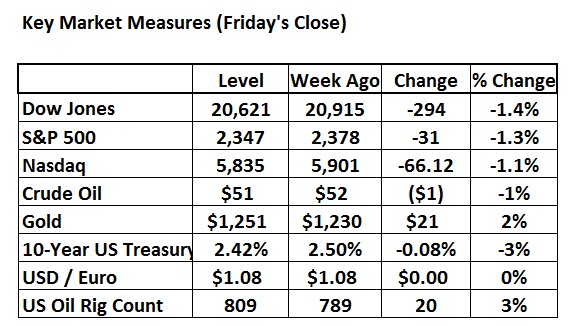
by Todd Shaver | Mar 26, 2017 | Weekly Newsletter 7pm Sunday
Highlights From the Past Week
The markets were a bit weaker last week. Friday’s close ended with uncertainty over Healthcare reform. Regardless of the outcome, some people are starting to ask tough questions. Is this Congress going to be able to deliver on the aggressive Trump agenda? Across the board, we are not just talking simply healthcare, but taxes, trade, regulations, the wall, and so on. This very first test for the new Congress will set the tone for the years ahead. And we are sure you heard what happened on Friday. No healthcare deal. Now what?
No matter what, there is always a bull market here! Week in and week out, we you can find it right here at The Bull Market Report. We currently see a bull market across many parts of the stock market. This week we highlight the following securities: Mazor Robotics, Apple, Google, Facebook, Home Depot, Celgene, and VMware.
Keystone XL Pipeline To Start Construction. The Trump administration announced on Friday that it would issue a permit for the construction of the Keystone XL pipeline, a long-disputed project that would link oil producers in Canada and North Dakota with refiners and export terminals on the Gulf Coast. The announcement by the State Department, reversed the position of the Obama administration. The pipeline has been the focus of a long fight between environmentalists and the project’s advocates, who say it would further the goals of energy independence and economic growth. The event marks a key inflection point for American’s refocusing on business.
The Markets Don't Care About Healthcare As Long As They Get Their Tax Cut. For the stock market, the drawn out effort to pass the healthcare bill may not matter after all. Regardless of whether Republicans can push the bill through (they didn’t), pro-growth and economic policies are next on the agenda. If so, markets win either way. They are not willing to hold economic growth/tax reform hostage to the Affordable Care Act reform any longer. This is a broad market-positive signal that bolsters the case for 2017 tax reform. Tax reform will start to take center stage this Spring.
Optimism Sweeps the Nation and Pulls Money Into Stocks. The surge in business and consumer sentiment reflects an assumption that is deeply rooted in the American psyche: that deregulation and tax cuts always unleash transformative pro-growth entrepreneurship. That is what we are seeing since late last year. Money has been flowing into exchange-traded funds like never before, helping to propel stocks higher. $130 billion has flowed into these index-tracking funds in the first two months of 2017. This follows a record-breaking year in 2016, when ETF managers gathered more than $390 billion in new cash. Moreover, the CBOE Volatility Index, the VIX, a popular gauge of market fear, is trading near historic lows. Even the somewhat pretentious term -- “animal spirits” -- has come back with a vengeance in the financial media.*
*People say "animal spirits" as in reference to optimism and capitalistic mentality. Additionally they mean there is business opportunity out there that is obvious, management has that and is going for it.
BMR Companies and Commentary
Mazor Robotics (MZOR: $29, +24% - all percentages in this letter are for the last week)
Mazor had a big week. Honestly, there was no specific news on the company. There doesn’t always have to be a “new” story. Sometime, people just get more comfortable with what’s happening at a business, and they start to accumulate the stock.
The latest public development at Mazor was the Hartford HealthCare news. Hartford HealthCare is Connecticut's most comprehensive healthcare network. A week or so ago Hartford announced it was joining forces with Mazor. The new partnership will bring unprecedented precision to surgeons performing spine surgery and the patients they serve. The Mazor X system was developed to enhance predictability and improve patient outcomes. It enables surgeons to be more precise, more efficient, and reduce the overall risk rate of spinal surgery.
Hartford is the first healthcare system in the state of Connecticut and throughout the Northeast to debut this technique. Physicians performed surgeries this week at the Bone & Joint Institute at Hartford Hospital and at MidState Medical Center.
BMR Take: Mazor is serving quite the niche - spine surgery - and doing a great job. We continue to like this stock pick. This week’s healthy stock performance reaffirms our conviction. The stock reached our Target Price of $29, and we are now up 70% since June when we added the stock at $16. What should you do? Obviously you could sell or you could hold from here. We are raising our Target to $36 and raising our Sell Price from $18 to $26.
Apple (AAPL: $141, +1%)
With Apple once again moving to record highs, it seems that all anyone talks about is the next big iPhone launch. Buzz surrounding the coming 10-year anniversary iPhone is growing ever louder. Sales of the iPhone 8 debut later this year will shatter expectations and help fuel estimate-beating profit growth.
Yet high hopes for the iPhone 8 aren’t the only reason to take a bigger bite out of Apple. Let’s not forget, it is one of the few technology companies that pays a cash dividend to shareholders. There is talk that the iPhone maker is poised to announce next month plans to significantly increase the capital it returns to shareholders with a $35 billion boost to its existing share buyback plan and a 15% dividend hike. (AND WAIT UNTIL TRUMP starts his tax reform plan with the cash repatriation proposal.)
Apple is a great value proposition. Warren Buffett’s Berkshire Hathaway became one of the company’s biggest shareholders late last year when it added the stock to its portfolio.
BMR Take: With the iPhone continuing to blow away its competition, and Apple’s high-margin services business continuing to race higher, there is just so much to like here.
Google (GOOG: $814, -4%)
Google has run into a bit of a rough patch here. We like it even more down here at this level.
Major advertisers are halting advertising on YouTube after Google said it was taking steps to protect its clients from inadvertently supporting hate. The controversy over ad placement, is now in its second week. We believe it to be way overblown. Chairman Eric Schmidt said Google could "get pretty close" to guaranteeing companies' ads won't be placed near hateful material.
Range Rover it was suspending its YouTube campaign in South Africa while it investigates. Nissan said it was "urgently reviewing" its campaign with Google. JP Morgan Chase and Ford suspended their YouTube ads on Thursday. AT&T, Johnson & Johnson, GlaxoSmithKline and Verizon Communications have joined the boycott in recent days, after the BBC, Volkswagen and Toyota said they had pulled ads in the UK.
BMR Take: We reiterate that we believe this is a good opportunity to buy more of one of the best technology companies on the planet. Admittedly, Google isn't yet fully addressing advertisers' concerns and needs to take stronger steps to regain the trust of brands. However, they will get it right, and when they do, it’s back to the great story we know - and a much higher stock price.
Facebook (FB: $141, flat)
According to one Wall Street analyst’s recent due diligence, they observed Facebook advertising spend volume growing 85% so far this year, from a year ago, across its client base and ahead of the company’s internal forecasts.
Why the strength? Facebook’s customer match offerings and the return on investment benefits of lower cost per click are driving demand strength. Remember, they have 1.9 billion customers. 1.9 billion customers!
Separately, Instagram continues to represent a larger share of Facebook’s overall revenue and is a key driver of growth. Higher engagement is being driven by increased video content. What does this mean? Very good things. Higher engagement means more opportunity to sell advertising. With ad pricing stable, this trend adds up to more and more revenue. You get it. More engagement doesn't just mean people are happier on the platform. More engagement triggers more advertising opportunities for the business model.
BMR Take: It always nice to hear about how the current quarter is going before the current quarter is reported. We sleep well at night thinking about the future for Facebook’s advertising revenue.
Home Depot (HD: $148, -1%)
The remodeling boom continues. Remodeling is so popular right now that homeowners are expected to spend nearly $325 billion dollars on remodeling and repairs this year, according to Harvard. Wow!
Usually you decide to remodel or renovate your home when you're ready to upgrade worn-out areas, want to add new features, or simply because you're ready for a change. But like any good investment, there are a few areas where you can make a nice return on the money you're spending.
The number one interior improvement that ups the value of a home is a kitchen remodel. This can run $20,000 to $50,000 and even much more.
When it comes to the outside of the home, buyers apparently value structural upgrades over decorative improvements to the interior. New roofs lately have been growing fast.
BMR Take: Home Depot is benefiting from this remodeling boom. Retailers like Sears and Macys may be coming under increased pressure from online retailers, but Home Depot is trucking along just fine.
VMware (VMW: $92, -1%)
VMware is in a unique situation in the escalating hybrid cloud war. The company has a strong presence in datacenters but needs large public cloud providers as partners, given the high capital requirements to offer these services in scale. In February 2016, VMware entered into a partnership with IBM to offer hybrid cloud products. In October, VMware announced an alliance with Amazon, the largest public cloud provider, to do the same.
Recent quarterly results from VMware showed rising interest by customers in these partnerships. Lately we’ve seen rising customer confidence in VMware's long-term cloud strategy and its future position in the technology industry.
IBM's large client base in IT outsourcing gives it a novel edge as the adoption of hybrid cloud grows. It also has the entire breadth of services required to move clients at their pace from a legacy architecture to the cloud. IBM is also the world's largest IT services vendor with expertise in design, consulting and re-engineering of legacy IT to cloud. IBM is a leading vendor of both software and IT services, unlike other major cloud providers that historically focused more on software. Its early move into cognitive products through Watson should also help it drive additional growth in hybrid cloud.
BMR Take: We continue to like this core story around the “hybrid” cloud for VMware. Amazon and IBM - what great companies to call your partners! We expect more good news about this business in the near-future.
Celgene (CELG: $123, -2%)
The Affordable Care Act saga in Washington has created a buying opportunity for Celgene. We describe the situation below. The bottom line is that Celgene is lumped into the conversation with other bad actors. The reality is Celgene will do just fine if drug prices come down. It’s the real bad actors like Mylan that will be hurt.
The ACA saga in Washington has created a buying opportunity for Celgene. We describe the situation below. The perception is that Celgene is lumped into the conversation with other bad actors. The reality is that Celgene will do just fine if drug prices come down. It’s the bad actors like Mylan that will be hurt.
When you rush any kind of massive project, you raise the risk that people get hurt. That's certainly the case with healthcare reform. As President Donald Trump and congressional Republicans have scrambled (and lost) to save their troubled attempt to repeal and replace the Affordable Care Act, they addressed Trump’s repeated rhetoric that drug pricing needs to be rationalized. This is such a broad statement; there is a lot of uncertainty about how lower drug prices will impact each player in the healthcare space. So many medicines carry massive price tags because most patients typically pay just a small fraction of those list prices, while insurers handle the rest. We are all in wait-and-see mode as to how the new insurance schemes will influence drug pricing.
BMR Take: Lower drug pricing does not ruin Celgene. This is actually an opportunity for you, with this lower stock price. Celgene is widely cited by Street analysts as a top pick in the space as the franchise is best in class. The company has a stacked pipeline of new drugs creating strong financial prospects.
Consensus Ratings for Celgene
Ratings Breakdown: 1 Sell Rating, 4 Hold Ratings, 23 Buy Ratings
Price Targets:
3/8/2017 Cowen and Company $150
3/6/2017 Oppenheimer Holdings $148
3/2/2017 Cann $148
2/28/2017 Jefferies Group $155
2/25/2017 Canaccord Genuity $156
2/18/2017 Cantor Fitzgerald $159
2/18/2017 Credit Suisse Group $148
2/17/2017 Robert W. Baird $162
Must be something the Street likes about Celgene!
Upcoming Economic News
TUESDAY, MARCH 28
S&P CoreLogic Case-Shiller Home Price Index – January
Time: 9:00 am
Forecast: 5.7% yearly change of 20-city index
Gains in home sales over the long-term amid tight supply can keep the Case-Shiller home price index rising in excess of 5% annually in January. Nationally home prices now lag their pre-crisis peak by 7%, as certain local markets are considered overvalued. Yet broadly, consistent price gains have greatly reduced the share of homeowners underwater on their mortgages, which allows the housing market to function more smoothly.
Conference Board Consumer Confidence – March
Time: 10:00 am
Forecast: 113.0
Consumer confidence as measured by the March Conference Board survey is forecast to remain strong, even if the index slips a bit from February’s 15-year high. In February, the share of survey participants anticipating rising incomes exceeded the share expecting their incomes to decline by 10% for only the second time in the past decade. That gap points to persistent wage gains and an upward bias to price growth.
WEDNESDAY, MARCH 29
Pending Home Sales Index – February
Time: 10:00 am
Forecast: 2.4%
The Pending Home Sales Index is expected to rise in February after sliding to the 12-month low in January. Though sales and home lending are on a long-term uptrend, the pace of gains has not been consistent. Those uneven results imply that further gains in mortgage rates can weigh negatively on housing activity after borrowing costs rose in recent weeks to the highest levels since 2014.
THURSDAY, MARCH 30
GDP – Fourth Quarter (Third Estimate)
Time: 8:30 am
Forecast: 2.0%
Though overall GDP growth slipped in the fourth quarter, output still found support from a hearty pace of consumer spending. That may not be the case in the current quarter after January’s 0.3% decline in real consumer spending equaled the largest shortfall since 2009. Though GDP growth may once again disappoint in the early months of the year, healthy gains in jobs and improved industrial production trends signal stronger underlying economic progress.
FRIDAY, MARCH 31
Personal Income & Spending – February
Time: 8:30 am
Forecast: 0.4% income, 0.2% spending
Personal income is projected to rise 0.4% for the second straight month in February, aided by somewhat faster wage growth. Annual income growth touched 4% in January for the first time in over a year, partly signaling increased labor market tightness. Further gains must be registered in order for real spending to keep ahead of the recent uptick in inflation.
University of Michigan Consumer Sentiment – March
Final Time: 10:00am
Forecast: 98.0
Sentiment in the final March reading of the Michigan survey is likely to continue to display the strong post-election bounce. The reading on current economic conditions reached the highest level in 17 years in the preliminary March survey. That points to ample consumer resources that can keep the aged economic expansion chugging along.
Apple Hits New High This Week at $142.80
Pacific Crest raised their bullish price target for Apple to $175 based on the prospect of a cash repatriation holiday. This is a common song on Wall Street these days, and as you know we have been pounding the table about this for some time now. There is $2.5 trillion of cash overseas. Bring a little more than half of that back and you have $1.5 trillion that would be set to go to work creating jobs and benefitting stockholders. We might see a huge increase in the dividend. Maybe even a large, special distribution of $10-20 a share.
Goldman Sachs reiterated their Buy rating and $150 price target on Apple, saying the iPhone 8 supply chain data points to higher-than-usual seasonality in February based on average sales from six of the company’s suppliers.
And note that Apple was upgraded to Buy by one of the biggest bears on the stock on Wall Street. Bernstein now has a price target of $175. Now THAT’S saying something.
You heard it here first. What price would Apple have to hit to be the first* trillion dollar company? $190. Sounds like it's pretty far away, doesn’t it? But when Apple hits $160, it will be a hop skip and a jump away. Food for thought...
*Alas, PetroChina (PTR) was the first trillion dollar company, hitting that number in 2007. It’s worth just $200 billion now. (So we’re not counting it!) Apple will be the first. Or maybe Google or Amazon or Tesla. The race is on!
Number of monthly active Facebook users worldwide as 4Q16
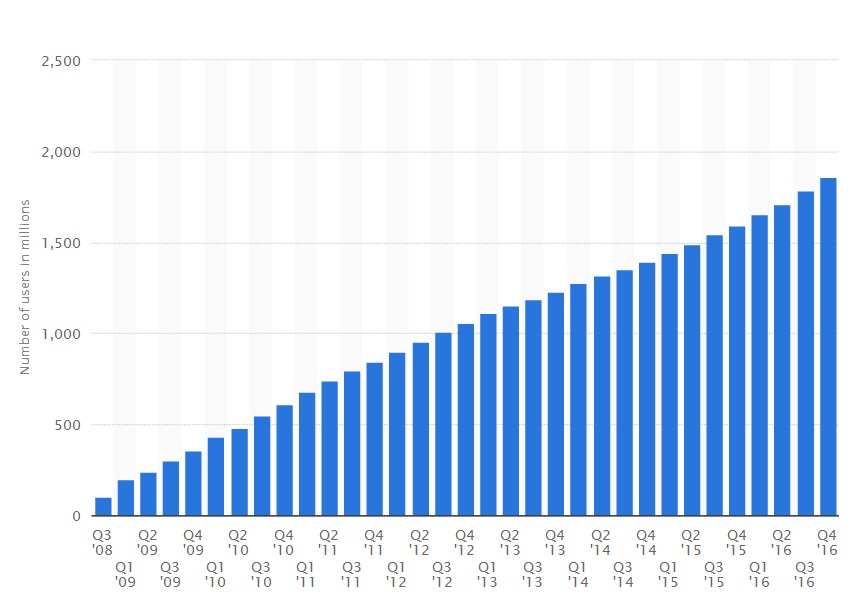
This statistic shows a timeline with the worldwide number of monthly active Facebook users from 2008 to 2016 in millions. As of the fourth quarter of 2016, Facebook had 1.86 billion monthly active users. Extrapolating, we'd say they are well over 1.9 billion. 2 billion look out!
Consensus Ratings for Facebook
Ratings Breakdown: 1 Sell Rating, 4 Hold Ratings, 39 Buy Ratings, 4 Strong Buy Ratings
Price Targets:
3/21/2017 BTIG Research $175
3/13/2017 Cantor Fitzgerald $175
3/6/2017 Royal Bank of Canada $170
3/3/2017 Nomura $155
3/3/2017 Citigroup $165
High Yield Corner
By Michael Foster
This was a particularly good week for many Bull Market Report picks even though the high yield markets were rather dull.
The SPDR Barclays High Yield Bond ETF (JNK: $37) ended the week flat despite some interesting excitement in the Treasury markets. The 10-year yield retreated throughout the week to 2.42%, a drop of over 8 bp from the start of the week. This is significant because that yield is a combination of economic growth and inflation expectations, and the yield has been driven higher by the Federal Reserve’s rate hike and forward guidance of more rate hikes throughout the year. With the 3-month Treasury yield up to 0.75% and market expectations of an end-of-year yield of 1.5%, the spread between short-term and long-term bonds has shrunk considerably in the last few months. This means the market does not believe rate hikes from the Fed will come hard and fast, but will happen very gradually over a longer time period.
Why does this matter? Rate hikes intrinsically sound like monetary tightening, which is particularly bad for bonds and other debt instruments. For high yield bonds, it’s especially bad because it suggests that yields need to go up to compensate for the risk as yields on Treasuries get bigger. Since yields and price are inverted, it also means high yield bonds currently issued will go down in price. That, in turn, would hit funds like the SPDR High Yield fund
However, the Federal Reserve is not tightening relative to expectations. That “relative” clause is key here. The Fed is making borrowing more expensive, but everyone in the market expects the Fed to do this. The real question is how fast and how often they do it. The market now thinks that the Fed will raise rates at a slower pace than the market used to think, which means the Fed is tightening less than expectations. This, paradoxically, is good for high yield bonds because it indicates the downside of a tight policy is already priced in.
Extraordinarily, that “priced in” moment came in 2015. We’re getting near the 2-year anniversary to that cycle of discounting corporate bonds for future rate hike action. And keep in mind that is after junk bonds were discounted for future rate hike action back in 2013. If you look at the price return for the SPDR fund over the last five years, the fund is down over 7%. In other words, junk bonds have been discounting the Fed’s future rate hikes for several years, and every time the rate hike schedule is delayed, it bolsters junk bonds’ value even further.
That doesn’t mean junk bonds have fully recovered, though. The market is still very cautious because of a lot of misunderstanding about what the rate hike really means for corporate bonds, causing money to be left on the sidelines. That makes junk still a good opportunity, although you can’t expect the 10% price returns on junk bonds that were so easy to get a year ago.
So with that in mind, there remain valuable funds with high yield and corporate bonds in them. BMR picks AGIC Equity and Convertible Income Fund (NIE: $19.11, down -1%) and the PIMCO Dynamic Income Fund (PDI: $29, flat) remain solid picks that are earning their dividends and have capital gains potential. Impressively, Pimco has already seen a 5% return in 2017 although we haven’t even gotten to spring yet! That doesn’t mean the performance will annualize at that rate by the end of the year, but it may. What it does mean is that the fund remains a market outperformer that can continue to pay out its current dividend in a market where many funds are cutting distributions.
The AGIC fund has not been as solid of a performer largely because of its equity holdings. The fund had a bad week, but has a 4% year-to-date performance when looking at its NAV. That lags the S&P 500, which is up 4.6% over the same period. That underperformance does not bother us for two reasons. Firstly, the fund has tremendous liquidity thanks to its high 8% yield. It also has maintained its 10%+ discount to NAV throughout the year because the market simply underappreciates this fund. Thanks to that discount, the fund’s management needs to get just a 7.1% return annualized to maintain payouts and not see NAV go down. Thanks to the market’s growth and high yields on convertible bonds, this not difficult for AGIC Equity to earn in the current market. While there are some other risk factors at hand, they aren’t significant enough at the moment for investors to be concerned with.
Elsewhere in the high yield world, things were quiet this week. The SPDR Dow Jones REIT ETF (RWR: $92, flat) saw little movement, but BMR picks fared far better. Digital Realty Trust (DLR: $104) and Kimco Realty (KIM: $23) ended the week flat alongside the broader market, but Omega Healthcare Investors (OHI: $32, up 3%), Government Properties Trust (GOV: $21, up 1%), and Care Capital Properties (CCP: $25, up 2%) fared significantly better than the index. We’re nowhere near overbought territory for these REITs, but we may get there if further price appreciation comes to these stocks.
One asset class was particularly hard hit this week, and it’s one that readers know we have been cautious about for several weeks now: BDCs. The UBS BDC ETF (BDCS: $23, down -1%) was one of the worst performers in the high yield world, but former BMR favorite Main Street Capital (MAIN: $37) did much worse, losing over 1% for the week. Now Main Street’s price is up only 1% for 2017, making it a market laggard. Nothing fundamentally has changed with Main Street, but the market has finally warmed up to this stock so much that it’s gotten far overpriced and thus is now a bad value. It trades at a tremendous premium to its NAV, as we’ve mentioned several times since The Bull Market Report pulled it from its High Yield portfolio. It remains a very high quality BDC with market dominance, but at a 6% yield excluding special dividends, it just doesn’t provide the income worth the risk of paying for such a high premium. We are happy for management to have earned a deserved price premium for the value they add for investors, but we are not willing to pay that premium. Main Street is fairly to slightly overvalued, which is what you would expect for a good company in a healthy stock market. We will wait to buy Main Street again if and when the market gets unhealthy.
Finally, a word on municipal bonds. In 2016 we were pounding the table aggressively on almost all high yield assets, but were tentative about municipal bonds. The asset class was overbought throughout 2016 and undersold before that run up, especially when compared to the more ridiculous panic selling elsewhere in REITs, junk bonds, and especially corporate bonds. We didn’t see muni bonds fairly priced until late 2016, and then they became near bargains a short time later. That is when we started to dip our toes in the asset class and see tremendous value in the market.
Slowly, the market is beginning to come our way. The iShares S&P National AMT-Free Municipal Bond Fund (MUB: $109, up 1%) had a very strong week, and that’s helped the fund return again to positive territory for 2017. BMR pick Nuveen AMT-Free Fund (NVG: $14.53, up 1%) had a similarly strong week and has a similar year-to-date performance. Yet its dividend yield is over twice the iShares fund and its capital gains potential is much greater as well. There is no reason to shy away from municipal bonds now, and we can only hope that the trend we saw last week will continue over the coming weeks. Muni bonds deserve more market demand - it’s only a question of when that market demand materializes.
Good Investing,
Todd Shaver
CEO, Editor and Founder
The Bull Market Report
Since 1998