March 26, 2017
by Todd Shaver | Mar 26, 2017 | Weekly Newsletter 7pm Sunday
Highlights From the Past Week
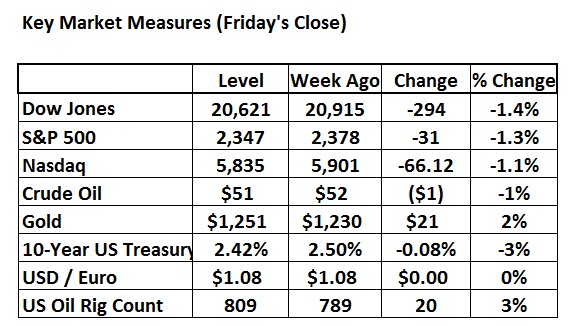
The markets were a bit weaker last week. Friday’s close ended with uncertainty over Healthcare reform. Regardless of the outcome, some people are starting to ask tough questions. Is this Congress going to be able to deliver on the aggressive Trump agenda? Across the board, we are not just talking simply healthcare, but taxes, trade, regulations, the wall, and so on. This very first test for the new Congress will set the tone for the years ahead. And we are sure you heard what happened on Friday. No healthcare deal. Now what?
No matter what, there is always a bull market here! Week in and week out, we you can find it right here at The Bull Market Report. We currently see a bull market across many parts of the stock market. This week we highlight the following securities: Mazor Robotics, Apple, Google, Facebook, Home Depot, Celgene, and VMware.
Keystone XL Pipeline To Start Construction. The Trump administration announced on Friday that it would issue a permit for the construction of the Keystone XL pipeline, a long-disputed project that would link oil producers in Canada and North Dakota with refiners and export terminals on the Gulf Coast. The announcement by the State Department, reversed the position of the Obama administration. The pipeline has been the focus of a long fight between environmentalists and the project’s advocates, who say it would further the goals of energy independence and economic growth. The event marks a key inflection point for American’s refocusing on business.
The Markets Don't Care About Healthcare As Long As They Get Their Tax Cut. For the stock market, the drawn out effort to pass the healthcare bill may not matter after all. Regardless of whether Republicans can push the bill through (they didn’t), pro-growth and economic policies are next on the agenda. If so, markets win either way. They are not willing to hold economic growth/tax reform hostage to the Affordable Care Act reform any longer. This is a broad market-positive signal that bolsters the case for 2017 tax reform. Tax reform will start to take center stage this Spring.
Optimism Sweeps the Nation and Pulls Money Into Stocks. The surge in business and consumer sentiment reflects an assumption that is deeply rooted in the American psyche: that deregulation and tax cuts always unleash transformative pro-growth entrepreneurship. That is what we are seeing since late last year. Money has been flowing into exchange-traded funds like never before, helping to propel stocks higher. $130 billion has flowed into these index-tracking funds in the first two months of 2017. This follows a record-breaking year in 2016, when ETF managers gathered more than $390 billion in new cash. Moreover, the CBOE Volatility Index, the VIX, a popular gauge of market fear, is trading near historic lows. Even the somewhat pretentious term -- “animal spirits” -- has come back with a vengeance in the financial media.*
*People say "animal spirits" as in reference to optimism and capitalistic mentality. Additionally they mean there is business opportunity out there that is obvious, management has that and is going for it.
BMR Companies and Commentary
Mazor Robotics (MZOR: $29, +24% - all percentages in this letter are for the last week)
Mazor had a big week. Honestly, there was no specific news on the company. There doesn’t always have to be a “new” story. Sometime, people just get more comfortable with what’s happening at a business, and they start to accumulate the stock.
The latest public development at Mazor was the Hartford HealthCare news. Hartford HealthCare is Connecticut's most comprehensive healthcare network. A week or so ago Hartford announced it was joining forces with Mazor. The new partnership will bring unprecedented precision to surgeons performing spine surgery and the patients they serve. The Mazor X system was developed to enhance predictability and improve patient outcomes. It enables surgeons to be more precise, more efficient, and reduce the overall risk rate of spinal surgery.
Hartford is the first healthcare system in the state of Connecticut and throughout the Northeast to debut this technique. Physicians performed surgeries this week at the Bone & Joint Institute at Hartford Hospital and at MidState Medical Center.
BMR Take: Mazor is serving quite the niche - spine surgery - and doing a great job. We continue to like this stock pick. This week’s healthy stock performance reaffirms our conviction. The stock reached our Target Price of $29, and we are now up 70% since June when we added the stock at $16. What should you do? Obviously you could sell or you could hold from here. We are raising our Target to $36 and raising our Sell Price from $18 to $26.
Apple (AAPL: $141, +1%)
With Apple once again moving to record highs, it seems that all anyone talks about is the next big iPhone launch. Buzz surrounding the coming 10-year anniversary iPhone is growing ever louder. Sales of the iPhone 8 debut later this year will shatter expectations and help fuel estimate-beating profit growth.
Yet high hopes for the iPhone 8 aren’t the only reason to take a bigger bite out of Apple. Let’s not forget, it is one of the few technology companies that pays a cash dividend to shareholders. There is talk that the iPhone maker is poised to announce next month plans to significantly increase the capital it returns to shareholders with a $35 billion boost to its existing share buyback plan and a 15% dividend hike. (AND WAIT UNTIL TRUMP starts his tax reform plan with the cash repatriation proposal.)
Apple is a great value proposition. Warren Buffett’s Berkshire Hathaway became one of the company’s biggest shareholders late last year when it added the stock to its portfolio.
BMR Take: With the iPhone continuing to blow away its competition, and Apple’s high-margin services business continuing to race higher, there is just so much to like here.
Google (GOOG: $814, -4%)
Google has run into a bit of a rough patch here. We like it even more down here at this level.
Major advertisers are halting advertising on YouTube after Google said it was taking steps to protect its clients from inadvertently supporting hate. The controversy over ad placement, is now in its second week. We believe it to be way overblown. Chairman Eric Schmidt said Google could "get pretty close" to guaranteeing companies' ads won't be placed near hateful material.
Range Rover it was suspending its YouTube campaign in South Africa while it investigates. Nissan said it was "urgently reviewing" its campaign with Google. JP Morgan Chase and Ford suspended their YouTube ads on Thursday. AT&T, Johnson & Johnson, GlaxoSmithKline and Verizon Communications have joined the boycott in recent days, after the BBC, Volkswagen and Toyota said they had pulled ads in the UK.
BMR Take: We reiterate that we believe this is a good opportunity to buy more of one of the best technology companies on the planet. Admittedly, Google isn't yet fully addressing advertisers' concerns and needs to take stronger steps to regain the trust of brands. However, they will get it right, and when they do, it’s back to the great story we know - and a much higher stock price.
Facebook (FB: $141, flat)
According to one Wall Street analyst’s recent due diligence, they observed Facebook advertising spend volume growing 85% so far this year, from a year ago, across its client base and ahead of the company’s internal forecasts.
Why the strength? Facebook’s customer match offerings and the return on investment benefits of lower cost per click are driving demand strength. Remember, they have 1.9 billion customers. 1.9 billion customers!
Separately, Instagram continues to represent a larger share of Facebook’s overall revenue and is a key driver of growth. Higher engagement is being driven by increased video content. What does this mean? Very good things. Higher engagement means more opportunity to sell advertising. With ad pricing stable, this trend adds up to more and more revenue. You get it. More engagement doesn't just mean people are happier on the platform. More engagement triggers more advertising opportunities for the business model.
BMR Take: It always nice to hear about how the current quarter is going before the current quarter is reported. We sleep well at night thinking about the future for Facebook’s advertising revenue.
Home Depot (HD: $148, -1%)
The remodeling boom continues. Remodeling is so popular right now that homeowners are expected to spend nearly $325 billion dollars on remodeling and repairs this year, according to Harvard. Wow!
Usually you decide to remodel or renovate your home when you're ready to upgrade worn-out areas, want to add new features, or simply because you're ready for a change. But like any good investment, there are a few areas where you can make a nice return on the money you're spending.
The number one interior improvement that ups the value of a home is a kitchen remodel. This can run $20,000 to $50,000 and even much more.
When it comes to the outside of the home, buyers apparently value structural upgrades over decorative improvements to the interior. New roofs lately have been growing fast.
BMR Take: Home Depot is benefiting from this remodeling boom. Retailers like Sears and Macys may be coming under increased pressure from online retailers, but Home Depot is trucking along just fine.
VMware (VMW: $92, -1%)
VMware is in a unique situation in the escalating hybrid cloud war. The company has a strong presence in datacenters but needs large public cloud providers as partners, given the high capital requirements to offer these services in scale. In February 2016, VMware entered into a partnership with IBM to offer hybrid cloud products. In October, VMware announced an alliance with Amazon, the largest public cloud provider, to do the same.
Recent quarterly results from VMware showed rising interest by customers in these partnerships. Lately we’ve seen rising customer confidence in VMware's long-term cloud strategy and its future position in the technology industry.
IBM's large client base in IT outsourcing gives it a novel edge as the adoption of hybrid cloud grows. It also has the entire breadth of services required to move clients at their pace from a legacy architecture to the cloud. IBM is also the world's largest IT services vendor with expertise in design, consulting and re-engineering of legacy IT to cloud. IBM is a leading vendor of both software and IT services, unlike other major cloud providers that historically focused more on software. Its early move into cognitive products through Watson should also help it drive additional growth in hybrid cloud.
BMR Take: We continue to like this core story around the “hybrid” cloud for VMware. Amazon and IBM - what great companies to call your partners! We expect more good news about this business in the near-future.
Celgene (CELG: $123, -2%)
The Affordable Care Act saga in Washington has created a buying opportunity for Celgene. We describe the situation below. The bottom line is that Celgene is lumped into the conversation with other bad actors. The reality is Celgene will do just fine if drug prices come down. It’s the real bad actors like Mylan that will be hurt.
The ACA saga in Washington has created a buying opportunity for Celgene. We describe the situation below. The perception is that Celgene is lumped into the conversation with other bad actors. The reality is that Celgene will do just fine if drug prices come down. It’s the bad actors like Mylan that will be hurt.
When you rush any kind of massive project, you raise the risk that people get hurt. That's certainly the case with healthcare reform. As President Donald Trump and congressional Republicans have scrambled (and lost) to save their troubled attempt to repeal and replace the Affordable Care Act, they addressed Trump’s repeated rhetoric that drug pricing needs to be rationalized. This is such a broad statement; there is a lot of uncertainty about how lower drug prices will impact each player in the healthcare space. So many medicines carry massive price tags because most patients typically pay just a small fraction of those list prices, while insurers handle the rest. We are all in wait-and-see mode as to how the new insurance schemes will influence drug pricing.
BMR Take: Lower drug pricing does not ruin Celgene. This is actually an opportunity for you, with this lower stock price. Celgene is widely cited by Street analysts as a top pick in the space as the franchise is best in class. The company has a stacked pipeline of new drugs creating strong financial prospects.
Consensus Ratings for Celgene
Ratings Breakdown: 1 Sell Rating, 4 Hold Ratings, 23 Buy Ratings
Price Targets:
3/8/2017 Cowen and Company $150
3/6/2017 Oppenheimer Holdings $148
3/2/2017 Cann $148
2/28/2017 Jefferies Group $155
2/25/2017 Canaccord Genuity $156
2/18/2017 Cantor Fitzgerald $159
2/18/2017 Credit Suisse Group $148
2/17/2017 Robert W. Baird $162
Must be something the Street likes about Celgene!
Upcoming Economic News
TUESDAY, MARCH 28
S&P CoreLogic Case-Shiller Home Price Index – January
Time: 9:00 am
Forecast: 5.7% yearly change of 20-city index
Gains in home sales over the long-term amid tight supply can keep the Case-Shiller home price index rising in excess of 5% annually in January. Nationally home prices now lag their pre-crisis peak by 7%, as certain local markets are considered overvalued. Yet broadly, consistent price gains have greatly reduced the share of homeowners underwater on their mortgages, which allows the housing market to function more smoothly.
Conference Board Consumer Confidence – March
Time: 10:00 am
Forecast: 113.0
Consumer confidence as measured by the March Conference Board survey is forecast to remain strong, even if the index slips a bit from February’s 15-year high. In February, the share of survey participants anticipating rising incomes exceeded the share expecting their incomes to decline by 10% for only the second time in the past decade. That gap points to persistent wage gains and an upward bias to price growth.
WEDNESDAY, MARCH 29
Pending Home Sales Index – February
Time: 10:00 am
Forecast: 2.4%
The Pending Home Sales Index is expected to rise in February after sliding to the 12-month low in January. Though sales and home lending are on a long-term uptrend, the pace of gains has not been consistent. Those uneven results imply that further gains in mortgage rates can weigh negatively on housing activity after borrowing costs rose in recent weeks to the highest levels since 2014.
THURSDAY, MARCH 30
GDP – Fourth Quarter (Third Estimate)
Time: 8:30 am
Forecast: 2.0%
Though overall GDP growth slipped in the fourth quarter, output still found support from a hearty pace of consumer spending. That may not be the case in the current quarter after January’s 0.3% decline in real consumer spending equaled the largest shortfall since 2009. Though GDP growth may once again disappoint in the early months of the year, healthy gains in jobs and improved industrial production trends signal stronger underlying economic progress.
FRIDAY, MARCH 31
Personal Income & Spending – February
Time: 8:30 am
Forecast: 0.4% income, 0.2% spending
Personal income is projected to rise 0.4% for the second straight month in February, aided by somewhat faster wage growth. Annual income growth touched 4% in January for the first time in over a year, partly signaling increased labor market tightness. Further gains must be registered in order for real spending to keep ahead of the recent uptick in inflation.
University of Michigan Consumer Sentiment – March
Final Time: 10:00am
Forecast: 98.0
Sentiment in the final March reading of the Michigan survey is likely to continue to display the strong post-election bounce. The reading on current economic conditions reached the highest level in 17 years in the preliminary March survey. That points to ample consumer resources that can keep the aged economic expansion chugging along.
Apple Hits New High This Week at $142.80
Pacific Crest raised their bullish price target for Apple to $175 based on the prospect of a cash repatriation holiday. This is a common song on Wall Street these days, and as you know we have been pounding the table about this for some time now. There is $2.5 trillion of cash overseas. Bring a little more than half of that back and you have $1.5 trillion that would be set to go to work creating jobs and benefitting stockholders. We might see a huge increase in the dividend. Maybe even a large, special distribution of $10-20 a share.
Goldman Sachs reiterated their Buy rating and $150 price target on Apple, saying the iPhone 8 supply chain data points to higher-than-usual seasonality in February based on average sales from six of the company’s suppliers.
And note that Apple was upgraded to Buy by one of the biggest bears on the stock on Wall Street. Bernstein now has a price target of $175. Now THAT’S saying something.
You heard it here first. What price would Apple have to hit to be the first* trillion dollar company? $190. Sounds like it's pretty far away, doesn’t it? But when Apple hits $160, it will be a hop skip and a jump away. Food for thought...
*Alas, PetroChina (PTR) was the first trillion dollar company, hitting that number in 2007. It’s worth just $200 billion now. (So we’re not counting it!) Apple will be the first. Or maybe Google or Amazon or Tesla. The race is on!
Number of monthly active Facebook users worldwide as 4Q16
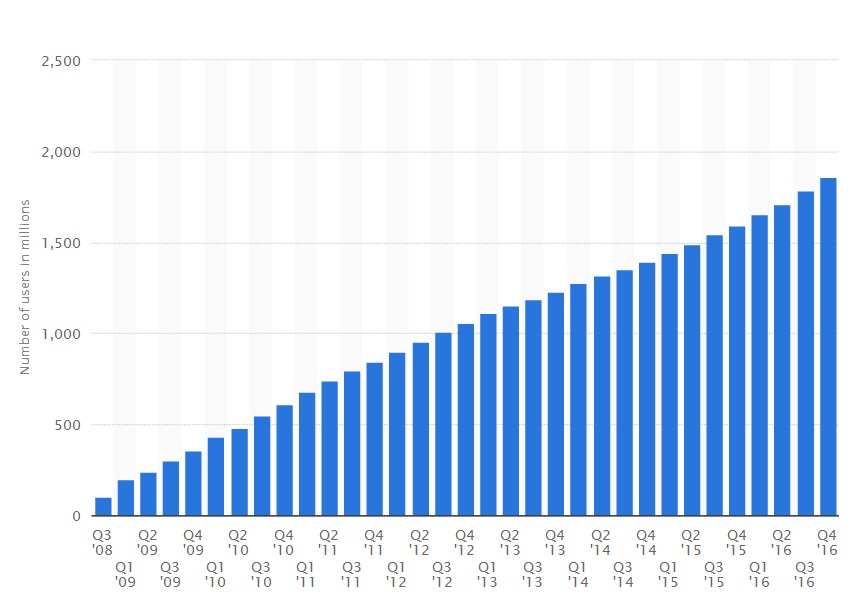
This statistic shows a timeline with the worldwide number of monthly active Facebook users from 2008 to 2016 in millions. As of the fourth quarter of 2016, Facebook had 1.86 billion monthly active users. Extrapolating, we'd say they are well over 1.9 billion. 2 billion look out!
Consensus Ratings for Facebook
Ratings Breakdown: 1 Sell Rating, 4 Hold Ratings, 39 Buy Ratings, 4 Strong Buy Ratings
Price Targets:
3/21/2017 BTIG Research $175
3/13/2017 Cantor Fitzgerald $175
3/6/2017 Royal Bank of Canada $170
3/3/2017 Nomura $155
3/3/2017 Citigroup $165
High Yield Corner
By Michael Foster
This was a particularly good week for many Bull Market Report picks even though the high yield markets were rather dull.
The SPDR Barclays High Yield Bond ETF (JNK: $37) ended the week flat despite some interesting excitement in the Treasury markets. The 10-year yield retreated throughout the week to 2.42%, a drop of over 8 bp from the start of the week. This is significant because that yield is a combination of economic growth and inflation expectations, and the yield has been driven higher by the Federal Reserve’s rate hike and forward guidance of more rate hikes throughout the year. With the 3-month Treasury yield up to 0.75% and market expectations of an end-of-year yield of 1.5%, the spread between short-term and long-term bonds has shrunk considerably in the last few months. This means the market does not believe rate hikes from the Fed will come hard and fast, but will happen very gradually over a longer time period.
Why does this matter? Rate hikes intrinsically sound like monetary tightening, which is particularly bad for bonds and other debt instruments. For high yield bonds, it’s especially bad because it suggests that yields need to go up to compensate for the risk as yields on Treasuries get bigger. Since yields and price are inverted, it also means high yield bonds currently issued will go down in price. That, in turn, would hit funds like the SPDR High Yield fund
However, the Federal Reserve is not tightening relative to expectations. That “relative” clause is key here. The Fed is making borrowing more expensive, but everyone in the market expects the Fed to do this. The real question is how fast and how often they do it. The market now thinks that the Fed will raise rates at a slower pace than the market used to think, which means the Fed is tightening less than expectations. This, paradoxically, is good for high yield bonds because it indicates the downside of a tight policy is already priced in.
Extraordinarily, that “priced in” moment came in 2015. We’re getting near the 2-year anniversary to that cycle of discounting corporate bonds for future rate hike action. And keep in mind that is after junk bonds were discounted for future rate hike action back in 2013. If you look at the price return for the SPDR fund over the last five years, the fund is down over 7%. In other words, junk bonds have been discounting the Fed’s future rate hikes for several years, and every time the rate hike schedule is delayed, it bolsters junk bonds’ value even further.
That doesn’t mean junk bonds have fully recovered, though. The market is still very cautious because of a lot of misunderstanding about what the rate hike really means for corporate bonds, causing money to be left on the sidelines. That makes junk still a good opportunity, although you can’t expect the 10% price returns on junk bonds that were so easy to get a year ago.
So with that in mind, there remain valuable funds with high yield and corporate bonds in them. BMR picks AGIC Equity and Convertible Income Fund (NIE: $19.11, down -1%) and the PIMCO Dynamic Income Fund (PDI: $29, flat) remain solid picks that are earning their dividends and have capital gains potential. Impressively, Pimco has already seen a 5% return in 2017 although we haven’t even gotten to spring yet! That doesn’t mean the performance will annualize at that rate by the end of the year, but it may. What it does mean is that the fund remains a market outperformer that can continue to pay out its current dividend in a market where many funds are cutting distributions.
The AGIC fund has not been as solid of a performer largely because of its equity holdings. The fund had a bad week, but has a 4% year-to-date performance when looking at its NAV. That lags the S&P 500, which is up 4.6% over the same period. That underperformance does not bother us for two reasons. Firstly, the fund has tremendous liquidity thanks to its high 8% yield. It also has maintained its 10%+ discount to NAV throughout the year because the market simply underappreciates this fund. Thanks to that discount, the fund’s management needs to get just a 7.1% return annualized to maintain payouts and not see NAV go down. Thanks to the market’s growth and high yields on convertible bonds, this not difficult for AGIC Equity to earn in the current market. While there are some other risk factors at hand, they aren’t significant enough at the moment for investors to be concerned with.
Elsewhere in the high yield world, things were quiet this week. The SPDR Dow Jones REIT ETF (RWR: $92, flat) saw little movement, but BMR picks fared far better. Digital Realty Trust (DLR: $104) and Kimco Realty (KIM: $23) ended the week flat alongside the broader market, but Omega Healthcare Investors (OHI: $32, up 3%), Government Properties Trust (GOV: $21, up 1%), and Care Capital Properties (CCP: $25, up 2%) fared significantly better than the index. We’re nowhere near overbought territory for these REITs, but we may get there if further price appreciation comes to these stocks.
One asset class was particularly hard hit this week, and it’s one that readers know we have been cautious about for several weeks now: BDCs. The UBS BDC ETF (BDCS: $23, down -1%) was one of the worst performers in the high yield world, but former BMR favorite Main Street Capital (MAIN: $37) did much worse, losing over 1% for the week. Now Main Street’s price is up only 1% for 2017, making it a market laggard. Nothing fundamentally has changed with Main Street, but the market has finally warmed up to this stock so much that it’s gotten far overpriced and thus is now a bad value. It trades at a tremendous premium to its NAV, as we’ve mentioned several times since The Bull Market Report pulled it from its High Yield portfolio. It remains a very high quality BDC with market dominance, but at a 6% yield excluding special dividends, it just doesn’t provide the income worth the risk of paying for such a high premium. We are happy for management to have earned a deserved price premium for the value they add for investors, but we are not willing to pay that premium. Main Street is fairly to slightly overvalued, which is what you would expect for a good company in a healthy stock market. We will wait to buy Main Street again if and when the market gets unhealthy.
Finally, a word on municipal bonds. In 2016 we were pounding the table aggressively on almost all high yield assets, but were tentative about municipal bonds. The asset class was overbought throughout 2016 and undersold before that run up, especially when compared to the more ridiculous panic selling elsewhere in REITs, junk bonds, and especially corporate bonds. We didn’t see muni bonds fairly priced until late 2016, and then they became near bargains a short time later. That is when we started to dip our toes in the asset class and see tremendous value in the market.
Slowly, the market is beginning to come our way. The iShares S&P National AMT-Free Municipal Bond Fund (MUB: $109, up 1%) had a very strong week, and that’s helped the fund return again to positive territory for 2017. BMR pick Nuveen AMT-Free Fund (NVG: $14.53, up 1%) had a similarly strong week and has a similar year-to-date performance. Yet its dividend yield is over twice the iShares fund and its capital gains potential is much greater as well. There is no reason to shy away from municipal bonds now, and we can only hope that the trend we saw last week will continue over the coming weeks. Muni bonds deserve more market demand - it’s only a question of when that market demand materializes.
Good Investing,
Todd Shaver
CEO, Editor and Founder
The Bull Market Report
Since 1998
March 20, 2017
by Todd Shaver | Mar 20, 2017 | Monthly Newsletter Daily 6am if new
What a week. Another interest rate hike has come. The entire market and all the Fed officials, except one dissenting opinion, wanted the March rate hike. Who dissented? Minneapolis Fed President Neel Kashkari. Why? Kashkari said the announcement of the Fed’s balance sheet plan could trigger somewhat tighter monetary conditions resulting in the equivalent of a rate hike of unknown size. After it has been published and the market response is understood, then he says the Fed can return to using the federal funds rate as a primary policy tool, with the balance sheet normalization under way in the background. Understanding Kashkari’s lone wolf dissenting opinion is something to take note of. We need to keep an eye on the rising interest rate cycle and how it impacts the bull market going forward. For the time being, the bull market continues to break new highs.
No matter what, there is always a bull market here! Week in and week out, you can find it right here at The Bull Market Report. We currently see a bull market across many parts of the stock market. This week we highlight the following securities: Tesla, Visa, Apple, Google, and PayPal.
)
Highlights From The Past Week
Another Week of Huge Cash Inflows! According to industry data, overall cash continued to flood into equities for a total of $14.5 billion, the 11th consecutive week of inflows. Most of this was due to allocations to ETFs, which saw $19.7 billion in inflows, the highest weekly amount YTD, offset by $5.1 billion in outflows from actively managed funds. Looking at what its private clients are doing, an investment bank notes that the top 3 ETF inflows in the past 4 weeks were Financials, Bank Loans, and MLPs.
Has OPEC Underestimated US Oil Production Once Again? The U.S. crude cowboys are back on their horses and leading a strong recovery in the oil patch that is not expected to falter. With lessons learned from the oil price crash, companies have streamlined their budgets and are focused on the most prolific shale plays. U.S. drillers are giving OPEC a hard time by raising output and hedging future production. This is all good things for US energy independence and stability.
Refreshed Fed Forecast Leaves Long-Run Rate Outlook Unchanged. For those curious what the Fed's latest Fed Funds rate forecast reveals, here is the summary: (i) median target for end-2017 is 1.375%, unchanged; (ii) median target for end-2018 is 2.125%, unchanged; (iii) median target for end-2019 is 3% vs. 2.875% in December; and (iv) long-run target is 3%, unchanged. Given that the long-run expectations of 3% is unchanged, some say we could see a more gradual rising interest rate cycle than some had thought. Good thing for equities!
Homebuilders: Not Been This Confident Since The Peak Of The Last Housing Bubble. Builder confidence in the market for newly-built single-family homes jumped six points to a level of 71 on the National Association of Home Builders/Wells Fargo Housing Market Index (HMI). This is the highest reading since 2005 - the ultimate peak of the last housing bubble. This record confidence level is welcomed for the current bull market.
BMR Companies and Commentary
Tesla (TSLA: $262, +7% - all prices are for the previous week)
Tesla’s $170 million battery play is just the beginning. Tesla is ready to power some grids. And not just in California or Australia. Last week, Elon Musk wagered he could address South Australia’s energy crisis with 100 megawatts (MW) of batteries installed in 100 days or less – “or it’s free.” The exchange blew up on Twitter and led to phone calls between Musk and leading Australian politicians, including Prime Minister Malcolm Turnbull. (Ukraine Prime Minister Hroisman later chimed in that he’s interested, too.)
An analysis finds that such a deal wouldn’t only alleviate South Australia’s blackouts, but would also be profitable - at an anticipated cost of roughly $170 million. Battery prices are tumbling fast - by almost half since 2014 - and such mega projects are increasingly popping up around the world.
Megawatts measure the amount of power a battery can provide at any given time. Tesla’s battery projects typically supply a four-hour duration for each megawatt, so it’s reasonable to assume that South Australia’s 100 MW project would entail a 400- megawatt-hour battery installation. That would make it Australia’s biggest battery-capacity project, and one of the biggest on Earth.
BMR Take: Tesla led by Elon Musk has time and time again been at the front of the pack doing innovating things in the world. This battery event is just yet another example of the value of Tesla and Elon Musk to the world and why we favor the stock of Tesla.
Consensus Ratings for Tesla
Ratings Breakdown: 1 Sell Rating, 2 Hold Ratings, 1 Buy Rating
Consensus Price Target: $280
3/17/2017 Goldman Sachs Group Target: $187
3/9/2017 Sanford C. Bernstein Target: $250
2/23/2017 Dougherty & Co Target: $375
2/23/2017 Royal Bank of Canada Target: $314
Visa (V: $90, +1%)
Visa took the microphone at a major investment banking conference this week. What did management have to say? Here are a few tidbits of color on the business and market environment from Visa management:
“We certainly have seen a tick-up in what I would call the drivers of the business, which is what we like because that is, in the end, what counts.”
“We saw, a step-up in payment volumes almost everywhere except a couple of places like Brazil; we saw a nice step-up in Europe. Certainly, in the U.S., we were helped by gas, and also, we were helped by the portfolio wins we've had like Costco and USAA.”
“What really helped was cross-border volume growth getting to double-digits. It's been a long time since we've had double-digit cross-border volume growth. I think you have to go back three or four years. In fact, I think the U.S. cross-border volume growth was double-digit for the first time since early 2014.”
BMR Take: Visa is a powerhouse in payments. Fundamental trends are strong. A new all-time high this week. Stay the course!
Apple (AAPL: $140, +1%)
Taking a look back at another week of news from Apple, this week’s developments include: the high price of the IPhone 8, the sneaky MacBook Pro price cut, details on the new iPad, the AirPods health-focused future, price fixing in Russia, the challenge from the Galaxy S8, and running Windows XP on your iPhone.
The key to watch is how expensive will the new iPhone 8 be, in our view. One of the major big picture trends in the smartphone market is the proliferation of competition and how, if at all, will it impact Apple. Will Apple be able to sell expensive phones for a long time to come? We are keenly focused on this question.
One way to keep up the price of the iPhone for Apple is constant innovation and great features. Leaks about iPhone 8 say that Apple’s decision to switch the redesigned iPhone from LCD (Liquid Crystal Display) to OLED (Organic Light Emitting Diode) improves screen visualization. We hope to hear more about new improvements. Apply customers are as loyal as they come and are likely to dig deep into their wallets for the latest and greatest.
BMR Take: Expectations for iPhone sales are a key driver of the business. We continue to monitor developments closely. All is checking out okay so far this year. And Apple sets a new all-time high this week. The market cap is now $735 billion, on the way to $750 billion and then $800 billion.
Google (GOOG: $852, +1%)
Google had to apologize to the UK government over some YouTube ads. Google apologized to senior officials representing the government and pledged a review of their advertising systems.
Google advertising revenues were $60 billion in 2014, $67 billion in 2015, and $79 billion in 2016. The acquisition cost of this revenue is just 20% leaving 80% going to gross profit. What a hugely profitable business this is! We see continued growth ahead. Google AdWords remains a world class place for performance-based advertising. Admittedly, like the UK situation, there are sometimes kinks in the armor though they are minor in the overall picture.
BMR Take: Google is fighting to hold onto a top spot in the advertising world. This UK news is just one of many examples of some of the challenges the company is facing. The good news is that as Google’s YouTube irons out its business model, we think YouTube could be one of the top assets in all of media in 10 years.
PayPal (PYPL: $43, flat)
Big news out this week was that Google’s gmail can now send payments. There is a lot of debate about what this means for PayPal. Some believe it’s a competitive threat, but for right now it just looks like more fear than reality. Why?
Being an independent platform like Paypal is so important in payments. All PayPal does is sit at the center of commerce as an exchange for trading goods and services. In contrast, Google and so many other playing in the mobile payments space have alternative interests. Obviously, Google is big in advertising.
Merchants have been very clear they want an independent platform as a partner not a potential competitor. This is why Home Depot works with PayPal and not Apple for mobile/online payments.
BMR Take: If you own PayPal, don’t be frightened by the Google gmail news out this week. You already own the best asset in the space. Don’t doubt it.
Upcoming Economic News
WEDNESDAY, MARCH 22
Existing Home Sales – February
Time: 10:00 am
Forecast: 5.58 million
February existing home sales are expected to slip from January’s decade-long high, but still contribute to steady long-term growth. Sales rose 6.4% year-over-year in January, an admirable pace given the limited inventory. Home prices rose at the yearly rate of 5.6% in the December 20-city Case-Shiller index, part of a consistent path of gains that can draw more sellers to the market.
THURSDAY, MARCH 23
New Home Sales - February
Time: 10:00 am
Forecast: 560,000
February new home sales are projected to rise marginally from January’s level. Sales of new homes have cooled a bit, rising 6% year-over-year in the three months ending January after soaring by 20% in Q3. Yet if last year’s highs proved unsustainable, the rising number of new household units amid the continued economic expansion will keep new home sales and construction on an uptrend.
FRIDAY, MARCH 24
Durable Goods Orders – February
Time: 8:30 am
Forecast: 1.0% overall, 0.5% ex transportation
Core durable goods orders figure to rise in February after falling for the first time in seven months in January. Even with the January dip, orders rose 10% annualized in the past three months, the best such result in three years. That upturn in demand reflects rising domestic confidence and improved economic prospects across the globe.
The Glamour of Dividend Stocks Has Lessened [THEY SAY]
[Who’s “They”?]
So says RBC Capital, as the premium investors earn from glamour dividend stocks over the benchmark Treasury rate has narrowed.
Really we say?
They say: "The average dividend spread in our coverage is 1.9% currently, compared to 2.1% in the past 5 and 10 years." Narrower spreads were caused by fluctuations in the 10-year Treasury rate and changes in dividend policies, RBC said. "Although average dividend yields did not change much, the spreads vs. 10Y T-bond are narrower today vs. the 10-year average.”
OK – Go on…. We’re not buying this argument yet. [Nor ever for that matter.]
“Meanwhile, some peculiar changes have come about in the consumer staples sector. First, while the dividend yield for the consumer staples index remains constant at 2.6%, the spread over the Treasury rate has changed from negative to positive.”
“Secondly, tobacco stocks no longer earn the highest dividend yield among consumer staples.”
OK – Who would want to own tobacco stocks anyway?
In fact, they noted, "At present, Coca Cola has a higher dividend than Altria Group. This compares to MO carrying a dividend yield that has historically been 200 bps-plus higher than KO. This could be due to investor concerns over Coca Cola's core business, combined with investor excitement over consolidation in the tobacco industry.”
BMR Take: All in all, a very boring report. It’s typical of the big research firms always talking about the “high dividend paying stocks” like Coca-Cola and Altria. Coke pays 3.5%. And Altria pays 3.25%. Big deal we say. Why? See our High Yield Portfolio discussed below and on the website where the average stock pays 6-8%, with Annaly (NLY) still paying 11%!
The Bull Market High Yield Report
By Michael Foster
Special to The Bull Market Report
Of course, we need to start with the rate hike.
Last week we said that Janet Yellen would almost certainly raise interest rates. Now it has happened. The rate hike itself was exactly as markets expected: 25 basis points, with forward guidance of two more rate hikes this year. So we’re in a tightening part of the credit cycle.
Yet everything went up. A lot. This caused a great deal of consternation in the financial press. We saw three common responses:
1. The rate hike is the beginning of more, and the bond and stock markets should go down but they didn’t.
2. The rate hike was too small and should be bigger - 50 bp rate hikes might be coming soon, and the stock and bond markets should go down to factor this into account.
3. The rate hike was a bad idea and will cause financial/economic mayhem, so the stock and bond markets should go down but they didn’t.
This is very gloomy, negative, cautious sentiment about the rate hike all around, with even more negativity about the market’s strong response following the move.
If you have been reading this column with any regularity, you know that we have little respect for much of the financial press. They just get things wrong too often, and their incentives for more page views, clicks, ratings and so on, actively encourages hysteria and overly positive or negative responses to markets that are on the whole quite rational. This week’s move is case in point; the S&P 500 ended the week up a whopping 0.24%. Big deal. While PE ratios are high at nearly 27, there are many reasons to dismiss this metric, such as: the combination of an unusual monetary policy regime, years of virtually no inflation, repressed corporate earnings, the structural shift towards technology stocks where PE ratios tend to be higher, and the drag from the still mostly unprofitable Energy sector.
More crucially, we saw the markets make a modestly constructive response to a modestly constructive monetary policy. Yellen is slowly and rather gracefully raising interest rates at a time when the economy and the stock market can handle it.
This is why the financial press narratives are wrong.
Stocks and bonds went up following the rate hike for pretty much the same reason: Yellen’s rate hike is actually quite dovish. Let’s listen to the Fed itself speak:
"The stance of monetary policy remains accommodative, thereby supporting some further strengthening in labor market conditions and a sustained return to 2 percent inflation.”
This is the crux of the FOMC’s recent statement, and it’s a pretty simple premise: while the rate hikes sound hawkish on the surface, they are in fact rather dovish. The reality is that, relative to labor, inflation and other financial indicators, the Fed’s 25 basis point hike and plans for another two hikes in 2017 are very dovish. They don’t superficially represent QE* in 2013 or ZIRP* in 2014-2015, but they are pretty much the same thing.
*Qualitative Easing; Zero interest-rate policy
Yet throughout 2013-2015 there were many periods where the market sold off stocks and bonds in anticipation of scheduled rate hikes. But each period turned into a “buy the dip” opportunity. Those who are bearish about higher interest rates and their impact on equities and bonds have pretty much given up. Yet the bulls haven’t fully taken over. The result is a rather measured, moderate response to the Fed’s monetary policy, which is itself quite measured and moderate.
Of course, that doesn’t make for sexy headlines. “The Fed is Competent and the Market is Responding Rationally” doesn’t make for salacious reading. Yet the dynamics at play here, especially in the backdrop of years of QE in the US and ongoing QE in Europe and Japan (as well as the looser monetary policy in China and many, many other dynamics we simply don’t have time to discuss here), indicate that a bearish viewpoint would be a hysterical and irrational one.
However, if you want to find a pocket of irrational exuberance, you can find a bit of it in the high yield world. This bothers us as high yield analysts; We’d like for this pocket to be a bit more fearful than the market as a whole, providing buying opportunities. Alas, animal spirits are heating up more here than elsewhere, which is urging caution and consolidation.
As a result, we are sadly and reluctantly off all BDCs despite our affection for the sector. The UBS BDC ETF (BDCS: $23, up 2%) went up way too much this week, compounding an over 3% year-to-date gain and now 21% year-over-year gain. This is absurd, especially as most BDCs have reported and NAVs have declined in many cases and barely risen in others. We need to see a major correction before this sector gets attractive.
The same could be said, although less stridently, about junk bonds. The SPDR Barclays High Yield Bond ETF (JNK: $37, up 1%) had a strong week and remains up 7% over the past year. Those aren’t stratospheric numbers like BDCs, but it does show a curious disconnect. Often, investors obsess over default rates. And it’s true that middle market defaults at 1.5%, are far less than the 5.8% default rate in junk bonds*. Of course, there’s more to this story than meets the eye. Middle market default rates are going up and junk bond rates are going down - some estimates believe high yield debts could see a 4% default rate by the end of this year. And looking at the price trends over the last two years, these default risks are priced in.
*Remember, BDCs specialize in middle market loans
So we remain bullish on junk bonds to a limited extent, and prefer them over BDCs. But one needs to be selective to avoid those defaults. The PIMCO Dynamic Income Fund (PDI: $29, up 2%) remains a top pick although it is approaching a sell point. We at the Bull Market Report may need to find another junk bond fund to replace this one. This is a great fund, but it’s trading at a hefty 7% premium to net asset value. In such a situation the upside this fund provides may sadly be already priced in.
If you’re looking for deals and high yield, now is still the time to buy municipal bonds. We suspect there will be a lot of time to buy munis - the market continues to discount them based on several irrational fears, and the risk-averse retiree-investor base of these assets means fears tend to be priced into munis longer than other asset classes. Additionally, many municipal bonds are bought in open-end funds where money managers are often forced to sell if they face fund redemptions. With so many people looking to buy other assets and fearing rate hikes, it’s not surprising that they’re pulling cash out of the muni market. But this pressure isn’t due to fundamental weakness in munis, meaning they will come back. But it may take time.
That’s great. That means investors can greedily snap up munis. The iShares S&P National AMT-Free Municipal Bond Fund (MUB: $108, flat) is one option, but you’ll get assets at a discount, a better quality portfolio, and access to cheap leverage with Invesco Municipal Trust (VKQ: $12.23, up 1%) and the Nuveen AMT-Free Fund (NVG: $14.28, up 1%). Note both had a stronger week than the muni index ETF from iShares, and that is likely to be the story for a while to come if the market comes to its senses about munis.
As you can see, the big theme here is that the market is being “mostly” rational: But slightly irrationally bullish in one asset class (BDCs) and irrationally bearish in another (municipal bonds). For investors, this means rotating into the best funds exposed to the sector that’s getting unfairly punished and avoiding the irrational bullishness in the other sector. Sadly, this is not as easy as making money in 2016, when you could just buy junk bonds and REITs at the start of the year and rebalance once or twice later in the year.
It will be harder to make good money in the high yield market in 2017, but it won’t be impossible. We identified REITs as one pocket of potential after the big selloff in the middle of 2016. And now that payoff is really coming to fruition.
The SPDR Dow Jones REIT ETF (RWR: $92, up 2%) had an extremely strong week thanks to the Fed’s dovish position. However, the REIT ETF remains down over 6% over the last six months. So we’re in a good position to add to REIT positions without being back at the top.
But what REITs? Care Capital Properties (CCP: $25, up 3%) is great to hold but the recent run-up exceeds other high-quality REITs such as Digital Realty Trust (DLR: $103, down 1%) and Omega Healthcare Investors (OHI: $32, up 1%). It may make more sense to buy a bit of Digital Realty and Omega Healthcare if you’re looking for REIT exposure right now.
And at the moment, buying a bit of REITs and a bit of municipals makes a lot of sense. We’d like to see more caution in other pockets of the high yield market before betting too big in it, but we aren’t at the point of calling a top either. Now is the time to stick with high yield, reallocate to the underappreciated asset classes, and wait to see if the sentiment changes. And it will. It always does.
Good Investing,
Todd Shaver
Founder, CEO and Editor
The Bull Market Report
Since 1998
March 19, 2017
by Todd Shaver | Mar 19, 2017 | Weekly Newsletter 7pm Sunday
What a week. Another interest rate hike has come. The entire market and all the Fed officials, except one dissenting opinion, wanted the March rate hike. Who dissented? Minneapolis Fed President Neel Kashkari. Why? Kashkari said the announcement of the Fed’s balance sheet plan could trigger somewhat tighter monetary conditions resulting in the equivalent of a rate hike of unknown size. After it has been published and the market response is understood, then he says the Fed can return to using the federal funds rate as a primary policy tool, with the balance sheet normalization under way in the background. Understanding Kashkari’s lone wolf dissenting opinion is something to take note of. We need to keep an eye on the rising interest rate cycle and how it impacts the bull market going forward. For the time being, the bull market continues to break new highs.
No matter what, there is always a bull market here! Week in and week out, you can find it right here at The Bull Market Report. We currently see a bull market across many parts of the stock market. This week we highlight the following securities: Mazor Robotics, Opko Health, Tesla, Visa, Apple, Google, and PayPal.
)
Highlights From The Past Week
Another Week of Huge Cash Inflows! According to industry data, overall cash continued to flood into equities for a total of $14.5 billion, the 11th consecutive week of inflows. Most of this was due to allocations to ETFs, which saw $19.7 billion in inflows, the highest weekly amount YTD, offset by $5.1 billion in outflows from actively managed funds. Looking at what its private clients are doing, an investment bank notes that the top 3 ETF inflows in the past 4 weeks were Financials, Bank Loans, and MLPs.
Has OPEC Underestimated US Oil Production Once Again? The U.S. crude cowboys are back on their horses and leading a strong recovery in the oil patch that is not expected to falter. With lessons learned from the oil price crash, companies have streamlined their budgets and are focused on the most prolific shale plays. U.S. drillers are giving OPEC a hard time by raising output and hedging future production. This is all good things for US energy independence and stability.
Refreshed Fed Forecast Leaves Long-Run Rate Outlook Unchanged. For those curious what the Fed's latest Fed Funds rate forecast reveals, here is the summary: (i) median target for end-2017 is 1.375%, unchanged; (ii) median target for end-2018 is 2.125%, unchanged; (iii) median target for end-2019 is 3% vs. 2.875% in December; and (iv) long-run target is 3%, unchanged. Given that the long-run expectations of 3% is unchanged, some say we could see a more gradual rising interest rate cycle than some had thought. Good thing for equities!
Homebuilders: Not Been This Confident Since The Peak Of The Last Housing Bubble. Builder confidence in the market for newly-built single-family homes jumped six points to a level of 71 on the National Association of Home Builders/Wells Fargo Housing Market Index (HMI). This is the highest reading since 2005 - the ultimate peak of the last housing bubble. This record confidence level is welcomed for the current bull market.
BMR Companies and Commentary
Mazor Robotics (MZOR: $24, +5% - all price changes in this report are for the week)
As you know, Israel-based Mazor Robotics has teamed up with Dublin, Ireland-based Medtronic to co-market and promote the Mazor X. Mazor X expands on the company's robotic guidance technology to include analytical tools, multiple-source data, precision guidance, optical tracking, intra-op verification and connectivity technologies. That is a lot of jargon, but we tell you this so that you know that Mazor X is a key technology for spine surgery.
Mazor is at a key inflection point, in our view, having generated record sales in the most recent quarter. Specifically, the 21 systems ordered during the most recent quarter illustrated strong ongoing demand – strong news on the fundamentals.
What is more exciting is that there is a clear and significant shift toward direct orders for the Mazor X system. Importantly, of the 21 systems currently in backlog, 18 are for Mazor X and only six of those are from Medtronic. This indicates significant bottom-up demand from surgeons. The Medtronic partnership is a good starting point, but the business is picking up momentum on its own.
BMR Take: What is harder to do than spine surgery? Mazor is a top player in the space that is delivering on growth. We see compelling value in the stock.
Opko Health (OPK: $8.12, +2%, but the high for the week was $8.54)
After a recent decline after its latest earnings report, Opko seems to be picking up support in the analyst community. Recently, one analyst chimed in reiterating a $12 price target and another came out with a more optimistic $14 target. Then just this week, the most bullish call came in from Guggenheim expecting a whopping $25 price target. The analyst notes belief that Rayaldee sales could hit $700 million by 2021 and the company has several underappreciated assets in its pipeline. Recall that Rayaldee is a new treatment for kidney disease. The FDA's approval of Rayaldee represents an important milestone. It is the first product to receive FDA approval for kidney disease and is one of Opko’s many pharmaceutical products being developed for significant medical problems which will benefit from new treatment options.
BMR Take: Opko remains one of the most exciting stories we see in Biotech. With a $4.5 billion market cap, there is so much room for upside, yet that also carries a bit more volatility with it. For investors looking for big gain potential here, this fits the bill as we continue to like what we see at Opko.
Consensus Ratings for Opko Health
3 Hold Ratings, 6 Buy Ratings
Consensus Price Target: $16
3/14/2017 Guggenheim Price Target: $25
3/5/2017 Standpoint Research Target: $14
1/3/2017 Laidlaw Target: $19
1/3/2017 Ladenburg Thalmann Financial Target: $19.50
Tesla (TSLA: $262, +7%)
Tesla’s $170 million battery play is just the beginning. Tesla is ready to power some grids. And not just in California or Australia. Last week, Elon Musk wagered he could address South Australia’s energy crisis with 100 megawatts (MW) of batteries installed in 100 days or less – “or it’s free.” The exchange blew up on Twitter and led to phone calls between Musk and leading Australian politicians, including Prime Minister Malcolm Turnbull. (Ukraine Prime Minister Hroisman later chimed in that he’s interested, too.)
An analysis finds that such a deal wouldn’t only alleviate South Australia’s blackouts, but would also be profitable - at an anticipated cost of roughly $170 million. Battery prices are tumbling fast - by almost half since 2014 - and such mega projects are increasingly popping up around the world.
Megawatts measure the amount of power a battery can provide at any given time. Tesla’s battery projects typically supply a four-hour duration for each megawatt, so it’s reasonable to assume that South Australia’s 100 MW project would entail a 400- megawatt-hour battery installation. That would make it Australia’s biggest battery-capacity project, and one of the biggest on Earth.
BMR Take: Tesla led by Elon Musk has time and time again been at the front of the pack doing innovating things in the world. This battery event is just yet another example of the value of Tesla and Elon Musk to the world and why we favor the stock of Tesla.
Consensus Ratings for Tesla
Ratings Breakdown: 1 Sell Rating, 2 Hold Ratings, 1 Buy Rating
Consensus Price Target: $280
3/17/2017 Goldman Sachs Group Target: $187
3/9/2017 Sanford C. Bernstein Target: $250
2/23/2017 Dougherty & Co Target: $375
2/23/2017 Royal Bank of Canada Target: $314
Visa (V: $90, +1%)
Visa took the microphone at a major investment banking conference this week. What did management have to say? Here are a few tidbits of color on the business and market environment from Visa management:
“We certainly have seen a tick-up in what I would call the drivers of the business, which is what we like because that is, in the end, what counts.”
“We saw, a step-up in payment volumes almost everywhere except a couple of places like Brazil; we saw a nice step-up in Europe. Certainly, in the U.S., we were helped by gas, and also, we were helped by the portfolio wins we've had like Costco and USAA.”
“What really helped was cross-border volume growth getting to double-digits. It's been a long time since we've had double-digit cross-border volume growth. I think you have to go back three or four years. In fact, I think the U.S. cross-border volume growth was double-digit for the first time since early 2014.”
BMR Take: Visa is a powerhouse in payments. Fundamental trends are strong. A new all-time high this week. Stay the course!
Apple (AAPL: $140, +1%)
Taking a look back at another week of news from Apple, this week’s developments include: the high price of the IPhone 8, the sneaky MacBook Pro price cut, details on the new iPad, the AirPods health-focused future, price fixing in Russia, the challenge from the Galaxy S8, and running Windows XP on your iPhone.
The key to watch is how expensive will the new iPhone 8 be, in our view. One of the major big picture trends in the smartphone market is the proliferation of competition and how, if at all, will it impact Apple. Will Apple be able to sell expensive phones for a long time to come? We are keenly focused on this question.
One way to keep up the price of the iPhone for Apple is constant innovation and great features. Leaks about iPhone 8 say that Apple’s decision to switch the redesigned iPhone from LCD (Liquid Crystal Display) to OLED (Organic Light Emitting Diode) improves screen visualization. We hope to hear more about new improvements. Apply customers are as loyal as they come and are likely to dig deep into their wallets for the latest and greatest.
BMR Take: Expectations for iPhone sales are a key driver of the business. We continue to monitor developments closely. All is checking out okay so far this year. And Apple sets a new all-time high this week. The market cap is now $735 billion, on the way to $750 billion and then $800 billion.
Google (GOOG: $852, +1%)
Google had to apologize to the UK government over some YouTube ads. Google apologized to senior officials representing the government and pledged a review of their advertising systems.
Google advertising revenues were $60 billion in 2014, $67 billion in 2015, and $79 billion in 2016. The acquisition cost of this revenue is just 20% leaving 80% going to gross profit. What a hugely profitable business this is! We see continued growth ahead. Google AdWords remains a world class place for performance-based advertising. Admittedly, like the UK situation, there are sometimes kinks in the armor though they are minor in the overall picture.
BMR Take: Google is fighting to hold onto a top spot in the advertising world. This UK news is just one of many examples of some of the challenges the company is facing. The good news is that as Google’s YouTube irons out its business model, we think YouTube could be one of the top assets in all of media in 10 years.
PayPal (PYPL: $43, flat)
Big news out this week was that Google’s gmail can now send payments. There is a lot of debate about what this means for PayPal. Some believe it’s a competitive threat, but for right now it just looks like more fear than reality. Why?
Being an independent platform like Paypal is so important in payments. All PayPal does is sit at the center of commerce as an exchange for trading goods and services. In contrast, Google and so many other playing in the mobile payments space have alternative interests. Obviously, Google is big in advertising.
Merchants have been very clear they want an independent platform as a partner not a potential competitor. This is why Home Depot works with PayPal and not Apple for mobile/online payments.
BMR Take: If you own PayPal, don’t be frightened by the Google gmail news out this week. You already own the best asset in the space. Don’t doubt it.
Upcoming Economic News
WEDNESDAY, MARCH 22
Existing Home Sales – February
Time: 10:00 am
Forecast: 5.58 million
February existing home sales are expected to slip from January’s decade-long high, but still contribute to steady long-term growth. Sales rose 6.4% year-over-year in January, an admirable pace given the limited inventory. Home prices rose at the yearly rate of 5.6% in the December 20-city Case-Shiller index, part of a consistent path of gains that can draw more sellers to the market.
THURSDAY, MARCH 23
New Home Sales - February
Time: 10:00 am
Forecast: 560,000
February new home sales are projected to rise marginally from January’s level. Sales of new homes have cooled a bit, rising 6% year-over-year in the three months ending January after soaring by 20% in Q3. Yet if last year’s highs proved unsustainable, the rising number of new household units amid the continued economic expansion will keep new home sales and construction on an uptrend.
FRIDAY, MARCH 24
Durable Goods Orders – February
Time: 8:30 am
Forecast: 1.0% overall, 0.5% ex transportation
Core durable goods orders figure to rise in February after falling for the first time in seven months in January. Even with the January dip, orders rose 10% annualized in the past three months, the best such result in three years. That upturn in demand reflects rising domestic confidence and improved economic prospects across the globe.
The Bull Market Report Adds a New Company to Our High Technology Portfolio
A Top Innovator In Payments
Square: (SQ: $17.30)

March 20, 2017
Company Description
Square provides mobile payment solutions. The company develops point-of-sale software that helps in digital receipts, inventory, and sales reports, as well as offering analytics and feedback. Square also provides financial and marketing services.
If your neighborhood bakery now accepts credit cards as well as cash, you might have Square to thank for the convenience. Square provides hardware (a square-shaped card reader) and software to merchants and other service providers that enable them to accept credit card payments. The card readers attach to smartphones and tablets, providing a business with a low-cost point of sale system. Square's software handles the backend of the transaction, making sure accounts square up between the merchant, the card company, the bank, and the consumer. Square charges a per-transaction fee (its standard rate is 2.75%). An early provider of mobile payment equipment and software, Square faces competition from established financial and technology companies.
Investment Thesis
We believe Square - by virtue of its strong brand and cohesive payment and business software platform that addresses the major challenges small merchants face to start, run, and manage their businesses - is well-positioned to capture a significant piece of a large market opportunity. We see potential for strong multi-year growth and improved EBITDA profitability as the business scales.
The large, underserved market opportunity presents a long growth runway. We believe Square offers the most complete and cohesive payments and business software platform for small and mid-market merchants, which addresses many challenges facing small businesses including hardware, software, and payment services from different vendors and pricing that is often complex and opaque. We believe the market is large and underserved with an addressable market opportunity of 30 million merchants in the U.S., representing a “greenfield” opportunity, as 20 million of these merchants currently do not accept electronic payments.
Square’s products offer a cohesive payments platform for merchants. We believe Square has evolved from a payments company to one that offers a full range of products and services to sellers to help them start, run, and grow their businesses. In addition to processing payments on its sellers’ behalf, Square provides analytics, capital, invoicing capabilities, customer engagement services, and payroll services, among other offerings. As sellers grow, Square's business with those customers grows in parallel, both through increased processing volume, complementary services, and the incremental payment volume that those services can generate.
Consensus expectations are modeling 30% and 28% growth in revenue over 2017 and 2018. While the story will evolve, we see Square driving strong revenue growth of 20-25% long-term while balancing improved profitability. Not many people have caught on to just how strong the long term growth tailwinds could be, we believe. We anticipate Square will continue to invest in its platform, but we do not believe it is a “grow at all costs” story. We believe Square is committed to improving profitability
IPO
Square raised $240 million in its initial public offering late in 2015. The company's offering price was $9 a share, which was less than investors had expected. The stock closed out 2015 at around $14.
Operations
Square extends its platform by offering products and services such as Square Cash, a peer-to-peer payment service using debit cards for businesses and consumers; Square Payroll, which helps merchants track employees' hours and wages; and Square Capital, which extends credit to Square customers. Square also has services that help its customers engage with their customers.
Square generates 85% of its revenue from transactions fees charged to its general customers. Transaction fees for Starbucks accounted for as much as 10%. Some 5% of revenue comes from software and data products and hardware.
Geographic Reach
Square began generating revenue outside the US in 2014 and international sales, in Canada and Japan, accounted for 10%% of revenue in 2016.
Sales and Marketing
Square has pitched itself as the company that enables small businesses to accept almost any kind of payment and that seems to work. Small businesses account for most of its sales. Its customers with less than $125,000 in annual revenue account for 62% of sales. Those with revenue between $125,000 and $500,000 generate 27% while those with more than $500,000 account for 11%. The mix has changed over Square's history with the less than $125,000 segment declining from 88% of Square's revenue in 2011; a good thing.
The company advertises through channels that include online, mobile, email, direct mail, and direct response TV. Square's sales and marketing expenses include the costs of making and distributing the Square Reader for magnetic stripe cards. The company offers the reader free on its website. Customers who buy card readers can get a full rebate on the price.
Strategy
From the foundation of its mobile payments customers (which Square calls “sellers”), Square is building an ecosystem of financial and management systems directed mostly at small businesses, the ones who have neither the time, money, nor inclination to install and learn big software systems. The company has added products that help analyze sales, manage a business, track payroll, make appointments, and engage with customers. Square's products work with payment options such as Apple Pay and Android Pay as with near-field communications and card chip systems. It also encourages the creation of apps for its platform by third-party developers.
Since it was founded in 2009 Square has attracted millions of small businesses to its platform, which underscores the value of its brand.
While the company has grown quickly, it has drawn several competitors as the market for mobile payments has grown. Some of them such as Visa, MasterCard, Google (with Google Wallet), Intuit and PayPal are more established companies with deeper resources. Amazon, which launched a Square competitor in 2014, pulled the plug on the service in 2015.
Starbucks transactions accounted for 14% of Square's revenue in 2014. But Square's agreement to provide point-of-sale services for Starbucks came to an end in late 2015, taking a chunk out of Square's revenue. On the other hand, the Starbucks deal was a money loser for Square. Overall, Starbucks was a good deal for Square by boosting brand awareness.
Another widely cited issue for Square is that its CEO, Jack Dorsey also is the CEO of Twitter. He was a co-founder of Twitter and had previously served as its CEO. He founded Square and has been its only CEO. It remains to be seen how the arrangement will affect each company. We don’t think it matters too much at this point.
BMR Take: We see a major bull market in mobile payments and identify Square to be front and center in shaping the future of the industry. The company has a track record of outstanding innovation and a brand that is challenging the likes of big names like Visa, MasterCard, and American Express (what great company to be in!). You know we like PayPal which now has a market cap of over $50 billion. Square at bit of $6 billion has the potential to grow to PayPal size. Now wouldn’t that be nice! We are placing a Price Target of $24 on the stock, an upside of 40%, and a Sell Price of $14.
Consensus Ratings for Square
Ratings Breakdown: 9 Hold Ratings, 20 Buy Ratings
3/06/2017 Instinet Price Target: $21
2/24/2017 Susquehanna Bancshares Target: $20
2/23/2017 Royal Bank of Canada Target: $18
2/23/2017 Wedbush Target: $19
2/23/2017 Goldman Sachs Group Target: $17
2/23/2017 Mizuho Target: $19
A Word from Gary Jefferson
Jefferson Financial Group
First Vice-President, Investments
UBS Financial Services, Inc.
Since World War II the Fed has embarked on 13 tightening cycles. Ten of those cycles led to recessions. If this is going to be one of the three that didn't, we had best begin seeing action and policy sooner than later.
Lower taxes and the repeal of the Dodd-Frank Act were big promises and equally big positives to Wall Street. Almost every financial stock took off, sending the Financial ETF (XLF) up 13% in November.
The promise of over $1 trillion in infrastructure spending also brought buyers into the industrial and material stocks. The Industrial ETF (XLI) was up 9% for the month, while materials ETF (XLB) was up 6%. Some steel stocks have already started backing up, however, as "action and policy" seems to be stuck in the smelter.
As President Trump sets his agenda for his first 100 days in office, one item at the top of his to-do list will be undertaking regulatory reform. Both on the campaign trail and during his transition period, Mr. Trump has reiterated his commitment to relieving the regulatory burden on certain industries in order to create jobs and revitalize the US economy. Many companies stand to benefit from the potential lifting or relaxation of regulatory constraints.
So, with the establishment Congress beginning to ramp up its resistance to the Trump growth agenda we are now in a period we will call "investor fatigue". Top it off with the rate hike, and you have a combination of deterioration in the momentum we enjoyed for the past 12 weeks and a real economic strain as pressure on margins goes up along with the higher interest rates. The remedy is well known, but if it is put off until next year or watered down to the extent that it reportedly may be, then investors could get the opportunity to "buy the dip" sooner than expected.
Consensus Ratings for Kimco Realty (KIM: $23, up 5%)
Ratings Breakdown: 1 Sell Rating, 7 Hold Ratings, 8 Buy Ratings
2/3/2017 Canaccord Genuity Target: $34
1/23/2017 Barclays Target: $27
1/9/2017 Raymond James Financial Target: $28
The Glamour of Dividend Stocks Has Lessened [THEY SAY]
[Who’s “They”?]
So says RBC Capital, as the premium investors earn from glamour dividend stocks over the benchmark Treasury rate has narrowed.
Really we say?
They say: "The average dividend spread in our coverage is 1.9% currently, compared to 2.1% in the past 5 and 10 years." Narrower spreads were caused by fluctuations in the 10-year Treasury rate and changes in dividend policies, RBC said. "Although average dividend yields did not change much, the spreads vs. 10Y T-bond are narrower today vs. the 10-year average.”
OK – Go on…. We’re not buying this argument yet. [Nor ever for that matter.]
“Meanwhile, some peculiar changes have come about in the consumer staples sector. First, while the dividend yield for the consumer staples index remains constant at 2.6%, the spread over the Treasury rate has changed from negative to positive.”
“Secondly, tobacco stocks no longer earn the highest dividend yield among consumer staples.”
OK – Who would want to own tobacco stocks anyway?
In fact, they noted, "At present, Coca Cola has a higher dividend than Altria Group. This compares to MO carrying a dividend yield that has historically been 200 bps-plus higher than KO. This could be due to investor concerns over Coca Cola's core business, combined with investor excitement over consolidation in the tobacco industry.”
BMR Take: All in all, a very boring report. It’s typical of the big research firms always talking about the “high dividend paying stocks” like Coca-Cola and Altria. Coke pays 3.5%. And Altria pays 3.25%. Big deal we say. Why? See our High Yield Portfolio discussed below and on the website where the average stock pays 6-8%, with Annaly (NLY) still paying 11%!
The Bull Market High Yield Report
By Michael Foster
Special to The Bull Market Report
Of course, we need to start with the rate hike.
Last week we said that Janet Yellen would almost certainly raise interest rates. Now it has happened. The rate hike itself was exactly as markets expected: 25 basis points, with forward guidance of two more rate hikes this year. So we’re in a tightening part of the credit cycle.
Yet everything went up. A lot. This caused a great deal of consternation in the financial press. We saw three common responses:
1. The rate hike is the beginning of more, and the bond and stock markets should go down but they didn’t.
2. The rate hike was too small and should be bigger - 50 bp rate hikes might be coming soon, and the stock and bond markets should go down to factor this into account.
3. The rate hike was a bad idea and will cause financial/economic mayhem, so the stock and bond markets should go down but they didn’t.
This is very gloomy, negative, cautious sentiment about the rate hike all around, with even more negativity about the market’s strong response following the move.
If you have been reading this column with any regularity, you know that we have little respect for much of the financial press. They just get things wrong too often, and their incentives for more page views, clicks, ratings and so on, actively encourages hysteria and overly positive or negative responses to markets that are on the whole quite rational. This week’s move is case in point; the S&P 500 ended the week up a whopping 0.24%. Big deal. While PE ratios are high at nearly 27, there are many reasons to dismiss this metric, such as: the combination of an unusual monetary policy regime, years of virtually no inflation, repressed corporate earnings, the structural shift towards technology stocks where PE ratios tend to be higher, and the drag from the still mostly unprofitable Energy sector.
More crucially, we saw the markets make a modestly constructive response to a modestly constructive monetary policy. Yellen is slowly and rather gracefully raising interest rates at a time when the economy and the stock market can handle it.
This is why the financial press narratives are wrong.
Stocks and bonds went up following the rate hike for pretty much the same reason: Yellen’s rate hike is actually quite dovish. Let’s listen to the Fed itself speak:
"The stance of monetary policy remains accommodative, thereby supporting some further strengthening in labor market conditions and a sustained return to 2 percent inflation.”
This is the crux of the FOMC’s recent statement, and it’s a pretty simple premise: while the rate hikes sound hawkish on the surface, they are in fact rather dovish. The reality is that, relative to labor, inflation and other financial indicators, the Fed’s 25 basis point hike and plans for another two hikes in 2017 are very dovish. They don’t superficially represent QE* in 2013 or ZIRP* in 2014-2015, but they are pretty much the same thing.
*Qualitative Easing; Zero interest-rate policy
Yet throughout 2013-2015 there were many periods where the market sold off stocks and bonds in anticipation of scheduled rate hikes. But each period turned into a “buy the dip” opportunity. Those who are bearish about higher interest rates and their impact on equities and bonds have pretty much given up. Yet the bulls haven’t fully taken over. The result is a rather measured, moderate response to the Fed’s monetary policy, which is itself quite measured and moderate.
Of course, that doesn’t make for sexy headlines. “The Fed is Competent and the Market is Responding Rationally” doesn’t make for salacious reading. Yet the dynamics at play here, especially in the backdrop of years of QE in the US and ongoing QE in Europe and Japan (as well as the looser monetary policy in China and many, many other dynamics we simply don’t have time to discuss here), indicate that a bearish viewpoint would be a hysterical and irrational one.
However, if you want to find a pocket of irrational exuberance, you can find a bit of it in the high yield world. This bothers us as high yield analysts; We’d like for this pocket to be a bit more fearful than the market as a whole, providing buying opportunities. Alas, animal spirits are heating up more here than elsewhere, which is urging caution and consolidation.
As a result, we are sadly and reluctantly off all BDCs despite our affection for the sector. The UBS BDC ETF (BDCS: $23, up 2%) went up way too much this week, compounding an over 3% year-to-date gain and now 21% year-over-year gain. This is absurd, especially as most BDCs have reported and NAVs have declined in many cases and barely risen in others. We need to see a major correction before this sector gets attractive.
The same could be said, although less stridently, about junk bonds. The SPDR Barclays High Yield Bond ETF (JNK: $37, up 1%) had a strong week and remains up 7% over the past year. Those aren’t stratospheric numbers like BDCs, but it does show a curious disconnect. Often, investors obsess over default rates. And it’s true that middle market defaults at 1.5%, are far less than the 5.8% default rate in junk bonds*. Of course, there’s more to this story than meets the eye. Middle market default rates are going up and junk bond rates are going down - some estimates believe high yield debts could see a 4% default rate by the end of this year. And looking at the price trends over the last two years, these default risks are priced in.
*Remember, BDCs specialize in middle market loans
So we remain bullish on junk bonds to a limited extent, and prefer them over BDCs. But one needs to be selective to avoid those defaults. The PIMCO Dynamic Income Fund (PDI: $29, up 2%) remains a top pick although it is approaching a sell point. We at the Bull Market Report may need to find another junk bond fund to replace this one. This is a great fund, but it’s trading at a hefty 7% premium to net asset value. In such a situation the upside this fund provides may sadly be already priced in.
If you’re looking for deals and high yield, now is still the time to buy municipal bonds. We suspect there will be a lot of time to buy munis - the market continues to discount them based on several irrational fears, and the risk-averse retiree-investor base of these assets means fears tend to be priced into munis longer than other asset classes. Additionally, many municipal bonds are bought in open-end funds where money managers are often forced to sell if they face fund redemptions. With so many people looking to buy other assets and fearing rate hikes, it’s not surprising that they’re pulling cash out of the muni market. But this pressure isn’t due to fundamental weakness in munis, meaning they will come back. But it may take time.
That’s great. That means investors can greedily snap up munis. The iShares S&P National AMT-Free Municipal Bond Fund (MUB: $108, flat) is one option, but you’ll get assets at a discount, a better quality portfolio, and access to cheap leverage with Invesco Municipal Trust (VKQ: $12.23, up 1%) and the Nuveen AMT-Free Fund (NVG: $14.28, up 1%). Note both had a stronger week than the muni index ETF from iShares, and that is likely to be the story for a while to come if the market comes to its senses about munis.
As you can see, the big theme here is that the market is being “mostly” rational: But slightly irrationally bullish in one asset class (BDCs) and irrationally bearish in another (municipal bonds). For investors, this means rotating into the best funds exposed to the sector that’s getting unfairly punished and avoiding the irrational bullishness in the other sector. Sadly, this is not as easy as making money in 2016, when you could just buy junk bonds and REITs at the start of the year and rebalance once or twice later in the year.
It will be harder to make good money in the high yield market in 2017, but it won’t be impossible. We identified REITs as one pocket of potential after the big selloff in the middle of 2016. And now that payoff is really coming to fruition.
The SPDR Dow Jones REIT ETF (RWR: $92, up 2%) had an extremely strong week thanks to the Fed’s dovish position. However, the REIT ETF remains down over 6% over the last six months. So we’re in a good position to add to REIT positions without being back at the top.
But what REITs? Care Capital Properties (CCP: $25, up 3%) is great to hold but the recent run-up exceeds other high-quality REITs such as Digital Realty Trust (DLR: $103, down 1%) and Omega Healthcare Investors (OHI: $32, up 1%). It may make more sense to buy a bit of Digital Realty and Omega Healthcare if you’re looking for REIT exposure right now.
And at the moment, buying a bit of REITs and a bit of municipals makes a lot of sense. We’d like to see more caution in other pockets of the high yield market before betting too big in it, but we aren’t at the point of calling a top either. Now is the time to stick with high yield, reallocate to the underappreciated asset classes, and wait to see if the sentiment changes. And it will. It always does.
Good Investing,
Todd Shaver
Founder, CEO and Editor
The Bull Market Report
Since 1998
by Todd Shaver | Mar 19, 2017 | High Technology
A Top Innovator In Payments
Square: (SQ: $17.30)
March 20, 2017
Company Description
Square provides mobile payment solutions. The company develops point-of-sale software that helps in digital receipts, inventory, and sales reports, as well as offering analytics and feedback. Square also provides financial and marketing services.
If your neighborhood bakery now accepts credit cards as well as cash, you might have Square to thank for the convenience. Square provides hardware (a square-shaped card reader) and software to merchants and other service providers that enable them to accept credit card payments. The card readers attach to smartphones and tablets, providing a business with a low-cost point of sale system. Square's software handles the backend of the transaction, making sure accounts square up between the merchant, the card company, the bank, and the consumer. Square charges a per-transaction fee (its standard rate is 2.75%). An early provider of mobile payment equipment and software, Square faces competition from established financial and technology companies.
Investment Thesis
We believe Square - by virtue of its strong brand and cohesive payment and business software platform that addresses the major challenges small merchants face to start, run, and manage their businesses - is well-positioned to capture a significant piece of a large market opportunity. We see potential for strong multi-year growth and improved EBITDA profitability as the business scales.
The large, underserved market opportunity presents a long growth runway. We believe Square offers the most complete and cohesive payments and business software platform for small and mid-market merchants, which addresses many challenges facing small businesses including hardware, software, and payment services from different vendors and pricing that is often complex and opaque. We believe the market is large and underserved with an addressable market opportunity of 30 million merchants in the U.S., representing a “greenfield” opportunity, as 20 million of these merchants currently do not accept electronic payments.
Square’s products offer a cohesive payments platform for merchants. We believe Square has evolved from a payments company to one that offers a full range of products and services to sellers to help them start, run, and grow their businesses. In addition to processing payments on its sellers’ behalf, Square provides analytics, capital, invoicing capabilities, customer engagement services, and payroll services, among other offerings. As sellers grow, Square's business with those customers grows in parallel, both through increased processing volume, complementary services, and the incremental payment volume that those services can generate.
Consensus expectations are modeling 30% and 28% growth in revenue over 2017 and 2018. While the story will evolve, we see Square driving strong revenue growth of 20-25% long-term while balancing improved profitability. Not many people have caught on to just how strong the long term growth tailwinds could be, we believe. We anticipate Square will continue to invest in its platform, but we do not believe it is a “grow at all costs” story. We believe Square is committed to improving profitability
IPO
Square raised $240 million in its initial public offering late in 2015. The company's offering price was $9 a share, which was less than investors had expected. The stock closed out 2015 at around $14.
Operations
Square extends its platform by offering products and services such as Square Cash, a peer-to-peer payment service using debit cards for businesses and consumers; Square Payroll, which helps merchants track employees' hours and wages; and Square Capital, which extends credit to Square customers. Square also has services that help its customers engage with their customers.
Square generates 85% of its revenue from transactions fees charged to its general customers. Transaction fees for Starbucks accounted for as much as 10%. Some 5% of revenue comes from software and data products and hardware.
Geographic Reach
Square began generating revenue outside the US in 2014 and international sales, in Canada and Japan, accounted for 10%% of revenue in 2016.
Sales and Marketing
Square has pitched itself as the company that enables small businesses to accept almost any kind of payment and that seems to work. Small businesses account for most of its sales. Its customers with less than $125,000 in annual revenue account for 62% of sales. Those with revenue between $125,000 and $500,000 generate 27% while those with more than $500,000 account for 11%. The mix has changed over Square's history with the less than $125,000 segment declining from 88% of Square's revenue in 2011; a good thing.
The company advertises through channels that include online, mobile, email, direct mail, and direct response TV. Square's sales and marketing expenses include the costs of making and distributing the Square Reader for magnetic stripe cards. The company offers the reader free on its website. Customers who buy card readers can get a full rebate on the price.
Strategy
From the foundation of its mobile payments customers (which Square calls “sellers”), Square is building an ecosystem of financial and management systems directed mostly at small businesses, the ones who have neither the time, money, nor inclination to install and learn big software systems. The company has added products that help analyze sales, manage a business, track payroll, make appointments, and engage with customers. Square's products work with payment options such as Apple Pay and Android Pay as with near-field communications and card chip systems. It also encourages the creation of apps for its platform by third-party developers.
Since it was founded in 2009 Square has attracted millions of small businesses to its platform, which underscores the value of its brand.
While the company has grown quickly, it has drawn several competitors as the market for mobile payments has grown. Some of them such as Visa, MasterCard, Google (with Google Wallet), Intuit and PayPal are more established companies with deeper resources. Amazon, which launched a Square competitor in 2014, pulled the plug on the service in 2015.
Starbucks transactions accounted for 14% of Square's revenue in 2014. But Square's agreement to provide point-of-sale services for Starbucks came to an end in late 2015, taking a chunk out of Square's revenue. On the other hand, the Starbucks deal was a money loser for Square. Overall, Starbucks was a good deal for Square by boosting brand awareness.
Another widely cited issue for Square is that its CEO, Jack Dorsey also is the CEO of Twitter. He was a co-founder of Twitter and had previously served as its CEO. He founded Square and has been its only CEO. It remains to be seen how the arrangement will affect each company. We don’t think it matters too much at this point.
BMR Take: We see a major bull market in mobile payments and identify Square to be front and center in shaping the future of the industry. The company has a track record of outstanding innovation and a brand that is challenging the likes of big names like Visa, MasterCard, and American Express (what great company to be in!). You know we like PayPal which now has a market cap of over $50 billion. Square at bit of $6 billion has the potential to grow to PayPal size. Now wouldn’t that be nice! We are placing a Price Target of $24 on the stock, an upside of 40%, and a Sell Price of $14.
Consensus Ratings for Square
Ratings Breakdown: 9 Hold Ratings, 20 Buy Ratings
3/06/2017 Instinet Price Target: $21
2/24/2017 Susquehanna Bancshares Target: $20
2/23/2017 Royal Bank of Canada Target: $18
2/23/2017 Wedbush Target: $19
2/23/2017 Goldman Sachs Group Target: $17
2/23/2017 Mizuho Target: $19
March 12, 2017
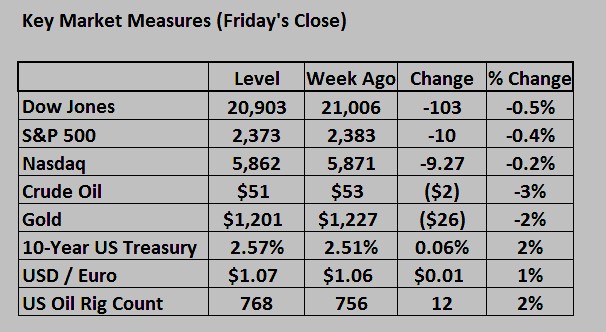
by Todd Shaver | Mar 12, 2017 | Weekly Newsletter 7pm Sunday
What a week just passed. The bond market sold off hard. An interest rate hike this coming week is as close to guaranteed as it gets. But how many more hikes will we see this year - 2 or 3 or 4 in total? Some savvy long timers are starting to talk about the days when the Fed hiked more than a quarter point per meeting. Could this return? Aside from Fed policy, the Trump team is on a roll. The appointed head of the Commerce Department, Wilbur Ross, spoke to his new 40,000+ employee team, and formally established so many new directives to change the game of US and global trade. The prospects for the bull market run in the stock market remain bright!
No matter what, there is always a bull market here! Week in and week out, you can find it right here at The Bull Market Report. We currently see a bull market across many parts of the stock market. This week we highlight the following securities: Bristol-Myers Squibb, Facebook, Simon Property Group, Tesla, VMware, Celgene and Amazon.
Highlights From The Past Week
Up, up, and away for stock markets. While expansion in PE multiples has sent the S&P 500 to a level above the 90% percentile of historical valuations, higher corporate profits are likely to push the equity market to even higher levels. We could see near-term weakness as earnings forecasts are revised downward due to tax reform occurring in 2018 versus 2017, but this should not jitter long term investors.
Record net inflows. "Fear of missing out" is quickly becoming the go to phrase for many of America's stock market investors. As The Wall Street Journal reports, investors poured money into stocks through mutual funds and exchange-traded funds in 2017, with global equity funds posting record net inflows in the week ended March 1st based on data going back to 2000. Inflows continued the following week.
Great Jobs report. Steady U.S. job growth has set the stage for the Fed to raise interest rates. A wave of hiring in February — President Trump’s first full month in office — pointed to a strong foundation for the nation’s economy, providing further evidence for the Federal Reserve that the moment to raise interest rates has come. The Labor Department reported a gain of 235,000 jobs and healthy wage growth in a month when even the weather cooperated. It was the last major data release before Fed policymakers meet Tuesday and Wednesday, when they have signaled their intent to increase the benchmark interest rate.
BMR Companies and Commentary
Bristol-Myers Group (BMY: $58, +2% - all price changes in this report are for the week)
Scott Gottlieb, a former deputy commissioner of the U.S. Food and Drug Administration, is President Donald Trump’s choice to lead the agency, per White House media relations.
Gottlieb, 44, served in several senior positions at the FDA during the Bush administration. He’s a partner at one of the world’s largest venture capital firms, New Enterprise Associates, which has a portfolio of more than 300 businesses in the Technology and Healthcare industries. He has talked extensively about how to lower the cost of prescription drugs by modernizing the agency’s approval process and speeding cheaper generic competitors to market. Since leaving the FDA, Gottlieb has worked as an adviser to investment firms and as a fellow at the conservative-leaning American Enterprise Institute, a Washington think tank. He has been the drug industry’s preferred choice for the FDA job and has worked as a consultant to some of its companies.
Bristol is largely already a good actor, but could have been taken down with the broader industry. Management understands the concern that with escalating healthcare costs, and with the increased burden they place on patients and their families, there needs to be close scrutiny. At the end of the day, Bristol feels that prices of its medicines should reflect the value they bring to patients, healthcare providers, payers and society as a whole. The results of how Bristol has contributed to the transformation of the treatment of diseases like HIV, HCV and cancer demonstrate that the model for sustainable innovation is working - which is good news for patients and society. For example, in melanoma, prior to the availability of Immuno-Oncology treatment options, 25% of patients diagnosed with metastatic melanoma survived 1 year. This increased to 75% with Immuno-Oncology therapies.
So you see Bristol is making real progress towards the goal of shifting cancer from a death sentence to a chronic disease that can be managed and controlled. Bristol is leading the way on the conversation for fair, reasonable, and visible drug prices, and the appointment of Gottlieb is far less disruptive than it could have been.
BMR Take: The event is a major positive for the Drug industry. The reason why is more so the counterfactual. With the current battleground discussion happening over the cost of drugs, Gottlieb is a far less extreme pick than some of the other candidate contenders. This means less pressure going forward for Bristol and others to lower prices.
Facebook (FB: $139, +1%)
Facebook has scored a deal to lives stream Major League Soccer matches. As competition in the live streaming space heats up, Facebook has scored a significant deal that will allow it to stream at least 22 live Major League Soccer matches on its social network.
Through a collaboration with both MLS and Univision, Facebook gained the rights to stream the 2017 MLS regular-season matches in English, as well as enhance the video content with various interactive elements. The streams will include Facebook-specific commentators and interactive graphics, as well as fan Q&A and polling features that let Facebook viewers engage with the commentators as the matches take place.
These are the same games that are being broadcast on Univision networks in Spanish, but Facebook has scored exclusive rights to the English language streams.
As a part of the deal, MLS will also produce more than 40 original “Matchday Live” analysis shows that will be posted to the MLS Facebook page. These shows will include feature highlights and discussions from around the league, as well as previews of the upcoming matches.
BMR Take: Soccer is the sport of the globe. Facebook just found a way in the back door to this global sport. It is exciting to see Facebook leverage the audience into stronger user engagement. Sitting at an all-time high of $139, we see no reason why the stock can’t continue higher. With management like Zuckerberg driving growth, we see this investment is in good hands. We hereby raise the Target to $150, and our Sell Price to $125.
Simon Property Group (SPG: $168, -6%)
We have here a REIT focused on owning and managing commercial real estate. The Simon portfolio is dominated by malls and premium outlets located in the U.S. Shares have been under elevated stress in recent weeks. Two factors are driving the concerns. First, a rising rate cycle presents headwinds. Second, retail exposure could be toxic.
The rising Fed Funds rate is leading to increasing debt costs for Simon. The company must successfully pass these increases to its tenants or operating results will suffer. Moreover, all of Simon's tenants will also have their own funding costs moving higher, which squeezes their capacity to pay rent. A challenging operating environment.
Malls and physical retail are also subject to secular pressure thanks to the internet's inroads throughout the retail space. Target and Macy’s recent earnings miss are the latest sign of the wave of stress coming. The fear is that if major anchor tenants in malls go down, then who could possibly step in to replace them. The answer is not clear.
We admit that Simon's has some great assets and can leverage them. However, the internet may affect the company in the future. BusinessWeek, in an article on Macy’s, said: “Long term bets on retail real state could be risky. America has too many stores, and more than 10% of US retail space - almost 1 billion square feet – may need to be closed, be converted to other uses, or charge less rent in the coming years. That could leave some REITs in trouble if they load up on losing properties or can’t find tenants, or if real estate values plummet. The larger retailers are shrinking their footprint. The question is, how far do they shrink it?”
BMR Take: We don't always get it right. But we do always address issues with you honestly when they happen. We are exiting our Simon position.
Tesla (TSLA: $244, -3%)
Tesla recently published its annual report and we have some notes to share.
SolarCity contributed $84 million in revenue from 11/21/16 to the end of the year. Their 10-K filing shows 2016 revenue totaled $730 million.
Tesla had 790 Supercharger stations worldwide at 2016 end, up from 715 locations globally at 3Q16 end (+8% q/q). The net book value of the Supercharger network was $207 million at FY16 end.
The company notes over 7,100 Tesla wall connectors have been installed at more than 4,100 locations worldwide to enable vehicle charging.
The company plans to begin production of its solar roof product at the Gigafactory 2 in Buffalo this summer, to be ready for customer installations later in the year.
Tesla estimates combined tax savings under agreements with the California Alternative Energy and Advanced Transportation Financing Authority will total approximately $200 million.
BMR Take: After reading the company’s annual report, we find a lot of tidbits of good information. Overall we continue to like the company’s prospects.
Elon Musk and His Take on Solar Panels for Your Home
Have you seen the presentation Elon Musk has put out for all to see?
Check it out here: http://read.bi/2mN4SLN
These new solar panels for your home look like any normal roof, but are indeed solar panels. Can you imagine how big this market is? We have solar panels on our roof here in Aspen and we don’t pay for electricity for eight months of the year. But we had to install those giant, bulky solar panels. Wouldn’t it be great to have a roof look like a roof but have it be totally solar?
Musk says his roofs are not expensive; we disagree. But what we do know is that over time the price will come down so everyone with a home will be able to afford a new solar roof.
Musk has grand ideas, some of which work, some of which don’t. (Have you heard that he is guaranteeing to fix Australia’s power outages for $100 million, but if he can’t do it in 30 days, the $100 million is on him!)* We love him for his brave ideas.
* From Reuters: Tesla boss Elon Musk on Friday offered to save Australia's most renewable-energy dependent state from blackouts by installing $25 million worth of battery storage within 100 days, and offering it for free if he missed the target.
The offer follows a string of power outages in the state of South Australia, including a blackout that left industry crippled for up to two weeks and stoked fears of more outages across the national electricity market due to tight supplies.
Musk made the offer on social media. He said via Twitter: "Tesla will get the system installed and working 100 days from contract signature or it is free. That serious enough for you?"
BMR Take II: We sure wish the stock wasn’t so darn volatile. We believe in Musk and we believe in Tesla (Solar City included.) And we think the stock can go to $400 and beyond. But the company certainly has its challenges financially. The market is so fickle that it might must crush the stock because of some short-term issue, scaring us and many investors out of this great company. Be diligent, Investors!
VMware (VMW: $90, flat)
VMware recently spoke at an investor conference. We wish to recap part of the discussion for you.
2016 was a very interesting year for VMware. It was a year that ended up with the company being in a much better position than what people expected, both in terms of the growth rate and customer satisfaction.
The company’s Chief Operating Officer specifically said one of the biggest things accomplished in 2016 was refining its strategy for customers. The Software-Defined Data Centers are the key part of the new strategy. The company has moved beyond compute to storage and networking. Four years ago, all VMware could talk about was Compute. Now, VMware has gone from nothing to the leader in storage and networking software with 7,000 customers. Plus, the recent Dell partnership just became a big opportunity for more growth.
BMR Take: VMware has been a great pick out of the gate for us at The Bull Market Report. We continue to believe in the company and believe the stock will go much higher towards our Target of $95. We just may raise the Target here soon.
Celgene (CELG: $124, flat)
Celgene recently spoke at an investor conference. We wanted to recap part of the discussion for you.
The big takeaway was this: The President of the Oncology division said, “I think it's fair to say that Celgene is at an inflection point. We have an incredible momentum as we've been saying and additional drivers that should absolutely enable us to achieve our 2020 numbers. The recent positive results that we have been reporting on ozanimod in relapsed multiple sclerosis have not been fully baked into the $21 billion revenue number of 2020. We have multiple Phase III studies, reading out. Five of them are going to read out by this year. So, I think we have a great opportunity to not only achieve but then overachieve what we've been telling you we should have as a financial goal for 2020.”
That is sure exciting. Don’t you agree?
BMR Take: Celgene is widely cited by Street analysts as a top pick in the space. We love it too. We raise our Price Target to $135 and our Sell Price to $115.
Upcoming Economic News
TUESDAY, MARCH 14
Producer Price Index – February
Time: 8:30 am
Forecast: 0.0% overall, 0.2% core
The downdraft in oil prices can leave the Producer Price Index unchanged in February after three straight monthly increases. Ahead of this potential pause, businesses were feeling somewhat higher cost pressures with the PPI equaling the 29-month high annual rate of 1.6% in January.
WEDNESDAY, MARCH 15
Consumer Price Index – February
Time: 8:30 am
Forecast: 0.0% overall, 0.2% core
While a decline in fuel costs can restrain the Consumer Price Index in February, the annual pace of growth will remain substantially elevated. The CPI has rapidly accelerated from the yearly advance of just 0.8% last July to the five-year high of 2.5% in January. The core CPI has long been pointing to livelier underlying inflation trends, rising more than 2% annually for 14 straight months.
Retail Sales – February
Time: 8:30 am
Forecast: -0.1% overall, 0.1% ex auto
A drop in gasoline sales is projected to lead a poor result for February retail sales. Outside of gasoline and plateauing auto sales, retail sales rose at the solid 5.0% yearly rate in the three months ending January. This points to higher potential for real consumer spending.
NAHB Housing Market Index – March
Time: 10:00 am
Forecast: 65
Homebuilder confidence is expected to remain elevated in the March NAHB index. Despite some slowing in the pace of new home sales, builders still foresee strong sales growth well into the future. The index of expected sales over the next six months was at 73 in February, far above the historical average of 57.
Business Inventories – January
Time: 10:00 am
Forecast: 0.3%
Business inventories are in line to expand for the third straight month in January amid improving production trends. Sharp growth in imports indicate that investment and output trends are moving into positive territory after extended soft periods.
FOMC Rate Decision
Time: 2:00 pm
Forecast: 0.75%-1% Fed Funds target range
Barring an unforeseen shock, the Federal Reserve is pushing toward lifting the Fed Funds target range at the March FOMC meeting. The more aggressive tightening stance is not entirely surprising, as a rate hike would have to be imminent to live up to policymaker projections of three increases this year. Unlike what has transpired in the past few years, there have been no financial market volatility or economic shortfalls to push the Fed off track.
THURSDAY, MARCH 16
Housing Starts & Building Permits – February
Time: 8:30 am
Forecast: 1.26 million starts, 1.25 million permits
Housing starts are forecast to hold steady in February, maintaining strong near-term gains. Starts rose 17% annualized in the three months ending January against the previous quarterly period, as homebuilding is recovering from the weak results in the middle of last year. The uplift in starts is set to continue with building permits rising 10% annualized in the three months ending January.
FRIDAY, MARCH 17
Industrial Production & Capacity Utilization – February
Time: 9:15 am
Forecast: 0.2% industrial production, 75.5% capacity utilization
Industrial production is looking to turn higher in February after the utility sector led an overall decline in January output. The manufacturing sector is reporting consistently positive results, rising in four of the last five months through January. The broad recovery in manufacturing will likely get little help from the auto sector, after auto output declined at least 2% in both November and January as sales slow.
University of Michigan Consumer Sentiment – March
Preliminary Time: 10:00 am
Forecast: 96.3
Consumer sentiment in the March Michigan survey is likely to be little changed from February’s three month low. Yet even with modest declines in the overall index, the Michigan readings on consumers’ assessments of current economic conditions have barely changed from December’s 11-year high. Continued positive trends in hiring and income are bolstering confidence, helping to lift potential consumer outlays.
Leading Economic Indicators Index – February
Time: 10:00 am
Forecast: 0.3%
Rising stock prices and the falling count of claims for unemployment insurance can help the Leading Economic Indicators Index expand for the sixth straight month in February. Much of the optimism baked into record stock index levels are derived from expectations of corporate tax cuts.
Amazon (AMZN: $852, flat) Grocery Sales
Nielsen, a consumer monitoring company, released a report entitled, The Digitally Engaged Food Shopper. It said that Amazon is 9th in groceries sales now. But they will be moving to 3rd by 2022. Wow. They said that online grocery shopping could grow 5-fold over the next decade, with American consumers spending upwards of $100 billion on food-at-home items by 2025. Online grocery spending could grow during the 2016-2025 forecast period from 4% of the total U.S. food and beverage sales to as much as a 20% share, based on the most upbeat scenario. Last year, online grocery sales were about $20 billion.
Amazon is setting up stores where you can order online ahead of time and then either pick up your order yourself, or have it packed and delivered to your home, usually within two hours. In fact, Amazon Go lets customers walk in, grab food from the shelves and walk out again, without ever having to stand in a checkout line. This is a new concept and they are just starting to test this in Seattle, their home base. The stock is trading within a whisker of an all-time high of $860, set on February 23rd. We have a $900 price target on the stock, but if and when it hits this number we are raising it to $1000.
Notes at the Margin
Philip K. Verleger, Jr.
Former Director of the Office of Energy Policy
at the United States Department of Treasury
March 13, 2017
Expectations Frustrate Oil Producers
The oil industry’s “high and mighty” met last week in Houston during IHS CERA’s annual conference. Oil ministers and company CEOs addressed the throngs in attendance. Separately, key individuals met privately. Lacking a castle in Scotland, the key OPEC representatives met with several CEOs there. As they did, the company counsels likely trembled while thinking of the potential antitrust implications.
Quoting one official on how companies are moving aggressively to bring breakeven costs down:
“Everyone is driving break-even prices down,” Deborah Byers, head of U.S. oil and gas at consultants Ernst & Young, said in an interview at the meeting, the largest annual gathering of industry executives in the world. "It isn’t just shale companies; it’s everyone, from deep-water to conventional."
Some examples:
--- Statoil has driven the costs for its next generation of projects from $70 per barrel to well below $30.
--- Exxon’s CEO Darren Woods and Total’s Patrick Pouyanné believe many projects can be profitable at $12 per barrel.
--- Rystad Energy sees a 46% decline in shale costs from 2014 to 2016.
--- Shell’s reported the company had cut deepwater costs 50% over two years.
The conference speakers all touted the increased output they expected to achieve, some mentioning rates of twenty and thirty percent per year. Markets responded to the news. Crude oil prices dropped sharply. The decrease in cash markets began on Wednesday. In three days, prices fell $4.50 per barrel,
[Verleger’s Conclusion: The world oil market has become much too sophisticated for OPEC management. ]
A Word from Gary Jefferson
Jefferson Financial Group
First Vice-President, Investments
UBS Financial Services, Inc.
Twelve days ago President Trump delivered just what investors wanted to hear during his Joint Session of Congress address. He talked about a large corporate tax cut, massive infrastructure spending, and tax relief for the middle class. All of these are pro-growth initiatives and were clearly the catalysts behind the impressive bull run the day after the speech.
Amazingly enough, we heard a couple of financial pundits on TV say something that actually made sense – that before the market moves much higher, investors will likely demand more proof of the actual implementation of these pro-growth policies. We say that the faster things come together the better. And, the longer it takes, the tougher it will be to continue to make new highs.
We think the market will focus in on three key things: The February Jobs Report, February CPI and the Fed's March Meeting. Unless there are some really bad surprises, we believe the Fed will raise rates at their March meeting this week. How high do rates have to go to raise a red flag for equities? The Oracle of Omaha recently stated that he thought the stock market would be fine until the 10-year Treasury rose above 3%. It's currently trading right around the 2.6% level, which is not that much higher than the average dividend yield of S&P 500 stocks.
Consensus Ratings for AstraZeneca (AZN: $29.50)
Ratings Breakdown: 1 Sell Rating, 5 Hold Ratings, 11 Buy Ratings
Consensus Price Target: $36
3/7/2017 Barclays Initiated Coverage - Overweight
Two Letters from Our Readers:
From John Tennant
Good call on OPKO in your March 5th report! I have been loading up under $8..... One of my larger positions now, average cost $8.50. Note new info from Dow Jones this morning. "OPKO Health: EU Orphan Drug Status Granted for AntagoNAT to Treat Dravet Syndrome"
Our answer:
Yes, so far so good. But $9 would make us feel a LOT better!
[Note: the stock was up 7% this week.]
Hi Todd,
After reading your newsflash on The Carlyle Group (CG: $15.70), I went to Yahoo Finance. The dividend shows $0.64. I then went to TDAmeritrade where it shows $1.84. Fidelity shows the same as TDAmeritrade. And the screen shot you shared shows $1.60.
I am a little confused as to which is the correct information. Could you please help resolve this? Thanks again for all your guidance week in week out. It is greatly appreciated.
Regards, Nilanjan Das
Our Answer:
Hi Das –
The problem for all reporting companies like us is that this company issues a different dividend each quarter. The last four dividend payments were: 26 cents, 63 cents, 50 cents and 16 cents. That’s $1.55. The four before that total $2.07. So go figure!
The point here is that the company will be paying out as much as possible, and we think that average will be around $1.60 to $1.80.
Todd Shaver
The Trillions of Dollars of Cash Overseas
We had a discussion with a friend of ours recently who is a very astute investor and we were impressed with actually how smart he is. On Election Eve when it was clear that Trump had won the election, the futures market was down 800 Dow points. He said he bought over $1 million of equities in the overnight trading markets. And he still has those positions. He wouldn’t tell me how much he is up but I can guess – 20%? 30%? Wow.
We then had a discussion over how much corporate cash is sitting in banks overseas. We know that Apple has over $250 billion stashed in Ireland and other places, and we always thought the total amount of cash was hovering around $1.3 trillion. He said that the number was $2.5 trillion. Well, we did a little research and found out that he is exactly right. $2.5 trillion is sitting overseas waiting to come back to America when Trump lays out his tax cut plans. We don’t think an overall corporate and personal tax cut is a good idea, but Trump says he is going to do it so we have to roll with it. Increasing the $20 trillion debt it not a good thing in our book, but Trump also says he can wipe out the debt in eight years. This ain’t gonna happen, folks.
But repatriating 50-75% of this cash will change America for the good. What can corporations do with this cash? Stock buybacks, starting new companies, investing in technology, hiring more people. The list is endless. Keep your eyes peeled for this big move from the White House.
The High Yield Corner
By Michael Foster
This week, we need to start with Treasuries.
High yield investors don’t buy Treasuries, especially not in a post-2006 world. After all, a 10-year Treasury note is paying a whopping 2.6% yield. With inflation going up, that’s not enough to cover the rising cost of living let alone provide a real inflation-adjusted return. But high yield investors need to keep paying attention to U.S. Treasuries, because they represent the baseline - the limit that high yield investments can go before they yield too little to warrant buying, given their greater risk.
That baseline is going up because Treasuries are going down. As Treasury prices fall, their yield goes up. And the 10-year yield has skyrocketed from less than 2% in 2016 to the 2.6% we’re seeing today. As a result, anyone who bought Treasuries in an attempt to find a low-risk investment is down on their investment big time. The iShares Barclays 20+ Year Treasury Bond ETF (TLT: $117) has fallen over 7% in the last year. So much for avoiding risk!
And while I pity people who bought Treasuries in 2016, I can’t say I’m all that surprised. Yields had fallen to their all-time historic low and political pressure on the Federal Reserve to raise interest rates made the low yield on long-term Treasuries untenable.
Here’s the problem for high yield investors: This makes the situation for many riskier debts untenable.
In particular, we are at a crossroads for the high yield world in which corporate bonds are getting to their breaking point. To demonstrate this, we need to look at a relatively obscure financial metric known as the Merrill Lynch US High Yield Option-Adjusted Spread. This is an index that calculates the difference between junk bond yields and Treasury yields..
This index tends to revert to its mean and go up and down wildly. When it’s at its highest points, like in early 2016, the market has sold off corporate bonds to such an extreme that there are a lot of bargains for selective investors. When it’s at its lowest points, like in June 2007, the market is way too complacent and a sell-off is likely on the horizon.
This index was at 8.6 in February 2016 when The Bull Market Report began aggressively recommending high yield investments. The index is now at 3.9. The bigger the spread, the more risk-averse bond investors are acting. The smaller the spread, the more risk hungry
We’re still 50% above its low in 2007, so we’re not at the top of a bubble by any means. But the index is at about the same level it was at in July 2014. That’s when the SPDR Barclays High Yield Bond ETF (JNK: $36) reached its top only to fall 21% until reaching its low in 2016.
The SPDR junk bond fund fell 2% this past week. It is flat year-to-date and up over 7% from a year ago. There is no indication that junk bonds are going to crash - but we also have clearly left the bullish trend that we saw in 2016.
This means investors need to stay cautious and ready to rotate out of junk bonds in the coming months. This is especially a prudent course of action before the Federal Open Market Committee’s March meeting next Tuesday and Wednesday. Janet Yellen has already dropped several strong hints that she is set to raise interest rates at this meeting. The futures market also thinks an interest rate raise is coming, with the futures market implying a 97% probability.
The drop in long-term Treasury prices is simply the market anticipating the Fed driving up short-term Treasury interest rates. But that doesn’t mean the move is fully priced in. What’s more, the junk bond market has not really priced this in at all. Junk bonds are up 7% during a time period when the Treasury market is down 7%. This is wild. With junk prices up, the rates have fallen. With Treasuries down, the rates have risen; and thus the spread between the rates has gotten about as small as it ever does outside of an unusual bubble situation like the housing disaster of last decade.
As a result, it’s time for high yield investors to lay off of junk bonds. We do not recommend selling all junk bond holdings, but a lighter allocation to previous BMR recommendation PIMCO Dynamic Income Fund (PDI: $28, down 1%) makes sense here. This fund’s near-5% premium pricing no longer makes sense in the current bond market, even though fundamentally this is a great fund to buy in most market conditions. A rebalancing slightly out of PDI now that the junk bond market is heating up makes sense, while still holding some shares to enjoy the double-digit yield.
So where should that money go instead? While corporate bonds have not priced in interest rate risks due to intense investor demand, the more easily frightening municipal bond market has. The Invesco Municipal Trust (VKQ: $12.16, down -3%) and Nuveen AMT-Free Fund (NVG: $14.11, down -2%) have continued to slide and are now yielding 6% each. Depending on your tax bracket, that could mean a taxable equivalent yield of 9%, making them close to PDI in terms of post-tax income.
At the same time, these funds have not been bid up in an overly risk-tolerant market like PDI, meaning the risks of capital loss are not as acute.
In fact, there is a lot of undue fear that tax policy changes will remove the tax benefits of municipal bonds, but now that the Trump administration has released its new budget plans, it seems that muni bonds are not a target. We at The Bull Market Report have reiterated this position repeatedly; it makes no sense for the Republicans to alienate retirees by cutting tax benefits to municipal bonds. But the market is still treating muni bonds as unduly risky, currently not a bad thing as yields have remained high.
Using Warren Buffet’s terminology of “greedy,” we like the more fearful approach of the municipal bond market, which is making investors more greedy. Conversely, the more greedy approach of the junk bond market is making us more fearful.
The same dynamic exists in other parts of the high risk lending world. BDCs are showing signs of weakness, but they aren’t suffering the kind of sell-off after last year’s run up. The UBS Etracs BDC ETF (BDCS: $23, down 1%) remains in the green for 2017 and is up a whopping 19% over the last year excluding (!) its 8% dividend.
This wouldn’t be a real problem if BDCs were reporting good earnings, but that’s not happening. Blackrock Capital Corporation (BKCC, $7.72) reported a 2% year-over-year decline in net asset value per share and the company cut its dividend by 14%. Yet the stock is up 11% year-to-date and has seen large daily drops and increases over the last week. This kind of volatility and disconnect between stock price and fundamentals is dangerous.
But it’s not just happening with Blackrock Capital. KCAP Financial (KCAP: $4.02) and Horizon Technology Financial Corp (HRZN: $10.33) reported a similar drop in NAV this week.
It isn’t all doom and gloom in the high yield sector though. REITs saw a sharp sell-off this week, uncovering some more bargains for income-hungry investors. The SPDR REIT ETF (RWR: $90) fell over 4% to show a 1% decline from a year ago. This is good news because it is unlocking several high quality REITs whose investment income remains strong and whose borrowing costs are still extremely manageable despite the shenanigans at the Fed, all of which is giving us continued opportunities to accumulate these high yields.
Healthcare REITs were particularly hit hard, which has resulted in BMR favorites Omega Healthcare Investors (OHI: $31) and Care Capital Properties (CCP: $24) to struggle. These REITs fell 5% last week and are down 6% and 12% respectively over the last year. This means it’s time to buy more. Omega’s yield is approaching 8% but its FFO is still amply covering dividends. Care Capital is now paying a huge 9% but it too is covering dividends. Both stocks are a screaming buy at this current level. After the Fed raises rates and the market sees that this won’t actually change much for the REITs, we’ll see both companies recover. Now is the time to get in before that happens.
Good Investing,
Todd Shaver, CEO and Editor
The Bull Market Report
Since 1998
