October 15, 2017
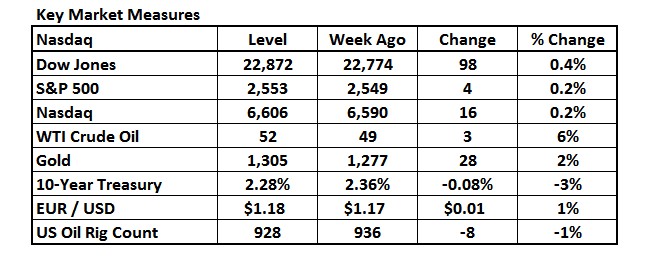
by Todd Shaver | Oct 15, 2017 | Weekly Newsletter 7pm Sunday
The Weekly Summary
Tulip Mania was a period in the Dutch Golden Age when the price of bulbs reach ridiculously high levels in a craze only to eventually have the price crash badly in 1637. While we are not seeing broad-based craze in today’s markets, we must be mindful that there are pockets of risk out there, and that while market prices today haven’t reached “ridiculously high levels” they have still come a long way, raising the bar for how much risk lingers around out there. For example, this week the mainstream news media extensively covered Wall Street’s junk market bond binge. Junk rated companies are raising debt at the fastest pace since 2012. Not just is the issuance up a lot, but the terms of the deals (i.e. the debt covenants) are getting looser and looser, and thus easier to borrow money. We only raise these points to say, please be mindful of the risks, but there remains plenty of opportunity for future profits!
No matter what is happening out there, there is always a bull market here at The Bull Market Report! This week we highlight some of our favorite stocks/funds where we think you can still make good money, including: Athenahealth, Nutanix, Cloudera , Opko, Apple, Annaly and BlackRock.
BMR Companies & Commentary
Another week, another all-time record high. Does this scare you? Not us. Why should it scare you? The economy is strong. We have 325 million people who are trying to better themselves by starting companies, by investing in real estate, by buying equities and bonds. No one thing or no one event can bring down the entrepreneurial nature of this country. The market is climbing a wall of worry. Trump, North Korea, breaking the Iran deal, the Taliban, our war in Afghanistan (that Trump is escalating now – ouch), Trump – oh wait, we just said that above. Yes, climbing a wall of worry. But the stock market has been doing this for over 100 years. Seriously. Look what it has been through and look where it is now. Look where our economy is now. Amazing. So Dow 23,000 look out and who knows, maybe in a year or two we will be saying “Dow 30,000 look out.”
If you really are worried and/or if things do get worse, sell your growth stocks and buy some income producing stocks from our REIT portfolio or our High Yield portfolio. Annaly Capital Mortgage (NLY: $12.22, up 1%) has been paying over 10% for over 20 years. I am going to repeat this for you here: Annaly Capital Mortgage has been paying over 10% for over 20 years. Since 1997 they have operated through bull and bear markets in stocks and bonds and they have survived and thrived. You’re worried about the stock market? Buy some Annaly – it is non-correlated with the market.*
*It has a beta of 0.30. A beta of 1 means it follows the overall stock market equally – if the market is up 1%, Annaly is up 1%. But no, Annaly has a beta of 0.30% meaning little to no correlation. The beta of an investment indicates whether the investment is more or less volatile than the market as a whole. In general, a beta less than 1 indicates that the investment is less volatile than the market, while a beta more than 1 indicates that the investment is more volatile than the market Beta can be zero. Some zero-beta assets are risk-free, such as treasury bonds and cash.
You want diversification? There are many other stocks in those two portfolios that pay from 4% to 9% dividends. Buy a basket of them and sit back and sleep like a baby at night!
Athenahealth (ATHN: $115, down 7%)
While Athenahealth didn’t perform well this week, as far as we can tell the issues are just some pre-earnings jitters, not anything serious. The company is scheduled to report earnings on Friday. The consensus is looking for EPS of $0.50 on $310 million of revenue.
We expect all the key fundamentals to remain solid. Recall, the company recently committed to several key initiatives, including: (i) targeting approximately $100 million in cost-savings to increase profitability and drive growth; (ii) committing to significant operating margin expansion; (iii) launching a search to recruit a seasoned independent chairman of the board and additional independent director; and (iv) augmenting the senior management structure to establish the role of president, in addition to an ongoing CFO search.
We do note that the interim CFO sold 4,000 shares this week. Sometimes this news spooks people, but in this case we see no reasons to be concerned about it.
BMR Take: With Elliott Management in there shaking things up, there is a lot of excitement ahead. We love this company but believe now is the time to take profits. For those of you who bought on our recommendation, we made a fair amount of money since we added the stock at $103 in November. While we already officially removed the stock from our portfolio on 8/7/17, we once more reiterate taking profits. Why again? We know some of you out there may have stayed the course selling calls, as that’s what we recommended to do at the time if you weren’t ready to get out. Well, we want to be sure to now say without any hedging - time to exit completely! Let’s buy this one back below $100.
Nutanix (NTNX: $27, up 15%)
Goldman Sachs called Nutanix the investment opportunity of a decade. Why?
The demand pendulum appears to be swinging toward emerging, best-of-breed vendors with more modern approaches, and away from traditional, one-stop shop vendors that are often viewed to be out-of-step with the latest trends.
The proof is in the success or failure of new clients. Just this past quarter Nutanix had a strong quarter for large deals, including multiple deals in the high seven-figure range (several of these in the public sector). Nutanix is now working with a big chunk of the Fortune 500.
The big exciting part about Nutanix is that the company has doubled the number of clients in the past year. The typical client starts with a small contract, but then increases the amount of business they do, often 3x, 5x, or even 10x within a few years. So if Nutanix does nothing else but take care of the clients it already has, we should see strong growth in the years ahead.
BMR Take: We think Nutanix is a must-buy at current levels. Don't be worried about the current valuation. Let's look at why. This year the consensus is for EPS of $0.07, which is nothing much. However, the company is plowing money into sales and marketing to grow the business. Did you know they could save a few hundred million dollars tomorrow generating $1.50+ of EPS if they wanted to stop investing for growth? You see this analysis reveals the serious earnings power embedded in the business model, which is why we like the company so much.
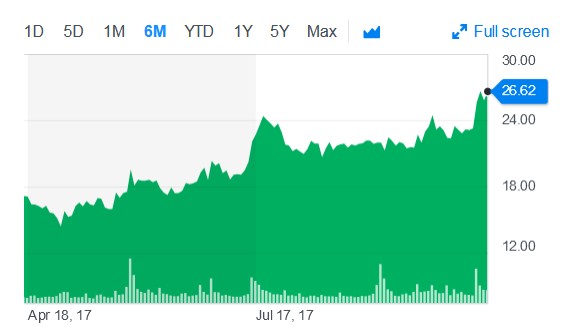
Cloudera (CLDR: $15.72, down 6%)
Remember the company we really like just mentioned above, Nutanix? Well they are doing great things with Cloudera, which means there is more than one way to make money here.
Nutanix, a leader in enterprise cloud computing, announced that its Enterprise Cloud Platform software has been certified to run Cloudera Enterprise workloads. Through this certification, joint customers can reduce management complexity and derive more value by deploying and managing their Cloudera analytics workloads on the market’s leading hyperconverged software platform.
For big data deployments, choosing the right hardware and software is critical to success but often challenging for IT teams balancing ambitious corporate goals with smaller budgets and fewer resources. Joint customers can now run Cloudera workloads on an on-premises, elastic, software-driven infrastructure that can scale on-demand, one node at a time. And because Cloudera workloads can run on the same shared infrastructure as other workloads, IT teams can reduce costs and focus their attention on strategic projects, rather than managing multiple silos of underutilized infrastructure. Great news!
BMR Take: With $360 million of sales projected this year, a growth of 40%, Cloudera is an emerging growth stock worth keeping an eye on. With acquisitions building out the product suite and accelerating revenue growth, momentum is undeniably picking up. A $2 billion market cap, this company is a pipsqueak in the world of commerce. But given its high growth rate, in 2-3 years, the firm can be a major factor (if the company doesn’t get taken out by the big boys.)
Wall Street Consensus Ratings for Cloudera
Ratings Breakdown: 5 Hold Ratings, 4 Buy Ratings
Consensus Price Target: $22.40
10/11/2017 Mizuho $18
9/8/2017 J P Morgan Chase $24
9/8/2017 Morgan Stanley $19
9/8/2017 Stifel Nicolaus $24
5/24/2017 Bank of America $23
5/23/2017 Raymond James Financial $23
5/23/2017 Citigroup $23
5/23/2017 Deutsche Bank $25
Opko Health (OPK: $6.95, flat)
Opko is a diversified healthcare company that seeks to establish industry leading positions in large, rapidly growing markets. The diagnostics business includes BioReference Laboratories, the nation's third largest clinical laboratory with a core genetic testing business and a 400 person sales and marketing team to drive growth and leverage new products, including the 4Kscore® prostate cancer test and the Claros® 1 in-office immunoassay platform. The pharmaceutical business features Rayaldee, an FDA approved treatment for Secondary hyperparathyroidism in stage 3-4 chronic kidney disease (CKD) patients with vitamin D insufficiency.
Opko recently announced that it has entered into an exclusive agreement with Japan Tobacco (JT) for the development and commercialization in Japan of Rayaldee for the treatment of SHPT in dialysis patients with chronic kidney disease. This is great news for growth!
Under the terms of the agreement, JT will make an upfront payment to Opko of $6 million with another $6 million payment to be made upon initiation of Opko’s planned phase 2 study of Rayaldee in US dialysis patients. In addition, Opko will be eligible to receive up to an additional $31 million in development and regulatory milestones and $75 million in sales-based milestones. JT will also pay Opko tiered, double digit royalties on net product sales. Wow!
BMR Take: Consensus calls for about $1.2 billion of revenue for the company this year heading to $2 billion in a few years. We could be in for some major upside to estimates. Now wouldn’t that be nice, after being so patient with this little $3.9 billion company.
Apple (AAPL: $157, up 1%)
Apple could be disrupting more industries soon.
Barclays, the British bank, will need to defend its advantages in the payments business from encroachment by technology companies including Amazon and Apple, according to Barclay’s CEO Jes Staley.
There are some tectonic shifts going on, driven by tech and the geopolitical environment. The banks are very focused on the payments space and that may be where the battleground of finance is fought over the next 15 years. Could you imagine if Apple started taking share of the banking business from the world’s largest banks (like Barclays, JP Morgan, and Wells Fargo) as well as the world’s largest payments companies (like Visa and MasterCard). This would be another huge long-term growth driver.
BMR Take: Note that Apple has $260 billion in cash now, and with a market cap of $810 billion cash is 32% of the stock price. So more than $50 of the stock price is in cash. This is UNPRECEDENTED in the history of Wall Street. Apple remains an exciting investment opportunity. The services business is projected to double in revenue to $50 billion over the next several years. The Services business is much more profitable than hardware so the impact to earnings is even better. Don’t sell a share. We believe Apple has a lot more room to go on the upside.
BlackRock (BLK: $475, up 3%)
BlackRock, the world's largest money manager with $5.7 trillion in assets under management, reported better-than-expected earnings on Wednesday, which sent its stock to a record high.
And shares could go even higher, according to Credit Suisse (and us!) Following 3Q17 results, BlackRock remains the best-positioned traditional asset manager in the world with EPS growth expected to run 15-20% through 2019.
Most of the company's growth has come from its wildly successful exchange-traded fund business, known as iShares, which now accounts for half of all US investments in the products. There continues to be strong demand for iShares's ETFs driven by the evolution of the US retail channel (from commission-based to fee-based) and increased adoption by institutional clients and pricing reductions in its core series. Year to date, iShares accounted for about 50% of total ETF flows in the US.
Passive investments, like ETFs and other products that track a weighted index rather than a single equity, have steadily eaten away at active managers' portfolios in recent years.
BMR Take: BlackRock is among the best-positioned companies in investment management owning the top ETF franchise that is growing rapidly due to passive investing, as well as an increasing product portfolio of technology. Recall, there are several top hedge funds on the list of shareholders in BlackRock. With EPS set to approach $30 over the next 3 years, this stock pick is among our favorites.
Upcoming Economic News
Industrial Production
Tuesday, October 17, 2017 09:15 AM
Period: September
Consensus: 0.30%
Prior: -0.90%
Housing Starts
Wednesday, October 18th, 8:30 AM
Period: September
Consensus: 1,180,000
Prior: 1,180,000
Continuing Jobless Claims
Thursday, October 19th, 8:30 AM
Period: October
Consensus: 1,895,000
Prior: 1,889,000
A Word from Gary Jefferson
Jefferson Financial Group
First Vice-President, Investments
UBS Financial Services, Inc.
The 4th quarter is off and running strongly, which is not uncommon. Even though it includes October (Octoberphobia), Q4 has historically been the strongest quarter of the year for the S&P 500. Since 1950, the S&P 500 has gained 4% on average in the fourth quarter, advancing 79% of the time. Oil dipped back under $50 per barrel and gold has fallen over 7% in just the last month because the US Dollar has strengthened due to the belief that the Fed will hike rates again in December. Maybe or maybe not. We still think tax reform is a bigger wild card than another Fed hike. The expectation of tax reform has resulted in just about everything with the exception of energy being up for the year, but even energy has some building tailwinds.
According to Boone Pickens Advisors, worldwide demand is soaring and set to hit 100 million barrels per day next year – a feat that was only expected around 2025 by most long-term forecasts including those from OPEC and Exxon. Growing energy demand is normally associated with growing economies, so this continues to be good news for future market gains based on earnings growth. The point being made is that if the market suffers a setback due to the failure of tax reform, it should not develop into a real bear market because of the support to be found in continued earnings growth. If Boone Pickens Advisors is right about soaring demand for energy, there is plenty of upside left in this bull.
General Electric (GE: $23, down 10% this week, and down from $32 in December - wow)
The drop in the stock in the last 10 months is almost 30%. With a market cap of $200 billion GE is not going away. But they are the Dog of the Dow. You know what the Dogs of the Dow are, right? They are the five worst performing stocks of the 30 Dow stocks. GE is gunning for THE DOG of the Dow this year. Many value money managers love this stuff. They buy the Dogs and historically, they have been big winners the following year and years.
We are thinking of adding GE to our Stocks For Success portfolio, not just because of the thinking in the above paragraph but for a host of other reasons. It has just had a shakeup in management, which will continue for the next few months. Old CEO out (Immelt), new CEO in (John Flannery). Lots of executives leaving or getting pushed out. Dividend is 4% which is pretty darn good for a Dow stock. 100+ year history of success as a global business leader. Lots going on with this huge company.
A note about the dividend. Some analysts think the dividend could get cut in order to conserve cash. This would be bad and good news. The stock would probably get nailed by another 10% down to $21 or even lower, but that would most likely mark the bottom. So if you are thinking of taking a position, keep this in mind. In other words, keep some cash around (keep your powder dry) in order to buy more at a lower price. If this dividend cut doesn’t happen, then buy some more as the stock moves up over the coming 24 months as it gets back into the $30s. The all-time high is about $58 back in 2000, right after the bubble started bursting in the dotcoms. It dropped to $24 in 2002 and then rallied to $41 in 2007. It got whacked to $12 in 2009 in the financial crisis and has moved straight up for eight years to $32 in 2016. We think there is a good possibility of seeing $30 and $40 in this great franchise as we move into the latter stages of the twenty teens.
Again, we are thinking of writing a research piece on GE soon. We believe it is a long term winner for the super conservative investor.
Update on Shopify
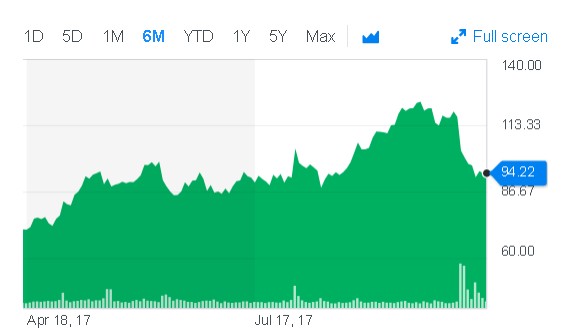
As you know, we love Shopify (SHOP: $94, down 4%) but along came Andrew Left and his firm Citron announcing that he was short the stock, that it was going way down, and that the company was fraudulent, among other silly claims. Many analysts jumped in this past week on the story. Here’s what one of them said:
"Citron’s Argument is Weak
"Let’s call a spade a spade - Shopify is selling a dream.
"So, is the Shopify stock news on-point? Is Shopify using illegal marketing tactics in selling that dream? That’s a gray area to be sure, but is the marketing message remarkably more misleading than the TV commercials inviting consumers to participate in class action lawsuits that mostly enrich attorneys, but rarely pan out as well as expected for the actual plaintiffs?
"Is a vision of a healthy cancer patient within a television commercial for a cancer drug some sort of unspoken guarantee of long-term survival? Does a young man that uses the Axe brand of personal-hygiene products actually expect to be besieged by young women, as depicted in Axe’s television commercials?
"The answer to all these questions is, of course, no. The FTC tolerates the imagery simply because it knows it has to give consumers at least a modicum of credit in distinguishing the difference between a contract and a commercial.
"And as for Shopify’s lack of profits, Shopify is in good company. Most young companies don’t turn a profit until after they’ve matured, but savvy investors know the time to get into some of them is before, not after, that fact. Look at Amazon, the most prominent of the rags-to-riches stories. It’s been one of the best long-term investments anyone could have made over the course of the past couple of decades. Investors don’t care where a company is, they care about where it’s going.
"Looking Ahead for SHOP Stock
"Don’t misread the message. The FTC might crack down on Shopify’s advertising. The company might never turn a profit. The market might not care if Shopify does eventually turn a profit. Nobody really knows the future. That’s the speculative nature of stock-picking.
"Andrew Left, however, seems to be grasping at straws with this one. Though he certainly rattled shareholders by generating some rather alarming Shopify stock news headlines, this time his claims are more bark than bite.
"If your gut is telling you this may be a time to scoop up shares at bargain prices, you may want to trust your gut."
BMR Take: Again, this was an opinion of a consensus of Wall Street analysts. But we certainly concur. We think this guy Left is out in left field. Here’s a chart of the last six months. You can see that the stock is where it was in August, just two short months ago. In April it was $71. We think there is tremendous value here with this company and believe Andrew Left will be left high and dry.
Update on Cloudera (CLDR: $15.72, down 6%)
Nothing new this week, just a lower stock price, giving the stock even more value for the investor.
Here’s what we said three weeks ago on September 24th.
Cloudera (CLDR: $16.90, down 8%)
Cloudera is issuing new stock, diluting existing stockholders, hence why the stock is down. Specifically, Cloudera announced that it has filed a registration statement with the U.S. Securities and Exchange Commission relating to a proposed follow-on public offering of its common stock. A portion of the shares to be sold in the offering will be sold by existing stockholders of Cloudera, and a portion of the shares will be sold by the company. Cloudera will not retain any proceeds from the shares sold by existing stockholders. The number of shares to be sold and the allocation of the shares between existing stockholders and the company have not yet been determined.
Morgan Stanley, J.P. Morgan, and Allen & Company are acting as lead bookrunners for the offering. Merrill Lynch, Citigroup, and Deutsche Bank Securities are acting as book-running managers and Stifel, JMP Securities, and Raymond James are acting as co-managers.
BMR Take: Two weeks ago they reported this:
Recent Business and Financial Highlights:
Subscription revenue was up 46% year-over-year to $74 million
Subscription revenue represented 82% of total revenue, up from 79% in year-ago period
Subscription gross margin for the quarter was 85%, 200 basis points higher than second quarter fiscal 2017
Dollar-based net expansion rate was 140% for the quarter
45 net new Global 8000 customers added
And they have $500 million in the bank. Yes, they aren’t profitable yet, but remember, revenues tell all.
Taking a step back, companies do what Cloudera just did all the time — raise equity and use the proceeds for corporate purposes. It is not a reason for us to sell the stock or for the stock to be down as much as it is. The fundamental business has not changed one iota on this development. So it makes sense for us to stay invested. We will certainly keep a close eye on this management team though. For the time being, we are sticking with the company.
The High Yield Corner
By Michael Foster
Remember the slight volatility we recently saw in REITs? That’s gone. Instead, 4 of the 6 REITs in the High Yield portfolio were up this week, while two were flat. While not rising the most, Omega Healthcare Investors, Inc (OHI: $32, up 1%) is the most important and interesting story of the week. Extremely cautious, risk-averse investors dislike this stock because of its high yield (8%) and relative youth. Having been around since the late 1990s, it lacks the history of many dividend growth stocks. It also had a pretty disastrous collapse in its dividend back in 2000. However, that’s all long history by now. More recently, Omega Healthcare has devoted itself to a penny-per-quarter dividend hike that makes it a uniquely high yielding dividend growth stock. Some will warn that these dividend increases are unsustainable, and that may be true. But if the hikes last 10 years instead of 2 quarters and you avoid it because it won’t last forever, you’re giving up some extreme gains over a decade. This is how risk averse behavior cuts into returns.
The more aggressive investors who own Omega realize this, which is why they look at both the firm’s FFO and its dividend growth rate like a hawk. Last week, Omega yet again gave investors a penny-per-share raise. At the new payout, FFO covers the dividend pretty well - at a 125% rate. Bear in mind that that’s below the 130% threshold that we frequently write about here, which makes us cautious about the longevity of the rate hikes. We need to see FFO per share slow significantly before that dividend coverage ratio gets hurt and a cut becomes a mathematical necessity.
But how long could that take? Our best guess is that we have at least three years until a cut becomes necessary, but there are two factors that could grossly change that estimate. For one, shares outstanding growth. The more shares Omega releases, the more dividends it has to pay, which makes its FFO less powerful in covering payouts. Total shares outstanding have risen to 197 million from 196 million in the last year - a pretty small jump. But shares were just 68 million a decade ago, meaning an 11% annualized growth rate in total shares outstanding. That brings us to our second factor: FFO - funds from operations. During that same decade, FFO has risen 22% annualized over the same period. So you can see how Omega has been able to grow far beyond its obligations to shareholders and keep that growth rate going!
Can Omega continue? The real answer is no one knows, but there is reason to be concerned. The growth rate has slowed significantly in recent years, especially since Omega was smart to expand during the post-2009 years when all real estate was on sale. Deals are harder to find now, making growth a lot harder.
There’s another lever Omega can pull, though: Getting strong rent hikes. Keep in mind that Omega’s wheelhouse is a customer base that struggles with inflation, which makes rent hikes particularly challenging. For that reason, we think the long term trend of strong growth at Omega is definitely a thing of the past, and the penny-per-quarter hike cannot continue forever. But selling now and missing out on years of high yield dividend growth would be folly. Instead, we need to keep our positions and look closely at the numbers before jumping out. Now is not the time.
Our strongest REIT of the week is in many ways the exact opposite of Omega. Digital Realty Trust (DLR: $122, up 3%) saw a really strong week without too much relevant news. Last week the firm announced it would expand its Silicon Valley Connected Campus, with a new six-megawatt facility planned for 1Q18 delivery. This is a really small part of Digital Realty’s portfolio, comprising just a $75 million investment, so it isn’t enough to move the needle. Also, as counterintuitive as it sounds, Digital Realty’s strength isn’t in the Valley but in its distributed presence around the country. The company has many retail-facing clients, as well as the U.S. government, where the need is to have many hubs where human beings who use the Valley’s services are located.
Digital Realty is on track to grow that business, but the real story of last week’s price movement is more technical than fundamental. The stock has retreated from its 52-week high hit last month ($127), and after this week’s gains is approaching it yet again. The dividend yield is also nearing the sub-3% level, which it hit in September briefly before rising. We fear we may have a repeat of that in the short term - but that’s hardly a cause for concern. It simply means that Digital Realty is for the most part range bound right now, and we need to content ourselves with that while we wait for the company to aggressively ramp up its dividend. The last rate hike was in March, and another one by the end of the year would be nice. In reality, this company’s management has settled itself into a predictable pattern of one-per-year dividend hikes despite a rapid acceleration in FFO growth. FFO per share is now over double payouts - an absurd ratio to say the least! We would like to see Digital Realty aggressively ramp up its dividend hike schedule.
We doubt we’ll see it anytime soon, but we do think it’s an inevitability with this company. Simply put, it cannot stop making money, and its business is growing too rapidly for it to be at risk anytime soon. Eventually, Digital Realty will need to start increasing its dividend more frequently or doing much more aggressive dividend hikes. Either way, its 3% yield at current prices is destined to turn into more of a 5% yield in the next 3-5 years. For that reason, investors long the stock should stay tight even if you’ve been in it for the past year and are sitting on some attractive capital gains.

Good Investing,
Todd Shaver, CEO, Founder and Editor
The Bull Market Report
Since 1998
October 8, 2017
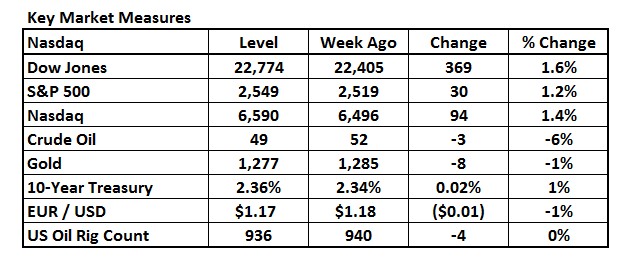
by Todd Shaver | Oct 8, 2017 | Weekly Newsletter 7pm Sunday
The Weekly Summary
It’s market mania for assets around the world! Financial markets posted fresh records this week, as the upswing in global manufacturing added fresh legs to the relentless rally in equity and credit markets around the world. The most eye-catching: The U.S. stock market’s volatility gauge set an all-time low Thursday while the S&P 500 Index jumped to a fresh high, its sixth consecutive record close -- a feat last repeated back in 1997. Global stocks posted new record highs amid strong economic data. Credit premiums hit fresh post-crisis lows. Let the good times roll.
No matter what is happening out there, there is always a bull market here at The Bull Market Report! This week we highlight some of our favorite stocks where we think you can still make good money, including: Celgene, PayPal, Google, WageWorks, VMware, and Blackrock.
BMR Companies & Commentary
Celgene (CELG: $139, down 5% - all prices herein are for the week)
Celgene entered into a long-term strategic alliance with Nimbus Therapeutics (private) centered on autoimmune disorders.
Nimbus’s preclinical programs target central mediators of inflammation. Nimbus competes in this area against Bristol-Myers and Gilead. But given Nimbus’s demonstrated track record of success and the promising nature of the targets, the consensus view this alliance as particularly encouraging and indicative of Celgene’s dedication to expanding its presence in immunology and inflammation. Awesome!
Celgene will be given an option to acquire each program. Nimbus will receive an upfront payment and potential milestone payments per program that Celgene chooses to acquire. In the interim, Nimbus will retain full control of R&D activities for each program. Financial terms will be disclosed only in the event that Celgene chooses to acquire a program.
BMR Take: We remain bullish on Celgene as total revenues are expected to rise from $13 billion this year to $21 billion by 2020. We expect Celgene’s four blockbuster drugs (Revlimid, Abraxane, Otezla, and Pomalyst) to drive the revenue growth, while the recent acquisitions of Receptos and Delinia as well as investments in collaborators like Acceleron, Epizyme, Agios, and others will ensure growth from 2017 and beyond. We continue to view Celgene as a top large-cap pick in Healthcare.
PayPal (PYPL: $66, up 3%)
Mastercard and PayPal announced a significant expansion of their longstanding partnership into Canada, Europe, Latin America and the Caribbean, and the Middle East and Africa, to make Mastercard the clear payment option within PayPal across the globe. With the addition of these markets – and following the recent expansion of their partnership into the U.S. and Asia Pacific – Mastercard and PayPal have now reached a global agreement.
Similar to previous agreements, the global expansion will create a number of joint growth opportunities that will advance Mastercard and PayPal’s shared vision to offer consumers greater choice and flexibility to manage and move their money.
For example, PayPal will have the opportunity to expand its presence at the point of sale by utilizing services from Mastercard, allowing consumers to use their Mastercard in their PayPal Wallet to make in-store purchases at more than 6.5 million contactless-enabled locations across the globe. Consumers will also have the ability to quickly cash out funds held in their PayPal accounts to a Mastercard debit card.
BMR Take: People everywhere know and trust the familiar Mastercard brand, whether they’re paying in the physical or digital world. The expanded partnership with PayPal affirms the attractive growth outlook for PayPal’s users could go from the current 200 million to upwards of 1 billion, in our view. This should take the stock much higher.
Google (GOOG: $979, up 2%)
Google parent Alphabet’s internet-by-balloon Project Loon tweeted that they hoped to bring emergency connectivity to Puerto Rico after Hurricanes Irma and Maria left more than 90% of the island without cellphone coverage. Just 7 days later, the Federal Communications Commission Friday gave the company a green light to fly 30 balloons over Puerto Rico and the US Virgin Islands for up to 6 months.
If all goes to plan, Alphabet's balloons will soon help replace the thousands of cellphone towers knocked down by hurricane-strength winds. The balloons would provide voice and data service through local carriers to users’ phones.
Alphabet has previously deployed Loon to provide emergency phone service in Peru following flooding there earlier this year. They had already been working closely with a local wireless network, Telefonica, to coordinate spectrum use and prepare handsets to work with its balloons.
Project Loon was born in Alphabet’s moonshot X division, with the aim of serving the half of the world’s population that is still without internet access. It has launched several successful pilot projects, but Loon has yet to be deployed commercially on a wide scale.
BMR Take: This is such a cool innovative initiative to see from one of the US’s leading tech companies. They are truly improving the world. Companies that do that tend to improve the performance of your portfolio. We remain bullish on Google. We see EPS heading to $60 over the next 3-5 years pushing the stock much higher.
We have been reminding you that this stock was cheap in March at $815 and after setting highs in June, got cheap again in July at $900. It has been on one of these slow Google rolls lately, moving up $3-6 a day for weeks now. We sure hope you have some of this great company. And if you don’t it is NOT too late to buy. It is within a whisker of an all-time high at $988 and we can see it breaking four figures and moving much higher from there.
WageWorks (WAGE: $63, up 4%)
WageWorks cares about people and wants to empower everyone - employers, employees, and their families - to lead healthier, happier, and more productive lives. The company simplifies the complex world of Consumer-Directed Benefits. They make benefits programs easier to understand and use so that everyone can take advantage of pre-tax savings and focus on what matters most.
The latest new development is a partnership with none other than Uber! WageWorks and Uber are revolutionizing your commute, giving you more options on how to get to and from work.
WageWorks has entered into a first-in-market partnership with Uber, the world’s leading rideshare company, to offer you the convenience of using a WageWorks Commuter Prepaid MasterCard, WageWorks Visa Prepaid Commuter Card and TransitChek QuickPay Prepaid Visa Card to pay for uberPOOL rides. This new partnership gives the customer the flexibility to use his or her pre-tax funds to pay for uberPOOL rides when they commute.
What does this mean? Customers can now save up to 40% when they rideshare to work via uberPOOL. That’s more money back in their pocket every month. Use of WageWorks commuter benefits with Uber is currently available in the following markets: Atlanta, Boston, Chicago, Denver, Las Vegas, Los Angeles, Miami, New York, Philadelphia, San Diego, San Francisco, Seattle, Washington D.C., and the state of New Jersey. And this will expand dramatically in the coming year.
BMR Take: WageWorks is on track to generate $1.75 of EPS this year. We see a sizeable market opportunity where earnings can double over the next 5 years. WageWorks serves a unique market niche and is an off-the-radar business many people have never heard of, making this name a unique opportunity to outperform the S&P500
VMware (VMW: $112, up 2%)
VMware announced that it is helping Partner Communications (PTNR: $5.20) implement a novel approach to network functions virtualization (NFV) that has resulted in a rapid conversion to NFV and a reduction in cost-per-customer to deliver network services.
What does this mean? First, we will give you the technical jargon. Then, we’ll break it down, as we do best.
Partner Communications, a leading Israeli Telco group, selected Cloudify and VMware to launch its new solution called V-NET. V-NET is delivered through a unique, cloud-based approach to network service orchestration using an incremental approach referred to as "orchestration first."
In layman’s terms, NFV is fundamentally changing the way communications services are provided. The Partner V-NET platform creates intelligent management of communications networks, services and cloud access, enabling IT managers to have direct access to any point or branch of the management interface, while saving significant manpower, time, hardware and money.
BMR Take: VMware has been a solid performer since we started covering the name. We see EPS settling in at around the $5-$6 level. We will continue to scan the opportunities in front of the company for reasons to reassess our EPS outlook higher. This deal above, is just another small reason for the great success of this not-so-small $46 billion market cap company. Remember Dell Technologies owns 83% of VMware. It’s only a matter of time before they make an offer for the 17% it doesn’t own.
We added the stock in January at $83 and currently have a $120 target. We see no reason why this can’t be reached later this year if the stock market stays steady.
BlackRock (BLK: $463, up 4%)
BlackRock is in discussions to invest in financial technology company Capital Preferences to help bolster its focus on retail investors.
Capital Preferences gathers data to help wealth managers understand the risk tolerance and preferences of clients, allowing firms to create portfolios suited to investors’ needs. The talks, which are preliminary, include determining ways of incorporating the company’s software into BlackRock’s existing technology offerings.
The world’s largest asset manager is investing in technology in part to diversify revenue as investor money flows into cheaper passive strategies. BlackRock is also using technology to indirectly expand its reach to retail investors, who are typically charged higher fees than institutions.
BlackRock, which manages $5.7 trillion in assets, has made several strategic investments in startups in recent years with the aim to eventually acquire some. It owns FutureAdvisor and has participated in a funding round for iCapital Network, an online marketplace that offers ultra-wealthy investors and their financial advisers alternative investments.
CEO Larry Fink has recently said that he hopes technology will account for 30% of revenue in the next five years up from 7% currently. BlackRock is counting on its risk management system, known as Aladdin, to help push it toward that goal.
BlackRock's Rob Goldstein, the chief operating officer of BlackRock, thinks there are a lot of misconceptions around one of the biggest trends overtaking Wall Street. BlackRock. One, for instance, is the name.
"We actually believe one of the greatest misnomers is this word “passive” because we don't believe any investment decision is a passive decision."
Passive investing, which means tracking a market-weighted index rather than actively trading single stocks, has steadily eaten away at active-investment management over the past several decades. Index investing has been revolutionary for investors, allowing them to bypass high-fee investment managers, many of which have not performed well. The firms that specialize in index investing and exchange-traded funds, another form of passive investing, have become giants of the industry.
BlackRock is one of them. They pulled in more money into its ETF arm in the first half of this year than all of last year.
And Goldstein added this:
My sales pitch is very simple: BlackRock is a growth company. BlackRock is a growth technology company and we're growing our technology functions. We have a very ambitious plan that we call "Tech 2020." And as part of that, we are looking to extend the 2,000-plus technologists we already have within BlackRock. And we're really excited about the opportunity to take BlackRock, which is already at the forefront of technology in its industry, and keep expanding that.
BMR Take: BlackRock is among the best-positioned companies in investment management, owning the top Exchange Traded Fund franchise (iShares), that is growing rapidly due to “passive” investing, as well as an increasing product portfolio of technology. Recall, there are several top hedge funds on the list of shareholders in BlackRock. With EPS set to approach $30 over the next 3 years, this stock is among our favorites. What a great week the stock had, and we expect much more of the same. Don’t be put off by the high stock price. Think Google at $980 a share!
Upcoming Economic News
JOLTS Job Openings
Wednesday, October 11th,10:00 AM
Period: August
Consensus: 6,170,000
Prior: 6,170,000
PPI ex-Food & Energy
Thursday, October 12th, 8:30 AM
Period: September
Consensus: 2.0%
Prior: 2.0%
Retail Sales ex-Auto
Friday, October 13th, 8:30 AM
Period: September
Consensus: 0.80%
Prior: 0.20%
Update on Shopify
We were able to get our hands on a report from Morgan Stanley recently. Here are some excerpts from it.
Shopify (SHOP: $98, down 16%) Trading at roughly 18 times its forward sales estimate and having never turned a profit, Shopify certainly looks expensive. The company has delivered impressive sales growth so far, but even then, investors are paying a premium for the promise of its business. That tends to be a risky proposition, but sometimes it's one worth pursuing. With that in mind, we think Shopify's momentum and expansion potential actually make the stock cheap, even as it currently trades at all-time highs.
For those unfamiliar with the company, Shopify provides e-commerce platforms as a service -- allowing sellers to quickly launch and conveniently maintain online sales portals. It mostly caters to small- and medium-sized businesses. However, it also counts some larger brands, including Budweiser and Red Bull, among its customers. All told, the company provides service to over 500,000 merchants worldwide -- up from 165,000 roughly two years ago. That's an impressive reach for a young company, but it still leaves lots of room for expansion.
Last quarter saw revenues climb 75% year over year, and the company is doing a good job of growing sales relative to expenses even as it prioritizes expansion over near-term earnings. With Shopify's current customers more or less locked in, reducing its advertising and marketing expenses could quickly shift the company to profitability.
While Shopify is not cheap by the established guidelines of value investing, ownership involves a greater degree of speculation than some investors will be comfortable with. However, Shopify's current price could look like an absolute steal five years from now.
BMR Take: This report was written before this ridiculous Andrew Left started shorting the stock and making a fool of himself on Bloomberg TV and elsewhere. We believe he is wrong and we believe the market will prove him wrong. He is “winning” at the moment as the stock dropped $13 on Wednesday when he went public with his diatribe, $3 on Thursday and $3 on Friday. It had hit $93 on Thursday, so it came back sharply. But he will lose in the end. Remember, he has to BUY BACK his short position at some time, pushing the stock up when he does.
We have to say that the stock was quite strong in the weeks leading up to this Wednesday. This maniac had been shorting the stock in a big way, putting downward pressure on the stock, and yet the stock was moving higher and higher since the middle of August when it was at the $95 level. That tells us there is buying power out there, and as soon as this blows over we expect the stock to start moving back up again. We could easily just bow out of the stock, since we added it in the spring at $73 and thus have a nice gain. But we are going to stay with it because we believe in the company, plus their revenue growth is huge – on the order of 75% last quarter. And you know what we are going to say here: Revenues always win out in the end.
Here is some more from Morgan Stanley:
With Shopify declining 16% this week following circulation of a short report, investors have been digging into details on the company's model. We continue to believe that Shopify has a strong core business model and highlight several of the more frequent questions asked, along with responses:
--- How does Shopify's model compare to a pyramid marketing model?
Answer: Shopify has a success-based model where its revenue is reliant on the success of its merchants. Unlike some pyramid models, there is typically little upfront investment required by merchants on the Shopify platform with no annual commitment required. If a merchant is not successful on SHOP's platform, it can exit the platform with little cost of failure. Historically, we believe churn has been high but Shopify's growth has been supported by the growth of its successful merchants which have outweighed the cost of those that have failed on its platform.
--- How does the company's affiliate marketing platform work?
Answer: Shopify has over 13,000 ad agencies, consultants, and partners that support its marketing efforts with over 500,000 merchants now on its platform. When a partner refers business into Shopify, they can be eligible to receive a bounty. Where bounties are paid, Shopify may continue paying fees associated with referred merchants while they remain on the platform. Affiliate marketing models are not uncommon among small to medium sized web services vendors.
--- How much revenue does Shopify generate from its business exchange?
Answer: Shopify rolled out a myriad of new products and services for its merchants this year. The company's exchange was rolled out this summer and, like other services, is in its early stages and its size is not yet disclosed. We do not believe the company has generated a meaningful amount of revenue from this platform yet. Last quarter, 47% of the company's revenue was generated from Subscription Solutions (subscriptions, themes and apps).
The remainder of the company's revenue (53% of total) can be attributed to its Merchant Solutions business which is primarily payments driven and benefited from approximately $5.8 billion sold over the platform.
--- How much do bloggers contribute to the company's customer acquisition?
Answer: Shopify does not disclose this number. However, the company has stated that most of its merchants are introduced to the platform organically. Paid advertising is the second most meaningful source of new merchants followed by partners, of which bloggers are a subset.
--- To what extent do non-Plus merchants contribute to revenue growth?
Answer: We do not have a breakout of total revenue by merchant category but for Subscription Solutions, management stated that Shopify Plus merchants accounted for over 18% of total monthly recurring revenue last quarter compared to 13% for 2Q16, implying approximately 127% growth for Shopify Plus and 55% for non-Plus business. On the Merchant Solutions side, the company has disclosed that Advanced and Shopify Plus merchants are responsible for over 50% of volume processed over its platform.
Update on Tesla’s Delivery “Problems”
Excerpted from a BusinessInsider article
Tesla has over-promised and under-delivered ever since the company was founded. But investors continue to believe in the genius who runs the company.
Tesla does not benefit from being normal. The company is organized around being special, different, extraordinary. You don't change the world by restraining yourself. And Wall Street doesn't care. Over the past two years, Tesla's stock is up over 1,200% since the company's 2010 IPO.
Tesla's third-quarter delivery numbers were both impressive and depressing. The carmaker is on pace to sell 100,000 vehicles this year for the first time in its 14-year history. But it's also far, far behind with the production of its new Model 3 sedan, the vehicle that's supposed to bring Tesla to the masses and spell the beginning of the end for gas-powered cars.
Getting to 20,000 in monthly production by December now seems like a hopeless expectation, as does CEO Elon Musk's prediction that Tesla will be manufacturing 500,000 vehicles annually by the end of 2018. But the markets are unconcerned. Tesla stock is still up 65% in 2017 and the brand has lost none of its captivating aura.
But it's also obvious that for a car maker that's been around as long as Tesla, they aren’t good at building vehicles.
So why is Tesla struggling to build the Model 3 on its own admittedly ambitious schedule?
1. The Model 3 is all-new production.
Tesla is reasonably good at manufacturing its expensive, luxurious Model S sedans and Model X SUV. Production of these vehicles was designed around a run-rate of about 100,000 per year, and Tesla will hit that mark most likely in 2018.
Of course, the Model X endured "production hell," as Musk memorably put it, during its roll-out in 2016. The Model S also endured early production issues that were later corrected. And Musk declared that production hell would be back for the Model 3.
Musk talks about Model 3 production in terms of an "S curve," with a very slow ramp rapidly speeding up before leveling off at a desired point. But Tesla also has a second S curve, related to learning. It doesn't know, exactly, how to build the Model 3. Established automakers build cheaper cars in volume all the time; Tesla never has.
2. Tesla enjoys endless patience from everybody.
Tesla's brand equity is probably its most valuable asset. And Tesla knows it. Yes, we aren't going to make our goals — but we also aren't going to lose focus on the big picture, which isn't to sell more cars, but rather to save the planet.
3. Tesla isn't actually mass-producing the Model 3 yet.
Even if Tesla had hit its goal of 1,500 Model 3s in September, it would still be a long way from the levels of production needed to meet demand. The low numbers, which the company chalked up to production "bottlenecks," suggest that the ramp to just pre-mass-production is taking longer than expected.
If Tesla hadn't fallen so short of its own run-rate for September, we could assume some bobbles, but unfortunately, it looks more like the decision to forego the process of testing out the Model 3 assembly line before trying to accelerate the production ramp isn't working out.
4. The Model 3 looks simpler then the Model S and Model X — but is it?
The Model X is complicated. The Model 3 is supposed to be simple. Tesla designed the Model 3 to be easier to build than the Model S and Model X, but compared with electric cars that have now been in production for a while - the Chevy Bolt and the Nissan Leaf, for example - there's a lot of "clean slate" to the newest Tesla.
To build an EV that they can get to market quickly, build easily, and price below $40,000, other manufacturers are just adapting existing gas-car platform to the task. The Bolt doesn't feel all that futuristic inside, and the Leaf has a fairly conventional interior. Neither car is dramatic to look at on the outside.
Tesla has eliminated as much dashboard instrumentation as possible with the Model 3, going for a very clean, minimalist vibe that stars a single, horizontal touchscreen. Although that might sound like it makes everything easier, it doesn't necessarily because it's a major departure from how cars are currently put together.
Ultimately, Tesla's plan to simplify will pay off, but in the short term, negotiating the learning curve could slow them down.
BMR Take: As we’ve said many times, this company is speculative. But it sure is fun being on the ride with them.
A Word from Gary Jefferson
Jefferson Financial Group
First Vice-President, Investments
UBS Financial Services
Some good news – bad news. According to Stock Trader's Almanac (STA), October is the last month of the “Worst Six Months” for DJIA and S&P 500 and the last month of Nasdaq’s “Worst Four Months”. The bad news is that in post-election years, the DJIA has been up 11 times in 17 years with an average gain of 0.7%, but in the last three years ending in “7,” October has been trouble. In 2007, the bull ended and the financial crisis began, in 1997 the Dow plunged 12% and in 1987 the market crashed on "Black Monday", a day we will never forget. [We don’t buy these types of things at The Bull Market Report.]
The good news is that, looking back through history, a big upside move of over a 5% gain on the S&P 500 during the Worst Six Months (or the “Sell in May” period) from May through October has usually been followed by great gains in the overall market. Thus far, that 5% gain has happened. There is just one month left in the Worst Six Months. So if the market can pick up further gains in October and not succumb to the historical and often self-fulfilling prophecy of "Octoberphobia" – and particularly the curse of the 7th year - that would be, according to STA, a solid indication for stronger gains over the next Best Six Months (November to April) and 2018.
We understand the argument that this bull market is way long in the tooth. However, there is another maxim of Wall Street that says, "Bull markets don't die of old age; they die because of recessions or policy mistakes". We see nothing on the horizon indicating we are headed for a recession. The Fed could overplay its hand by hiking interest rates too high and too fast. However, we think if the Fed errs it will be on the side of "too little" rather than "too much" because, so far, it has been very conservative in its approach to normalizing both its balance sheet and interest rates. We do think it will be a "policy mistake" for Congress not to pass meaningful tax reform – the market is 100% counting on this happening and if it doesn't, good earnings might keep the market afloat, but probably won't be enough of a catalyst to produce meaningful gains until some of the PE multiple expansions are digested. Bottom line: Tax cuts are now the most credible and legitimate “bullish” or “bearish” wildcard remaining for the markets in 2017.
From a bullish standpoint, real tax cuts could easily push the S&P 500 up another 4% or 5% because that will increase expected 2018 EPS to a conservative $145/share.
From a bearish standpoint, while tax cuts aren’t quite yet "fully" priced into stocks, there is the expectation they will get done, especially regarding foreign profit repatriation. If tax cuts, like healthcare, fail, then we’re now sitting with a market at 18X next year’s earnings and no identifiable future growth catalyst (and a Fed raising rates). We believe that will cause investors to reduce exposure and, if we had to make a guess based on these fundamentals, we would expect a potential pullback in the 5-10% range should Congress fail to enact promised tax reforms, compared to anticipated 5-10% gains over the next Best Six Months if reforms are passed.
An Update on Teva Pharmaceuticals
The FDA approves Mylan's generic Copaxone, Teva shares lower
Shares of Mylan (MYL; $38, up 23%) are 18% higher while shares of Teva Pharmaceuticals (TEVA: $15.94, down 9%) drop sharply following the FDA's approval of Mylan's generic Copaxone: Glatiramer Acetate Injection. Teva management followed up the announcement with a press release estimating the impact of the two launches to its Q4 earnings of at least $0.25/share and while they have planned for the introduction of eventual generic competition and remain confident in Copaxone, but that it is too soon to officially comment on any change to their full year business outlook.
Most analysts see it as a clear negative for Teva as the generic approval comes earlier than expected with most firms anticipating a 1Q18 arrival. That said, this is a long anticipated event and firms estimated the impact to shares should be closer to the 5% range with some preferring to see the news as removing an overhang on shares that could clear the deck for management.
For Mylan, analysts call it a significant win/positive, given the process was a long drawn out 7-year pursuit and Mylan landed the first approval with potential exclusivity.
The firms suggest that any generic entry may take some time and/or over a protracted period, which could make the opportunity for Mylan quite long-tailed with high margins and thus quite negative for Teva.
This is the day that TEVA investors have dreaded for many years. We believe the bulk of the downside from the loss of Copaxone sales is already priced into TEVA shares.
This news comes earlier than Teva expected and some investors had thought possible. Given the potential $0.25 impact per quarter and applying this to full year 2018, it is possible Teva's new 2018 guidance could fall well below $3.00.
BMR Take: We’ve had it. We have put up with a lot of negatives with this company. What’s next? What will they disappoint us with next?
We’re out. We added the stock in May at $29 and it has gone straight down. Bad choice on our part. We are truly sorry.
If you want to stay in and wait, you can. These suggestions of ours are just that. It is always up to you depending on your own goals. More than likely the stock will stay at this level for months and if things go well, will slowly inch back up. We say this is likely, but if things get worse, we could see $13 at this time next year.
The High Yield Corner
By Michael Foster
For a long time, the market simply didn’t believe the Federal Reserve would hike rates three times in 2017. The probability of a rate hike in December, as calculated by Treasury futures markets, was far below 30% for a long time. Then in September Janet Yellen made it very clear that a rate hike was coming. Even through the fog of “Fed speak,” the Fed’s intentions are incredibly clear, and futures markets responded accordingly. As of this time of writing, the futures market is implying an 89% probability of rates going up.
We’ve been here before. In 2015, the market reacted swiftly to Yellen’s public statements, and we saw a lot of carnage in the high yield world as a result. If you were in the market back then, you remember seeing just about anything with a big yield, from BDCs to municipal bonds and everything in between, falling hard at the end of the year. Several analysts (myself included) rightly called this a buying opportunity of a lifetime. Since the start of 2016 to now, many high yield investments, including those recommended by The Bull Market Report, rose by double digits not including dividends. That’s big.
Yet with this reversal in market expectations, the high yield market has remained mostly unfazed. Traders and investors have learned their lesson: A sudden collapse in yield just means a buying opportunity, because the income stream from these investments remains largely sound and trustworthy. This is why the recent Fed announcements haven’t caused as much of a buying opportunity as they did two years ago.
There are, however, exceptions. Unsurprisingly, those exceptions tend to be very popular with retail investors who are somewhat risk averse and tend to sell off too aggressively in times of caution. This is why we’re seeing a pretty big hit among some high yielding REITs, although there’s been virtually no news to suggest there’s any problem with any of these companies.
Among Bull Market Report picks, Welltower (HCN: $68, down 3%) was hit the hardest last week. While there hasn’t been any news that has any material impact on the REIT, Welltower shares continued a protracted slide that began in mid-September and has been aggravated by the Fed’s comments. Nothing has changed in the company’s business operations, and its FFO still exceeds payouts by a healthy margin (although, it must be admitted, not the healthiest). Now shares are yielding 5%, the highest yield since March of this year. And just like March was a great buying opportunity, so is right now, although we may see yields climb up to 5.5% before the stock bottoms, as we saw happen in November 2016 when, you guessed it, investors sold off in a panic over rising interest rates.
Considering the stock is similar to Welltower in many ways, it is not surprising to see Ventas (VTR: $63, down 3%) react similarly. At a 4.6% yield, Ventas’s recent slide also brings it to its lowest point since March, although there’s no news to indicate the firm is facing any new hardships. In fact, one of the exciting things about Ventas is that it’s been diversifying aggressively into the medical office space, where capitalization rates can often grow faster than with skilled nursing facilities. Additionally, medical offices are less exposed to the whims of regulators and Medicare funding. The market isn’t rewarding this shift - at least not yet. Instead, traders are focusing on interest rate issues. Considering Ventas’s size gives it a relatively low borrowing cost, its 0.56 debt-to-asset ratio is conservative in the REIT sector. It’s clear that the selling pressure on this stock is unjustifiable. That doesn’t mean it won’t go lower in the coming weeks, but it does mean the stock is quite likely to go higher after the rate hike and the market realizes this actually didn’t hurt their balance sheet.
Elsewhere in the REIT space, we saw a lot of dull action. Digital Realty Trust (DLR: $118) and Apollo Commercial Real Estate Finance (ARI: $18.20) ended the week flat, despite both REITs’ relative price outperformance throughout 2017. Similarly, we saw Nuveen AMT-Free Municipal Credit Fund (NVG: $15.43) and Invesco Municipal Trust (VKQ: $12.72) stay flat for the week. While comparing muni funds to REITs is very much apples to oranges, in this case the comparison is illuminating. Here we’re seeing a trend that encompasses much of the high yield universe - the market is largely shrugging off Yellen’s rate hike talk. In part that’s because municipal bonds, especially after the recent hurricanes, and these REITs in particular (thanks to their cloud computing and complex financial structure, respectively) are less popular with retail investors right now and more popular with institutional investors, who tend to react less aggressively to upcoming rate hikes.
What, then, should high yield investors do? Right now, there’s no reason to sell anything in The Bull Market Report portfolio. What’s more, the more aggressively sold-off REITs are becoming increasingly attractive. What we are seeing is a buying opportunity more than a cause for concern. Sadly, it’s not as good of an opportunity as late 2015, but we should be grateful for whatever we can get in this incessant bull market.
Good Investing,
Todd Shaver
CEO, Founder and Editor
The Bull Market Report
Since 1998
October 5, 2017
by Todd Shaver | Oct 5, 2017 | 7am News Flash
Shopify (SHOP: 103, down $13) Falls Sharply After Andrew Left Calls the Company a “Get-Rich-Quick Scheme”
Short-seller Citron Research issued a stinging lecture of the Canadian e-commerce company, calling it a "get-rich-quick scheme." In tweets and in an interview on Bloomberg TV, CEO Andrew Left said Shopify is "dirtier" than Herbalife, which has been targeted by regulators for deceptive business practices.
Shopify had no comment.
Shopify, which provides websites, payments and shipping for online merchants, has been one of the top technology stocks globally in recent years, gaining 8-fold from its IPO in 2015.
Left has trashed Valeant Pharmaceuticals, and urged the U.S. Federal Trade Commission to look at Shopify’s claims that members can quit their jobs and become millionaires, similar to what Herbalife has said and was censured for. On Shopify’s Facebook page it says that “2,700 people become millionaires each day,” and the company brands itself as “the online store for someday millionaires.” The FTC prohibited the Herbalife from claiming that “members can “quit their job” and enjoy a lavish lifestyle,” and fined them $200 million. Left also accused Shopify of paying bloggers and influencers to promote the company without disclosing those relationships.
Some things that Left said:
“This is not an $11-billion company.”
“This needs to get completely looked at by the FTC and completely looked at by Wall Street.”
“Shopify should be down 45% immediately."
He set a $60 price target on the stock.
Robert W. Baird & Co. defended the shares, saying that Citron is "largely off-base" and that they would use the weakness as a buying opportunity. The company views the selloff of Shopify as a buying opportunity. Baird said that Shopify is not a multi-level marketing company; it is a technology company that sells a SaaS e-Commerce platform focused on small and medium sized businesses. The vast majority of the marketing campaigns are focused on easy online store set-up, building a brand, selling on Facebook, or creating an online shop. They have an Outperform rating on the stock.
To review, in the second quarter revenue was up 76%. The company is still operating at a loss right now, but it closed the gap toward profitability by reporting an adjusted operating loss of just 2% of revenue in the second quarter, compared to 4% of revenue in 2016's second quarter.
The company also said in August that it now has 500,000 customers across 175 countries. That puts annual growth at an extremely strong 74% pace since 2012.
Shopify is expecting revenue of $165 million in the third quarter, which would represent a 66% year-over-year increase at the midpoint.
BMR Take: Remember, revenue always wins out in the end.
We are with Baird on this one. We feel this is a buying opportunity. The stock could go lower in the next few days but in the long run, we believe this stock will go much higher. And you know what a short seller has to do some day? He has to buy back his shares, which of course is bullish.
We added the stock in March at $72, so we are up 42%. If you don’t like controversy, you might want to take profits here. But we believe a year from now the stock will be a lot higher.
September 10, 2017

by Todd Shaver | Sep 10, 2017 | Weekly Newsletter 7pm Sunday
The Weekly Summary
Sloane Stephens beat Madison Keys to win the woman’s United States Open Tennis Championship and Rafael Nadal faced off against Kevin Anderson (who?) for the men’s title Sunday. World class tennis looks a lot like the market these days. Lots of long rallies. Excitement. Unexpected turn of events.
The primary news right now is all the hurricanes. Florida and Texas are taking the brunt of the unfortunate weather. We are seeing disruption across industries, from cruise lines to power generation to real estate.
The North Korea crisis lingers. Trump continues to say to China that you handle this. China keeps looking right back at Trump saying, well, you got it. While the US and China agree that North Korea needs to be rid of nuclear weapons, the lack of agreement on how best to achievement that goal has created a stalemate and a lingering overhang on the markets.
Another major event that has sure caught your attention recently was the Equifax data breach. Sensitive data on two of every five Americans was exposed in the cyberattack, making it one of the largest ever recorded. The future of online crime presents serious threats to the economy and the markets. We must keep an eye on these events as they could serve as a sell-off if they all gang up on each other.
If you wish to know what to do about the Equifax issue, here are two articles from The Washington Post and the Chicago Tribune:
https://www.washingtonpost.com/news/the-switch/wp/2017/09/09/after-the-equifax-breach-heres-how-to-freeze-your-credit-to-protect-your-identity/?utm_term=.af2b2f7fb8f8
http://www.chicagotribune.com/business/ct-equifax-consumer-protection-0910-biz-20170908-story.html
No matter what is happening out there, there is always a bull market here at The Bull Market Report! This week we highlight some of our favorite stocks where we know you can still make good money, including: Andeavor, Square, Eli Lilly, Shopify, Home Depot, Cloudera and Celgene.
BMR Companies & Commentary
Andeavor (ANDV: $102, flat)
Andeavor recently announced that it has officially begun operating in Mexico and has successfully opened the first ARCO station in Tijuana, Mexico. Andeavor and ProFuels have an established wholesale marketing agreement and have outlined plans to expand the ARCO brand to achieve a leading market position in the Mexico. Opening the first ARCO station in Northwest Mexico is a natural and strategic link for West Coast operations and the company’s integrated value chain, which furthers marketing integration in a growing market.
This first station marks the beginning of growth to include an anticipated 200 to 400 ARCO stations over the next several years. ProFuels also intends to grow the ARCO brand through supply contracts with independent owners and operators of existing and new gas stations that are interested in marketing fuel under the ARCO brand.
BMR Take: This is a nice catalyst for growth ahead for Andeavor. The company currently trades at 18x this year’s anticipated EPS of $5.60. But the EPS outlook is heading to $7.50-$8.00 next year, which should push the stock price higher. Our Price Target is $110 and our Sell Price is $95.
Square (SQ: $27, up 6%)
Square is applying for a US banking license, signifying the beginning of the firm’s long-speculated push into financial services.
The bank should help bolster Square Capital, the firm’s business lending segment. The bank will be focused squarely on merchants, not consumers. Square Financial Services (SFS) won’t extend consumer loans or house services like Square Cash, but will rather focus on the extension of Square Capital.
And it should help Square grow its burgeoning lending business. Square Capital has posted consistent, steady growth, issuing $1.8 billion in loans to over 140,000 merchants since its launch. SFS could improve that offering by bringing operations in-house, which could increase efficiency and allow the firm to grow or diversify its portfolio and offerings.
BMR Take: Square is among the most exciting companies in all of payments. They are sparking change across the ecosystem and now integrating a bank into their model is just the latest example. Consensus calls for nearly $1 billion of revenue this year with growth running 30% for the foreseeable future. It’s hard to find this kind of growth in the market today making Square a gem. Our Price Target is $29 and we are up 54% on the stock since March. Not bad in six months. But this Square story is just in Chapter One.
Eli Lilly (LLY: $83, up 3.5%)
Eli Lilly recently presented data showing their clinical trial drug lasmiditan significantly reduces pain in patients with migraine. This was very well received by the market. The company presented key primary and secondary endpoint data for lasmiditan, an oral, first-in-class molecule for the acute treatment of migraine, which demonstrated statistically significant improvements compared to placebo in the Phase 3 study. Detailed results were highlighted at the 18th Congress of the International Headache Society (IHC) in Vancouver. Lilly plans to submit a new drug application for lasmiditan to the FDA in the 2nd half of 2018.
BMR Take: Lilly is a healthcare powerhouse. Sales this year will exceed $22 billion. This new drug is just another piece of the story. Hopefully it can contribute $1+ billion of annual revenue when it hits full potential. With many drugs like this, Lilly has a well-diversified portfolio making the stock attractive to us at 20x this year’s consensus EPS estimate of $4.25. Our Target is $88 and we would love to see this by the end of the year.
Shopify (SHOP: $114, up 10%)
Shopify announced the winners of Inaugural Build, a business competition. Winners receive a one-of-a-kind, eight-day entrepreneurship experience, including mentorship from some of the world’s most successful entrepreneurs - Tony Robbins, Daymond John, Debbie Sterling and more.
From March to July 2017, Build a BIGGER Business competitors were asked to grow or scale their businesses using traditional and non-traditional strategies and tactics. To help with this growth, competitors were given access to the exclusive Build a BIGGER Business online academy, including immersion sessions with mentors on topics ranging from organizational leadership to how to optimize your sales funnel. The Build a BIGGER Business Competition attracted applicants from 70 different countries, spread over 750 different cities. Over the course of five months, competitors generated over 8 million orders, resulting in more than half a billion dollars in gross merchandise volume (GMV).
The average growth for the businesses participating in the competition was 14% during the competition period. The Top 10 participants with the highest percentage growth increased their GMV by an average of over 500%. The Top 50 participants with the highest percentage growth increased their GMV by an average of over 100%. To enter the Build a BIGGER Business competition, participants needed to have an existing business on the Shopify Platform with sales between $1 million and $50 million.
BMR Take: You might be saying why do I care about some business competition? Well, you should. Just think about how many businesses took interest in Shopify due to the competition and what the results looked like. It’s proof of the Shopify business model. The whole situation is a genius marketing event by the company and reaffirms why we like the stock. With $650 million of revenue expected this year growing at a rate of greater than 50%, and over 400,000 customers and growing, Shopify is the next best thing to Amazon in eCommerce.
We’re up 56% on this one since late March and our Price Target is $115. We hereby raise our Target to $125 and our Sell Price from $93 to $105. The stock set a new all-time high Friday and is worth $11 billion. That’s a big number for the founders and employees, but a tiny number for the big boys* that are on the lookout for acquisitions. If it were taken out it would have to be $125 to $135 a share.
* Facebook, Amazon, Microsoft, Apple, Google. But you knew that!
Home Depot (HD: $160, up 7%)
Shop from Home Depot with just your voice thanks to the Google Assistant. Really? Sweet!
Need something from The Home Depot? Just ask the Google Assistant. The Home Depot will join Google Express this fall, adding the ability for its customers to shop through voice with the Assistant on Google Home, making it more convenient than ever for customers to shop however they want.
The Home Depot offers customers flexibility with its 2,282 stores and digital endless aisle. Later this fall, customers will have an additional way to purchase innovative products - with the Assistant on Google Home or on the Google Express website or app.

BMR Take: There is a lot going on out there impacting Home Depot. Obviously, the floods could boost sales as repair efforts begin. Beyond this seasonal event, we think it is important to keep an eye on the long term core part of the business, technology. We are really excited to see Home Depot focused on digital. At 22x this year’s EPS of $7.25, we continue to think the stock is a compelling buy.
The stock set a new all-time high on Friday and is now worth almost $190 billion. The company knows what it is doing. Our Target of $160 has GOT TO GO. We hereby raise it to $170, leaving our Sell Price at $150.
Cloudera (CLDR: $21, up 9%)
Cloudera is acquiring Fast Forward Labs, a startup that gives companies the latest information on how to apply machine learning and AI to their businesses, as well as consulting.
Cloudera specializes in operating on top of open-source technology, looking to deliver an enterprise-grade product for larger organizations. The enterprise is more excited about machine learning and applied artificial intelligence than ever. Collecting that kind of expertise is going to be critical as it looks to woo enterprises into paying for additional support and services on top of open-source software.
Cloudera’s business can be a tricky one. Cloudera has to show companies that it can build a better product than they might be able to implement themselves, or simply make it much easier to deploy by paying the company, so it’s another thing those companies don’t have to worry about. This acquisition really helps toward this end.
BMR Take: With $360 million of sales this year growing 40%, Cloudera is an emerging growth stock worth keep an eye on. With acquisitions building out the product suite and accelerating revenue growth, momentum is undeniably picking up. Still under $3 billion in market cap, this company is a pipsqueak in the world of commerce. But given its high growth rate, in 2-3 years, the firm will be a major factor (if the company doesn’t get taken out by the big boys.)
Upcoming Economic News
JOLTS Job Openings
Tuesday, September 12th, 10:00 AM ET
Period: July
Consensus: 6,000,000
Prior: 6,160,000
PPI ex-Food & Energy
Wednesday, September 13th, 8:30 AM
Period: August
Consensus: 0.20%
Prior: -0.10%
CPI
Thursday. September 14th, 8:30 AM
Period: August
Consensus: 0.30%
Prior: 0.10%
Retail Sales
Friday, September 15th, 8:30 AM
Period: August
Consensus: 0.10%
Prior: 0.60%
Celgene (CELG: $140, up 1%)
This company has been a big winner for us here at The Bull Market Report. We added the stock at $95 last summer and it is up almost 50% now. The firm is worth a staggering $110 billion. They have $10 billion in cash and just $14 billion in long-term debt. Revenues for the past three years are $7.7 billion, $9.2 billion and $11.2 billion. That’s what we call growth. We would love to see more profitability as they reported $2 billion last year, the same as in 2014. But 2Q17 hit $1.06 billion in earnings, so our wishes are being answered.
Celgene discovers, develops, and commercializes therapies to treat cancer and inflammatory diseases worldwide and they are firing on all cylinders. If you want to be invested in cancer research, this is the place to be. Our Target is $150 and our Sell Price is $125.
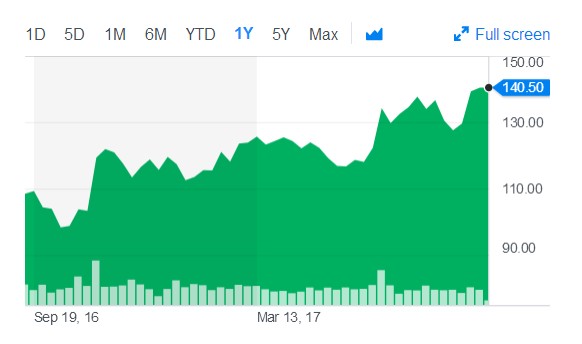
A Word from Gary Jefferson
Jefferson Financial Group
First Vice-President, Investments
UBS Financial Services, Inc.
If there is going to be a real market pullback (5% to 10%), history shows us that the Sept-Oct period is the most likely time for it to happen. So, we thought this would be an opportune time to get on the Market Jet, climb to 30,000 feet, and look down at the current "Big Picture". Here is the view from above:
The market has been good to us. We have been in a real bull market since 2009. Until 2015, most experts we respect were split, with one group believing we were still in a secular bear market which began in 2000 and that the bull market beginning in 2009 is only a cyclical bull still within the overall larger secular bear market; i.e. when this 2009 bull ends, the market will reverse course so that we end up back at the year 2000 levels. The other group believes the secular bear market ended in 2013, and that we are now in the 4th year of a new secular bull market. Secular bull markets historically last from 8 to 20 years – in other words we have between 4 and 16 years left for this bull market to run. (The last secular bull market ran from 1982 to 2000). Relying on dozens of experts as well as our 30+ years of experience, we believe we are in a new secular bull market with higher highs to be made over the next 4 to 16 years. We should expect to see a cyclical bear market at some point within the bull market run, but in the "big picture", investors should do well over the coming years.
Several other "big" things are going on. While the DOW and S&P 500 have hit new highs – because the economy is posting GDP growth of 2.5%-3.0% (finally!) – the Utility index hit a new high last week, while copper prices also hit a 3-year high. This is way out of whack. Historically, high copper prices have always signaled higher world growth. Higher growth in turn signals higher interest rates and inflation – all bad news for utilities. What seems to be happening in the "big picture" is that investors are frustrated and tired of waiting for interest rates to rise so they are chasing anything with yields- i.e. utilities. What this is really signaling, however, is that institutional money is buying in to the belief that interest rates are going to remain low for an extended time. Investors cannot ignore the bond market, and when it tells us it believes in lower rates for longer, it bodes well for the bull market hypothesis.
Again, looking at the "big picture" of the overall stock market, it is clear that the market is shrinking big-time. According to CNN Money "America's Stock Market is Shrinking", the number of public US stocks peaked at 7,600 in 1988. By 2015, there were just 3,800 US public companies. Obviously, there are more companies exiting than entering the market. It is shrinking because of an increase in mergers, companies going private and a slowdown in IPO's. Thus, please consider the math – there is a lot more money today chasing a lot fewer stocks. In the big picture, this is also a favorable trend for the stock market.
Finally, the big picture is a little less clear on the subject of taxes. What is obvious is that tax cuts and real tax reform will be great for individuals, businesses and the overall economy. A simple formula would be: Lower taxes = higher profits, more money in consumer pockets, higher spending, higher dividends, more stock buybacks = higher stock prices. Unfortunately, at 30,000 feet or 3 feet, it's impossible to see through the swamp. The only thing that could derail this part of the bull market movement is politicians.
For those worried about the end of the bull market, Barron’s recently put out a new article warning that it may be looming. The piece describes several scenarios for how the bull market might end. There are seven different factors which it identifies as possible catalysts to ending the bull run: a Fed mistake, inflation, China, antitrust, the end of QE, geopolitics, local politics. It does, however, make the point that longevity, high prices, and bad politics are usually not enough to cause a bear market. Recession is what usually causes it, and it makes the further point that the first four catalysts could trigger a recession. The fed mistiming rate hikes could cause big issues, as could a collapse in China, or a big antitrust movement against large tech companies.
These things are all possible, of course, but we believe Barron's should have made their argument in the context of secular bull and bear markets. A secular bear market historically lasts from 8 to 20 years, with intermittent cyclical bull markets within it. We may see a cyclical bear market (normally lasting from a few months to one or two years) inside the current 4-16 year bull move we see ahead of us, but that would not be anything similar to a long term secular bear. Understanding the difference between cyclical and secular market moves is important to being able to see the "big picture". Those that jumped out of the market in 1987 when the bear "crash" (a cyclical bear market) occurred, missed the rest of the move up in the most recent 1982-2000 secular bull market.
The High Yield Investor
By Michael Foster
Part of The Bull Market Report Team
It was another mixed week for stocks and another strong week for The Bull Market Report High Yield portfolio. We saw REITs mostly deliver strong returns, municipal bond funds rise, and a big boost from Pharma.
Let’s start with REITs. Omega Healthcare Investors (OHI: $32, up 0.5%) had another solid week of gains that were neither too extravagant nor disappointing. We’ve seen a lot of investors question the durability of Omega Healthcare’s dividend growth trend, and the doubts have increased lately as a result of one very simple (and, to our mind, naive) hypothesis. The thinking goes like this: Omega focuses on skilled nursing facilities (SNFs), and those facilities are losing popularity among Americans. This is quite surprising, considering America’s demographics: the country is aging rapidly, so expectations of growing demand for SNFs has been somewhat baked into Healthcare REITs’ stock prices for a long time.
Again, that’s the theory, but it’s not quite accurate. While it’s true that SNFs are seeing a decline in demand, it isn’t actually impacting Omega as much as a lot of critics would suggest. Yes, revenue has been challenged by the trend, and a lot of Omega’s tenants have seen more disappointing demand than they were expecting. Nonetheless, again this is all baked into Omega’s stock price. Keep in mind that Omega’s current price point is at the exact same spot where it was 4 and ½ years ago despite the substantial growth in Omega’s operations since then. The reason for this is simple; the disappointing SNF market growth has been priced into Omega’s stock price for a long time.
That’s why this has been a particularly good REIT to buy on dips, especially when it yields 8% or more. We’re at 8% right now, so it’s a strong buy in our book for the reasons mentioned above and for its tremendous income stream. And the income is not under threat. As we’ve mentioned in the past, Omega’s dividend coverage ratio is on the higher end for Healthcare REITs, despite its higher yield. That combination makes this a perfect buy and hold.
Elsewhere in the Healthcare REIT sector, Welltower (HCN: $75, up 1%) ended the week up nicely. Now might be a good time to talk about how this company is different from Omega and why we recommend both. Omega is about 16 years old and has been rapidly growing over the last decade. Welltower started in 1970 and has been an S&P 500 component for years. It also has a tremendous dividend growth track record thanks to improving net income and steady, higher-than-average occupancy rates. In part, that’s because of Welltower’s more diversified approach. While Omega focuses on the riskier SNF sector, Welltower offsets that risk with investments in post-acute care facilities, medical office buildings, and senior housing facilities. As a result of that diversification and longer track record, it is considered more seasoned and conservative and thus their dividend yield is almost half of Omega’s, at less than 5%.
But we still maintain owning both, because the lower volatility in Welltower’s stock can help you offset the psychological impact of temporary dips in Omega’s stock, as we’ve seen in the past. Additionally, there’s a lot more capital gains upside potential with Welltower. The stock isn’t up much over the last 5 years - just about 25% - but that’s a lot better than Omega’s flat pricing. Additionally, we’ve seen Welltower climb steadily throughout 2017 despite the more jittery market demand for Omega. The steady but low-yielding holdings in one offset the more volatile but opportunity-yielding pricing of the other.
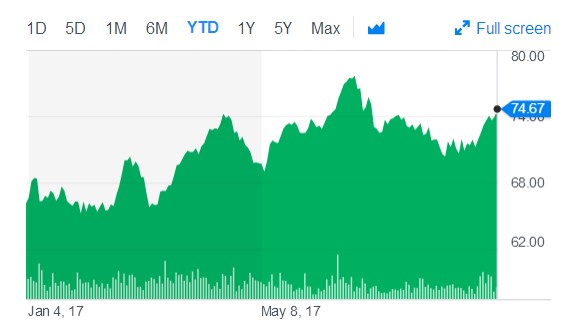
Welltower Chart from the beginning of the year
On the subject of healthcare, let’s jump into AstraZeneca (AZN: $32, up 4%) and its wonderful week. We’ve been watching this one with intense amusement, because a number of bears have come out of the woodwork to attack the company’s product pipeline - ironic, considering the firm’s pipeline looks stronger than ever, with recent trial successes that indicate its R&D department is still yielding a lot of fruit. AstraZeneca scientists are busy presenting on Imfinzi (durvalumab) and Tagrisso (osimertinib) at a lung cancer congress in Europe, and the feedback remains solid enough to drive shares sharply higher. Ignore the bears, because, frankly, they just don’t know enough about the science behind AstraZeneca’s pipeline.
Finally, let’s turn to municipal bonds. A number of Wall Street analysts are noticing that municipal bonds were a sleeper winner in 2017, with modest price gains that were often ignored because of the obsessive focus on the so-call Trump rally. That’s helped Nuveen AMT-Free Municipal Credit (NVG: $15.77, up 1%) and Invesco Municipal Trust (VKQ: $13, flat) recover nicely from their 2016 lows, when The Bull Market Report first recommended these funds. It’s nice to see the mainstream pick up on the quality of this asset class, but we also need to acknowledge how late they are to the party.
Unfortunately, there is a bit of a gray cloud for munis that we need to think about. Inflation trends are weakening and expectations of a third interest rate hike from the Federal Reserve in 2017 are dwindling. A longer path towards raising interest rates is bad for municipal bond closed-end funds, which depend on leverage to extend returns and maintain high yields for investors. The spread between the rate that funds borrow at and the rate that funds can earn through munis has been narrowing. This means dividend cuts might be on the horizon.
We don’t expect the cuts to be massive or come soon, but we do expect the income from these funds to decline slightly (and by slightly we mean less than 5%) in the next few months. I don’t think this is going to impact the pricing of these funds - muni funds often cut dividends without getting a hit to their stock. But keep in mind that the dividend stream from these funds is going to be a bit uneven. That doesn’t mean 5% annualized total returns won’t still come in if we average over a long period of time, but it does mean short-term returns from dividends will be a bit meeker than we’ve seen in the last few months. But that’s ok - we’re up way more than 5% in the last few months alone from both of these funds.
Good Investing,
Todd Shaver
CEO, Editor and Founder
The Bull Market Report
Since 1998
August 17, 2017
by Todd Shaver | Aug 17, 2017 | 1pm News Flash
An Update on a Few of Our Stocks
Rough day out there as we write this. Dow down 140 and the S&P 500 down 20 or 0.8%.
Nutanix (NTNX: $22.40) is having a good day. It’s at the top today of all of the stocks we follow, up 3%. Just think what a good day it would be having if the market were up 140 points instead of down 140. This stock is a winner that just hasn’t been realized yet. But note that if it had been discovered, the stock would be at $40 or higher where is ought to be.
Firsthand Technology Value Fund has disclosed that Nutanix is one of its top five positions. The fund is a small fund - $140 million – but they have put 7% of the entire fund into Nutanix. That’s $10 million.
Nutanix is a provider of hyperconverged data center equipment that merges computing, storage, and networking capabilities in a single piece of equipment. More businesses are looking to adapt the technology, with 18% of chief information officers saying they expect to move to hyperconverged systems in the next two years, according to a survey by Goldman Sachs. Goldman added the stock to their conviction list, saying it has an estimated 50% return potential to their $31 price target.
Last quarter Nutanix said it gained 800 new customers, with 20 global companies buying more than $1 million in hardware or software. The larger deals helped push overall sales growth to 67%. The company got some big name wins in the quarter, including corporate giants such as Caterpillar, Kyocera, Société Générale and Sprint. One undisclosed customer win was a retailer with $50 billion in sales in the U.S.
The company’s leadership in the space, including the combination of hardware and software it offers, makes it a “once-in-a-decade tech infrastructure story,” wrote Goldman. They see Nutanix on a path for long-term double-digit growth, high gross margins and large operating leverage.
Despite its leadership in the space, the stock is down 15% year-to-date. “The stock drop and Nutanix’s unique position in the space, however, make it a prime acquisition target,” Goldman said.
BMR Take: We like this company. Growth in revenues always wins out in the end.
Shopify (SHOP: $95) and Twilio (TWLO: $31) are both up slightly today too, even as the market is not having a good day. That sends us a strong message of confidence.
