September 18, 2016

by Todd Shaver | Sep 18, 2016 | Weekly Newsletter 7pm Sunday
The Week Ahead
It was a week of ups and downs, with the Nasdaq up big, due to Apple and other Tech, and two out of the three major indices ending flat. There is clear confusion. World class investors at the Delivering Alpha Conference hosted by CNBC in NYC this week could not even agree which way the market is heading. While volatility has started to rise, we believe the moderation that was seen toward week end reflects a wait and see attitude surrounding what the Fed will do next week at their meeting. The probability for a rate hike is only 20%, but we are bracing for a potential surprise, as the Fed needs to prove to the market that it will hike rates, counter to low market probabilities, in order to demonstrate that they are leading the market and not the other way around. With all the volatility and uncertainty, we continue to stress top quality stocks as the place to be. This week we highlight Tesla, Visa, Qualcomm, and Home Depot.
Here is How Last Week Progressed
Monday (9/12) - S&P 500 +1.8%
--- Markets rallied after Friday’s big selloff. Goldman Sachs issued a report calling for last week’s bond market selloff, triggered by UK concerns and Japan monetary policy, to extend into the 4th quarter, with US Treasuries reaching 2% by year-end (currently 1.69%).
--- In Energy, a ratings agency issued a new report discussing how recovery rates for 15 US exploration and production bankruptcies averaged a “catastrophic” 20% last year, well below the historical average of 60%. (So out of those that go bankrupt, lenders are getting back just 20 cents on the dollar vs. 60 cents. Not good.)
--- In Financials, Wells Fargo (WFC: $45, down 7% last week)admitted to secretly creating millions of bank and credit card accounts over the past five years without their customers’ knowledge or consent. An entire arm of the bank was fired over the matter and the stock is down sharply.
Tuesday (9/13) - S&P 500 -1.5%
--- Monday’s recovery turned wobbly as concerns of general global economic conditions are increasing.
--- The Delivering Alpha Conference in NYC hosted some of the brightest and richest minds in investing. Billionaire Paul Singer issued cautionary words for the path ahead discussing how it's a very dangerous time in the global economy and global financial markets, adding that gold was under-represented in investors' portfolios. Billionaire Ray Dalio warned that the current environment is analogous to the 1935 to 1945 period in America where we reached the limits of central banking’s ability to stimulate the economy and raise global asset prices.
--- A US think tank warned that Australia has about six weeks or so to turn their situation around or face a massive hit to property valuations.
--- Another Fed president has decided to call it a day. President of the Atlanta Fed Dennis Lockhart announced he will be stepping down on February, 2017.
Wednesday (9/14) - S&P 500 -0.1%
--- Markets stood still.
--- Goldman Sachs issued reports reducing their odds for a hike next week to 25% from 40% previously.
--- CNBC hosted numerous conversations about the volatile mechanics of the stock and bond markets simultaneously selling off over the past week.
--- In Healthcare, an undercover investigation by the Government Accountability Office found that 100% of their fictitious enrollees were able to sign-up and maintain Obamacare coverage and taxpayer subsidies despite submitting fictitious documents and/or refusal to submit any documentation at all.
Thursday (9/15) - S&P 500 +1.1%
--- The morning began with news of the biggest German M&A deal in history. Monsanto accepted Bayer’s takeover offer for $66 billion creating an agriculture giant.
--- More concerns about markets soon followed. Former Fed Chairman Allen Greenspan made public comments discussing how this is the worst economic and political environment that he has ever been remotely related to, noting that the U.S. is headed toward stagflation. New data soon after the statement confirmed Greenspan’s concerns.
--- Year-over-year growth in Retail Sales rose just 1.9%, which represented the weakest level since March's plunge and is now worryingly in historical recession territory.
Friday (9/16) - S&P 500 -0.9%
--- Market performance was soft into the weekend. In Autos, just weeks after warning that sales had reached a plateau, Ford is now warning investors that operating profit will fall in 2017 and as a result the company is relocating small car production to Mexico.
--- In Transportation, bankrupt shipping giant Hanjin said that as of this morning it had 93 vessels, including 79 container ships, stranded at 51 ports in 26 countries.
--- Gearing up for next week’s Fed meeting, former Fed leader Ben Bernanke was out with some noteworthy comments foreshadowing the future path of interest rates in the US - negative! Specifically, he said, "The fact that negative rates would be temporary and deployed only during severely adverse economic conditions, would be an advantage. Like quantitative easing, which was also unpopular in many quarters, a period of negative rates would probably be tolerated by politicians if properly motivated and explained."
Bull Market Report Companies and Commentary
Tesla (TSLA: $205, +6%) This past week, Tesla released an Autopilot update announcing advanced signal processing capabilities for its radar, which can now act as a primary control sensor and does not require the camera to confirm visual image recognition. It is just another sign of the transformational shift in auto manufacturing, where Tesla is leading the way,
Digging into the new technology a bit, the software upgrade collects more data in order to better determine the risk of a collision and prevent unnecessary braking. All very exciting stuff. In fact, just in the past few days at Ford’s annual investor day, Chairman Bill Ford acknowledged that "the technology is here in the world of autonomous driving, but there are a lot of things to work through and we have something to learn from every competitor [inferring Tesla]". This was quiet the notable endorsement for the direction Tesla is heading.
Note that Robert W. Baird set a $338 price target on Tesla on Monday. FBN Securities upped their price target from $260 to $275 and gave the stock an outperform rating. Morgan Stanley reaffirmed an equal weight rating and set a $245 price target. Six research analysts have rated the stock with a sell rating, 13 have a hold, 10 have a buy rating and two have assigned a strong buy to the company. The consensus target price is $253.
BMR Take: We view the AutoPilot announcement as a positive that shifts focus back to Tesla's core competitive advantage as a leader in the development, distribution, and monetization of ground-breaking automotive technologies. With that said, we await more news of the Gigafactory progress; the progress of the integration of SolarCity into the future of Tesla; and how in the world they can deliver on the 400,000 orders for the new Model 3 (for which they received $400 million in cash from the down payments.) These are the big picture items. And again, Tesla is RISKY. The stock could go to $400 in the next year or two, or it could go to $70. Or both. This one is volatile and not for the faint of heart.
Visa (V: $82, +1%) We have seen some big headlines in the stock market in recent weeks, but this company just quietly continues to perform. We want to be sure this stock doesn’t fall off your radar.
There are several catalysts that appear to be pushing stronger top line revenue growth including improved cross-border volumes, new deal wins (Costco, USAA), price increases (adds 100 bps to the growth rate), and accretion from the Visa Europe deal.
On cross-border volume, Visa is optimistic about improving trends as oil and the stronger US dollar comparables ease. Visa isn’t seeing any pricing pressure on cross border fees and is seeing significant growth in online commerce (the growth of digital grows at double the rate of offline). Cross border is 6-7x more profitable than domestic transactions.
Another big opportunity coming out soon is their entering the China market. Although there is no specific timeline yet, there is a big future opportunity to process Chinese domestic volumes and more Chinese cross-border transactions. In fact, some analysts size the opportunity to be $3 billion of revenue by 2020. Currently, Visa is focused on adding-single branded Visa cards to the Chinese market, while the cobrand relationships move towards expiration.
BMR Take: Visa is a very steady business model and a proven stock. The global opportunity to convert cash to electronic forms of payments remains lucrative. We continue to view this stock as a long term core holding.
Qualcomm (QCOM: $63, +4%) With all the news out on the Apple iPhone 7 launch, we can’t overlook the implications to Qualcomm. Eyes are on the Intel baseband share of the iPhone 7 business because the remaining share falls to Qualcomm.
Multiple reports have surfaced claiming to be able to discern the amount of share that Intel has taken in the iPhone 7. It is a bit premature to make a pronouncement on this, given that Apple is likely only slowing letting Intel into their phones. Either way, the impact is confined to only a 65% subset of iPhones that are non-CDMA* capable. Moreover, it is very likely that Apple is very slowly introducing Intel into the product line, considering recent major disruptions others in the industry have experienced, like with Samsung's recent migration to a new chip stumbled.
*CDMA stands for code division multiple access, which is a channel access method used by various radio communication technologies. It often determines what network (Verizon, AT&T, etc.) your iPhone will work on).
To be clear, Qualcomm is expected to continue to hold 100% share in CDMA capable smartphones. According to industry estimates, CDMA capable smartphones represented 30% of total iPhone unit volume over the past 12 months and 35% in the 2nd quarter. As referenced above, the 65% of 2Q unit volume that was not CDMA capable is where Intel is possibly taking share. Some more aggressive expectations presume Intel may take the lion’s share of this 65% bucket. However, more in-depth analysis from industry experts points out that it is entirely possible that even where Apple is using Intel they may also be using Qualcomm in the same model. Bottom line, the Intel versus Qualcomm market share discussion in the iPhone remains pure speculation at this point, but is a must-watch trend going forward.
The most important trend to watch, however, is overall smartphone demand which remains strong.
BMR Take: We continue to like the prospects for the Apple ecosystem, which includes Qualcomm. Moreover, shares look attractive here with a 3.3% dividend yield. Qualcomm is a cash machine riding the smartphone wave to higher levels.
Home Depot (HD: $121, -1.3%) Management was on the road this past week meeting with investors. Several favorable takeaways on the business surfaced. The Western part of the US continues to see strength, as Home Depot attributes it to more than just a California story, with a mini Silicon Valley forming in the Northwest states and great momentum around this build out. Phoenix is also improving and they believe there is a strong upside to the market based on how much there is left for that housing market to appreciate to reach the prior peak. Home Depot generates 1/3rd of its sales in the West.
Management highlights that the Pros customer base (professionals) are a little less price conscious given that they want to be able to know their costs and seem to have less patience for following promotions. Recall that 40% of sales is generated by the Pro customer.
Lastly, management noted that their second half guidance is not just based on the strength of the housing market but also feedback from the Pro customer base; that the project pipeline is strong for at least the next six months. Management noted that the Pros are taking vacations for the first time in years based on the healthy labor market.
BMR Take: Solid trends are seen over at Home Depot. The implications are good for the broad economy and stock market. We continue to favor this blue chip.
Gilead Sciences (GILD: $79, up 1%) We thought we would give you some news on recent upgrades and research reports have been issued on Gilead. A large bank in Germany issued a buy rating and a $112 price target on the stock. Barclays reaffirmed an overweight rating. RBC Capital Markets set a $105 target price on Gilead and gave the stock a buy rating. Morgan Stanley has a price target of $103. Nine research analysts rate the stock with a hold, 18 have a buy and two have issued a strong buy rating on the company. The company has a consensus rating of Buy and a consensus price target of $105.
Gilead last posted its earnings results on July 25th. They reported $3.08 EPS for the quarter with revenue of $7.8 billion. On average, equities analysts predict that Gilead Sciences will post $11.80 for the current year.
The business also recently announced a quarterly dividend, to be paid on September 29th. The $1.88 annualized dividend produces a yield of 2.4%, paying out just 17% of earnings. There is plenty of room for growth in the dividend here.
Hedge funds and other institutional investors have recently added to their stakes in the company. Norges Bank acquired a new position in Gilead valued at about $1.3 billion. Bank of Montreal acquired a new position in Gilead Sciences during the second quarter valued at $430 million. Capital World Investors boosted its position in Gilead Sciences by 28% in the second quarter. They now own stock valued at $1.3 billion. Investec Asset Management acquired a new position during the first quarter of $280 million. Finally, Parnassus Investments CA boosted its position by 45% in the second quarter. Parnassus now owns $700 million. 78% of the stock is owned by institutional investors and hedge funds.
BMR Take: The stock has a market cap of $102 billion and a price-to-earnings ratio of 7. The stock is grossly undervalued and we expect the stock to go back to the triple-digit level late this year or next.
Upcoming Economic News
It is a very light week for economic news. The focus will be on the FOMC statement out Wednesday. The probability of a rate hike is just 20% with >50% odds that a hike will not occur until December. But who knows! Yellen now has Bernanke in her corner prescribing possible negative rates.

FIRST SOLAR CORNER
We like to write about our stocks that go up. Like Apple and Main Street (MAIN: $34, up 1%) and Facebook (FB: $129, up 2%), and so on. But we have to cover our tough ones too. First Solar (FSLR: $34, down 6%) has been hammered beyond belief lately. We got a letter from a reader who asked if he should hang in with this company. Here is what we said:
Hi Richard –
We think this is an amazingly viable company and it will come back. But watching it go down is painful. So we are left with a choice. Hang in there or sell.
The company is huge. They did $3.6 billion in revenue in 2015, up from 2013 and 2014. Expenses were much higher last quarter, so profits were lower. But revenues were up 10% sequentially last quarter. The stock was over $70 in March. It was almost $300 in 2008. The company is certainly going to have to prove itself to us again. But watching it go down is painful. So we are left with a choice. Hang in there or sell.
BMR Take: We are inclined to stay with the stock, even though it makes our numbers look bad, currently down 45%. Right – we know – a terrible return. We added the stock in February at $63 and truly believe the stock can get back to this level and move higher. But it will certainly take some time.
If you have a small position we would recommend that you buy more now to average down your cost. If you don’t have a position, we would enter one here. The value is just very compelling at this price.
THE APPLE CORNER
Apple had a great week. The stock was up $12, or 11%, closing at $115. I hope you are listening to us here at The Bull Market Report as we’ve been pounding the table on Apple for months! The stock saw its strongest four-day streak in over two years and is destroying short sellers who bet against it. The newest fuel was Apple's announcement that initial quantities of the iPhone 7 Plus have sold out globally. Sprint said sales set records, far out-pacing sales of the iPhone 6 two years ago. That sent the stock up 3% on Thursday, after a 3% rise on Wednesday.
It was the strongest 4-day percentage increase since 2014, when Apple shot 13% higher over four days after the company increased its share buybacks and announced better-than-expected quarterly result.
Apple was responsible for much of this week's gains in the Dow Jones Industrial Average. If Apple had been unchanged this week, the Dow would have been down 0.1%, instead of the 0.2% gain it recorded.
Apple on Tuesday made available new software (at no charge) for iPads and iPhones bringing huge enhancements to Messages, Maps, Siri, Photos, Apple Music, News, and more. This is what customers love about the company. And this is what WE at The Bull Market Report love about the company.
BMR Take: The stock trades at a PE of 14 times its past 12 months of earnings compared with 20 for the S&P 500. Will we see new highs ($134) in the stock by Christmas?
Opko Health (OPK:$10.21, up 5%)
We added this one last week at $9.85 and the stock had a nice little run. We got a comment on our website. Here it is:
Opko Health: A Loved Healthcare Stock That Could Double
Author: John T.
Comment: Not only a good day...you guys did a great job on this one!
Our response: Thanks, John. But hold your horses. We are only in week one. The stock is up 4% from where we added it on Tuesday, but we are not celebrating with you yet. We'll wait until it hits $11 and then break out the party hats. Champagne comes out at $13.
You can see all comments on this post here:
https://www.bullmarket.com/opko-health-loved-healthcare-stock-double/#comments
Note that CEO Phillip Frost acquired 3,600 shares of the stock. Not a biggie, but he does have over 3 million shares. We wonder why he would be buying more. Hmmm. Maybe because he thinks the stock is going higher???
HIGH YIELD CORNER
Last week we warned that the stock market was looking ready to make a big correction after several weeks of near-flatlining at an all-time high. The week was tumultuous, but the S&P 500 ultimately ended the week flat after rising on Monday, falling Tuesday and Wednesday, recovering Thursday, and falling again on Friday. We have seen this kind of action before - continued market uncertainty bringing volatility to the markets.
The confusing mix of economic data this week didn’t help, either. Unemployment claims rose, retail sales disappointed, and inflation rose. These are mixed messages when we think about the Federal Reserve; on one hand, higher unemployment and bad retail sales mean a weak economy that will force the Fed to pause raising interest rates, although every indication suggests the Fed is desperate to get rates normalized fast. Yet higher inflation could essentially force the Fed to raise rates soon to stop price gains from spiraling upwards.
The biggest concern with this combination of data is that it’s bad news from both ends. Higher unemployment and weak retail sales mean a pressured American consumer, and higher inflation means they’ll get pressured even more. It’s a bad economic mix that won’t only pressure the Fed but, if it continues, it will pressure all companies. Most critically: it could cause revenues to decline as consumers pull back on spending as more items become unaffordable.
What this all says for high yield is complicated. On the one hand, it is a sign that junk bonds could get pressured in the future. The SPDR High Yield Bond ETF (JNK: $36, flat) saw little action this week, helping it hold its over 6% year-to-date gains. But the ETF remains 3% below its 52-week high, reached just a few weeks ago. Corporate defaults continue to rise, with the fall in oil the culprit. With commodity-related defaults driving corporate defaults to their highest point since 2009, there remains a lot of worry about the junk bond market. This means willy-nilly buying of a junk bond index fund like the SPDR fund is likely going to result in trouble.
However, there are alternatives. Our beloved Pimco Dynamic Income Fund (PDI: $28) rose nearly 1% this week and is still up 3% year-to-date. The fund’s 9% yield is also secure from net investment income, and the fund currently has a sizeable amount of undistributed net investment income that is likely going to come back to shareholders in a special dividend by the end of the year. It’s a bit early to think about end-of-year plans, but we urge investors to keep holding on to this fund in anticipation of a big special dividend payout in December. It’s a bit early to say just how big this dividend will be, but don’t be shocked if it’s over $1. Yes, that would mean a bonus payout of over 3% based on today’s price.
Now, on to REITs. The SPDR Dow Jones REIT ETF (RWR: $95) had another bad week, falling over 1%. The red-hot REIT bull run is clearly over - but that doesn’t mean it’s turning into a bear. Rather, a deep correction followed by a return is clearly in the cards. Valuation multiples for high quality REITs remain quite low, and have gotten lower.
This is one reason why we recommend doubling down on those REITs that have corrected and remain high quality buys, such as Digital Realty Trust (DLR: $93). No one disputes that the growth of cloud computing and demand for server space is on the rise, and Digital Realty Trust’s scale and established customer base - AT&T, Amazon, the Federal government, and so on - make it one of the safest bets in this marketplace.
When we first recommended Digital Realty Trust, it was trading for $85. It then shot up to $110, and is now at $93. We may not see $85 again soon, but if we did that would be a great purchase price. Even $93 is a bargain considering the company’s monstrous growth. Revenues were up 22% year-over-year in the last reported earnings quarter, an almost unheard of growth rate for a REIT of this company’s size ($14 billion market cap.) With a massive presence across the country, this growth is almost guaranteed thanks to demand from Tech companies.
That brings us to another key income-producing asset class: BDCs. The UBS Etracs BDC ETF (BDCS: $22) fell over 1% this week, bringing it down 6% from its 52-week high. For most of this year, this sector has been recovering from its awful performance in 2014 and especially 2015, but that recovery is now stalling thanks to the concerns about credit quality in the high-risk corporate lending world. This is why we’re not eager to recommend any but the best BDCs, and that means Main Street Capital (MAIN: $34, up 1%). Not only did Main Street buck the trend this week and actually end higher, but it’s also up a shocking 18% year-to-date. This is a solid BDC thanks to management’s ability to choose the most credit-worthy debtors. There’s no reason to think their ability to do so will be hindered, insulating them from the continued tsunami of credit defaults.
Next week, we will need to look closely at the markets. After a volatile, flat week, next week may be the time when the market decides whether it wants to go up or down. Stay tuned - it’s likely to get bumpy from here.
Observation on Interest Rates
The US Government is willing to pay you 1.7% for 10 years if you buy the 10-year Treasury note. But if someone told you it is possible for the US Government to pay you TWICE that rate with another government instrument, what would you say? As The Wall Street Journal put it: “You probably would be tempted either to sign up right away or call the cops to arrest the guy for securities fraud.” What’s the deal? It’s the EE savings bond. If you buy one today you will get back twice your money in 20 years. That’s 3.5% per year, guaranteed.
However, there is a caveat. First of all, you have to hold it for the full 20 years to get that return. If you sell it earlier, they take a LOT of the yield away from you. Long story short – it’s like a zero coupon bond where it pays no interest but the value of the bond goes up as it approaches maturity.
You know what WE would do, right? Look above at the High Yield Corner and go to the website at https://www.bullmarket.com/high-yield. Returns range from 4 to 11%. We’d take that any day over US Treasuries.
The Bull Market Report MOBILE APP
Have you tried our mobile app? We’ve gotten rave reviews from our subscribers as it gives you The Bull Market Report newsletter and all of our research while you are on the go. Our mobile app allows you to keep our EXCLUSIVE portfolios, research, News Flashes, and of course our popular Newsletter, all in the palm of your hand. Any Bull Market subscriber can download the app from the Apple iTunes Store or Google Play.
Here is the link to download from apple App Store:
https://itunes.apple.com/us/app/bull-market-report/id1132771690?mt=8
Here is the link to download from GooglePlay:
https://play.google.com/store/apps/details?id=com.app_bmrep.layout
And finally, once you have it downloaded to your phone, here is the app tutorial video:
https://www.bullmarket.com/need-help-mobile-app/
Let us know what you think of the app. Write us here:
Info@BullMarket.com
Good Investing,
Todd Shaver, Editor in Chief
September 5, 2016
![The Bull Market Report: September 6, 2016]()
by Todd Shaver | Sep 5, 2016 | Weekly Newsletter 7pm Sunday
The Week Ahead
Welcome to September. Markets are running to record highs. The conclusion of the Fed’s Jackson Hole conference and Friday’s Jobs report all but confirmed that we are not looking at a rate hike until December. Accordingly, we brace for possibly selected solid equity market gains in the month ahead, as “last call” is now another few months away. But note that history has shown us that when the Fed raises rates, the market is generally higher a year later. Remember the rate rise in December? The market is up 9% from the low it hit a few days after they announced the hike.
This week we revisit our positions in Tesla, Home Depot, UPS, and Blackstone.

Market Watch for the Past Week:
Monday (8/29) - S&P 500: +0.5%
- Mylan launched a generic, half-priced EpiPen to silence outcry. (It didn’t work. See our notes below on “We were right on Mylan.”
- S&P Financials surged to record highs despite the collapse of the yield curve to 9-year lows.
- Investors around the world are rotating away from defensive equity sectors and into cyclicals in a sign of growth optimism. The FTSE All World Cyclical Index is on track for its best two-month performance since 2012 relative to the FTSE All World Defensive Index. The cyclical index is up 10% since the end of June, while the defensive index is down 1%.
Tuesday (8/30) - S&P 500: -0.2%
- Deutsche Bank calculated how much of the S&P’s value is due to central bank planning and determined that central bank policies are directly responsible for approximately 40% of the "value" in the market. The Bank went on to calculate that any moves to undo this support could result in a drop that leaves the S&P in the neighborhood of 1,400.
- We learned that slumping economic growth is not much of a concern for US consumers, as the US Consumer Confidence Index jumped to 101.1 in August, which was the highest level recorded since Sept 2015 and smashed expectations.
Wednesday (8/31) - S&P 500: -0.2%
- Gallup recently completed the "most robust and comprehensive study of the millennial generation" and found them to be disengaged, aloof and completely incapable of prioritizing their own workload. Gallup determined that 7 out of 10 millennials are in fact disengaged from meaningful employment, which presents material demographic issues for the labor force in years ahead.
- Trader bullishness hit a three-year high as NYSE margin debt jumped the most since April of last year.
- Brazil formally impeached Dilma Rousseff in a 61 to 20 vote. She thus becomes the second president to be impeached in Brazil’s 31-year-old democracy, paving the way for what the market hopes is a fundamental shift in economic policy, which is a very important change in one of the world’s leading growth regions.
Thursday (9/1) - S&P 500: -0.1%
- Baker Hughes reports the US Oil Rig count rose by 1 to 407, which followed last week's unchanged rig count and is the highest in 7 months. Most importantly, we now have 10 consecutive weeks of no decline in the rig count.
Friday (9/2) - S&P 500: +0.5%
- In California a new bill was passed making it the only state in the country to provide overtime wages to agriculture workers after 8 hours a day or 40 hours per week. It could be the beginning of new policies aimed at fixing structurally fractured labor markets in several industries.
- We call your attention to the upcoming referendum vote in Italy. If Renzi wins come October, the EU has fresh hope. But if he fails, then Italy fails and the EU moves further along the concerning path created by Brexit.
BMR: Companies and Commentary
Tesla Motors (TSLA: $198, -10%) Why have shares been weak? Elon Musk sent an e-mail to employees at Tesla urging them to cut costs and deliver “every car we possibly can” in a push to show positive cash flow in the third quarter. The chief executive officer of the electric-car company said it would be his last chance to show improved financial numbers before he tries to raise more money. Another equity raise! Shares are selling off in advance of the transaction.
The third quarter is crucial to Tesla’s future because the company is in the process of acquiring SolarCity and preparing to roll out the Model 3, its lower-priced sedan, late next year. Musk wrote in an August 29th e-mail, “The simple reality of it is that we will be in a far better position to convince potential investors to bet on us if the headline is not ‘Tesla Loses Money Again,’ but rather ‘Tesla Defies All Expectations and Achieves Profitability.’” The e-mail says that Tesla is “on the razor’s edge of achieving a good Q3, but it requires building and delivering every car we possibly can, while simultaneously trimming any cost that isn’t critical, at least for the next 4.5 weeks.”
Tesla delivered 50,500 vehicles in 2015 and has said it will deliver about 80,000 this year. It missed its first two quarterly sales targets and hasn’t given guidance for the third quarter, but said it will deliver 50,000 cars in the second half of the year. “I thought it was important to write you a note directly to let you know how critical this quarter is,” Musk wrote in the email. “The third quarter will be our last chance to show investors that Tesla can be at least slightly positive cash flow and profitable before the Model 3 reaches full production.”
Musk also reaffirmed Tesla’s need for cash, writing that “we will need to raise additional cash in Q4 to complete the Model 3 vehicle and the Gigafactory” in Reno, which will produce battery cells. Tesla burned through $600 million in cash in the first half of this year and $2.2 billion last year. The company also lost $570 million in the first half of this year and lost $890 million last year. “It would be awesome to throw a pie in the face of all naysayers on Wall Street who keep insisting that Tesla will always be a money loser!” Musk said.
BMR Take: Musk is a once-in-a-generation leader. Long term we would bet on his vision. In the very near future, however, we might see further softness in the stock as the market re-prices for the upcoming equity raise.
Home Depot: (HD: $135, flat) This home improvement giant has been soaring on the strength of rising home prices. Are the good times about to end? Home Depot, the world's largest home improvement retailer, has given investors plenty of reasons to smile. Its stock has been one of the winners in a risky and choppy market.
Low oil prices, improving employment and a low interest rate environment have all worked in favor of Home Depot. The savings made because of lower gas prices and the low cost of credit leave more room for discretionary spending by working Americans.
Home Depot has also benefited from an improving housing market, which is encouraging homeowners to take on large-scale home improvement projects. Home Depot is the go-to destination for home improvement needs, and CEO Craig Menear said that it was witnessing "40, 50, 60, even 70 items in the basket."
Though Home Depot operates in the same line of business as Lowe's, it has scored some extra points over its rival. Builders and professional renovators make up an important chunk of Home Depot's clientele and have stepped up demand for its products. Lowe's, on the other hand has a stronger hold on the garden business, which was hit by cool weather a few months ago.
Home Depot's encouraging performance comes at a time when other retailers, such as Macy's and Sears, are fighting for the customer's wallet and are losing out to online giants like Amazon. Home Depot, however, has an advantage here. Amazon has become the bane of bricks-and-mortar stores, offering customers almost every product conceivable, at competitive rates at their doorstep, and sometimes even on the same day. But there are some needs that are best met when customers physically come to the store, like when they need to pick up paint or when the size of the product is too big. And that is where Home Depot scores. Even so, Home Depot is not ignoring online shoppers. The company is in the midst of the launch of its “Buy Online, Deliver From Store” feature and should complete its rollout by the end of this year.
BMR Take: The company's recent performance and future prospects have triggered optimism from management and analysts alike. It is definitely premature to say that Home Depot's rally is over. This stock still belongs as a key component of your growth portfolio.
UPS (UPS: $110, +1%). UPS has announced that it is increasing Ground, Air, International, Freight and Air Freight Services rates. Rates will increase by an average of 5% and go into effect in stages rolling out this month and on into December. The timing of this announcement comes a month and a half earlier than last year’s rate increase announcement in October, and ahead of FedEx’s normal pricing update for the coming year. It is anticipated that FedEx will release its coming year pricing updates after the close on September 20th.
BMR Take: The UPS price increases are standard fare. The company generally raises prices every year around Christmas. This year they are announcing a little earlier. The company is a cash machine.
Blackstone Group (BX: $27, flat). A Wall Street research firm that is a perennial bear and loves to issue reports on stocks to short added Blackstone to its best short ideas list. The lead analyst called Blackstone a “dangerous stock” contending that the core factors that drive its shares are beginning to deteriorate. We’ve seen this many times before and we just don’t buy it. Maybe there is some truth to the call, but maybe not. Below is a recap of this past quarter’s core results. We are sticking to our position to be long the stock. Let’s see how the upcoming quarter performs relative to our expectations. After all, the short call is not for a blowup, rather just a gradual slowdown, so there is plenty of time to exit if we choose, so we don’t have to rush.
Blackstone’s 2Q16 income of $0.44 beat the consensus estimate of $0.39 and the dividend of $0.36 was a penny ahead of expectations. The net income beat was due to better returns in credit and also better private equity investment performance. Fundraising was especially strong again with $21 billion raised reaching $38 billion so far this year. The backdrop into the second half of the year is promising with good exit opportunities amid better markets.
BMR Take: We do not want to be overly optimistic and overlook the concerns voiced in the short report. That said, management recently delivered a very strong quarter. Management is on a road show stopping in Colorado in the weeks ahead. We will hear more about the performance of the core business, including management’s assessment of whether there is risk of deceleration. We doubt it.
Upcoming Economic News
The upcoming week is quiet on the data front. We expect the Jobs data out this past Friday to carry the torch. Jobs were 150,000 versus 180,000 consensus. Only 1 out of a dozen firms had a lower estimate than the result. So how can Jobs miss so badly yet the market rally? Here’s what we think: The weak Jobs number now prevents the Fed from raising rates at this month’s meeting. We are now more likely to see a December rate hike. The extra period of lower rates resulting from the soft Jobs report is therefore somewhat of a quantitative easing, pushing asset prices higher.

Some Thoughts from Jefferson Financial Group
Gary Jefferson, First Vice-President, Investments
UBS Financial Services, Inc.
The big deal last week was the Fed meeting at Jackson Hole. As usual (three years running now), the message was clear that they want to raise rates. The remarks proved that officials are split about the economic outlook and when to raise rates. Some Fed members want a rate hike this month and again in December. Then you have the total opposite: St. Louis Fed President Bullard suggested that the Fed may only be likely to raise rates "one time" between now and late 2018. That's 2018, not 2017! His reasoning was that the US growth rate would probably remain under 2%.
The market hates uncertainty, and here you have a good example of some of the best economists in the world who can't agree on when to pull the trigger. The reason is simple - they are uncertain because the timing of rate increases is tricky. Investors have been fairly "certain", however, that the Fed is not going to raise rates any time soon - thus the upward movement of stocks for the past several months. The twisted translation to all this is that the market likes the certainty of the Fed being uncertain with such certainty. [How’s that for a statement!]
We don't believe there is anything tricky or uncertain about these facts:
Based on profit calculated under generally accepted accounting principles, the S&P 500 companies have posted negative growth for six straight quarters, a stretch that's been exceeded only once since 1936. That was the 7-quarter slump of the 2007-2009 recession. That means we are in the second worst slump in 80 years.
Today, the media pundits all seem to be saying that the profit recession has troughed and we are now entering a resumption of net earnings growth. Factset recently forecast forward-12-month earnings per share of $128 for the S&P 500. Based on Friday's closing price of 2180, the forward 12-month PE would be 17. If this holds true, then an earnings growth resumption bodes well for the market. Yet, it stands to reason that the Fed would not want to act before seeing some sort of "proof in the pudding". Where's the upside for the Fed if it acts before actually seeing economic data that reveals the end of the earnings trough, and wage inflation and core inflation that is trending higher on a sustainable basis? That's why we tend to agree more with Mr. Bullard's assessment of slower growth, at least until we see some back-to-back positive quarters.
And that brings us to everyone's favorite question – what's next? We see a do-nothing Fed and a sideways bond market as a green light for investors over the near term to continue to take advantage of the bull market – especially in dividend-paying equities.
And, we do agree wholeheartedly with the quote from Yogi Berra: "It's tough to make predictions… especially about the future."
A Discussion of Tesla
Tesla Motors (TSLA: $198, down 10%) had a bad week. The $29 billion market cap company was in the news because Elon Musk says they need to raise capital for 2017. They will need to sell equity – new stock – and whenever a company announces these things, the stock falls. Well, fall it did.
There was a very interesting article in Futures Magazine about the company and we thought we would bring you a few of the concepts. The author discussed a report from a Wall Street research firm that states that Tesla is not an automotive company. It is a technology firm. They said “You must look at Tesla the way you look at Apple. The way you look at Amazon. They are companies built on creating ecosystems. Ecosystems of developers; ecosystems creating apps. Apps developers create an ecosystem of partners.”
They argue that Tesla also makes super chargers, which is similar to a gas station, and it is opening its new Gigafactory, which can be equated to a refinery. They say that no other car company makes an automobile, a gas station, and a refinery, all while having an app store and cloud-computing component. “They generate the power, they distribute the power and then they do surge pricing. There’s no other company like that.”
Their analyst has generated headlines in recent months after valuating Tesla’s new Gigafactory at $50 billion, far more than the existing valuation of all of Tesla. Tack on the addition of SolarCity, and you have a powerhouse organization poised to alter the future of automotive, energy and more.
They are also bullish about the cost of advertising, which is next to zero, at $6 per car, while the “average car company spends more than $1,000.” For comparison, Lincoln spends about $2,550 to advertise every car it sells.
Tesla can thank Elon Musk and his ebullient personality for much of its ability to sell cars without advertising. Musk is constantly in the news, and has one characteristic that helps him stay in the limelight - his penchant for predicting startling new advances that will occur in impossibly short periods of time. And many of them do.
Most recently, he moved the timetable for the launch of the Model 3 forward by nearly two years. The article said: “Following Musk is like watching a high wire act at the circus. Lots of people want to see him succeed, but others are always waiting for him to fall off.”
They have a target price of $385 for the stock.
BMR Take: This is a tough one. We have said many times that Tesla is risky. The stock was hammered this week and could easily drop another 10% this week. In fact, the stock could go to $150 in the coming months. Too hot for you in the kitchen? Then get out now. But the stock could go to $400 in the coming years. You are betting on Musk, just like people bet on Jeff Bezos, and Bill Gates, and Steve Jobs, as well as Sergey Brin, and Mark Zuckerberg. Look at all the smiling faces that invested in those men.
THE APPLE CORNER
The European Commission order requiring Apple (AAPL: $108, up 1%), to pay Ireland $14.5 billion in unpaid taxes drew swift rebukes from the Obama administration and lawmakers in Congress. The White House and the Treasury Department, which enforces federal tax policy, warned that US-EU economic relations could be affected by the European Commission's ruling that Apple had received illegal state aid under its agreement with Ireland.
Business groups protested. The Business Roundtable, which represents U.S. chief executives, called the decision "an act of aggression" against a law-abiding U.S. company and a sovereign government.
Members of both parties in Congress pointed at the decision as evidence that the U.S. tax code should be rewritten to give American companies an incentive to bring home some $2.1 trillion in U.S. corporate profits held abroad. But of course gridlock in Congress will more than likely result in nothing being done on this front.
Citizens for Tax Justice produced a study last year and found that Apple has over $180 billion offshore, more than any U.S. company.
The good news for Apple is that Ireland is completely on their side. Finance Minister Michael Noonan has insisted Ireland would fight any adverse ruling ever since the European Union began investigating Apple's Irish tax affairs in 2014, arguing that it had to protect a tax regime that has attracted large numbers of multinational employers.
Noonan said the retroactive nature of the EU ruling was "little short of bizarre and outrageous." He said, "How could any foreign direct investor come into Europe if they thought the valid arrangements they made under law could be overturned a generation later and they would be liable to pay back money."
The main Irish coalition party wants to take on the EU to safeguard Ireland's decades-old low corporate tax policy that has drawn in multinationals such as Apple, creating one in 10 jobs in what was once an impoverished country.
BMR Take: We think this whole thing is nothing to sneeze at, but will ultimately blow over with Apple paying at most $1 billion if anything. With $232 billion of cash in the bank, $1 billion, even $5 billion is a drop in the bucket. The stock is telling us the real story here. It was up last week on the news.
Mylan (MYL: $40, down 7%) We removed Mylan from our Healthcare Portfolio two weeks ago at $46. We said that the ruckus over the EpiPen could cause the stock to be sold off. Well, it was. It is down 13% from that point in these two weeks. Not pretty.
You know the story, right? EpiPens are used to treat severe allergic reactions. The company raised the price of the EpiPen from $100 to $600 over the last eight years. Now lawmakers are getting involved. This is never good. Senators Ron Wyden, an Oregon Democrat, and Frank Pallone Jr., a New Jersey Democrat, contend Medicaid may have been “grossly overpaying” for the EpiPen because Mylan returned too little in rebates. Since at least 1997, the EpiPen may have been incorrectly designated as a generic in the Medicaid program, thus reducing the rebate to Medicaid, according to a news release from the two senators. They sent a letter to Sylvia Burwell, secretary of Department of Health and Human Services, to look into the matter. Again, not good.
BMR Take: We were so disappointed in the company for doing this, as the overall company is solid and a grower. But the stock may go lower yet, because we don’t think they have done enough good PR with this situation, and the world may beat down on them even more than they have, until the company really "gets" the whole story. We think they are very slow in coming around on this one. The stock is almost at the point where you could buy it back, or if you still have it, buy more to lower your cost basis. But we are still on the sidelines and watching.
The Bull Market Report MOBILE APP
Have you tried our mobile app? We’ve gotten rave reviews from our subscribers as it gives you The Bull Market Report newsletter and all of our research while you are on the go. Our mobile app allows you to keep our EXCLUSIVE portfolios, research, News Flashes, and of course our popular Newsletter, all in the palm of your hand. Any Bull Market subscriber can download the app from the Apple iTunes Store or Google Play.
Here is the link to download from apple App Store:
https://itunes.apple.com/us/app/bull-market-report/id1132771690?mt=8
Here is the link to download from GooglePlay:
https://play.google.com/store/apps/details?id=com.app_bmrep.layout
And finally, once you have it downloaded to your phone, here is the app tutorial video:
https://www.bullmarket.com/need-help-mobile-app/
Let us know what you think of the app. Write us here:
Info@BullMarket.com
HIGH YIELD CORNER
It looks like high yield is back.
After several weeks of a worrying trend, we saw a strong week for all high yield categories. While the S&P 500 closed the week up 0.5% thanks to Friday’s strength (more on that in a bit), the week was more consistently strong for some high yield assets, particularly REITs. The SPDR Dow Jones REIT ETF (RWR: $100) rose nearly 2% this week in a period of little news about the REIT sector specifically. But many other macro issues have been front and center.
We have been looking closely at REITs since they seemed to be declining from their peak in early August, and persistent weakness has taken its toll on some REITs - especially those not in the Bull Market Report portfolio. That may be reversing, if this week is any indication. We haven’t seen REITs have this kind of week for a long time, and it may just be the beginning of a swift recovery. For those who were waiting to buy the dip, this may be your last chance to get in.
Specific Bull Market Report selections significantly outperformed this week. Government Properties Income Trust (GOV: $24, up 3%) saw a gain of nearly double the REIT sector broadly, despite recent sell-side caution about the stock. The cause of that caution has to do with so-called worries about the firm’s real estate holdings. While the firm’s portfolio is dominated by office space leased to government agencies, Government Properties has been slowly shifting towards office space for private companies. Office rents and commercial real estate have been increasing in value significantly, both of which spells a good opportunity for higher income and capital gains for Government Properties. But caution remains fierce over real estate, with some worrying the commercial real estate market is in a bubble.
We see this as a good thing. As long as there is a lot of caution in the market about a bubble, there cannot be a bubble. Bubbles only happen when everyone is sure of the right trade, and that side of the trade gets too heavy. We’re not there yet for commercial real estate. In fact, we may not be there for years to come, leading us to keep recommending Government Properties - and we congratulate readers who have enjoyed the stock’s 51% year-to-date price growth.
Another strong REIT performer in the Bull Market Report’s portfolio is Kimco Realty (KIM: $30, up 2%), which has been struggling a bit since its 52-week high was reached in early August. We’ve seen this as a great buying opportunity, as the REIT’s yield rose to 3.4%. We like Kimco because it is safe: With a widely diverse portfolio of 535 properties in 36 states, Kimco can resist weakness in one part of the country thanks to its holdings elsewhere. Its strip mall and open-air shopping centers are a good mix of practical properties and more upper-end retail outlets that cater to a wide swath of American society. On top of that, Kimco’s tenants are top notch retailers that are aggressively expanding themselves - companies like Panera Bread and Starbucks are Kimco’s tenants.
The topic of safety brings us to the BDC world. The UBS BDC ETF (BDCS: $22, up 2%) outperformed all other High Yield sectors this week, leading to a 10% year-to-date return not counting the 8% yield on the stock. We don’t like BDC because some of its holdings are sub-standard; for BDC exposure, we much prefer Main Street Capital (MAIN: $34, up 1%), which is up over 18% year-to-date. In addition to a recent dividend increase and a near 1% special dividend paid in June, Main Street remains a strong buy and stronger hold thanks to its unique approach to BDC investing.
Main Street, like some of its competitors, focuses on senior lien loans to high quality companies with proven and reliable cash flow. For an example of this, let’s look at Impact Telecom. This local telco firm provides the traditional kind of telephone services millions still rely on, and has been expanding into VoIP and IP-based network solutions for its customers. The company also acquired two competitors in 2013, making it even more robust. This has been a good thing for Main Street, whose investment in the company through senior lien loans mostly, with some equity, has literally paid dividends.
Finally, let’s move over to junk bonds. The SPDR High Yield Bond ETF (JNK: $37) was up very slightly this week after paying out another 19 cent dividend. At this rate, JNK is paying a 6% dividend yield - quite high compared to the last couple of years. Still, that yield was closer to 7% back in 2012, so there may be room for junk bond prices to fall and yields to rise, especially since we have seen yields continue to fall everywhere in the bond market for quite some time. Additionally, there is the issue of bankruptcies which is still not being adequately priced into the junk bond market. It’s no surprise, then, that other high yield sectors have begun outperforming junk. That may be a trend we see continue as we march towards 2017. The key is to be selective about buying junk - or hiring a fund manager (via the ETFs) to be selective for you.
Good Investing,
Todd Shaver, Editor in Chief
August 2, 2016
by Todd Shaver | Aug 2, 2016 | Earnings Preview 6 PM
Tesla (TSLA: $224)
Earnings Date: August 3, 2016 4:30 PM ET
Consensus: 2Q16
Revenues: $1.67 Billion
EPS: $ -0.51
Year Ago Quarter Results
Revenues: $950 Million
EPS: $-0.48
Key Things to Watch For in the Quarter
The revenue prediction is around $1.67 billion, a 36% increase from last quarter. EPS predictions stand at a loss of $0.51, slightly bigger than last year’s second quarter loss of $0.48.
BMR Take:
This upcoming earnings is coming at a time that’s critical for the company. It’s about a year before Tesla brings its low cost Model 3 into the market. The release of this car is important for the company’s future as they continue to ramp up efforts to hit 500,000 units per year by 2018. Analysts now believe that most Model X production issues have been resolved. We'll see, won't we.
Tesla just finalized the deal with Solar City and as Elon Musk believers, we are going along for the ride with him as we have faith in his vision for a completely integrated alternative energy company in transportation, and electricity for the home and business from the sun and batteries.
First Solar (FSLR: $47)
Earnings Date: August 3, 2016 4:30 PM ET
Consensus: 2Q16
Revenues: $860 Million
EPS: $0.55
Year Ago Quarter Results
Revenues: $900 Million
EPS: $0.93
Key Things to Watch For in the Quarter
First Solar’s revenue is expected to fall 3% YoY, but is 3% higher than the first quarter of 2016. According to company reports, they are expecting to gain most of their revenue through utility scale projects across North America. First Solar has beaten EPS forecasts in seven quarters of the last three fiscal years. Last quarter the company reported EPS of $1.66 compared to the consensus of $0.93.
BMR Take:
First Solar is a great value play and if it keeps beating EPS forecasts, it will reward investors greatly. First Solar is an impressive renewable energy company as it has an adept ability to adapt. [How is that for alliteration!]
First Solar has invested in increasing solar panel efficiencies. Going forward, what makes this company more valuable is the large-scale projects on the timeline. One of these projects is a system designed to include energy storage, putting the company way ahead of competitors.
Aetna (AET: $116)
Earnings Date: August 2, 2016 4:30 PM ET
Consensus: 2Q16
Revenues: $15.7 Billion
EPS: $2.12
Year Ago Quarter Results
Revenues: $15.1 Billion
EPS: $2.08
Key Things to Watch For in the Quarter
Aetna has managed to beat nine EPS quarterly forecasts in the past three fiscal years, with a positive average surprise of 75% to boot.
BMR Take:
The US Government is trying to block the merger with Humana. We have said for a long time that if it goes through, it’s good. But if not, the company is powerful and profitable on its own.
AmerisourceBergen Corporation (ABC: $90, up $4 today)
Earnings Date: This morning
Consensus: 3Q16
Revenues: $36.6 Billion
EPS: $1.27
Year Ago Quarter Results
Revenues: $34.0 Billion
EPS: $1.20
Key Things to Watch For in the Quarter
We missed the earnings release this morning. Sorry about that. The company released its 3Q16 results before the market opened that topped analysts' estimates. They reported earnings of $1.37 per share, up 14% from the 3Q15. Consensus had $1.27 per share.
Revenue rose 8% year-over-year to $37 billion, higher than consensus of $36.7 billion. The revenue increase reflects an 8% rise in the company's pharmaceutical distribution revenue.
The market liked the fact that the company is projecting revenue growth of 8% and operating income growth of 5% to 6%.AmerisourceBergen’s has beaten estimates three out of the last four quarter and it was no exception today.
BMR Take:
Everything is working well at the company and they continue to have a lot of potential. The company just extended its distribution agreement with Walgreens Boot Alliance for an additional 10 years. Market growth is being led by new brand products and boosting its pharmaceutical segment. We believe you can buy this one and put it away for a few years and be quite pleased with the results.
Devon Energy (DVN: $35)
Earnings Date: August 2, 2016 4:30 PM ET
Consensus: 2Q16
Revenues: $2.3 Billion
EPS: $-0.22
Year Ago Quarter Results
Revenues: $3.7 Billion
EPS: $0.78
Key Things to Watch For in the Quarter
Devon Energy is expected to beat earnings estimates this quarter. Last quarter this energy company boosted a positive earnings surprise of 11.7%. Devon Energy reported lower EPS last year in Q2 due to lowered realized crude oil and natural gas prices. If current oil prices are any indication, then there’s a possibility of the EPS remaining negative and the company falling in line with analyst consensus.
BMR Take:
The energy sector is at a point where no one knows when the industry is going to turn up or dry out. Devon Energy is one of our reports special opportunities that’s on an uptrend again. The stock has increased by 124% alone since February of 2016.
Well, yesterday it happened. The stock got hammered, closing down 6% and it is down another 50 cents today. If the stock breaches the $35 level, we sadly will have to exit the stock. Having added it at $19 in February, we will happily book this 84% gain.
Upcoming Earnings Next Week
Silver Wheaton Corp 8/10/2016
Home Depot 08/16/2016
Brookdale Senior Living 08/08/2016
July 21, 2016
by Todd Shaver | Jul 21, 2016 | 1pm News Flash
Qualcomm (QCOM: $60, up 7%) The company reported good results yesterday for its June quarter and issued a solid outlook for the current three-month period. The company earned $1.45 billion, or 97 cents per share, up from $1.2 billion, or 73 cents per share in the year-ago quarter, topping expectations.
Revenue hit $6.0 billion in the period, vs. expected revs of $5.6 billion. A year ago Qualcomm posted revenue of $5.8 billion.
Qualcomm said results in the latest quarter reflect "meaningful progress" with licensees in China as well as a strong new product ramp among original equipment manufacturers in that country.
Referring to the next generation of mobile telecommunications technology, the president was quoted as saying: "We are executing well on our strategic priorities, and we remain confident that our focused investments in 5G and other advanced technologies will create a strong foundation for long-term earnings growth."
BMR Take: We said just this week in the newsletter: “4% dividend, $80 billion market cap. We should see a slow and steady rise in revenues and earnings as the company moves into new markets.” We see nothing but good news ahead as the stock reaches for the 52-week high of $65 and our target of $62. We hereby raise our price target to $72 and our Sell Price from $39 to $52.
BTW, the market cap is now closer to $90 billion!
Microsoft (MSFT: $56, up 6% yesterday) Microsoft led all Dow components with a 5% jump after announcing strong quarterly results to close out its 2016 fiscal year. Revenue rose 2% as healthy growth in its cloud segment more than offset the declining personal computing division. The company hit $22.6 billion in revenue beating estimates of $22.1 billion. Profits also significantly outpaced targets, rising 11% year-over-year to $0.69 per share compared to the $0.57 per share that Wall Street was forecasting.
Microsoft's cloud services , called Azure, spiked to $12 billion as revenue doubled. It is on track to meet management's $20 billion annual goal by 2018, and now sits at over half the revenue of the company. Amazing.
BMR Take: We hereby raise the Price Target of Microsoft to $66 from $62. And note that $60 is the all-time high for the company reached in 1999! Look out ahead for this cash machine.
Netflix (NFLX: $86) The company reported second quarter EPS of $0.09, up from $0.06 a year ago. The consensus estimate was for EPS of $0.02. The company announced that it added 1.7 million subscribers in the quarter, which was below its forecast of 2.5 million. Second quarter EPS is expected to be $0.05. Street expectations are for EPS of $0.07.
BMR Take: We are very disappointed. Our overriding emotions are telling us to remove this stock from our Stocks For Success. But we can’t bring ourselves to do this at the moment. So what do YOU do? Be careful. Be very careful. With the very high PE (over 100) This stock could go to $70, or it could go back it $120. It’s like an Amazon. Trading at a triple-digit PE for years, and now producing profits.
Hedging your position in Netflix by selling calls against it is not a bad idea. You could even do a collar, whereby you sell a call and use that money to buy a put. This stock is not for the weak of heart. If you have any qualms about it, get out now and invest in something much more solid.
APPLE (AAPL: $99.50) The stock hit $100 yesterday and earlier today. This value stock is going to go a lot higher from here.
TESLA (TSLA: $220) Elon Musk, has published a new "master plan," which involves installing a solar panel system into cars, building heavier vehicles and introducing a ride-hailing business.
In a blog post, Musk espoused some bigger ideas for the company and its new potential acquisition of S0lar City. He discussed building semi trucks and buses, as well as pursuing self-driving technology, which would allow people to use their cars for ride-sharing.."
Mr. Musk acknowledged the scale of his ambitions: "Starting a car company is idiotic and an electric car company is idiocy squared." Analysts followed suit. One said: "As is typical, Elon Musk has laid out a grandiose plan for the future with no timeframes and few specifics, and no mention of how and when Tesla will be profitable."
BMR Take: Another volatile stock which could shoot to $300 or move to $150. Buyers beware.
Blackstone (BX: $27) The stock continues to trickle higher each day. See our newsletter this week.
CBRE: (CBG: $29) See comment just above for Blackstone, and repeat out loud for CBRE.
Under Armour (UA: $43) Is $50 on the horizon again? Look out ahead.
July 4, 2016
![The Bull Market Report: September 6, 2016]()
by Todd Shaver | Jul 4, 2016 | Weekly Newsletter 7pm Sunday
In America They Trust
Public opinion polls show a majority of voters distrust both presidential candidates for the White House. But don’t tell THAT to the millions of foreign investors that poured billions of dollars into our market last week. Yields on the US 10-year note and 30-year bond fell to record lows on Friday leaving US income investors reaching elsewhere for yield. But if you are a British investor, faced with negative interest rates and a tumbling Pound, US government yields are sweet music. In reality they are the third highest in the world of all major currencies. The Brits aren’t the only ones flooding our stock and bond markets. The financial world is paying a visit. The inscription on the dollar bill needs to be updated: “In America They Trust”.
It is this trust that sent stocks to the best weekly gain in 2016. For the first time in a long while, stocks turned in a better performance than Gold. Meanwhile Crude held its own, amid mixed news. Crude inventories were down 3.2 million barrels but gasoline inventories gained 1 million barrels. On Friday Baker Hughes announced that its weekly rig count increased by 11 to 341. This is the third consecutive gain.
Overall, investors seized opportunities, turning last week’s concerns into sudden confidence. Ironically, this week’s biggest winner was the week’s biggest loser. We are referring to the tremendous drop in fear measured by the CBOE Volatility Index, the VIX (^VIX: 14.77). For the few brave and bold who sold the VIX short a week ago Friday, these lucky soles made a tidy 43% return on investment in a week. This is hardly our style but hats off to those who put their bucks on the line.
Here is How The Major Averages Performed For The Week:

Last week’s economic news in the US was completely overshadowed by the UK, the EU and all related matters. With the holiday-shortened week here at home, this will again be the case. As long as negative European money yields exist and uncertainty prevails, money flows will head west. Happy 4th of July America.
BREXIT LEAVE: A Post Mortem
To leave or not to leave, that is still the question. We pointed out last week, leaving the EU under Article 50 takes lots of time; perhaps two-three years. In this time many things can happen. Rather than adding to the uncertainty, the period of the next few months will form a framework of negotiation between the UK and the EU. This is good for all sides.
Already there are petitions calling for a new vote. International investor George Soros sees this as a real force and believes there will very soon be more signatures on the new petition than there were Brexit Leave votes. Who knows if this will result in a revote on British EU membership, but for all of us investors, it will make for interesting summer watching. This is where opportunities will arise.
Where To Now?
For the past three months, the S&P 500 has traded in a fairly narrow 6% range between 2000 and 2120, including the initial sharp pull back from Brexit Leave victory.
This type of trading range market is why we get excited about events like Brexit. It creates the opportunity to buy good companies at even better prices. While the Brits are sitting on the table negotiating “To Be or Not To Be”, we have a decisive strategy. And here it is:
The Bull Market Report Company Commentary
Buy America
Whole Foods (WFM: $33, Up 6% on the week)/Sprouts Farmers Market (SFM: $23, up 4%) Buy America. This is our investment mantra. What could fit that notion better than the two biggest Organic grocery outfits in the country? Grown, shipped and sold right here with virtually no foreign uncertainties.
Investing in these two companies makes more sense than ever. First of all, there is great value. Both stocks are off about 50% from their all-time highs back in 2013. They trade at about the same 21 times 2016 earnings, less than the average S&P 500 Company. This has never happened before for these two stocks and the market is now starting to take notice. Since the Brexit vote, both have performed like true winners. But there is still lots more good news to come. It is time for action on these two favorites.
Splunk (SPLK: $55, flat) Another feather in the cap for this company was handed out last week when they inked a multi-year deal with eCommerce giant Groupon to provide a full suite of Operational Intelligence and security. Every day, tons of data is generated from the Groupon eCommerce operation from many different sources and software platforms. Splunk software allows the management of data to be seamlessly assimilated thus allowing maximum usefulness and security.
The agreement signals that Splunk’s software is very much on fire. Wall Street is finally taking note. Over the past 30 days, there have been 25 upward revisions for 2016 and 2017 EPS. Compared with EPS of $0.18 earned in 2015, a 50% increase is predicted, to $0.28 this year. An even larger 75% gain to $0.49 is expected for 2017. Splunk has become a key player in the Operational Intelligence business and now is a great time to own this stock.
CBRE (CBG: $26, down 5%) The Sky Is Not Falling. However, the stock has been hammered by the Brexit Leave decision. The price fell 20% from $31 on June 8, just before the Brexit vote to a low on Monday to just under $25. Is this justified? The answer is no and here is why.
CBRE has enjoyed the benefits of the huge bull market in London office property. The region CBRE classifies as Europe, Middle East and Africa is the fastest growing segment of their global empire. This huge geographic region accounts for 27% of worldwide revenues. But the UK slice amounts to 5% to 10% at most.
Remember, the stock fell 20%, which discounts a great deal of uncertainty. In our view, the price action is telling us that all of the business from this region is going to be lost. This notion is ridiculous.
CBRE management is as good as you will find in the real estate business. Here are two things to remember. If Brexit results in the relocation of the financial industry away from London (which we doubt), CBRE services in places like Paris, Frankfort and Switzerland will benefit. And guess who has a strong base in all of these countries? Additionally, with the drubbing of the British currency, residential property values become more attractive, so there will be increased activity in this market as well. (The same is true to a less extent in Europe).
The PE multiple pre-Brexit is only 11. Even if Wall Street drops the consensus for 2016 by 20% (which we have stated is ridiculous), the multiple is still only 14. The world is not coming to an end. It is time to buy CBRE, the best real estate services company on the planet.
PayPal Holdings. (PYPL: $36, up 4%) Of the 70 technology companies in the S&P 500 index, PayPal has the second largest revenue exposure to the UK at 13%. Should that cause concern? Until last week, the month of June had been pretty tough on the stock, down almost 6%. But our take is that the price decline had already discounted the worst possible outcome for PayPal business prior to the vote. When more sober minds prevailed, the stock staged a strong rally of 4% last week. This is a great example on how to improve investment returns when others overreact.
PayPal’s business model is unique and we do not exaggerate in the least. As a recent public company, they now have the capital and have spent the time to build a financial technology network that is rock solid. Others would love to be in their shoes. Apple, Google and Samsung are trying, but none is close. This makes PayPal a target of acquisition offers. The day any of these big three giants gets tired of playing the payments game at the minor league level, that’s the day when PayPal shareholders cash in big time. With a market cap of $44 billion, this is unlikely. But what is NOT unlikely is for PayPal to continue to dominate and grow. We are holders for the LONG term.
Mazor Robotics (MZOR: $18.32, up 3%) Anybody watching this stock in the past two weeks of market turbulence must be impressed with its relative strength. It acts like a seasoned veteran. We are clearly biased toward this robotic spine and brain surgery pioneer. The fact that the stock is outperforming many giants of the Healthcare industry, tells us that Mazor is on the right track. Our analysis points to a present value of $25. Longer term the numbers are staggering. We invite you to read our full report on the company by clicking on the Opportunities in Healthcare section of The Bull Market Report website, here:
https://www.bullmarket.com/healthcare-portfolio
Gilead Sciences (GILD: $85, up 5%) It was a big week for Gilead as it received approvals in the US and Europe for Epclusa, the first pill to treat all major forms of hepatitis C. This is a breakthrough. No other treatment has ever been given this type of blanket clearance. It can even be prescribed for patients with existing levels of liver damage. When you take just the 2.7 million US hepatitis C cases, the domestic potential alone for Epclusa is enormous. With a PE of only 7 and a dividend yield of 2.3%, Gilead Sciences is screaming to be bought.
First Solar (FSLR: $49, up 5.4%) In the middle of Brexit-driven volatility, the wisdom of owning businesses concentrated in the United States points to First Solar. But the stock certainly doesn’t lack volatility. Monday the stock sold down 9% to an intraday low of $44 before bouncing back. There is an explanation for this tendency.
First Solar focuses on building utility-size solar energy plants rather than residential systems. The company generates business in giant spurts which results in “lumpy revenues.” This is inconvenient but worth it in the long run.
First Solar is able to deliver utility scale solar power for $0.03-$0.05 per kilowatt, less than one half the cost for home-mounted systems. First Solar has all the advantages of being the lowest cost provider. This is a huge competitive advantage.
Short-term swing traders love the volatility but this action is not our style. First Solar is a company we want to own for many years to come. We think the business is just that good. The best approach is to buy and hold. We don’t recommend watching it on a daily or even a monthly basis. Important to remember: As long as the sun rises (Hail to Apollo), there will be opportunities in solar power. First Solar is our first choice.
Goldman Sachs Group (GS: $148, up 5%) According to Barron’s, the stock could rise as much as 30% over the next year if the company buys back stock and cuts costs. The Barron's report said the company's shares have fallen too far, especially after losing 7% of their value a week ago Friday after Britain's referendum vote to leave the European Union. The report stated that the bank's book value has tripled in the last 10 years, while its stock has stayed basically flat.
We couldn’t agree more. Goldman makes money in up markets and down; in high interest rate environments and low. Risky? Well, certainly more so than owning JP Morgan or Wells Fargo (Warren Buffett now owns more than 10% of Wells.) So if you want calmness and lower risk in the Banking sector, go for the big banks. But if you want a stock that has a shot of moving from $150 to $200 in the next year or two, Goldman is your best bet.
Upcoming US Economic News
Washington reserves this week for patriotic and political speeches and very little economic data. Friday is the only meaty day when June non-farm payrolls will be announced. When the data for May showed a gain of only 38,000, that was a big disappointment. A safer bet for June is an improvement of 100,000. Otherwise the Washington data factory is basically taking the week off. We hope you got some time away this weekend as well.
For What It’s Worth Department – George Soros’s Opinions
In a report from Reuters, billionaire investor George Soros a week ago Saturday called for thorough reconstruction of the European Union in order to save it, even though he warned that Britain's vote to leave the bloc makes "disintegration of the EU practically irreversible."
Before Thursday’s vote, Soros had warned of a financial meltdown if Britain voted to leave the European Union. He had said the effects of the decision will likely damage Britain.
"Britain eventually may or may not be relatively better off than other countries by leaving the EU, but its economy and people stand to suffer significantly in the short to medium term."
Soros made huge profits in 1992 by betting against the British pound as it crashed and had to be withdrawn from the European Exchange Rate Mechanism. Many said he caused it.
He warned in an article in British newspaper The Guardian, before the vote, predicting a Brexit victory would send the pound down by at least 15%, and perhaps more than 20%, to go below $1.15. What did happen is that the pound fell around 10% on Friday the 24th, hitting a 31-year low, but never went below $1.32. No one knows if Soros bet against the pound, as he declined to comment on whether he placed bets on Brexit. We think he did.
The pound started at $1.50 just before the vote and closed Friday at $1.33, a 30-year low. Some analysts are looking for the pound to hit parity with the U.S. dollar by the end of the year or early in 2017. A team of currency strategists at Bank of America sees the pound ending the year at $1.30. Economists at Capital Economics see it ending the year at $1.20.
THE POUND
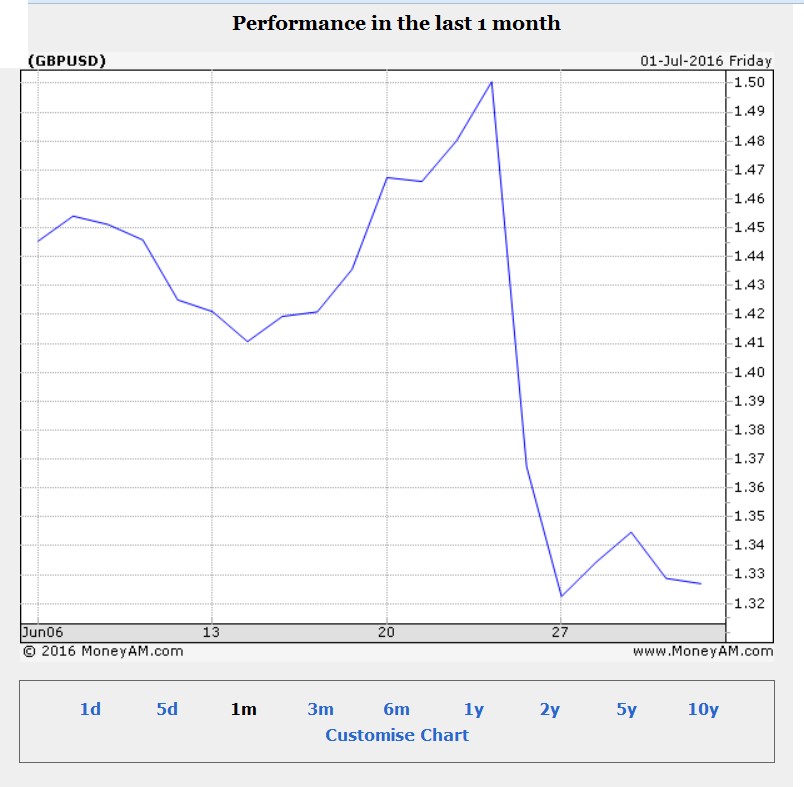
"Now the catastrophic scenario that many feared has materialized, making the disintegration of the EU practically irreversible," wrote Soros. "The financial markets worldwide are likely to remain in turmoil as the long, complicated process of political and economic divorce from the EU is negotiated." He said the consequences for the real economy would be comparable to the financial crisis of 2007-2008.
S&P Strips the United Kingdom of Its Triple-A Credit Rating
Standard & Poor's stripped the U.K. of its pristine triple-A credit rating, warning the country's vote to leave the European Union will lead to a less predictable, stable and effective policy framework.
The firm also said the vote for "Remain" in Scotland and Northern Ireland creates wider constitutional issues for the country as a whole.
A Word or Two from Gary Jefferson of Jefferson Financial Group
First Vice-President, Investments
If we heard Brexit once, we’ve heard it a thousand times over the weekend.
As former Secretary of Defense Donald Rumsfeld once famously said, “... because, as we know, there are known knowns; there are things we know we know. We also know there are known unknowns; that is to say we know there are some things we do not know. But there are also unknown unknowns - the ones we don't know we don't know.”
What we know is that no one was prepared for Brexit... nor were they expecting it. 99.9% of every "expert" we heard opined that the Brits would not exit.
We know there was an unmitigated selling panic across global markets resulting in the biggest ever one-day fall in equity prices in history.
We know the British pound fell to a 31-year low. (Bloomberg 6/25/16)
We know the selling started when hedge funds began unwinding positions. (Fox Sunday Market Futures 6/26/16)
We know the 10-year Treasury note tumbled to 1.47%, hitting a new 150 year low, before ending back up slightly above 1.50%. (Bloomberg 6/27/16)
We know that there are more than enough "pouting pundits of pessimism" crying that "the sky is falling". But this is the key to knowing what you know and don't know when it comes to their dire predictions, or anyone else's for that matter: Countless mainstream analysts and economists are going to be competing amongst themselves trying to predict what will happen next as Britain stumbles toward splitting with the European Union. But no one has any idea how it will all play out……so just ignore predictions. As always, anyone who tells you they know exactly how everything is going to play out is full of you-"know"-what. (pun intended)
We know that uncertainty causes market volatility. Specifically, we know that Brexit unleashed a number of possible and probable headwinds regarding trade, currency, tariffs and regulations. We know we don't know how all this will play out because it has never happened before. And, this uncertainty will create volatility until some things become more certain.
We know that, as the famous sportswriter Blackie Sherrod said, "History must repeat itself because we pay such little attention to it the first time…."
The key is simple: Don't panic. We've been here before. We would agree with this quote we read, "Today's move is going to be just a blip in the markets longer term. Don't get wrapped up in the media and political panic. Stick to the buy and sell disciplines you have always used."
We know that the S&P 500 started the year at 2040, plunged to 1830, then rallied back above 2100. Basically, this worldwide panic crash has, thus far, not done too much more than take back all of this year's gains.
One thing we feel optimistic about is the fact that the carnage in equities has not yet spilled over into high-yield bonds. We have never seen a terrible bear market develop that didn't include a concurrent terrible bear market in the high-yield income area. To us, this indicates that our equity market is still stuck in a trading range. Hopefully we don't go all the way back down to retest the February lows, but we know that is possible because we've already been there earlier this year. Unfortunately, we know that in these kinds of panic selloffs, many leveraged investor accounts get margin calls the next day and they are forced to sell, causing a vicious cycle which drops the market more than expected, but we know these sell-offs are not based on company fundamentals.
Finally, we know that Brexit very probably means no rate hikes in the U.S. and more money printing in Europe, Japan and the U.K. More money means more stimuli and more demand for commodities.
This is more of a clear path for growth than not.
Bottom line: Long-term investors should stand firm, watch for opportunities and take confidence in the fact that every sell-off in history has been followed by a market that has gone on to higher highs over time. The average S&P500 company pays a dividend higher than the 10-year Treasury, and that alone will eventually attract investors back into equities.
Reading Elon Musk’s Mind with Tesla’s Addition of Solar City
Tesla is playing the long game. Musk’s vision isn’t next year; It’s 2027.
And SolarCity (SCTY: $24) is integral to that vision, and that's what everybody is missing here. If the SolarCity deal goes through, then Tesla ($217: up 7%) will be a carmaker; a battery maker, with the Gigafactory being built in Nevada; an energy storage company, selling residential battery packs; and a solar finance firm. Musk says: Put all that together under one roof and you get a company that can give you transportation, heat your home, and do it all off the grid.
Yes, all that debt could eventually be a major problem for Tesla. It’s debt levels are high, but so is its cash level. The $400 million from the 400,000 orders for the new Model 3 certainly help. But it is burning cash at a high level and the things to watch closely is how the company handles this cash burn as we move into the latter part of the decade.
Note that Tesla had a great week after Wall Street hammered the company for announcing the buyout of Solar City. It was up 7% for the week. Wall Street loves this company, as do we, but the stock is not for the faint of heart. There are tremendous risks involved here – the stock could be $300 in a year or $100. We think the former, but buyer beware.
Silver Wheaton (SLW: $25, up 16%) was upgraded by analysts at Credit Suisse from a neutral rating to an outperform rating. They now have a $35 price target on the stock, up previously from $28.00.
Brexit Drives Down U.S. Mortgage Rates, With the 30-Year at 3.48%
• Home-loan costs decline to the lowest level since 2013
• The 30-year T-bond drops close to record low of 2.24%
Rates for 30-year U.S. mortgages dropped to the lowest level in more than three years as U.K. voters’ decision to leave the European Union drove investors to the safety of American government bonds that guide home loans.
The average rate for a 30-year fixed mortgage was 3.48%, down from 3.56% last week and the lowest since early May 2013, Freddie Mac said in a statement Thursday. The average 15-year mortgage slipped to 2.78% from 2.83%, the mortgage-finance company said.
The good news for both buyers and homeowners looking to refinance is that the Federal Reserve isn’t likely to raise interest rates any time soon. Brexit has only heightened concerns about the global economy that have been pushing down borrowing costs since the start of the year.
The average 30-year mortgage rate has been below 4% since the start of the year. It reached a record low of 3.31% in November 2012.
Energy Corner
Exxon Mobil (XOM: $94) announced a big discovery at its new well in the waters offshore in Guyana, called Liza-2. It builds on the success of 2015’s Liza-1. At Exxon’s recent annual meeting, CEO Rex Tillerson declared that first Liza to be the world’s biggest discovery of 2015. Together, the reservoirs could hold more than 1.4 billion recoverable barrels of high-quality oil.
In the virtually unexplored waters of Guyana, the former British colony east of Venezuela, Exxon is going big, having expanded its position to 8 million acres. “To put this in perspective, this is the equivalent of 1,400 Gulf of Mexico blocks,” Tillerson said. Exxon says the 3-D seismic survey that it conducted on the lease was the biggest in company history.
Exxon has 45% of the Liza prospect. Hess (HES: $60) has 30% and China’s Cnooc (CEO: $126) 25%. If Liza is a big deal for Exxon, it’s a bigger deal for smaller Hess, at a $19 billion market cap. In a statement, CEO John Hess called it an “exciting prospect” and “world-class” with additional wells planned.
BMR TAKE: Exxon is reaching for its all-time high of $101 set in 2013 when crude was over $100 a barrel. Crude is half that now and the company is going strong. It is still paying over 3% a year in dividends. We don’t have it in our portfolios, because we can’t have EVERY stock in our portfolios, but we SHOULD have it in our Stocks For Success, because you cannot keep this goliath down.
Almost $400 billion in market cap, it is the 2nd or 3rd largest in the world. And they buy back their own stock like there is no tomorrow. We burn 95 million barrels of oil a day in this world of ours, and Exxon is involved in just about every barrel. (Well, that is an exaggeration. We just wanted to see if you are paying attention. But the 95 million barrels a day is NOT an exaggeration, and our love for this stock is not either!)
UPDATE ON RIG COUNT
Total U.S. rig count (oil and gas) increased by 10
Total U.S. oil rig count increased by 11
The horizontal count increased by 7 (6 are oil rigs)
This brings the increase in horizontal rigs over the last five weeks to 18 (most of them being oil rigs).
This week's report from Baker Hughes brings the largest increase in horizontal rigs since November of last year, with a corresponding large increase in the U.S. oil rig count. Whereas last week's report showed a relatively large decline in oil rigs, these were very low quality rigs and the trend pointed to an acceleration in the rate of new rig additions. This week's increase consists of very high quality rigs, with the bulk being either horizontal or located in very productive basins. After the new additions, the total domestic oil rig count is now back to April levels; a reasonably large increase over a short period of time, but nevertheless still far from being able to compensate for declining production of existing fields.
HIGH YIELD REPORT
Now that the market has fully digested Brexit, just about everything is rallying. The S&P 500 has recovered its losses, but the real action is in high yield, as investors realize income-producing assets in the United States are likely to outperform no matter what happens in Europe.
The clearest winner here are REITs, with the SPDR Dow Jones REIT ETF (RWR: $100, up 5%) enjoying an amazing run in the last week, and bringing other REITs to 2016 highs. Our favorites are doing really well.
Government Properties Income Trust (GOV: $23, up 9%) soared for the week and reached a 52-week high. It’s up 22% in the past year, with most of those gains coming since we recommended the stock earlier this year. With dividends still covered by funds from operations and the expectation that government demand for properties is not going to let up anytime soon, investors are quickly realizing their earlier sell-off of the stock was a mistake.
Similarly, Digital Realty Trust (DLR: $109, up 5%) had a great week as the company’s earnings announcement approaches later this month. Expectations have gotten extremely high for the company, but we’re not worried. Here’s why: Deals with Amazon, AT&T, and other tech giants have been driving their funds from operations higher for over a year, and the growth rate is likely to far exceed their competitors. Digital Realty’s scale and penetration into key geographic regions in California and Virginia give it a wide moat that is increasingly impenetrable.
Business Development Corporations (BDCs) also did a fine job this week, with the UBS BDC ETF* (BDCS: $21) getting a 2.4% rise this week. But for more stability and high income, we are also pleased to see municipal bonds rise, as seen by the iShares National AMT Municipal Bond Fund (MUB: $114) staying flat for the week and keeping its gains for the year.
* The investment seeks to replicate, net of expenses, the performance of the Wells Fargo Business Development Company index. The index is a float adjusted, capitalization-weighted index that is intended to measure the performance of all Business Development Companies (“BDC”) that are listed on the New York Stock Exchange or NASDAQ and satisfy specified market capitalization and other eligibility requirements.
The reason for municipal bond strength? Interest rates. Now that Brexit has put tremendous uncertainty into the global economy, the Fed has little choice but to abandon its plans to raise interest rates in the short term - maybe for the rest of the year. That means less reason for investors to dump munis for lower-yielding Treasuries - and in fact, 10-year and 30-year Treasury yields have fallen t0 all-time lows. This means retirees will need to stick with municipals if they want dividends above 3%, but the municipal bond market is still seeing no rise in defaults or greater stress among debtors.
For this reason, The Bull Market Report is planning to release a series of reports on municipal bond funds with in-depth analysis of which funds will get you the highest yields with the lowest risk. Some of these funds yield over 6% - and that will be tax free for most Americans! That means a taxable equivalent yield of as much as 10%, depending on your tax bracket. That’s a great reason to consider bolstering your income portfolio with municipals, while the strength in the market and the low bankruptcy rate just makes the deal sweeter.
Blackstone (BX: $24.50) Why we love this company.
In Forbes recently, CEO Stephen Schwarzman and Blackstone were profiled. Some excerpts:
Early last year Stephen Schwarzman got a telephone call from JPMorgan. They were helping General Electric unload $30 billion in commercial real estate assets lingering on its books. GE boss Jeffrey Immelt was uncomfortable with the massive financial services business his predecessor, Jack Welch, had slowly built up. Schwarzman was told that the real estate sale was the keystone to Immelt’s reinvention plan.
The hang-up: finding a single buyer for a portfolio that included financing for everything from Mexican warehouses to Parisian office buildings to commercial mortgages in Australia. The billions in real estate and commercial mortgages were scattered across six countries, comprising all sorts of risks. Immelt knew that Blackstone Group was the only firm with three key traits: the global reach to understand all the different assets, the resources to close a deal quickly and the financial firepower to swallow the entire package.
Four weeks later, on Apr. 10, Immelt announced that Blackstone would purchase $14 billion of GE’s assets.
“It was a perfect deal for us,” Schwarzman says. “No one else in the world is set up to buy both equity assets and real estate debt on a global basis.”
Indeed, Blackstone’s massive 2015 purchase, executed flawlessly, announced to the world that there was a new pecking order that put private equity firms on top – with Blackstone at the apex and its chairman and chief executive, Schwarzman, as the most powerful banker on the planet.
In the past eight years Blackstone’s footprint and influence under Schwarzman have become nothing short of breathtaking. Since the financial crisis Blackstone’s assets have nearly quadrupled. More than 85% of its 2,070 employees have joined since 2007, and the firm has introduced dozens of new products. Blackstone has major stakes in 92 companies, from Hilton Hotels and Michaels Stores, to iconic brands like Versace and Leica Camera; it owns thousands of pieces of commercial real estate, including Manhattan’s Stuyvesant Town and Chicago’s Willis Tower, and more single-family homes in the U.S. than any other private entity. In nearly every business in which it operates, including hedge funds and credit, Blackstone is the leader.
In its core private equity business, Blackstone hasn’t had a single fund lose money since it launched its first one in 1987. The average annual returns realized by its private equity funds (19%), real estate funds (20%) and credit funds (14%) have all trounced the S&P 500, which has delivered an annualized return of 10% over the past 30 years.
“There’s some perception that turning out great returns over 30 years is going to stop in year 31,” Schwarzman says. “I don’t know what the reason for that is. People have been saying that since the first 5 years we were in business. We have a system that works.”
On the eve of the financial crisis and the collapse in the stock market, Schwarzman decided to bolster Blackstone’s permanent capital via an initial public stock offering. On June 21, 2007 Blackstone raised $4.1 billion in capital, valuing the firm at $34 billion. The deal was so coveted that China’s sovereign fund invested $3 billion just prior to the offering and agreed to give up its voting rights. Schwarzman held on to 23% and sold $500 million of stock.
“I had this desire for permanent capital,” Schwarzman says. “I just felt something bad was going to happen. The markets were peaking, and I just wanted to be prepared for the nuclear winter.” Within two years Blackstone’s new partnership units (as its shares are formally known) cratered from the $31 IPO price to $4.00. “It was a deluge which didn’t have anything to do with us.”
Schwarzman’s directive to his team of dealmakers was clear: Be smart, be entrepreneurial, but above all, don’t lose capital. A good example: Schwarzman’s 2013 purchase from Credit Suisse of Strategic Partners, a business that raises money to buy investor stakes in existing private equity funds. The big Swiss bank managed about $9 billion. Blackstone ran with it, doubling its assets to $19 billion today.
By nearly all measures business is booming. Blackstone has raised $80 billion for its funds in the past 12 months, dwarfing rivals like KKR, Carlyle Group and Apollo. Perhaps even more impressive is the fact that Blackstone’s analyst program has become the most coveted ticket at elite schools. Some 15,000 candidates from every Ivy League school applied for just 84 positions in 2015. That’s a 0.6% acceptance rate, compared with 4% for the analyst program at Goldman Sachs.
If there is any blemish in Schwarzman’s impressive tenure, it’s probably Blackstone’s stock: While it has returned 63% in the past three years, it is still trading at less than its IPO price and sells at a steep multiple discount to the shares of other asset managers.
Public shareholders hate volatility, and Blackstone’s earnings depend on the timing of asset sales and mark-to-market adjustments. For the 12 months through Mar. 31, Blackstone earned $900 million, an 83% drop from the $5.2 billion earned a year earlier. During the first quarter Blackstone marked its fee-earning holdings down by $1.6 billion as global equity and credit markets went on a roller-coaster ride tied to oil prices and central bank actions. Across the firm’s total assets under management, there was still a positive appreciation during the quarter of $382 million.
Taking a page from “buy and hold” sages Warren Buffett and Jack Bogle, Schwarzman may have devised a novel solution to his earnings-volatility problem. Blackstone recently introduced “core-plus” funds in real estate: essentially open-ended investment vehicles that use less leverage, have longer holding periods and offer lower returns. They also tend to lock up capital.
Core-plus funds are a great way for Blackstone to capitalize on the huge and growing demand among its clients for “safe yields.” These funds charge fees of 1% and 10%, and there is no expectation that Blackstone will “fix” or “sell” the assets. The firm’s $5.3 billion purchase of New York residential complex Stuyvesant Town in 2015 is an example. “Stuytown” is a 68-year-old, 110-building apartment complex just north of Manhattan’s East Village and should generate market rents for a very long time to come. The core-plus real estate strategy gained 4.4% in the first quarter of 2016 alone, and it has already amassed $12 billion in assets.
Perhaps this latest financial innovation – which Schwarzman thinks could reach $100 billion within a decade – will smooth earnings and finally afford Schwarzman the status he thinks he deserves among the financial greats.
Blackstone’s new mantra: “The power of this business is holding the assets forever.”
BMR TAKE: Schwarzman will win in the end. We would be buyers of the stock at these levels. The all-time high occurred last year in the spring at around $44. We don’t see any reason why the stock won’t get back to these levels, and higher in the future. We wish we could tell you WHEN, but while you wait you’ll get a company worth $15 billion that ought to be worth $25 billion, and is paying you 4.5% per year, AND you get to let a master company builder do all the work for you.
Good investing this week!
Todd Shaver, Editor in Chief
The Bull Market Report
LEGAL TERMS/DISCLAIMER
The Bull Market Report editorial staff are not registered investment advisors, broker/dealers, or research analysts.
Readers are advised that the commentary and reports on The Bull Market Report website (the “Website”) and in its newsletters are issued solely for informational purposes and should not to be construed as an offer to sell or the solicitation of an offer to buy any security. The opinions and analyses included herein are based on sources believed to be reliable and written in good faith, but no representation or warranty, expressed or implied is made as to their accuracy, completeness or correctness.
YOU SHOULD VERIFY ALL CLAIMS AND DO YOUR OWN RESEARCH BEFORE INVESTING IN ANY SECURITY MENTIONED IN THE BULL MARKET REPORT, OR THAT IS DISCUSSED ON THE BULLMARKET.COM WEBSITE. INVESTING IN SECURITIES IS SPECULATIVE AND CARRIES A HIGH DEGREE OF RISK. YOU MAY LOSE PART OR ALL OF YOUR PRINCIPAL INVESTMENT.
Readers are urged to consult with their own independent financial advisers with respect to any investment. All information contained in this report should be independently verified with the companies mentioned. Neither The Bull Market Report, nor Todd Shaver, nor their officers, directors, partners, members, contributors or employees/consultants accept any liability whatsoever for any direct or consequential loss arising from any use of information on this website or any use of information in its newsletters.
Todd Shaver and his partners, contributors or employees and consultants may on occasion hold positions in the securities mentioned on the Website. These positions may change at any time. Please note that neither Todd Shaver nor any of the Website editorial staff receives compensation of any kind for mentioning a company on the Website.
The Website is limited to the dissemination of general information pertaining to investments, together with access to additional investment-related information and links. Accordingly, the publication of the Website on the Internet should not be construed by any subscriber, consumer or prospective subscriber as the rendering of personalized investment advice for compensation, over the Internet. We are neither attorneys nor accountants and no portion of the Website content should be interpreted as legal, accounting or tax advice.
Certain portions of the Website may contain a discussion of, or provide access to, positions or recommendations as of a specific prior date. Due to various factors, including changing market conditions, such discussions may no longer be reflective of current positions or recommendations. Moreover, no prospective or existing subscriber should assume that any such discussion serves as the receipt of, or a substitute for, personalized advice from an investment professional.
Past performance may not be indicative of future results. Therefore, no prospective or existing subscriber should assume that future performance of any specific investment or investment strategy, including the investments or investment strategies made reference to directly or indirectly in the Website, or indirectly via a link to an unaffiliated third party website, will be profitable or equal any historical performance levels.
Please remember that different types of investments involve varying degrees of risk, and there can be no assurance that any specific investment will be suitable for a prospective or existing subscriber’s investment portfolio. Historical performance results for investment indices or categories generally do not reflect the deduction of transaction or custodial charges, the deduction of an investment management fee, nor the impact of taxes, the occurrence of which would have the effect of decreasing historical performance results.
USE OF THIS SITE AND THE ASSOCIATED EMAILS THAT ARE SENT OUT SIGNIFIES YOUR AGREEMENT TO OUR TERMS OF USE AGREEMENT
