September 11, 2016
by Todd Shaver | Sep 11, 2016 | Weekly Newsletter 7pm Sunday
The Week Just Past and the Week Ahead
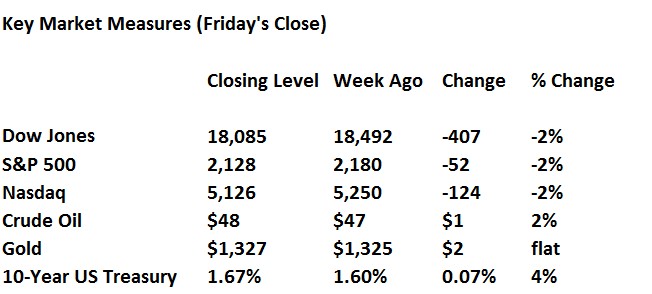
A sharp sell-off on Friday has rattled confidence. This was the first time in over two months that the S&P 500 moved more than 1% in a day. There are several driving forces. Due to a wave of profit warnings, the consensus expectations for a second half EPS recovery is now being reset lower. Moreover, the ongoing interest rate hike debate saga continues. While economists who watch Yellen conclude that she is signaling the Federal Open Market Committee will start raising rates in June, the futures market indicates no such thing. Bloomberg's World Interest Rate Probability function, which is based on futures trading data, sees only a 17% probability that the top end of the Fed's target range will go up at or before the June meeting of the rate-setting committee. Bottom line, new concerns that a rate hike is in the cards this month was a factor to the sharp market movements seen on Friday. We are not at all surprised to see the markets fade from recent all-time highs. While there may be more volatility ahead this week, our bias is to stand by ready to buy and scoop up our favorite stocks. This week we highlight Microsoft, Facebook, Alphabet, and Twitter.
Here is How Last Week Progressed
Monday (9/5) - S&P 500 -0.1%
Traders returned from vacation to find S&P futures flat, oil and the dollar lower, and a flurry of M&A activity. In fact, analysts at Morgan Stanley caved on their bearish call by raising their 12-month price targets for the S&P 500 – base case from 2200 to 2300, their bear case from 1600 to 1800, and their bull case from 2400 to 2500. For the bull case, Morgan Stanley left their EPS outlook essentially unchanged, but raised the multiple from 18x to 19x to yield their new 2500 bull target.
Tuesday (9/6) - S&P 500 +0.2%
Abysmal Class 8 truck net orders came out and continued to just get worse with each passing month. August net orders were down over 25% compared to last year. In fact, the level of trailing 12-month net orders is the lowest since 2011 with the annual change trend line now in negative territory for 18 consecutive months. The truck order data combined with Institute of Supply Management data that is flirting dangerously with recession levels are painting a very concerning picture about the core health of parts of the economy. Separately, billionaire Mark Cuban publicly stated that he has no doubt the market will tank if Donald wins. Could we see a Brexit like sell-off in the US should Trump win?
Wednesday (9/7) - S&P 500 +0.1%
Quant strategies on Wall Street are increasing in popularity. Did you know that the signals picked up by many quant strategies were able to get many investors out of oil prior to the massive sell off? Accordingly, we note that JP Morgan’s head quant has released a new report saying that the recent period of record calm across asset classes is about to end, warning of an increase in realized volatility, correlations, and tail risk* in September and October.
* Tail risk is something that is unlikely to happen - but still could. Broadly speaking, a tail risk is an event with a small probability of happening, says Bob Conroy, professor of finance at the University of Virginia Darden School of Business. “In every event there are tails; there are really good things that can happen and really bad things.”
Thursday (9/8) - S&P 500 -0.1%
Total consumer credit rose by $17.7 billion in July, up from last month's $14.5 billion, and above the $16.0 billion expected, as US consumers continued to get increasingly more indebted. However, while the credit spigot appears to be fully functional once again, it does not explain the disappointing car sales numbers in recent months, which prompted Ford earlier this week to warn that US car sales have now hit a plateau. Moreover, there are already concerning signs of credit performance. In July, 60 day subprime loan delinquencies were up 13% on a month-over-month basis and were up 17% compared to the same month last year. Prime delinquencies were up 12% on a month-over-month basis and were up 21% compared to the same month last year. Ouch.
Friday (9/9) - S&P 500 -2.5%
Markets were in a turmoil as the S&P moved more than 1% in a day for the first time in over two months. In fact, it was the 11th biggest jump in VIX in history, as August saw the volatility at a 2-year low. (The VIX (^VIX) was up 40% to 17.50 from 12.51.) What is going on here? Among other issues, we note deteriorating earnings expectations as the second half earnings growth rate pick-up baked into consensus appears to now not be materializing. This week we observed a wave of profit warnings from some large- and small-cap companies including Ford Motor, Barnes & Noble, Tractor Supply, SuperValu, Sprout’s Farmers Market, Pier 1 Imports, General Mills, HD Supply Holdings and Dave & Buster’s.
Separately, the ongoing stream of cautious data points continues to flow. Last week, we learned that PIK Toggle note* issuance is growing sharply. Looking back, the 2007 ramp in PIK Toggle note issuance was a pretty good indicator that the high-yield market was frothing over and the party was near an end. After all it's probably not a good sign when a market completely loses discipline to the point of rushing to hand out nearly $20 billion to companies that are basically admitting they may not even be able to afford the interest on the loan.
* A payment-in-kind bond, where the issuer has the option to defer an interest payment by agreeing to pay an increased coupon in the future. It is a sign that the company is having trouble repaying its debts. It's financing for companies undergoing a bankruptcy / restructuring process. The very nature of the loans is risky.
The Bull Market Report Companies and Commentary
Microsoft (MSFT: $56, -3% for the week) Microsoft is a high quality bellwether. Recent reports indicate that channel partners* see strong business trends for the company’s Cloud product, Azure. Azure is a key pillar of expected EPS growth embedded in consensus forecasts. Accordingly, it is a good sign to hear that Azure is on track with expectations.
* A channel partner is a company that partners with a manufacturer or producer to market and sell the manufacturer's products, services, or technologies, usually done through a co-branding relationship. Channel partners may be distributors, vendors, retailers, consultants, systems integrators (SI), technology deployment consultancies, and value-added resellers (VARs) and other such organizations.
To be more specific, channel partners are seeing strong sustained growth for Microsoft Cloud products, with a couple of partners underscoring a pronounced uptick with respect to Azure. One partner recently observed a renewed push by Microsoft to make inroads into the federal government vertical with its government Cloud. Lastly, a few channel partners referred to overall softness in their legacy Microsoft practices, partially driven by a faster-than-expected transition into the Cloud. This should be read as good news. Basically, the use of office desktop products is slowing because companies are transitioning to the Cloud.
We like that trend. We are fine with the legacy Microsoft business declining if the customers are moving to the Microsoft Cloud. It’s quicker and better, and a higher valuation is applied by the Street for the Cloud versus the desktop business
While Microsoft’s Azure product faces fierce competition from Amazon’s comparable AWS offering, one channel partner noted that Microsoft’s head start in the market with Office 365, along with their inherent long term relationships in Enterprise IT gives Microsoft a slight advantage in the Cloud space as compared to Amazon.
In fact, there is currently talk of an enormous energy conglomerate that has physical data centers in multiple countries which they are finding incredibly difficult to manage and scale and hence is thinking of moving to a Cloud infrastructure model. While this company has engaged both Microsoft and Amazon, the company appears to have a preference to go with Microsoft Azure because of the long standing relationship with Microsoft. This case study reinforces the storyline that Microsoft has created enough of a reputation now so that Amazon doesn’t seem like the only company in the public Cloud space.
BMR Take: The Cloud business is booming. Microsoft’s Azure product is recording revenue growth of greater than 100% a year. Channel partners are suggesting momentum is building. We view Microsoft as a high quality portfolio holding with an attractive dividend yield and substantial upside ahead.
Facebook (FB: $127, +2%) Weak sentiment surrounding the stock presents a buying opportunity. Facebook has delivered three consecutive quarters of 60%+ ad revenue growth, with an acceleration in four of the past five quarters. Street estimates have an upward revision bias with the 2017 consensus EPS having increased 35% so far this year. The overall lack of enthusiasm is reflected in the lower forward PE multiple and creates an opportunity.
One debatable topic right now is ad growth. Despite management’s caution on the 2Q16 earnings call, ad loads still have room to increase. Ad loads are a less significant growth driver of EPS estimates than many appreciate. Street estimates now call for slowing ad load growth to around 10% this year and actually declining in 2017-2018. Though there are several levers for management to focus on to drive improvement. For example, the company is currently working on ad targeting, relevancy, formats, and profitability in ways that don't alter the user experience. Facebook still has opportunity ahead for ad load growth despite the recent near term headwinds.
Another debatable topic right now is engagement. Despite a small sequential drop in 2Q16 daily and monthly active users across all regions, the overall ratio of daily to monthly active users remains steady at 66%, which highlights the stickiness of the customer base. Moreover, Facebook’s share of US mobile Internet time of 13% is 2x greater than Snapchat, Twitter, Instagram combined, which highlights how healthy engagement remains. Recent product changes such as prioritizing friends and family in the Facebook and Instagram feeds and the launch of Instagram Stories may acknowledge shifting usage and increased competition, at least in certain demographics, but we expect Facebook to remain innovative on products. We are not concerned about a slight slowing of engagement.
BMR Take: We think weak sentiment surrounding ad growth and engagement presents a buying opportunity. Street price targets are as high as $170, framing the compelling upside potential. We added the stock in February at $97, and we are approaching our Price Target of $140. We are pleased.
Alphabet (GOOG: $760, -2%). Building on the discussion above surrounding the booming Cloud business, Google’s efforts with its Cloud product Google Cloud Platform (GCP) are gaining momentum. We think there is plenty of room in the massive end market for several winners, so we do not view Google’s progress as a negative for Microsoft.
GCP is getting more aggressive and gaining traction in part due to a renewed focus and alignment with heavier investment and financial commitment with over $1 billion in acquisitions in the past year. In summary, the narrative around GCP being a distant third place in the public Cloud race may start to improve going forward.
Channel partners say that Google is targeting a select number of marquee Silicon Valley prospects, including a few that might be Amazon AWS displacements. GCP may soon make some material product announcements. Some partners are saying that GCP is hiring sales reps aggressively and the consensus view is that GCP is trying to win on its products and infrastructure, not on price.
Most firms still see GCP well behind AWS and Azure in the large enterprise market, with a less mature sales effort and premium service suite. That said, it is now believed that a $400 million revenue run-rate estimate for GCP in 2016 might be too low and that it could be closer to $750 million. On its 2Q16 call, Google called out the Cloud as the primary driver of the re-accelerating growth for Licensing and Other revenue, the first time the business has been mentioned in such manner.
BMR Take: Google Cloud Platform is a small but growing part of the Google investment thesis. We put it in the bucket of Google businesses with potential upside surprise versus consensus thinking. We would be buyers of Google all day long.
Twitter (TWTR: $18.11, -7%). Shares rose in the last week of August on rumors of a take-out, but the Board met on Thursday and thereafter communicated there were no offers to buy the company on the table right now. Accordingly, Twitter is now left (again) to deal with proving out their business model independently. Some analysts are now saying that if CEO Jack Dorsey can’t fix the business model in the next few quarters, he should volunteer to step down.
Shareholders want Twitter to become one of the first news sources users turn to. Many social media users see what Twitter provides as a basic necessity of an emerging digital age. Users offer unpaid labor hours to create content, which generates data that can be recorded, measured, and sold. They believe the trade is fair. Twitter maintains extensive databases of this information to exploit the content. The key will be figuring out how to satisfy shareholders for playing matchmaker without disturbing the part of the model that is working.
BMR Take: We see value in the Twitter platform. The company continues to take efforts to improve the model, with recent emphasis on live-streaming technology and new partnerships with the NFL and other sports leagues. While we likely won’t see a near-term takeout at a sizeable premium, we still see lots of opportunity ahead.
Upcoming Economic News
This week we have a few Fed governors speaking on Monday at various conferences. Then a wave of data comes out Thursday. We hope to see stable to healthy Retail sales figures and some signs of stabilizing weakness in the Industrial sector. Any pick-up in inflation figures would also be a positive. The Fed is in a real bind if the aforementioned trends go the opposite direction because they would then be having to raise rates into an incrementally worsening economic situation. Doing so could produce lost confidence in the Fed, which could have more of an effect on markets than even the math of the rate hike. Stay tuned.

Some Thoughts on the Markets
With Gary Jefferson
UBS Financial Services, Inc.
For the past several quarters "bad news" has been treated by the market as a good thing; i.e., no rate hike and a continuation of easy money. A well-known research firm on the Street has used an equation for this scenario for a couple of years: "Low interest rates + no recession = stock market gains."
However, according to the Stock Trader's Almanac, "The market is now navigating the weakest part of the calendar year, September. Since 1950, September is the worst performing month of the year for DJIA and S&P 500. Even in election years the month has been challenging. Once tans begin to fade and the new school year begins, fund managers tend to clean house as the end of the third quarter approaches, causing some nasty selloffs near month-end over the years…….."
Thus, investors should not be surprised to see a pullback in the market as we go through the month. We would view it as a buying opportunity ahead of the expected year-end rally fueled by improving earnings in both the 3rd and 4th quarters.
Meantime, the experts are all over the board:
Goldman Sachs says a bear market is inevitable. The bank contends that: “There are only three possible ways forward for the market. Firstly, there is the “Reflation” option, which sees inflation reignited, but bond yields rising too, hurting stocks and bonds. The second option is “Stagflation,” which would send yields higher because of rising inflation, but a lack of growth would hurt stocks. And thirdly, “Fat and Flat,” which is basically a continuation of the status quo, but accompanied by weakening earnings, reversing investor sentiment, and falling prices."
Morgan Stanley’s equities team has just gone on the record calling for a jump in the S&P 500 over the next year. The bank now thinks the S&P 500 will rise to 2,300 within 12 months.
A lot of people are worried because of the fresh highs at which the S&P 500 is trading, [this was written before Friday’s rout!] but in a recent article Bank of America argues that now is a great time to buy stocks. The bank runs a “Sell Side Indicator” which measures the bullishness of Wall Street analysts. That indicator is now sitting at its lowest sentiment reading since 2013. Basically, BOA's summary of the situation is: “Historically, when our indicator has been this low or lower, total returns over the subsequent 12 months have been positive 100 percent of the time, with median 12-month returns of more than 27%.”
In the real scheme of things, however, the whole Fed question shouldn’t be a big deal for folks making long-term investment decisions. What difference does it make whether the Fed announces a quarter of a percent increase in rates today, in December or some future date? Higher rates may become problematic for several industries, but given Yellen's clear indication that she will raise rates very slowly, we are nowhere near problematic interest rates and likely will not be for a long time to come. And, at this juncture, we still don't see the U.S. heading for a recession, although we certainly need to see some evidence fairly soon that 3rd quarter earnings are picking up some momentum.
We would modify the equation referred to above: "Historically low interest rates + improving corporate earnings + no recession = a rising stock market."
BMR Take: Well said, Gary Jefferson. Friday was a bad day, but the sun will come up Monday and the United States economy will continue pumping out goods and services, and entrepreneurs will continue building new ideas and creating wealth. We want to be fully invested in high quality stocks. If you are nervous about the markets and want to reduce risk, look at the High Yield Portfolio. These stocks have been knocking the cover off the ball, many of them are up over 10% this year, and all are paying from 4% to 10% dividends on top of the rise in prices – just absolutely stellar overall returns.
HIGH YIELD CORNER
Has the Bottom Finally Fallen Out of the Market?
Friday’s correction turned into a self-reinforcing bear market, with the S&P 500 closing down over 2%. Keep in mind this was a short trading week because of Labor Day, and Tuesday and Wednesday were particularly slow-action markets. That makes the downturn on Friday more worrisome.
What exactly caused the downturn? Most financial pundits are citing rate hike fears, after Eric Rosengren, president of the Boston Federal Reserve, hinted at the chance of an increase in interest rates in the near term. This is a significant development, because Rosengren has been one of the more dovish Fed officials, so his caution about the need to raise rates suggests the Fed really is getting serious about raising.
Why did that cause stocks to fall? Simple: With higher interest rates, there will be more of an incentive to buy U.S. Treasuries, and people will sell stocks to buy those Treasuries. At least, that’s the theory. But note that moves to higher interest rates in the past have not always correlated with a steep fall in stock prices, so this logic isn’t as certain as many market participants assume. In fact, we have said many times before that in more than half of the cases of the first or second interest rate raise by the Fed, the stock market is higher one year later.
However, interest rate hikes have a much more direct impact on the debt market, and this is where high yield investors need to stand up and pay attention.
Higher interest rates will do many things to debt markets. For one, higher interest rates will make existing notes and bonds less valuable. Secondly, higher interest rates could cause companies to default more.
Are debt markets ready for an interest rate hike? The answer is yes, somewhat. Corporate bonds fell significantly in value at the end of 2015 as investors prepared for rate hikes. As those hikes were delayed this year, the market realized it had oversold bonds and we saw a huge increase in the price of corporate bonds, especially junk bonds and high quality funds like our own favorites: Pimco Dynamic Income Fund (PDI: $28, down 3%) and AllianzGI Equity & Convertible Income Fund (NIE: $18.60, down 2%). Both of these funds had a bad week and underperformed the S&P 500, but are up 8% and 4% respectively over the last six months. That’s excluding dividends - PDI’s yield is 9% and NIE’s is 8%.
What now? The real key right now is buying dips. It seems that the market is just starting a correction, and this could easily last another few weeks. High yield defaults continue to rise, which is a good enough reason for junk bond markets to continue to correct. This trend has been ignored by the market for months now, which again suggests a correction can continue for a while. One way to think about this is to focus on the "BofA Merrill Lynch US High Yield Option-Adjusted Spread,” an ugly name for a simple concept but an economic metric tracked by the Federal Reserve. This measures the difference between average junk bond yields and the yield on a U.S. government bond. The lower the number, the more investors are willing to pay for junk bonds. When the number gets too low, it usually suggests junk bonds are overpriced and will fall in price as the market realizes it has gotten too greedy and ignored risks too much.
This number has fallen to its lowest point in a year, although junk bond defaults are at their highest point in a year. This is a clear disconnect, and the market is likely going to focus on this for a while, possibly producing a massive sell-off in high yield followed by a recovery.
Does this mean we recommend selling the AllianzGI and Pimco funds? Absolutely not. For one, these funds are not entirely in junk bonds; Pimco’s fund focuses on mortgage-backed securities (where default rates are falling), and AllianzGI has a lot of equity holdings.
Of course both will be hurt as the market focuses on risk and begins panic selling, so prices may go down in the short term. But the fundamentals are strong on both, so it is likely that their prices will recover whenever the market realizes it has gotten too nervous about rate hikes. On top of that, an interest rate hike’s impact on equities and MBS’s is much less significant than on high yield bonds, which have much of this risk already priced in over the last two years anyhow. With that in mind, the long-term risks are minimal even as the market is getting extra nervous.
Does this mean buy the dip? Simply put, yes. But no one will be able to call a bottom, so a systematic approach to adding to high yield positions probably makes sense over the next few weeks. If your favorites go down 2%, buy a little more. If it goes lower from there, buy a little more. When things calm down, these stocks will come bouncing right back.
What about other high yield sectors? The now infamous growth in REITs throughout 2016 has reversed, and the SPDR Dow Jones REIT ETF (RWR: $97) was down 4% over the past week. That may continue as the rate hike fears cause weakness in high yield sectors, but there is little reason to believe the best quality REITs are suffering any fundamental weakness in their operations or are likely to be unable to continue to pay out and grow dividends to shareholders.
Similarly, BDCs were down 2%, as we see from the UBS Etracs BDC ETF (BDCS: $22), but that is actually slightly better than the S&P 500. BDCs have been less exposed to moments of market panic in 2016 after their severe underperformance in 2014 and 2015, but there is no guarantee that will continue. Non-accruals* have become less of a concern for BDCs right now, but if junk bond defaults are rising, debts to smaller companies are likely to rise even more. If a surprising growth of non-accruals hits BDCs, this sector could face a more severe downturn. We aren’t seeing this yet, but focusing on quality is important here. That is why we still see Main Street Capital (MAIN: $34, down 1%) as a strong hold.
* Nonpayment of an interest payment due on a debt.
The Apple Corner
We think about Apple (AAPL: $103, down 4%) all the time and have had some thoughts about the recent new product announcement that some say was a bit flat. We agree to a certain extent, but we also are believers in not changing a good thing. The iPhone 7 looks like the 6, although the insides were beefed up a great deal – it’s faster and offers more storage. The Watch came out with a new version and is now fully waterproof. We could go on here for 10 more pages about the new products, but we will let you scour the web for more details if you like. You can start here if you haven’t done so already:
http://www.Apple.com Suffice it to say that the iPhone 7 will sell in big numbers this fall and Christmas, generating more profits and more cash to the bottom line for the company. And knowing the company the way we do, we wouldn't be surprised to see more exciting products announced sooner rather than later.
Additionally, with Friday’s sell-off it makes us think about how much Apple could go down from here. Here’s our take: It is unlikely that the stock can go down too far. Sure, if the market goes to 16,000, then we all have problems, and Apple will go to $90 again and maybe lower. But that cash cushion is unmatched in the annals of Wall Street. They literally have $42 a share in cash. (We know most of it is overseas, but with the EU’s demand of Ireland to get $14 billion from Apple in back taxes is spurring talk in Washington of allowing repatriation of the $3 trillion or so of cash that US companies hold overseas. This is a good thing.)
So for every share you own at $103, 41% is in cash. Now Apple management is not stupid. They will figure out a way to monetize the cash – through buying technology; buying people; buying income producing assets (companies); buying back stock; increasing the dividend; and a host of other ways you and I haven’t thought about yet. We believe in Apple management .
Under Armour Update:
Kevin Plank, CEO and Founder of Under Armour (UA: $38, flat) announced that he will be selling 2.1 million shares of stock starting in October. A subscriber wrote in and asked our opinion of the situation, as he thought this was a bad thing.
Here’s what we wrote back:
“Hi Samuel –
“We generally don’t mind if executives sell stock. Plank currently owns 34 million shares of the company’s Class B stock, 135,000 shares of Class A stock and 34 million shares of Class C stock, representing 65% of the voting power in the company. So 2 million shares is a small part of his holdings. He is just diversifying.”
That’s how we feel. Of course, we secretly wish we had 2 million shares to sell of our own, and we admire Plank and all the others that have created all of the amazing companies out there, like Amazon and Facebook and Google, and so on. This is America. The entrepreneurs and the risk takers shall reap the rewards. Again, we would not even blink a negative eye over this CEO selling a small part of his stake in the company. Bill Gates has been selling 20 million shares a quarter since 2002. Wow. And we still love Microsoft.
That’s all for this week.
Good Investing,
Todd Shaver
Editor in Chief
August 31, 2016
by Todd Shaver | Aug 31, 2016 | 7am News Flash
Twitter: (TWTR: $19.21)
Shares popped 5% yesterday on comments made directly by the company’s co-founder that a sale of the company should be considered.
Co-founder Ev Williams said in an interview with Bloomberg TV that the company has to weigh all options amid ongoing speculation it’s a takeover target. Williams initially declined to comment when asked by Bloomberg whether Twitter can remain an independent company. He went on to say, "We’re in a strong position now, and as a board member we have to consider the right options."
Board members are obliged to consider credible takeover overtures and often make similar boilerplate pronouncements when asked about deal-making. Even so, the Williams's comments come at a time when Twitter is often mentioned publicly as an acquisition target, as has been mentioned many times here at The Bull Market Report. The stock ran up 9% in early August amid unsubstantiated speculation that former Microsoft Chief Executive Officer Steve Ballmer and Saudi Prince Alwaleed bin Talal Al Saud were teaming up to buy the company. While analysts played down the chatter, Axiom Capital said that if Twitter’s business doesn’t turn around by mid-2017, a case could be made for a sale.
CEO Jack Dorsey, the co-founder who took the top job again officially in October, is trying to reshape the company’s reputation and product mix to draw a more mainstream audience. Investors have lamented Twitter’s recent user-growth slowdown, and the stock has fallen more than 17% this year. Revenue at Twitter is growing slower than expected, even as the company steps up efforts to court advertisers. The company is cutting deals to stream more live events, from sporting matches to political debates, and this year acquired an artificial intelligence startup to make live video look more professional.
BMR Take: The current situation feels eerily similar to LinkedIn, which was eventually acquired by Microsoft at a 50% markup. We see value in Twitter at these levels – that’s why it’s in the Special Opportunities Portfolio. We believe there are two opportunities here. The first is for the company to start the turnaround, growing users and revenues and profits. The second is for a firm with a ton of cash or valuable stock to swoop in and pick up the company. Google? Apple? Facebook? A Saudi Prince? A Steve Ballmer with all that Microsoft money? After all, Twitter started the Arab Spring; Twitter has been able to handle Donald Trump's comments; Jimmy Fallon starts a “trending topic” every Wednesday. Twitter is no Blackberry. It is a company of the future with a huge upside.
August 15, 2016
![THE BULL MARKET REPORT FREE MONTHLY for August 15, 2016]()
by Todd Shaver | Aug 15, 2016 | Monthly Newsletter Daily 6am if new, Uncategorized
Welcome to The Bull Market Report Monthly for August 15, 2016. This is a free publication from the subscription-based Bull Market Report, with access to News Flashes as they occur, and access to our four portfolios – Stocks for Success; Special Opportunities; High Yield; and Opportunities in Healthcare. The High Yield portfolio has been very special to our subscribers, as these are stocks paying 4%, 8% and even 12% dividends per year. AND the stocks themselves have been up 5% and 10% and even more than 20%, which amazes US!
In any case, and without further ADO, here is this month’s Bull Market Report MONTHLY. Enjoy!
Oh – we have a SPECIAL OFFER for you at the bottom of this newsletter. You know – they are ALWAYS SPECIAL, right? Will this one really is?!
Let’s Get Ready to Rumble!
On Thursday the Dow, S&P and Nasdaq all closed at records on the same day for the first time since 1999. (And the markets are in record territory again as we compile this on Monday.) Last time around this historic trifecta meant a fantastic year for stocks. Many on Wall Street are now hollering for a repeat. Some say the money flows are pointing to “the final melt up” and “a blow off top”. We don’t buy that. Everybody from pension funds to retirees are desperately searching for yield in a world of historically low bond returns. The new mentality that prevails is being called “TINA” investing, which stands for “there is no alternative”. If you are looking for new ideas in a market that may approach continued new highs, we highlight Mazor, Twitter, Netflix, and Splunk as places to find value. Have a great week!
Here is How The Major Indices Performed Last Week

Here is How Last Week Progressed
Monday (8/8) - S&P 500 -0.1%
The markets opened at fresh all-time highs only to drift toward an end result that was about flat for the day. China reported July trade data that confirmed a global slowdown. Specifically exports were down 4.4% versus the -3.5% consensus, and imports were down 12.5% versus the -7.0% consensus. The hoped-for moderation that would signal gearing up for orders heading into peak shopping season at year end did not come. Oil prices rose despite the glut of crude supply. Data revealed that corporate bond issuance totaled $88 billion worldwide in the first week of August, the most since 1999, which clearly highlights the amazing strength of the bond market, despite historic low yields.
Tuesday (8/9) - S&P 500 +0.1%
It was a very tepid day. The VIX nearly touched 11, which was last seen in July 2014. The 10-year US Treasury Note closed at 1.55%, which compares to the consensus forecast 8 months ago for the level to be 2.80%. Some savvy market participants are pointing to a 10-year of 0.80% in the intermediate term due to global spreads that face a widespread negative yield curve. (Of course, given consensus results as noted just above, it is obvious that no one has any idea.) Wholesale inventories rose mildly and sales surged to 4-year highs. The interpretation is that the inventory-to-sales ratio of 1.3x is in recession territory. Analysis from Morgan Stanley shined light on trailing 12 month profit margin now at the lowest levels since before the global financial crisis back in 2006 when the S&P was trading 700 points lower.
Wednesday (8/10) - S&P 500 -0.3%
The market continued grinding sideways. The BOJ disclosed in a policy report that tapering of its stimulus program in September is unlikely. The JOLTS data for job openings showed 5.62 million new jobs versus the expectation for 5.68 million. While the pace of hiring rebounded to 5.13 million from 5.05 million a month ago, the annual growth rate for hiring decelerated, which some pointed to as a key indicator that the US jobs market has peaked. Crude fell due to surprising builds despite gasoline drawdowns and production cuts. DOE data confirmed the build in crude of +1.05 million marked the third weekly rise. A rare event was seen in global treasury markets. The spread of the 10-year US Treasury Note to the 10-year GILT (UK bonds) exceeded 100bps, the widest spread seen since 2000.
Thursday (8/11) - S&P 500 +0.5%
The best day of the week so far. The Europe Stoxx 600 Index officially fully recovered from the Brexit decision. Oil prices rose 4% on the Saudi Minister’s OPEC remarks, saying that there is now a meeting scheduled for late September to discuss stabilizing prices, though is past times this rhetoric has led to little. The aforementioned good news overlooked lingering concern of the BLS massive downward revision of the 1Q16 annual growth rate for real wages to -0.4% from +4.2%. US federal tax receipts increased a modest +1% from last year slowing dramatically from the +13% pace of growth recorded just last summer.
Friday (8/12) - S&P 500 -0.1%
Word started circulating calling for a major melt-up in equity price indices. The upcoming Jackson Hole meeting with the leading economists in the US including Fed officials is anticipated to kick-start a discussion about the health of the US economy and a slow rate-hike cycle. At the same time, institutional investors will be returning from summer vacations needing to put money to work, where low interest rates is likely to force money flows into risk assets. St. Louis Fed President James Bullard was already on a radio show today talking about how the Fed sees no recession risk in the near term. A big firm in Europe sold $5 billion of gold futures right before the close perhaps bracing for a sell off on Monday.
Bull Market Report Companies and Commentary
Splunk (SPLK: $64, +5% for the week) Splunk caught a bid early in the week when Morgan Stanley raised its price target to $74 from $58 while reiterating an Overweight rating. What is there to like? The company is the leader in operational intelligence software that helps enterprises make sense of machine data. This end market is large and expanding, which offers a runway for sustainable 30% revenue growth. The business model is increasingly more predictable as the revenue base grows. In the most recent quarter, Splunk’s bookings accelerated to 48% annual growth, which was the highest pace recorded in six quarters. Moreover, the company guided well for the full year raising revenue guidance from $880 million to a new level of $895 million. We should also note that Splunk added 450 new customers and completed 320 deals over $100,000, up 40% from a year ago, which highlights very healthy demand. And this: The Splunk Cloud business doubled from last year, as well!
BMR Take: We see momentum carrying the shares to the $70+ level. This valuation assumes a premium to the peer group justified by the company’s leadership position.
Netflix (NFLX: $97, +1% for the week) Shares started the week off wobbly on news that Alibaba would not be making an investment in Netflix. However, by the end of the week, investor focus returned to the fundamentals, where there is a lot to like. A comparison of Google search volume suggests that "Stranger Things" has had the biggest debut of any new series in 2016 on traditional cable or online, and there is not even a close second place. The extraordinary consumer interest in this science fiction TV show is particularly notable given the lack of a large marketing budget and high profile talent on the show. We believe this demonstrates the power of scaled distribution online, as well as the benefits of full season releases, which allow for instant immersion in a series.
At this point, we do not believe any cable network could replicate this type of performance with a new series. Looking ahead, the release schedule includes Narcos 2 and Disney’s The Crown. While there was concern in the recent quarter over lighter than expected US and International subscribers, it was all driven by elevated churn, which is mostly believed to be the result of price increases in contrast to something more concerning like competition or saturation. Historically, 40% of churning subscribers ultimately return considering the content is increasingly irresistible as we just discussed, which means the recent softness may very well ease.
BMR Take: We remain positive on the long term outlook and expect shares to recover their footing to test 52-week highs of $133.
Mazor (MZOR: $24, +3%). We saw impressive gains in Mazor last week. The focus remains on continued performance improvement building off of the recent solid quarter result. Mazor recently received orders for 11 new Renaissance systems, six in the US, and five internationally. Importantly, there were 16 orders in 1H16, which marked the best six month period in company history. Sales in 2Q16 were up an impressive 30% sequentially. The outlook for the US pipeline in the second half of the year was strong. Utilization continues to increase as recurring revenue growth is running above 30% with increasing system usage cited by management as a key driver. Management has indicated confidence that 2016 will be a record year for both systems sales and procedure volumes. Lastly, the headcount of sales professionals during the quarter increased by one to 17. This compares to plans to reach hundreds of sales reps, which will be transformational.
BMR Take: We see strong fundamentals for long term growth. That said, the stock has appreciated significantly in a short period, so watch it closely.
Twitter (TWTR: $20, +7%). The company had a great week as it was in the headlines this week for a few whacky storylines, plus the prospects for an acquisition, the latest mentioned buyer being Alphabet. The core fundamentals have been steady in terms of revenue deceleration and slowing engagement growth. In fact, management’s latest 3Q revenue guidance of $600 million came in well below the consensus of $680 million. However, there are encouraging signs. In particular, there is much discussion over the new product pipeline. Growth in engagement is now being driven by product changes and marketing efforts, versus previously what were only marketing efforts. The fact that engagement growth is now coming from product changes is a clear sign of increased business momentum. We believe engagement growth coming from product changes is positive, and we would like to see this continue.
Additionally, there is opportunity in video. The company notes that video is one of the two big opportunities for growth, as online video ad budgets for clients across the marketing ecosystem have only recently been revised to permit allocations to Twitter. Note that video is the number one ad format in terms of revenue on Twitter. We likely will not see an impact from live video until 4Q16 since only three events were live on Twitter thus far and just two NFL games will be on Twitter in 3Q16.
BMR Take: Good things will happen here.
Apple Corner
Nothing much new with Apple (AAPL: $108) except another $800 million in cash in the bank this past week. Ha. Nothing new. Right. And the stock TRICKLED UP another 1%. This week? Well if the market moves higher, then Apple is going to add another few dollars. We really do believe we will see new highs in Apple down the road. This year? Maybe. But certainly next year. Can you wait for a year for the stock to move from $108 to $134? Well, let’s see. That’s a 24% return in a year if it happens. I guess we can wait for that! We are quite confident that this will happen.
Upcoming Economic News
It is a very quiet upcoming week for the economic data release schedule. The highlight will be housing starts, out Tuesday. A month ago, we observed the US Census released June housing start data that supported the long-term outlook for a slow-paced recovery to normalized levels. We believe the industry is benefitting from a return of the first-time homebuyer which has accelerated as 3% FHA loans have become more commonplace. We also see the recent decline in interest rates as a potential catalyst in the second half of the year as homebuyers look to take advantage of incrementally attractive financing opportunities. However, we note that permits are now lagging starts by over 5%, which is a relatively large margin from historical standards and does not verify future acceleration to be a given.

High Yield Corner
High yield assets continue to see strong performance throughout 2016, again confirming The Bull Market Report’s recommendation to go heavy into these sectors earlier this year. However, new warning signs suggest more caution is necessary as we plow through the second half of the year.
Junk bonds had another strong week, with the SPDR Barclays Capital High Yield Bond ETF (JNK: $36) up over 1% for the week. That means high yield is now up over 7% for 2016, and up 15% from the lowest point in February.
That’s all great news, but fundamentals urge greater caution right now. The junk bond default rate rose to 5.5% by the end of July, according to a new report by Moody’s, and the number of defaults in July rose by 11, meaning 102 defaults in total for 2016. That’s the highest amount of defaults since 2009. What’s causing the defaults? Oil, of course. Moody’s expects a shocking 10% default rate for metals and mining sectors and 7% for oil and gas. Defaults are also expected to continue to climb for the year, peaking at 6% by the end of the year.
Is the corporate bond market pricing these defaults in and offering creditors a higher yield on bonds to compensate for the risk? Simply put: no, it is not. The average yield on junk bonds fell again this week by nearly 2%, and yields have fallen over 30% from their highest point during the great risk-off moment in February. Right now the market seems to have an insatiable appetite for risk, meaning that investors are willing to buy high risk bonds even if the interest rate they are getting is lower than it was when the bond market was less risky. Why? Simple: there are few alternatives. U.S. Treasury yields continue to stay around all-time lows, meaning there are less places to get income than ever before without taking on more risk. Income-hungry investors are willing to accept the higher risks in the corporate bond world because there are few options out there.
This trend has also driven money into REITs, with the SPDR Dow Jones REIT ETF (RWR: $101) up over 10% year-to-date and up over 23% from the lowest point in February. The REIT world’s strength in 2016 has astounded us, even though we were bullish on REITs earlier this year.
Our favorite REITs continue to be strong performers and continue to cover dividends with funds from operations (FFO). Omega Healthcare Investors (OHI: $37) rose 5% this week, although the SPDR Dow Jones REIT ETF actually fell slightly, due largely to underperformance from large and low-yielding REITs that make up that index.
Our other favorite REIT, Digital Realty Trust (DLR: $103) is up another 2% for the week, and is up over 36% year-to-date. Digital Realty Trust has been one of our best picks this year, and the strong recent performance makes it tempting to sell the REIT and go elsewhere, but this temptation needs to be resisted. Why? Digital Realty Trust is optimally positioned to benefit from the continued explosive growth in cloud computing and companies’ and governments’ need for server space. As a competitive, attractively priced, and highly reliable lessor of server space, Digital Realty Trust has gained the respect and business of Amazon, AT&T, and the U.S. Federal Government - and each of these entities is not only renewing leases but demanding more. We want to profit from that continued high demand.
Another place where we have seen cautious growth is the BDC sector. The UBS Etracs BDC ETF (BDCS: $22) rose less than 1% this week and is up 7% year-to-date. That’s good, but our super pick Main Street Capital (MAIN: $34) is up over 1% for the week and a shocking 18% year-to-date. Plus, dividend coverage remains well over 100% and the company’s recent special dividend payout - and expected December payout - means this stock is yielding nearly 8% on an annualized basis. Such a high yield from a company that can cover payouts so well is unprecedented both inside and outside of the BDC world. Thus it’s no surprise that investors have been flocking to this stock in recent months, and that capital flow is likely to continue. Main Street’s management is just too good, and the company is too well positioned in the BDC world to attract the best quality debtors in need of cash. Thus the increased corporate default rate - which of course means higher defaults among smaller businesses - is not a concern for Main Street, while it dos remain a concern for smaller and less competent BDCs.
In summary, there are growing signs that investors need to be more cautious now that high yield defaults are up but yields are down. This means that a more careful and diligent allocation of capital to the best funds and companies is essential. The lower-quality companies are going to suffer, and that is going to impact indexes and the more risky funds. Sadly, this means investors cannot simply index the market and ride the valleys and troughs. It means investors need to be very careful, pick the best high yielding assets out there, and hold them in thick times and thin.
Note that our Weekly Newsletter has a lot more information - things like the Options Corner; commentary from one of the world's most renowned Energy expert, Philip Verleger; commentary from Gary Jefferson of UBS Financial Services; and a whole lot more. Plus we send out News Flashes when appropriate during the week if any news or announcements affect the stocks in our portfolio. Please join us and take advantage of some super discounts below.
Good Investing,
Todd Shaver
Editor in Chief
The Bull Market Report
August 14, 2016
![THE BULL MARKET REPORT FREE MONTHLY for August 15, 2016]()
by Todd Shaver | Aug 14, 2016 | Weekly Newsletter 7pm Sunday
“Let’s get ready to rumble!”
On Thursday the Dow, S&P and Nasdaq all closed at records on the same day for the first time since 1999. Last time around this historic trifecta meant a fantastic year for stocks. Many on Wall Street are now hollering for a repeat. Some say the money flows are pointing to “the final melt up” and “a blow off top”. We don’t buy that. Everybody from pension funds to retirees are desperately searching for yield in a world of historically low bond returns. The new mentality that prevails is being called “TINA” investing, which stands for “there is no alternative”. If you are looking for new ideas in a market that may approach continued new highs, we highlight Mazor, Twitter, Netflix, and Splunk as places to find value. Have a great week!
Here is How The Major Indices Performed Last Week
Here is How Last Week Progressed
Monday (8/8) - S&P 500 -0.1%
The markets opened at fresh all-time highs only to drift toward an end result that was about flat for the day. China reported July trade data that confirmed a global slowdown. Specifically exports were down 4.4% versus the -3.5% consensus, and imports were down 12.5% versus the -7.0% consensus. The hoped-for moderation that would signal gearing up for orders heading into peak shopping season at year end did not come. Oil prices rose despite the glut of crude supply. Data revealed that corporate bond issuance totaled $88 billion worldwide in the first week of August, the most since 1999, which clearly highlights the amazing strength of the bond market, despite historic low yields.
Tuesday (8/9) - S&P 500 +0.1%
It was a very tepid day. The VIX nearly touched 11, which was last seen in July 2014. The 10-year US Treasury Note closed at 1.55%, which compares to the consensus forecast 8 months ago for the level to be 2.80%. Some savvy market participants are pointing to a 10-year of 0.80% in the intermediate term due to global spreads that face a widespread negative yield curve. (Of course, given consensus results as noted just above, it is obvious that no one has any idea.) Wholesale inventories rose mildly and sales surged to 4-year highs. The interpretation is that the inventory-to-sales ratio of 1.3x is in recession territory. Analysis from Morgan Stanley shined light on trailing 12 month profit margin now at the lowest levels since before the global financial crisis back in 2006 when the S&P was trading 700 points lower.
Wednesday (8/10) - S&P 500 -0.3%
The market continued grinding sideways. The BOJ disclosed in a policy report that tapering of its stimulus program in September is unlikely. The JOLTS data for job openings showed 5.62 million new jobs versus the expectation for 5.68 million. While the pace of hiring rebounded to 5.13 million from 5.05 million a month ago, the annual growth rate for hiring decelerated, which some pointed to as a key indicator that the US jobs market has peaked. Crude fell due to surprising builds despite gasoline drawdowns and production cuts. DOE data confirmed the build in crude of +1.05 million marked the third weekly rise. A rare event was seen in global treasury markets. The spread of the 10-year US Treasury Note to the 10-year GILT (UK bonds) exceeded 100bps, the widest spread seen since 2000.
Thursday (8/11) - S&P 500 +0.5%
The best day of the week so far. The Europe Stoxx 600 Index officially fully recovered from the Brexit decision. Oil prices rose 4% on the Saudi Minister’s OPEC remarks, saying that there is now a meeting scheduled for late September to discuss stabilizing prices, though is past times this rhetoric has led to little. The aforementioned good news overlooked lingering concern of the BLS massive downward revision of the 1Q16 annual growth rate for real wages to -0.4% from +4.2%. US federal tax receipts increased a modest +1% from last year slowing dramatically from the +13% pace of growth recorded just last summer.
Friday (8/12) - S&P 500 -0.1%
Word started circulating calling for a major melt-up in equity price indices. The upcoming Jackson Hole meeting with the leading economists in the US including Fed officials is anticipated to kick-start a discussion about the health of the US economy and a slow rate-hike cycle. At the same time, institutional investors will be returning from summer vacations needing to put money to work, where low interest rates is likely to force money flows into risk assets. St. Louis Fed President James Bullard was already on a radio show today talking about how the Fed sees no recession risk in the near term. A big firm in Europe sold $5 billion of gold futures right before the close perhaps bracing for a sell off on Monday.
Bull Market Report Companies and Commentary
Splunk (SPLK: $64, +5%) Splunk caught a bid early in the week when Morgan Stanley raised its price target to $74 from $58 while reiterating an Overweight rating. What is there to like? The company is the leader in operational intelligence software that helps enterprises make sense of machine data. This end market is large and expanding, which offers a runway for sustainable 30% revenue growth. The business model is increasingly more predictable as the revenue base grows. In the most recent quarter, Splunk’s bookings accelerated to 48% annual growth, which was the highest pace recorded in six quarters. Moreover, the company guided well for the full year raising revenue guidance from $880 million to a new level of $895 million. We should also note that Splunk added 450 new customers and completed 320 deals over $100,000, up 40% from a year ago, which highlights very healthy demand. And this: The Splunk Cloud business doubled from last year, as well!
BMR Take: We see momentum carrying the shares to the $70+ level. This valuation assumes a premium to the peer group justified by the company’s leadership position.
Netflix (NFLX: $97, +1%) Shares started the week off wobbly on news that Alibaba would not be making an investment in Netflix. However, by the end of the week, investor focus returned to the fundamentals, where there is a lot to like. A comparison of Google search volume suggests that "Stranger Things" has had the biggest debut of any new series in 2016 on traditional cable or online, and there is not even a close second place. The extraordinary consumer interest in this science fiction TV show is particularly notable given the lack of a large marketing budget and high profile talent on the show. We believe this demonstrates the power of scaled distribution online, as well as the benefits of full season releases, which allow for instant immersion in a series.
At this point, we do not believe any cable network could replicate this type of performance with a new series. Looking ahead, the release schedule includes Narcos 2 and Disney’s The Crown. While there was concern in the recent quarter over lighter than expected US and International subscribers, it was all driven by elevated churn, which is mostly believed to be the result of price increases in contrast to something more concerning like competition or saturation. Historically, 40% of churning subscribers ultimately return considering the content is increasingly irresistible as we just discussed, which means the recent softness may very well ease.
BMR Take: We remain positive on the long term outlook and expect shares to recover their footing to test 52-week highs of $133.
Mazor (MZOR: $24, +3%). We saw impressive gains in Mazor last week. The focus remains on continued performance improvement building off of the recent solid quarter result. Mazor recently received orders for 11 new Renaissance systems, six in the US, and five internationally. Importantly, there were 16 orders in 1H16, which marked the best six month period in company history. Sales in 2Q16 were up an impressive 30% sequentially. The outlook for the US pipeline in the second half of the year was strong. Utilization continues to increase as recurring revenue growth is running above 30% with increasing system usage cited by management as a key driver. Management has indicated confidence that 2016 will be a record year for both systems sales and procedure volumes. Lastly, the headcount of sales professionals during the quarter increased by one to 17. This compares to plans to reach hundreds of sales reps, which will be transformational.
BMR Take: We see strong fundamentals for long term growth. That said, the stock has appreciated significantly in a short period, so watch it closely.
Twitter (TWTR: $20, +7%). The company had a great week as it was in the headlines this week for a few whacky storylines, plus the prospects for an acquisition, the latest mentioned buyer being Alphabet. The core fundamentals have been steady in terms of revenue deceleration and slowing engagement growth. In fact, management’s latest 3Q revenue guidance of $600 million came in well below the consensus of $680 million. However, there are encouraging signs. In particular, there is much discussion over the new product pipeline. Growth in engagement is now being driven by product changes and marketing efforts, versus previously what were only marketing efforts. The fact that engagement growth is now coming from product changes is a clear sign of increased business momentum. We believe engagement growth coming from product changes is positive, and we would like to see this continue.
Additionally, there is opportunity in video. The company notes that video is one of the two big opportunities for growth, as online video ad budgets for clients across the marketing ecosystem have only recently been revised to permit allocations to Twitter. Note that video is the number one ad format in terms of revenue on Twitter. We likely will not see an impact from live video until 4Q16 since only three events were live on Twitter thus far and just two NFL games will be on Twitter in 3Q16.
BMR Take: Good things will happen here.
Apple Corner
Nothing much new with Apple (AAPL: $108) except another $800 million in cash in the bank this past week. Ha. Nothing new. Right. And the stock TRICKLED UP another 1%. This week? Well if the market moves higher, then Apple is going to add another few dollars. We really do believe we will see new highs in Apple down the road. This year? Maybe. But certainly next year. Can you wait for a year for the stock to move from $108 to $134? Well, let’s see. That’s a 24% return in a year if it happens. I guess we can wait for that!
We hope it happens.
Upcoming Economic News
It is a very quiet upcoming week for the economic data release schedule. The highlight will be housing starts, out Tuesday. A month ago, we observed the US Census released June housing start data that supported the long-term outlook for a slow-paced recovery to normalized levels. We believe the industry is benefitting from a return of the first-time homebuyer which has accelerated as 3% FHA loans have become more commonplace. We also see the recent decline in interest rates as a potential catalyst in the second half of the year as homebuyers look to take advantage of incrementally attractive financing opportunities. However, we note that permits are now lagging starts by over 5%, which is a relatively large margin from historical standards and does not verify future acceleration to be a given.
High Yield Corner
High yield assets continue to see strong performance throughout 2016, again confirming The Bull Market Report’s recommendation to go heavy into these sectors earlier this year. However, new warning signs suggest more caution is necessary as we plow through the second half of the year.
Junk bonds had another strong week, with the SPDR Barclays Capital High Yield Bond ETF (JNK: $36) up over 1% for the week. That means high yield is now up over 7% for 2016, and up 15% from the lowest point in February.
That’s all great news, but fundamentals urge greater caution right now. The junk bond default rate rose to 5.5% by the end of July, according to a new report by Moody’s, and the number of defaults in July rose by 11, meaning 102 defaults in total for 2016. That’s the highest amount of defaults since 2009. What’s causing the defaults? Oil, of course. Moody’s expects a shocking 10% default rate for metals and mining sectors and 7% for oil and gas. Defaults are also expected to continue to climb for the year, peaking at 6% by the end of the year.
Is the corporate bond market pricing these defaults in and offering creditors a higher yield on bonds to compensate for the risk? Simply put: no, it is not. The average yield on junk bonds fell again this week by nearly 2%, and yields have fallen over 30% from their highest point during the great risk-off moment in February. Right now the market seems to have an insatiable appetite for risk, meaning that investors are willing to buy high risk bonds even if the interest rate they are getting is lower than it was when the bond market was less risky. Why? Simple: there are few alternatives. U.S. Treasury yields continue to stay around all-time lows, meaning there are less places to get income than ever before without taking on more risk. Income-hungry investors are willing to accept the higher risks in the corporate bond world because there are few options out there.
This trend has also driven money into REITs, with the SPDR Dow Jones REIT ETF (RWR: $101) up over 10% year-to-date and up over 23% from the lowest point in February. The REIT world’s strength in 2016 has astounded us, even though we were bullish on REITs earlier this year.
Our favorite REITs continue to be strong performers and continue to cover dividends with funds from operations (FFO). Omega Healthcare Investors (OHI: $37) rose 5% this week, although the SPDR Dow Jones REIT ETF actually fell slightly, due largely to underperformance from large and low-yielding REITs that make up that index.
Our other favorite REIT, Digital Realty Trust (DLR: $103) is up another 2% for the week, and is up over 36% year-to-date. Digital Realty Trust has been one of our best picks this year, and the strong recent performance makes it tempting to sell the REIT and go elsewhere, but this temptation needs to be resisted. Why? Digital Realty Trust is optimally positioned to benefit from the continued explosive growth in cloud computing and companies’ and governments’ need for server space. As a competitive, attractively priced, and highly reliable lessor of server space, Digital Realty Trust has gained the respect and business of Amazon, AT&T, and the U.S. Federal Government - and each of these entities is not only renewing leases but demanding more. We want to profit from that continued high demand.
Another place where we have seen cautious growth is the BDC sector. The UBS Etracs BDC ETF (BDCS: $22) rose less than 1% this week and is up 7% year-to-date. That’s good, but our super pick Main Street Capital (MAIN: $34) is up over 1% for the week and a shocking 18% year-to-date. Plus, dividend coverage remains well over 100% and the company’s recent special dividend payout - and expected December payout - means this stock is yielding nearly 8% on an annualized basis. Such a high yield from a company that can cover payouts so well is unprecedented both inside and outside of the BDC world. Thus it’s no surprise that investors have been flocking to this stock in recent months, and that capital flow is likely to continue. Main Street’s management is just too good, and the company is too well positioned in the BDC world to attract the best quality debtors in need of cash. Thus the increased corporate default rate - which of course means higher defaults among smaller businesses - is not a concern for Main Street, while it dos remain a concern for smaller and less competent BDCs.
In summary, there are growing signs that investors need to be more cautious now that high yield defaults are up but yields are down. This means that a more careful and diligent allocation of capital to the best funds and companies is essential. The lower-quality companies are going to suffer, and that is going to impact indexes and the more risky funds. Sadly, this means investors cannot simply index the market and ride the valleys and troughs. It means investors need to be very careful, pick the best high yielding assets out there, and hold them in thick times and thin.
Notes on the market from Gary Jefferson
Jefferson Financial Group
First Vice-President, Investments
Investor: "Mr. Market……I'm a little worried about you. You've been a manic depressive so far this year – super lows followed by super highs. Can you give me an idea about how you feel now and maybe tell me what you see going on?"
Mr. Market: "I feel pretty good. I can tell you that I only care about two things today – bond yields and oil. (We have always considered oil as a 'wild card') So, whether you agree or not, I feel fairly confident that investors will pay me historically high valuations for stocks because interest rates are so low – and I believe they are going to stay low for as long as the central bankers remain 'uncertain' about what rate hikes would do to the global economy. That said, I have to caution you that bond yields staying low are critical to the ability of stocks to keep rising…."
Well – that's simple enough – as long as oil doesn't collapse back to the $30s and rates stay low. The many reasons to be bullish outweigh the many reasons to be bearish at this time.
We would add one important caveat to this "forever low rates" forecast: Earnings. Rates may stay low forever, but without corporate earnings growth, stocks can only form a bubble if they keep rising higher. UBS released its 2nd Quarter Earnings Recap Monday:
"Q2 2016 Recap
“Approximately 89% of the S&P 500 index has announced results. Reported earnings and revenue growth was -3.8% and -0.7%, respectively. 67% of companies have beaten earnings expectations (vs. an average of 69% since '09) while 43% have beaten revenue expectations (vs. 47% since '09). Turning to guidance, 86 of 194 companies have delivered above-consensus outlooks for the FY. On average, FY guidance is in line with consensus estimates, quarterly guidance for Q3 is 12.8% below consensus.
“With better than expected earnings results, consensus EPS estimates seems to have finally found a floor, with economic activity picking up in Q2 and Q3 of 2016. Current estimates now imply a growth rate of 0.5% for 2016 S&P 500 EPS, with a recovery in 2017 to 13.9% growth, a level we find reasonably overoptimistic given our UBS top-down estimate of 5.9% growth………."
These numbers are basically unchanged from a prior UBS recap dated 6/6/16 which estimated 2016's earnings for the S&P 500 will come in around $119 and are forecast to rise 6% in 2017 to $126. At today's level of 2180, the S&P 500 would trade at 17X forward earnings and at 18X trailing earnings. That doesn't leave a whole lot of wiggle room for stocks this year. If next year's consensus forecast of 14% growth materializes, earnings for 2017 jump up to around $135, which would result in a trailing P/E of 16%. If the market kept the same 18X for trailing earnings of $135, we would see the S&P500 at 2470. That is 17 months away but it is a whopping 13% higher than today.
Bottom line: If we had to guess, earnings will likely come in somewhere between UBS's forecast of $126 and the consensus estimate of $135. That still gives stocks some room to the upside. And, as always, companies with superior earnings should do much better than this somewhat restrained backdrop for equities.
OPTIONS CORNER
Do you think Microsoft (MSFT: $58) can get to $70 or $75 by early 2018? That’s about a year and half away. Well, if you do, you could make some serious money buying some calls on the stock. (You could also lose all your money. Gotta remind you about this AGAIN. Options are risky.)
If you think it could get to $75 because it’s paying a 2.5% dividend; because it has $113 billion in cash with $54 billion in low-interest debt; because is making 30%+ after tax returns on sales; because they have a monopoly on the PC operating system marketplace; because they are a cash machine (oh – we already said that); because they are one of the most innovative companies in the world; because they are worth $450 billion, one the highest market caps in history. We could go on and on, but for these reasons you might surmise that the stock could get to $75.
If it were to get to $75 you could make some serious money. The January 2018 $70 calls are trading at a shade under $1.50. If the stock gets to $75 the calls would be worth $5 for a return of 333%. If you invested $20,000 you would have $66,000.
Now, if the stock were to hit $80, the options would be worth $10 for a return of 666%, so your $20,000 would be worth $132,000. (The risk: If the stock doesn’t hit $71.50, the breakeven point, you would lose all your money.)
Of course, another, more conservative way to play the options game with Microsoft would be to buy the stock and sell an option against it. We love SELLING options, because options are a wasting asset and if you sell something and get money for it now, the fact that it is wasting away is a good thing. The June 2017 $62.50 call is trading for a little over $2, so you buy the stock and sell the option and if the stock goes to $62.50 by June, you would return 11% on the trade in 10 months, plus receive the dividend of 2.5% for a nice 12-13% return on a great company. (Of course, if it goes higher than $62.50 you wouldn’t participate in the gains on the stock unless you bought back the call. You could then replace it with a higher strike price – very easy to do.)
Note that options on Microsoft are relatively not very dear. Why? Because the company is now a value stock rather than a growth stock and the market doesn’t think the stock is going to explode in price like the old days. This is a good thing if you want to speculate by buying calls, but not a great thing if you are selling calls. If you want more action with options, you need to be trading stocks that are a bit wilder, like Netflix or Tesla.
Tesla (TSLA: $225, down 2%) is good stock to sell calls on. For example, with the stock at $225, you could sell the January 2018 $250 call for about $28. If the stock goes higher than $250, you would make $25 on the stock and $28 on the call for a return of $53 on a $197 investment, or 27% in less than a year and half.
Do you think the stock can go to $300? Sell the January 2018 $300 call for $14. If the stock hits $300, your net gain would be $89 on a $211 investment or 42%. Not bad.
You don’t want to tie up your stock until 2018? Sell the January 2017s. The $250s are selling for about $9. If the stock goes to $250, you’d see a $34 return on a $216 investment or 18% in five months. Wow. We like this one.
As you can see, there are many, MANY variations of options. Go here to make up your own trade:
http://finance.yahoo.com/quote/TSLA/options?p=TSLA&date=1484870400
That’s all for the week.
Good Investing,
Todd Shaver
Editor in Chief
The Bull Market Report
August 4, 2016
by Todd Shaver | Aug 4, 2016 | 1pm News Flash
Twitter (TWTR: $18.30, up 7% yesterday and another 3% today) Twitter had a good day yesterday. Rumors are currently swirling that the company is on the verge of being bought out by two private investors, former Microsoft CEO Steve Ballmer, and Saudi Arabian investor Prince Al-Waleed bin Talal. Both names are well known in the investing world, particularly where tech companies are concerned. Bin Talal owns 5% of the company and Ballmer owns 4%. Some analysts have stated that they are skeptical that the company will be sold at this time.
There has been considerable speculation in the past 24 hours. CNBC reports that many are attributing the rise in the stock to the potential takeover that may be impending. It certainly could be true as nothing else has happened recently that could have prompted a spike in the stock. In an article published after the market closed on Wednesday, USA Today stated that it was “time for Twitter to sell.” According to him, Twitter has become contaminated with many of the same problems as Yahoo, such as a lack of speed in revenue growth and fierce competition from other social media companies like Facebook, who outperformed them considerably in previous quarters. He also implies that Twitter is unable to specify what its strategy for dealing with such problems is.
Before yesterday’s rise, the stock had fallen 64% over the last two years. Its Monthly Active Users numbers aren’t helping either. They’ve only risen 3% in the past year, leading analysts to conclude that Twitter is stuck in the low 300 millions and has reached its popularity peak. This is one of the reasons for Twitter’s consistent stock declines in recent years.
BMR Take:
Overall, it seems likely that changes are afoot for the company. Some analysts have claimed that it is just as likely that the deal could happen. If it doesn’t, the company may see a change in command, as it has also been highly speculated that CEO Jack Dorsey’s days there are numbered. It appears that there are other buyers interested in Twitter. If that’s true, there will likely be another spike, this time towards our Target of $28.
Note also that we are raising our Sell Price from $11 to $15.
