September 4, 2017
by Todd Shaver | Sep 4, 2017 | Weekly Newsletter 7pm Sunday
The Weekly Summary
We sadly observed Hurricane Harvey devastate Texas this past week. 52,000 people are in shelters as thousands of homes are flooded. The state of Texas ranks as the 2nd largest contributor to GDP in the US trailing only California and ahead of New York. So the economic impact has yet to be fully seen. Real estate portfolios caught without flood and business disruption insurance may be seriously in trouble. Auto sales are already seeing a sizeable dip. Chemical plants are shut down. We could go on and on. What an unfortunately troublesome situation to watch and one with the potential for lingering negative impacts for months to come.
In other news, lawmakers decide to give bipartisanship a shot on healthcare. The Senate Health Committee will turn its attention to bipartisan legislation aimed at shoring up Obamacare markets for 2018. The drift toward compromise follows high profile repeal failures, but still faces an uphill battle as many Republicans have spent years railing against the health law. Staff has been working on it over the summer break and there is general agreement that insurer payments will continue, though specifics are sparse.
Separately, we have yet to see formal action following Trump’s opioid emergency declaration. No formal paperwork has been filed and no new policies have been announced. This appears to be new territory for the government as the national emergency designation is typically used for relief of temporary issues like natural disasters rather than chronic problems like opioid abuse. In addition, administration officials seem to have been caught off guard by Trump's statement. The White House has indicated that it is considering all options for action. Why should we care? This is a big deal for labor force participation, which is at historical lows. If we can get everybody back to work contributing to our economy and off drugs, that is the path to 3.0% GDP growth versus where we are now at 1-2%.
No matter what is happening out there, there is always a bull market here at The Bull Market Report! This week we highlight some of our favorite stocks where we think you can still make good money, including: Apple, Gilead, Bristol-Myers, Amazon, and PayPal.
BMR Companies and Commentary
Apple (AAPL: $164, up 1.5%, all prices are for the week)
Apple has officially scheduled its first-ever event in the company's Steve Jobs Theater, a September 12th invitation-only press conference expected to reveal the latest iPhones and possibly a revamped Watch and Apple TV. The company emailed invitations Thursday that read "Let's meet at our place," with an picture of an Apple logo in red, white and blue. The event, hosted at the company's new spaceship-style Apple Park headquarters is scheduled to start at 1 PM ET. For several years, Apple has revealed its latest iPhones in September, in time to promote them for the holiday season. This year, 10 years after the first iPhone hit the market, Apple is widely expected to reveal the iPhone 8, and the rumor mill has already churned out reports that the device will have a larger OLED* screen and a virtual home button. There are also reports Apple will reveal a Watch that has its own cellular connection and an Apple TV that adds 4K UHD. This is likely it—the big event for Apple’s new iPhone launch! We will all be watching closely.
* Organic light-emitting diode. An OLED display works without a backlight; thus, it can display deep black levels and can be thinner and lighter than a liquid crystal display (LCD). In low ambient light conditions (such as a dark room), an OLED screen can achieve a higher contrast ratio than an LCD.
The main risk to keep an eye on is prices. The argument is that costs are getting so high on new smartphones that customers will not be willing to keep paying up to get them. If this is so, we will see margin compression and perhaps fewer sales by Apple.
Apple Consensus on the Street
Apple was upgraded by analysts at Cleveland Research from a “neutral” rating to a “buy” rating in a report released on Tuesday, and they raised their price target to $197.
On the Street there are 10 Hold Ratings, 39 Buy Ratings, 1 Strong Buy Rating
9/1/2017 Royal Bank Of Canada Target: $180
8/29/2017 Cleveland Research Target: $197
8/24/2017 Bank of America Target: $180
8/24/2017 Drexel Hamilton Target: $208
8/22/2017 Canaccord Genuity Target: $180
8/14/2017 Sanford C. Bernstein Target: $175
BMR Take: Remember the big story for Apple is their services business. They have all these iPhones out there in use by a huge customer base. Can they now get more money from these customers through services? The iPhone 8 is a key part of the strategy. We note that Apple has $260 billion in cash now, which is the equivalent of $50 a share, and greater than 30% of the stock price. This is UNPRECEDENTED in the history of Wall Street. Apple remains an exciting investment opportunity. The services business is projected to double in revenue to $50 billion over the next several years. The Services business is much more profitable than hardware so the impact to earnings is even better. Don’t sell a share. We believe Apple has a lot more room to go on the upside.
Gilead Sciences (GILD: $84)
We removed Gilead from our Healthcare portfolio in February after holding them for a year with poor results. Things have changed dramatically since that time as management has tackled various issues head-on, so we give you an update as things have changed even more this past week.
Gilead announced a big acquisition. Gilead will acquire Kite Pharma for about $12 billion in cash; it was unanimously approved by both the Gilead and Kite Boards of Directors and is anticipated to close in the fourth quarter of 2017. The transaction will provide opportunities for diversification of revenues, and is expected to be neutral to earnings by year three and accretive thereafter.
The acquisition of Kite establishes Gilead as a leader in cellular therapy and provides a foundation from which to drive continued innovation for people with advanced cancers. We are greatly impressed with the Kite team and what they have accomplished, and believe they are on the cutting edge of cell therapy that will be the cornerstone of treating cancer. The field of cell therapy has advanced very quickly, to the point where the science and technology have opened a clear path toward a potential cure for patients. The two company’s similar cultures and histories of driving rapid innovation in order to bring more effective and safer products to as many patients as possible make this an excellent strategic fit.
BMR Take: Gilead is losing two major drugs this year with big revenues due to the expiration of their patents and was the reason we removed the stock earlier this year . Over the past several years they were among the largest sellers in the history of Healthcare so replacing them will be a tough uphill climb. Could Kite provide a way to do it? We will see.
Bristol-Myers Squibb (BMY: $60, up 3%)
This week Bristol-Myers will announce more than 60 presentations, including seven late-breaking abstracts, from its Oncology portfolio featured at the European Society for Medical Oncology 2017 Congress in Spain. Presentations of data from company-sponsored studies, clinical collaborations and research will explore the potential role of Opdivo (nivolumab) as monotherapy and in combination with Yervoy (ipilimumab) and with relatlimab, a fully human monoclonal antibody that targets lymphocyte activation gene-3 (LAG-3); or with chemotherapy in 13 types of cancer.
All this news matters a lot because healthcare investors love new data! We are seeing the stock pick up some momentum getting ready for what is likely to be a wave of good news.
BMR Take: We are still optimistic Bristol-Myers could be a take-out candidate. Activist investor Carl Icahn is in the stock and pushing for change. We believe we could see a 25-50% premium from today’s price if a sale gets done. Further supporting our view, we note Jana Partners is now also building a position in the stock. Jana had a big stake in Whole Foods, and was taken out by Amazon this past week as you know.
Amazon (AMZN: $978, up 4%)
Amazon announced 3,000 more jobs coming to Ohio. This follows news a few weeks ago about doing a major facility in New Jersey. We continue to highlight the Amazon machine because this single company alone is now a major driving force behind the economy.
The internet retailer received approval on Wednesday for state tax incentives for two distribution operations in Ohio. The project approved by the Ohio Tax Credit Authority will create 2,000 jobs. The company said it will invest $100 million at the site, which eventually will result in a 855,000 square-foot facility. The second distribution-center project, will result in an estimated 1,000 jobs if the company goes ahead with the project. Amazon had no presence in the state until recently.
BMR Take: The Amazon powerhouse is steamrolling the real economy and the stock market. With over $20 of EPS potential by 2020 according to analyst consensus estimates, we see a lot of potential ahead.
We noticed that the stock is on a little roll lately. The stock hit a closing high of $1052 a month ago in late July and then proceeded to drop over $140 to the low 900s. But this week the stock was up a little bit every day until Friday when it took a breather. We have watched these high-priced stocks for years and many times it is human nature to not be able to bring yourself to buy a stock that is almost $1000 a share. But we always mentally build in a stock split. Say 10-1 in Amazon’s case. If the stock were a $98 stock, would you buy 100 shares? Sure you would. So we just look to buy 10 shares for $980. Same difference. If you think the stock is going to $2000 a share in the future like we do, 10 shares here, 20 shares there, and 30 shares beyond, adds up to real money.
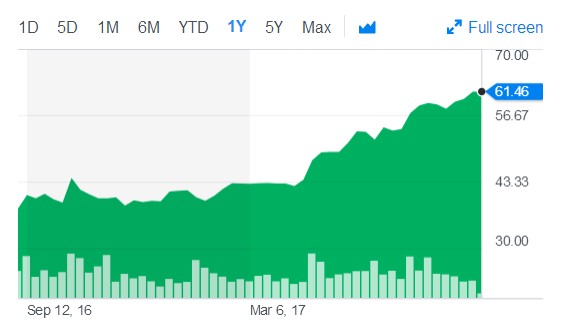
PayPal (PYPL: $61, up 2.5%)
PayPal customers in the U.S. can now earn cash back on every purchase online and in stores with the recent launch of the new PayPal Cashback Mastercard issued by Synchrony Bank. The PayPal Cashback Mastercard, designed exclusively for PayPal members, offers cardholders 2% cash back every day, on every purchase – everywhere Mastercard is accepted.
Unlike other rewards credit cards, there is no annual cash back limit, no minimum redemption amount, no restriction on how to spend cash rewards and no expiration. The PayPal Cashback Mastercard offers all the security and convenience expected from PayPal, plus all the traditional benefits of a Mastercard. All accounts are automatically added to the member’s PayPal wallet to simplify checkout and provide peace of mind.
The introduction of the PayPal Cashback Mastercard with Synchrony Bank continues PayPal’s commitment to provide customers with rewarding product experiences and a range of innovative credit options. By providing a simple way for people to earn cash rewards for the shopping they’re already doing, the PayPal Cashback Mastercard will give consumers yet another reason to shop with PayPal.
BMR Take: PayPal has 200 million customers on the way to over 1 billion longer-term (after all, Facebook has over 2 billion, showing the possibilities for a global internet-based business model). With EPS closing in on $3 by 2020, and EPS growth moving along in the mid-teens, we see growth at a reasonable price here in the stock and like it a lot!
Nutanix (NTNX: $22, flat)
We reported via News Flash on Friday on the stellar earnings report the company issued on Thursday. The stock shot higher on Friday, hitting $24, but settled at $22, flat for the week. We’re not traders as you know, but long term investors, and we have seen this many times in our career. We are going out on a limb here and will say that the stock will move higher from here over the coming weeks and months.
We mentioned the high level of sales that were booked but not reported as revenues – the backlog. Management indicated that billings growth was 40% year over year and that the company continued to build up a significant backlog of deals that booked but did not ship in the quarter. The sales transition toward large enterprise is progressing nicely. Management's next quarter guidance implies billings growth of 25% YoY compared to consensus of 17%, due to the significant backlog build.
To recap:
Fiscal 4Q 2017 Financials
Revenue: $226 million, up 62% year-over-year from $140 million in 4Q16
Net Loss: $50 million, compared to a net loss of $47 million in 4Q16
Operating Cash Flow: $6 million, compared to $2.5 million in 4Q16
Cash and Short-term Investments: $350 million, up 90% from 4Q16
Deferred Revenue: $525 million, up 77% from 4Q16*
Free Cash Flow: $(6.5) million, compared to $(6.5) million in the fourth quarter of fiscal 2016
Billings: $289 million, growing 40% year-over-year from $207 million in 4Q16
BMR Take: We added the stock in May at $17.45 and have a Target of $30. Our Sell Price at $14 is way too low, so we hereby raise it to $19. This was a great quarter and if Wall Street doesn’t wake up to the potential of this company, we would be very surprised.
Upcoming Economic News
Domestic Auto Sales
Monday, September 4th, 8:00 AM ET
Period: August
Consensus: 4.6 Million
Prior: 4.5 Million
Trade Balance
Wednesday, September 6th, 8:30 AM
Period: July
Consensus: -$44.5 billion
Prior: -$43.6 billion
Initial Claims
Thursday, September 7th, 8:30 AM
Period: 09/02
Consensus: 240,000
Prior: 236,000
Consumer Credit
Friday, September 8th, 3:00 PM
Period: July
Consensus: $15.0 billion
Prior: $12.4 billion
A Word from Gary Jefferson
Jefferson Financial Group
First Vice-President, Investments
UBS Financial Services, Inc.
Over the previous weekend, these were the economic headlines:
--- Robust Retail Sales
--- Disappointing Durable Goods
--- Strong Business Inventories
--- Uneven Industrial Activity
--- Mixed Housing Data
Economic data suggests that things are good, but not great.
Fed Chair Janet Yellen's signaling of continued restraint on monetary policy at Jackson Hole triggered another rally in US stocks last week. This extends the current bull market to 102 months, surpassed in length only by the 113-month run leading up to the dotcom crash. Skepticism over valuations is even higher now with a record 46% of investors believing equities are overvalued.
While the bull market may be entering the later stages of the cycle, UBS strategists believe it can run further based on these observations:
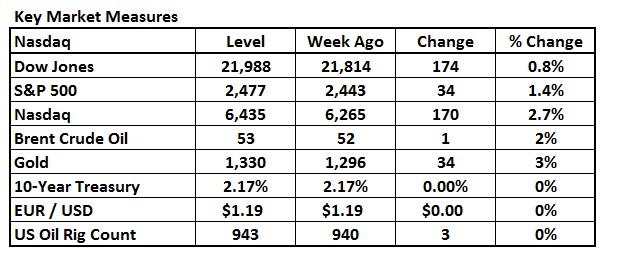
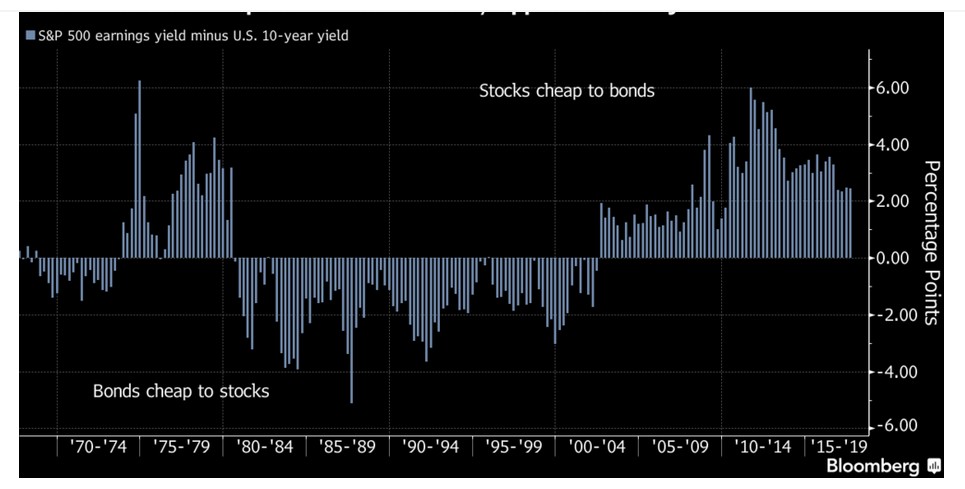
--- The earnings yield on the S&P 500 is 4.8% compared with a yield of 2.17% for 10-year Treasuries.
--- At 18x, current market PE ratio is near long-term averages. Historically when valuations have been in an 18x to 23x range, the MSCI AC World Index has returned 6% over the subsequent six months (versus an overall average of 5%). And relative valuations of equities also suggest long-term outperformance versus bonds.
--- Corporate earnings growth remains robust, at 12% in the US and around 10% in the Eurozone in the last quarter. Synchronized global growth should continue to support this, with all 45 OECD economies on track to expand this year.
There are, however, some caution flags appearing here and there. We prefer to look at price-to-sales ratios rather than PE's, and they haven't been this high since the peak of the dotcom bubble in 1999. This means that new investors are paying more for every dollar of sales than at almost any time since the dotcom bust. However, if sales continue to grow as expected this ratio will normalize to some degree. Put another way, stocks are priced almost to perfection and if the earnings growth story were to falter, it could cause some real volatility.
VMware (VMW: $107, up 5%) Has 500,000 Customers
BMR Take: Think about this. Half a million customers. Can you imagine? We think this is just fabulous. We’re up 30% since we added them in January at $83. What a great company. Our Target is $108 which it hit Friday, an all-time high (not counting the euphoria 10 years ago when they went public). With a market cap of $44 billion, and Dell Technologies being the principal owner (80%+) we think very highly of this company. So we hereby raise our Target to $120 and raise the Sell Price from $90 to $100.
The Blackstone Group (BX: $33, up 4%) had its Target Price set at Credit Suisse Group at $45
A Few Wall Street research firm targets
8/30/2017 Credit Suisse Group $45
7/25/2017 Morgan Stanley $40
7/21/2017 Deutsche Bank $33
7/14/2017 Keefe, Bruyette & Woods $37
7/14/2017 Oppenheimer Holdings $38
5/28/2017 Citigroup $41
Blackstone Considers IPO of Gates Corp.
Blackstone Group is considering an initial public offering of Gates Corp. that could value the auto-parts maker at as much as $9 billion. Its products include belts, hoses, industrial power transmission, fluid power, and automotive. The company was founded by Charles Gates in 1911 and is headquartered in Denver. In 2014, the company was acquired by Blackstone in a deal worth $5.4 billion.
The private-equity giant is in the early stages of laying the groundwork for the possible offering, according to people familiar with the matter. The business could be worth $8 billion to $9 billion, one of the people said. It isn't clear whether that includes debt.
BMR Take: We can’t tell you how good this company is. Well, maybe we can: This company is great! Look at the wealth being created by this firm. In 3-4 years in this one deal alone, they have created $3-4 billion of equity. Absolutely amazing. Our Target is $35 but we are dying for the stock to hit this price so we can raise it to $42. This is a value stock like no other.
The High Yield Corner
By Michael Foster
Significant news came this week from AstraZeneca (AZN: $30, up 3%), helping the shares rise solidly by the end of the week. The biggest news is the company’s presentations at a conference in Spain that will demonstrate the company’s phase-3 study of imfinzi for non-small cell lung cancer and tagrisso for. EGFR cancers.* The science is complex and far for non-specialists to understand without a lot of deep reading, but the market is a great place because it prices in that knowledge instantaneously, which is why AstraZeneca shares rose 2% on the news.
* EGFR is short for estimated glomerular filtration rate. The EGFR is a number based on your blood test for creatinine, a waste product in your blood. It tells how well your kidneys are working.
Another intriguing tidbit from AstraZeneca: the company announced on Tuesday that it was recruiting Takeda Pharmaceutical to work on an antibody for Parkinson’s disease treatment. Again, more exciting developments that prove the mega-pharma company’s pipeline is very healthy. Remember a year ago when this was a primary concern on the company and thus the stock? Those concerns are gone now; instead, investors have finally realized that there is tremendous value in this company and it is still innovating; thus it’s no surprise shares are up 10% in 2017 so far. Paying a solid 3.1% dividend, we can see some dividend increases in the months and years ahead. We’ve got a $42 Price Target on the stock and would hope to see this level sometime next year.
Elsewhere in The Bull Market Report High Yield portfolio we see green across the board. There’s only one exception: Invesco Municipal Trust (VKQ: $12.93), which ended the week flat. No surprise; municipal bonds are a low volatility asset class, and there’s not really any news in the municipal bond market to warrant a massive jump. That includes the latest tragedy in Texas. While large storms and ecological disaster might intuitively seem like they will hurt municipal bond markets (lower economic activity should mean lower government revenue and thus higher default risks), it’s important to remember that this “common sense” is actually false. (Often, the common sense view doesn’t quite work in finance.) In reality, credit agencies do not downgrade bond issuers faced with economic disasters; furthermore, the lower revenue may make the state’s budget tighter in the short term, but the risk of that hurting municipal bonds is negligible. Additionally, natural disasters rarely result in massive new bond issuances to fund repairs, so it’s not like existing bonds will get priced out by new issues.
We saw Nuveen AMT-Free Municipal Credit Fund (NVG: $15. 64, up 1%) have a solid showing. Also a nice surprise from Nuveen this week: the company announced dividends for all of its closed-end funds, but did not lower dividends on NVG - although many other funds did see their distributions decline slightly. Again, good news for municipal bond investors long this fund.
The Bull Market Report’s other closed-end fund picks also ended the week in the green and announced distributions that were in-line with previous dividends. AllianzGI Equity & Convertible Fund (NIE: $20, up 1%) announced that its 38 cent quarterly dividend would continue at the same level, and PIMCO Dynamic Income Fund (PDI: $30, up 1%) also announced its monthly dividend would stay at the same level. These funds are paying 8% in income, year-in and year-out, while also seeing their share prices rise. Closed-end funds are typically income vehicles that aren’t often traded for short-term capital gains, but both funds have given investors that opportunity this year. AllianzGI is up 10% year-to-date and Pimco Dynamic is up 14% year-to-date - extremely impressive returns for such diversified funds. And the income does not look to be threatened anytime soon, so investors can continue to hold them with confidence.
Now, let’s turn to REITs. Digital Realty Trust (DLR: $118, flat) announced that its COO was leaving the company in September. Markets shrugged; while he obviously has done well for the company in the past, there’s no reason to assume he’s irreplaceable. We’re sure that his replacement will be skillful.
Despite little news elsewhere affecting REITs, we saw price gains for Omega Healthcare Investors (OHI: $32, up 3%), Government Properties Income Trust (GOV: $18.50, up 1%), Apollo Commercial Real Estate (ARI: $18.18, up 2%), Ventas (VTR: $69, up 1%), and Welltower (HCN: $74, up 2%).
Also, there wasn’t any real news on Kimco Realty (KIM: $20, flat), but it’s interesting to note that this retail-focused REIT has had a bit of a resurgence lately thanks to the surprising strength in retail. (Note that we removed Kimco from our portfolio in May, but we wanted to give you an update.) If you remember, several weeks ago in this column we wrote at length at how the “death of retail” cliché was really more about shock financial journalism trying to get clicks from disaster-starved readers and had little to do with the reality of our economy. Well, we were right. In addition to beats from Macy’s, Dollar General, Target, Wal-Mart, and several other retailers, even the near-death dogs like Sears Holdings and Abercrombie & Fitch impressed the market with their quarterly results, beating expectations. Retail is not the healthiest sector on Earth, but it isn’t dead or dying. But Kimco was priced for a dying retail sector. So what does that mean? Kimco shares are up 11% in the last three months.
We want to go on record with another prediction that drives bullishness on retail REITs like Kimco. Amazon’s recent acquisition of Whole Foods and their price drop at the supermarket is going to drive retail sales for two reasons. Firstly, Amazon Prime members will be incentivized to leave their computers and shop in person more. Secondly, more people can now afford Whole Foods and will shop there. That also means people are going to spend more time shopping at auxiliary stores adjacent to Whole Foods. This is a rising tide that is going to lift many boats, which is why buying retail REITs right now makes a lot of sense. Check back in after about six months and see if we’re right.
Good investing,
Todd Shaver, CEO, Founder and Editor
The Bull Market Report
Since 1998
August 21, 2017

by Todd Shaver | Aug 21, 2017 | Monthly Newsletter Daily 12pm if new
The Weekly Summary
It was rough week with lots of domestic and international issues popping up, producing anguish. In particular, nine CEOs turned their back on Trump. It all started when first Merck’s Kenneth Frazier, then Under Armour’s Kevin Plank and Intel’s Brian Krzanich stepped down from a White House business group set up to advise Donald Trump. While none mentioned the president, Frazier, one of the country’s most-prominent black chief executive officers, quit the council as Trump was being assailed for failing to quickly condemn white supremacists for deadly violence at a rally Saturday in Charlottesville. Frazier said he was acting on a “matter of personal conscience.” Trump shot back on Twitter Tuesday morning, saying, “For every CEO that drops out of the Manufacturing Council, I have many to take their place.
Then on Wednesday President Trump rushed to announce that he was shutting down the two advisory councils of business leaders, after the members had decided on their own to disband in the wake of the president’s comments on the events in Charlottesville. Of course, these kinds of advisory councils seldom accomplish much of anything.
Look, all this drama will pass. The market will move on. But there is definitely an unsettled feeling out there. It is good that the market showed signs of turning around at week’s end, but we did see a few glimpses of nasty selloffs in a few trading sessions this week. It was a rough week. If you are super worried, then we suggest you take some profits off the table. There are many choices for you to move your money to in the High Yield and the REIT portfolios. These are much more secure, stable stocks with very nice dividends that you can enjoy and sleep better with.
No matter what is happening out there, there is always a bull market here at The Bull Market Report! This week we highlight some of our favorite stocks/funds where we think you can still make good money, including: high yield equities like Annaly and larger caps like Apple, Google, Microsoft, Home Depot, and Visa,
BMR Companies & Commentary
Annaly Capital Management (NLY: $12.34, up 1%)
Annaly recently reported respectable earnings at the beginning of the month. Here are our thoughts on the outlook for the rest of the year and what to watch. Many people are cautious given Annaly’s fixed-rate agency exposure and the current valuation. We know that the company has a set yield on government guaranteed paper. So while there is no credit risk other than the full faith and credit of the United States, there is interest rate risk – we know this and accept this. The newer investments are coming on at lower rates with higher yielding holdings rolling off. And we know that if short term rates rise the current portfolio valuation will be sensitive to the movements. We are likely to see some pressure on Annaly’s business model.
But what can the company do? They can rotate into higher yielding MBS* investments. They can increase leverage. They can do a number of things to cover the dividend. Look, if you think a business model is flawless without risk then you don’t know it well enough. Annaly has rsk to higher rates, but higher rates are ultimately good for the company. And investors are missing all the offsetting possible moves management can take. Remember, this is a company that is 18x the size of the median mortgage REIT by market cap, has outperformed the S&P 500 by 3x since its IPO for total return, and has successfully raised $1.5 billion in new capital this year. They know the world they live in and have survived and thrived for 20 years.
* Mortgage-backed Securities
BMR Take: A Director at the company just bought 13,500 shares. Another one just bought 17,700 shares. We love love love to see that! We are looking at a $0.30 dividend paid quarterly for the time being which is good. The stock looks compelling based on this income stream, producing a dividend over 10%.
Apple (AAPL: $158, flat) is Getting into Programming
Apple has set a 12-month budget of $1 billion to develop original programming. Apple could buy and produce as many as 10 TV shows. Apple's first two efforts -- Planet of the Apps and Carpool Karaoke -- have not been warmly received by critics. Apple executives are talking with Hollywood agents about shows that Apple can buy.
BMR Take: Note that Apple has $260 billion in cash now, and with a market cap of $813 billion cash is 32% of the stock price. So $50 of the stock price is in cash. This is UNPRECEDENTED in the history of Wall Street. Apple remains an exciting investment opportunity. The services business is projected to double in revenue to $50 billion over the next several years. The Services business is much more profitable than hardware so the impact to earnings is even better. Don’t sell a share. We believe Apple has a lot more room to go on the upside.
And how about Apple's performance last week in a very tough week for equities.
Google (GOOG: $911, flat)
The Cloud is a huge opportunity in technology and all the industry giants are fighting to grab their fair share. Let's stipulate up front that Amazon Web Services (AWS) remains the top choice for most companies that are thinking about moving their data and software into cloud data centers. Having said that, however, Amazon's cloud is no longer the only option that companies consider. For example, those companies wanting extensive analytics are taking a good hard look at the Google Cloud Platform. And many firms are hedging their bets by using multiple cloud providers to avoid being stuck with one down the road.
While AWS is still the largest cloud provider by far, Microsoft and Google are coming on strong. AWS's revenue growth appears to be slowing, in part because it's hard for such a huge business - AWS is expected to produce $16 billion in revenue this year - to grow as fast as its younger, smaller incarnations. Startups are considering alternatives now for several reasons: standard cloud computing and storage services from the three top players are all seen as competitive, and no one thinks any of the three major cloud contenders is going away. Basically, AWS, Microsoft, and Google are seen as safe bets.
BMR Take: Google took a hit on the recent earnings report. Buy the dip. This company will generate over $40 of EPS in 2018. The stock is far from a stretched valuation.
Microsoft (MSFT: $72, up 1%)
As Internet-of-Things (IoT), artificial intelligence (AI), smart factories and intelligent applications continue to advance, businesses are increasingly turning to these technologies to create new business solutions with greater agility in order to drive competitive advantages. Microsoft launched its IoT Innovation Center in Taiwan last October to spur development between IoT partners and international enterprises and organizations. In September, Microsoft will hold its second IoT Expo in conjunction with the World Congress on Information Technology. Jason Zander, Corporate Vice President, Microsoft Azure, will deliver a keynote on "Leading Digital Transformation and Landing IOT Value with a Strong IoT Partner." Zander oversees the development and global deployment of cloud infrastructure and technology, including Microsoft Azure IoT. In addition to sharing the success of Microsoft's IoT Innovation Center and its partners, Mr. Zander will also provide Microsoft's vision of the development of IoT and in-depth analysis on the integrated application solutions of the world's leading IoT partners.
BMR Take: The Internet of Things is a megatrend. We are going from 10 billion devices connected to the internet to 30 billion. Your hair dryer will be connected to the internet someday. All of this is going to be a huge opportunity for Microsoft. The company is on track to generate $4 of EPS in 2018. The valuation remains compelling.
And note how strong Microsoft was last week in the very rough week on Wall Street. This company is solid.
Upcoming Economic News
Richmond Fed Index
August 22th, 10:00 AM
Period: August
Consensus: 12.0
Prior: 14.0
New Home Sales
August 23th, 10:00 AM
Period: July
Consensus: 614,000
Prior: 610,000
Building Permits
August 24th, 8:00 AM
Period: July
Consensus: 1,223,000
Prior: 1,223,000
Blackstone Entity Merging with Starwood Homes
Invitation Homes (INVH, $23), a portfolio company of The Blackstone Group (BX: $32, down 1%) , is merging with Starwood Waypoint Homes. The combined company, to be called Invitation Homes, will have 82,000 homes. Once the deal closes Invitation Homes stockholders will own about 59% of the combined company. The total enterprise value of the deal is $20 billion.
Invitation Homes, a U.S. home rental company, went public in February. Blackstone will own about 40% of Invitation.
--- The portfolio of homes will be focused on high-growth markets, with nearly 70% of revenue coming from the Western US and Florida.
--- The merger is expected to drive $50 million in annual synergies.
--- Continued strong performance with the combined company experiencing 7% same-store NOI growth in Q217 with over 95% occupancy.
--- The two companies have invested nearly $2 billion, an average of approximately $22,000 per home, in renovations and maintenance, improving resident experience and driving economic growth and job creation in local communities.
BMR Take: Just one more example of the innovation that Blackstone is involved with day in and day out. With a dividend of 7% and a leader (Schwarzman) dedicated 24-7 to moving the stock higher, what is there not to like. $38 billion market cap. Reaching the all-time high of $44 set in 2012 is surely on the horizon.
Tesla Near to Completion of Gigafactory
Tesla ($348, down 3%) has released some interesting pictures and a video of their gigafactory in Nevada, 95 times bigger (sic) than a football field. New drone footage shows how massive Tesla's Gigafactory is.
http://www.businessinsider.com/tesla-gigafactory-pictures-facts-2017-8
In other news, Tesla raised $1.8 billion in a bond sale on Friday, boosting the amount by $300 million to meet demand. The 8-year bonds were priced at a record-low yield of 5.3%. The 5.3% coupon is a record low for a bond of its rating and maturity, according to data compiled by Bloomberg. The sale was managed by Goldman Sachs Group and Morgan Stanley.
BMR Take: The bond market loves this company. We do too. But we know the risk involved here is on the high end of the scale. Tesla is either headed to $400 a share or $300. And one could make an argument for either. If it hits $400 and they continue to ramp up production as promised, then $500 is a great possibility. But if it goes to $300, $200 would be in range. You want a risky stock? Then Tesla is your baby.
Amazon Sells Bonds for Whole Foods Acquisition
Speaking of bond sales, Amazon (AMZN: $958, down 1%) went to the markets for money last week and sold $16 billion of unsecured bonds to fund its $14 billion acquisition of Whole Foods Market. And in a sign of market interest, the longest portion of the offering, a 40-year security, was sold at a yield of 1.45 percentage points above Treasuries.
BMR Take: Now that is just unreal low. The company has $21 billion in cash so they didn’t need to go to the bond market but did because rates are so low. Smart thinking, Jeff. The deal is the 4th largest this year, behind ATT and Microsoft.
Apple Goes to the Debt Market in Canada
Apple raised $2.5 billion at a rate of 2.51% in a 7-year note sale in Canada on Tuesday. At $2.5 billion the financing is the largest corporate non-financial borrowing in Canadian history.
Stocks Cheap Compared to Bonds
 We’re Just Sayin’
The High Yield Report
By Michael Foster
We’re continuing to see market chaos and a lot of selling of high quality assets although the macro risks from political uncertainty are dwindling. But the current selloff is very different from the previous week’s in one very telling, interesting way: Not all assets are falling at the same rate, and some are actually doing very well.
To wit, take a look at The Bull Market Report’s Healthcare REIT pick Omega Healthcare Investors (OHI: $31) which had a strong showing this week after some initial weakness, helping Omega Healthcare end the week up 2%.
We’re seeing a lot of reshuffling in the markets, with investors rotating in and out of funds, stocks, and assets as they rise or fall due to market demand. This is the real “random walk” of Wall Street, and it’s a dynamic that makes short term trends for any individual asset to be unpredictable. In reality, we’re seeing a lot of individual investors making choices to buy on the dip - and they’re pulling money from other assets to do so.
What can an investor do in such an environment? Simple: sit tight. If you have extra cash on the sidelines, now is the time to deploy into the high yield picks that The Bull Market Report has been recommending for a long time. Last week we suggested buying more of Omega Healthcare shares; it’s up 2% since then. Now is the time to do the same with other REITs seeing irrational weakness like Sabra.
You can also consider adding Kimco Realty Corporation (KIM: $19.34) and Apollo Commercial Real Estate (ARI: $17.92) to your shopping list after Kimco fell over 3% in the last week and Apollo remained flat. There is no change in these companies FFO to justify the decline, and Kimco’s year-long weakness on the often-touted (and always inaccurate) “death of retail” has made it just that much more compelling. We have discussed at length here why Retail isn’t dead, and how Amazon’s recent purchase of Whole Foods indicates that the shift from pre-dotcom retail to mobile “bricks and clicks” commerce is far more complicated than the simple narrative of dying malls. In any case, Kimco doesn’t buy enclosed malls! It’s a high-quality strip mall-focused REIT, and Whole Foods (and thus soon Amazon) is one of its biggest tenants.
There are more buying opportunities beyond REITs, and investors are keen to lighten up their cash allocation to consider the other funds and stocks in the High Yield portfolio. However, there is one word of caution to consider when it comes to one of our best performing picks, the PIMCO Dynamic Income Fund (PDI: $29). This fund was flat last week.
What’s going on here is a pretty basic misunderstanding of the fund’s future income potential. You see, Pimco releases a monthly scorecard of net investment income (NII) on its website, while also calculating its dividend coverage ratio. And, simply put, the news isn’t good for the Dynamic Income Fund.
In the past, Pimco easily out-earned its dividend and had a tremendous amount of undistributed net investment income (UNII). That’s why the fund paid a special dividend of $1.45 at the end of 2016. By this time last year, the fund had around $1 in UNII, so it was pretty obvious that a big special dividend was coming (we discussed this at the time and estimated a strong special dividend at the end of last year – and nailed it). This year, however, the Dynamic Income fund has only 4 cents in UNII - a pretty tremendous drop from a year ago!
There are a few reasons why the fund isn’t earning as much income as it used to, most of which revolves around the crowding out of great investment opportunities in mortgage backed securities. The MBS is a pretty daunting asset made sinister by The Big Short and growing awareness of their role in the subprime housing crisis. However, that crisis is a decade behind us, and the quality of MBS investments has skyrocketed. While Pimco was one of the few asset managers aggressively buying up these assets in the past, there are now a lot of people wanting to buy them. That means lower yields for the assets, thus weaker income for the Dynamic Income Fund.
However, at the same time, it also means growing market prices for these assets. This fund’s NAV has risen by 10% so far in 2017, largely a result of that constant demand for MBS’s in the market. Last year, the Dynamic Income Fund’s NAV had risen by far less than 1% over the same time period, because the demand for these assets simply wasn’t there. That means that the fund is sitting on a lot of capital gains with dwindling income.
What does this mean for shareholders? In all honesty, it’s hard to tell. The fund hasn’t really faced a crowding out of supply due to strong demand since 2012. It has enjoyed both NAV and income gains in earlier years, and the end-of-year special dividends reflected that. We simply don’t know if the fund’s managers will decide to return some of those capital gains to shareholders or hold on to it and give a massively reduced special dividend at the end of the year.
It seems that the market has begun to price in the likelihood of a lower special dividend. The fund’s premium to NAV has plummeted from over 10% earlier this year to just 3%. It may fall even further as we get closer to December. If Pimco surprises and gives a big special payout at the end of the year, that could reverse quickly. If it doesn’t, we’ll probably see middling price growth throughout 2017.
The risk with the fund is that its Net Investment Income continues to fall and it fails to cover its dividend on a long-term basis. While we’ve seen hints of that now, it’s far too early to conclude that this risk is really here and it’s time to sell. But investors need to prepare for that eventuality. We will keep a close eye on this trend and advise you if it’s time to move out of this great fund. Hopefully we won’t have to recommend selling anytime soon.
How should you react? Holding the fund for its income stream makes sense now, and buying more when the fund’s premium disappears and it starts trading at a discount also makes sense. That means there’s no reason for investors to get scared and sell off the fund, but it also means investors shouldn’t expect a massive jump in the fund’s price throughout 2017. That’s not a bad thing - it really reflects what the fund should be seen as: A source of steady and reliable income.
Good Investing,
Todd Shaver, Founder, CEO and Editor
The Bull Market Report
Since 1998
August 20, 2017
by Todd Shaver | Aug 20, 2017 | Weekly Newsletter 7pm Sunday
The Weekly Summary
It was rough week with lots of domestic and international issues popping up, producing anguish. In particular, nine CEOs turned their back on Trump. It all started when first Merck’s Kenneth Frazier, then Under Armour’s Kevin Plank and Intel’s Brian Krzanich stepped down from a White House business group set up to advise Donald Trump. While none mentioned the president, Frazier, one of the country’s most-prominent black chief executive officers, quit the council as Trump was being assailed for failing to quickly condemn white supremacists for deadly violence at a rally Saturday in Charlottesville. Frazier said he was acting on a “matter of personal conscience.” Trump shot back on Twitter Tuesday morning, saying, “For every CEO that drops out of the Manufacturing Council, I have many to take their place.
Then on Wednesday President Trump rushed to announce that he was shutting down the two advisory councils of business leaders, after the members had decided on their own to disband in the wake of the president’s comments on the events in Charlottesville. Of course, these kinds of advisory councils seldom accomplish much of anything.
Look, all this drama will pass. The market will move on. But there is definitely an unsettled feeling out there. It is good that the market showed signs of turning around at week’s end, but we did see a few glimpses of nasty selloffs in a few trading sessions this week. It was a rough week. If you are super worried, then we suggest you take some profits off the table. There are many choices for you to move your money to in the High Yield and the REIT portfolios. These are much more secure, stable stocks with very nice dividends that you can enjoy and sleep better with.
No matter what is happening out there, there is always a bull market here at The Bull Market Report! This week we highlight some of our favorite stocks/funds where we think you can still make good money, including: high yield equities like Annaly and larger caps like Apple, Google, Microsoft, Home Depot, and Visa,
BMR Companies & Commentary
Annaly Capital Management (NLY: $12.34, up 1%)
Annaly recently reported respectable earnings at the beginning of the month. Here are our thoughts on the outlook for the rest of the year and what to watch. Many people are cautious given Annaly’s fixed-rate agency exposure and the current valuation. We know that the company has a set yield on government guaranteed paper. So while there is no credit risk other than the full faith and credit of the United States, there is interest rate risk – we know this and accept this. The newer investments are coming on at lower rates with higher yielding holdings rolling off. And we know that if short term rates rise the current portfolio valuation will be sensitive to the movements. We are likely to see some pressure on Annaly’s business model.
But what can the company do? They can rotate into higher yielding MBS* investments. They can increase leverage. They can do a number of things to cover the dividend. Look, if you think a business model is flawless without risk then you don’t know it well enough. Annaly has rsk to higher rates, but higher rates are ultimately good for the company. And investors are missing all the offsetting possible moves management can take. Remember, this is a company that is 18x the size of the median mortgage REIT by market cap, has outperformed the S&P 500 by 3x since its IPO for total return, and has successfully raised $1.5 billion in new capital this year. They know the world they live in and have survived and thrived for 20 years.
* Mortgage-backed Securities
BMR Take: A Director at the company just bought 13,500 shares. Another one just bought 17,700 shares. We love love love to see that! We are looking at a $0.30 dividend paid quarterly for the time being which is good. The stock looks compelling based on this income stream, producing a dividend over 10%.
Apple (AAPL: $158, flat) is Getting into Programming
Apple has set a 12-month budget of $1 billion to develop original programming. Apple could buy and produce as many as 10 TV shows. Apple's first two efforts -- Planet of the Apps and Carpool Karaoke -- have not been warmly received by critics. Apple executives are talking with Hollywood agents about shows that Apple can buy.
BMR Take: Note that Apple has $260 billion in cash now, and with a market cap of $813 billion cash is 32% of the stock price. So $50 of the stock price is in cash. This is UNPRECEDENTED in the history of Wall Street. Apple remains an exciting investment opportunity. The services business is projected to double in revenue to $50 billion over the next several years. The Services business is much more profitable than hardware so the impact to earnings is even better. Don’t sell a share. We believe Apple has a lot more room to go on the upside.
And how about Apple's performance last week in a very tough week for equities.
Google (GOOG: $911, flat)
The Cloud is a huge opportunity in technology and all the industry giants are fighting to grab their fair share. Let's stipulate up front that Amazon Web Services (AWS) remains the top choice for most companies that are thinking about moving their data and software into cloud data centers. Having said that, however, Amazon's cloud is no longer the only option that companies consider. For example, those companies wanting extensive analytics are taking a good hard look at the Google Cloud Platform. And many firms are hedging their bets by using multiple cloud providers to avoid being stuck with one down the road.
While AWS is still the largest cloud provider by far, Microsoft and Google are coming on strong. AWS's revenue growth appears to be slowing, in part because it's hard for such a huge business - AWS is expected to produce $16 billion in revenue this year - to grow as fast as its younger, smaller incarnations. Startups are considering alternatives now for several reasons: standard cloud computing and storage services from the three top players are all seen as competitive, and no one thinks any of the three major cloud contenders is going away. Basically, AWS, Microsoft, and Google are seen as safe bets.
BMR Take: Google took a hit on the recent earnings report. Buy the dip. This company will generate over $40 of EPS in 2018. The stock is far from a stretched valuation.
Microsoft (MSFT: $72, up 1%)
As Internet-of-Things (IoT), artificial intelligence (AI), smart factories and intelligent applications continue to advance, businesses are increasingly turning to these technologies to create new business solutions with greater agility in order to drive competitive advantages. Microsoft launched its IoT Innovation Center in Taiwan last October to spur development between IoT partners and international enterprises and organizations. In September, Microsoft will hold its second IoT Expo in conjunction with the World Congress on Information Technology. Jason Zander, Corporate Vice President, Microsoft Azure, will deliver a keynote on "Leading Digital Transformation and Landing IOT Value with a Strong IoT Partner." Zander oversees the development and global deployment of cloud infrastructure and technology, including Microsoft Azure IoT. In addition to sharing the success of Microsoft's IoT Innovation Center and its partners, Mr. Zander will also provide Microsoft's vision of the development of IoT and in-depth analysis on the integrated application solutions of the world's leading IoT partners.
BMR Take: The Internet of Things is a megatrend. We are going from 10 billion devices connected to the internet to 30 billion. Your hair dryer will be connected to the internet someday. All of this is going to be a huge opportunity for Microsoft. The company is on track to generate $4 of EPS in 2018. The valuation remains compelling.
And note how strong Microsoft was last week in the very rough week on Wall Street. This company is solid.
The Home Depot (HD: $147, down 4%)
Home Depot took a bad hit on earnings. But we feel this is a great time to initiate a position or add to an existing one. A few Wall Street analysts upgraded the stock to Buy reaffirming our confidence.
Revenue for the quarter was $28.1 billion versus the consensus for $27.8 billion. Revenue guidance for the year is $95 billion, short of the $99 billion consensus. EPS of $2.25 beat the consensus of $2.21. Chairman, CEO Craig Menear said: "We were pleased with our results this quarter as our customers rewarded us with the highest quarterly sales in company history. We also achieved the highest quarterly net earnings in company history."
So what happened? Analysts were largely upbeat on the results, with same store sales beating expectations despite a tough backdrop for all of the Retail industry. Specifically, same store comparable sales growth was +5.5% beating the +4.6% guidance. So all the momentum looked good this quarter but why the bad outlook for lower revenue? The shares traded down because of this guidance miss. But under the covers many people just think it is conservatism from management, not something serious.
BMR Take: We expect to see momentum continue over the rest of the year following what was the largest quarter ever, pointing to strong sales growth, operating margin expansion and EPS growth. With EPS heading to $9 in 2018 we this valuation is compelling right here to be buying.
Visa (V: $103, up 3%)
Visa announced a multi-year, global partnership with Marqeta, the open API payment card issuing platform, to drive further innovations in commercial and consumer payments. Additionally, Visa has made a strategic investment in Marqeta to support both company’s domestic and international growth objectives.
The Fintech industry is booming, Fintech being short for financial technology. Everybody in financial services from banks like JP Morgan to networks like Visa are having to figure out how to keep up with the technology revolution in finance. That is why this deal is so key for Visa. Visa is embracing the change and going to be delivering the most innovative solutions in payments for years to come. This supports why we love the Visa EPS growth story and believe the stock should be a core holding in your portfolio.
The initial efforts of the partnership will involve growing opportunities for virtual, physical and tokenized payments across a number of commercial markets and use cases that can benefit from Marqeta’s developer-friendly platform.
The market for electronic payments continues to grow in commercial payables, alternative lending, disbursements, eCommerce, on-demand services and P2P payments. To enable this growth, Marqeta’s platform allows companies of all sizes to authorize their own card transactions, fundamentally changing how companies engage with card issuing and transaction processing.
This is the latest partnership and investment for Visa with an emerging innovator within the payments ecosystem. As a global payments technology company, Visa continually evaluates technologies of all kinds – especially those that have the potential to advance digital payments for Visa’s clients and their customers. Recently, Visa has made investments in Chain, Klarna, Square and Stripe, among others.
BMR Take: Visa is a safe haven investment. With EPS heading to $4, we continue to see tremendous value here.
Upcoming Economic News
Richmond Fed Index
August 22th, 10:00 AM
Period: August
Consensus: 12.0
Prior: 14.0
New Home Sales
August 23th, 10:00 AM
Period: July
Consensus: 614,000
Prior: 610,000
Building Permits
August 24th, 8:00 AM
Period: July
Consensus: 1,223,000
Prior: 1,223,000
Blackstone (BX: $32, down 1%) Entity Merging with Starwood Homes
Invitation Homes (INVH, $23), a portfolio company of The Blackstone Group, is merging with Starwood Waypoint Homes. The combined company, to be called Invitation Homes, will have 82,000 homes. Once the deal closes Invitation Homes stockholders will own about 59% of the combined company. The total enterprise value of the deal is $20 billion.
Invitation Homes, a U.S. home rental company, went public in February. Blackstone will own about 40% of Invitation.
--- The portfolio of homes will be focused on high-growth markets, with nearly 70% of revenue coming from the Western US and Florida.
--- The merger is expected to drive $50 million in annual synergies.
--- Continued strong performance with the combined company experiencing 7% same-store NOI growth in Q217 with over 95% occupancy.
--- The two companies have invested nearly $2 billion, an average of approximately $22,000 per home, in renovations and maintenance, improving resident experience and driving economic growth and job creation in local communities.
BMR Take: Just one more example of the innovation that Blackstone is involved with day in and day out. With a dividend of 7% and a leader (Schwarzman) dedicated 24-7 to moving the stock higher, what is there not to like. $38 billion market cap. Reaching the all-time high of $44 set in 2012 is surely on the horizon.
Tesla Near to Completion of Gigafactory
Tesla ($348, down 3%) has released some interesting pictures and a video of their gigafactory in Nevada, 95 times (sic) bigger than a football field. New drone footage shows how massive Tesla's Gigafactory is.
http://www.businessinsider.com/tesla-gigafactory-pictures-facts-2017-8
In other news, Tesla raised $1.8 billion in a bond sale on Friday, boosting the amount by $300 million to meet demand. The 8-year bonds were priced at a record-low yield of 5.3%. The 5.3% coupon is a record low for a bond of its rating and maturity, according to data compiled by Bloomberg. The sale was managed by Goldman Sachs Group and Morgan Stanley.
BMR Take: The bond market loves this company. We do too. But we know the risk involved here is on the high end of the scale. Tesla is either headed to $400 a share or $300. And one could make an argument for either. If it hits $400 and they continue to ramp up production as promised, then $500 is a great possibility. But if it goes to $300, $200 would be in range. You want a risky stock? Then Tesla is your baby.
A Word from Gary Jefferson
Jefferson Financial Group
First Vice-President, Investments
UBS Financial Services, Inc.
Earnings were everything expected, plus a little more. So here we are with about six weeks before the 3rd quarter comes to a close. Unemployment is low, interest rates are low, energy costs are low and consumer confidence is fairly high. Besides a garden variety correction, what could derail the markets? - not counting a war, which in our opinion and most experts we listen to is a fairly low probability. The most likely candidate would be a recession. With earnings growth better now than the past eight years, this critical element in the recession scenario seems relatively safe for the next several quarters.
However, after speaking with some very learned folks in the banking industry, there is one problem that has caught our attention. We have been told that it is very difficult for banks to make enough profit to lend money when short-term and long-term interest rates are less than 1%. Today, the difference between a 2-year Treasury note and a 10-year Treasury bond remains less than 1%. Rate hikes have a history of producing bear markets in the past and could do so again because there just isn’t enough profit for commercial banks to lend money. Recessions develop out of these situations. We are not yet in an "inverted yield curve" situation (where short-term rates are higher than long-term rates), which is a classic signal of a coming recession, and we don't believe banks are to the point that they are going to substantially curtail lending. However, it is something we will watch for over the coming quarters.
As we said last week, stocks don't go straight up forever. There will be volatility and pullbacks as Fed-tightening continues, but until we see actual signs of an approaching recession, we believe stocks continue to offer better value than bonds.
Amazon Sells Bonds for Whole Foods Acquisition
Speaking of bond sales, Amazon (AMZN: $958, down 1%) went to the markets for money last week and sold $16 billion of unsecured bonds to fund its $14 billion acquisition of Whole Foods Market. And in a sign of market interest, the longest portion of the offering, a 40-year security, was sold at a yield of 1.45 percentage points above Treasuries.
BMR Take: Now that is just unreal low. The company has $21 billion in cash so they didn’t need to go to the bond market but did because rates are so low. Smart thinking, Jeff. The deal is the 4th largest this year, behind ATT and Microsoft.
Apple Goes to the Debt Market in Canada
Apple raised $2.5 billion at a rate of 2.51% in a 7-year note sale in Canada on Tuesday. At $2.5 billion the financing is the largest corporate non-financial borrowing in Canadian history.
Stocks Cheap Compared to Bonds
We’re Just Sayin’
Cantor Fitzgerald: OPKO Health - Overweight Rating, $20 Price Target
And how about this:
In other Opko Health news, Director John A. Paganelli purchased 5,000 shares of the company’s stock on June 1st. Following the transaction, the director now owns 350,000 shares in the company. Director Richard A. Lerner purchased 10,000 shares of the company’s stock on June 5th. Insiders have bought a total of 1,600,000 shares of company stock worth $10,000,000 in the last three months. Insiders own 40% of the company’s stock.
There are eight research companies following Opko. Six have a buy rating; two have a hold. Their average price target is $16.40.
BMR Take: For those of you still hanging in there with Opko Health (OPK: $6.12, down 2%) this report from Cantor Fitzgerald is good news. $20 Wow. That is over three times the current price. What are we missing here? Oh – I know. We are missing a higher stock price! Well maybe, just maybe this is the start of the re-rising (is that a word?) of the stock to the $8 level and then $10 and then on to the races from there. Hope springs eternal, doesn’t it? Well, yes, but with all the good things this company has going for it, for it to stay at $6 any longer JUST DOESN’T MAKE ANY SENSE!
The High Yield Report
By Michael Foster
We’re continuing to see market chaos and a lot of selling of high quality assets although the macro risks from political uncertainty are dwindling. But the current selloff is very different from the previous week’s in one very telling, interesting way: Not all assets are falling at the same rate, and some are actually doing very well.
To wit, take a look at The Bull Market Report’s Healthcare REIT pick Omega Healthcare Investors (OHI: $31) which had a strong showing this week after some initial weakness, helping Omega Healthcare end the week up 2%.
We’re seeing a lot of reshuffling in the markets, with investors rotating in and out of funds, stocks, and assets as they rise or fall due to market demand. This is the real “random walk” of Wall Street, and it’s a dynamic that makes short term trends for any individual asset to be unpredictable. In reality, we’re seeing a lot of individual investors making choices to buy on the dip - and they’re pulling money from other assets to do so.
What can an investor do in such an environment? Simple: sit tight. If you have extra cash on the sidelines, now is the time to deploy into the high yield picks that The Bull Market Report has been recommending for a long time. Last week we suggested buying more of Omega Healthcare shares; it’s up 2% since then. Now is the time to do the same with other REITs seeing irrational weakness like Sabra.
You can also consider adding Kimco Realty Corporation (KIM: $19.34) and Apollo Commercial Real Estate (ARI: $17.92) to your shopping list after Kimco fell over 3% in the last week and Apollo remained flat. There is no change in these companies FFO to justify the decline, and Kimco’s year-long weakness on the often-touted (and always inaccurate) “death of retail” has made it just that much more compelling. We have discussed at length here why Retail isn’t dead, and how Amazon’s recent purchase of Whole Foods indicates that the shift from pre-dotcom retail to mobile “bricks and clicks” commerce is far more complicated than the simple narrative of dying malls. In any case, Kimco doesn’t buy enclosed malls! It’s a high-quality strip mall-focused REIT, and Whole Foods (and thus soon Amazon) is one of its biggest tenants.
There are more buying opportunities beyond REITs, and investors are keen to lighten up their cash allocation to consider the other funds and stocks in the High Yield portfolio. However, there is one word of caution to consider when it comes to one of our best performing picks, the PIMCO Dynamic Income Fund (PDI: $29). This fund was flat last week.
What’s going on here is a pretty basic misunderstanding of the fund’s future income potential. You see, Pimco releases a monthly scorecard of net investment income (NII) on its website, while also calculating its dividend coverage ratio. And, simply put, the news isn’t good for the Dynamic Income Fund.
In the past, Pimco easily out-earned its dividend and had a tremendous amount of undistributed net investment income (UNII). That’s why the fund paid a special dividend of $1.45 at the end of 2016. By this time last year, the fund had around $1 in UNII, so it was pretty obvious that a big special dividend was coming (we discussed this at the time and estimated a strong special dividend at the end of last year – and nailed it). This year, however, the Dynamic Income fund has only 4 cents in UNII - a pretty tremendous drop from a year ago!
There are a few reasons why the fund isn’t earning as much income as it used to, most of which revolves around the crowding out of great investment opportunities in mortgage backed securities. The MBS is a pretty daunting asset made sinister by The Big Short and growing awareness of their role in the subprime housing crisis. However, that crisis is a decade behind us, and the quality of MBS investments has skyrocketed. While Pimco was one of the few asset managers aggressively buying up these assets in the past, there are now a lot of people wanting to buy them. That means lower yields for the assets, thus weaker income for the Dynamic Income Fund.
However, at the same time, it also means growing market prices for these assets. This fund’s NAV has risen by 10% so far in 2017, largely a result of that constant demand for MBS’s in the market. Last year, the Dynamic Income Fund’s NAV had risen by far less than 1% over the same time period, because the demand for these assets simply wasn’t there. That means that the fund is sitting on a lot of capital gains with dwindling income.
What does this mean for shareholders? In all honesty, it’s hard to tell. The fund hasn’t really faced a crowding out of supply due to strong demand since 2012. It has enjoyed both NAV and income gains in earlier years, and the end-of-year special dividends reflected that. We simply don’t know if the fund’s managers will decide to return some of those capital gains to shareholders or hold on to it and give a massively reduced special dividend at the end of the year.
It seems that the market has begun to price in the likelihood of a lower special dividend. The fund’s premium to NAV has plummeted from over 10% earlier this year to just 3%. It may fall even further as we get closer to December. If Pimco surprises and gives a big special payout at the end of the year, that could reverse quickly. If it doesn’t, we’ll probably see middling price growth throughout 2017.
The risk with the fund is that its Net Investment Income continues to fall and it fails to cover its dividend on a long-term basis. While we’ve seen hints of that now, it’s far too early to conclude that this risk is really here and it’s time to sell. But investors need to prepare for that eventuality. We will keep a close eye on this trend and advise you if it’s time to move out of this great fund. Hopefully we won’t have to recommend selling anytime soon.
How should you react? Holding the fund for its income stream makes sense now, and buying more when the fund’s premium disappears and it starts trading at a discount also makes sense. That means there’s no reason for investors to get scared and sell off the fund, but it also means investors shouldn’t expect a massive jump in the fund’s price throughout 2017. That’s not a bad thing - it really reflects what the fund should be seen as: A source of steady and reliable income.
Good Investing,
Todd Shaver, Founder, CEO and Editor
The Bull Market Report
Since 1998
May 17, 2017
by Todd Shaver | May 17, 2017 | 1pm News Flash
Kimco Realty (KIM: $18.00)
May 17, 2017
Kimco Realty is an industry-leading real estate investment trust specializing in outdoor shopping centers and strip malls. The company has 710 shopping centers in its portfolio in 39 states, making it one of the most geographically diversified retail landlords in America. The company has top-tier tenants, including large firms and recognizable brands like Whole Foods, Trader Joe’s, The Gap, and Darden Restaurants (Olive Garden, etc.)
BUT, the stock is going down and down. We added the stock in March 2016 at $27, set a Sell Price of $24 and have stuck with the stock as it has dropped from $25 in January, $24 in February, $23 in March, $23 in April and now $18 in May. Obviously, we should have stayed with our Sell Price.
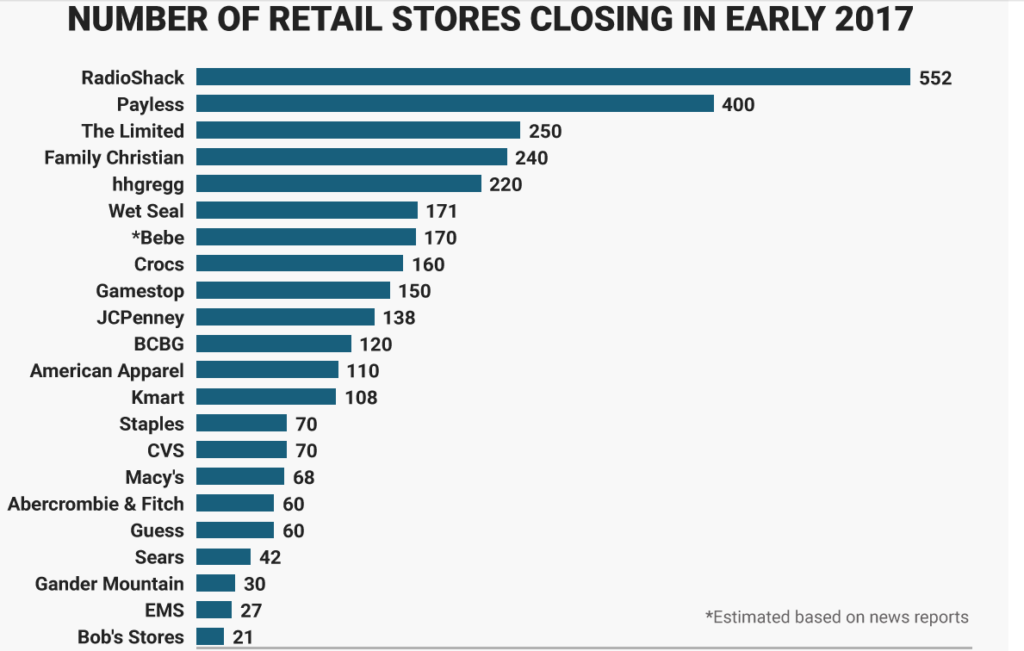
The problem is not the company – it is doing well. It is the perception of a weak Retail environment that Wall Street sees now. The PERCEPTION is sweeping the Street - that Retail as we know it is ending. Many are selling first and talking later. Warren Buffett was quoted last week saying similar things. We know this not to be true, but perception rules the Street many times. It includes most if not all stocks that are associated with Retail. Did you see the chart in this week’s newsletter that we included about store closings? We reprint it for you here:
Source: Business Insider
That’s the whole story right here in this chart.
The dividend of $1.08 giving new investors a 5.7% yield is secure through earnings and cash flow but that is not enough to hold up the stock.
With great regret, we hereby remove the stock from our REIT portfolio.
April 30, 2017
by Todd Shaver | Apr 30, 2017 | Weekly Newsletter 7pm Sunday
The Week Ahead
Tax season came to a close two weeks ago. We filed an extension of course. Now Tax Reform is front and center. A new plan released by the Trump Administration got the market excited about the prospects. The bull in us hopes to see the corporate tax rate dropped to 15% from 35% and tax repatriation bring home the bacon from overseas – they are talking 10% for this cash that totals $2.6 trillion. We personally are excited about that prospect. We look for more progress in the weeks ahead to drive continued improvement in sentiment and higher stock market prices.
There is always a bull market here at The Bull Market Report! This week we highlight the following securities: Amazon, PayPal, CBRE Group, UPS, Google, Celgene and Athenahealth.
Highlights From The Past Week
The biggest tax cut in US history? The announcement outlined the general principles of proposed US tax cuts and reform. The proposals outline the lowering of the marginal corporate tax rate to 15% from 35%. This rate will be applied to a simplified tax code. Border tax adjustments have been said not to work in their current form but discussions are continuing. Overseas cash will be repatriated at a one-time lower tax rate, although this rate is yet to be determined. The timeline for US tax reform is still unclear. The budget neutrality of these proposals has not been outlined in detail. Secretary Mnuchin stated that the reform would pay for itself with economic growth. But we know this is just impossible. Arthur Laffer would be laughing from the grave. Oh wait – he is still around – a healthy 76 years old.
Remember the Laffer Curve? Google it. It has come to be remembered as the concept of lowering taxes (thus cutting tax revenue to the government) causing so much growth that the increased tax revenues pays for the tax cut. Again – this has been completely debunked over the past four decades.
Cash repatriation a big deal for the Technology sector. In recent years, US companies have accumulated estimated overseas cash balances of $2.6 trillion on their balance sheets. Overseas cash holdings are dominated by the Information Technology sector. Companies such as Apple ($255 billion), Microsoft ($110 billion) and Google ($75 billion) have significant cash holdings well in excess of their working capital requirement. If this cash starts coming back we think it will be a boost to the economy and the stock market.
No healthcare vote this past week. The latest House attempt to pass a revised Obamacare replacement bill seems to have stalled. Despite continued pressure from the White House and recent speculation that a vote could take place over the weekend, House Speaker Ryan and his top lieutenants decided during a late-night meeting on Thursday that they still do not have the votes to pass the legislation. Note that at least 15 House Republicans remain firmly opposed to the bill, while at least another 20 are leaning towards no or are still undecided. Recall that Republicans can lose only 22 votes. The Hill recently reported that at least 21 Republicans have said they would vote no on the bill.
Big inflows to equities. Dampened risk aversion surrounding the French election, tax reform back in the headlines, and better earnings sentiment all are reflected in the latest flow data. Equities saw $21 billion of inflows this week, the largest since the US election. US equities saw inflows of $14 billion, the largest in 19 weeks. Inflows to European equities were $2.4 billion, the most since December 2015. Emerging market equities saw its sixth straight week of inflows. US value has now seen outflows in five of the last six weeks. At the same time, we saw the biggest inflows to small caps in 23 weeks, the biggest inflows to Financials in seven weeks and outflows from bond proxies like real estate, utilities and telecom. Investment grade bond funds attracted funds for an 18th straight week. At the same time, the biggest inflows to Treasury/government bond funds in 13 weeks occurred.
BMR Companies and Commentary
Amazon (AMZN: $925, up 3% - but being up $27 sounds better!)
Amazon reported better than expected 1Q17 results, whereby revenue came in 1% above consensus and operating income was 10% above consensus despite a continued ramp in investments globally. All around it was a great quarter. Check out the News Flash from Thursday.
While Amazon continues to invest globally with a focus on content and fulfillment center expansion, in addition to starting up newer markets, like India, and services such as Prime in Mexico, we believe it is increasingly attracting a greater share of consumer wallets globally as a result of these investments and is focused on cost discipline and efficiency where possible. It’s a great strategy – one that is working and working well.
Amazon remains in investment mode globally, and we believe margins can be sustained as the company continues to focus on cost discipline, as earlier projects become increasingly efficient. As an example, most fulfillment centers typically need to go through three peak periods before reaching sustained efficiency levels. To this end, the maturing of existing fulfillment centers helped Amazon’s operating margin of 5.2% in 1Q17 beat projections. This is great news. Recall, a few quarters ago the stock sank on weak operating margin.
Internationally, Amazon is investing in newer markets and is rolling out many of its products and Prime benefits globally sooner than prior, pressuring profitability in the short term as international losses reached $1.5 billion over the prior three quarters alone. We note that Prime recently launched in Mexico with 20 million eligible items. We believe these member benefits should result in greater adoption of Amazon’s services globally.
Amazon Web Services (AWS) revenue of $3.7 billion increased 44% from last year and was largely in line with projections. AWS continues to launch newer products and we note recent customer additions, Snap, Dunkin Brands, and Liberty Mutual, among others.
BMR Take: Our $1,000 price target is quickly approaching. We expect around $19 of EPS in 2018 versus the $13 in 2017. We believe Bezos will be focusing on earnings as the company moves forward and with nearly 50% EPS growth in the cards, Amazon moving to $1,000 is not a stretch at all.
PayPal (PYPL: $48, up 9%)
PayPal delivered a solid set of results and raised its revenue and earnings outlook modestly by around 3%. The metrics were quite robust all around, starting with acceleration in active accounts (partly helped by consumer choice), robust transaction growth, healthy growth in total payment volume, a lower deceleration in take rate and numerous partnership announcements in the quarter highlighting business momentum.
In particular, we love to see big growth as that confirms a bull market is alive and well. On this front, PayPal delivered through mobile. Mobile volume growth was +50% overall with Venmo doing +115%.
First-quarter revenue of $3.0 billion (up 17% annually) and EPS of $0.44 (up from $0.37), beat estimates of $2.94 billion and $0.41. PayPal expects second quarter revenue of $3.1 billion and EPS of $0.42; and full-year revenue of $12.6 billion (up 16%) and EPS of $1.76. Over $2.7 billion in free cash flow is expected this year. Wow.
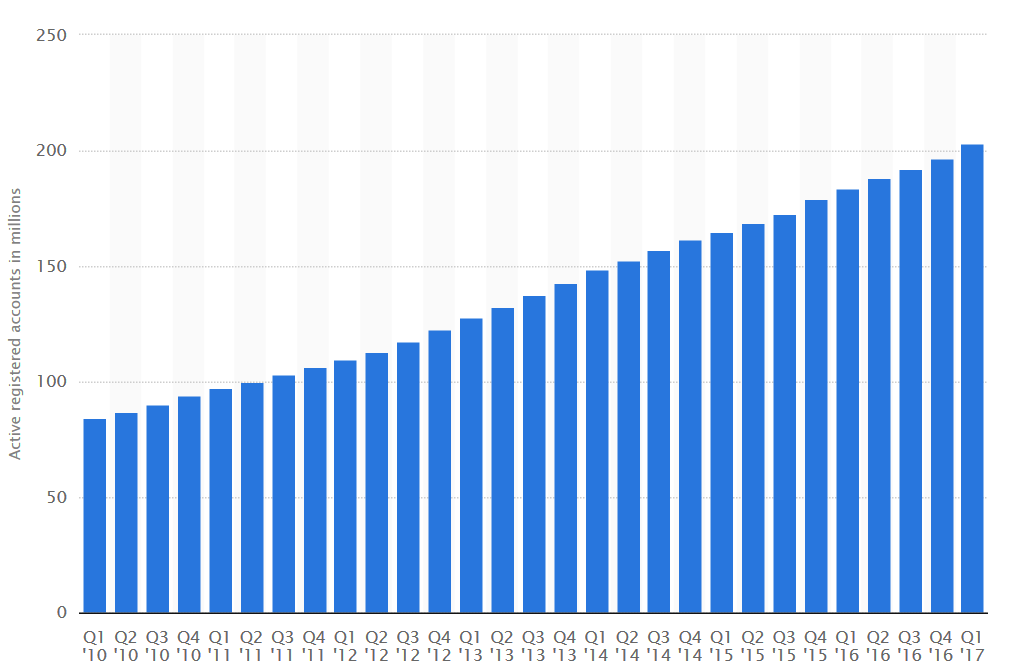
Number of PayPal's total active registered user accounts from 1Q10 to 1Q17 (in millions)
And check this out:
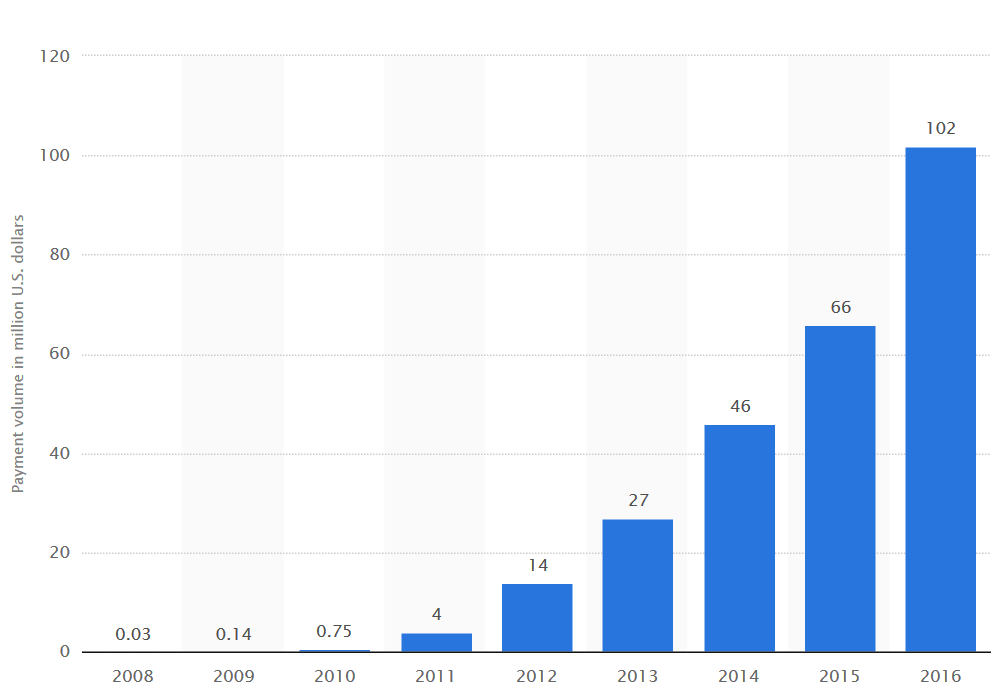
PayPal's annual mobile payment volume from 2008 to 2016 (in $billions)
PayPal announced a new $5 billion stock repurchase authorization. This news caught investor’s attention and was one of the key drivers to send the shares up 7% in the trading session the day after posting results.
One noteworthy ongoing debate is the option to move to more of an “asset light” model, which should increase the valuation the business receives from the market. This strategy would require selling PayPal Credit so the company doesn’t do any lending but only runs technology and processing operations. We would be pleased to see this catalyst occur.
BMR Take: EPS estimates call for around 15% growth to upwards of $2.50 in 2019. With all fundamentals looking great, this freight train is rolling, baby! Our Price Target is $48. Since it hit this price on Thursday, we hereby raise our Target to $56. With a market cap of $57 billion now, if it reaches this new target we will see the cap reach $67 billion. Now THAT’S a story.
Oh – our Sell Price? It remains the same: We would not sell PayPal.
Google (GOOG: $906, +8%, or $63 a share)
Results were better than expected in 1Q17. Gross revenue of $24.8 billion grew a nice 24% from a year ago and was 2% above consensus. The results reflected continued strength from mobile search, YouTube, and programmatic ads as paid clicks growth accelerated 53% from a year ago.
What is really exciting? There is a belief that it remains relatively early days for “mobile search monetization”. To this end, we saw local shopping queries increase by 45% from a year ago and the company achieved 2 billion app installs since September 2016. What does this all mean? More and more people are on their phones searching for stuff as they walk through malls, sit in their cars, and do whatever they do every day. This trend is unlocking “mobile search monetization” we described above. Bottom line, mobile search continues to lead to good results for Google for the foreseeable future.
YouTube did great. YouTube usage was 1+ billion hours of video watched daily in February. Holy cow! This might be the best asset in all of video media. During the quarter, we saw large brand advertisers increasingly come back to the platform after some recent mishaps around inappropriate video uploads being attached to the marketing campaigns of some advertisers on the platform. Very nice to see the recovery unfold here.
BMR Take: We continue to believe Google is among the best-positioned Internet companies due to its leadership position in artificial intelligence, mobile, search, video, and programming, all of which are core Internet growth drivers. With EPS on track to do over $50 in 2018, you just have to own this one.
CBRE Group (CBG: $36, up 4%)
Another Bull Market Report stock delivered a good quarter. It was a clean beat for CBRE. EPS of $0.43 came in well-ahead of the $0.33 consensus, as expenses trended materially below expectations.
CBRE Group’s resilient first quarter result validated the persistent strength of the commercial real estate cycle and the company’s first-rate global platform.
EMEA* and Asia stood out for the company. Asia posted 10% revenue growth.
*Europe, Middle East and Africa
The company has a strong outlook. Management commented that it was not making any adjustments to its 2017 earnings outlook of $2.40. The backdrop remains favorable as rates have retreated, the election fallout has stabilized, global economies are growing and new construction remains strong.
M&A is emerging again. This could be a big boost for the company. The company closed two investments in the quarter, and an additional one at quarter end. Management suggested that after a year of remaining mostly absent from the acquisition markets, pricing was becoming more rational again, suggesting we could see slightly more activity from the company. With a balance sheet that remains healthy, with in excess of $3 billion of dry powder on hand, management could step on the gas if they choose to.
BMR Take: CBRE Group is the Rolls Royce of real estate. With nearly $3.00 in EPS due in 2018 with upside from possible M&A, the current price in the mid $30s sure looks like a cheap value to us.
Celgene (CELG: $124, up 1%)
Celgene reported 1Q17 light on revenues, but modestly ahead of Street consensus on lower spending, and provided positive 2017 guidance. EPS of $1.68 was above Street consensus of $1.64. Revenues of $2.95 billion were slightly below consensus of $3.05 billion.
The modest revenue softness was largely due to weakness in sales of Otezla, which were negatively affected by a greater than anticipated contraction in U.S. prescriptions for psoriasis/psoriatic arthritis, and a modest inventory draw-down through 1Q17. Other products - namely Revlimid and Pomalyst - were also negatively affected by Medicare prescription problems.
We note that previous guidance of $1.5-$1.7 billion in net Otezla sales for 2017 remains intact despite this soft quarter. Further, the contracts negotiated with large payers have significantly broadened access to Otezla for up to 100 million covered lives, intimating future tailwinds for the asset.
BMR Take: We remain bullish on Celgene and forecast total revenues to rise strongly. We expect Celgene’s four drugs (Revlimid, Abraxane, Otezla, and Pomalyst) to drive revenues to over $13 billion by 2017, and over $21 billion by 2020. Note that revenues were $7.7 billion in 2014, $9.3 billion in 2015, and $11.2 billion 2016. Now that’s growth. Recent acquisitions of Receptos and Delinia along with investments in collaborators such as Acceleron, Epizyme, Agios, and others likely ensure growth from 2017 and beyond. We continue to view Celgene as a top large cap pick in healthcare. The market cap is at $96 billion now.
United Parcel Services (UPS: $107, +2%)
UPS pleased investors with earnings results too, mainly on the top line. Total revenue climbed 6.2%. Revenue grew in all segments and in all major product categories, as balanced market demand occurred across the company’s broad product portfolio.
There was a wave of other good news to report. Total fuel expense increased $187 million or 43% over Q1 2016. The fuel surcharge revenue lagged expense, however a February 2017 surcharge change mitigates this variance for future periods. Capital expenditures to support network enhancements were $938 million during the quarter, demonstrating a run-rate at the annualized guidance level.
UPS paid dividends of $775 million, an increase of 6% per share over the prior year, rewarding shareowners with continued strong dividend yield. The company repurchased 4.2 million shares for approximately $450 million in line with the company’s capital allocation policy.
What is exciting? The company is accelerating investments to create the industry's leading smart global logistics network and value-creating portfolio. UPS customers are benefiting from expanded capacity, choice and improved time-in-transit, while technology solutions continue to deliver efficiencies. One example of expanded service is the company's new Saturday delivery program, which began rolling out this year. While the roll-out cost the company $35 million this quarter, UPS is hoping it will give the company a leg up on competitors. The service is now in 15 metro areas. By the holiday season, the company hopes to have Saturday delivery capability in 4,700 cities.
BMR Take: UPS is without question a top logistics franchise globally. With projections pushing towards strong EPS growth and nearly $8 of EPS potential in a few years, we expect the company to deliver. The stock is slowly making a comeback from the sharp drop we saw from $117 to $103 in early February. We wouldn’t be surprised to see $110 soon and $115 again in a month or so. This $93 billion market cap company is a well-oiled machine and with more and more people buying online instead in malls, their business is assure of growth in the future.
US Economic Outlook
The first quarter can be full of surprises. During the existing expansion, first quarter GDP growth has come in short of consensus expectations every time, with an average absolute forecast error of 0.5%. Initially, disappointing first quarter GDP growth led some to question the durability of the expansion, but that should fade now that the issue of residual seasonality has come to the forefront.
Residual seasonality in GDP implies that there is a predictable seasonal pattern. This is clear in the first quarter, as GDP tends to be noticeably weaker than in the subsequent three quarters. The differences are frequent and large enough that they are unlikely a fluke. Also, residual seasonality is evident across many of the major components of GDP, including parts of services spending, exports, federal and state and local government expenditures, and nonresidential structures.
The Bureau of Economic Analysis has made adjustments to correct some of the issues related to residual seasonality, but it likely remains a sizable weight on GDP growth. GDP came in weak in the first quarter, rising 0.7% at an annualized rate. Residual seasonality appears to be shaving 0.5% off first quarter GDP growth. There are other reasons for the weakness in the first quarter, including weather and possibly the delay in tax refunds.

We believe the Fed will look through the poor start of the year, as GDP is inconsistent with other hard data, including employment. Still, sub-1% GDP growth could create a challenge for the Fed, since we still expect it to raise rates in June. Though GDP is heavily scrutinized, the employment cost index for the first quarter could have greater influence on monetary policy. The Fed is worried that the tight job market will lead to a sudden acceleration in wages that would then boost inflation.
Federal Reserve policy makers are set to meet next week, and while there is little expectation that an interest-rate increase will be announced when the meeting ends on Wednesday, the latest economic reading could sway the Fed’s outlook. The monthly report on job creation is due next Friday, and a strong showing could ease some of the concern over the lack of vigor in the first quarter.
Reaffirming its recent findings, the University of Michigan said its consumer sentiment index finished April with a decidedly bullish reading of 97, up from 87 just before the election.
A Word from Gary Jefferson
Jefferson Financial Group
First Vice-President, Investments
UBS Financial Services, Inc.
Viva Le Pen! Laissez les bon temps roulez! But wait a minute……..the market wants Macron to win and therefore is acting as though his election is a foregone conclusion. Does that ring a bell? Remember how Clinton was a "foregone conclusion" and how that night the market absolutely crashed……but made a miraculous recovery after the Trump victory. As far as we can tell, US stocks shouldn't be materially affected one way or the other and we view this as a "sideshow" to the earnings season that is under way here at home. Or, as Alfred E. Neuman might comment on the whole French thing, "What, me worry?"
President Trump announced a new tax plan which he called "bigger, I believe, than any tax cut ever". This news is, in our humble opinion, of much greater interest to the US investor than the French election. We are seeing a plan that is pro-growth and nothing but pro-growth, and which has a realistic chance of garnering enough support to get passed. If that happens, we expect a nice rally. If it doesn't, then we would expect the market to react with some sort of displeasure.
Earnings update: Thomson Reuters is reporting that earnings are expected to grow by more than 11% in the first quarter. 76% of the earnings reports have already come in above estimates. 62% of companies have beat revenue forecasts, and revenues are expected to be up just under 7% on the quarter. These are good, solid numbers. Numbers like these should provide durable support for the market.
Blackstone (BX: $31) killed in the first quarter of 2017. They earned 82 cents a share on revenue that rose 108% year over year to $1.94 billion. Analysts were looking for 68 cents on revenue of $1.6 billion. Total assets under management climbed to a record $368 billion. The company said that realizations totaled $16.6 billion, a company record. The bulk of the realizations came from the firm’s flagship private equity and real estate strategies, with an average multiple on invested capital of 2.6 times.
Underlying portfolio company fundamentals appear strong. Management noted its private equity portfolio companies are experiencing high single-digit EBITDA growth and in real estate, both rents and occupancy continue to improve.
BMR Take: And the stock took off this week. It was up 5%, counting the fabulous 87 cent dividend that it paid a few days ago. You know, we are always looking for new companies to invest in that will give you above-average gains. We will tell you this: There is going to come a time when this stock will skyrocket. We can see it hitting $40 down the road and it just might come sooner rather than later. Why? Because this stock has been undervalued so long that investors have given up on it. But don’t forget that Stephen Allen Schwarzman has NOT given up on it. From what we can gather he has 230 million shares. WOW. That’s 45% of the company, worth north of $15 billion. He thinks the stock is WAY undervalued and is working on a million ways to get the stock higher. We’re going with Steve on this one. We’re up 25% on Blackstone since early 2016, but our Target is $36 and we think hitting this is quite possible in the next few months.
Athenahealth (ATHN: $98) got hammered on Friday, dropping $23, all of our gains since we added the stock in November at $103. We’re down 5% now, not pretty, but not bad in the whole scheme of things. We just hate to see these overreactions. Look at this: revenues for the past three years are $750 million in 2014, $925 million in 2015, and $1.1 billion for 2016. The company reported revenue of $285 million in the quarter up from $255 million in the year ago quarter. And the company stated last week that they expect full-year revenue of $1.23 billion. So really, if you look at the numbers, everything is still solid. Earnings were $22 million, down from $24 million. Yes, earnings were a bit weaker, but revenue growth is key in our book.
We are going to stick with this company for now. We can see the overreaction continuing a bit, taking the stock down to $95 or even a little lower, so you have to make a decision – stick with it or bail. These are always tough decisions and of course, it is impossible to predict what will happen. Many investors say to cut your losses and move on. Others say, like we are saying here, that this great company is being punished by the market for a silly little miss on the earnings front.
Trump’s Repatriation Initiative
Credit Suisse told investors to buy high tech shares because the companies will thrive under President Donald Trump's tax reform, saying it will enable an increase to its shareholder return program and allow for more strategic acquisitions.
The firm raised its rating on one of the giant tech companies two notches, to outperform from underperform, a rare "double upgrade."
"We believe the possibility of an upcoming repatriation and balanced approach towards M&A [mergers and acquisitions] and capital return could drive long term earnings power," they said.
There is over $2.6 trillion of cash offshore, which can be "unleashed" under tax repatriation reform, at least half of which is controlled by Tech firms. If Trump's tax plan is passed, Credit Suisse estimated that about half of this ($650 billion) can return to shareholders during the next five years and another $500 billion could be used for mergers and acquisitions.
"The combination of a potential buyback combined with accretion from M&A, has the capacity to drive these firms’ earnings materially higher in the coming years," they wrote.
BMR Take: The firms with the largest hordes of cash are Apple with over $255 billion, Facebook, Google and Oracle, so we expect them to be the biggest beneficiaries of this tax cut if it every happens.
AstraZeneca (AZN: $30, flat) went up and down after reporting earnings. Revenue of $5.4 billion fell 12% from a year ago and EPS of 99 cents was 4 cents up from a year ago. The company’s ability to grow earnings with falling sales is impressive, and partly justifies the 24 P/E ratio. Most impressive was the company’s ability to lower core SG&A costs by 14% - greater than the sales decline, suggesting greater operational efficiency.
Why were sales down so much? Really this is a one-story issue: Crestor. This drug lost its patent in the U.S. and is a big hit to sales. The company still has plenty of cancer and diabetes drugs in the pipeline, indicating upside is still possible. We will be paying close attention to the company’s pipeline in the months ahead.
Shopify (SHOP: $76) hit an all-time high on Monday. Two weeks ago the stock surged from the $70 level to the $76 level and last week the gains were sustained. The market cap is still a tiny $7 billion and we continue to maintain that a firm could come in a make a $90 or $100 offer for them and it wouldn’t make a dent on the acquirer’s balance sheet. Apple with $255 billion in cash, or Oracle (ORCL: $45) worth $185 billion with $60 billion in cash are just two possible buyers. Don’t get me started on Google or Facebook or Amazon! With over 300,000 websites using Shopify software we expect great things for this company in the future.
The High Yield Corner
By Michael Foster
Special to The Bull Market Report
Of all the high yield sectors as a whole, junk bonds performed the best. The SPDR Barclays High Yield Bond ETF (JNK: $37, up 1%) closed the week stronger despite slightly disappointing GDP news, with the trend starting last Monday at its strongest and continuing throughout the week. The asset class did far better than U.S. Treasuries, especially on the long-term end of the curve, where yields slipped this week, although that slip began before the GDP data. This trend is not sustainable in the long term; junk bond yields cannot keep falling and U.S. Treasury yields cannot keep rising at the same time. At one point or another the gap between the two would narrow and there would be no risk premium for investing in assets that can and do default a lot (junk bonds), versus an asset that cannot default, outside of a major apocalyptic event (U.S. Treasury).
While junk had a good week, BDCs have had a good year so far. The UBS BDC ETF (BDCS: $24, up 1%) is up over 4% year-to-date versus junk bonds’ 1%, with the more popular BDCs becoming an increasingly popular trade. Main Street Capital Corporation (MAIN: $40) is now up 9% year-to-date after another 1% gain this week. But note that Friday was a peak that very swiftly and steeply fell, causing the stock to lose 1% in a day. With a premium to net asset value of 80% by the end of the week, we cannot expect this trend to continue. Of course, we have been saying this ever since we removed Main Street from the high yield portfolio and while we haven’t seen a correction, we have seen the stock’s run up stalling slightly. Timing a top exactly is impossible, but recognizing that we’re at or near a top is easy. This is the case with Main Street as well as several other popular BDCs. While we suspect a correction in the junk bond market to be uncomfortable, we expect a similar trend in BDCs to be much more severe. That may come next week or next year, but these 80% premium valuations cannot last forever.
We’ve given a similar word of caution regarding REITs. Last year, especially the start of the year, was a stellar time for the asset class, with post-August proving much more challenging and post-Trump proving even more difficult. The SPDR Dow Jones REIT ETF (RWR: $92, down 2%) had yet another rough week. Despite the problems surrounding REITs, we have not recommended exiting the sector entirely as we found most prudent with BDCs. The reason for that was simple: REIT valuations remained modest and much less efficient than in BDCs. Part of this is due to the greater ease of valuing BDCs in terms of the market value of their debt portfolio. Due to the strategy of accounting for depreciation with REITs, this sector is much more complicated. As a result, valuing these assets in terms of their book value is largely useless or must be done with extreme care. For this reason, many investors prefer to focus on price to FFO as a ratio - in other words, determining how much you’re paying for income instead of paying for the underlying assets producing this income. This of course is unwise because FFO and asset values can be extremely divorced from each other as a result of a variety of market factors.
Ultimately, this means a closer analysis of the underlying business is necessary when analyzing REITs, and in doing so investors can find amazing deals. This is the back story of our REIT picks, and is why Digital Realty Trust (DLR: $115, up 3%) has remained a major pick for a long time. This income stock is now up over 33% in the last year and the dividend has grown 6%, with more dividend hikes inevitable thanks to its strong and growing FFO. The market has no qualms giving this REIT a high valuation, so it’s no surprise that it jumped this week despite weakness in REITs elsewhere.
That weakness, however, impacted several other Bull Market Report picks. Omega Healthcare Investors (OHI: $33, down 4%), Kimco Realty (KIM: $20, down 6%), Government Properties Trust (GOV: $21, down 2%), and Care Capital Properties (CCP: $27, down 4%) fell with the broader market. These are extremely big movements, largely a result of market panic in the sector. It has also created tremendous opportunities, especially with the very safe Kimco Realty, which has an amazing track record and solid dividend coverage. This is a “buy the dip” opportunity.
A Note on Facebook’s Growth:
Facebook (FB: $150) has four operations that have over one billion users. There is Facebook itself with 1.9 billion. Messenger is at 1.2 billion, as is WhatsApp at 1.2 billion. Then there is Instagram. Listen to this: Since inception, the company has been adding 100 million users about every nine months. But something happened when they hit 500 million. Going from 500 million to 600 million took just six months. And getting to 700 million took just FOUR months. This is unreal growth. When will Instagram reach 1 billion? Good question, but at this rate it just might be in early 2018. And people wonder why the stock hit $150 this week, up 5%. Repeat – Facebook has FOUR operations with over 1 billion users. One billion. That’s 1000 millions. We are just in shock.
OK – the stock hit our Target of $150 Friday and we are now up 55% since we added it in January last year. The stock is going a lot higher folks, so we hereby raise our Price Target to $165 and our Sell Price from $125 to $140.
Good Investing,
Todd Shaver, CEO and Editor
The Bull Market Report
Since 1998

