March 5, 2017
by Todd Shaver | Mar 5, 2017 | Weekly Newsletter 7pm Sunday
The Week Ahead
“Smart Investors Turn To ETFs” was the front page Wall Street Journal headline over the weekend. It is sort of laughable. Wall Street seems to always proclaim it has found the holy grail. They sell product after product with the same pitch. This time we are seeing it happen in ETFs. Don’t be fooled. Look, we like ETFs. We have the Energy ETF in our portfolio. Beyond Sector ETFs, we think there are good investment opportunities in broad-reaching global ETFs. Yet, there remains good investment opportunities in individual common stocks. If anything, the time to by buying your favorite stocks is when everyone else is blindly buying ETFs.
No matter what, there is always a bull market here. Week in and week out, you can find it right here at The Bull Market Report. We currently see a bull market in the REIT universe. This week we highlight the following securities: Simon Property Group, Anally Capital Management, Care Capital Properties, Government Properties, and Welltower. Check out our new REIT portfolio on the website. If you have forgotten your User ID or Password, write us here: Info@BullMarket.com.
Highlights From The Past Week
IPO window wide open as Snap goes public. Having priced at $17, Snap (SNAP) opened for trading at $24, valuing the company over $34 billion - almost three times the size of Twitter, bigger than both HP and CBS, and almost as big as eBay. With losses running greater than revenue, investor demand for the Snap IPO reveals nothing less than a vibrant IPO market. And some craziness! And then the next day it jumped another 10%.
Goldman raises March rate hike odds move to 95% after Yellen speech. Following Yellen's speech which did not throw any curve balls to this week's sharply revised, hawkish narrative by her FOMC peers, a March rate hike - according to Goldman Sachs Research - appears to be in the books. Fed Chair Yellen said that a rate increase at the March FOMC meeting “would likely be appropriate”, as long as incoming data continue to confirm officials’ outlook. Goldman sees this as a “strong signal for action at the upcoming meeting, and we have raised our subjective odds of a hike to 95%." We’re not too worried. Rates hikes are good and bad. They are bad because no one wants to pay higher rates for loans. But they are good because it shows the economy is doing well.
The Fed Is preparing $1 trillion in Qualitative Easing (QE) for the next recession. Should the US encounter a recession in the next several years, the most likely reaction by the Fed would be another $1 trillion in QE, according to Deutsche Bank, delaying indefinitely any expectations for a return to a "normal" balance sheet. This provides downside protection in the event the current bull market loses any momentum.
BMR Companies and Commentary
Simon Property Group (SPG: $179, down 3%)
Houston we have a problem? Nope. Houston-area malls owned by Simon Property Group have not been harmed by market-specific energy-related challenges or broader retail-industry struggles.
Simon’s two Houston properties total 3.7 million square feet worth about 2% of the portfolio. Trends have been stable. Its top Houston mall, The Galleria, is in the midst of a redevelopment to add high-end shops and restaurants into a former Saks. The Galleria is anchored by Neiman Marcus, Nordstrom, Macy’s, and previously Saks. The other of the two malls, Katy Mills, is anchored by Neiman Marcus and Saks 5th Off.
It is not just Simon’s properties holding up. We see the same stability from General Growth Properties (GGP), which owns five Houston properties that total 5.5 million square feet, which is much larger than Simon’s.
BMR Take: The oil bust of late has placed some sour sentiment on any security with exposure to the commodity. The same thing is happening with regard to brick and mortar retail sales. We have not yet seen the two concerns hurt Simon. We are keeping a close eye out for any signs of stress. There is some concern in certain quarters that online shopping will ultimately impact the mall owners of the world like Simon. We don’t believe so, as people like the concept of shopping at 150 stores at a time in real stores, rather than sitting hunched over a computer. But, with that said, if Simon heads lower from here we are going to take a quick, minor loss and look for other places to put our money.
In the interim, we believe stocks like Simon are trading at compelling values.
Annaly Capital Management (NLY: $10.96, down 1%)
Annaly is an internally-managed Mortgage REIT based in New York City with total assets of $83 billion. Incorporated in 1996 and public since 1997, Annaly is by far the largest of the six public Mortgage REITs, which invest in Agency residential mortgage-backed securities.
The company currently invests solely in mortgage securities that are guaranteed by government-sponsored entities, Freddie Mac and Fannie Mae, or by an agency of the federal government, Ginnie Mae. All of these securities have an actual or implied AAA credit rating.
Annaly's principal business objective is to generate income for distribution to investors from the spread between its agency RMBS portfolio and the cost of borrowings. The key point to understand is that Annaly’s business model is very sensitive to interest rates, more so than even other REITs.
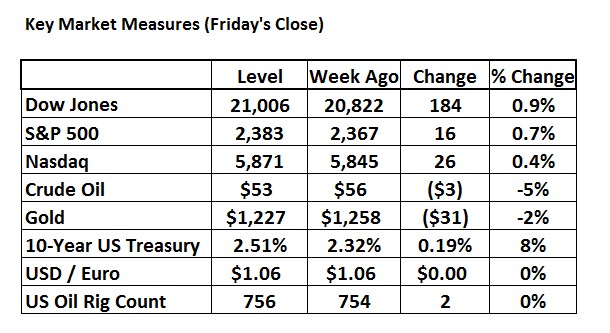
BMR Take: With the 10-year Treasury stepping up 19 basis points to 2.51% this week, Annaly shares remained relatively stable. This was a $10.22 stock a month ago, so we remain quite pleased with this investment.
Care Capital Properties (CCP: $26, up 1%)
Care Capital is a self-administered, self-managed Real Estate Investment Trust ("REIT") engaged in the ownership, acquisition and leasing of skilled nursing facilities and other healthcare assets operated by private regional and local care providers.
Care Capital primarily generate revenues by leasing properties to third-party operators under triple-net leases, pursuant to which the tenants are obligated to pay all property-related expenses, including maintenance, utilities, repairs, taxes, insurance and capital expenditures.
As of December 31, 2016, Care Capital had a diverse portfolio of 345 properties and 40 private regional and local care provider relationships. The portfolio is spread across 36 states and contains a total of roughly 38,000 beds/units.
Management is in the process of “re-positioning” the portfolio to improve portfolio metrics. The company was spun out of Ventas in August 2015 and since then has been selling assets and reinvesting in new development and redevelopment.
BMR Take: While near-term portfolio “re-positioning” is weighing on rental revenues and divestitures are resulting in lower earnings assets, ultimately we think the transition is working to produce a high quality better run portfolio that will receive more favor from the market.
Government Properties (GOV: $20, down 2%)
Government Properties is an externally advised real estate investment trust that owns, acquires, and manages office properties leased primarily to government tenants. The company’s niche focus afforded it the opportunity to go public in the midst of the financial crisis in 2009 where it raised $230 million.
Admittedly, core results have been mixed. Despite solid leasing volume, the real estate optimization strategy among government tenants remains a headwind. Average term of just 3.3 years marks the lowest term in recent memory. Tenants contributing 2.6% of rents are scheduled to vacate soon, as the Department of Justice, which currently represents 3% of rents, has moved from the “at risk” bucket to “vacating”. Fortunately, there is some offset by the National Institutes of Health, which has decided to stay. We don’t want to alarm you about recently mixed core results. It is the natural ebb and flow of the business. It could all easily swing the other way.
Providing some comfort, management had alluded to an expanding deal pipeline, given frothy pricing and demand for government-tenanted properties. We are seeing it happen. The company recently announced three acquisitions totaling roughly $130 million, with the largest asset being a 98% leased office park in Virginia; this property represents the largest investment since 2014.
BMR Take: Government Properties serves a unique niche in the REIT space and we see compelling value in the shares.
Welltower (HCN: $70, down 1%)
Welltower is at the forefront of investing in innovative healthcare infrastructure to create the physical and social environments necessary to promote wellness and quality of life for the aging population. Welltower’s operating platform supports post-acute care, independent living, assisted living and memory care facilities for more than 200,000 elderly residents and state-of-the-art outpatient medical facilities handling more than 16 million patient visits annually.
Recently, Welltower began collaborating with Johns Hopkins in a major new partnership. Johns Hopkins Medicine is one of the world’s pre-eminent patient care, research, and teaching institutions. Initially, Welltower and Johns Hopkins Medicine will explore joint initiatives in areas including: measuring quality outcomes in assisted living and memory care; educational programs for patients and care givers; and sharing of health and wellness and business expertise, information, best practices and research. The collaboration will also assess healthcare market opportunities and investments in modern, efficient infrastructure to deliver better care at a lower cost.
Americans ages 65 to 85 is the fastest growing segment of our population and the largest consumers of healthcare. Welltower is a leader in the space on all fronts from infrastructure to science.
BMR Take: The consensus forecast is for a dividend of $3.50 this year, $3.57 next year, and $3.82 in 2019. This 5% dividend yield looks compelling for a leading Healthcare REIT.
Upcoming Economic News
MONDAY, MARCH 6
Factory Orders – January
Time: 10:00 am
Forecast: 0.9%
Sizable growth in transportation sector orders is likely to lead overall factory orders higher in January. Core durable orders are showing positive trends for business investment in the near-term. Such orders rose 10.1% annualized in the three months ending January—the best such gain in nearly three years.
TUESDAY, MARCH 7
Trade Balance – January
Time: 8:30 am
Forecast: -$45.7 billion
The US trade deficit is likely to widen in January as the advance report on trade in goods showed significant gains in imports. Despite the growing trade gap, exports are once again adding to US output as opposed to representing a major drag on growth. Exports rose at the two-year high rate of 1.8% year-over-year in the fourth quarter while December’s 2.7% monthly advance was the best result in four years.
WEDNESDAY, MARCH 8
Productivity & Unit Labor Costs – Fourth Quarter
Time: 8:30 am
Forecast: 1.5% productivity, 1.5% unit labor costs
Long moribund productivity trends showed some uplift in the second half of last year, rising 2% annualized. Yet that recent bump needs to be sustained for quite some time to greatly undo the sickly 0.5% annualized gain for productivity over the past three years. Of concern to the Federal Reserve is the stronger pace of gains exhibited by unit labors costs, which rose 2.4% annualized over the same three-year period.
Import Price Index – February
Time: 8:30 am
Forecast: 0.1%
Moderation in the pace of raw materials price gains is expected to limit the February Import Price Index to its smallest gain of the past three months. Higher oil prices are facing resistance as current values entice a broader array of producers to drill. But the rising cost of imported goods is already weighing on consumer purchases, as the Import Index rose at the five-year high annual rate of 3.7% in January.
FRIDAY, MARCH 10
Employment Report - February
Time: 8:30 am
Forecast: 174,000 nonfarm payrolls, 4.7% unemployment rate
Job growth is showing no signs of stalling out after workers on nonfarm payrolls increased at the four-month high count of 227,000 in January. Employers are very hesitant to lay off staff, resulting in new claims for unemployment insurance hovering near lows not seen in over 40 years. That signal of labor market tightness can carry over to faster wage growth, helping to push up worker earnings above levels that remain historically weak for an extended economic expansion.
Apple Increases Research and Development Spend
Apple (AAPL: $140, up 2%) is pouring money into R&D in an attempt to improve products that don't currently generate revenue, but might in the future, according to remarks made by Apple CFO Luca Maestri at the Goldman Sachs investor conference Tuesday.
The company spent a huge $2.8 billion on R&D in 4Q16, bringing the total to nearly $10.5 billion in total for the year. Apple's annual spend is up by roughly $4 billion since 2014, marking a very noteworthy increase.
Why? Apple's hardware product range is growing. The iPhone is driving the company’s growth and it is adding new products to the lineup to further growth. The price of the phone is pricing out many customers, so we expect to see lower priced phones in the future, allowing them to sell a phone to everyone in the world.
Plus Apple's Services business, which comprises revenue from internet services, Apple Care, Apple Pay, licensing, and the App Store, is expected to grow to the size of a Fortune 100 company this year, according to Apple CEO Tim Cook. That's about $28 billion in revenue for the year, or a year-over-year growth of 15%.
BMR Take: Apple is sitting at an all-time high. We’ve been beating the drums, through endless negativity, especially when the stock fell into the 90s last summer. We were right and we are here to tell you that $150 is not out of sight. And we CAN’T WAIT until the President comes up with his repatriation plan for the $250 billion in cash the Apple has tucked away overseas.
Opko Health Discussion
Opko Health (OPK) had a rough week, losing 12% to $7.45. Earnings were reported last week. Revenue for the quarter was $275 million, flat from the year before. For the year: $1.22 billion, up from $490 million last year. Earnings for the quarter – a loss of $14 million. For the year: a loss of $25 million, compared to a small profit last year. The numbers were skewed by the purchase of BioReference Labs in 2015 for $1.5 billion, which added over $1 billion to revenues last year.
Opko says the potential market for Rayaldee, the kidney disease drug, could be as high as $10 billion but the drug didn't launch until November so there was no breakout of revenues that many were waiting for. We’ll just have to wait until next quarter to see any type of results from this drug.
The 4KScore test, launched several years ago, measures four prostate-specific substances in the blood to identify men who have a high likelihood of developing an aggressive form of prostate cancer. Opko that in Q4 about 18,000 4Kscore prostate cancer tests were ordered, representing growth of more than 12% compared to Q316. Some said they were looking for much bigger numbers here. The company has $170 million in cash and long-term debt of $110 million.
Consensus in the analytical community show that of the six analysts that follow the stock, four rate Opko a Buy, while two rate the stock a Hold. The stock’s consensus target price stands at $13.30.
BMR Take: We’ve said two things before: that if the stock hit $8 we would sell. But recently we said if the stock hit $8 we would buy more. We are going to reiterate this position now. We would buy more here. The caveat is that you have time to wait. Good things comes from patience. But patience in the financial world can be upsetting and cause you to lose sleep. So if this is the case with you, there are lots of other places to put your money. This company has great potential but we don’t control the marketplace that they live in and we don’t control management. We believe in management, but they might disappoint us. (See Under Armour.) Wall Street certainly thinks highly of the company. We give you the Consensus so that you can evaluate the whole picture. Some say that Wall Street analysts are mostly wrong. We don’t believe that. (See Apple, where EVERY ANALYST thinks the stock is going higher, and of course, the stock is sitting at an all-time high.) In any case, this company has amazing potential. Revenues are strong; cash and debt are certainly in line; it should be just a matter of time before we see positive results.
A Letter to the Editor about Simon Property Group (SPG: $179, down 3%)
Hello Bull Market,
Simon Property Group has been doing well but my concern is about the trend toward online retail which has and should continue to have a chilling effect on mall traffic. Doesn't it worry you that several large retailers that are anchor tenants at malls like Macy's and Sears have plans to close stores all over the country? To the extent that online purchases increase won't that hurt brick and mortar retail and foot traffic through malls? Thanks.
Richard Reed
Hi Richard -
We've discussed this with some folks on the Street as well as my own analyst team and it's no doubt that this is the biggest risk factor. If we start to see the risk having a bigger impact on the business, that would be a reason for us to exit. Not that we like to play with fire or pick up coins on the railroad track, but the reality is all businesses are not flawless and have their risks, so it not a reason to not invest. The good news here is that everyone knows this risk so we would argue that it is already baked into the stock's current price. And we must say that shopping online and shopping at 150 stores in a mall are two completely different experiences. It's pretty tough to buy a suit online. And furthermore, people love the social aspect of shopping in stories. That will never change.
BMR Take: Bottom line – if the overall stock market falters, and/or if Simon moves lower, we will take a small loss and move on. But we are believers in the company long term and we are watching closely.
A Word from Gary Jefferson
Jefferson Financial Group
First Vice-President, Investments
UBS Financial Services, Inc.
There are plenty of fundamental evidence in favor of US equities. The ISM Manufacturing Index, NFIB small business confidence gauge, and Consumer Confidence measures are all higher than 12 months ago and, historically, S&P 500 earnings growth has averaged nearly 15% in the year after such a simultaneous rise. UBS Financial is looking for 11% growth in 2017. UBS research also shows that since 1960, investors who have bought in when the market has been at an all-time high have performed similarly to those who have bought at other times. And investors who have bought in when the market has been trading in the current 18-20x PE valuation range have seen annualized returns of 10% and 7%, over one and 10- year time frames, respectively.
With all that being said, we are still in a rhetoric phase rather than a reality phase. In order to buck the odds of major stock market correction, we believe the following promised catalysts will have to show up this year:
Corporate Tax Break: The campaign pledge of a 15% rate is a powerful idea that would generate abundant earnings, GDP and equity growth. This is the "Holy Grail" for investors.
Individual Tax Break: This is also good for the economy, but the direct correlation to stock price gains is not expected to be as strong as the corporate tax break.
Infrastructure Spending: This should provide another big economic benefit.
We still believe an overweight in US equities and underweight in traditional bonds remains a valid tactical allocation in a rising interest rate cycle and expanding economy.
Analysts' Ratings for Under Armour (UA, $18.64, down 6%)
6 Sell Ratings, 21 Hold Ratings, 9 Buy Ratings
2/27/2017 Nomura $16
2/27/2017 Instinet $16
2/14/2017 Morgan Stanley $20
Things just keep getting worse at Under Armour. A tragedy.
Analysts' Ratings for Tesla Motors (TSLA: $251, down 2%)
7 Sell Ratings, 10 Hold Ratings, 12 Buy Ratings
Consensus Price Target: $256
2/27/2017 Morgan Stanley Outperform $305
2/27/2017 Guggenheim Buy $300
2/27/2017 Goldman Sachs Group Sell $185
2/24/2017 Deutsche Bank AG Hold $215
2/23/2017 RBC Capital Markets Target $314
2/23/2017 Royal Bank of Canada Target $314
2/23/2017 Robert W. Baird Outperform $368
Tesla was downgraded by analysts at Goldman Sachs from a “neutral” rating to a “sell” rating in a research note issued to investors on Monday, They presently have a $185 price target on the stock. Dougherty & Co lowered their price target from $500 to $375 and set a “buy” rating on the stock. Royal Bank of Canada increased their price target from $245 to $314 and gave the company a “sector perform” rating.
Analyst Ratings for Kimco Realty (KIM: $24, down 4%)
1 Sell Rating, 7 Hold Ratings, 8 Buy Ratings
Consensus Price Target: $30
2/3/2017 Canaccord Genuity Buy $34
1/23/2017 Barclays Overweight $27
1/9/2017 Raymond James Financial Outperform $28
THE HIGH YIELD CORNER
BY MICHAEL FOSTER
In high yield, this week was eventful on two fronts. Those who invest in closed-end funds likely received shareholder notices during the week, but the more exciting activity was in the BDC sector. A few BDCs reported this week and more are coming. Among the companies reporting was Goldman Sachs BDC (GSBD: $24.20), which reported a NAV decline exceeding 1% during the quarter and a near 3% decline in net investment income (NII). That wasn’t as bad as TCP Capital Corporation’s (TCPC: $17.20) 7% NII decline over the same period.
Neither stock was negatively impacted by the news, which wasn’t far from expectations anyhow, although Goldman’s BDC fell for the week and TCP Capital surprisingly rose. Goldman’s decline was modest and may ironically be a result of the company’s conservative approach. As one analyst wrote shortly after the earnings release, NAV’s decline is largely “a result of restructurings of non-accruals” and the firm’s more conservative approach to credit issuance. To wit, Goldman has not been expanding its loan portfolio significantly in a market that the fund’s managers have complained is not conducive to BDCs because of tight credit spreads, too much capital chasing too few deals, and overall risks in the marketplace. That has kept Goldman out of the market.
But surely Goldman can originate loans easily. Isn’t Goldman’s management in a position to throw billions of dollars’ worth of loans to their BDC? Well, yes; Goldman knows just about every wealthy person and multi-million dollar company on Earth.
The problem is a lack of incentives; Goldman has little reason to throw business the way of the totally separate and autonomous Goldman Sachs BDC, which is itself an entirely separate corporate structure. Combine this with the challenge of finding deals in a highly competitive marketplace, and you see why Goldman’s BDC is choosing to grow slowly rather than quickly.
The big takeaway from this is that now is not a good time to be in the BDC business. This is even truer for investors that rely on BDCs for passive income. There is so much competition between BDCs, that getting yields on loans is getting harder. And then there is so much competition between investors in BDCs, that premiums to stock values are getting higher, which in turn lowers dividend yields. Goldman Sachs’s BDC is trading at nearly a 30% premium to its NAV and is near its highest premium in history.
This is why we reluctantly sold Main Street Capital Corp (MAIN: $37) and continue to fret over the now absurd the 68% premium to NAV that the stock is currently trading at. Main Street is in our view the best BDC in the world but it’s just too expensive to own with a clear conscience. A diversified BDC fund like the UBS BDC ETF (BDCS: $23) is even worse, providing exposure to overpriced BDCs AND BDCs with bad portfolios or shady management. The sector provides value when it’s out of the market’s favor, but it’s in favor now so we continue to urge caution.
So where can an investor go for high yield? Other sectors are faring much better, and the 2016 muni bond rout seems to be fully behind us. The iShares S&P National AMT-Free Municipal Bond Fund (MUB: $108) had a flat week, but BMR pick Invesco Municipal Trust (VKQ: $12.53, up 1%) fared slightly better. Nuveen AMT-Free Fund (NVG: $14.41) fell a bit though, dropping just a shade over 1.5%.
These funds are paying around 5% in dividends, but remember that this is tax-free money. Depending on your tax status, that could mean an 8% taxable equivalent yield. With such a return, there is little rationale in staying away from municipals and taking on higher risk BDCs where defaults are much more likely, management fees are much higher, leverage is much more severe, and dividend payouts are much less sustainable.
On the issue of returns, let’s consider a moment the concept of the risk premium. Basic financial theory states that at-risk investments will always earn a return that is higher than the risk-free rate of return (ROR). There’s no such thing as 100% risk free, but U.S. Treasuries are about as close to risk free as you can get as long as you hold them to maturity. The Fed Funds rate is set to rise to 0.75% or even higher if Janet Yellen raises interest rates this month, which she says she will, and could go as high as 1.5% or above within a year or so. At-risk assets, then, need to offer a ROR above 0.75% for short-term assets. The calculation that is made is always between Treasuries and whatever risky investment you’re analyzing: Treasuries and oil junk bonds for instance.
However, there is another risk premium calculation that investors should make even though they generally don’t: The difference between the ROR on the investment you are considering and the taxable equivalent yield on municipal bonds. Why? Because retail investors can easily buy municipal bonds and get the income from those instead of choosing the riskier asset. This alternative means there is always a limit to just how low yields can go on at-risk assets before retail investors turn away from them.
Just how low is that yield? That’s a complicated calculation that would take a lot of data and a lot of analysis to figure out, but we can do a rough spot calculation by looking at the popular municipal bond ETFs, calculate their taxable equivalent yields, and compare that to the yields on taxable high yield assets. Doing so tells us that 4% is pretty much the limit. Corporate bonds now are apparently at or around their fair value from this metric.
Does that mean it’s time to buy these assets? Not really, but it’s not time to sell either. That means the SPDR Barclays High Yield Bond ETF (JNK: $37, flat) is not set for any great collapse but it isn’t exactly where you want to be either. It also means the near-term seems OK for BMR picks. The PIMCO Dynamic Income Fund (PDI: $29, up 1%) has reached a somewhat distressing premium to NAV of 8% but the fund’s sharp performance makes this bearable. The AGIC Equity and Convertible Income Fund (NIE: $19.73, up 1%) is seeing its discount to NAV remain around 11%, rather high from a long-term perspective and an attractive reason to hold.
Now, to REITs. The best news for BMR subscribers came from this sector this week, as the SPDR Dow Jones REIT ETF (RWR: $94.45, down 1%) saw a modest decline that was overshadowed by BMR’s REIT picks. Digital Realty Trust (DLR: $107, flat), Omega Healthcare Investors (OHI: $33, flat), and Care Capital Properties (CCP: $26, up 3%) were significantly better performers with flat to slightly up growth for the week. Government Properties Trust (GOV: $20, down 1%) tracked the market quite closely, showing that risky REITs are not selling off greater than the broader market, which is usually the signal of a broader and more worrisome panic. However, the most risk averse investors who look for more stable and less risky REITs are clearly selling off, as Kimco Realty (KIM: $24, down -4%) had a truly awful week. This appears indicative of a broader market trend towards risk aversion that is only beginning in the REIT sector but may continue in the weeks to come. Now is a good time to remain vigilant with the REIT sector and look to rebalance as mispricings continue. For now BMR’s recommendations remain unchanged, but more declines in Kimco could cause us to suggest a bit of rebalancing in the short term.
A final word on AstraZeneca (AZN: $30, up 2%). BMR has been following this drugmaker for a while and have held through months of weakness as the biotech industry was destroyed by political risk-related fears. Trump is now president and despite his tweets about drug prices, drugmakers don’t seem to be in any immediate danger. The market has recognized this and is slowly tiptoeing back into the sector. Astra-Zeneca is up 10% year-to-date for this reason alone. The pipeline hasn’t changed, but everyone is getting more enthusiastic about the company’s prospects. This remains a good time to remain long this stock.
Good Investing,
Todd Shaver, Founder, CEO and Editor
The Bull Market Report
Since 1998
February 19, 2017
by Todd Shaver | Feb 19, 2017 | Weekly Newsletter 7pm Sunday
The Week Ahead
“Kraft Makes Surprise Bid For Rival” was the weekend’s front page Wall Street Journal headline. The deal would be one of the biggest ever valued around $150 billion, ranking 2nd. However, it was flat out rejected on the premise of not being enough. Analysts expect Kraft to up the ante, perhaps substantially, so we could soon see the biggest deal ever in the next week or so. The largest deal so far was Vodafone buying Mannesmann for $172 billion in 2000. The second largest deal was Verizon Communications buying Verizon Wireless for $130 billion.
Why is all this M&A monitoring so important? If this deal passes, we would now have seen four out of the top five deals of all-time occur in the past two years. This flurry of mega deals reaffirms the strength of today’s bull market, which is perhaps turning into the greatest bull market of all-time.
Ha. This just in as we go to press. Kraft has withdrawn its bid. Story over for now.
The reality is, no matter what, there is always a bull market somewhere and you can always find it here. This week we highlight evidence of a bull market in the following securities: PayPal, Apple, Kinder Morgan, Home Depot, and Eli Lilly.
Highlights From The Past Week
Auto Bubble Bursting? For years there has been concern that record auto sales have been propped up by (i) low interest rates, (ii) a perpetual loosening of auto lending standards with terms being stretched to the max, and (iii) a wave of leases. All of these factors have allowed the American consumer to trade up to more expensive vehicles while maintaining low monthly payments. A quick look at the 61+ day delinquencies in General Motors' subprime securitization book would seem to support the rather negative thesis on future auto sales. January 2017 delinquency rates soared to the highest levels since 2010.
Mark Zuckerberg Rejects "America First" Calling For Global Community. Take a few moments to read the internal memo that he sent out to all Facebook (FB: $133, flat) employees:
“On our journey to connect the world, we often discuss products we're building and updates on our business. Today I want to focus on the most important question of all: Are we building the world we all want? History is the story of how we've learned to come together in ever greater numbers -- from tribes to cities to nations. At each step, we built social infrastructure like communities, media and governments to empower us to achieve things we couldn't achieve on our own. Today we are close to taking our next step. Our greatest opportunities are now global -- like spreading prosperity and freedom, promoting peace and understanding, lifting people out of poverty, and accelerating science. Our greatest challenges also need global responses -- like ending terrorism, fighting climate change, and preventing pandemics.
“Progress now requires humanity coming together not just as cities or nations, but also as a global community. This is especially important right now. Facebook stands for bringing us closer together and building a global community. When we began, this idea was not controversial. Every year, the world got more connected and this was seen as a positive trend. Yet now, across the world there are people left behind by globalization, and movements for withdrawing from global connection. There are questions about whether we can make a global community that works for everyone, and whether the path ahead is to connect more or reverse course.
“This is a time when many of us around the world are reflecting on how we can have the most positive impact. I am reminded of my favorite saying about technology: "We always overestimate what we can do in two years, and we underestimate what we can do in ten years." We may not have the power to create the world we want immediately, but we can all start working on the long term today. In times like these, the most important thing we at Facebook can do is develop the social infrastructure to give people the power to build a global community that works for all of us.
“There are many of us who stand for bringing people together and connecting the world. I hope we have the focus to take the long view and build the new social infrastructure to create the world we want for generations to come.”
A $17 Billion Trade Gone Wrong. Many traders across the Street were talking all week about a multi-billion dollar forced short cover by Catalyst Funds' Hedged Futures Strategy Fund (HFXAX). The fund was short upwards of $17 billion of S&P 500 call options and got backed into a corner and had to cover the position. Many believe this event pushed the S&P 500 Index over 2,300.
BMR Companies and Commentary
PayPal (PYPL: $42, +3% for the week)
The European commission has quietly launched the next offensive in the war on cash. These unelected bureaucrats have boldly asserted their intention to crack down on paper transactions across the E.U. and solidify a trend that has been gaining momentum for years. The financial uncertainty amplified by Brexit has incentivized governments throughout Europe to seize further control over their banking systems. France and Spain have already criminalized cash transactions above a certain limit, but now the commission has unilaterally established new regulations that will affect the entire union. The fear of physical money flowing out of the trade bloc has manifested a draconian response from the State.
The European Action Plan doesn’t mention a specific dollar amount for restrictions, but as expected, their reasoning for the move is to thwart money laundering and the financing of terrorism. Border checks between countries have already been bolstered to help implement these new standards on hard assets.
The above event further reinforces the secular idea of a cashless economy. This environment would be terrific for a purely online payments service like PayPal, just terrific! We highlight some additional opinions from credible sources on the topic below.
Governments around the world have pushed forward their agendas towards a cashless society. Former Chief Economist at the International Monetary Fund (IMF), Kenneth Rogoff, published a paper last year advocating for the U.S. $100 bill to be removed. He wrote: “There is little debate among law-enforcement agencies that paper currency, especially large notes such as the U.S. $100 bill, facilitates crime: racketeering, extortion, money laundering, drug and human trafficking, the corruption of public officials, not to mention terrorism. There are substitutes for cash - cryptocurrencies, uncut diamonds, gold coins, prepaid cards - but for many kinds of criminal transactions, cash is still king. It delivers absolute anonymity, portability, liquidity and near-universal acceptance.”
Former Treasury Secretary Larry Summers wrote last year that the E.U. would likely be the trailblazer of the West towards this new digital model: “But a moratorium on printing new high denomination notes would make the world a better place. In terms of unilateral steps, the most important actor by far is the European Union. The €500 bill is almost six times as valuable as the $100. Some actors in Europe, notably the European Commission, have shown sympathy for the idea and European Central Bank chief Mario Draghi has shown interest as well.”
PayPal announced this past week that it is acquiring the bill payment firm TIO Networks, which serves as a major player in the North American bill pay market, for $230 million. This will continue to help PayPal become more embedded in all of our financial lives.
PayPal has 200 million customers now and TIO Networks will add another 15 million. The market is big for bill pay. In the US, 15 billion bills were paid online worth $4 trillion. PayPal wants in and with TIO processing $7 billion worth, this a strong step in the right direction. PayPal did over $350 billion in payment volume last year, so this acquisition is small by any standard, but the way PayPal operates we can see this business doubling and tripling in the next five years. PayPal is a patient company and this is just another step in the right direction.
BMR Take: We are keeping eye on government actions that accelerate the speed the world is traveling at towards a cashless economy. PayPal is a big beneficiary. We’re up 18% since we added PayPal last year. We think it is lagging a bit lately and would definitely overweight the stock here at $42. Our Target remains the same at $48 which we would hope to see sometime in the first half of this year.
Apple (AAPL: $136, +3%)
It’s 13-F season. The 13-F report is filed by all investment shops detailing their holdings. This is where anybody with a computer and the internet can peer into the investment portfolios of the best investors on the planet. Well, our curious mind traveled through quite a few of the filings. We were surprised – though not really – to see investor after investor had recently increased their stake in Apple. The list of famous investors includes Greenlight Capital, Berkshire Hathaway, and Third Point. Berkshire won the prize for the largest increase in the size of their position, +277%. We recall that Warren took a position in Apple in May, right at the lows. He now holds 57.4 million shares, worth $7.8 billion. (This is the influence of Warren’s new young bucks who are making many of the new decisions in the company as the founder is now 86.)
So something must be going very right. Big investors are buying. Goldman Sachs research raised their price target from $133 to $150. What is going on? It is slowly coming to light just how undervalued the Services business is. People still don’t widely appreciate that Apple’s Services business alone would be a Fortune 100 company. Services now contributes profit greater than all non-iPhone segments combined.
UBS research estimates that if Services were valued similarly to PayPal, shares would be at least 10% higher.
BMR Take: There are times to be a contrarian, but now sure does not look like one of those times. The Apple train is breaking new speed.
Consensus Ratings for Apple
1 Sell Rating, 10 Hold Ratings, 36 Buy Ratings, 2 Strong Buy Ratings
2/14/2017 Robert W. Baird Target: $145
2/13/2017 Goldman Sachs Target: $150
2/8/2017 Bank of America Target: $145
2/7/2017 Canaccord Genuity Target: $154
2/6/2017 RBC Capital Markets Target: $140
2/2/2017 Wells Fargo & Company Target: $117
Come on, Wells Fargo. Get with the program!
Apple set a new all-time high last week of a shade over $136. We hereby raise the Price Target from $140 to $155. Our Sell Price remains: “We would not sell Apple.”
Home Depot (HD: $143, +2%)
The Home Depot recently announced its first major investment in a wind-powered renewable energy project. The energy purchased from the wind farm is enough to power 100 Home Depot stores for a year while also providing $150,000 in local community benefits.
The Los Mirasoles Wind Farm, owned and operated by EDP Renewables North America, is located in Hidalgo and Starr Counties, near McAllen, Texas. Through a 20-year power purchase agreement, Home Depot's annual purchase of 50 megawatts (MW) is a fifth of the wind farm's 250 MW capacity. The farm utilizes Vestas V110 2.0 MW wind turbines and produces enough power to provide more than 70,000 average U.S. homes with clean electricity each year.
As a part of its renewable energy initiative, The Home Depot's goal is to procure 135 megawatts of various renewable energy sources, including solar and wind, by the end of 2020.
The company also procures energy from solar farms in Delaware and Massachusetts. More than 150 stores and distribution centers utilize on-site fuel cells that produce roughly 85% of the electricity each store needs to operate.
BMR Take: We are glad to see Home Depot acting more like Amazon by getting more deeply involved in all aspects of their business--even it has nothing to do with lumber. The behavior is likely to lead to many more good things to come for Home Depot. The stock hit a new all-time high last week and the company is now worth $175 billion. Management knows what they are doing and we see no reason why the stock can’t hit $160 sometime this year if the market stays steady to higher. We hereby raise our Price Target to $160 from $135 and raise the Sell Price from $105 to $130. We are up 20% on the stock since we added it a year ago.
Kinder Morgan (KMI $22, -3%, market cap $49 billion)
Kinder’s CFO John Edwards spoke to investors at the Credit Suisse conference on Wednesday. Some insightful perspective was shared. Below we review the key points.
Kinder has an unparalleled asset footprint. They are the largest Energy Infrastructure company in the United States. They are the leader in all of their business segments. They are the largest natural gas network in North America moving over 40% of the gas in the U.S. They are the largest independent transporter of petroleum products, moving a little over 2 million barrels a day. They are the largest transporter of CO2. They are the largest independent terminal operator with approximately 155 terminals. And in the Canadian segment, they are the only pipeline serving the West Coast. These assets make Kinder well-positioned to take advantage of growth in North American energy.
While it might not seem like it to the casual eye, Kinder Morgan has a much simpler structure now than a few years ago. There is one publicly traded equity security versus four a few years ago, and that security is very liquid. It trades over 15 million shares a day, and the management team that is aligned with investors. Management and directors, own about 14% of the outstanding shares, a good thing.
Having survived the latest energy downturn, management is more than ever focused on remaining cost conscious. They want to control costs. Some people refer to management as cheap, but they want to make sure that they are spending money where they need to spend money, and they are not spending money where they don't need to. They do want to spend money on their assets to keep them operating safely and efficiently. On 35 out of 36 of metrics, they rank better than the industry average. Wow.
There is a very deep pool of capital out there in terms of the Canadian pension funds, The company is currently considering a Canadian IPO to tap that money. The IPO would be attractive capital. It would be long term. It would allow for growth investments and balance sheet improvement (paying off debt).
BMR Take: Fellow shareholders, Kinder has the best assets in North American energy. They have a management team that could be flashy but is instead frugal. We may get access to a flood of Canadian pension money. Life is good.
Eli Lilly (LLY: $80, +3%)
Additional results from the pivotal RA-BEAM study were published in New England Journal of Medicine. The study on their arthritis drug is being done by Eli Lilly along with Incyte Corporation. The goal is to greatly improve treatments for arthritis.
The New England Journal of Medicine publication included supplementary data, which showed that starting as early as week 8, and sustained through week 52, a higher proportion of patients taking baricitinib (a drug fighting arthritis) achieved 50% and 70% improvement - compared to the old drug adalimumab. These improvements were statistically significant. A breakthrough!
Lilly and Incyte previously announced positive topline results of at least a 20% improvement.
This is an exciting time for rheumatology, with potential new treatments for arthritis. The RA-BEAM study of baricitinib is the first phase 3 trial showing that a once-daily, oral treatment significantly improved clinical outcomes compared with a current standard of care, injectable adalimumab used with background methotrexate therapy. These data demonstrate that baricitinib could provide another treatment option for people with arthritis.
BMR Take: Eli Lilly’s success with the arthritis drug just further shows the business has a healthy pipeline of new products and is not broken. The stock has had a big rally from $64 back in December to now $80. Between a favorable trial outcome and the big rally recently, the Lilly turnaround is manifesting.
Lilly has reached our Price Target of $80. We are up 18% from where we added it just two months ago. We hereby raise the Price Target to $88 and raise the Sell Price to $76.
Upcoming Economic News
WEDNESDAY, FEBRUARY 22
Existing Home Sales – January
Time: 10:00 am
Forecast: 5.55 million
Existing home sales look to move higher in January after sliding in December. Sales rose 7% year-over-year in the fourth quarter, keeping the housing recovery steadily on track. With only four months’ worth of inventory at the latest monthly sales pace, prices will continue to climb, encouraging more homeowners to sell.
FOMC Meeting Minutes
Time: 2:00 pm
The minutes from the uneventful February FOMC meeting will give some indications about what policymakers expect for growth and inflation. The outlook for the economy is clouded by the potential actions of the new administration. Yet some near-term upward pressure on prices and wages still keeps the Fed on track to lift its policy rate three times this year. SO THEY SAY. Who is they? The analysts and pundits. We at The Bull Market Report aren’t so sure. We are watching the 10-year note which is stuck at the 2.4% range. We are in the camp of LOWER interest rates ahead, not higher. Watching and waiting are we.
FRIDAY, FEBRUARY 24
New Home Sales – January
Time: 10:00 am
Forecast: 575,000
New home sales are projected to rebound sharply in January after slumping to a 10-month low in December. Even with the December setback, the sales pace remains exceptionally strong at 25% year-over-year in the fourth quarter. Growth in new home sales can continue to be stellar. The most recent monthly sales pace is 25% above the average of the past 20 years.
University of Michigan Consumer Sentiment – February
Final Time: 10:00 am
Forecast: 96.0
The preliminary value of the Michigan Sentiment Index showed above-average confidence despite slipping from January’s 12-year high. Consumers are starting to feel the bite of higher gasoline prices, as short-term inflation expectations rose to equal the 23-month high. But long-term inflation expectations are muted at just 2.5% annualized between five and ten years ahead, as a sustained acceleration in price growth is doubtful.
Our Favorite Warren Buffet Quote:
"You can't produce a baby in one month by getting nine women pregnant." -- Warren Buffett
Love it. Be patient out there.
More on Stocks We Love
CBRE (CBG: $36, up 5%)
CBRE set a new 52-week high this week and is within a whisker of the all-time high of $38.50 set in 2015. We see no reason why the stock can’t hit $40 this year. It hit our Price Target of $35 this week, so we hereby raise the Target to $40. We are changing the Sell Price to $32.
Annaly Capital Management (NLY: $10.82, up 5%). Why We Love Thee.
With an 11.1% dividend yield, it's one of the highest yielding stocks on the market today. It is a real estate investment trust and a Mortgage REIT, specializing in mortgage-backed securities, or MBS's. A REIT is simply an investment fund that owns income-producing real estate or real estate-related assets. Among other requirements, a REIT must invest at least 75% of its total assets in real estate assets and cash, and derive at least 75% of its gross income from real estate-related sources. And it has to pay out 90% of its income.
In Annaly's case, it doesn't invest directly in real estate, but rather in MBS's. These are fixed-income securities, much like bonds, that are backed by residential mortgages. Annaly invests in securities that are issued by Fannie Mae or Freddie Mac, and are thus backed by the full faith and credit of the United States government. It means that the risk that its assets will default is nil.
On Annaly's most recent balance sheet, for instance, agency MBS's accounted for $82 billion out of $88 billion in total assets.
Annaly's biggest task is to deal with the interest rate risk. Annaly uses leverage to buy assets. They borrow money at low short-term interest rates and invest that money in higher-yielding long-term assets - MBS's. The firm has $88 billion in assets, composed of $13 billion in equity and $75 billion in debt. Thus the leverage is about 5 to 1. In years past, this leverage has been as high as 10-1. We are pleased to see the leverage at this lower level. Annaly hedges the risk of rising short term rates by buying interest rate swaps. These are financial derivatives designed to lock in the cost of financing. Annaly has outstanding interest rate swaps of approximately $31 billion.
As we mentioned above, as a REIT Annaly must distribute at least 90% of its income to shareholders to qualify as a REIT. Thus, Annaly doesn't have to pay corporate income taxes on its earnings.
The dividend yield of Annaly is currently 11.1%. That's almost six times greater than the 1.95% yield on the S&P 500.
In order to grow its capital Annaly sells new shares of stock in secondary offerings. In the old days they used to do this as much as twice a year, each time raising $500 million to $1 billion in fresh equity. In the new Annaly world, they don’t do as many secondaries, as management is content with growing the NAV slowly, with the company now worth over $11 billion.
BMR Take: We are comfortable with the company growing NAV slowly, as we hope you are too. Patient investors can sit back contentedly and enjoy the 11% dividend and if the stock is up just 50 cents in a year, that’s another 5% in overall growth producing over 15% in a year. And note that last week the stock was up 30 cents!
The Yield Curve Today. Or, Where are Interest Rates Going?
“Everyone” thinks rates are going higher. Right? You feel this way too, don’t you! Well, we don’t think this way. We think rates might just decide to peter out here and fall back. The 10-year US Treasury Note is at 2.42% right now, up from the 1.8% level before the election. But note that rates around the world are in many cases much lower than what we have in this country. In fact, late last year over $11 trillion was paying ZERO interest.
Take a look at this chart, concentrating on the 10-year notes in gray:
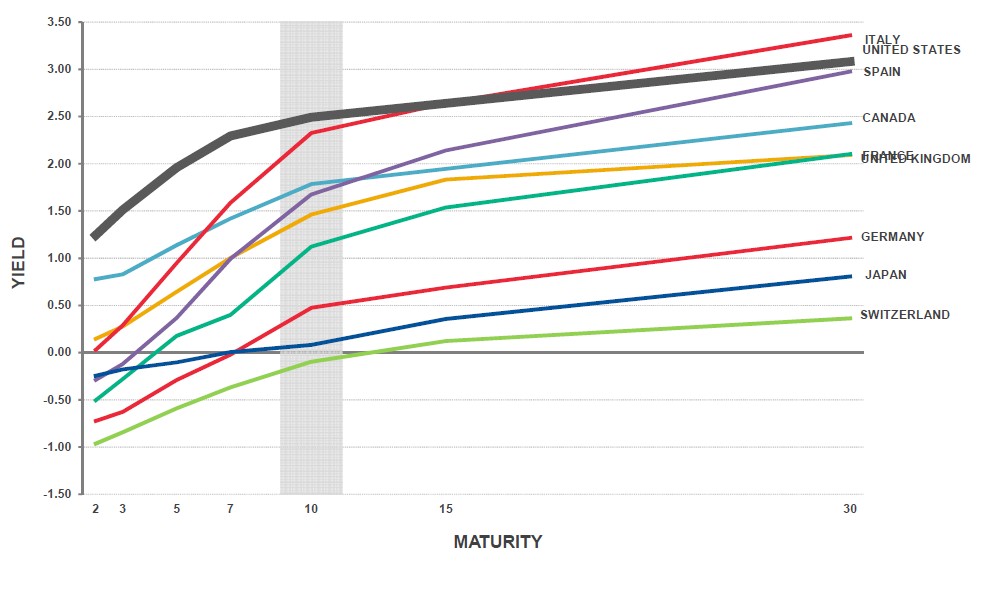
Note that Germany, Switzerland and Japan are hovering around 0%. How could this be? The answer to that may take our writing a book, but suffice it to say that IT IS REAL. And if it can happen in Germany and Switzerland, can it happen here?
BMR Take: The short answer? Yes it can. It “could” happen here. Will it? We wish we knew, but with all the turmoil in the world economically, we think there is more likelihood of rates going down rather than up at this time. We are not convinced that Yellen will have the power to buck THE MARKET. The MARKET will dictate interest rates, not the Fed. We see interest rates going lower rather than higher. And when rates go down, bonds and bond-like funds go up. Food for thought.
The High Yield Report
By Michael Foster
Special to The Bull Market Report
Another week, another bull run for the S&P 500.
The action has certainly slowed, but a 1% gain for the index is still impressive considering the long stretch of strength we’ve seen since November. The strength came on the back of Janet Yellen’s surprisingly hawkish testimony to Congress, an increase to unemployment claims that surprised analysts, and inflation rising to near 2%.
There’s a lot to unpack here.
First, let’s address Yellen, because this is most important to high yield markets. The Fed Chairwoman made her intentions very clearly in this paragraph:
"The Committee's view that gradual increases in the federal funds rate will likely be appropriate reflects the expectation that the neutral federal funds rate- - that is, the interest rate that is neither expansionary nor contractionary and that keeps the economy operating on an even keel- - will rise somewhat over time. Current estimates of the neutral rate are well below pre-crisis levels - a phenomenon that may reflect slow productivity growth, subdued economic growth abroad, strong demand for safe longer-term assets, and other factors. The Committee anticipates that the depressing effect of these factors will diminish somewhat over time, raising the neutral funds rate, albeit to levels that are still low by historical standards.”
Keep in mind that Yellen’s job is to talk in complicated, confusing phrases. But Yellen is actually a lot clearer than Greenspan was back in his day. In this block of awkward verbosity, we interpret what Yellen had to say:
1. Interest rates are going to naturally rise over time.
2. The Federal Reserve needs to anticipate these natural rises, because the market isn’t anticipating improvements in productivity, global conditions, investment, etc.
3. The Fed is going to raise interest rates swiftly and frequently.
If Yellen said this in 2014, the market would have tanked. Saying this in 2017, though, the markets barely budged. This is good for the Fed and bad for interest rates. It clearly means the Fed feels that it has the room to raise interest rates often and will do so throughout 2017. (We at The Bull Market Report are not so sure. See the following chart on interest rates around the world. We are not convinced that Yellen will have the power to buck THE MARKET. The MARKET will dictate interest rates, not the Fed. We see interest rates going lower rather than higher. And when rates go down, bonds and bond-like funds go up. Food for thought.
Where does that leave high yield assets?
On the surface, higher interest rates are bad for BDCs, junk bonds, and REITs. But remember that raising interest rates has been expected for years now; much of this is already priced in. The market knows this and so has not sold high yield assets in a panic.
Just look at the indices for high yield assets. The UBS BDC ETF (BDCS: $23, up 1%) ended the week up solidly, while the SPDR Barclays High Yield Bond ETF (JNK: $37, flat) held its ground. REITs did better than both of these assets. The SPDR Dow Jones REIT ETF (RWR: $94, up 2%) had yet another strong week despite the fact that higher borrowing costs will negatively impact REIT profitability. The market knows this and has already priced it into the sector.
In other words, everyone knows Yellen is getting more hawkish; they just don’t care.
Does this mean the market is overconfident and we should panic? No, not exactly. It does mean that there aren’t as many “screaming buys” in today’s market as there were at the start of 2016, when it was a much less obvious call to say junk bonds were worth snapping up at current valuations. But it also doesn’t mean those assets are overbought, either.
We’re clearly making the transition from “fear” to “greed,” as Warren Buffett would put it. But we’re not exactly at greed quite yet. In a market where buying and selling aren’t obvious choices, what can an investor do?
Simple: be selective. When it comes to being selective, it means finding assets that aren’t moving with the broader market. Fortunately there are some great values out there that are not performing as well as they should be. This week offered some new ones.
The first is a BMR favorite: Care Capital Properties (CCP: $25, down -2%), which failed to track the REIT bull run. Likewise, Omega Healthcare Investors (OHI: $32, down -2%) stumbled this week. Both REITs are in the Healthcare sector, which is being hit by greater uncertainty than the REIT universe as a whole. We’ve discussed in previous reports why we like both REITs. They’re well-managed and fear is driving the Healthcare REIT industry, making it a rare value play in a swiftly appreciating asset class.
To demonstrate just how undervalued these REITs are getting, compare them to our other REIT favorites Kimco Realty (KIM: $24, up 2%) and Government Properties Trust (GOV: $20, up 3%). Both outperformed the REIT sector as a whole this week.
Two more funds are getting attractively valued: the AllianzGI Equity and Convertible Income Fund (NIE: $19.35, up 1%) and the PIMCO Dynamic Income Fund (PDI: $28, up -1%). The Allianz fund went up this week, but its NAV has been going up at a faster rate than its stock price; as a result, its discount to NAV has grown to over 11%, making it a stronger buy than it’s been for months. Similarly, the Pimco fund’s decline this week makes it another great buy.
One final word on a stock that’s been a pain for us for a long time: Astra-Zeneca (AZN: $29, up 5%) had a stellar week. We’re now just 3% off from a year ago. This is a stock that has proven the old adage: best things come to those who wait. We’re still holding strong after liking what we heard at the company’s earnings release. Now we’re just anticipating possible dividend growth in this best-of-breed Pharma stock.
Good Investing,
Todd Shaver
Founder, Editor and CEO
The Bull Market Report
Since 1998
January 29, 2017
by Todd Shaver | Jan 29, 2017 | Weekly Newsletter 7pm Sunday
The Dow hitting 20,000 was no fluke. Today’s stock prices are well supported by solid prospects for corporate earnings and economic growth. In fact, if President Donald Trump can avoid stumbling into a trade war - or a real war - there’s no reason the Dow Jones Industrial Average can’t exceed 30,000 by the year 2025 or sooner. Clearly, part of the propulsion behind stocks has been the Trump administration and its flurry of business-friendly edicts. If Trump can succeed in reducing regulation and lowering corporate taxes, stocks could surge further this year. An additional 5% or even 10% gain in 2017 wouldn’t be surprising.
It was a strong week for the markets, with the S&P 500 closing up 1%. But the equity strength, driven partly by good earnings results so far, should give us pause. On Friday we saw fourth quarter GDP results come in below expectations. The market dismissed this entirely, and it’s not clear why. We suspect many investors shrugged at the news, thinking it’s old news and economic trends are fundamentally different in a Trump-led world. Nothing could be further from the truth. Despite his bombast, his ardent supporters and critics, and his aggressive use of executive orders, the economy does not hinge on the executive branch of the United States.
While the government can and does steer economic moods, animal spirits are aroused by many things. Ask yourself: Did you choose your last car because of who was president? Did you go out to dinner last night because Trump is president? Did you buy your house because of who is in the White House? For sure, government plans on corn subsidies, mortgage support via Fannie Mae and tax policies, and spending on infrastructure influence what we eat, where we live, and what we drive. But it’s very easy to over-estimate just how much of an impact there is, and it’s also easy to expect Trump to radically alter our consumption habits. Outside of Healthcare, there is little evidence to suggest Trump will change much else.
That may change, but until then investors should take a closer look at GDP announcements and other major macroeconomic indicators. It’s far too early to sell anything or change one’s market view. There is still broad strength and fairly valued or inexpensive assets out there.
This week we provide some insights on our latest thinking for PayPal, Facebook, Amazon, Celgene, Microsoft, and VMware.
Highlights From The Past Week
Concerning the Auto Cycle. Despite record U.S. auto sales last year, the number of vehicles on car-dealer lots remains near record highs, and, as J.D.Power warned this week, 2016 ended with an inventory "bubble" that will require less production or more incentives to clear. With near record-high inventories of 3.9 million vehicles, U.S. auto inventory finished 2016 at about 66 days supply, up from 60 days a year earlier. Inventory would last 2.2 months at the November sales pace, according to the latest available data from the Census Bureau. The stock-to-sales ratio in 2016 is elevated compared to historical norms of 1.9 months.
California To Leave The United States? A proposal for California to break away from the United States has been submitted to the Secretary of State's Office in the state capital. If it qualifies, it could trigger a vote on whether the most populous US state should become a separate nation. The group behind the proposal, Yes California Independence Campaign, was cleared on Thursday by Californian Secretary of State Alex Padilla to begin the bid to collect some 600,000 voter signatures required to put the ambitious plan on the ballot. This would not bode well for the stock market. (Look what happened to Great Britain and Brexit.)
Let Trade Negotiations Begin. Starting With Mexico. Of the $300 billion in total Mexican exports (offset by $180 billion in imports), the largest two categories were electrical machinery & equipment, followed by nuclear reactors, boilers machinery & equipment, with motors only coming in third spot. But no matter the breakdown in categories, one thing is clear: Mexico needs the US - which imports over 80% of Mexico's net exports - and needs the NAFTA agreement far more than the US does. This is not to say that the US won't be impacted once NAFTA is eliminated. Trump began re-negotiating with Mexico’s President this week. Again, this could be rough sailing ahead for US stocks if things get messy. (How could they not?)
BMR Companies and Commentary
VMware (VMW: $87, +6%)
The company reported fourth quarter earnings. We observed more pieces of the puzzle coming together for VMware. revenue for 2016 was $7.1 billion, an increase of 8% from 2015. The CEO called the fourth quarter results “one of the most balanced quarters for VMware in years.” The tone of the earnings call was encouraging. Analysts were pleased with the strong product momentum and customer enthusiasm for the Cloud strategy. VMware is proving to the market that it has one of the world's most complete and capable hybrid cloud architecture, uniquely offering customers freedom and control in their infrastructure decisions.
Recall, in October, VMware and Amazon Web Services announced a partnership to provide a new VMware vSphere-based cloud service running on AWS. VMware Cloud on AWS will make it easier to run any application, using a common set of familiar software and tools, in a consistent hybrid cloud environment. This new service will be delivered, sold and supported by VMware and will be available later in 2017.
One of the best parts of the quarter was news of a stepped up buyback program. The company announced the authorization of an additional $1.2 billion of stock repurchases to be completed during 2018. The stock repurchase authorization is in addition to the company's existing $500 million stock repurchase program. This is big.
BMR Take: Management’s outlook for next year was as expected by consensus for the first quarter and slightly higher for the full year. Specifically, management tells us to now expect $7.6 billion of revenue this year versus consensus for $7.4 billion and EPS of $4.85 versus consensus of $4.65. All signs point to momentum and confidence building for the stock.
Amazon (AMZN: $836, +3%)
Amazon, aka the innovation machine, is at it again. Amazon’s next frontier to conquer? Auto Parts. Amazon boss Jeff Bezos, whose online behemoth is likely to become the country’s number one apparel retailer this year, is setting his sights on the next sector to dominate, the $50 billion do-it-yourself after-market Auto Parts business.
In recent months, Amazon has struck contracts with the largest parts makers in the country, including Robert Bosch, Federal-Mogul, Dorman Products and Cardone Industries. To further grease the wheels, it’s possible that Amazon may even snatch up some of the regional parts distributors.
This could spell bad news for the nation’s retailers - O’Reilly Auto Parts, Advance Auto Parts, AutoZone and Genuine Parts. The chains have prospered over the last several years as their profit margins have swelled, thanks in no small way to the iron grip they exercise on suppliers.
Amazon, which rang up revenue of $128 billion in the 12 months ended September 30th, could see its auto parts business expand more than 50% this year, to $5 billion. While some observers are skeptical that Amazon will succeed with auto parts as it has with books, electronics and toys, others aren’t taking Bezos’ moves lightly. He seems to just always figure it out after all.
Amazon recently widened its selection of name-brand parts — and is already selling them for less than its brick-and-mortar rivals. For example, a 34 Series RedTop Optima Battery was recently being offered at $166 on Amazon, versus $216 at AutoZone. In a September report, investment bank Jefferies said Amazon is offering same-day delivery for auto parts in 40 major US cities at prices that average 23% less than those of O’Reilly, Advance and AutoZone. That looks like disruption to us. What do you think?
BMR Take: There are two kinds of people in the world. Those that own Amazon stock and those that don’t. Those that do are on an enjoyable ride that just keeps on getting better.
Microsoft (MSFT: $66, +5%)
Microsoft delivered solid fiscal second quarter results, led by an upsurge in revenue and profits in the Cloud. There was some modest revenue and EPS upside to consensus estimates. Revenue was $24.1 billion versus $23.8 billion a year ago. EPS was $0.83 versus $0.62 a year ago. Most impressing, all segments were above consensus and operating expenses again came in below guidance. Customers are seeing greater value and opportunity as they partner with Microsoft for their digital transformation. Specifically, accelerating advancements in artificial intelligence across Microsoft’s platforms and services are providing further opportunity to drive usage growth of the Microsoft Cloud.
Business from Azure, the cloud-based business unit, surged over 90% from a year ago.
Microsoft’s Office business also had strong results as more of its customers signed on to use a subscription version of Office 365 software. Revenue rose 10% to $7.4 billion.
The category also benefited from $230 million in revenue that LinkedIn brought in for Microsoft after the acquisition closed. But LinkedIn lost $200 million during the period.
One of the biggest surprises of the quarter was a 5% increase in the revenue Microsoft received from personal computer makers for licenses to its Windows software.
This was the first quarter we saw any contribution from LinkedIn. Management’s guidance did not include any impact from LinkedIn, which was a point of some confusion for analysts, but really no big deal in our view. Specifically, the outlook for next quarter was slightly lower than expected for revenue, as not all the analysts knew whether or not to count LinkedIn, and if so how much, when establishing their forecasts in recent quarters.
BMR Take: We remain bullish considering operating momentum and the potential for estimates to move higher going forward.
PayPal (PYPL: $40, -3%)
PayPal delivered Q4 earnings in which revenues of $2.98 billion and EPS of $0.42 were both in line with consensus expectations. Management guided Q1 revenues to $2.9-$2.95 billion and EPS of $0.40-$0.42. Management’s outlook for 2017 was also slightly light with revenues expected of $12.55 billion as compared to the Street's $12.62 billion forecast. We are not concerned about these tiny adjustments.
Analysts were generally constructive towards the quarter. Total Payment Volume growth spooked some given the deceleration to 25% versus the heightened expectations calling for 29% growth. With that said, it was a solid quarter overall and many analysts were impressed by the momentum seen in (i) new customer accounts,* (ii) steady operating margins, and (iii) transactions per account increasing to 31x from 27x in the prior year. The potential for increasing strategic partnerships was one key highlight to be excited about. In particular, it was alluded that PayPal is in talks with Amazon (AMZN) about a payments partnership. We hope to hear more soon!
* Growth of 5.4 million active customer accounts in the quarter. Active customer accounts of 197 million, up 10%. with growth of 18 million active customer accounts versus last year. (Huge.)
BMR Take: Not a blow-out quarter for PayPal, but respectable; solid. We continue to be very bullish on the long term picture. Did you hear about India moving to a cashless economy? Such a trend could be a massive tailwind for digital payments platforms like PayPal.
Celgene (CELG: $114, +1%)
We remain bullish on Celgene as total revenues are expected to rise to $21+ billion by 2020. We expect Celgene’s four blockbuster drugs (Revlimid, Abraxane, Otezla, and Pomalyst) to drive revenues over $13+ billion in 2017. The recent acquisitions of Receptos and Delinia, as well as investments in collaborators like Acceleron, Epizyme, OncoMed, Agios, and others likely ensure growth from 2017 and beyond.
Further reaffirming our confidence in the outlook, we just received this week some favorable news about the blockbuster drug Revlimid. Specifically, Celgene received a positive CHMP (Committee for Medical Products for Human use) opinion to expand the use of Revlimid as maintenance therapy for patients newly diagnosed with multiple myeloma post autologous stem cell transplantation. The European Commission, which generally follows the CHMP’s recommendation, is expected to make its final decision in about two months. If approved, Revlimid will be the first and only licensed maintenance therapy available for these patients, further expanding its applicability across the disease spectrum of multiple myeloma and solidifying its leadership position in this area. Exciting!
BMR Take: Healthcare is a tough sector right now given the regulatory risk of imposing pricing deflation by the new administration. However, Celgene has four blockbuster drugs to carry big time revenue growth over the next several years. Accordingly, Celgene is our top pick in this sector.
Facebook (FB: $132, +4%)
Getting excited for the Super Bowl? Mobile upgrades are a touchdown for Super Bowl fans and Facebook. Super bowl tickets might cost thousands of dollars, but many attendees will spend much of their time texting, tweeting and posing for selfies. Being unable to post that one-handed touchdown catch or epic halftime performance on Facebook would be catastrophic. Until recently, that kind of frustration was the reality for mobile-savvy Texans fans at NRG Stadium.Before, you'd basically just sit there and drink your beer and wouldn’t bother messing with your phone. But the NFL's decision to grant Houston the 2017 Super Bowl helped prompt wireless providers to upgrade infrastructure at the stadium. Wi-Fi has been introduced. Prior, if you were with certain providers, it was not even worth bringing your phone in the stadium. Now, every phone has the ability to connect.
To prepare for this year's game, Verizon has spent nearly three years designing and building a system of 780 small antennas in the stadium. It also added antennas throughout, providing capacity equal to 54 cell towers. As of last February, it had spent more than $40 million on this distributed antenna system.
BMR Take: It doesn’t get much bigger than the Super Bowl and one of our favorite stocks, Facebook, will be right in the mix of things with millions of users at the game and at parties around the country sharing their fun with friends and family on the platform.
Facebook had a blowout week, up 4% setting all-time high this week of $133.50. The market cap is now $380 billion, running neck and neck with Amazon (at $395 billion), but still far behind Google ($575 billion) and Apple at $640 billion, the largest in the world. Do not think Facebook is done. Everyone we know uses Facebook. The women in our personal world are on Facebook for hours a day – we are not kidding. The Bull Market Report has decided to use Facebook now for advertising, instead of Google AdWords. 1.8 billion users and climbing, and run by one of the smartest men in the world.
Upcoming Economic News
MONDAY, JANUARY 30
Personal Income & Spending – December
Time: 8:30 am
Forecast: 0.4% income, 0.5% spending
Strong gains for average hourly earnings can put a halt to the decelerating growth trend in wage and salary income. Wages and salaries grew 4.1% year-over-year in the quarter ending November, the slowest pace in six months. But with average hourly earnings expanding at a 7-year high rate of 2.9% yearly, the tightening labor market is giving an added kick to income and spending.
Pending Home Sales Index - December
Time: 10:00 am
Forecast: 1.5%
Rising demand for home mortgages have the Pending Home Sales Index poised to expand in December after the significant decline in the previous month. The moving 4-week average of the MBA’s index of mortgage applications for home purchases is within 1% of the highest such value since June. To the extent that buyers are eager to head-off potential additional rate increases, the long-term uptrend in home sales will be sluggish at best.
TUESDAY, JANUARY 31
S&P CoreLogic Case-Shiller Home Price Index – November
Time: 9:00 am
Forecast: 5.0% yearly change in 20-city index
Tight housing inventories can help the Index maintain the 4-6% annual growth pace that has held for over two years. The 1.9 million existing homes available for sale in December is 27% under the historical average. Though growing briskly, the still depressed level of new home construction gives limited relief to the price-boosting lack of inventory.
Conference Board Consumer Confidence – January
Time: 10:00 am
Forecast: 112.8
The Conference Board measure of consumer confidence will perhaps step back in January after soaring to the 15-year high in December. The burst in optimism was led by the near 20 point jump in the expectations since October, as consumers anticipate great improvements in economic conditions. Yet the limitations of an aged recovery may serve to dampen such inflated attitudes in the months ahead.
WEDNESDAY, FEBRUARY 1
ISM Manufacturing Index – January
Time: 10:00 am
Forecast: 54.8
Positive short-term momentum for the Industrial sector can prevent the January ISM Manufacturing Index from backsliding after reaching the 2-year high in December. Industrial production expanded annually for the first time in 16 months, rising 0.5% year-over-year in December. Relief from the deep past declines in Mining and Utility sectors output will remove major drags on overall industrial sector performance.
Construction Spending – December
Time: 10:00 am
Forecast: 0.3%
Consistent gains in residential activity can lead overall construction spending higher for the third straight month in December. Housing starts rose 7% year-over-year last quarter, the quickest gain of the past three quarters. That positive trend is joined by private nonresidential construction, which expanded 6% year-over-year in the three months ending November.
FOMC Rate Decision
Time: 2:00 pm
Forecast: 0.5-0.75% fed funds target range
No significant action on monetary policy is likely in February after the Federal Reserve moved in December to lift its rates for the first time in a year. Continued uplift for prices and wages can keep the Fed on track to make three quarter-point rate hikes in 2017. Yet dollar strength and the limited feed-through from wages to prices can dampen inflation, allowing the FOMC to act more infrequently.
Vehicle Sales – January
Forecast: 17.7 million annualized
Vehicle sales are forecast to drop in January after leaping to the 11-year high in December. Heavy incentives have helped. Yet after managing a mere 1% year-over-year gain in the fourth quarter, no further maneuvering from sellers is likely to recapture the strong sales growth seen earlier in the recovery.
Productivity & Unit Labor Costs – Fourth Quarter
Preliminary Time: 8:30 am
Forecast: 0.5% productivity, 2.4% unit labor costs
Slower output growth and accelerating wage growth is expected to greatly limit the rise in productivity in the fourth quarter. Even after growing at the 2-year high rate of 3.1% annualized in the third quarter, productivity showed no change year-over-year. Reduced investment in heavy industry and restrained consumer demand has held back productivity gains over the long-term.
FRIDAY, FEBRUARY 3
Employment Report – January
Time: 8:30 am
Forecast: 163,000 non-farm payrolls, 4.7% unemployment rate
Job growth is projected to grow admirably in January, keeping new unemployment insurance claims near multi-decade lows. Though the yearly increase in nonfarm jobs has slowed to 2.2 million from the cycle high of 3.1 million, gains are more than keeping up with the rate of population growth. That trend will start to put more upward pressure on wages provided that the economic recovery persists.
ISM Non-Manufacturing Index – January
Time: 10:00 am
Forecast: 57.0
Steady demand for services can keep the January ISM Non-Manufacturing Index near December’s 14- month high. Real spending on services lagged for much of the recovery, yet it has stayed above 2% since late 2014. That area of spending is likely to stay firm in the near-term, with the orders component of the Non-Manufacturing Index reaching the 16-month high of 61.6 in December.
Factory Orders – December
Time: 10:00 am
Forecast: 1.1%
As with the expected outcome for durable goods orders, overall factory orders can reverse part of the steep November decline and turn higher in December. The first two months of last quarter brought strong gains for core capital goods orders. That raises the odds that real investment spending outside of inventories can quickly undo the 0.5% yearly decline recorded to the third quarter.
A Word from Gary Jefferson
Jefferson Financial Group
First Vice-President, Investments
UBS Financial Services, Inc.
A week ago Friday was quite an historic day – not for the stock market but rather for the United States of America. It could, however, be the beginning of an historic period for certain stocks and industries – what some call "an epic opportunity". It involves President Trump's proposed policy changes that could positively affect (in a major way) specific industries and companies in the next few months – and some stocks almost immediately. The last "epic opportunity" like this was in 1981 following President Reagan's election. His new pro-business policies sent the economy and certain stocks soaring. If Yogi Berra were to opine on the situation today we believe he would say, "It looks like déjà vu all over again".
First things first, however. The macro backdrop is already very favorable for anything else that could add to it. Today we have continued global growth, central bank support and an improved earnings outlook not only in the U.S. but also abroad. Now add to this the profound policy changes likely to be implemented: repatriation of trillions of dollars; trillions of infrastructure stimuli and the revision of one-sixth of our entire economy (healthcare). The "epic opportunities" abound in companies and entire industries that could benefit greatly from these and other policy changes. Some of the beneficiaries would almost certainly include corporations with large off-shore cash holdings, steel and other infrastructure industries and certain healthcare businesses.
That said, a quick caveat: Expectations for growth have improved post-election but so have valuations and sentiment – especially in some of the stocks widely expected to be the beneficiaries of coming changes. Because of the big post-election rally, stock and sector selection is at a premium. The S&P500 started the year at 2258, however, and has effectively gone nowhere for the past three weeks (today sitting around the 2266 level). We believe opportunities still remain across a subset of the market including, in particular, parts of the healthcare, energy, infrastructure and technology sectors, among others. We also believe merger and acquisition activity should pick up in the year ahead as a result of the potential influx of cash from repatriation and lower corporate taxes, and this could further broaden the scope of opportunities.
Finally, don't forget about interest rates, The rising rate policy, while not new, is certainly significant. We believe it is almost a certainty that rates continue to rise throughout the coming year. A Wall Street firm recently posted their latest equation on rising rates: "Rates still historically low + Signs of rising inflation + Economic acceleration + Growth oriented Trump policies = Higher Interest Rates".
Rising interest rates are not necessarily a bad thing. In fact, Stock Trader's Almanac has documented that stocks generally have performed well during the first few years of a new rising interest rate cycle. So, we'll add our own equation to the overall market scenario: "Favorable macro-economic backdrop + Beneficial Trump policy + Positive rising rate cycle = Epic Opportunities in the stock market."
Letter to the Editor
Hi Todd, Congratulations on your almost perfectly timed exit of Qualcomm. Do you have any updated thoughts now that the stock is much cheaper than your exit point?
Mike Jones
Editor’s Note: We exited Qualcomm (QCOM) on October 30th last year at $69 for a 59% gain in 10 months.
Hi Mike –
Qualcomm is an amazing company. They mint cash and have great management. So if the stock market holds from here the stock will hold as well. If the market is headed to 21,000 then QCOM will easily head back to $65 and higher, after the lawsuit with Apple blows over.
Thanks,
Todd Shaver
Apple Short Interest Falls Sharply Over the Past Two Weeks
The number of shares sold short in Apple fell by 3.1 million for the two-week period that ended January 13. That left the total at 44.5 million. For the period, Apple was the 12th most shorted stock on the Nasdaq. Our take is that being the largest market cap in the world there will always be naysayers out there. With 5.3 billion shares outstanding, 44 million is a drop in the bucket – it’s actually less than 1%. So we are paying this no heed.
Alphabet Reports 8% Profit Increase on a 22% Revenue Gain
Earnings: $6.6 billion vs. $6.0 billion. last year, 9.1% growth
EPS: $9.36 vs. $8.67 last year.
Revenue: $26.1 billion vs. $21.3 billion last year.
Revenue Change: 22%.
All in all a huge quarter. Again. We will report more in-depth information in a News Flash Tuesday morning.
Microsoft Sets New All-Time High
We have Microsoft (MSFT: $66, up 5%) in our Stocks for Success portfolio and with good reason. The all-time high of $120 was set in 1999 just before the dotcom crash of early 2000. The stock subsequently split 2-1 for the all-time high of $60 stood until late last year. But this week we saw the stock hit $65.91 giving the company a market cap of $511 billion. If you are not an owner, don’t despair. The stock is headed to $70 and $80 and beyond. Just be patient.
Opko Health (OPK: $8.69, up 1%)
We read this amazing article in Forbes on the company and its founder. If you have the stock or are thinking about buying at these new lower levels, you have to read the article. It is called: "A Bountiful Mind: Forget the 30 Under 30. If there were an 8 over 80, it would include Phillip Frost – doctor, investor, inventor." Frost is the CEO of Opko and after reading this article, if we at The Bull Market Report invested in our stocks, which we don’t, we would take a lot of our pennies and dollars and invest in this man. Read for yourself:
https://www.forbes.com/sites/schifrin/2017/01/03/meet-miamis-renaissance-billionaire/#3912053b7306
The chart here lists all of Frost’s and Opko’s investments. This list is AMAZING, and we are not exaggerating. We would strongly suggest that some or all of them will pay off in the future.
https://www.forbes.com/sites/schifrin/2017/01/03/the-buffett-of-biotechs-portfolio/#5cd7e7c3a4a3
BMR Take: We have a Sell Price of $8 on the stock, but we are contemplating buying more if it hits this level. Stay tuned. And write us here after you read the article: Info@BullMarket.com. We would love to hear your thoughts.
Notes at the Margin
by Philip K. Verleger, Jr.
Former Director of the Office of Energy Policy
at the United States Department of Treasury
In Denial: The Oil Industry’s Cluelessness about Trump
To emphasize Trump’s “America First” focus, his transition team outlined some goals on The White House website minutes after he took office. The first item under the “Issues” tab is “An America First Energy Plan,” which includes this text: “We must take advantage of the estimated $50 trillion in untapped shale, oil, and natural gas reserves, especially those on federal lands that the American people own. We will use the revenues from energy production to rebuild our roads, schools, bridges and public infrastructure. Less expensive energy will be a big boost to American agriculture, as well.”
The source of the $50 trillion estimate is not explained. The number implies that US oil and gas reserves total one trillion barrels if one assumes a price of $50 per barrel. This in turn implies that US oil and gas production should rise to the equivalent of 140 million barrels per day, a number completely at odds with all other calculations. One must leave it to The White House to explain. [Note: The world consumes 95 million barrels a day.]
The “American First Energy Plan” also asserts that “President Trump is committed to achieving energy independence from the OPEC cartel and any nations hostile to our interests.” This US policy change suggests the risk of investing in drilling projects here has dropped sharply. Firms can take greater chances going forward, knowing that any effort to “cap US shale activity” will be countered by a Washington government determined to protect US crude oil producers aggressively. The United States will now benefit from improving technology, greater access to resources, and our president’s desire to put America first.
An import fee or Border Adjustment Tax (BAT)* would eliminate most if not all the incentive for US producers of crude oil or products to export. In the case of a tax of, say, 25%, the effect is obvious. The cost of one barrel of crude to a US refiner would rise from $53, its closing value Friday, to $67. Producers in the Permian Basin or North Dakota could realize similar prices by selling to domestic refiners. Their realizations would fall to less than $54, though, were they to export.
The implementation of an import fee would give producers every reason to keep their oil in the US. With a fee in place, the United States would export as little oil as possible. The millions invested in export facilities on the US Gulf would go to waste. Some of the expenditures on natural gas export facilities might also go to waste as the increase in domestic oil prices might heighten the opportunity to displace oil with gas and the resulting higher prices could make exporting US gas unprofitable.
Refiners, too, would have far less interest in exporting if the Trump administration imposed a fee. Why, for example, would Marathon Petroleum or Valero accept $65 to $70 per barrel for products sold to buyers in Europe if buyers in New York and Boston would pay between $80 and $90? They wouldn’t. Instead they would rush to charter Jones Act ships to move product from the Gulf to the Northeast. Charter rates for those vessels would jump.
*Do you want to read more about the BAT? Go here:
http://www.forbes.com/sites/anthonynitti/2017/01/26/the-border-adjustment-tax-for-dummies-who-will-pay-for-the-wall/#d23a5eb15b68
The High Yield Corner
By Michael Foster
In the high yield world, the recovery in junk bonds hasn’t ended. There’s still good reason to think more investors will buy the growing number of corporate bonds that will be issued in the future, even with interest rates rising. But we don't have as high of a conviction to buy high yield assets as we used to. That’s why we’re keeping a close eye on our portfolio and looking to sell as assets hit our price targets.
This is especially the case with some strong performers in our portfolio, many of which beat the S&P 500 this week (and have been beating the index since we recommended them). The AGIC Equity and Convertible Income Fund (NIE: $19.10, up 2%) had an excellent week and is closing in on a 20% total return over the last year. The fund’s strong performance is largely the result of investors rediscovering convertible bonds, which were out of favor during fears of the now priced-in interest rate hikes the Fed is ready to hand us. Now that the market has priced in this risk and accepted it, more investors are realizing that convertibles offer equity upside on top of an income stream and can outperform in bull markets. So this fund’s net assets have increased in value, driving the fund upwards with it. We still want the fund’s discount to NAV to narrow a bit before selling; right now we're getting assets at a 12% discount. The stock continues to be a strong income producer and a great hold.
An even better showing came from our REITs. The SPDR Dow Jones REIT ETF (RWR: $92, up 1%) underperformed all of our REIT picks, of which Digital Realty Trust (DLR: $106, up 3%) was the best performer by far. Digital Realty is an odd pick for us, because it’s as much a growth company as a high yield play. What’s more, since going up over 40% in a year for us, it’s less of a high yielder than it used to be. But the good thing is that valuation metrics (price-to-FFO being the most important) don’t make it a particularly overpriced stock despite the strength, thanks to high net income growth that’s been sustained for years. Despite yet another strong week, we’re not ready to recommend selling the stock just yet.
We’re also seeing improvements in the Healthcare REIT world. Omega Healthcare Investors (OHI: $32, up 2%) and Care Capital Properties (CCP: $24, up 1%) have continued their recovery just a couple weeks before these companies report earnings. There’s still a lot of way to go, with both stocks down from a year ago. A few things have hurt this sector. Underperformance at HCP, Inc. hurt the entire industry. Worries about higher interest rates depressed REITs in the second half of 2016 after falling in 2015. Perhaps most significantly, concerns about the future of the Healthcare industry in a post-Obamacare world have raised many uncomfortable questions about Healthcare stocks in general. These risks were fully priced into these companies a long time ago, and they keep providing strong income and sustainable growth. Now is hardly the time to shy away from either company.
On the topic of healthcare, Astra-Zeneca (AZN: $27, down -2%) remains our worst performer among our high yield picks, and is now down 14% over the last year. We need to wait this out. Astra-Zeneca saw its operating margin rise in 2015 after many years of declines, and the company’s drug pipeline remains healthy. As with the Healthcare REITs, this company has been hit by worries about the future of healthcare, and that makes us more convinced that now is the time to buy and hold this company. Wait out the fears, because they will eventually change when we learn more about the future of healthcare in Trump’s America. Now is not the time to give in to fear and sell.
Good Investing,
Todd Shaver, Founder and Editor in Chief
The Bull Market Report
January 22, 2017

by Todd Shaver | Jan 22, 2017 | Weekly Newsletter 7pm Sunday
The Week Ahead
This week will be a thriller. President Trump and his cabinet of business leaders will be laying out action plans for a new governing structure for America. Carl Icahn said we haven’t seen a structural reform like this in government in a generation. In this newsletter, we provide some insights on our latest thinking for Bristol-Myers Squibb, Splunk, Kinder Morgan, VMware, Visa, Home Depot, Invesco Municipal Trust, Under Armour, Tesla and Netflix.
Highlights From The Past Week
Trump releases formal agenda. According to a statement posted on the White House website, President Trump’s economic plan will create 25 million new jobs in the next decade, return to 4% annual economic growth, lower rates for Americans in every tax bracket, simplify the tax code, and reduce the U.S. corporate tax rate. We’ll see how Congress will modify these lofty goals.
A few ways the markets could be surprised, according Credit Suisse. The S&P 500 hits 2,500 before falling back to 2,000, versus the consensus view of the index going to 2,300 and leveling off. The Euro falls to $0.90 then strengthens sharply to $1.20, versus consensus outlook for moderate drift to $1.00. Chinese GDP growth slows to 5%, versus consensus of 6.8%. Trump’s policies don’t work, as inflation expectations rise and protectionist policies disrupt world trade. Oil prices hit $75 by year end, versus consensus outlook of $62.
Wake up call. Yes, American politics is not great. But at least we aren’t Brazil. The death of Brazilian Supreme Court Justice Teori Zavascki who had presided over the sprawling "Carwash" corruption scandal, and who died yesterday in a freak airplane crash Thursday has sent shockwaves both around the globe and in Brazil, because while few in polite company will discuss it, it has opened the possibility of political assassinations as a means of "quieting" legal proceedings.
BMR Companies and Commentary
Bristol-Myers Squibb (BMY: $49, -12% for the week)
Bristol-Myers announced that it has decided not to pursue an accelerated regulatory pathway for the combination of Opdivo plus Yervoy in first-line lung cancer in the United States based on a review of data available at this time. In order to protect the integrity of ongoing studies, the company will not be providing additional details. This news sent the stock price tumbling this week.
The situation is just very unfortunate. As Citi’s analyst put it, “We never believed Bristol-Myers had an accelerated pathway to market for Opdivo and Yervoy in front line lung cancer.” This was just totally botched communication by management. As the Citi’s analyst went on to put it, “On a fundamental basis, in our view, nothing has really changed aside from credibility in the guidance.”
What happened? Some people in the investment community started speculating Bristol-Myers could take the accelerated regulatory pathway to catch up to Merck on developing imuno-oncology. The company never stated this. Bristol should have been more vocal that this strategy was not in the cards. They needed to be more pro-active.
The reality is unfortunate for us shareholders having to stomach the near-term volatility. But we should not be worried about the long term picture. As the company put it, “Our vision for the future of cancer care is focused on researching and developing transformational Immuno-Oncology (I-O) medicines that will raise survival expectations in hard-to-treat cancers and will change the way patients live with cancer.”
BMR Take: Bristol is still going to do great things over the long term in cancer and healthcare. We are excited about it. If you aren’t involved in Bristol yet, lucky you. If you have some shares and you have some additional cash to put into this company, we would do it. The shares under $50 are a screaming value. This is an $82 billion market cap behemoth in Healthcare we are talking about; not some pre-revenue biotech moonshot.
Splunk (SPLK: $54, -5%)
Splunk recently hosted its analyst day setting the stage for the stock to rock and roll. Specifically, management laid out monster guidance. Management spoke of the path for Splunk, which is expected to end 2016 at nearly $1 billion in revenue, to hit $2 billion in revenue and $2.3 billion in billings in 2019. This path is driven by accelerating customer growth (with Splunk ending 2019 with 20,000 customers, up from 12,700 in 3Q16; growing deals over $1 million (reaching 300 such deals in 2019, up from 140 in 2016), and the license average selling price growing from $55,000 in 2017 to $80,000 in 2019. This guidance suggests a 3-year revenue growth rate of 29% annually.
On top of the revenue picture, management said that at $2 billion in revenue, Splunk is expected to more than double its operating margin from 5.5% (the midpoint of 2016 guidance) to 12-14% in 2019, mostly through sales and marketing leverage. Wow!
BMR Take: We like Splunk because: 1) it is the leader in operational intelligence software that helps enterprises make sense of machine data; 2) it addresses a large and expanding market; 3) its model is becoming more predictable as the revenue base grows; 4) the company has a long runway to sustain 30%+ growth; and 5) we believe its strong business momentum will continue.
Kinder Morgan (KMI: $22.50, flat)
Kinder Morgan reported earnings of $0.08 per share, which was better than the $0.32 loss reported a year ago, but not as good as consensus analyst expectations for $0.18. There were minor disappointments causing some weakness in the stock after the announcement, but expectations were and remain low and overall you should walk away from the quarterly results feeling that operations are in a stable to improving place.
The company plans to invest $3.2 billion in growth projects during 2017, which it says will be funded with internally generated cash flow without the need to access equity markets. We are encouraged to hear the word “growth” being discussed in the Energy market nowadays.
Even though Kinder Morgan's balance sheet remains of a concern for us, the company did significantly enhance its credit profile by reducing debt by over $3 billion during 2016. You have to give them some credit. In fact, they finished ahead of plan for 2016 year-end leverage, and are progressing toward reaching the targeted leverage level of around 5 times debt to earnings, which will position them to return substantial value to shareholders through some combination of dividend increases, share repurchases, additional attractive growth projects or further debt reduction.
BMR Take: We remain bullish on the rebound for Kinder Morgan along with the rest of the MLP sector. Kinder Morgan has an unparalleled asset footprint spanning the breadth of the United States with leading North American industry positions in each of its five business segments – Natural Gas Pipelines, CO2, Products Pipelines, Terminals, and Kinder Morgan Canada. They really have a great franchise here.
VMware (VMW: $83, +1%)
We are excited to now be involved in VMware. The company’s server virtualization technology helped spark the cloud computing phenomenon. VMware has nearly doubled revenues in the last five years, growing from $3.8 billion in 2011 to $6.6 billion last year. We think there is more room for this bull to run.
Sanjay Poonen is chief operating officer at VMware. He joined VMware in 2013 from SAP, where he was responsible to “build bridges” between the data center and the public cloud, and to the end user through better mobile tools. Serving enterprise mobile users is an effort SAP began in earnest in 2014, with the acquisition of mobile device management company AirWatch. Now VMware has Poonen working on building a similar strategy for shareholders.
VMware sees the hybrid-cloud model as an extension of VMware’s original mission. In a hyper-cloud setup, storage, computing and networking capabilities are integrated and handled largely by software, rather than hardware. The “single box” can save companies from having to buy separate components to integrate manually. Managing a unified system through software also lets technology executives to make changes, such as adding storage space, more easily and less expensively than performing the same changes on individual pieces of hardware and software. It better technology for users. It’s cheaper for users. It’s a major win.
BMR Take: Hybrid-cloud is changing the economics of enterprise IT. VMware is going to win a good chunk of the opportunity. Partnerships are already in place with Amazon and IBM.
Visa (V: $82, +1%)
Walmart reached an agreement to continue accepting Visa credit cards across Canada, ending the retailer’s threat to bar the world’s largest payments network from its 410 stores in the country.
Walmart’s Canadian unit threatened to expel Visa from all of its stores nationwide unless the network agreed to lower the amount it charges for credit-card transactions. Walmart Canada, which has said it pays more than $76 million annually on credit-card transaction fees, called the amount Visa charges “unacceptably high.”
BMR Take: What a battle royal. Visa versus MasterCard. Not quite as good as Ali vs. Frazier. The bad news is that they had to cut their fees. The good news is that Visa didn’t lose the battle and will reap huge revenues from the largest retailed in the land.
Home Depot (HD: $136, flat)
Home Depot has fallen right in the middle of a big debate. The Republican border-adjustment proposal aimed at taxing imports may pressure retailers’ earnings by driving up the cost of their inventory.
However, gauging the plan’s exact impact on retailers including Home Depot is difficult because the companies do not break out what percentage of their inventory is imported, and many goods produced in the United States rely on imported material.
Trade associations for large retailers have been voicing opposition to the proposal, with the National Retail Federation saying it is a “scary proposal with a lot of unknowns.”
One analyst’s research that suggests the tax bills of six large retailers may jump about $15 billion to a total of $28 billion under the current House plan, though some advocates say currency adjustments will offset the tax changes and mute retailers’ objections.
BMR Take: Trump’s first 100 days will be loaded with market moving events. We will be closely watching the border-adjusted tax situation. Trump is already backing away from the proposal saying it is too complicated. So the outlook is all clear for the moment.
Invesco Municipal Trust (VKQ: $12.51, flat)
The recent blow-up of the Dallas Police and Fire Pension System was entirely predictable. While it is tempting to blame unusual circumstances for the recent lock-up of redemptions and substantial reductions to pensions for those still in the fund, many other American pension funds are heading down the same road.
The combination of overpriced financial markets, inadequate contributions and overly generous pension promises mean dozens of US local and state government pension plans will end up in the same situation. The simple math and political factors at play mean what happened at GM, Chrysler, Detroit and now Dallas will happen nationwide in the coming decade.
Pew Charitable Trusts research estimates a $1.5 trillion pension funding gap for the states alone, with Kentucky, New Jersey, Illinois, Pennsylvania and California going backwards at a rapid rate. Using a wider range of fiscal health measures the Mercatus Center has the five worst states as Kentucky, Illinois, New Jersey, Massachusetts and Connecticut. The five state pension plans in Illinois have an average funded ratio of just 38%.
BMR Take: All the above is not good and is unsustainable. It’s weighing on Invesco Municipal Trust. But honestly, it is not as bad as it sounds. One needs to be more specific and not paint everything with the same brush. Take for instance the Dallas Texas credit in the portfolio. They are getting crushed on this pension news story. But the reality is Dallas is one of the most vibrant cities in the America. You can pick-up some of the general obligation bonds of the city at a 4% yield right now compared to the benchmark curve at just 2%. They are rated AA too!
Upcoming Economic News
TUESDAY, JANUARY 24
Existing Home Sales – December
Time: 10:00 am
Forecast: 5.50 million
December existing home sales are forecast to decline after rising a 9-year high in November. The Pending Home Sales Index fell to the 10-month low in November, a warning that existing home sales have lost some momentum. Yet some buyers are looking to move before mortgage rates potentially rise further, as the moving 4-week average of mortgage applications for home purchases recently rose to the highest level since last June.
THURSDAY, JANUARY 26
New Home Sales – December
Time: 10:00 am
Forecast: 585,000
New home sales may have dipped in December after reaching a 4-month high in November. But the long-term sales trend has been stellar, with sales of new homes rising 20% year-over-year in the quarter ending November. And sales still have much more room to grow to get back to historically normal levels relative to the size of the population. The most recent monthly new home sales pace trails the average of the past 20 years by 19%.
Leading Economic Indicators Index – December
Time: 10:00 am
Forecast: 0.5%
Spikes in stock prices and consumer confidence can power the Leading Economic Index in December to the largest gain in five months. The policies of the incoming administration will determine if this burst in optimism can translate into a sustained upturn in growth. Yet quickening wage growth gives a clear signal that consumers now have more resources to increase spending.
FRIDAY, JANUARY 27 GDP
Fourth Quarter (Advance Estimate)
Time: 8:30 am
Forecast: 2.1%
A widening trade gap is expected to lead slower GDP growth in the fourth quarter after reaching the fastest rate in two years in the previous quarter. The future effects of trade on US output are rife with uncertainty with regard to the evolution of policy and the value of the dollar. But the underlying pace of consumer spending is holding firm, getting a lift from the recent upside surprise in auto sales.
Durable Goods Orders – December
Time: 8:30 am
Forecast: 2.2% overall, 0.4% ex transportation
Solid recent indicators for industrial demand hint that Durable Goods orders can rise for the fourth straight month in December. The new orders reading from the ISM Manufacturing Index jumped to the two-year high of 60.2 last month, raising expectations for near-term industrial output. Core durable goods orders have also shown similar vigor of late, rising at the 2-year high rate of 5% annualized in the three months ending November.
University of Michigan Consumer Sentiment – January
Final Time: 10:00 am
Forecast: 98.0
The final reading on sentiment in the January Michigan survey is forecast to show only a mild decline from December’s multi-year high. Significant increases in consumer inflation expectations in the initial January survey signal that prices are poised to accelerate a bit.
A Word from Gary Jefferson
Jefferson Financial Group
First Vice-President, Investments
UBS Financial Services
Earnings season will continue this week. Fourth quarter results for several of the largest banks were announced last week - JPMorgan Chase, Bank of America, Wells Fargo and PNC – and they were generally quite strong.
Remember – earnings for 3Q16 were up 3.1%, which broke the back of the preceding 6-quarter earnings recession. According to Thomson Reuters, earnings for the S&P 500 are expected to increase by 6.1% in the fourth quarter. Last year still didn't see 3% GDP growth, but expectations are for that plus more this year. UBS's pre-Trump forecast was for earnings growth of 5.9% in 2017, and that figure is expected to be revised higher based on the implementation of Trump economic policies.
The biggest question marks for 2017 may not come from economic data alone, but instead, from changes in political leadership. As everyone knows, stocks have already rallied on hopes that President-elect Trump will reduce regulation and taxes while increasing infrastructure investment. However, no one knows for sure what actual changes could be on the horizon - or how Trump's policies will affect trade. Or how Congress may bottle up his potential policies. Trump will lay out an economic "game plan" which could ease some of the market uncertainty that still swirls around the dramatic change in Washington politics. One thing we are concerned about is the formula of “Hope + Uncertainty = ?” In our experience, the answer to that equation is most often "volatility".
Meanwhile, the market still functions on basic fundamentals [and as noted above there are lots of economic reports coming out this week.] And, investors will be watching oil prices, along with gold, the dollar and interest rates. That's because the investment landscape has changed from the expectation of lower interest rates and slower growth for longer periods of time to the possibility of moderately stronger growth and a stronger dollar with higher interest rates due to potentially higher future domestic inflation.
• Oil Prices - Oil began the new year higher as U.S. Crude rose to $54 a barrel.
• Gold - Gold has recovered a bit to start the year, closing at $1210 an ounce on Friday.
• U.S. Dollar - The U.S. dollar index continued to show strength.
• U.S. Treasury Rates - The yield on the benchmark 10-year Treasury settled at 2.47%.
Tesla Motors (TSLA; $245, up 3%) Tesla continues higher. From a low of $181 in early December, the stock is up 35% reaching $39 billion in market cap and stretching for the all-time high of $275 in the summers of 2014 and 2015. What will this summer bring? Good question, but we will tell you that this summer the firm will be a lot closer to delivering the new exciting Model 3 that they are holding 400,000 $1000 deposits on. That’s $400 million in cash that the firm can use for corporate purposes.
Tesla saw some upgrades on Wall Street recently. Morgan Stanley raised their Target to $305 from $242. Goldman is stuck at $190. Wake up Goldman! Robert Baird is looking at $338 and Guggenheim has a $280 target in place. There are six Sell Ratings, 11 Hold Ratings and 12 Buy Ratings. We maintain our Target Price of $290.
Under Armour (UA: $25.16; UAA: $29.02) Two things here. First, the stock. The Class A shares trade under the symbol UA, and the Class C shares trade under the symbol UAA. They both have close to 200 million shares outstanding and the average volume for both is around 3 million a day. But, the company has changed the voting rights of each class of stock. The UAA shares have one vote per share. The UA shares have none. Many other companies have done this, primarily so the founders can maintain control. Google has done it – GOOG has no voting rights, GOOGL has one vote – same story as Under Armour. And there is a class B share in both companies that actually have 10 times the voting rights of the Class A shares. Guess who owns the Class B shares? Kevin Plank, the founder.
BMR Take: Both classes of stock are fine for us, the small investor. Ultimately the UA shares will have more liquidity as the UAA shares are retired, so go with the UA shares if you are buying new positions.
Secondly, the company. What can we say? The company had a bad year and the stock has been hammered. We believe that over the course of the next five years the firm will grow and prosper dramatically. With the stock this low (trading at the same level as 2014), we see tremendous value here. The all-time high is $50 set in the summer of 2015 and we see no reason why it won’t hit this level again. Yes, that’s right – a double from here.
Look at revenues: $2.3 billion in 2013, $3.1 billion in 2014 and $4.0 billion in 2015. We think they could hit $5 billion in 2016 when they report 4th quarter earnings on January 31st. We think they will hit $6 billion in 2017. Long story short – we think this is a huge growth story – the kind of company we would love to own for the coming decade.
Netflix killed last quarter. Netflix (NFLX; $139, up 4% to a new all-time high)
The bad news: The DVD service shed 160,000 subscribers during the final three months of last year to end December with 4.1 million customers. That’s an 11-year low. But the business hangs on and is VERY profitable.
The good news: The streaming service now boasts 94 million subscribers in 190 countries, after adding another 1.9 million in the U.S. and 5.1 million in overseas markets during the final three months of last year. One firm predicts Netflix will have 160 million streaming subscribers by 2020. The company is coming off its biggest quarter of customer growth yet.
The financial quarter for Netflix was huge. The company reported revenues of $2.48 billion, up 36% from $1.8 billion. Earnings were $66 million, up 55%. Cash flow – up 125%. These are huge numbers. One small problem, their earnings equate to only 15 cents a share. They need to beef this up in the coming quarters and years. We think they can and they will.
The stock has blown through our Target of $133. We still like the stock and think it is going much higher over the coming decade. We hereby raise our Target to $165 and raise our Sell Price to $125.
We had a question from a reader about our new Invesco Municipal Trust recommendation (VKQ: $12.49)
From: Bob Valentine
Sent: Thursday, January 19, 2017 2:59 PM
To: info@bullmarket.com – The Bull Market Report
1. Just because bonds can be called, why do you think they will be called over the next couple of years?
2. Your research report says 25% of the fund’s assets will or could either mature or be called over the next two years. Can you send me your calculation as I do not come close to this.
3. Why do you think bonds that are maturing will be invested at higher rates than what they are already invested at? it appears possible that they will have to be invested at lower rates based on my review.
Here is our response:
Hi Bob –
1. Bonds tend to be called when debtors can get a lower interest rate. This may still be possible for municipalities if they call shorter-term bonds and issue longer-term ones or if their credit quality improves. In a rising interest rate environment, there’s good reason to call short-term bonds and issue new long-term bonds to lock in lower interest rates. Of course in a falling interest rate environment (which is extremely unlikely right now) you call bonds and issue new ones to cut down your interest costs.
2. The article does not say 25% of the fund’s assets - it says 25% of the bonds. That’s an important difference. Look at all of the portfolio here:
http://hosted.rightprospectus.com/Invesco/Fund.aspx?cu=46131J103&dt=AR&ss=ce
You’ll see that 20 holdings expire in 2017 and 32 expire in 2018. There are a bit over 200 bonds in the portfolio total, meaning nearly a quarter of its bonds will either be called or redeemed by the end of 2018.
3. Interest rates have gone up for all municipal bond indices over the last year, see here:
https://www.bloomberg.com/markets/rates-bonds/government-bonds/us
Thanks you for writing, Bob.
Todd Shaver and Michael Foster
The Bull Market Report
The High Yield Corner
By Michael Foster
Special to The Bull Market Report
The biggest news for markets and the world was the inauguration of President Trump. The markets’ response to this news was muted. at the start of the new President’s speech, stocks dipped but by the end of Friday, all of the major indices had recovered to pre-speech levels.
The excitement that gripped political pundits and policy junkies has been a non-starter for us more economically- and financially-minded types. You can see this by tracking the changes in asset classes around the election according to retail investor interest. More esoteric asset classes like junk bonds and market volatility were relatively unmoved. The SPDR Barclays High Yield Bond ETF (JNK: $37) stayed pretty much flat before and after, and ended the week flat. We also saw trading volumes below average for this ETF and for the asset class as a whole.
This observation leads us to a much more pressing issue: The market is losing steam. If you look at the S&P 500’s performance since the election, you see a hockey stick jump after the slight pre-results dip. That bull run peaked on December 13th and the index has not recovered from that level since. But it hasn’t crashed either (we’re less than 1% down from the all-time high). Instead, we’ve seen a tight range of around 2% movement from top to bottom in the last month - and the bottom was at the end of December, where tax-loss harvesting is to be expected. The market quickly recovered, but has stayed flat since the start of 2017 excluding the recovery on January 3rd.
What does this mean? It means the bull run has either stopped or is taking a pause. It may come back before turning into a bear trend. This will ultimately depend on upcoming economic data over the next few weeks, especially unemployment, CPI trends, and GDP estimates. None of these are expected to be weak, so a slight miss probably won’t cause a huge decline.
But markets are fickle. One bad note, however minor, can lead to a panic. We remember the start of 2014 when weak manufacturing data from China led to a huge market correction; investors were terrified that this single data point was the canary in the coal mine, and a broad global slowdown was in the works. This didn’t happen and the markets recovered, but this kind of irrational response to one data point is always possible after a long-term bull run loses steam. This bears watching right now.
For these reasons there is good reason to be cautious in the short term and keep some dry powder available to buy heavily discounted assets. When it comes to high yield, we remain constructive on all of our recommendations but the possibility of a major price correction in these assets in the short term is greater than it has been since last summer. Investors should keep this in mind.
Alongside junk bonds, most high yield asset classes showed little signs of life this week, staying mostly flat. One exception was The SPDR Dow Jones REIT ETF (RWR: $93, up 1%) as REITs continue their recovery from the summer sell-off that extended after Trump’s victory.
We’ve remained positive on selected REITs, and our picks once again outperformed the sector. Digital Realty Trust (DLR: $106, up 2%), Omega Healthcare Investors (OHI: $32, up 3%), Kimco Realty (KIM: $25, up 2%), Government Properties Trust (GOV: $19.80, up 2%), and Care Capital Properties (CCP: $25, up 1%) all saw higher price growth this week, and once again it’s interesting to note that the more volatile picks in our REIT portfolio did not go up significantly more than the lower-volatility ones. This is often a sign of complacency, but it seems a bit early to come to that conclusion for REITs. It does however suggest that one may want to wait for a correction before adding more in these assets, and instead look for alternatives in the high yield space.
For alternatives, The AllianzGI Equity and Convertible Income Fund (NIE: $18.80, down -1%) offers a yield as strong as REITs without leverage despite the fund’s strong holdings in high quality firms in various sectors. The fund’s discount is now over 12%, slightly lower than its historical average but not significantly so. There is a chance, but not a certainty, that a major market correction would lower this fund’s NAV and cause the discount to widen, bringing its price lower, which would make it a great buy. How low can it go? Assuming a 5% market correction and a premium widening to 17%, which is at the extreme end of the fund’s historical trend, we could see the stock fall to around $16.90. That’s a full 10% lower than its current level, so there is a lot of downside potential here. With that in mind, an investor who wants to invest cash now might be wise to buy some NIE, wait and track the markets for the next month, and buy more if the market falls by around 5%.
Keep in mind that these short-term market timing strategies are not for the faint of heart and involve some level of risk. Nonetheless, a post-bull run flat market like this very frequently results in a short-term correction. Making some liquid assets available for such an opportunity can often result in higher long-term returns and, most crucial for the high yield investor, provide opportunities to buy high quality assets and get a high dividend yield.
Good Investing,
Todd Shaver, Founder, CEO and Editor in Chief
The Bull Market Report
January 19, 2017

by Todd Shaver | Jan 19, 2017 | Monthly Newsletter Daily 6am if new
The Week Ahead
We are quickly approaching Donald Trump’s Friday inauguration. The event will mark a key inflection point for the markets. After the big rally in stocks and sharp sell-off in bonds following the November election, a plethora of expectations for the future will soon meet the reality of what is possible, as we move into the first 100 days of the President’s term.
This week we provide some insights on our latest thinking for Amazon, Facebook, Google, Netflix, Bristol-Myers Squibb, and Tesoro Petroleum.
Highlights From The Past Week
Recession Watch. History has shown us that a recession has generally occurred during the first term of a new president, especially when following a two-term presidency. Could this be the case this time around? The leading economic indicators (LEIs) are positive, and there has never been a recession without those indicators going negative. CEO confidence is moving up and consumer confidence is exploding, which seemingly points to the likelihood that a recession is not imminent. We are not big believers in patterns, to tell you the truth. So we are leaning towards a continued strong economy and a continued bullish stock market.
There may be a Trump backlash coming though. You know, the one we expected in November after the election. We have talked to a number of our subscribers and many of you are worried about this. Our suggestion is that if you are worried so much so that you are losing sleep, with commissions as low as they are in this century, it is easy enough for you to sell those stocks that make you nervous and look to some of the issues in our High Yield Portfolio. They are generally more stable than other stocks.
However, there is also talk that the Trump presidency could be the best thing Wall Street has seen in a long time. Cutting taxes, bringing back the huge horde of cash overseas, tackling the infrastructure building that needs to be done, etc.; these are all things that could help the economy. Dow 25,000 soon? Oh wait – we haven’t hit 20,000 yet! Stay tuned.
Interest Rates. If the economy continues to grow steadily, the US Treasury 10-year Note could hit 6% in four years, about the time of the next presidential election, up from its current level of 2.4%. Inflation and economic growth are already at levels similar to 2006, when interest rates were at that level.
Stronger dollar. The dollar holds a unique position in the global economy, and a rapidly rising dollar exchange rate has historically caused something somewhere in the global economy to break. Those in emerging markets that have borrowed in dollars face the reality of a liability stream that has become more expensive to repay. Meanwhile, the second largest economy on the planet, China, has informally pegged the yuan to the dollar. A stronger dollar generally means a stronger yuan; a stronger yuan means a less competitive export sector for an economy that is all about trade.
BMR Companies and Commentary
Amazon (AMZN: $817, +3% for the week)
JP Morgan Chase is offering a new, co-branded Visa rewards card through Amazon that offers compelling rewards for both Amazon Prime purchases and all other purchases outside of Amazon. Specifically, the new Chase card offers 5% cash back on all Amazon purchases by eligible Amazon Prime members. This deal marks another win for Amazon deepening their existence in banking.
How about the core business of Retailing? What started out as an online bookseller is now on pace to overtake Macy’s as the world’s largest apparel retailer, a startling development when you remember that e-commerce was once considered an impossible way to sell clothing. Amazon has reportedly recorded record holiday season sales at the same time that traditional department stores, including Macy’s, Sears, and Kohl’s, have reported declines. These companies aren’t adding thousands of new workers like Amazon. To the contrary, Macy’s plans to close 100 stores to improve profitability, and Sears has sold its Craftsman tools line for $900 million to raise cash.
BMR Take: Amazon is currently not far from its all-time high of $844, set in October. There is still the potential for upside for investors here, and the stock could go even further, perhaps passing the $1,000 mark sometime in 2017 or 2018.
Facebook (FB: $128, +4%)
Facebook has underperformed the Nasdaq since the company’s 3Q16 earnings report, due to a number of factors, including concerns about slowing growth, heightened expenses in 2017, and sector rotation out of Technology.
Investors have also cited concern about the headwind from a possible 1Q17 IPO of Snap. As far as the competitive risks of new more exciting Tech IPOs stealing away investors from Facebook, any impact is likely to be temporary and potentially more modest than investors fear. Press reports suggest that Snap (aka Snapchat) was considering an IPO as early as March at a valuation as high as $40 billion. Given that Snap’s IPO will represent the largest tech IPO since Alibaba went public in 2014, some investors have begun to question how the issuance may impact existing public market Tech stocks and in particular its closest comp, Facebook.
BMR Take: Yes, it has underperformed since November, but it has been on a TEAR since the start of the year. Be advised that the upcoming Snapchat IPO will be all over the headlines, but don’t sell your Facebook over this. Facebook’s long term prospects are fantastic. Facebook is fast approaching its all-time high of $133.50 set in October. And fast approaching 2 billion users. The company adds 1 million subscribers every two days. With growth of 35% a year projected for the next two years, the stock is not over-priced.
Netflix (NFLX: $134, +2%)
A big name stock analyst that was short Netflix covered his call this week. It’s nice to see them come join our camp. There is so much to like about Netflix. In fact, the stock hit an all-time high of $133.93 this week!
On the heels of new details about Hulu’s upcoming live TV offering (pricing, content lineup, etc.), Netflix reiterated that it has no plans to make any other meaningful changes to its business model or content strategy, stressing that the simplicity of its offering is a key advantage.
The company has also evaluated the merits of an ad-supported model but continues to believe that focusing on its core business provides the greatest return on investment. Looking back at Netflix’s pricing changes and the un-grandfathering it worked through in 2016, the company feels good about its pricing power and is satisfied with the outlook. They also expect future price increases to be more staggered by country/region rather than by universal global changes.
While Netflix intends to keep pricing relatively consistent globally, in Japan, for instance, it has a lower price for its lowest tier ($5/month) in order to address Netflix’s more limited brand recognition in that market (i.e., to better spur new user adoption).
Netflix now has 50%+ of its content catalog available for downloads on Android and iOS today, and it expects that percent to increase. The company is increasingly self-producing content, which it believes can ultimately be 30%+ cheaper than licensing. Like what began in 3Q16, this will continue to impact cash burn in the near-term given the up-front costs associated with producing content.
BMR Take: Netflix is changing the game for television. We continue to believe they are on a long term path to 2020 EPS of $10 where a 20x PE multiple supports a $200+ valuation.
Google (GOOG: $808, flat)
Speaking of the future of media, Google’s YouTube is just crushing it. We highlight the following data points tracking YouTube through December 2016:
--- YouTube worldwide video views for the top 1000 publishers in December 2016 totaled 70 billion, which was up dramatically from last year. This brings total cumulative views on YouTube for these top publishers to 1.97 trillion – wow. On a trailing three-month basis, total views were 190 billion - these numbers are astronomical! In November 2016 alone, videos uploaded to YouTube generated 147 Billion views, both organic and paid.
--- The total number of subscriptions to the top 1000 YouTube video publishers’ channels was 3.9 billion at the end of December, adding 120 million channel subscriptions in the last month alone, up nearly 70% from this time last year.
--- The total number of videos available on YouTube from these top publishers was 5 million at the end of December, accounting for 19% more content on the platform than in December 2015.
BMR Take: If these numbers don’t describe a healthy business, we don’t know what does. We view Google as a core holding, given: 1) the company remains a top player in the internet space 2) management's track record of execution, 3) the potential to maintain double-digit earnings growth for many years, and 4) attractive valuation.
Tesla (TSLA: $238. Up 4%) has been on a tear. At $182 on December 1st, the stock is up over 30%. The company just opened a showroom in Aspen and the place is packed. I met a friend on the street on Friday and motioned for him to come in. Guess what: He is taking a test drive next week and might buy one of the Model X’s that start at $85,000. 0-60 in 2.9 seconds. Call it a cult, or call it what you will, but this company is real and this company is exciting. With Saturday’s Space X launch of 10 satellites on the Falcon 9 and then landing the rocket on the drone ship in the ocean, Elon Musk’s star is riding high. Musk sent out this Tweet:
Elon Musk @elonmusk
Mission looks good. Started deploying the 10 Iridium satellites. Rocket is stable on the droneship.
BMR Take: We’ve said many times before in these pages that the stock is not for the conservative and that the stock could go to $150 before it goes to $250 due to its volatility, but we will tell you that this stock could go to $400 this year or next. We hereby raise the Price Target from $250 to $290 and raise the Sell Price from $150 to $180.
FAANG Stocks Bite Back Adding $90 Billion In Market Cap Over the Past Two Weeks. Technology stocks have found a cure for whatever was plaguing them during the early stages of the Donald Trump bull market. In especially brisk health is the FAANG block of Facebook, Amazon, Apple, Netflix and Google, which have rallied at 3.8% on average this week, poised for their best performance since October. About $85 billion has been added to their value as investors rotate back into post-election laggards. FAANG stocks were oversold after the election, although there’s likely no real impact from a Trump administration on the highest quality internet names. These five stocks could potentially outperform in 2017, despite pretty clear skepticism among almost all investors, who see a sustained rotation away from growth stocks in the wake of the Trump election. Not us. We are sticking with them. Like glue.
Alphabet (GOOG: $802, up $30)
Apple (AAPL: $119, up $3)
Facebook (FB: $127, up $12)
Amazon (AMZN: $808, up $58)
Netflix (NFLX: $140, up $16)
The Border Tax
Notes at the Margin
Philip K. Verleger, Jr.
Former Director of the Office of Energy Policy
at the United States Department of Treasury
The House of Representatives’ Republican leadership seems set on pushing the plan through despite suggestions from some experts that it is a bad idea. Indeed, their determination to pass the law seems palpable even though major economic players such as James Bullard, president of the Federal Reserve Bank of St. Louis, have admitted publicly that they do not understand the concept.
Still, for the world’s oil industry, it is critical to understand the border tax quickly. Why? Because its passage will likely change oil flows completely. Most US oil producers would have every incentive to sell at home and none to export. Bluntly speaking, for oil the law’s passage is pure mercantilism. Exporters from Mexico, Canada, and the rest of the world could be shut out.
How might this happen? Start with the fact that the “Made in America” price could be 25% higher than world prices. The boost occurs because US producers would pay no tax if they export oil while US importers would pay a 20% tax. This means US producers would receive $50 per barrel if they export. On “paper,” at the margin they would have to pay a 20% tax if they sell to domestic buyers. This means those buyers would have to pay $62.50 per barrel in a $50-per-barrel world for the domestic producer to net $50.
The High Yield Corner
By Michael Foster
Special to The Bull Market Report
It was a quiet week for the markets, with the S&P 500 ending flat with few dramatic days. Donald Trump’s odd press conference, in which the president-elect took a victory lap after his election win but failed to provide clarity on fiscal spending plans or an economic blueprint, caused a brief upset to the markets, but strong results from financial firms on Friday offset the macro worries quickly.
With that in mind, it’s unsurprising that the market was mostly quiet for high yield assets. The UBS BDC ETF (BDCS: $23) was mostly unchanged this week after accounting for its dividend payout, while the SPDR Barclays High Yield Bond ETF (JNK: $37) also saw no major move in any direction. Impatient traders may be frustrated at the lack of volatility, but we are pleased. Junk bonds and BDCs had a tremendous year in 2016, causing many funds and companies in these spaces to become worryingly overvalued. If we don’t see an aggressive run-up in pricing this year, we would be in a better position to hold our positions, add more on short-term dips, and avoid the need to sell overbought assets without viable alternatives for our cash.
This situation is particularly good for the PIMCO Dynamic Income Fund (PDI: $28, down -1%), which fell slightly this week but still has excellent dividend coverage and growth potential. After the fund paid out a massive special dividend last month (which we predicted), the fund is now in a position to accumulate new investment income and pay another big special at the end of this year. We fully expect this to happen, so we want to hold on. There’s only one problem: this fund's premium to its NAV is around 9%, bringing us dangerously close to a point where we would need to offload and choose another, lower-priced bond fund. We’d rather avoid making that trade because there are maybe two funds in the world that can match this fund in terms of yield, portfolio quality, and management acumen. As it stands, we can avoid choosing an alternative to the Pimco fund and enjoy its massive yield.
While things were quiet in BDCs and corporate bonds, there was a bit more action in municipal bonds, although this sleepy asset class is notorious for its low volatility and small moves. The iShares S&P National AMT-Free Municipal Bond Fund (MUB: $109) was flat this week, but our municipal bond picks both outperformed the broader index. Invesco Municipal Trust (VKQ: $12.58) and the Nuveen AMT-Free Fund (NVG: $14.63) both rose over 1% this week thanks to the market finally realizing these funds were underpriced relative to their portfolio quality. It makes little sense for these funds to offer discounts to their NAV, so we expect both to continue to rise in price as municipal bonds strengthen from the blood bath of 2016. For this reason we recommend a solid weighting of your overall portfolio in these bond funds for the foreseeable future.
Our biggest winner this week was AstraZeneca (AZN: $29, up 3%), which has been recovering from the broad panic that President-elect Trump is going to reign in drug prices and pressure Pharmaceutical firms’ profit margins. While a lot of talk before the election from both sides of the aisle pressured Pharma firms, the lack of clarity in Trump’s speech this week was ironically a positive for AstraZeneca. Investors are becoming more certain than ever that promises to reign in drug prices will get watered down heavily before they ever become a legislative reality - and that might never even happen. With that in mind, the big dip that this and other Pharma companies have suffered over the last year is becoming a buying opportunity. We’re pleased to keep AstraZeneca in our high yield portfolio for this very reason.
There is one sector that really took a beating this week: REITs. The SPDR Dow Jones REIT ETF (RWR: $93, down 2%) was the biggest loser of all the indices we track, but our REIT picks outperformed by a substantial margin. Even high-risk and overly volatile Government Properties Trust (GOV: $20, down 1%) saw declines only a fraction of the REIT sector as a whole. This is rare, as Government Properties Trust is notorious for rising more aggressively and falling more precipitously than REITs more broadly.
With one exception, our other REITs fared as well or better. Omega Healthcare Investors (OHI: $32, down 1%) and Care Capital Properties (CCP: $25, down 1%) fell slightly alongside the market, but Digital Realty Trust (DLR: $102) held on to its 2016 gains and ended the week flat. Digital Realty Trust has seen some of the highest capital gains of any of our high yield picks, but we aren’t selling quite yet. As we lap the year since we picked this stock and short-term capital gains become long-term capital gains, we might revisit this stock and consider changing our recommendation to a sell if (and only if) its price rises too fast and its upcoming earnings results shows weak FFO growth. This is something for us to keep our eye on.
Finally, our REIT under-performer is a surprising one: Kimco Realty (KIM: $25, down 3%). Usually a solid and low volatile firm, Kimco slid this week despite getting an upgrade by Raymond James. Kimco also announced that its next dividend will match its last one: 27 cents per share, which is up over 6% from just four months ago. The sell-off may be a result of impatient investors disappointed that we aren’t seeing another rate hike, although Kimco tends to do just one rate hike per year, and they did their last one last quarter. We’re shrugging at this dip, although it does mean Kimco is now flat on a year-over-year basis. Still, we aren’t in Kimco for capital gains, we’re in it for the dividend, so if we see Kimco start to fall further we might recommend doubling down.
All in all, a peaceful week for high yield, which is great for us since we’re getting paid 8% to hold these names. It’s also nice to see high yield resist growing market certainty that an interest rate hike is around the corner. If this trend continues for a few more weeks, we could easily expect high yield to be one of the strongest asset classes of 2017.
This coming week: Watch for a new research report on a fast-growing, powerful company in the virtualization and cloud infrastructure solutions space. Sounds pretty technical, doesn’t it? We’ll make it simple and understandable for you. As always.
Good Investing,
Todd Shaver, Founder, CEO and Editor
The Bull Market Report
