July 9, 2017
by Todd Shaver | Jul 9, 2017 | Weekly Newsletter 7pm Sunday
Climbing A Wall Of Worry
At the moment, everyone’s focus is on Trump’s G20 meeting as well as his first sit down with Vladimir Putin. Why care? Well… The G20 is comprised of the world’s wealthiest nations, so it is quite a powerful platform for business discussion. The big takeaway from the meeting was leaders like China’s Xi Jinping promoting an open world economy that contrasts Trump’s nationalist push. Trump believes in fair trade as opposed to free trade. Global trade policy has a huge potential impact on the bull market so watch closely.
Trump also sat down with Putin for their first face to face meeting. The two confronted issues over election meddling in addition to a variety of topics. Everybody is on guard about Russia and North Korea starting another war, so again this is really important stuff, in terms of watching out for the next Recession. But for now, the outlook is bright and the bull market continues to climb a wall of worry, which it has done for 100 years. In fact, there are no good old days. The market wakes up every day and worries about something. And the market generally goes higher, decade after decade.
There is always a bull market here at The Bull Market Report! This week we highlight the following stocks: Tesla, Shopify, Apple, Facebook, Square, and PayPal.
Highlights From The Past Week
Concerns over falling oil prices just won’t go away. After rig count falling for the first time this year last week, Baker Hughes reports US oil rig count rose once again for the 23rd week in the last 24. To support prices in the mid-$50s, OPEC would need to lower production by another 200,000-300,000 barrels a day and extend the output agreement to the end of 2018. We find this unlikely. OPEC cuts have had a tough impact on the oil market, driving prices much lower. Based on current trends, the oil market will be oversupplied again in 2018. Accordingly, we are likely to see the U.S. rig count steady to lower to keep oil output from flooding the market in the next 12-18 months. Ouch! More pain for oil ahead!
Second quarter numbers are in. The Nasdaq was up 4%, the Dow was up 3%, and the S&P 500 was up 2.6%. Not a bad quarter. So despite the Tech falloff since June 9th, the Nasdaq outshone the overall market. What will the third quarter bring? Well wouldn’t you like to know! We are not telling. We know, but aren’t telling. Well – not really. No one knows of course, but we think the Tech selloff will blow over as the FAAMG* stocks report fabulous earnings and the buying resumes.
* FAAMG – Facebook, Apple, Amazon, Microsoft and Google. Over $2.8 trillion in market cap.
Are central banks blowing bubbles? Wall Street strategists are calling attention to how central banks policies around the world are promoting inequality through Wall Street inflation coupled with Main Street deflation. In other words, the rich get richer from low interest rates spurring asset price bubbles, and the poor struggle against lackluster real economic growth. Now central banks need to quickly and painlessly undo their error. There are only two ways to cure inequality - you can make the poor richer or you can make the rich poorer. What a mess. They need to get GDP growth actually going again and normalize interest rates. So far not much progress to report.
This week we observed that the Swiss government could have issued a 50-year bond at a negative yield. Does this make any sense? If so, feel free to send us your money here at The Bull Market Report along with some interest and we are sure to be happy to hold onto it for you and return it in 50 years!
Tech titans could trigger rewrite of antitrust rules. Investors have spotted a vulnerability in the giant companies like Alphabet, Facebook, and Amazon. Since June 26 - the day before European regulators fined Google a record $2.7 billion in an antitrust case - the search giant’s stock has fallen 5%, versus a flat performance for the S&P 500. That works out to more than $30 billion in market value erased. Europe regulators have challenged the monopolistic business models Silicon Valley is printing money with. Well, stay tuned. There is a bunch of talk these tech titans will soon fight back. This may be the beginning of a big buying opportunity in Tech.
BMR Companies & Commentary
Tesla (TSLA: $313, down 11%)
After a week full of abysmal news for Tesla, the weekend couldn't come fast enough for Elon Musk. Tesla registrations in the country fell 10% in April from a year ago, based on IHS Markit data. The latest report showing a plateau for Tesla's products comes amid both investor concerns that demand for Tesla's luxury Model S sedan is waning ahead of the mass market Model 3 launch. With the sales of its Model X actually declining. Tesla may likely have to kiss its aggressive growth forecasts goodbye. Then again, they may not. There is lot going on here at the company and the future is wide open.
Tesla said that second-quarter global deliveries rose 53% from a year earlier, to just over 12,000 of the Model S and over 10,000 of the Model X. Musk blamed battery pack production problems for holding back vehicle output in the second quarter until early June, even though Tesla produced 2,000 more cars than it sold.
BMR Take: Things don’t always go right. That’s life. That’s business. But Elon Musk has been here before. This is what he does best. He solves problems. He innovates. He overcomes. It’s a controversial mood in the stock market for Tesla. But that creates a buying opportunity. While the company is losing money now, the Street consensus is for $12 in 2020, making this situation very interesting. As we have said many a time, this stock is not for the faint of heart. It could go to $250 or $200 before it goes to $400 or $500. But if you can handle the volatility, we believe it can get to $500 and beyond in the years ahead.
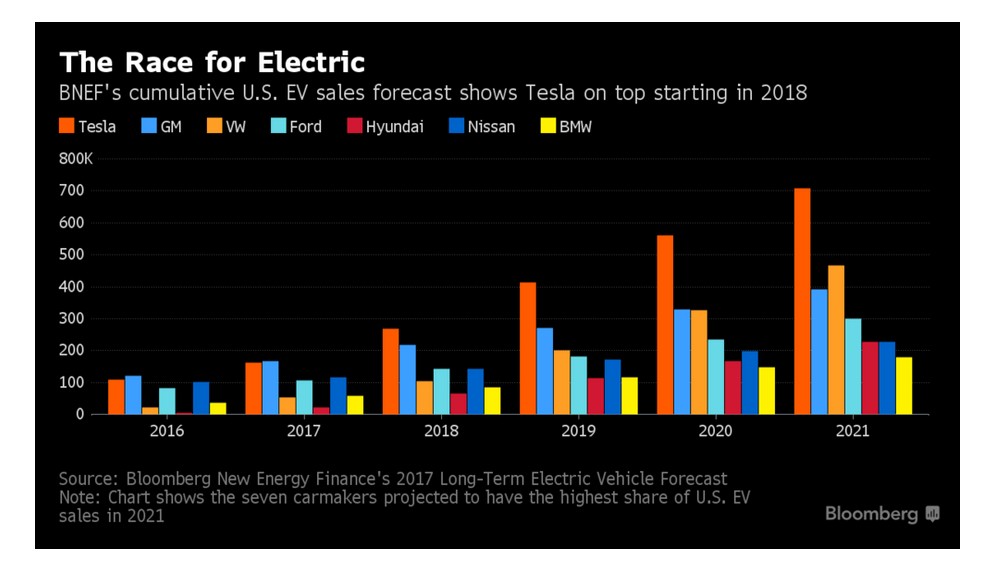
We saw a pretty good article from Bloomberg recently. The headline was “Tesla Projected to Win U.S. Electric-Car Race.” More than a dozen automakers are jostling to lead the U.S. electric-car race, but Bloomberg New Energy Finance (BNEF) sees a clear winner separating from the pack: Tesla.
BNEF expects Toyota’s Prius Prime plug-in hybrid to be the exception and hold the title of best-selling electrified vehicle in the U.S. this year. Tesla will get off to too late of a start with its Model 3 to catch up, with Musk planning to hold a handover party for its first 30 sedan customers on July 28. The company is aiming to ramp-up production to a rate of 20,000 cars per month in December.
“In the long term, we see battery electric vehicles winning because of the battery cost curve,” Bloomberg said.
Shopify (SHOP: $89, up 2%)
This past week, as you logged in to Shopify to check your sales or fulfill orders, you noticed a change: Shopify has had a makeover. The new look and feel is part of a broader effort to build the future of Shopify and supporting apps with one design mind, using the same set of guidelines. The improved design is now live in every Shopify store.
Why does it matter? Change can be hard sometimes, but these changes were actually designed to simplify the day-to-day navigation. The fresh look brings consistency across Shopify products, helps pages load faster, and makes content and menus easier to find and read.
BMR Take: Shopify is among the most exciting growth stories in the market today. EPS is expected to go from negative this year to $1.25 by 2020 starting what is expected to be a long term trail of sustainable EPS growth.
Apple (AAPL: $144, flat)
Apple has declined 7% from its all-time closing high of $156.10 in May, but the recent selloff represents yet another buying opportunity as investors turn their focus to the iPhone 8 launching this fall. Apple's quarterly results will be less important this summer as investors focus on the iPhone 8 this fall, along with the company's increased dividends and stock buybacks, lower valuation and new innovations as showcased at Apple’s Worldwide Developers Conference.
The upcoming iPhone cycle is setting up Apple to reach fresh all-time highs in the next 12 months, which would value the iPhone maker at over a trillion dollars. Apple's current market capitalization is around $750 billion. Wow!
There has long been an expectation that the next high-end version of the iPhone would have a new type of screen called an OLED (organic light-emitting diode). OLED screens boast more vivid colors and improved battery life. But they are also more difficult to produce, particularly at the levels that Apple requires for the iPhone. We believe that Apple will introduce this screen in the iPhone 8.
BMR Take: Apple remains among the most underappreciated stocks in the world. We looking at about $9 of EPS this year heading toward $11 in the next 1-2 years, giving it a forward PE of 13. Very low in our opinion.
Facebook (FB: $151, flat)
Facebook is building a village that will include housing, a grocery store and a hotel. Billions of people spend a lot of time living their lives on Facebook's social network. Now Facebook wants to try its hand at creating a community in the real world. In short, Facebook wants to build its own town.
Facebook unveiled plans on Thursday for the massive new construction project at its Menlo Park, California corporate campus, which is part of Facebook's plans to expand its home base. The 56-acre site, which Facebook bought in 2015 for $400 million, is located directly across the street from Facebook's headquarters. It will offer 1.6 million square feet of housing, or 1,500 units.
In a blog post announcing the plans, Facebook described the future development as a "mixed-use village" that will provide residents, many of which will be Facebook employees, with housing, transportation services and other amenities.
It will take roughly a decade to build. The initial phase of the project, which will include the housing and a grocery store, will be wrapped up in the first half of 2021. The subsequent phases will be completed every two years.
BMR Take: What can we take from this? The company is pretty confident in their 10-year plan and the outlook for their business to be making these kinds of internal investments. This year’s EPS of $5 is expected to double by 2020. With 2 billion users now, don’t miss being involved in this adverting giant’s success.
Mark Zuckerberg was quoted in the past week: “Give people the power to build community and bring the world closer together." Zuckerberg called the statement an extension of the company's original mission of making the world "more open and connected."
Facebook's unprecedented reach can be a powerful tool for tackling global problems and democratizing access to people and knowledge. "We feel like our responsibility is expanding, especially around passing this milestone of 2 billion people in the community," he said. "We’ve been thinking about what our responsibility is in the world and what we need to do."
We’re with you, Zuck!
PayPal (PYPL: $54, flat)
PayPal launched a campaign to reward freelancers in India. PayPal India has launched two new campaigns - Shopping Buddy and Go Global. The new campaigns will encourage Indian consumers and freelancers to buy and sell across outside of the country. Both campaigns will work on the concept of referrals. Available in more than 200 markets around the world, the PayPal platform, including Braintree, Venmo and Xoom, enables its over 200 million users to receive money in more than 100 currencies, withdraw funds and hold balances in their PayPal accounts.
Why did PayPal design the campaigns specially for the Indian market? India is the 2nd largest freelancer market outside of the US. India is also a hub for software exports, hence software and web related services constitute a significant portion of the freelancing business. Additionally, skilled women who have taken a break from their careers to manage the household, and retired professionals also contribute to this growing number in India.
BMR Take: PayPal is quietly emerging as a global payments power. India is so important to winning this battle and the above news is a great step in the right direction and a demonstration of the company being locked in on what needs to be done. With greater than 20% EPS growth as far as the eye can see, how can you not be involved here?
Square (SQ: $24, up 1%)
Payment-processing stocks had a hot week after a $10 billion deal between two industry players was announced. The news that Vantiv was buying London-based Worldpay for $10 billion has investors suddenly thinking about other combinations. Square shares rose 4% on Wednesday as result and finished the week strong.
For Square investors, consolidation in the payments industry is encouraging, because it means the fast-growing company could also be thought of as an acquisition target. PayPal is a much larger company than Square, with a market value of $66 billion, compared to $9 billion for Square, and it’s less likely a target. In fact, it’s a company that likes to acquire.
However, you look at it, the market is quickly realizing that the world is migrating to eCommerce and Square is as best-positioned as anybody.
BMR Take: Square is currently growing revenue at a 30% clip. Takeout valuations could be anywhere over a 20% premium to the current stock price. A compelling opportunity.
Upcoming Economic News
Consumer Credit SA
Monday, July 10, 3:00 PM
Period: MAY
Actual: N/A
Consensus: $13.3B
Prior: $8.2B
Note: Federal Reserve Statistical Release G. 19, Consumer Credit, reports most short- and intermediate-term credit extended to individuals, excluding loans secured by real estate.
JOLTS Job Openings
Tuesday, July 11, 10:00 AM
Period: MAY
Actual: N/A
Consensus: 5,975K
Prior: 6,044K
Note: Part of the US Bureau of Labor Statistics, the Job Openings and Labor Turnover Survey (JOLTS) program produces a monthly study that has been developed to address the need for data on job openings, hires, and separations. With the release of May 2003 data, the JOLTS program began publishing industry estimates based on the North American Industry Classification System (NAICS).
PPI ex-Food & Energy
Thursday, July 13, 8:30 AM
Period: JUN
Actual: N/A
Consensus: 0.10%
Prior: 0.30%
Note: The Producer Price Index (PPI) for all items less food and energy, often referred to as Core PPI, excludes the two most volatile components of the overall PPI for Finished Goods.
Manufacturing Production M/M
Friday, July 14, 9:15 AM
Period: JUN
Actual: N/A
Consensus: 0.10%
Prior: -0.39%
Note: Manufacturing production index measures real output in manufacturing. According to the NAICS, manufacturing relates to the mechanical, physical, or chemical transformation of materials, substances, or components into new products. Data is percentage change in relation to the last month.
An Update on Government Properties Income Trust (GOV: $17.90, down 2%)
This is what we said a week ago Wednesday, June 28th:
“First Potomac Realty Trust (FPO) is being acquired in a $1.4 billion deal announced today. The stock of Government Properties (GOV) is down 7% this morning to $20.25. First Potomac is a REIT with 11 million square feet of office space in and around Washington, DC. Government Properties, at a market cap of $1.4 billion, will now have an opportunity to prove its worth and assimilate the properties. This is creating a buying opportunity if you believe that management can turn around this company We believe they can and would be buyers of the stock here at the $20 level.”
Then last week we wrote this:
“Government Properties Income Trust (GOV: $18, down 19%)
“Don’t fall over in your chair! The stock got crushed this week, but it was because of an acquisition. Let us explain.
“First Potomac Realty Trust (FPO) will be acquired by Government Properties. To finance the deal, the company sold 25 million shares in a secondary at $18.50, raising over $450 million. They had to knock the stock lower to get the funds they needed. This is typical. We believe the deal will work out well, and that we will see a full recovery and then some.
“And the underwriters have been granted a 30-day option to purchase up to an additional 3,750,000 common shares. Two things: These overallotments are exercised about 99% of the time so expect to see another $65 million of cash in the bank. And expect to see the stock stay around this level for a month. Then there is a great likelihood that the stock will move back into the low 20s.
“You should be excited. The acquisition of First Potomac Realty Trust enables Government Properties to expand its business strategy to include the acquisition, ownership and operation of office properties leased to both government and private sector tenants in the metropolitan Washington, D.C. market area. The metropolitan Washington market area is one of the largest office markets in the U.S. and the nation’s largest beneficiary of spending by the U.S. government. Outside of the metropolitan Washington market area, Government Properties will continue to focus on acquiring, owning and operating office properties that are majority leased to government tenants.
“In addition to this transaction providing Government Properties with new potential growth opportunities, management expects to realize approximately $11 million of annual general and administrative expense savings compared to First Potomac Realty Trust on a standalone basis.
“Management is very pleased that they were able to achieve an attractive per share purchase price. Their preliminary estimates call for meaningful accretion and more detail will be forthcoming.
“BMR Take: NAV was $20.90 prior to raising some equity at $18.50. We don’t see any reason for the stock to trade at a discount to the lower level of $18.50. This is a buying opportunity for sure. Why do you think institutional investors just took down 25 million shares at $18.50? Get on board and put new money to work at a 9.4% yield right here in this name!”
Here’s our Take this week:
There have been no changes in the situation since the announcement. The stock is down 2% this past week, which is just noise, but we see that the stock has stabilized here at the $18 level, and in our opinion the only move the stock can make from here is up. The stock is paying a 9.6% dividend which is a bit too high historically, and thus a higher stock price will lower the dividend to the 8-9% ranges which we believe is quite sustainable. We are holding here and await the move back to the $20 level in the next few months.
A Word from Gary Jefferson
Jefferson Financial Group
First Vice-President, Investments
UBS Financial Services, Inc
An old stock market adage is "Calling a market top is a fool's errand." A Wall Street research firm wrote last week that calling a market top in today's market is just such a fool's errand because there is simply too much empirical evidence against it. First, the employment picture is pretty good from the standpoint of new jobs creation. (Of course, "if" new job numbers begin to substantially decline, it would be a red flag). Secondly, the latest Consumer Confidence Board report topped expectations. This indicates that consumers (70% of our economy is consumerism) are going to continue to consume. This is the engine that drives earnings. Lastly, the usual red flags that signal a major top just aren't visible – things like an inverted yield curve, a major technical breakdown (Nasdaq plunging below its 50 or 100-day moving averages), or, on a global basis, a major event such as a default by Italy or an economic collapse in China.
This is by no means to say that the market won't have a "top" in the sense of a "10% correction". It can happen even when nothing has really changed the fundamentals of the corporate earnings picture or for no real reason except media-hyped panic. There are many things happening in the market today that historically signal the possibility of a pullback in the 3-7% range. But long-term investors don't sweat the small stuff. It just isn't worth the aggravation and mental stress to try to time market corrections other than to possibly raise a little cash or to have some ready cash available to buy the dip. This is because it is nearly impossible to exit a stock, watch it drop 10% and then get back in before it jumps back up 5% before the opening bell one morning. It is literally impossible for anyone to successfully employ this kind of strategy.
The greatest risk ahead now seems to be what happens in Washington over the next few months, which is unfortunate. These events could either cause a market melt-up or a worse than average pullback – neither of which is predictable. Regardless of current conditions, in 90% of any market environment it makes sense to dollar-cost average large cash positions over several months as opposed to going all-in. That's because (quoting Ben Bernanke), "…….the 'market' is a very difficult subject. I've compared it to trying to learn how to repair a car when the engine is running…." It is difficult, but a long-term investor who is diversified and in quality assets will be just fine.
The High Yield Corner
By Michael Foster
Special to The Bull Market Report
The week was a bit harsh to many high yield investments, but a quick glance at The Bull Market Report picks shows that this is the result of a weak and temporarily frightened market The fundamentals, however, remain as strong as ever.
Starting with REITs, we saw Welltower (HCN: $73) fall 2% for the week, with those losses occurring almost entirely on Thursday. The marketwide weakness we saw did not leave REITs alone, so the decline was particularly pronounced here. However, Welltower shareholders should not despair; they’re up 9% year-to-date including the current near 5% dividend yield thanks to a dividend increase earlier this year. And dividend increases are very likely to continue. Over the last 12 months, Welltower has earned Funds from Operations (FFO) of $4.45, which gives the company a 130% dividend coverage ratio. As a rule of thumb, anything over 120% in REITs is healthy and anything over 125% indicates that the current schedule of dividend increases is likely to continue. For Welltower, that means a once-yearly pay raise is likely to continue.
This is a pretty big relief because higher borrowing costs in recent months have not been offset by higher rents for many REITs. That’s caused a lot of panicked selloffs throughout the sector, and Omega Healthcare Investors (OHI: $32) is no exception. The stock has been pretty heavily range bound after falling significantly in late 2016 - it's down 5% from a year ago - as it has been several times in 2017. Fortunately, the stock is up 3% from the start of the year so the bearish trend is clearly over even if we haven’t seen a breakout.
The interesting thing with Omega Healthcare is that investors frequently fret over the company’s dividend coverage. Omega’s management increases the dividend by a penny per share every quarter - and that is attractive to shareholders while also threatening the dividend coverage ratio. The only way Omega can cover those higher payouts is to aggressively expand. That causes frequent panics and a lot of anxiety, but a quick look at the numbers shows how silly those worries are. For the last four quarters, Omega’s FFO of $3.45 is far above the $2.50 annualized payouts at the current dividend rate and still higher if we assume penny-per-quarter payouts for the next four quarters. Either way, we’re talking about a dividend coverage ratio in excess of 130%, indicating that the dividend is absurdly safe despite the 8% yield that the stock currently offers.
In addition to the dividend payout growth fears, Omega has suffered from worries about uncertainty in Healthcare and the future funding of Medicare. Of course, Omega isn’t the only REIT suffering from this concern. Sabra Health Care REIT (SBRA: $23) fell 4% in the last week at a much higher rate than the marketwide decline in REITs. Fortunately, however, Sabra has been doing extremely well for a long time, meaning this selloff has little significant for long term shareholders. The stock is up over 12% from a year ago excluding its 7% dividend payout. And, as with Omega, the dividend is being covered by strong FFO - over the last 12 months the dividend coverage ratio for Sabra has been 130%, which is extremely solid, as with Omega. But investors fret over politics more often than they should, meaning Sabra isn’t getting the buy-in from investors that it deserves. That will change when the market goes back into risk-on mode*.
* When the market goes back to having an appetite for things like growth stocks, junk bonds, and REITs, instead of plowing into Treasuries.
Finally, Ventas (VTR: $67) is The Bull Market Report’s third Healthcare REIT pick that is known for its longer history and reliable dividend payments. As such, its yield is 4.6% following the near 3% price decline for the week. But as with our other Healthcare picks, Ventas is up for 2017 - up a solid 7% since the start of the year. The panicked Healthcare REIT selloff of late 2016 has been correcting itself in recent weeks and that is likely to restart again in the future as soon as this week’s hysterical fear ceases. No one knows when that will come, but it surely will; we’ve seen the market freak out suddenly several times since President Trump’s election, but the selloffs tend to be very brief and very shallow.
An interesting question to ponder is how this selloff and fear-based selling impacts municipal bonds, a safe haven for risk-averse investors. So far, 2017 has been pretty good for the asset class after a brutal 2016 selloff thanks to risk-hungry investors shifting to stocks. So far for the year, Invesco Municipal Trust (VKQ: $12.69) is up 4% - but the stock is still down 10% from a year ago. That gives the fund plenty of room to run in 2017, especially when we consider the fact that the fund is trading at a 6% discount to its net asset value. Similarly, Nuveen Municipal (NVG: $15.15) is up 5% for the year but is down 7% from a year ago. Like the Invesco fund, this is trading at a 6% discount to its NAV, providing another opportunity for gains as the market gets more excited about municipal bonds as a viable and lower-risk alternative to stocks and Treasuries, especially given the extra value that late 2016’s selloff provided. We are at the beginning of a trend in that direction, and it is likely to continue for quite some time.
Good Investing,
Todd Shaver
Founder, CEO and Editor
The Bull Market Report
June 25, 2017

by Todd Shaver | Jun 25, 2017 | Weekly Newsletter 7pm Sunday
The Week Ahead
Two themes are dominating the headlines heading into next week. First, several GOP Senators have come out to say they won’t vote for the Health Bill in its current form. But this is a yawn. Healthcare stocks rallied to end the week pushing past the uncertainty. Congress knows they need to do a good job because Americans are tired of their lack of accomplishments.
Second, everybody is talking about how Amazon will rule the world. Literally, the common question on conference calls now is: “Does your company have any Amazon risk?”. From Capitol Hill to Silicon Valley the bull market is rockin’ and rollin’. What a great time to be an investor. It won’t always be this good that’s for sure.
There is always a bull market here at The Bull Market Report! This week we highlight the following stocks: First Solar, Athenahealth, Tesla, Twilio, Bristol-Myers, and Eli Lilly.
Highlights From The Past Week
Fed Stress test results are in. And everyone passes. On Thursday the Fed released the first phase of its annual stress test which, once again, found that all 34 of the US largest banks "passed", exceeding minimum projected capital and leverage ratios under severely adverse scenarios, based on their projected ability to withstand economic shocks, which shows that "firms are getting the hang of the once-dreaded reviews." The result marks the third straight year all firms cleared the minimum requirements in the exams’ first phase, begging the question just how "stressful" this test truly is. Results covered the "Dodd-Frank Act Stress Test" that measures banks’ capital under stress over the nine quarters. The banking system is very healthy. This is good news for the bull market!
OPEC deal to impact the oil market. OPEC’s production cut deal is unlikely to survive beyond its current deadline in March 2018 many believe. This would result in a huge amount of extra oil to hit the market. OPEC’s most recent deal has not had the cartel’s desired effect on the markets, neither in terms of oil prices nor in drawing down the global glut. Why? OPEC finally decided to cut back production. This should have reduced supply and in turn led to oil prices recovering. But what happened instead? Those darn US swing producers just jumped right back into ramping up production at the opportunity of the void left by the OPEC cuts. Now we are seeing oil prices fall again.
OPEC can’t be pleased with the US nullifying their efforts. The ongoing oil drama is likely to continue. Fortunately, the bull market doesn’t seem to care. We will keep a close eye on the situation just in case as historically, energy boom and busts have had far reaching effects.
BMR Companies & Commentary
First Solar (FSLR: $40, up 11% for the week)
President Donald Trump proposed a solar wall across the Mexican border. And guess who is the likely winner of the contract, First Solar!
At a rally this week in Iowa, Trump announced plans to build a solar wall across the Mexico border.
It appears that the department of Homeland Security has issued 2 RFPs for border wall design prototypes - one for a solid concrete wall and a second for other alternative designs. One of the applicants has submitted plans to construct a border wall with solar panels that would be used for lighting, sensors and patrol stations at the border site as well as to sell excess electricity to the U.S. and Mexican customers. Selection of winning bids is expected sometime this month.
Media reports suggest that the border wall could be about 50 feet tall and would require anywhere between 1.5 to 5GW of solar panels resulting in $10-15 billion of expenditures. While more details have yet to be announced around transmission, permitting constraints, and so on, we expect this announcement to be an incremental positive as it shows that despite pulling out of the Paris accord, the current administration is actually thinking of plans to increase the use of solar and renewables. Moreover, a number of state governments have recently announced plans to promote solar
In terms of actual beneficiaries of the Trump wall, we note that the bidding process would likely involve a number of solar companies but considering the company's established market position, First Solar remain best-positioned to win much of this business opportunity.
BMR Take: Not including the above contract, First Solar EPS is expected to ramp from $0.51 this y ear to $1.34 in 2019, according to consensus estimates. This earnings level is expected off of a revenue base of $2.8 billion this year. You add the potential for a multi-billion dollar government contract and you can see why we like the stock.
Yes, we are underwater on this stock as the firm disappointed investors right after we added it to our Special Opportunities portfolio early last year. It happened fast and we elected to stay with the company through the turmoil. We have noted many times that a turnaround is in full force but it is going to take time, at least into 2018 for the turnaround to be fully successful. It appears to be on track and the stock is on a long slow trajectory to get back to the $60 level and beyond. Last week was a strong statement.
Athenahealth (ATHN: $146, flat)
Would Apple acquire Athenahealth? It might make sense. If Apple were looking to plunge deeper into the digital health market, it would make sense for Apple to buy Athenahealth in order to quickly get some scale. After all, the company’s market cap is less than $6 billion.
CNBC previously reported that Apple is working on ways to turn the iPhone into a way for patients to centrally manage their health data, with connection to a cloud-hosting platform. The idea rings familiar, as it’s the same strategy the company deployed with music.
While the industry continues to make progress, a major issue in Healthcare is adequate interoperability to ensure the seamless exchange of medical data. Apple has more than 1 billion iPhone users, but currently has limited access to clinical systems that capture data in hospitals and physician offices. Meanwhile, Athenahealth has instant access to approximately 10% of the market, 83 million patient records, and roughly half of all U.S. doctors through its health app. Athena’s platform could be a ‘disruptor’ for Apple.
Putting some credibility to the talk, we point out this interested fact - Athena’s CEO & co-founder Jonathan Bush is passionate about making a difference in Healthcare including bringing its technology into the 21st century and according to sources, apparently Apple would be one of few homes for the firm he’d consider.
BMR Take: Athena’s EPS is on track to grow from $0.65 this year to $1.45 in 2019. This growth was good enough for a major activist investor, Elliott Management, to get involved in recent months, which has sent the stock price soaring. But the upside is not done yet. A takeout could push shares much higher.
Tesla (TSLA: $383, up 3%)
Tesla set a new all-time high on Friday at $387, before settling a bit to close at $383. The market cap is $63 billion, as compared with GM at $52 billion and Ford at $44 billion. It’s got a ways to go to catch Toyota at $165 billion, but after you read our BMR Take, below, catching Toyota is not out of the question.
Tesla is reportedly considering launching its own streaming music service. The company has already spoken to the major labels about acquiring the rights to stream songs and albums from the biggest names in the world.
The company may still be a niche player in the auto world, but it is quickly becoming a more serious competitor, and there is no cooler or more in-demand product than Tesla right now.
It is already fairly easy to link a streaming platform and listen to music in a Tesla, but Musk and his employees are clearly interested in upping their offerings, which could make their cars that much more enticing to potential buyers.
Tesla apparently wants to offer several different tiers of this new musical product, all available at different price points. That’s a solid plan that few streaming outlets have been able to master, and few have even tried. If the company can deliver several different options for music lovers looking for different features at different prices, it could give the new service a competitive edge. And by helping it sell more cars, it could generate serious marketing revenue for Tesla.
BMR Take: Tesla is just one of the most innovative companies in the world. Who would of thought of a doing a music service? But they have the resources to pull it off. While Tesla is losing money this year (consensus calls for -$5.80 of EPS), the long term vision and potential here is unrivaled in the Auto sector. If you can’t drive a Tesla, at least ride the stock.
Note that we can foresee another secondary coming in the not too distant future. Tesla goes to the market to raise capital since they are still losing money in a huge way. The have 3.0 billion shares outstanding so selling just 1% of this in new shares, 30 million, would raise over $11 billion in fresh new capital. As we write this we are astounded at the math. No wonder the shorts are getting absolutely destroyed.
Twilio (TWLO: $29.70, up 10.5%)
We see several positive indicators ahead of Twilio. First, Twilio is seeing 20,000 inbound leads per month, up from 5-10,000 at the beginning of the year. Twilio hosted its Signal 2017 Developer Conference in May, which may have helped increase the lead flow. Twilio recently disclosed that it now has 1.6 million developer accounts on its platform, up from 1.0 million a year ago
Second, the sales organization at Twilio remains quite bullish and optimistic about the company’s prospects. According to reports, the long-time sales people at Twilio “have never been more bullish about this company.” Customer reviews show that 85% of reviewers have a positive business outlook about the company, 92% approve of CEO Jeff Lawson, and the overall rating for the company is 4.2 out of 5.0.
Lastly, there is a wisp of hope surrounding the Uber relationship. On the 1Q17 earnings call, management announced that its largest customer, Uber, was “changing the way they utilize and consume communications services.” Twilio said it expects Uber to remain an “important customer…going forward,” but lowered its 2017 base revenue guidance by $11-12 million as a result of the diminishing relationship.
All this aside, some people in the industry are now saying that Uber business might be back. Apparently, after an adjustment period in which Uber implements and executes on its multisourcing strategy, Twilio might be able to see its Uber business return to a growth phase. We sure hope this is the case.
BMR Take: We believe the stock represents an excellent opportunity for long-term capital appreciation. With sales ramping from $275 million a year ago to $360 million this year and heading to $600+ million by 2019, the lucrative 25% top line growth is an impressive feat.
Bristol-Myers (BMY: $57, up 4%)
Bristol-Myers’ stock has doubled the Healthcare sector index since April. While it has taken longer than expected for Bristol, the business outlook is finally starting to improve.
Hospital sales of Opdivo rose 13% in May compared with the 4-month moving average, according to data compiled by Symphony Health Solutions. Opdivo provided 23% of the latest quarterly revenue at the company. This blockbuster drug is having a major effect on lung cancer. It’s great to see these strong growth figures.
BMR Take: Many people continue to speculate that Bristol could be acquired. Recall that famous hedge fund investor Carl Icahn took a major stake in Bristol on this investment thesis and remains one of the company’s top shareholders. But at $93 billion, this would be a BIG acquisition. We don’t think a buyout will happen, but we are a secret admirer of Icahn. After all, he is worth $16 billion. We think he knows a thing or two.
Bristol is a healthcare bellwether. The EPS outlook is $2.90 this year and $3.15 next year, placing the P/E multiple attractively under 20x. With a 2.7% dividend yield, we like the fact that you get paid while you hold the shares. We see substantial upside potential with or without a takeout.
Eli Lilly (LLY: $84, up 2.4%)
As CEO of a 141-year-old Big Pharma company, Eli Lilly’s David Ricks has a fairly good platform for surveying the Healthcare ecosystem. He gave an interview this week and we highlight below some of the key takeaways.
Innovation and productivity are always a challenge for Big Pharma, so the unveiling of Lilly’s new expanded R&D facility warranted some celebration. Right now, the most exciting place is oncology. Something like half of the venture-backed investment is going into oncology companies. That’s because there’s a massive opportunity.
As everyone knows, the battle doesn’t end with an FDA approval. Drug pricing is a heated debate right now and soured sentiment on all of healthcare lingers. Obviously, there’s a lot of frustration with the drug pricing topic. Though one of the core problems is the changing model for insurance design, which is impacting the affordability of medications for people with chronic illnesses. A lot of the cost burden in the healthcare market right now has been shifted to premiums paid by consumers. The high level of premiums being paid today by consumers is not necessary. If political leadership can set new policies that take healthcare back to operating more efficiently, the cost burden currently being placed on consumer can ease up meaningfully.
BMR Take: Lilly is a top franchise in its market. With EPS of $4.10 this year expected to rise 5-10% a year for the foreseeable future, we like the prospects just on this alone. You add upside from innovation in oncology, and the possibility for drug price reform to increase sentiment, and a 2.5% dividend yield while you wait, it adds up to a recipe for investment success.
Upcoming Economic News
Dallas Fed Index
Monday, June 26, 10:30 AM
Period: JUN
Actual: N/A
Consensus: 18.2
Prior: 17.2
Notes: This is an indication of business activity.
Consumer Confidence
Tuesday, June 27, 10:00 AM
Period: JUN
Actual: N/A
Consensus: 116.7
Prior: 117.9
Note: The Conference Board's Consumer Confidence Survey is a monthly measure of the public's confidence in the health of the U.S. economy.
Pending Home Sales Index
Wednesday, June 28, 10:00 AM
Period: MAY
Actual: N/A
Consensus: 110.5
Prior: 109.8
Note: The National Association of Realtor's Pending Home Sales Index is designed to be a leading indicator of housing activity. This index measures housing contract activity.
Personal Income
Friday, June 30, 8:30 AM
Period: MAY
Actual: N/A
Consensus: 0.30%
Prior: 0.40%
Note: Monthly Personal Income and Outlays data are published by the U.S. Bureau of Economic Analysis. Personal income measures total pretax income earned by individuals, non-profit organizations, and private trust funds.
A Word from Gary Jefferson
Jefferson Financial Group
First Vice-President, Investments
UBS Financial Services, Inc.
The week which follows June option expirations (two weeks ago) has historically been one of the worst. But not this year. What we also like is the fact that oil has broken down below $45 per barrel and it hasn't dragged the market with it. Plus, the Fed raised rates AND laid out a plan to unwind its $4.5 trillion balance sheet (which represents its bond portfolio.) We said last week that such a move would likely be a headwind for the market, so one would think that the economy would have to be rather strong for them to approve both moves. It isn't, however, so we are at somewhat of a loss to understand the "exuberance" of the market in light of the statistics that clearly show a "softening" economy as opposed to a strong one:
Wholesale and Retail Inventories Down: Revised wholesale inventories shrunk 0.5% in April, the largest contraction in more than 12 months. The Commerce Department reported that retail sales fell 0.3% in May, marking the largest one-month drop since January of last year. That is just not a signal of a strong and growing economy, particularly in view of the fact that consumers are 70% of our economy.
Housing Data Weaker: U.S. homebuilding fell for a third straight month in May to the lowest level in eight months. Housing starts dropped 5.5% to a seasonally adjusted annual rate of 1.09 million units, which is well below forecasts of a 4.1% increase. Remember, 10,000 people turn 65 every day in the US (and will for the next 10+ years). These folks will eventually move, so homebuilding will have its own demographic headwinds to contend with in addition to the usual economic ones.
Economic Slowdown: The Fed has always targeted 2% inflation, but inflation slowed in April to an annual rate increase of 1.7% year-over-year, down from 1.9% recorded in March and 2.1% in February. Falling oil prices, excessive auto inventories and increasing apartment rental inventories will pretty much put the kibosh on reaching the Fed's target rate of 2% unless there is a dramatic turnaround in the last half of the year. We know that economic growth slowed in the first quarter, with GDP increasing at only a 1.2% annual rate - down from 2.1% in Q416. It's supposed to come in above 2% for the 2nd Qtr, but we'll have to wait for the numbers to come out.
Lower Expectations: Last but not least, the Bloomberg U.S. Economic Surprise Index, which measures whether economic data beat expectations, fell below zero for the first time this year. This signals potential headwinds moving forward.
Many experts believe the market has already priced in some of the new Administration's "growth agenda". However, the "Trump" trifecta (lower taxes, infrastructure spending and healthcare reform) is a nofecta at this point. Unless something gets done before the August recess, the markets will have to face the probability that zero gets done this year. If that happens, we will really need to get excellent earnings to avoid hearing the dreaded sound of air coming out of the market's balloon. And, it will be interesting to see if the Fed moves forward with another rate hike in 2017 in light of the weaker "Big Picture."
Cloudera Update
Cloudera (CLDR: $16.35, down 6%) had another rough week. The stock has gone straight down since we added it three weeks ago. In the earnings report for the June quarter, revenue was $80 million, an increase of 41% from the year ago quarter – a strong showing in our book. They operated at a loss which had been expected, but the market didn’t like this and took it out on the stock. The company went public two months ago at $15 and the firm was able to pocket $250 million in cash, so the company can stand a few quarters of losses, as long as revenues continue growing at this exalted rate.
BMR Take: Nothing has changed in the last three weeks except for the price of the stock. The company is still moving forward dramatically with increased revenues and we don’t expect this to change. Big revenue increases like this always win in the end. But this is not a stock for the weak. It is below our Sell Price, so if it is too painful for you, you should reduce or eliminate your position and watch from the sidelines. We believe in the company but obviously are too early on this one.
Nutanix Update
Nutanix (NTNX: $19.31) had a great week, up 9%. The firm is knocking down new business in bigger chunks lately, with two of its new orders valued at more than $5 million, while 35 deals were more than $1 million each. The firm added 800 new customers last quarter, hitting the 6000 customer mark, and the market is just starting to recognize this and is anticipating another strong quarter ending this week.
BMR Take: Revenues last quarter were big, hitting $192 million, up from $115 million a year ago. That’s 67% growth. We’ll take that to the bank any day of the week. This is still a relatively small firm, with a market cap of just $2.3 billion, so it’s not like investing in a Google at $675 billion, almost 300 times as big. So when you invest in firms that we recommend, do some serious thinking about the relative risk involved. Of course, Nutanix at $19 can go to $38 a lot easier than Google going from $966 to $1932. And for that matter, Nutanix and go to $9.50 a lot easier than Google can go to $483. It’s all relative. Risk vs. reward.
The High Yield Corner
By Michael Foster
Special to The Bull Market Report
The AGIC Equity and Convertible Income Fund (NIE: $19.69) had a relatively flat week despite a fall in price on Wednesday with volumes slightly higher than the fund’s average. That’s helped the fund achieve a 7% year-to-date return on top of the current 7.7% yield, which is in excess of the 6% annualized return since the fund’s inception in 2007. We’ve seen the fund maintain its dividends with no evidence so far that the dividend will be cut. The fund’s NAV has also seen a 9% return year to date, meaning the fund’s discount to its NAV has improved slightly from the start of the year. We like this one.
The PIMCO Dynamic Income Fund (PDI: $30, flat) had a similarly solid week, although the price action here has been more steady. The stock is up 2% in the last 30 days. The fund is currently trading at a 7% premium to its NAV as a result of a strong price appreciation over the last two years. Currently, Pimco Dynamic is up 8% year-to-date and is up 11% from a year ago, which excludes the fund’s 9% dividend yield. Huge.
And keep in mind that this excludes the fund’s special dividends, which have been 3% or more of the fund’s market price in recent years. While it’s too early to make any estimates of what that special dividend will be at the end of 2017, it is evident that we will see another special dividend come to shareholders. Remember last year in the fall and early winter? We talked about it incessantly and guess what? They came through in flying colors, issuing a $1.45 dividend on December 22nd. What an awesome Christmas present.
And now, let’s take a look at REITs. The Bull Market Report High Yield portfolio is heavily focused on a variety of REITs of various types. This week was favorable to all of them.
Digital Realty Trust (DLR: $120, up 4%) has been on a non-stop tear as investors continue to bet positively on the firm’s recent merger with DuPont Fabros Technology (DFT: $65), with synergies from the merger, making this an increasingly valuable reason to buy the stock. Shareholders can rejoice in the 23% gain in 2017.
While the data center space is seeing continued mergers and investor enthusiasm, the Healthcare sector is enjoying a much more low-key run. Omega Healthcare Investors (OHI: $34, up 4%) saw steady price gains for the week. Omega has been an interesting stock for a few reasons. After hitting the current level in April, we saw a pretty heavy dip to bring the REIT to be flat for the year, a rarity in 2017, which has treated REITs kindly. Previously at The Bull Market Report, we have discussed this as a somewhat random outflow of capital with no clear catalyst. The firm’s funds from operations, which is the primary metric when analyzing income and dividend sustainability, is stronger than ever, and the stock’s 7.5% yield is not at risk. So what’s driven the decline? There really is no clear answer, but it doesn’t matter much anyhow; no bad news has come from the firm and it’s since recovered to be up 8% for 2017. Omega Healthcare remains a firm hold for income investors.
Our other Healthcare REIT recommendation has also done extremely well. Care Capital Properties (CCP: $28) is up a whopping 5% for the week, being one of the best REIT performers of the week. That brings Care Capital’s price growth to 10% for the year. This is an eventuality that we have been waiting for for a long time. Care Capital was significantly oversold late in 2016 as a result of market fears that the Healthcare REIT sector would be decimated by President-elect Trump’s plans to overhaul Medicare/Medicaid. But nowadays the news from D.C. has much more to do with politics than policy, and healthcare reforms seem to be sidelined as D.C. focuses on other things. This has helped investors return to Care Capital. As they well should. It’s a solid REIT with over 100% dividend coverage and growing FFO, making us long term holders.
Note that Capital Care is being acquired by Sabra Health Care REIT (SBRA: $25) and it too, had a good week, up 5%.
Government Properties Trust (GOV: $23) was flat on the week with very little volume. In fact, volume has plummeted from a year ago. This may in part be a result of the strong showing the stock has had in 2017 - we’re up 19% already. When The Bull Market Report first recommended this stock, it was yielding 11% thanks to market fear around the company’s pivot towards more private office acquisitions. We did not see a problem with this, identifying it more as a diversification strategy that would lower the firm’s risk profile. The market seems to have taken to this view, as the stock now yields less than 8% thanks to its recent price run-up. Despite the significant capital gains this stock has provided The Bull Market Report REIT portfolio, we encourage investors to hold on to their shares and see what happens at the firm’s late-July earnings call. Any dramatic change in FFO or occupancy rates could make us change our view, but that seems to be an extremely unlikely eventuality.
Finally, a note on AstraZeneca (AZN: $35, up 1.5%). This was one of our big contrarian recommendations last year and we saw the stock fall significantly after our recommendation. Stubbornly, we stuck it out and encouraged readers to hold the company while the market gets its act together and recognizes that dividend coverage is solid thanks to well-managed cash flows, and a pipeline with many promising drugs ensures earnings growth is around the corner. Finally the market has realized its mistakes, and shares are up 29% in 2017. We are now up 17% from our initial recommendation, but more price growth is expected down the road. Again, investors should keep their AstraZeneca shares and enjoy the unrealized gains they’ve had, along with the gains in other High Yield Portfolio holdings. We see more gains coming ahead.
Good Investing,
Todd Shaver, CEO, Founder and Editor
The Bull Market Report
Since 1998
June 4, 2017
by Todd Shaver | Jun 4, 2017 | Weekly Newsletter 7pm Sunday
The Week Ahead
Skepticism mounts for a post-June rate hike at the Fed. While Janet Yellen and her Federal Reserve colleagues are poised to raise interest rates at their meeting this month, investors increasingly doubt the central bank’s projection for additional hikes following soft reports on U.S. employment and inflation. Goldman Sachs pushed back its forecast for a third rate increase this year to December from September. Investors are now pricing in less than one rate hike in 2018 for the first time since the eve of the U.S. elections in November. What does it all mean? As long as the Fed is accommodative with low interest rates, we see the bull market continuing.
There is always a bull market here at The Bull Market Report! This week we highlight the following stocks: Nutanix, VMware, Microsoft, Tesla, Tesoro and Splunk.
Highlights From The Past Week
"It's Not Just Wages" - Workers Without College Degrees Face "More Instability" If you believe San Francisco Fed President John Williams, the US labor market has almost never been more robust than it is today. Of course, middle- and working-class Americans who are struggling with levels of financial uncertainty that would be unfamiliar to their parents’ generation don’t necessarily care that the official unemployment rate is 4.3%. They’re too busy struggling to make ends meet when real wages have been stagnant for decades and economic growth is expected to slouch along at 2% for the foreseeable future. While researching their new book “The Financial Diaries,” Jonathan Morduch and Rachel Schneider followed more than 200 working and middle-class families around for a year and tracked “every dollar of their financial lives." They found that millions of workers without college degrees, especially those who are paid hourly, or who are paid by commission, experience what they call “income variability” - when their pay fluctuates by 25% above or below their average. Perhaps some of us can relate to facing "income variability" challenges, which is why you look to The Bull Market Report for good investment ideas to help supplement your future financial plans.
Stockman Warns Trump "Not a Chance of Reaching 4% Growth" Stuart Varney, the Fox Business economic host, recently interviewed David Stockman, the former Director of Office of Management & Budget under Ronald Regan. Stockman said that, during Reagan’s tax cut policy ranging from 1983 until Reagan’s exit in 1989, the U.S economy grew at an annual rate of 4.8%. However, he went on to say that there is no way we get to that level under Trump. To do so will require Trump-style inflation first, or “Trumpflation”. Doing so might not even be a good idea, he reminded the audience, by pointing out that Reagan’s greater than 4% growth was followed by a massive and deep recession in 1991 and 1992.
Central Bank Cash Flood Spurring Borrowing The good news for investors is that riskier assets will probably keep rallying in the near term. Companies and consumers have substantially boosted their leverage in the past few years as central bankers worldwide flood the market with cash to suppress borrowing costs. Though one thing to watch out for is lower recoveries in the future. In other words, companies and consumers that eventually become insolvent will have fewer assets available to repay their growing mountain of obligations. This is already happening on a small scale in the U.S. Auto industry, which has been suffering recently from falling sales and lower used-car values. Consumers borrowed more money than they could repay to buy new cars and trucks and are now defaulting on those loans at an increasing pace. Ultimate recoveries have declined to levels not seen since 2009.
BMR Companies & Commentary
Note: We would like to reiterate a part of our philosophy of investing here at The Bull Market Report. First of all, we primarily pick and follow stocks from this country. We don’t really have any great interest in Chinese companies. There are a few exceptions, but there are plenty of stocks to look at in this country, without worrying about what’s happening in Europe or Asia.
OK, on to the BMR Company section.
Nutanix (NTNX: $18.58, -5% - net changes in this newsletter are for the week)
Nutanix is a United States-based company that is an enterprise cloud platform that converges servers, virtualization and storage into an integrated solution.
Dheeraj Pandey, founder, chairman and CEO of "hyper-converged" technology vendor Nutanix is going up against all the old guard of tech, including Cisco. Hewlett Packard, Dell and VMware. He is undaunted, explaining his views on how companies and people evolve to new circumstances. He was recently interviewed and some of the excerpts are below.
Will Nutanix ever go all software? Is there are time when Nutanix will be all software, and stop making its own hardware appliances? Not anytime soon, he suggests. "Customers want a consistent experience, and the appliance will always be important for us. So, it’s very early to say that, for at least the next three to five years, it’s still an important part of our strategy” to have hardware. One reason is that some customers might want a “low-end” appliance. Pandey has noticed that other companies that were all software stumbled when they tried to meet such demands because it hit their high profit margins. “It’s about how we use the software gross margins to do a better job,” he says. "Oracle has done a good job of this, with their appliances. They started in software, and for us it’s the other way around. But think about how our software balances out the total company profit."
What about cloud computing? Doesn’t it constrain Nutanix’s growth? Not in Pandey’s view. In fact, he quickly rattles off the figures about Amazon’s AWS cloud service that he has committed to memory. When it was at $8 billion in annual sales, it was growing 84% per annum. When it reached $13 billion the slowed to 43%. "At $30 billion annually, they will be maxed out,” he says. "When we started this company, combined we had a $35 billion incumbency we were up against,” he says, referring to Cisco, privately held Dell, EMC, and the many other enterprise companies. In other words, $30 billion of AWS is not unlike the $35 billion of entrenched vendors Nutanix has already taken on. Then he adds, "What is the overall TAM [total addressable market] of computing? It’s about $215 billion, between servers and storage and networking. But OPEX [operating expenses] is over $400 billion annually." “So, it's more than a $600 billion market that needs to be addressed."
BMR Take: We feel Nutanix is undervalued, trading at 2.6x the consensus 2018 estimated sales forecast with Nutanix growing revenues 52% faster than peers.
VMware (VMW: $95, -2%)
Founded in 1998 and headquartered in Palo Alto, CA, VMware is the leading provider of virtualization solutions. Its virtualization solutions separate the operating system and application software from the underlying hardware, resulting in improvements in efficiency, availability, flexibility, and manageability, while lowering IT costs. In recent years, VMware has expanded beyond virtualization to include Software-Defined Data Center, Hybrid Cloud Computing, and End-User Computing.
The company reported strong F1Q18 results, with EPS of $0.99 (consensus $0.95) on revenue of $1.74 billion (consensus $1.71 billion) and also raised guidance for the year.
Overall, a number of things are going well for VMware, including: 1) its new products like NSX and vSAN, which grew license bookings 50%+ and 150%+ y/y, respectively; 2) its partnership with Dell, which is beginning to yield revenue synergies; and 3) perhaps most interestingly, the VMware Cloud on Amazon Web Services (AWS) seems to have relieved CTOs of some cloud transition anxiety and unlocked spending on VMware solutions.
In terms of the tech spending environment overall, CEO Pat Gelsinger made two key points. First, he simply said, “From the macro sense, we feel good.” Second, he argued that VMware is a beneficiary of the concept of digital transformation. In particular, as “every business is becoming a tech business,” VMware is “uniquely positioned to benefit from many of those trends” with its cloud offerings and software-driven offerings.
VMware said that it “made great progress with Dell this quarter.” In particular, Dell “grew well and performed a bit better” than VMware had expected in F1Q18. Management cited a number of key product areas that are benefiting from that partnership. In addition, VMware expects roughly $250 million of the $1 billion of revenue synergies from the partnership to be materialized in FY18.
BMR Take: We see VMware as a compelling value trading at just 18-19x the consensus 2018 earnings of $5.25, compared with $4.75 for 2017. Fundamentals are strong, revenue growth is in double-digits, and the new partnership with Dell brings excitement and much promise.
Microsoft (MSFT: $72, +3% - a new all-time high)
Microsoft is an American multinational technology company headquartered in Redmond, Washington, that develops, manufactures, licenses, supports and sells computer software, consumer electronics and personal computers and services. As we all know!
[Follow us here closely, as this discussion is about to get technical.] Microsoft Azure is a growing collection of integrated cloud services that developers and IT professionals use to build, deploy, and manage applications through the company’s global network of datacenters. With Azure, customers get the freedom to build and deploy software, using the tools, applications, and frameworks of the their choice. Azure modernizes IT applications. [For those of you more technically savvy folks, below is some of the specifics on how. For those of you who are bored by this, skip down to BMR Take, below.]
Microsoft will soon be delivering the Azure Stack capabilities that will provide Azure cloud services to customer and partner data centers. Combining current Azure cloud capabilities with the Azure stack will position Microsoft as the market leader in true hybrid platform and solutions which meet customers where they are, based on their current cloud adoption maturity. This hybrid approach translates into increased Microsoft hybrid platform adoption regardless of their current cloud maturity but more importantly secures an organization's future modern IT growth on the Microsoft hybrid platform.
A key reason Microsoft can leapfrog competitors is that its hybrid solution will allow customers to maintain their current Microsoft investments (e.g. platform, identity, infrastructure, tools, and resource skills) and extend their IT experience across cloud, hybrid, and on-premise.
It also overcomes connected and disconnected scenarios and data sovereignty limitations that limit many customer’s abilities to develop modern IT applications and accelerate their movement to hybrid models that best meet their risk and data requirements. Also, most Azure marketplace solutions will work on Azure Stack without modification driving more ISVs to promote their cloud-only offerings to on-premise opportunities expanding their potential revenue stream.
A key driver for Azure Stack adoption will also be the hardware and chip companies that can sell a full solution combining their hardware and Microsoft services for on-premise solutions. This will incent hardware manufacturers like Intel, HP, Lenovo to promote an Azure stack solution to maximize their hardware margins. It will also increase Microsoft hybrid adoption by customers driven by hardware partners.
Microsoft is best positioned to maintain its current on-premise customer base and to accelerate further Microsoft Azure adoption through unified development and operations capabilities and by Hardware and Cloud Software providers that want to take advantage of on-premise scenarios.
BMR Take: Microsoft Azure is one of the best assets in cloud technology and is fueling a new wave of growth for the company. While Microsoft is at all-time high, set Friday, the valuation of just 18x the ability to generate $4 of EPS with healthy dividends and buybacks, culminates in what we believe to be a compelling value.
Splunk (SPLK: $63, flat)
Splunk is an American multinational corporation based in San Francisco, that produces software for searching, monitoring, and analyzing machine-generated big data.
Splunk sold off quickly following Q1 earnings 10 days ago. However, most of the Q1 metrics in terms of revenue, billings and operating cash flow were solid. Furthermore, the revenue guide for Q2 and 2018 were raised a bit relative to consensus. The negative reaction towards Q1 results stemmed from License revenue and current product billings metrics that were soft and were attributable to Cloud revenue contribution and Europe region revenue under-performance.
The European results may have been related to deal-timing issues. Field contacts indicate that demand generation events have been well attended by prospects and sales activity in that region has been robust. Nevertheless, the shortfall in Q1 is going to necessitate that Splunk make organizational changes to get that region back on track.
Post Q1 checks indicate the Cloud business continues to enjoy momentum. AWS established a Quick Starts deployment option for Splunk this past February which could facilitate additional business on the AWS platform. Splunk continues to get tremendous leverage from the AWS platform.
Splunk has over 745 active partners globally, and the company wants to grow that number carefully, as we have seen other IT Security vendors suffer from being over distributed.
BMR Take: After a strong performance in the seasonally weakest quarter of the year, we would be buyers of Splunk on any weakness. Despite more than tripling revenue between FY:2014 to FY:2017 and consistently beating analyst expectations, the stock is 37% below the peak made in 2014. Now is a great time to take a closer look if you have not already.
Upcoming Economic News
United States - Total Light Vehicle Sales
Sunday, June 4 8:00 PM
Period: MAY
Actual: N/A
Consensus: 17.0M
Prior: 16.8M R
Unit: Millions of Vehicles
Institute for Supply Management (ISM) - Non-Manufacturing
Monday, June 5, 10:00 AM
Period: MAY
Actual: N/A
Consensus: 57.0
Prior: 57.5
Unit: Index
Notes: The Non-Manufacturing ISM Report on Business is based on data compiled from monthly replies to questions asked of more than 370 purchasing and supply executives in over 62 different industries representing nine divisions from the Standard Industrial Classification categories. A reading above 50 indicates that the non-manufacturing economy is expanding; below 50, that it is declining.
JOLTS* Job Openings
*Job opening and labor turnover survey – Janet Yellen’s favorite
Tuesday, June 6, 10:00 AM
Period: APR
Actual: N/A
Consensus: 5,725K
Prior: 5,743K
Unit: Thousands of Units
Notes: Part of the US Bureau of Labor Statistics, the Job Openings and Labor Turnover Survey (JOLTS) program produces a monthly study that has been developed to address the need for data on job openings, hires, and separations. With the release of May 2003 data, the JOLTS program began publishing industry estimates based on the North American Industry Classification System (NAICS).
Consumer Credit
Wednesday, June 7, 3:00 PM
Period: APR
Actual: N/A
Consensus: $15.0B
Prior: $16.4B
Initial Unemployment Claims
Thursday, June 8, 8:30 AM
Period: 6/03
Actual: N/A
Consensus: 240K
Prior: 248K
United States - Wholesale Inventories
Friday, June 9, 10:00 AM
Period: APR
Actual: N/A
Consensus: -0.3%
Prior: -0.3%
Notes: The Monthly Wholesale Trade Survey provides monthly estimates of sales and inventories of wholesale trade industries. .
A Word from Gary Jefferson
Jefferson Financial Group
First Vice-President, Investments
UBS Financial Services, Inc.
Well, finally, the market broke out and set a new all-time high, with the Dow closing above 21,200. This was despite some concerning bad economic news. New Home Sales for April fell 11%. The Richmond Fed Manufacturing Index for May fell off a cliff. The headline number declined from 20.0 to 1.0 and it was the first time in five months to be in single digits. New orders fell from 26 to zero. Order backlogs dropped from 4.0 to -15. The shipments component fell from +25 to -1. This suggests the post-election optimism in manufacturing sector is crashing. Another troubling component was shopper traffic that fell from 27 to 7 and expected demand fell from 96 to 73. Inventories fell from 24 to 1.
As we have said repeatedly, earnings fundamentals, of course, are ultimately the key in determining the price or value of a stock. Numerous research articles have shown that companies receiving upward earnings estimate revisions outperform the market while companies receiving downward earnings estimate revisions underperform the market. That's pretty much just plain old common sense. The fact remains that earnings estimate revisions are still the most powerful force impacting stock prices. Therefore, earnings, not other economic data, carried the day. Earnings are going to be the key that determines where the market ends up this year – i.e., they need to stay on track for the market to remain above 2400 and continue to move higher (2436 now.) And there was some good news to counter the weak numbers listed above which was found in the most recent GDP numbers:
GDPNow released it estimate at +3.7% for Q2 estimates and the Blue Chip economist consensus was at +3.1%. After eight years of sub 2%, these are very good numbers.
There are a couple of questions which need answering in order to get more clarity on the future of earnings. These include:
1) How many rate hikes will we get this year? Most analysts expect two more. The bigger question may be what the Fed will do to its balance sheet – if they decide to reduce it, this could create some issues for earnings and stocks.
2) Are current earnings growth estimates without a tax cut already priced into today's market? We think so. The question is raised whether tax cuts are still even possible or whether Trump's pro-growth agenda is completely derailed by a dysfunctional Congress caught up in all the political drama. It still seems to us that the market wants tax reform and wants the economic stimulus that will be provided by tax cuts, repatriation and infrastructure programs. As long as these things are still possible, we think the market will grind higher.
And, there are always the wild cards of 1) oil prices 2) an acceleration in the recent bond rally (bonds still compete with stocks) and 3) the overall world economy, in particular China. The bottom line at this juncture: The market is still signaling that it expects the current expansion to continue.
More on VMware (VMW: $95, down 1%)
VMware set a new all-time high on Thursday at $98 before settling a bit on Friday in a calm market. Here’s an update.
There are 34 Wall Street analysts that follow the stock:
18 Hold Ratings, 16 Buy Ratings
Targets:
5/31/2017 Royal Bank of Canada $110
5/31/2017 Robert W. Baird $115
5/25/2017 Cowen and Company $98
What are analysts saying about VMware stock?
Here are some recent quotes from research analysts:
"VMware’s revenues continue to register strong growth driven by its innovative product offerings. The company continues to benefit from its strength in the virtualization and hybrid cloud market. Its innovative product pipeline, strategic partnerships, frequent contract wins and robust international sales are expected to drive overall results.”
Drexel Hamilton: "VMware delivered a better than expected 4Q16 and we are pleased with the outlook for FY18. Moreover, VMware authorized an additional $1.2 billion stock repurchase program. As such, we are raising our price target to $105 from $90 and reiterate our BUY rating."
Robert W. Baird: "VMware posted a good Q4 and F18 guide. Its public cloud strategy is actually beginning to make sense, and we believe Dell has a better chance of driving revenue synergies than EMC.”
Jefferies Group: "Midway through an earnings season when many infrastructure software companies either reported soft results, guidance, or both, VMW reported one of its best quarters in years and gave very strong guidance that easily exceeded expectations.”
Note that VMware's management team includes the following:
Michael S. Dell, Chairman of the Board
Patrick P. Gelsinger, Chief Executive Officer, Director
Zane C. Rowe, Chief Financial Officer, Executive Vice President
Ownership of the company.
VMware's stock is owned primarily by Dell Technologies at 82%.
VMware declared that its board has authorized a share repurchase program in April, which allows the company to repurchase $1,2 billion in shares.
Cash and Debt
The company has $8 billion in cash and just $1.5 billion in debt. We like these numbers.
BMR Take: VMware is a fabulous company and we are seeing the rewards of the past few years as the company continues to tweak its business model and management continues to improve. With Michael Dell in control now, we expect even bigger things in the future. We wouldn’t be surprised if he decided to buy out the small interest in the company that he doesn’t already own. We added the stock at $83 and our Target is $95. The stock shot through our target recently so we hereby raise our Price Target to $108, and our Sell Price to $90 from $80. With the bull market continuing we expect to see the Target reached this year.
Tesla CEO and the Paris Climate Accord
Elon Musk had vowed to leave President Donald Trump’s advisory councils if the president were to pull the U.S. out of the Paris climate accord. Tim Cook of Apple placed a call to the White House on Tuesday with the same message. 25 companies, including Intel and Microsoft, have signed on to a letter that ran as a full page advertisement in the New York Times and Wall Street Journal on Thursday. A television ad ran Wednesday showed CEOs of top U.S. companies backing the pact.
To many of Musk’s fans, it’s about time. The accord was decades in the making, involving more than 200 nations representing almost the entirety of humanity.
He said Wednesday via Twitter before the announcement on Thursday:
“Don’t know which way Paris will go, but I’ve done all I can” to convince Trump to stick with U.S. commitments made under his predecessor, Barack Obama. Asked what he’d do if Trump decides to leave, the chief executive said he “will have no choice but to depart councils.”
Well, guess what? Trump ruled that we leave. Musk stuck to his word and left.
Tesla Motors (TSLA; $340) had another amazing week on Wall Street. The stock was up 5% to a new all-time high set Thursday. The company is worth $56 billion now.
The founder of Tesla and SpaceX angered many of his supporters earlier this year when he started meeting with Trump and joined the president’s business and manufacturing advisory councils. Some customers even canceled their $1,000 reservations for Tesla’s upcoming Model 3 electric car and posted their refunds on Twitter. Musk continued to advise Trump even as Uber CEO Travis Kalanick succumbed to similar pressure to step down. Musk insisted that it was his chance to ensure the president was hearing from people who take the threat of climate change seriously. Obviously, Trump doesn’t listen to the top minds of the world.
The only nations that haven’t signed on are Nicaragua and Syria.
Tesoro (TSO: $84.50, up 1%)
Tesoro is an independent petroleum refining, logistics and marketing company. The Company operates through three segments. The Refining operating segment refines crude oil and other feedstocks into transportation fuels, such as gasoline and gasoline blendstocks, jet fuel and diesel fuel, as well as other products, including heavy fuel oils, liquefied petroleum gas and petroleum coke for sale in bulk markets to a range of customers within its markets. The Logistics segment includes crude oil and natural gas gathering assets, natural gas and natural gas liquids processing assets, and crude oil and refined products terminaling, transportation and storage assets acquired from third parties. The marketing segment sells transportation fuels through branded and unbranded channels.
On the Street there are 19 firms that follow the stock.
There are 3 Hold Ratings and 16 Buy Ratings
Here are the Targets that a few firms have on the stock
5/30/2017 Morgan Stanley $110
5/19/2017 Credit Suisse Group $100
4/27/2017 Royal Bank of Canada $98
4/22/2017 Citigroup $104
4/19/2017 Jefferies Group $94
BMR Take: We’ve been saying for quite some time now that Tesoro is undervalued. But it’s been frustrating waiting and waiting. As you can see above, the Street has a strong following and high hopes for the company. Our Target remains at the high end as well at $110.
The Weekly High Yield Corner
By Michael Foster
AstraZeneca (AZN: $35, up 4%) had another strong week to help the stock reach a 52-week high, bringing the stock’s 1-year return to 18% excluding dividends. AstraZeneca has been an interesting company for a while, because it suffered both from market worries about pharmaceutical regulation and worries about British companies following Brexit. Both concerns have so far failed to materialize, with both the British economy showing consistently strong numbers and threats of pharma regulation having little bite in a Trump administration.
Instead, pharma is having something of a renaissance. FDA drug approvals have doubled from a year ago. At the same time, AstraZeneca’s pipeline is looking extremely strong. The company has unveiled new products on top of three recently released cancer-fighting drugs, bringing the firm halfway to its 2020 target to release six new medications for a variety of cancers. Ovarian cancer and lung cancer drug studies are so far looking good, with new drugs in Phase 2 and Phase 3 testing. That indicates a continually strong pipeline.
That, in turn, has made the stock more expensive in more than one way. Not only is the price up, but the stock’s PE ratio has risen to over 26. With new drugs in the works, this higher valuation is not unsurprising. It also means that Bull Market Report readers who bought this stock when it was down big got in at a much better valuation and are now better positioned to profit from the future earnings that drug pipeline will deliver.
Our Target has been $37 and our Sell Price has been $29. We raise both to $42 and $32 respectively. The all-time high of $39 set in 2014 is within reach.
More diversified Bull Market Report picks had a less strong but still good showing in the last week, with Invesco Municipal Trust (VKQ: $12.80) and Nuveen AMT-Free Municipal Credit Income Fund (NVG: $15.15) rising over 1% each in the last week. These funds are still delivering a 5%+ tax-free income stream and have delivered modest capital gains since the start of 2017. Both are also offering modest discounts to their net asset values (i.e., the value of the total assets in the fund if sold at market price and immediately distributed to shareholders).
Since Nuveen’s early 2017 dividend cut, the fund’s net investment income has been exceeding distributions on average and the fund is clearly better positioned to have a more sustainable dividend payments in the future. In fact, many municipal bond funds, following dividend cuts in the last five years or so, have been showing greater dividend sustainability in recent months. Why is this? Well, in part it’s because of the weakness in municipal bond markets last year. When muni bond prices go down, their yields rise, and that is actually a good thing for municipal bond funds like these. At the recent higher interest rates paid by already-issued municipal bonds, these funds can buy more aggressively by increasing leverage and/or by buying higher yielding bonds after older bonds in the portfolio are called away or expire. Since both the Nuveen and Invesco funds have loaded their portfolios with lower-duration municipal bonds (that is, bonds that expire in the next 3-4 years) over the last half decade, they have been in a prime position to buy more bonds.
If this sounds complicated, rest assured: These guys know what they’re doing. Nuveen and Invesco have seen their bond funds attract significant capital this year. They have the market experience and knowledge to take advantage of the recent weakness in the municipal bond market.
Now let’s talk REITs. We have been recommending Omega Healthcare Investors (OHI: $31) for a long time, which is why the early 2017 bump in the stock was a welcome sign that the market had caught on to our point of view. In fact, in April and May we came across several articles on various websites pounding the table on Omega Healthcare, arguing that demographic tailwinds, a sound and growing income stream, and an absurdly cheap valuation made this a great stock to buy.
We couldn’t agree more, as we have been saying this for over a year. And at the start of 2017, it seemed the market as a whole had accepted this way of thinking. Then, in the last few weeks something odd has happened with Omega. On May 25, the stock tanked for no clear reason. Again, exactly a week later, the stock tanked again - but recovered slightly to end this past week flat. After all of this, the stock is down over 3% from a year ago excluding dividends that yield 8% at the current price (and note those dividends have gone up every quarter). So no one who owns Omega should be crying just yet. In fact, it would make sense to buy at these current levels. The stock remains very well-valued considering its recent funds from operations report (think of it as EPS for REITs).
Elsewhere, we’ve seen Digital Realty Trust (DLR: $120, up 2%) continue to soar. The stock is now up over 21% year to date. That sounds like a heady number, but keep in mind that the stock was up a similar amount from the year before that. Why? We’re anniversaring the big REIT run-up of 2016, which was both great for Digital Realty and something of a curse in the late months of the year. Of course, that wasn’t a curse for us, since The Bull Market Report continued to recommend buying aggressively as the stock fell. Investors who did that in late 2016 are now sitting on more than 20% gains in a few months on top of the 20%+ gains from two years ago in June, 2015. Granted, the big price run-up means Digital Realty doesn’t really qualify as a “high yielder”, and one may question whether its 3% yield really prices in the risks of the data center rental space. That means the risks of buying at these levels are greater than before, and one may prefer to just hold the stock.
Let’s look at our Target and Sell Prices. We added the stock at $85 in early 2016 so we are up 41% not counting the dividend. The Target is currently $120 and the Sell Price is $89. We always hate to sell stocks that are doing well because of a previously picked Target Price. After all, the stock might go higher. So we will do this. We are going to set the Target at $125 but move the Sell Price up to $115. If it hits $115 we are out.
Good Investing,
Todd Shaver
Founder, Editor and CEO
The Bull Market Report
Since 1998
May 29, 2017

by Todd Shaver | May 29, 2017 | Weekly Newsletter 7pm Sunday
The Week Ahead
Is the bull market long in the tooth? Nah. In the past year, many fundamental and technical arguments have been offered to explain why the now eight-year-old bull market in U.S. stocks is due for at least a solid correction. And yet the stock market has gained ground in recent months, casting some doubt on these metrics but again suggesting the market is long in the tooth. Even news events that pro-market measures such as tax reform might be imperiled – or at least delayed – haven’t hurt stocks at all. So stay invested!
There is always a bull market here at The Bull Market Report! This week we highlight the following stocks: Nutanix, Twilio, The Blackstone Group, Splunk, and Tesoro. And a special report on Tesla.
Highlights From The Past Week
Short Sellers Resist Covering as S&P 500 Retakes Record Last Week It usually doesn’t work this way: Stocks vaulting to records, and bearish traders getting more aggressive. Lately, it has. The S&P 500 Index has climbed 8% since January, including its biggest gain since April in the just-completed week. Just one week ago, stocks suffered their worst rout in eight months as concerns over Trump’s presidency surfaced. Yet the loss was quickly erased and the S&P 500 rose seven straight days to reach a record high. It rose 1.4% to 2,416 last week, finishing with the best gain in a month. The Dow Jones Industrial Average added 279 points, or 1.3%, to 21,080, and closed just 3 points from its record high set Thursday. Technology shares continued to outperform as the Nasdaq 100 Index jumped 2.0% to close at a record high.
Short interest as a proportion of total shares outstanding has expanded, rising by 0.3 percentage point to 3.9%. Not since 2008 has an equity advance as big as this year’s occurred simultaneously with more short sales. It’s not hard to see why bears are standing firm, when any mishap from President Donald Trump could wreak havoc in a market where valuations sit at levels not seen since the dotcom era.
Fed's Williams doubtful of 3% economic growth. San Francisco Fed President John Williams said fiscal policy will not matter much to monetary policy over the next several months. He expressed doubt economic growth will rise sustainably to 3%, as assumed in President Donald Trump's budget proposal, because of certain possible changes in tax rates or policies. A giant jump in productivity growth is required to reach growth that much above the 1.50-1.75% range he thinks is currently sustainable. Williams supported gradual rate hikes and sees no pressure to do more than the two further hikes this year expected by most Fed officials, citing softer inflation readings. You may recall that Williams previously advocated 3-4 rate hikes this year. As to the Fed's balance sheet normalization*, Williams said details have yet to be decided, but promised a blueprint in coming months. Once the trimming begins, the Fed will not tinker with the plan unless there is a significant shock to the economy, emphasizing the process should be gradual and fundamentally on autopilot. In previous statements, Williams suggested the time horizon could be about five years.
* Normalization is the reducing of the size of the Fed's balance sheet. They bought a lot of assets in the Financial Crisis. Now it’s time to unwind that.
BMR Companies & Commentary
Nutanix (NTNX: $19.59, +22%, all changes in this newsletter are for the week)
Nutanix is a United States-based company that markets an enterprise cloud platform that converges silos* of server, virtualization, and storage into an integrated solution.
*An information management system that is unable to freely communicate with other information management systems. Communication within an information silo is always vertical, making it difficult or impossible for the system to work with unrelated systems. It occurs when departments or management groups do not share information, goals, tools, priorities and processes with other departments. The silo mentality is believed to impact operations, reduce employee morale and may contribute to the overall failure of a company or its products and culture.
The company delivered a great quarter highlighted by large-deal momentum. Nutanix reported fiscal 3Q17 EPS of -$0.42 versus the consensus -$0.45 on revenues 67% higher, year over year, of $192 million versus the $187 million expected. Management indicated Nutanix built up a significant backlog of deals that booked but did not ship in the quarter. Nutanix revenue topped analysts’ expectations, and produced a smaller-than-expected loss, and beat comfortably with its outlook for this quarter’s revenue. For the current quarter, the company sees revenue of $215 million to $220 million, and a net loss of 38 cents, better than consensus for $205 million and a 39-cent loss
There were three key takeaways from the quarter: (1) the sales transition toward large enterprise is progressing nicely (2) management's F4Q17 guidance implies billings growth of 32% Y/Y, compared to consensus of 24%, driven by continued confidence in the North American sales organization, large deal momentum, and a significant backlog buildup; and (3) we believe the momentum in large deals, combined with adoption of new technology (shipped on 23% of nodes compared to 9% in year-ago quarter), support the favorable thesis that Nutanix is becoming the preferred next-gen data center platform for enterprises.
The most exciting thing happening is that the shift to larger accounts is bearing fruit. As management indicated on its January-quarter earnings call, Nutanix is undergoing a transition to build a named account sales organization that targets larger enterprises. We think results in the April quarter demonstrate that the transition is now on a positive track and is generating noticeable returns. Management indicated its North American sales organization, which experienced sales execution issues last quarter, snapped back, with the region posting the best sales productivity since F4Q16, a period in which billings accelerated to 120% Y/Y growth.
We believe the better productivity was, in large part, driven by strong momentum in the large enterprise, where Nutanix has increasingly focused its sales efforts. Management indicated business from the world’s largest customers reached record levels in F3Q17, as they were 50% greater than any quarter in the company’s history. Nutanix landed 13 deals that were greater than $2 million in bookings in the quarter for a total of $45 million, compared to only four deals in F2Q17 over $2 million. We believe it has been an ongoing goal to move upmarket and we view the strong performance in the quarter as clear validation of the opportunity for Nutanix in that market.
CEO Deeraj Pandey said the results “reflect our continued focus on the global 2000, as well as a measurable improvement in the number of larger deals in the quarter, particularly in North America."
They ended the quarter with 6,200 customers, adding 800 new customers in the quarter, and ended the quarter with $350 million in cash and equivalents with no debt.
Nutanix shares still have 'significant upside,' says Piper Jaffray. They believe Nutanix has a strong competitive advantage and kept an Overweight rating on the name.
BMR Take: We feel Nutanix is undervalued, trading at 2.6x the consensus 2018 sales forecast, with sales growth of 70% this year and 35% next year.
Twilio (TWLO: $25, flat)
Founded in 2008, Twilio is the leading cloud platform for communications. Similar to Amazon Web Services, Twilio plays a critical role for software developers by allowing them to easily and securely build services such as voice, messaging, video, and authentication into their software applications and then scale those services globally.
We have a mix of good news and bad news to report from a major industry conference called SIGNAL 2017 that Twilio attended this week. The good news is that Twilio is doing the right things to win in the company’s addressable market, including: (1) building high quality, reliable technology services that have 99.99% availability that customers love; (2) introducing new features and products at a rate of one every 3.5 days, a rate competitors are hard-pressed to match; and (3) rapidly adding developers to its community, including 600,000 in the last 12 months, double the amount added in the prior 12 months, resulting in a total of 1.6 million developers on Twilio’s platform. (We find this hard to believe, but we have verified these numbers. Astounding.)
The bad news came from Airbnb, which indicated in its presentation that it is pursuing the same kind of multi-sourcing strategy that led to Uber significantly reducing its spending on Twilio in 1Q17.
BMR Take: Consensus estimates call for 2017 EPS of -$0.29 on revenue growth of 30% and for 2018 EPS of -$0.09 on revenue growth of 27%. Twilio currently trades at a 2018 price to sales multiple of 5x, which is cheaper than many other high growth internet companies. We hope Airbnb sticks around as a customer, but if they don’t, some part of the negative impact is already factored into the current lower valuation.
The Blackstone Group (BX: $33, +9%)
What a great week Blackstone had. Finally! Founded in 1985 as an M&A boutique, Blackstone has grown to become one of the largest and most broadly diversified global alternative asset manager in the world. Blackstone manages $370 billion of assets, roughly equally divided across four segments: Private Equity, Real Estate, Credit, and Hedge Fund Solutions.
This week Blackstone Group announced an investment management agreement in conjunction with CF Corporation’s acquisition of Fidelity & Guaranty Life (FGL), which we believe could represent an interesting longer-term opportunity. In addition to the agreement, Blackstone’s Tactical Opportunities and GSO businesses are investing capital alongside CF Corp. in the deal.
Upon the closing of the transaction, which is expected in 4Q17, Blackstone will earn roughly 20 bps on total assets ($28 billion today), which equates to $55 million of fees (around 1% of 2018E EPS). Not a bad little boost to the bottom line!
Over time, we believe the bigger opportunity for Blackstone will revolve around FGL’s ability to grow within CF Corp. (which we suspect is a big focus), which will drive incremental fees to Blackstone. While the near-term financial impact is small under conservative assumptions, we view the announcement as a positive, given the long-term strategic implications.
BMR Take: Blackstone has made some exciting announcements recently between FGL and the $40 billion infrastructure deal. Plus, the stock is inexpensive, trading under 11x 2018 EPS estimates with a juicy 7% dividend yield.
More Blackstone News
Saudi Arabia joined the parade of investors into U.S. public works by pledging a record investment with Blackstone Group. The country’s Public Investment Fund agreed to commit $20 billion to Blackstone’s new infrastructure fund in the latest push around the world by large investors to buy up airports, pipelines and other public projects, particularly in the U.S. Blackstone said the kingdom’s money would seed an investment fund that whose goal is to reach $40 billion and reach $100 billion with added debt, and by raising money from investors like sovereign-wealth funds, public pensions and rich families. With assets of $370 billion as of March 31, Blackstone manages nearly twice as much as its closest competitor, Apollo Global Management. Each of Blackstone’s four platforms - real estate, private-equity, hedge funds and credit - are among the largest investing businesses of their kind.
Our Thoughts on Things Going on in the World as it Relates to Our Stocks
We don’t talk much about world politics and the US administration here at The Bull Market Report. We watch it closely, but we understand that you are coming to The Bull Market Report for financial news, not mass murders, or the upsetting changes in the status quo in Washington DC. We know that that Trump does have an effect on the markets – we are not stupid or naïve. But the stock market is concerned with revenues and profits, and companies will do everything in their power to produce same, despite what Trump does. As we have seen, he has little effect on most of the things he campaigned about, and the S&P 500 and all the small companies in this country are focused on growing revenues and earnings. We like it that way. We believe in the financial health of America.
Splunk (SPLK: $63, -5%)
Splunk provides software solutions that enable organizations to gain real-time operational intelligence in the United States and internationally. By leveraging a proprietary technology to turn machine data into real-time operational intelligence, Splunk is benefitting from its position as a pioneer and leader in the world of machine data with its core software platform, Splunk Enterprise.
Starting off FY:2018 on the right foot, Splunk reported 1Q:FY18 revenue of $242 million (up 30% YoY) that exceeded the Street’s estimates at $234 million, and a loss per share of a penny that beat the Street at a loss of 4 cents. The company added more than 500 new enterprise customers during Q1. They lifted its revenue outlook for the fiscal year to $1.2 billion. Revenues for the past three years are $450 million, $670 million and $950 million. We’d say they are the right track. They have $1 billion in cash and no debt.
The tone of the call was positive for the seasonally weakest quarter of the year. We continue to believe that Splunk is very well-positioned to benefit from the Big Data wave in the coming years. Splunk is chasing down a big market opportunity and the company raised its total available market opportunity at its analyst meeting in January to $55 billion from the $45 billion.
BMR Take: After a strong performance in the seasonally weakest quarter of the year, we would be buyers of Splunk on any weakness. Despite Splunk more than tripling its revenue between FY:2014 to FY:2017 and consistently beating analyst expectations, the stock is 37% below the peak made in 2014. Now is a great time to take a closer look if you have not already!
Tesoro (TSO: $83, flat)
Tesoro is an independent refiner and marketer of petroleum products. Tesoro, through its subsidiaries, operates seven refineries in the western United States with a combined capacity of 900,000 barrels per day.
We are pleased that Tesoro announced that the waiting period applicable to its proposed acquisition of Western Refining has terminated. This satisfies one of the final conditions to the closing of the pending acquisition. Tesoro therefore expects the closing of the acquisition to occur on June 1, 2017. This news means the deal is highly likely to now close!
As a reminder, why do we like the Western Refining deal? The synergies of putting the two companies together are big. At first glance, we think the originally announced target synergies for the merger – including savings of $350-$425 million – look overly conservative. We believe there is opportunity to reach further into Tesoro’s legacy operations to optimize the retail business, and we believe the overall footprint in the Bakken could be sold for a lot. This is all just the low hanging fruit. Opportunities to optimize logistics in the Permian region could be another leg of upside over time. In summary, not only does Tesoro become an even larger franchise in the sector, but EPS is expected to go from $4 to $7 over the next few years.
BMR Take: We continue to see compelling value in Tesoro shares. The stock trades at a massive discount to post-merger net asset value estimates of $120-140 per share. In comparison, Berkshire Hathaway owns a 15% stake in Tesoro’s competitor Philllips66, which the market values at a premium to net asset value. With several big name institutional investors recently taking large positions in Tesoro, we can’t help but be excited about the prospects for this investment.
Note to our Readers:
We are well aware of the problems on our website getting current prices and data. We get our data feed from Yahoo and they have just informed us that they are discontinuing that service. Needless to say we are not pleased and we are working on the issue. We should be up and running with a solution this week.
Note: Just after we wrote this, we have a solution. Everything should be up and running perfectly Tuesday morning. Yea!
Upcoming Economic News
Consumer Confidence
Tuesday, May 30 10:00 AM
Period: MAY
Actual: N/A
Consensus: 119.5
Prior: 120.3
Note: The Conference Board's Consumer Confidence Survey is a monthly measure of the public's confidence in the health of the U.S. economy.
Personal Income
Tuesday, May 30, 8:30 AM
Period: APR
Actual: N/A
Consensus: 0.4% over last year
Prior: 0.2%
Note: Monthly Personal Income data are published by the U.S. Bureau of Economic Analysis. Personal income measures total pretax income earned by individuals, non-profit organizations, and private trust funds. Wages and salaries are the largest component of personal income.
Chicago PMI
Wednesday, May 31, 9:45 AM
Period: MAY
Actual: N/A
Consensus: 57.9
Prior: 58.3
Note: The Chicago Business Barometer provides an overall gauge of business activity as published in the NAPM - Chicago monthly Business Report. An index reading above 50% indicates that economic activity is generally expanding; below 50%, generally declining.
Pending Home Sales M/M
Wednesday, May 31, 10:00 AM
Period: APR
Actual: N/A
Consensus: 0.6% over last year
Prior: -0.8%
Note: The National Association of Realtor's Pending Home Sales Index is designed to be a leading indicator of housing activity. This indicator measures housing contract activity. It is based on signed real estate contracts for existing single-family homes, condos and co-ops. A signed contract is not counted as a sale until the transaction closes.
ISM Manufacturing
Thursday, June 1, 10:00 AM
Period: MAY
Actual: N/A
Consensus: 54.7
Prior: 54.8
Note: The Manufacturing ISM Report on Business is based on data compiled from monthly replies to questions asked of purchasing and supply executives in over 400 industrial companies. The PMI is a composite index based on the seasonally adjusted indices for five of the indicators with varying weights: New Orders; Production; Employment; Supplier Deliveries; and Inventories. An index reading above 50% indicates that economic activity is generally expanding; below 50%, that it is generally declining.
Nonfarm Payrolls
Friday, June 2, 8:30 AM
Period: MAY
Actual: N/A
Consensus: 175,000
Prior: 211,000
Note: This is survey data measuring nonfarm payroll employment. Employees on nonfarm payrolls are those who received pay for any part of the reference pay period, including persons on paid leave.
Average Workweek
Friday, June 2, 8:30 AM
Period: MAY
Actual: N/A
Consensus: 34.4
Prior: 34.4
Note: This is survey data measuring the average workweek for production or nonsupervisory workers on private nonfarm payrolls.
Is Tesla Where Apple Was 10 years Ago?
We read a great article in Business Insider about comparing Tesla and Apple which was written by Gene Munster of Loup Ventures. Formerly he was a senior research analyst at Piper Jaffray. Some excerpts:
Apple (AAPL: $153, flat) is the world’s largest company with a market cap of $800 billion. Tesla (TSLA: $325, up 5%) s an automaker with a market cap of $53 billion. There are many parallels between Apple about a decade ago and Tesla today, market cap being one of them. In 2005, Apple’s market cap was close to where Tesla’s is today. A decade from now, we think we’ll look back at Tesla and realize it was the next Apple. After all, the Tesla story is just getting started.
There are five major similarities to Tesla today and Apple in the mid-2000s:
1. Brand
2. Visionary leadership
3. Integrated hardware and software
4. Halo effect
5. Reshaping a market
Brand
Tesla has a great brand so far. Tesla owners love their Teslas, just as Apple users love their iPhones and Macs. 90% of Tesla owners state they would “definitely” buy their cars again, the highest rating of any automaker. The next two closest automakers are Porsche at 84% and Audi at 77%. By comparison, Tim Cook stated last year that the iPhone had a 97% satisfaction rate.
Tesla has built a brand around being a different kind of automaker. Not only because its vehicles are powered entirely by electric, but also because they don’t use model year numbers, and treat software updates more similar to updating an iPhone app than a car. The company has done this all while squarely placing itself in the conversation with BMW as one of the best-engineered cars in the world. Tesla is taking a new approach to the car market.
Visionary Leader
Elon Musk and Steve Jobs share similarities in that they are visionary entrepreneurs that simultaneously operated multiple groundbreaking companies. Musk with Tesla and SpaceX and Jobs with Apple and Pixar. However, both seem to have different guiding lights.
Where Jobs seemed to be singularly focused on developing the absolute best products he could to delight customers, Musk appears to be driven to save the world, from developing alternative energy products, to exploring space, to protecting humanity from AI. They both recognize the importance of quality to be successful.
Musk may be the biggest wild card in the comparison between the two companies. The drive to create great products is eternal from a business standpoint.
Obviously, the move to sustainable energy is a multi-decade opportunity. From an investment standpoint this may not matter, but from a philosophical standpoint it’s apparent that the world needs many things and Musk is convinced he can affect positive change.
He's already involved in Tesla and SpaceX as CEO. It was recently announced that he would also be CEO of Neuralink, a brain-computer interface company that creates a neural lace to enhance the human brain. Musk is also involved with The Boring Company, which is currently experimenting with tunneling under Los Angeles to reduce the traffic burden. Finally, Musk is involved with OpenAI, which is dedicated to creating open IP in artificial intelligence.
There will always be those capable of breaking conventional rules, in this case the importance of a laser focus. Musk is obviously one of those people. The only question may be if his desire to save humanity ultimately pulls him in too many directions. Musk has shown an ability to surround himself with great talent, enabling him to better leverage his own time.
Integrated Hardware and Software
Tesla, like Apple, produces its own hardware (cars) and its own software. Their integrated approach allows them to have complete control over the product experience, which is important because a car is a constant user experience when you’re in it.
Perhaps more importantly, Tesla has a multi-year head start over other automakers in terms of features like over-the-air updates and autonomous driving. As autonomous driving functionality becomes a requirement for modern auto buyers, Tesla holds an advantage in that its constantly improving self-driving software is an update away. Tesla's cars get wireless software updates that add new features to the car.
Looking at product categories beyond transportation, Tesla’s proven ability to integrate hardware and software will continue to set it apart from competitors looking to introduce real innovation. Their ability to control the product experience from end-to-end is an innovator’s advantage over the incumbents in industries that Tesla will address in the future.
Halo Effect
Perhaps more than any company in history, Apple has used the halo effect to its advantage. The company’s iPod represented a product that appealed to the masses, where the Mac computer line did not. Once customers adopted iPods and experienced Apple’s attention to detail in design and simplicity of use, it convinced customers to buy Macs.
The iPod also laid the groundwork for the iPhone. Combining the iPod with a phone had long been a topic of discussion, and those two features, combined with an Internet connection, were the iPhone’s features at launch. Now we see the halo effect in full with many iPhone owners also owning Macs, iPads, Apple Watches, and AirPods.
Tesla has a similar opportunity to create a halo effect through its cars. With the Model 3 starting at $35,000, a large audience of entry level luxury car owners are going to experience Tesla for the first time, and at a 90% satisfaction rate, they will be happy to join the club.
Aside from cars, Tesla also offers the Powerwall energy storage product ($5,500), as well as the Solar Roof and solar panels. We believe that Tesla owners will want to add other Tesla products to further reduce their dependence on traditional energy.
Tesla has taken over 400,000 pre-orders for the Model 3. For context, if you assume another 100,000 Tesla owners of Model S and Model X for a total of 500,000 Tesla owners in total by 2018-19, a 10% attach rate of Tesla owners buying the company’s Powerwall or solar products, and $30,000 in revenue from those products, there is an incremental $1.2 billion business opportunity in the near term due to the halo effect.
Reshaping A Market
Tesla’s stated mission is to accelerate the world’s transition to sustainable energy. The company is attacking two major industries - automotive ($1 trillion in US new vehicle sales in 2016) and electric utilities ($400 billion in US revenue in 2015). These industries make sense. Transportation accounts for 70% of total US oil consumption. 65% of electricity in the US is still produced by coal or natural gas. Tesla is creating a platform for sustainable energy from your vehicle to your home. Just as Apple captured significant value from the chain of industries it disrupted, we think Tesla can do the same.
As Tesla pursues its mission, it has a path to be one of the most valuable companies in the world. For the past 10 years, the largest company in the world as measured by market cap has been either Apple, Exxon Mobil, or Petrochina. Going back 20 years, the only other additions are Microsoft and General Electric. Therefore, either a consumer electronics company, an energy company, or a conglomerate represented the biggest company in the world. Tesla is all three.
Tesla’s cars are effectively consumer electronics, albeit expensive ones, that reduce our dependence on oil. Tesla’s acquisition of Solar City and introduction of the Powerwall and Powerpack are next-generation energy plays driving toward the replacement of coal and gas. Doing both makes it a conglomerate.
Tesla is not a car company. It's an operating system for sustainable energy that combines a powerful brand, a visionary founder, integrated hardware and software, and a halo effect all with the purpose of transforming a combination of large markets. Tesla might be the next Apple, as Tesla will forge its own path and the world will be better for it.
BMR Take: Wow. What a story. If this bullish scenario plays out and becomes reality, Tesla is a screaming buy - $1000 a share? $2000? If they run out of capital and have to be bailed out by a GM, Ford or Toyota, the stock is headed towards $100 and lower. But isn’t this the case with any new venture? Risk and reward. The stock market thrives on this.
We are in the bullish camp. We are Elon Musk believers and when the company starts producing cars in quantity in 2018 and 2019 and the world sees how great they are, then revenues and profits will accrue. What a story. We want to be a part of it.
Mazor Robotics (MZOR: $41, down 4.5%)
We are well aware of the price of the stock these past few days. The stock has been downgraded by a few firms due to valuation. Hmmm. What does that mean? It means the stock has gone up, perhaps higher than they ever thought. And yes, we know the stock has gone up. We are way up on the stock since we added it in the teens last year.
Needham restated a hold rating in a research report on May 11th. First Analysis downgraded shares from an overweight rating to an equal weight rating and boosted their target price for the company from $28 to $38 in a research report on the same day. Wells Fargo downgraded shares from an outperform rating to a market perform rating in a research report on May 11th as well. These aren’t stellar reports but they aren’t that bad either. As is common on Wall Street, they are just protecting themselves.
The recent downgrade was May 17th, 10-11 days ago, with nothing new since then. The stock is volatile and traded as high as almost $46 on the 18th, $45 on the 19th, and $43 on Monday of this week. It wasn’t until Tuesday that the stock sold off a bit. But it came right back later in the week. Note that the stock was at $35 a month ago. The point is that it’s not the end of the world. HOWEVER, we don’t know where the stock is going. We know where the COMPANY is going, but not the stock. We believe the COMPANY is doing well. Super well. But maybe the market will drop the stock to $35 or $30 and that would be devastating.
So what to do from here is up to you. We are going to stick with it a little bit longer and watch for it to get back on track. If it doesn’t we will exit with well over 100% gains.
The High Yield Report
By Michael Foster
One of the biggest events of the week was the big drawdown on Thursday of Omega Healthcare Investors (OHI: $32, down 6%), which is causing quite a bit of panic among high yield investors. The panic is in some ways compounded by the fact that this decline came on no news. Omega released their earnings back on May 3rd, with a slight miss on revenues that grew 9% year over year and in-line FFO, with reaffirmed full-year earnings guidance. This means that Omega’s dividend is covered by 135% - a very big number and unquestionably enough to not only support the current payouts but to even boost them higher. Since Omega has increased dividends every quarter since 2011, higher payouts aren’t too shocking.
That doesn’t mean Omega gets much love from markets. The stock has been range bound since shooting up in 2013, meaning its yield has gotten steadily higher thanks to those continual dividend hikes. But shares have remained below their all-time high in early 2015, and are now trading 16% below their 52-week high. Those metrics, combined with the recent sudden selloff, could cause panic in some investors’ eyes.
However, panic is unwarranted. The cause of the selloff is unknown (most likely one big institutional investor exited), but there’s no evidence that the long-term income growth behind this company is impeded by anything at all. What’s more, Omega shares are now at the upper end of their historical range, and will yield over 8% soon enough thanks to the company’s continual payout increases. This makes Omega a pretty good contrarian REIT play right now.
There’s just one problem: this company's been a good contrarian play for a few years now. Will Omega ever break out of this range and start to deliver capital gains?
There are a few reasons to think so, but let’s not get into that now. Instead, let’s think a bit about why you would want to buy Omega now or over the last six years. With increased dividends and ample dividend coverage, Omega has been a strong investment for anyone who wants capital preservation and a reliable income stream. Omega is a stock that reliably delivers about $65 per month in income for every $10,000 invested - and without loss of capital. It’s been doing that for years, which makes it a reliable play in a broader high yield portfolio.
So instead of asking whether Omega will earn us capital gains now or in the future, we should instead focus on the income stream. Is it in danger? Is there any reason to believe the dividend hikes won’t keep coming? Right now the answer to both questions is “no.” And for as long as it remains “no,” this is a stock worth considering for any high yield-focused investor.
Elsewhere in the high-yield world, the markets have been relatively quiet. The UBS BDC ETF (BDCS: $23, up 1%) and the SPDR Barclays High Yield Bond ETF (JNK: $37, flat) saw a modestly strong but mostly uneventful week. This is largely a result of a continually complacent credit market. Defaults are not spiking (despite harried tales of dying shopping malls and the end of retail commerce as we know it - this isn’t impacting corporate bonds to any significant scale.) And the future pace of Federal Reserve interest hikes is modest enough to not cause companies any big problems in repaying their debts. Also, as we have mentioned over the last few weeks, corporate profits are rising at large firms, which is making solvency more common and even encouraging more companies to take out more debt. In short, the corporate lending world is doing fine.
And beyond Omega Healthcare, REITs are fine too. The SPDR Dow Jones REIT ETF (RWR: $93, flat) had a decent showing this week thanks to the relative calm in many REITs, including the triple-net lease firms whose retail shopping focus was a cause for concern over the last couple of weeks. We’re also seeing a continual run-up in the tech-focused REIT world, a once sleepy and high-caution sector that is quickly turning into a market favorite. Digital Realty Trust (DLR: $118, up 3%) had yet another stellar week, bringing its yield even lower. We aren’t yet at a point where the tech REIT world is an overly crowded trade, but we are definitely inching in that direction every week.
Another big theme of the week has been OPEC, with the Saudis again doing all they can to put a floor on oil prices. They tried this back in November last year and failed miserably; oil prices fell after their oil production freeze, although that agreement spanned far beyond OPEC and reportedly had unusually high compliance. The high compliance and the multinational signatories indicates there is a lot of desperation among oil producers to do all they can to fight American shale. While it’s easy to interpret OPEC’s panic as a sign that oil prices will crash, that’d be overkill.
In reality, it looks like the range we’ve seen for crude oil futures will remain. That means oil companies who have gotten accustomed to this new price environment should be okay, and it also means companies that rely on energy to operate (i.e., just about everyone) won’t see input costs balloon. For high yield, this again is a good sign for seeing lower corporate defaults, but it also means MLPs aren’t as risky as they were in 2014 or 2015. The Alerian MLP ETF (AMLP: $12.16, flat) had a quiet week as a result, and MLPs haven’t seen either a panic selloff or an exuberant buy in the last year.
A quick word on Bull Market Report's diversified fund picks: The AGIC Equity and Convertible Income Fund (NIE: $20, up 1%) and the PIMCO Dynamic Income Fund (PDI: $30, up 1%) had a solid week thanks to NAV increases and higher demand for closed-end funds in general, while a sleepy municipal bond market meant Invesco Municipal Trust (VKQ: $12.70) and The Nuveen AMT-Free Fund (NVG: $15) saw little change. We are still waiting for more investors to realize the value in muni bonds, but with low volatility and market complacency, it may take a while for more investors to rotate back into munis and out of riskier stocks and corporate bonds. But it will happen - it’s just a question of when.
Good Investing,
Todd Shaver
Editor in Chief and CEO
The Bull Market Report
Since 1998
May 7, 2017
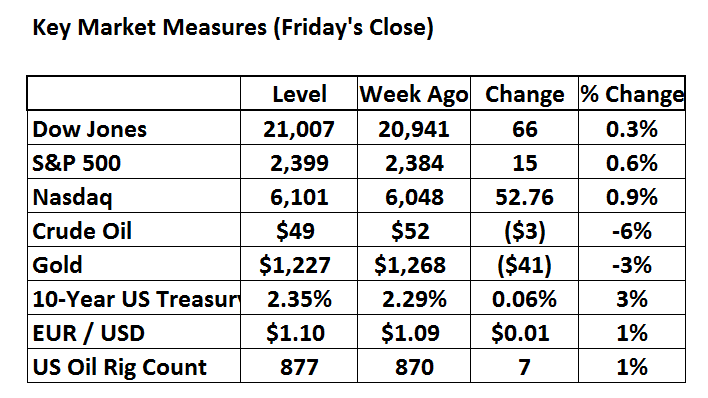
by Todd Shaver | May 7, 2017 | Weekly Newsletter 7pm Sunday
The Week Ahead
Well, it’s graduation week. Class of 2017 graduates are hitting the stage to accept their diplomas, listen to a keynote speech, make one last party, and then head out into the great big world. What will they find? GDP growth moving to 4% or stalling out around 2%. Will geopolitical tensions escalate as early as this year or find a sustainable comfort zone? Can equity prices hold? How bad will rising rates hurt the bond market? Everybody from the newest participant in the labor force to the most experienced must wrestle with these questions in the year ahead. We at The Bull Market Report hope to help you with some good insights about what to make of it all—week in and week out.
There is always a bull market here at The Bull Market Report! This week we highlight the following securities: Eli Lilly, Home Depot, Netflix, Splunk, PayPal, and VMWare. And a few others!
Highlights From The Past Week
Federal government expanding investigation of Fox News. The aggression against the media continues. Current and former Fox News employees have been interviewed, as authorities try to determine how settlement payments for sexual-harassment allegations were structured and which executives played roles in the payments. One source tells the WSJ that the investigators seem to be interested in intimidation tactics that former CEO Roger Ailes signed off on. The investigators are in the securities unit of the US attorney’s office, and no prosecution will necessarily follow. What does this all mean? You need to find trusted sources of information in this world. We strive to make The Bull Market Report a reliable and honest source of information for you to rely on.
It's the strangest thing: A hedge-fund manager apologizing for bad calls. Wellington Management Sr. VP Nick Adams isn't just apologizing for his mistakes on Silicon Valley venture deals -- which differ from the bank stocks he has a proven record with -- he's refunding fees. Adams, who has lost money two out of the past three years, put hundreds of millions of dollars into Mozido and Powa Technologies, which are both financially distressed. Adams has promised he won't ever invest in similar private deals in his flagship fund again. People familiar with the firm's finances say that after investors including Blackstone (BX) withdrew their cash, Adams's portfolio at the start of 2017 was $6 billion, down 40% from 2014. Adams has now returned to investing in traditional lenders like Bank of America and Citi, and his main fund rose 12% in Q1. We think there are lots of lessons to learn from this situation. For instance, if you ever wonder why many of The Bull Market Report’s stock picks are in household names that are often large cap stocks, well, now you know why. Traditional investing is a proven money maker and we try to take you where you can make money.
Don't assume the Healthcare industry will be fine. We think the market is right to assume that the Republican replacement for Obamacare won't be passed in its current version, but anything that hurts earnings for the sector could bring prices down, and the failure to pass any sort of healthcare reform may make a tax reform harder to achieve, which will be a negative for stocks more broadly. We all must keep an eye on this important event unfolding in Washington in the weeks ahead.
BMR Companies and Commentary
Eli Lilly (LLY: $83, +0.5% - All changes are for the week) Eli Lilly has more growth drivers than all its peers, but its continued pledge of "at least 5% annual sales growth" for 2015-20 is being called into question because a big portion of growth comes from two drugs - Jardiance and Trulicity - that have recently faced setbacks. We think Eli Lilly is a topnotch franchise in Healthcare and will overcome these hurdles.
Jardiance is a drug for type 2 diabetes. Johnson & Johnson has a competing drug called, Invokana, which is set to release new trial data in June. Everybody is saying that if Johnson & Johnson’s drug has good data, then there will be more pricing competition in 2018 for Eli Lilly’s drug. We think this risk is widely known, already factored into the numbers, and not a reason to not own Eli Lilly’s common stock.
Trulicity is also used for type 2 diabetes. It faces risks from the FDA's decision last August on Novo Victoza, specifically that this drug had problematic heart effects. Will the FDA say the same thing about Trulicity? We will find out in 2018. For now, it is overly pessimistic to assume Trulicity faces serious FDA challenges.
Note that Lilly's drug unit accounted for 83% of 2016 sales, with the balance coming from animal health, so the story is not just all about drugs. Also, Eli Lilly's operating margin trails most of its peers, except Bayer, and by leveraging new-drug launches, it aims to reduce R&D and SG&A expenses to 50% or less of sales in 2018 versus 56% in 2015. This target is achievable by Pharma standards as Jardiance's new heart label drives growth and Trulicity, an established product, continues to add to margins.
Lilly investors may be relieved by the good set of results in 1Q following recent drug setbacks. Older drugs, such as Cymbalta and Strattera, beat consensus, lifting margins and feeding through to the 2% EPS beat. Diabetes was strong with both Trulicity and Humalog beating consensus, while Jardiance missed by a little. Jardiance is a key driver of growth and while the miss raised eyebrows we say stay the course.
BMR Take: Eli Lilly is a top franchise in Healthcare boasting a market cap of $91 billion. On track to clear $5 of EPS, the stock is a good value.
Home Depot (HD: $156, flat)
A lingering debit/credit card breach has kept a lid on shares of Home Depot. The bad news is that it is so sad to see some large-scale breaches at US companies like Target and now Home Depot. The good news is Home Depot has taken strong steps to remedy the situation. In any case the stock is $1 from an all-time high, fast approaching $200 billion in market cap.
Companies hit by data breaches often face class action complaints filed by consumers. They also face lawsuits from shareholders looking to thwart future breaches and restore financial stability to companies in which they have invested. Home Depot's willingness to take meaningful but financially limited remedial mitigating action achieves a mutually beneficial resolution that companies facing any kind of data breach lawsuits, such as Yahoo, may rely on to improve their corporate data governance.
Under the proposed settlement, Home Depot will change many of its cybersecurity corporate governance policies. Home Depot agreed to document the duties and responsibilities of the chief information security officer; conduct table top exercises; monitor computer networks; maintain a “Data Security and Privacy Governance Committee;” hire a “dark web mining service;” receive reports on the company's information technology budget; join an information sharing program; and authorize the board to retain its own IT and data security professionals. Home Depot also agreed to pay $1.1 million in attorney’s fees and and $1.5 million to the shareholder representatives. They agreed to the settlement because it saw the attorneys’ fees as a minimal money issue and it believed the actions “would restore trust” in the company.
BMR Take: Home Depot is on track to deliver $10 of EPS and $100+ billion of sales. Don’t sweat the small stuff. Sorry to see the cyber breach, but the core business is doing great.
Netflix (NFLX: $157, +3%)
What could be more exciting than a Netflix merger with Apple? The world continues to talk about the prospects. Let’s break down the potential reality.
There may be as good as 40% odds that Apple acquires Netflix. The research arm of the investment bank Citi released a report with seven potential merger and acquisition targets for Apple. Tops on the list is Netflix. Elon Musk's Tesla, on the other hand, is only 5% likely. The full list of acquisition targets includes three media firms, three game developers, and, of course, one car manufacturer. Disney and Hulu are the media firms joining Netflix, while Activision, Electronic Arts, and Take-Two are the gaming companies.
Netflix makes a ton of sense, of course, as the company dominates streaming media both domestically and abroad. Disney has a strong list of properties as well, but slightly more oriented to traditional media consumption, whereas Netflix is well-positioned to take advantage of the continuing trend to cut the cord (cord-cutting has jumped 5x). Plus, Disney is worth $177 billion, whereas Netflix is worth $67 billion.
BMR Take: The future of TV consumption swings in the balance as the world moves away from traditional cable to the internet. Netflix is the powerhouse making the company a coveted asset in media. On track to do $10 of EPS by 2020 we see compelling value in the shares as a standalone entity even at current levels. A take-out could offer huge upside.
PayPal (PYPL: $49, +3%)
The PayPal network effect is working like charm. Investors in PayPal had plenty of reason to cheer last week when the company reported earnings. Nearly every metric was up by a better-than-expected percentage, surpassing expectations of all but the most bullish on the company.
More exciting to long-term investors, however, was the account growth and increase in user engagement with the company's core platform. Six million active accounts were added during the quarter, increasing the total to 203 million for the digital payments company. These active accounts now average almost 32 transactions per year, a 12% increase year over year. More customers using the company's platforms more often was a winning combination that the market liked.
PayPal's growth is beginning to fuel a powerful network effect opening a new window for the company. The beauty of this type of growth is that it drives itself. The more users that sign up for the platform the more important the service becomes for retailers to adopt it and the more places that accept it, the more attractive it becomes to new users. Get it?
At the end of March, 16 million retailers were accepting PayPal's core platform as a method of payment. Management is well aware of this virtuous cycle. During the conference call, CEO Dan Schulman stated: “Our powerful two-sided network engages both consumers and merchants, and the larger our scale, the stronger our network effect becomes. We made meaningful progress in advancing merchant adoption of PayPal in the quarter. At the end of March, the number of active merchant accounts on our platform increased to 16 million. The size of our merchant base is a formidable competitive advantage and is extraordinarily difficult for others to replicate.”
BMR Take: We think PayPal is in the middle of a decade-plus growth cycle that will deliver real value for shareholders. Stick around. They are already closing in on $3 of EPS.
Splunk (SPLK: $67, +4%)
Progress at Splunk is happening. Splunk, a provider of the leading software platform for real-time Operational Intelligence, recently announced support for SaaS Contracts in AWS Marketplace. Working with Amazon is a big deal!
The new globally available API capability* enables seamless procurement and deployment of Splunk® Cloud. The automated and accelerated purchasing process for Splunk Cloud via AWS Marketplace ensures fast time-to-value for customers leveraging Splunk solutions to gain real-time security, operational and cost management insights across their Amazon Web Services (AWS) and hybrid environment.
* Application program interface (API) is a set of routines, protocols, and tools for building software applications
The University of San Francisco is home to an innovative academic community of more than 12,000 students, faculty and staff. “As a higher education institution, USF prides itself on being at the forefront of technology, which is why we turned to Splunk and AWS,” said the vice president of information technology and chief information technology officer, University of San Francisco.
BMR Take: Working with Amazon gives Splunk big growth potential. The EPS outlook calls for great than 3x growth from $0.41 of EPS in 2017 to $1.35 of EPS in 2020. Ride this growth wave!
VMware (VMW: $94, flat)
VMware is out with some good news. The company is the first mobile application management provider to manage and secure hundreds of Oracle business applications and custom applications. As such, enterprise IT organizations can manage their Oracle application suite on a single unified platform together with their other business-critical applications and devices. Users who count on Oracle's business applications to make better decisions, reduce costs and increase performance can benefit by being able to access these applications through a simple digital workspace environment – be it from a mobile device, laptop or desktop – with VMware Workspace ONE and AirWatch.
What does that mean? VMware is continuing to make end roads in the lucrative cloud business, where growth is driving real results for stockholders.
The Chief Operating Officer, customer operations, said: "Mobilizing critical business processes is at the core of both of our organizations' DNA and this collaboration will help us advance this shared vision for our customers and their end users alike. We're proud to come together with Oracle to make it easier for IT administrators to secure and manage these critical mobile apps and help their end users seamlessly access them from any endpoint.” VMware Workspace ONE is the industry's only integrated platform for application and access management and unified endpoint management that enables simple enterprise secure access to any app from any device, accelerating adoption of digital workspaces.
BMR Take: The company is working. EPS is on track for $4.90 this year with growth upside to $6 in the next few years led by the cloud business and partnerships like the one described above serving Oracle.
Economic Outlook for the Coming Week
Monday, May 08, 2017 10:00 AM ET
United States - Labor Market Conditions
Period: APR
Actual: N/A
Consensus: N/A
Prior: 0.40
Labor market conditions index is derived from a dynamic factor model that extracts the primary common variation from 19 labor market indicators. It measures the changes of condition in the labor market. We expect to continue to see signs of a healthy labor market.
Tuesday, May 09, 2017 6:00 AM ET
United States - NFIB Small Business Index
Period: APR
Actual: N/A
Consensus: N/A
Prior: -$176B
NFIB Research Foundation has collected Small Business Economic Trends data from a sample of members from the National Federation of Independent Business (NFIB). Data from quarterly surveys since 1973 is based on 10 survey indicators. We expect to see an improving small business economy.
Tuesday, May 09, 2017 10:00 AM ET
United States - JOLTS Job Openings
Period: MAR
Actual: N/A
Consensus: 5,750K
Prior: 5,740K
Part of the US Bureau of Labor Statistics, the Job Openings and Labor Turnover Survey (JOLTS) program produces a monthly study that has been developed to address the need for data on job openings, hires, and separations. With the release of 2003 data, the JOLTS program began publishing industry estimates. We expect to see the JOLTS figures reveal a healthy labor market.
Wednesday, May 10, 2017 2:00 PM ET
United States - Treasury Budget NSA
Period: APR
Consensus: $166B
The monthly U.S. government surplus/deficit is published in the Monthly Treasury Statement (MTS). The MTS is assembled from data in the central accounting system. The major sources of data include monthly accounting reports by Federal entities and disbursing officers, and daily reports from the Federal Reserve banks. These reports detail accounting transactions affecting receipts and outlays of the Federal Government and off-budget Federal entities, and their related effect on the assets and liabilities of the U.S. Government. It is very critical what happens with Trump now negotiating the government budget and we are excited to see if he can get it under control and address the national debt.
Friday, May 12, 2017 08:30 AM ET
United States - Retail Sales ex-Auto
Period: APR
Actual: N/A
Consensus: 0.45%
Prior: 0.0%
Retail and food service sales data excluding motor vehicle are included in the Advance Monthly Sales for Retail and Food Service report, which provides an early indication of sales of retail and food service companies. We are keenly concerned about brick and mortar Retail sales declines and look to this economic release to assess the damage and potential impact.
MORE COMMENTARY ON BULL MARKET REPORT STOCKS
First Solar (FSLR: $35, up 17%) reported first-quarter earnings of 25 cents a share. The Street was looking for a loss of 13 cents.
Revenues hit $890 million in the quarter destroying the estimate of $700 million. (Who are these analysts anyway?) Revenues grew slightly from last year, up 2%. Profit was $84 million, down from $275 million a year ago. Ouch, but expected.
First Solar has $1.65 billion in cash, up from $1.35 billion at the end of the previous quarter. Long-term debt is $265 million at the end of the first quarter.
The big news is guidance. The company raised its revenue guidance to $2.9 billion from $2.85 billion. This is minuscule, but the Street liked it, pushing the stock up big. Gross margins guidance was moved to 13.5% from 12%.
Full-year earnings are now expected in the range of 25−75 cents per share, compared with the prior guidance of a breakeven to 50 cents.
We’ve said many times that this company is innovative and successful and that the turnaround will take time. This is the first positive information we have seen publicly that good things are actually happening. If you have patience, stick with First Solar. If you don’t, now is the time to take it off the table after this nice 17% run-up.
Facebook (FB: $150, flat)
Monthly active users totaled 1.94 billion while daily active users hit 1.28 billion. Expectations were for these numbers to hit 1.90 billion and 1.26 billion, respectively.
Facebook reported earnings of $2.5 billion or $1.04 per share on revenue of $8.03 billion. Expectations were for earnings of $0.87 on revenue of $7.83 billion. Huge beat. “We had a good start to 2017,” Mark Zuckerberg, Facebook founder and CEO, said. “We’re continuing to build tools to support a strong global community.”
Mobile is big at the company, as advertising revenue on mobile represented 85% of total advertising revenue, up from 82% a year ago. Ad revenue grew 51% over last year to $7.85 billion.
As of the end of the first quarter, the company had $32 billion in cash, and had almost 19,000 employees, up 38% from last year.
As Facebook nears the 5-year anniversary of its initial public offering, note this: In 2012, Facebook was the world's 10th-biggest seller of ads behind a bunch of traditional media companies such as CBS and 21st Century Fox. It has trounced almost all of them to rise to number two in the rankings, surpassed only by Alphabet, the Google parent that dominates search ads. Together, these two companies controlled 20% of the $550 billion spent on ads last year, up from 10% in 2012.
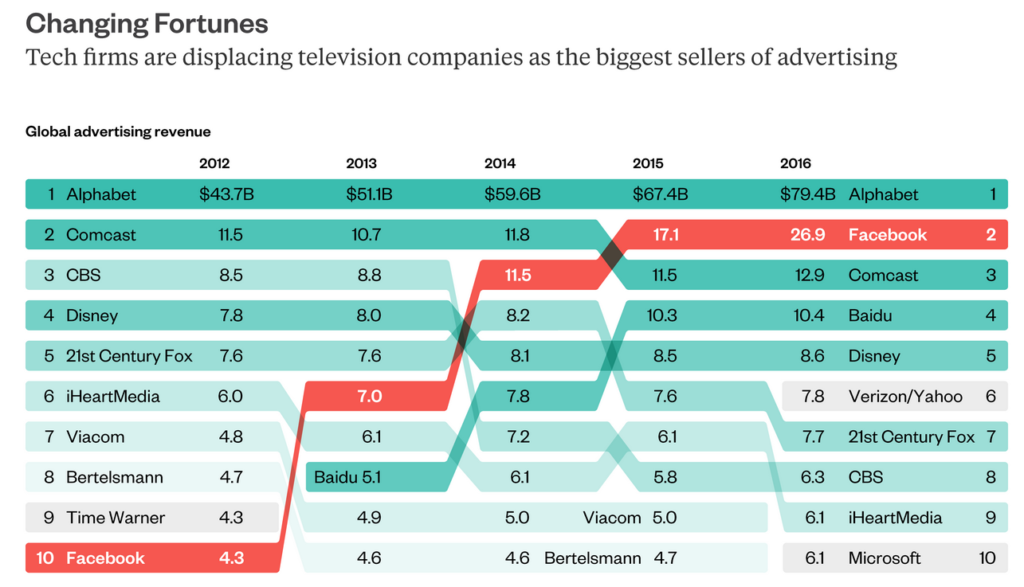
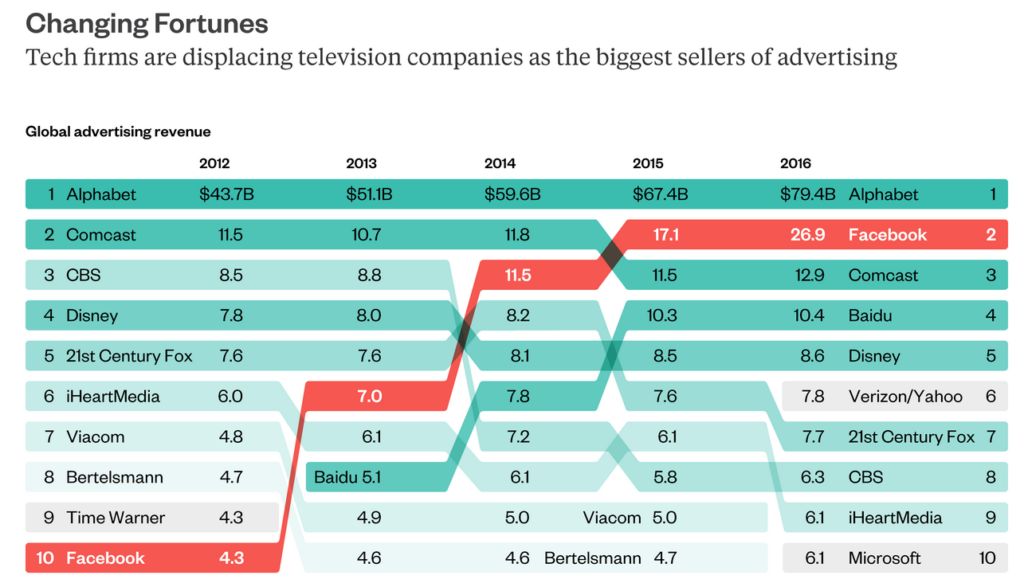
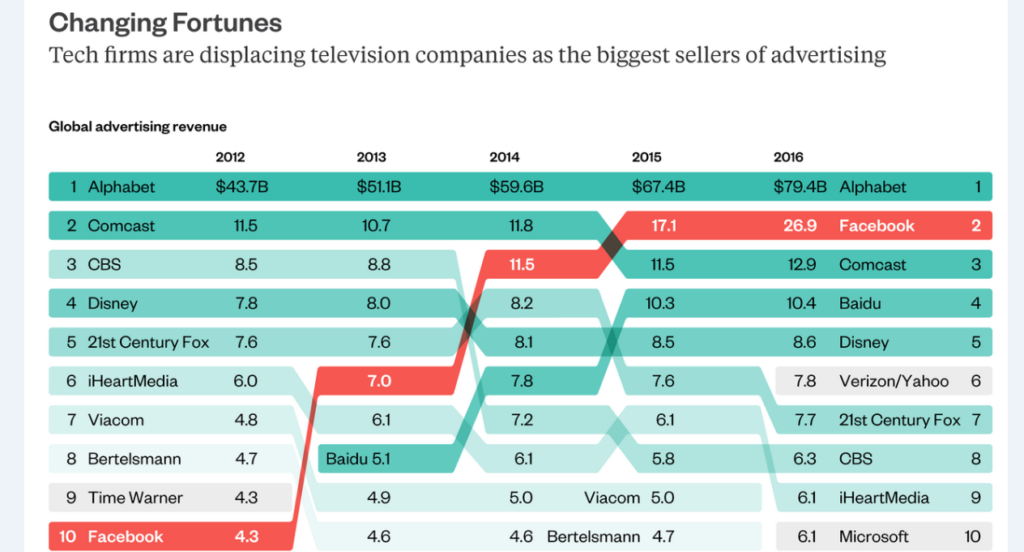
Source: Zenith Media
Jefferies hiked its price target on Facebook to $192 from $175, JPMorgan to $182 from $170, RBC Capital to $185 from $175, and Cowen to $170 from $156.
BMR Take: Our Target is in reach at $165. We would add to our positions at every opportunity. Wait until they hit 2 billion users. There will be fireworks and articles about the company galore and we just might see this as early as July. When this happens we can predict new all-time highs hit left and right.
Shopify News
We Tweeted this out on Friday:
“Shopify is on fire! All-time high at $86, up 5%. Stock was $73 a week ago. STRONG REVENUES will do it! Will eBay make an offer?” [The stock closed at $86 on Friday, up 13% for the week!]
The stock (SHOP) closed at $86 on Friday. We’re up 18% since we added the stock a little over a month ago. Our Target is $90. We can’t wait for it to hit so we can raise it to $100 or higher. And wouldn’t it be nice to see a stock split soon? What ever happened to stock splits? The markets in the 80s and 90s LOVED splits. We could see a 10-1 split for Amazon, bringing the price down to $93, and Google could split 20-1 bringing the price down to $46. Now wouldn’t THAT shake things up on Wall Street! The market would go wild.
Square (SQ: $19.78, up 8%) had a super good week. Square makes credit-card readers that plug into mobile phones and tablets and we were happy to see Square swing to a profit in the first quarter and raise full-year revenue guidance.
Led by Twitter Chief Executive Jack Dorsey, the company posted a quarterly loss of 4 cents per share on a revenue jump of 22% of $460 million. Analysts had expected a loss of 8 cents per share on revenue of $450 million, so of course the market liked what they saw. Square has predicted 2017 total revenue of $2.14 billion.
The company's gross payment volume - the total dollar amount of all credit card payments processed by sellers - jumped 33% to about $14 billion. We like numbers like this.
Another subsidiary, Square Capital, which offers loans to customers in exchange for a fixed percentage of their daily card sales, originated $250 million in loans in the first quarter of 2017, up 64% from a year earlier. We like large percentage increases like this. (We sound like a broken record…)
Square continues to move towards bigger customers. They said that 44% of the money flowing through its systems came from merchants that have over $125,000 in volume on the company’s platform, up from 39% a year ago. CFO Sarah Friar said: “That ongoing shift is good to see because those folks are not new to the payments world.”
Citigroup upped its price target on Square to $23 from $21, and Pacific Crest to $21 from $19.
BMR Take: We’re looking for $24, and hereby raise our Sell Price from $14 to $17.
Apple (AAPL: $148, up 4%) announced that it has $257 billion in cash as of the end of the quarter. They added $10 billion in the quarter which equates to about $800 million a week, or over $150 million per work day! Repeat: $150 million per work day. The company said it will return more of that to shareholders, announcing $50 billion in new stock buybacks and a 63-cent quarterly dividend. The company had already announced $175 billion in repurchases, helping maintain the stock price in lulls between new products, so the upcoming total is now $225 billion. Take a look at this chart of their cash buildup over the years:
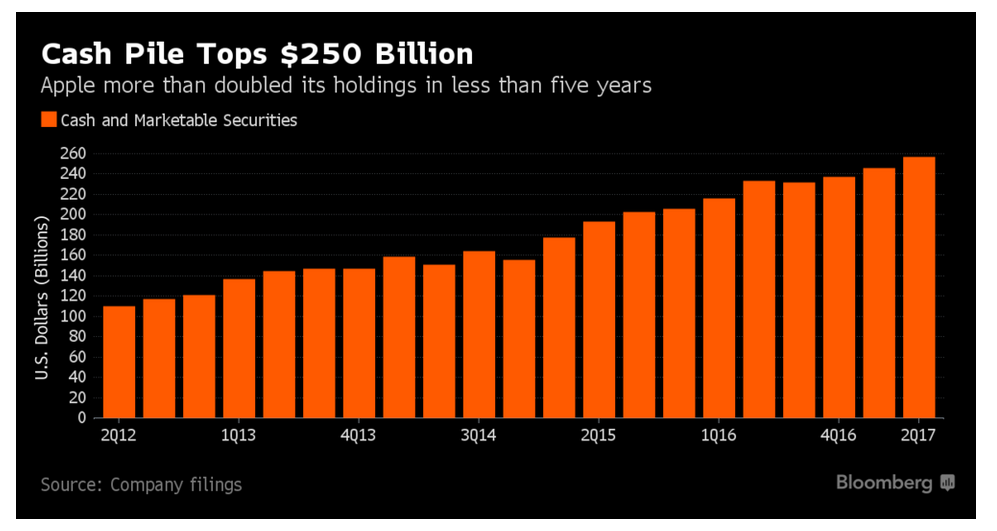
Twilio (TWLO: $24, down 27%) We reported via News Flash on Tuesday that despite strong revenues the market didn’t like the results. The biggest knockoff was the fact that one of their big customers, Uber, has decided to go it alone. Uber provides 12% of total revenue for the company, but Twilio grew revenue by 60% not including Uber. So ultimately, we are not that worried about future revenues. We believe they will continue strong. (We think they will come back to Twilio at some point.) WhatsApp, owned by Facebook is also a large customer, so some people are worried about this large concentration of revenue in one customer. We’re not. There is no word as to whether they are considering leaving. We would suggest that they are quite happy with the service they receive. And again, note that the company added 4,000 customers in the quarter – amazing really – giving them more than 41,000 customers, up from 29,000 at this time last year.
We had a letter from a reader about Twilio and we said this to him:
Bob -- Be prepared for anything that might happen. We could see $20 before we see $30. I hope this is not the case, but it could happen. Uber is slowly leaving as a customer and they had 12% of revenues. So, this will take some time to work out. They did add 4000 customers last quarter and are now over 40,000. They normally add 2800 a quarter. But unfortunately, like First Solar, this is going to take some time.
The Options Corner
We had mentioned in our News Flash about Twilio that we would do a column about options if anyone was interested. Well, we had a strong show of support for this. So here you go.
There are myriad of options strategies if you want to maintain a position in Twilio and you believe it will come back like we do. Of course, most options trades are risky except for selling covered calls, which are still risky but less so than buying options outright. The premiums on Twilio options are relatively high so that usually points to two types of options trades: doing covered calls, and selling naked puts or calls. The latter two are very dangerous.
Selling covered calls: Selling covered calls on Twilio is fairly straight forward. With the stock at $24 you can get about $1.80 for the January $30 call. If you have 1000 shares, you can sell 10 options and receive $1800 in your account that day. The downside is that you would be obligated to sell your stock at $30 if it goes higher than that. But, you can always buy back the option if the stock goes above $30. Depending on how long it takes the stock to get there will determine the price at which you have to buy back the options. If the stock goes to say $32 by January, then you could buy them back for about $2, losing about 20 cents, or $200. But with the stock at $32, you would feel good about that. The downside is that if someone buys Twilio out at $40 a share, you would be forced to sell your stock at $30. Not pretty.
If the stock stays below $30 until January, then you can turn around and sell another out-of-the-money option for a few dollars and wait for the stock to move higher and each time you do this you put cash into your account.
As you can see there are lots of scenarios that can happen so you have to watch carefully. Make sure you have the advice of your broker.
Buying options: If you think the stock can get to the $40 level or higher by say January 2019, you can buy out-of-the-money options inexpensively. But you could lose all of your money if the stock doesn’t reach the strike price that you choose. For example, you can buy 10 options, controlling 1000 shares, at a strike price of $40 expiring in January 2019 for about $2,300. If the stock goes to $45, these options would be worth at least $5,000. If it goes to $50, the options would be worth $10,000.
Or you could buy the January 2019 50s for about $1400 and if the stock goes to $55 they would be worth $5,000. BUT, if the stock doesn’t get to your strike price, they expire worthless.
Selling naked puts: YOU SHOULD ONLY DO THIS IF YOU WISH TO BUY THE STOCK and if you have the money to do so. You could sell the January 2019 $25 put for about $7, or $7,000 for 10 options. That would obligate you to buy the stock at some point between now and the expiration date at $25, BUT you got $7 per share so your net price is $18. You could do the same thing with a $20 put and get $4.30 per share, obligating you to buy the stock for a bit below $16. We like this latter strategy. Suffice it to say that selling naked puts on stocks you want to buy at a lower price, is a good thing. Again – very risky. Why? What if the stock goes to $10. You would be forced to buy the stock at $18 or $16 as described above. Not fun.
Send us your questions and comments please! Info@BullMarket.com.
Tesoro (TSO: $80, up 1%) moves in the wind with crude oil. Crude got down to $45 early Friday and bounced back to $46 by the close. We like the company but can’t be part of it if crude is headed to $40. If you know where crude is headed you’ll know what to do with your position in this fabulous refiner. Unfortunately, we don’t. If we knew, we could make $1 million trading crude oil futures. We added the stock at $85 in November and have a Sell Price of $75. But we would hate to have the stock go that low, so we are hereby raising our Sell Price to $78, which is two dollars below the current price. So, if Tesoro closes below $78 we are out.
Carlyle Group (CG: $18.10, up 2%) posted first quarter earnings that handily beat expectations on Wednesday, in line with its peers, after a strong stock market last quarter lifted investment returns. Carlyle's peer Blackstone Group (BX: $30, down 2%), a Bull Market Report favorite, reported first-quarter earnings that surpassed expectations.
Carlyle said it earned economic net income (ENI)* of $365 million after taxes, more than six times what it earned a year earlier. That translated into $1.09 EPS, well above analyst forecasts for 38 cents per share and the second-highest on record since the fourth quarter of 2013.
* ENI is a crucial performance measure for U.S. private equity firms as it accounts for unrealized gains or losses in investments.
Carlyle said its private equity investments appreciated 9% in the first three months, better than a 5% gain in the S&P 500 index in the same period. Carlyle Co-CEO William E. Conway, Jr. said, “We deployed capital at a strong pace in the first quarter, with $4.4 billion of capital invested despite a difficult environment. We believe we are well-positioned to continue this strong pace. We have already announced substantial new investments and almost $4 billion of exits that we expect to close in the coming quarters.”
BMR Take: Carlyle is still way undervalued but is paying you 4% while you wait. We’re waiting patiently for the market to recognize this situation. We are up 12% since March, but we sure would like to see our Target hit of $20.
The High Yield Corner
By Michael Foster
It’s finally started.
It’s a bit late, but we’re finally seeing a correction in the BDC world. The UBS BDC ETF (BDCS: $23, down 3%) got hammered in a week that was pretty humdrum for high yield and not bad for the stock market as a whole, despite a lot of drama. Yet BDCs are back to underperforming, as they should. Overstretched valuations and high premiums to NAV were unjustifiable before this week. Now that many companies have reported lackluster earnings, those premiums are even less justifiable.
Ironically, however, this isn’t hurting the most overvalued BDC of them all: Main Street Capital Corporation (MAIN: $40, up 1%), which closed the week strong as investors sighed relief following the company’s earnings. Net interest income rose 9% from a year ago to 61 cents per share and the company’s NAV rose nearly 2% to $22.44. There are two big implications for this: firstly, the company’s dividend coverage is 109% and there’s room for years of dividend growth to continue. We have a feeling Main Street management has the ultimate goal of becoming the first BDC Dividend Aristocrat*. We’ve still got about two decades until they can qualify, so it won’t be easy. But if that is their goal, Main Street is easily the best managed and most long-term focused BDC in the world.
* The Dividend Aristocrats are a select group of 51 S&P 500 stocks with 25+ years of consecutive dividend increases.
That doesn’t mean you should go out and buy. We at The Bull Market Report were happy with our pick and happy to see it rise. But we are not happy to pay an 80% premium to net asset value. Consider this: if you considered Main Street to be the best BDC in the world, you wouldn’t want to compare its premium valuation to the valuation of other BDCs. You’d probably want something safer, like a megabank like Bank of America, which not only lends to small and medium sized banks but also mega-corps and governments while diversifying in other banking activities like M&A advisory, retail deposits, and so on. Or at least you’d want your BDC valuation to be less than the valuation of these banks, right? But if you compare Main Street’s valuation to the price-to-book valuations of these big banks, Main Street is overvalued by 40% at a minimum. This just isn’t good enough for a very well-run but extremely undiversified asset.
The market has begun to realize just how silly BDC valuations were getting, but the market has made an exception for main Street largely due to the fact that just about every other BDC reported awful earnings. Net investment income fell for almost all BDCs that have reported so far, with Hercules Capital (HTGC: $13) seeing NII down 33% from the prior quarter. The dividend is now less than 100% covered. NAV fell a bit as well (over 1%). What happened? The market dumped shares, which fell over 16% in a week. This used to be considered one of the safest and best specialty BDCs out there, but the market can turn very quickly on this asset class. We’re not saying anything similar will happen to Main Street anytime soon, but it is a serious risk.
Then there’s Goldman Sachs’s BDC (GSBD: $24), which fell 3% this week due to a decline in net investment income and virtually flat NAV. The stock is still up 3% year-to-date so you’re paying a higher premium for shares, though. Now you’re paying 32% over what the underlying assets are worth. Of course, this BDC is up big over the past year, thanks in part to the secular bull market in BDCs and thanks in part to the Goldman brand. But, as we’ve written here previously, there is a complicated conflict of interest going on with this BDC that makes us extremely cautious. Goldman Sachs’s management is not duty bound to restrict their deal making just to this BDC, and so there’s a chance (although no evidence this is the case) that management can select better deals for the parent company and keep lesser deals for the BDC business. Without clearer governance resolutions, this makes us extremely cautious. And, at the end of the day, this demonstrates one of the structural problems with many BDCs: management and investors’ interests do not align.
Some of the BDCs in the business were loved for avoiding this trap. The big Ares Capital Corporation (ARCC: $16.60, down 6%) is a good example. But this stock tanked as well, after reporting earnings fell 50% from a quarter ago and NAV rose less than 1%. We don’t need to emphasize how bad those results are, and how they deserve a discounted valuation. But Ares is still trading at a slight premium to NAV.
Obviously, a bigger correction in the BDC market is coming, so where else can we look? REITs and municipal bonds remain our favorite corners of the high yield market. The iShares S&P National AMT-Free Municipal Bond Fund (MUB: $109, flat) remained sleepy due to the risk-on nature of the market encouraging more investors to avoid the asset class, despite the growing number of undervalued bonds and great opportunities to get low risk yield for fund managers. Bull Market Report favorites remained flat for the week, Invesco Municipal Trust (VKQ: $12.69, flat) and The Nuveen AMT-Free Fund (NVG: $14.79, flat) Buying more of either fund at this juncture would make a lot of sense.
And then as REITs go, the SPDR Dow Jones REIT ETF (RWR: $92, down 1%) fell slightly with investor apathy hitting the asset class on little news. This again is resulting in plenty of good deals among REITs, and The Bull Market Report continues to have high conviction for long-term sustainable yields from Digital Realty Trust (DLR: $114, down 1%), Omega Healthcare Investors (OHI: $32, down 2%), and Care Capital Properties (CCP: $27, flat) in particular. Looking forward, we will be looking closely at how REIT earnings results and more market responses from the BDC market causes a reset in high-yield land that offers an opportunity to rebalance the portfolio.
Good Investing,
Todd Shaver, Founder
The Bull Market Report
CEO and Editor in Chief
Founded 1998