August 21, 2017

by Todd Shaver | Aug 21, 2017 | Monthly Newsletter Daily 12pm if new
The Weekly Summary
It was rough week with lots of domestic and international issues popping up, producing anguish. In particular, nine CEOs turned their back on Trump. It all started when first Merck’s Kenneth Frazier, then Under Armour’s Kevin Plank and Intel’s Brian Krzanich stepped down from a White House business group set up to advise Donald Trump. While none mentioned the president, Frazier, one of the country’s most-prominent black chief executive officers, quit the council as Trump was being assailed for failing to quickly condemn white supremacists for deadly violence at a rally Saturday in Charlottesville. Frazier said he was acting on a “matter of personal conscience.” Trump shot back on Twitter Tuesday morning, saying, “For every CEO that drops out of the Manufacturing Council, I have many to take their place.
Then on Wednesday President Trump rushed to announce that he was shutting down the two advisory councils of business leaders, after the members had decided on their own to disband in the wake of the president’s comments on the events in Charlottesville. Of course, these kinds of advisory councils seldom accomplish much of anything.
Look, all this drama will pass. The market will move on. But there is definitely an unsettled feeling out there. It is good that the market showed signs of turning around at week’s end, but we did see a few glimpses of nasty selloffs in a few trading sessions this week. It was a rough week. If you are super worried, then we suggest you take some profits off the table. There are many choices for you to move your money to in the High Yield and the REIT portfolios. These are much more secure, stable stocks with very nice dividends that you can enjoy and sleep better with.
No matter what is happening out there, there is always a bull market here at The Bull Market Report! This week we highlight some of our favorite stocks/funds where we think you can still make good money, including: high yield equities like Annaly and larger caps like Apple, Google, Microsoft, Home Depot, and Visa,
BMR Companies & Commentary
Annaly Capital Management (NLY: $12.34, up 1%)
Annaly recently reported respectable earnings at the beginning of the month. Here are our thoughts on the outlook for the rest of the year and what to watch. Many people are cautious given Annaly’s fixed-rate agency exposure and the current valuation. We know that the company has a set yield on government guaranteed paper. So while there is no credit risk other than the full faith and credit of the United States, there is interest rate risk – we know this and accept this. The newer investments are coming on at lower rates with higher yielding holdings rolling off. And we know that if short term rates rise the current portfolio valuation will be sensitive to the movements. We are likely to see some pressure on Annaly’s business model.
But what can the company do? They can rotate into higher yielding MBS* investments. They can increase leverage. They can do a number of things to cover the dividend. Look, if you think a business model is flawless without risk then you don’t know it well enough. Annaly has rsk to higher rates, but higher rates are ultimately good for the company. And investors are missing all the offsetting possible moves management can take. Remember, this is a company that is 18x the size of the median mortgage REIT by market cap, has outperformed the S&P 500 by 3x since its IPO for total return, and has successfully raised $1.5 billion in new capital this year. They know the world they live in and have survived and thrived for 20 years.
* Mortgage-backed Securities
BMR Take: A Director at the company just bought 13,500 shares. Another one just bought 17,700 shares. We love love love to see that! We are looking at a $0.30 dividend paid quarterly for the time being which is good. The stock looks compelling based on this income stream, producing a dividend over 10%.
Apple (AAPL: $158, flat) is Getting into Programming
Apple has set a 12-month budget of $1 billion to develop original programming. Apple could buy and produce as many as 10 TV shows. Apple's first two efforts -- Planet of the Apps and Carpool Karaoke -- have not been warmly received by critics. Apple executives are talking with Hollywood agents about shows that Apple can buy.
BMR Take: Note that Apple has $260 billion in cash now, and with a market cap of $813 billion cash is 32% of the stock price. So $50 of the stock price is in cash. This is UNPRECEDENTED in the history of Wall Street. Apple remains an exciting investment opportunity. The services business is projected to double in revenue to $50 billion over the next several years. The Services business is much more profitable than hardware so the impact to earnings is even better. Don’t sell a share. We believe Apple has a lot more room to go on the upside.
And how about Apple's performance last week in a very tough week for equities.
Google (GOOG: $911, flat)
The Cloud is a huge opportunity in technology and all the industry giants are fighting to grab their fair share. Let's stipulate up front that Amazon Web Services (AWS) remains the top choice for most companies that are thinking about moving their data and software into cloud data centers. Having said that, however, Amazon's cloud is no longer the only option that companies consider. For example, those companies wanting extensive analytics are taking a good hard look at the Google Cloud Platform. And many firms are hedging their bets by using multiple cloud providers to avoid being stuck with one down the road.
While AWS is still the largest cloud provider by far, Microsoft and Google are coming on strong. AWS's revenue growth appears to be slowing, in part because it's hard for such a huge business - AWS is expected to produce $16 billion in revenue this year - to grow as fast as its younger, smaller incarnations. Startups are considering alternatives now for several reasons: standard cloud computing and storage services from the three top players are all seen as competitive, and no one thinks any of the three major cloud contenders is going away. Basically, AWS, Microsoft, and Google are seen as safe bets.
BMR Take: Google took a hit on the recent earnings report. Buy the dip. This company will generate over $40 of EPS in 2018. The stock is far from a stretched valuation.
Microsoft (MSFT: $72, up 1%)
As Internet-of-Things (IoT), artificial intelligence (AI), smart factories and intelligent applications continue to advance, businesses are increasingly turning to these technologies to create new business solutions with greater agility in order to drive competitive advantages. Microsoft launched its IoT Innovation Center in Taiwan last October to spur development between IoT partners and international enterprises and organizations. In September, Microsoft will hold its second IoT Expo in conjunction with the World Congress on Information Technology. Jason Zander, Corporate Vice President, Microsoft Azure, will deliver a keynote on "Leading Digital Transformation and Landing IOT Value with a Strong IoT Partner." Zander oversees the development and global deployment of cloud infrastructure and technology, including Microsoft Azure IoT. In addition to sharing the success of Microsoft's IoT Innovation Center and its partners, Mr. Zander will also provide Microsoft's vision of the development of IoT and in-depth analysis on the integrated application solutions of the world's leading IoT partners.
BMR Take: The Internet of Things is a megatrend. We are going from 10 billion devices connected to the internet to 30 billion. Your hair dryer will be connected to the internet someday. All of this is going to be a huge opportunity for Microsoft. The company is on track to generate $4 of EPS in 2018. The valuation remains compelling.
And note how strong Microsoft was last week in the very rough week on Wall Street. This company is solid.
Upcoming Economic News
Richmond Fed Index
August 22th, 10:00 AM
Period: August
Consensus: 12.0
Prior: 14.0
New Home Sales
August 23th, 10:00 AM
Period: July
Consensus: 614,000
Prior: 610,000
Building Permits
August 24th, 8:00 AM
Period: July
Consensus: 1,223,000
Prior: 1,223,000
Blackstone Entity Merging with Starwood Homes
Invitation Homes (INVH, $23), a portfolio company of The Blackstone Group (BX: $32, down 1%) , is merging with Starwood Waypoint Homes. The combined company, to be called Invitation Homes, will have 82,000 homes. Once the deal closes Invitation Homes stockholders will own about 59% of the combined company. The total enterprise value of the deal is $20 billion.
Invitation Homes, a U.S. home rental company, went public in February. Blackstone will own about 40% of Invitation.
--- The portfolio of homes will be focused on high-growth markets, with nearly 70% of revenue coming from the Western US and Florida.
--- The merger is expected to drive $50 million in annual synergies.
--- Continued strong performance with the combined company experiencing 7% same-store NOI growth in Q217 with over 95% occupancy.
--- The two companies have invested nearly $2 billion, an average of approximately $22,000 per home, in renovations and maintenance, improving resident experience and driving economic growth and job creation in local communities.
BMR Take: Just one more example of the innovation that Blackstone is involved with day in and day out. With a dividend of 7% and a leader (Schwarzman) dedicated 24-7 to moving the stock higher, what is there not to like. $38 billion market cap. Reaching the all-time high of $44 set in 2012 is surely on the horizon.
Tesla Near to Completion of Gigafactory
Tesla ($348, down 3%) has released some interesting pictures and a video of their gigafactory in Nevada, 95 times bigger (sic) than a football field. New drone footage shows how massive Tesla's Gigafactory is.
http://www.businessinsider.com/tesla-gigafactory-pictures-facts-2017-8
In other news, Tesla raised $1.8 billion in a bond sale on Friday, boosting the amount by $300 million to meet demand. The 8-year bonds were priced at a record-low yield of 5.3%. The 5.3% coupon is a record low for a bond of its rating and maturity, according to data compiled by Bloomberg. The sale was managed by Goldman Sachs Group and Morgan Stanley.
BMR Take: The bond market loves this company. We do too. But we know the risk involved here is on the high end of the scale. Tesla is either headed to $400 a share or $300. And one could make an argument for either. If it hits $400 and they continue to ramp up production as promised, then $500 is a great possibility. But if it goes to $300, $200 would be in range. You want a risky stock? Then Tesla is your baby.
Amazon Sells Bonds for Whole Foods Acquisition
Speaking of bond sales, Amazon (AMZN: $958, down 1%) went to the markets for money last week and sold $16 billion of unsecured bonds to fund its $14 billion acquisition of Whole Foods Market. And in a sign of market interest, the longest portion of the offering, a 40-year security, was sold at a yield of 1.45 percentage points above Treasuries.
BMR Take: Now that is just unreal low. The company has $21 billion in cash so they didn’t need to go to the bond market but did because rates are so low. Smart thinking, Jeff. The deal is the 4th largest this year, behind ATT and Microsoft.
Apple Goes to the Debt Market in Canada
Apple raised $2.5 billion at a rate of 2.51% in a 7-year note sale in Canada on Tuesday. At $2.5 billion the financing is the largest corporate non-financial borrowing in Canadian history.
Stocks Cheap Compared to Bonds
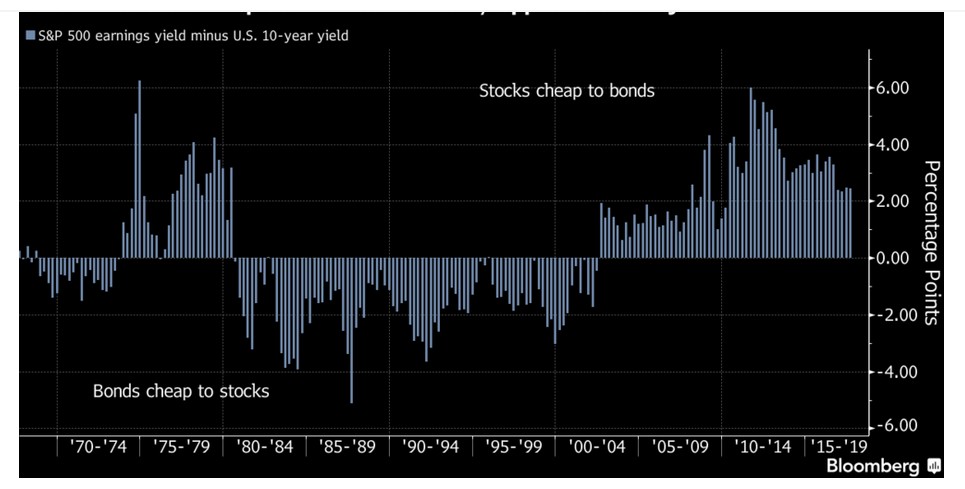 We’re Just Sayin’
The High Yield Report
By Michael Foster
We’re continuing to see market chaos and a lot of selling of high quality assets although the macro risks from political uncertainty are dwindling. But the current selloff is very different from the previous week’s in one very telling, interesting way: Not all assets are falling at the same rate, and some are actually doing very well.
To wit, take a look at The Bull Market Report’s Healthcare REIT pick Omega Healthcare Investors (OHI: $31) which had a strong showing this week after some initial weakness, helping Omega Healthcare end the week up 2%.
We’re seeing a lot of reshuffling in the markets, with investors rotating in and out of funds, stocks, and assets as they rise or fall due to market demand. This is the real “random walk” of Wall Street, and it’s a dynamic that makes short term trends for any individual asset to be unpredictable. In reality, we’re seeing a lot of individual investors making choices to buy on the dip - and they’re pulling money from other assets to do so.
What can an investor do in such an environment? Simple: sit tight. If you have extra cash on the sidelines, now is the time to deploy into the high yield picks that The Bull Market Report has been recommending for a long time. Last week we suggested buying more of Omega Healthcare shares; it’s up 2% since then. Now is the time to do the same with other REITs seeing irrational weakness like Sabra.
You can also consider adding Kimco Realty Corporation (KIM: $19.34) and Apollo Commercial Real Estate (ARI: $17.92) to your shopping list after Kimco fell over 3% in the last week and Apollo remained flat. There is no change in these companies FFO to justify the decline, and Kimco’s year-long weakness on the often-touted (and always inaccurate) “death of retail” has made it just that much more compelling. We have discussed at length here why Retail isn’t dead, and how Amazon’s recent purchase of Whole Foods indicates that the shift from pre-dotcom retail to mobile “bricks and clicks” commerce is far more complicated than the simple narrative of dying malls. In any case, Kimco doesn’t buy enclosed malls! It’s a high-quality strip mall-focused REIT, and Whole Foods (and thus soon Amazon) is one of its biggest tenants.
There are more buying opportunities beyond REITs, and investors are keen to lighten up their cash allocation to consider the other funds and stocks in the High Yield portfolio. However, there is one word of caution to consider when it comes to one of our best performing picks, the PIMCO Dynamic Income Fund (PDI: $29). This fund was flat last week.
What’s going on here is a pretty basic misunderstanding of the fund’s future income potential. You see, Pimco releases a monthly scorecard of net investment income (NII) on its website, while also calculating its dividend coverage ratio. And, simply put, the news isn’t good for the Dynamic Income Fund.
In the past, Pimco easily out-earned its dividend and had a tremendous amount of undistributed net investment income (UNII). That’s why the fund paid a special dividend of $1.45 at the end of 2016. By this time last year, the fund had around $1 in UNII, so it was pretty obvious that a big special dividend was coming (we discussed this at the time and estimated a strong special dividend at the end of last year – and nailed it). This year, however, the Dynamic Income fund has only 4 cents in UNII - a pretty tremendous drop from a year ago!
There are a few reasons why the fund isn’t earning as much income as it used to, most of which revolves around the crowding out of great investment opportunities in mortgage backed securities. The MBS is a pretty daunting asset made sinister by The Big Short and growing awareness of their role in the subprime housing crisis. However, that crisis is a decade behind us, and the quality of MBS investments has skyrocketed. While Pimco was one of the few asset managers aggressively buying up these assets in the past, there are now a lot of people wanting to buy them. That means lower yields for the assets, thus weaker income for the Dynamic Income Fund.
However, at the same time, it also means growing market prices for these assets. This fund’s NAV has risen by 10% so far in 2017, largely a result of that constant demand for MBS’s in the market. Last year, the Dynamic Income Fund’s NAV had risen by far less than 1% over the same time period, because the demand for these assets simply wasn’t there. That means that the fund is sitting on a lot of capital gains with dwindling income.
What does this mean for shareholders? In all honesty, it’s hard to tell. The fund hasn’t really faced a crowding out of supply due to strong demand since 2012. It has enjoyed both NAV and income gains in earlier years, and the end-of-year special dividends reflected that. We simply don’t know if the fund’s managers will decide to return some of those capital gains to shareholders or hold on to it and give a massively reduced special dividend at the end of the year.
It seems that the market has begun to price in the likelihood of a lower special dividend. The fund’s premium to NAV has plummeted from over 10% earlier this year to just 3%. It may fall even further as we get closer to December. If Pimco surprises and gives a big special payout at the end of the year, that could reverse quickly. If it doesn’t, we’ll probably see middling price growth throughout 2017.
The risk with the fund is that its Net Investment Income continues to fall and it fails to cover its dividend on a long-term basis. While we’ve seen hints of that now, it’s far too early to conclude that this risk is really here and it’s time to sell. But investors need to prepare for that eventuality. We will keep a close eye on this trend and advise you if it’s time to move out of this great fund. Hopefully we won’t have to recommend selling anytime soon.
How should you react? Holding the fund for its income stream makes sense now, and buying more when the fund’s premium disappears and it starts trading at a discount also makes sense. That means there’s no reason for investors to get scared and sell off the fund, but it also means investors shouldn’t expect a massive jump in the fund’s price throughout 2017. That’s not a bad thing - it really reflects what the fund should be seen as: A source of steady and reliable income.
Good Investing,
Todd Shaver, Founder, CEO and Editor
The Bull Market Report
Since 1998
August 20, 2017
by Todd Shaver | Aug 20, 2017 | Weekly Newsletter 7pm Sunday
The Weekly Summary
It was rough week with lots of domestic and international issues popping up, producing anguish. In particular, nine CEOs turned their back on Trump. It all started when first Merck’s Kenneth Frazier, then Under Armour’s Kevin Plank and Intel’s Brian Krzanich stepped down from a White House business group set up to advise Donald Trump. While none mentioned the president, Frazier, one of the country’s most-prominent black chief executive officers, quit the council as Trump was being assailed for failing to quickly condemn white supremacists for deadly violence at a rally Saturday in Charlottesville. Frazier said he was acting on a “matter of personal conscience.” Trump shot back on Twitter Tuesday morning, saying, “For every CEO that drops out of the Manufacturing Council, I have many to take their place.
Then on Wednesday President Trump rushed to announce that he was shutting down the two advisory councils of business leaders, after the members had decided on their own to disband in the wake of the president’s comments on the events in Charlottesville. Of course, these kinds of advisory councils seldom accomplish much of anything.
Look, all this drama will pass. The market will move on. But there is definitely an unsettled feeling out there. It is good that the market showed signs of turning around at week’s end, but we did see a few glimpses of nasty selloffs in a few trading sessions this week. It was a rough week. If you are super worried, then we suggest you take some profits off the table. There are many choices for you to move your money to in the High Yield and the REIT portfolios. These are much more secure, stable stocks with very nice dividends that you can enjoy and sleep better with.
No matter what is happening out there, there is always a bull market here at The Bull Market Report! This week we highlight some of our favorite stocks/funds where we think you can still make good money, including: high yield equities like Annaly and larger caps like Apple, Google, Microsoft, Home Depot, and Visa,
BMR Companies & Commentary
Annaly Capital Management (NLY: $12.34, up 1%)
Annaly recently reported respectable earnings at the beginning of the month. Here are our thoughts on the outlook for the rest of the year and what to watch. Many people are cautious given Annaly’s fixed-rate agency exposure and the current valuation. We know that the company has a set yield on government guaranteed paper. So while there is no credit risk other than the full faith and credit of the United States, there is interest rate risk – we know this and accept this. The newer investments are coming on at lower rates with higher yielding holdings rolling off. And we know that if short term rates rise the current portfolio valuation will be sensitive to the movements. We are likely to see some pressure on Annaly’s business model.
But what can the company do? They can rotate into higher yielding MBS* investments. They can increase leverage. They can do a number of things to cover the dividend. Look, if you think a business model is flawless without risk then you don’t know it well enough. Annaly has rsk to higher rates, but higher rates are ultimately good for the company. And investors are missing all the offsetting possible moves management can take. Remember, this is a company that is 18x the size of the median mortgage REIT by market cap, has outperformed the S&P 500 by 3x since its IPO for total return, and has successfully raised $1.5 billion in new capital this year. They know the world they live in and have survived and thrived for 20 years.
* Mortgage-backed Securities
BMR Take: A Director at the company just bought 13,500 shares. Another one just bought 17,700 shares. We love love love to see that! We are looking at a $0.30 dividend paid quarterly for the time being which is good. The stock looks compelling based on this income stream, producing a dividend over 10%.
Apple (AAPL: $158, flat) is Getting into Programming
Apple has set a 12-month budget of $1 billion to develop original programming. Apple could buy and produce as many as 10 TV shows. Apple's first two efforts -- Planet of the Apps and Carpool Karaoke -- have not been warmly received by critics. Apple executives are talking with Hollywood agents about shows that Apple can buy.
BMR Take: Note that Apple has $260 billion in cash now, and with a market cap of $813 billion cash is 32% of the stock price. So $50 of the stock price is in cash. This is UNPRECEDENTED in the history of Wall Street. Apple remains an exciting investment opportunity. The services business is projected to double in revenue to $50 billion over the next several years. The Services business is much more profitable than hardware so the impact to earnings is even better. Don’t sell a share. We believe Apple has a lot more room to go on the upside.
And how about Apple's performance last week in a very tough week for equities.
Google (GOOG: $911, flat)
The Cloud is a huge opportunity in technology and all the industry giants are fighting to grab their fair share. Let's stipulate up front that Amazon Web Services (AWS) remains the top choice for most companies that are thinking about moving their data and software into cloud data centers. Having said that, however, Amazon's cloud is no longer the only option that companies consider. For example, those companies wanting extensive analytics are taking a good hard look at the Google Cloud Platform. And many firms are hedging their bets by using multiple cloud providers to avoid being stuck with one down the road.
While AWS is still the largest cloud provider by far, Microsoft and Google are coming on strong. AWS's revenue growth appears to be slowing, in part because it's hard for such a huge business - AWS is expected to produce $16 billion in revenue this year - to grow as fast as its younger, smaller incarnations. Startups are considering alternatives now for several reasons: standard cloud computing and storage services from the three top players are all seen as competitive, and no one thinks any of the three major cloud contenders is going away. Basically, AWS, Microsoft, and Google are seen as safe bets.
BMR Take: Google took a hit on the recent earnings report. Buy the dip. This company will generate over $40 of EPS in 2018. The stock is far from a stretched valuation.
Microsoft (MSFT: $72, up 1%)
As Internet-of-Things (IoT), artificial intelligence (AI), smart factories and intelligent applications continue to advance, businesses are increasingly turning to these technologies to create new business solutions with greater agility in order to drive competitive advantages. Microsoft launched its IoT Innovation Center in Taiwan last October to spur development between IoT partners and international enterprises and organizations. In September, Microsoft will hold its second IoT Expo in conjunction with the World Congress on Information Technology. Jason Zander, Corporate Vice President, Microsoft Azure, will deliver a keynote on "Leading Digital Transformation and Landing IOT Value with a Strong IoT Partner." Zander oversees the development and global deployment of cloud infrastructure and technology, including Microsoft Azure IoT. In addition to sharing the success of Microsoft's IoT Innovation Center and its partners, Mr. Zander will also provide Microsoft's vision of the development of IoT and in-depth analysis on the integrated application solutions of the world's leading IoT partners.
BMR Take: The Internet of Things is a megatrend. We are going from 10 billion devices connected to the internet to 30 billion. Your hair dryer will be connected to the internet someday. All of this is going to be a huge opportunity for Microsoft. The company is on track to generate $4 of EPS in 2018. The valuation remains compelling.
And note how strong Microsoft was last week in the very rough week on Wall Street. This company is solid.
The Home Depot (HD: $147, down 4%)
Home Depot took a bad hit on earnings. But we feel this is a great time to initiate a position or add to an existing one. A few Wall Street analysts upgraded the stock to Buy reaffirming our confidence.
Revenue for the quarter was $28.1 billion versus the consensus for $27.8 billion. Revenue guidance for the year is $95 billion, short of the $99 billion consensus. EPS of $2.25 beat the consensus of $2.21. Chairman, CEO Craig Menear said: "We were pleased with our results this quarter as our customers rewarded us with the highest quarterly sales in company history. We also achieved the highest quarterly net earnings in company history."
So what happened? Analysts were largely upbeat on the results, with same store sales beating expectations despite a tough backdrop for all of the Retail industry. Specifically, same store comparable sales growth was +5.5% beating the +4.6% guidance. So all the momentum looked good this quarter but why the bad outlook for lower revenue? The shares traded down because of this guidance miss. But under the covers many people just think it is conservatism from management, not something serious.
BMR Take: We expect to see momentum continue over the rest of the year following what was the largest quarter ever, pointing to strong sales growth, operating margin expansion and EPS growth. With EPS heading to $9 in 2018 we this valuation is compelling right here to be buying.
Visa (V: $103, up 3%)
Visa announced a multi-year, global partnership with Marqeta, the open API payment card issuing platform, to drive further innovations in commercial and consumer payments. Additionally, Visa has made a strategic investment in Marqeta to support both company’s domestic and international growth objectives.
The Fintech industry is booming, Fintech being short for financial technology. Everybody in financial services from banks like JP Morgan to networks like Visa are having to figure out how to keep up with the technology revolution in finance. That is why this deal is so key for Visa. Visa is embracing the change and going to be delivering the most innovative solutions in payments for years to come. This supports why we love the Visa EPS growth story and believe the stock should be a core holding in your portfolio.
The initial efforts of the partnership will involve growing opportunities for virtual, physical and tokenized payments across a number of commercial markets and use cases that can benefit from Marqeta’s developer-friendly platform.
The market for electronic payments continues to grow in commercial payables, alternative lending, disbursements, eCommerce, on-demand services and P2P payments. To enable this growth, Marqeta’s platform allows companies of all sizes to authorize their own card transactions, fundamentally changing how companies engage with card issuing and transaction processing.
This is the latest partnership and investment for Visa with an emerging innovator within the payments ecosystem. As a global payments technology company, Visa continually evaluates technologies of all kinds – especially those that have the potential to advance digital payments for Visa’s clients and their customers. Recently, Visa has made investments in Chain, Klarna, Square and Stripe, among others.
BMR Take: Visa is a safe haven investment. With EPS heading to $4, we continue to see tremendous value here.
Upcoming Economic News
Richmond Fed Index
August 22th, 10:00 AM
Period: August
Consensus: 12.0
Prior: 14.0
New Home Sales
August 23th, 10:00 AM
Period: July
Consensus: 614,000
Prior: 610,000
Building Permits
August 24th, 8:00 AM
Period: July
Consensus: 1,223,000
Prior: 1,223,000
Blackstone (BX: $32, down 1%) Entity Merging with Starwood Homes
Invitation Homes (INVH, $23), a portfolio company of The Blackstone Group, is merging with Starwood Waypoint Homes. The combined company, to be called Invitation Homes, will have 82,000 homes. Once the deal closes Invitation Homes stockholders will own about 59% of the combined company. The total enterprise value of the deal is $20 billion.
Invitation Homes, a U.S. home rental company, went public in February. Blackstone will own about 40% of Invitation.
--- The portfolio of homes will be focused on high-growth markets, with nearly 70% of revenue coming from the Western US and Florida.
--- The merger is expected to drive $50 million in annual synergies.
--- Continued strong performance with the combined company experiencing 7% same-store NOI growth in Q217 with over 95% occupancy.
--- The two companies have invested nearly $2 billion, an average of approximately $22,000 per home, in renovations and maintenance, improving resident experience and driving economic growth and job creation in local communities.
BMR Take: Just one more example of the innovation that Blackstone is involved with day in and day out. With a dividend of 7% and a leader (Schwarzman) dedicated 24-7 to moving the stock higher, what is there not to like. $38 billion market cap. Reaching the all-time high of $44 set in 2012 is surely on the horizon.
Tesla Near to Completion of Gigafactory
Tesla ($348, down 3%) has released some interesting pictures and a video of their gigafactory in Nevada, 95 times (sic) bigger than a football field. New drone footage shows how massive Tesla's Gigafactory is.
http://www.businessinsider.com/tesla-gigafactory-pictures-facts-2017-8
In other news, Tesla raised $1.8 billion in a bond sale on Friday, boosting the amount by $300 million to meet demand. The 8-year bonds were priced at a record-low yield of 5.3%. The 5.3% coupon is a record low for a bond of its rating and maturity, according to data compiled by Bloomberg. The sale was managed by Goldman Sachs Group and Morgan Stanley.
BMR Take: The bond market loves this company. We do too. But we know the risk involved here is on the high end of the scale. Tesla is either headed to $400 a share or $300. And one could make an argument for either. If it hits $400 and they continue to ramp up production as promised, then $500 is a great possibility. But if it goes to $300, $200 would be in range. You want a risky stock? Then Tesla is your baby.
A Word from Gary Jefferson
Jefferson Financial Group
First Vice-President, Investments
UBS Financial Services, Inc.
Earnings were everything expected, plus a little more. So here we are with about six weeks before the 3rd quarter comes to a close. Unemployment is low, interest rates are low, energy costs are low and consumer confidence is fairly high. Besides a garden variety correction, what could derail the markets? - not counting a war, which in our opinion and most experts we listen to is a fairly low probability. The most likely candidate would be a recession. With earnings growth better now than the past eight years, this critical element in the recession scenario seems relatively safe for the next several quarters.
However, after speaking with some very learned folks in the banking industry, there is one problem that has caught our attention. We have been told that it is very difficult for banks to make enough profit to lend money when short-term and long-term interest rates are less than 1%. Today, the difference between a 2-year Treasury note and a 10-year Treasury bond remains less than 1%. Rate hikes have a history of producing bear markets in the past and could do so again because there just isn’t enough profit for commercial banks to lend money. Recessions develop out of these situations. We are not yet in an "inverted yield curve" situation (where short-term rates are higher than long-term rates), which is a classic signal of a coming recession, and we don't believe banks are to the point that they are going to substantially curtail lending. However, it is something we will watch for over the coming quarters.
As we said last week, stocks don't go straight up forever. There will be volatility and pullbacks as Fed-tightening continues, but until we see actual signs of an approaching recession, we believe stocks continue to offer better value than bonds.
Amazon Sells Bonds for Whole Foods Acquisition
Speaking of bond sales, Amazon (AMZN: $958, down 1%) went to the markets for money last week and sold $16 billion of unsecured bonds to fund its $14 billion acquisition of Whole Foods Market. And in a sign of market interest, the longest portion of the offering, a 40-year security, was sold at a yield of 1.45 percentage points above Treasuries.
BMR Take: Now that is just unreal low. The company has $21 billion in cash so they didn’t need to go to the bond market but did because rates are so low. Smart thinking, Jeff. The deal is the 4th largest this year, behind ATT and Microsoft.
Apple Goes to the Debt Market in Canada
Apple raised $2.5 billion at a rate of 2.51% in a 7-year note sale in Canada on Tuesday. At $2.5 billion the financing is the largest corporate non-financial borrowing in Canadian history.
Stocks Cheap Compared to Bonds
We’re Just Sayin’
Cantor Fitzgerald: OPKO Health - Overweight Rating, $20 Price Target
And how about this:
In other Opko Health news, Director John A. Paganelli purchased 5,000 shares of the company’s stock on June 1st. Following the transaction, the director now owns 350,000 shares in the company. Director Richard A. Lerner purchased 10,000 shares of the company’s stock on June 5th. Insiders have bought a total of 1,600,000 shares of company stock worth $10,000,000 in the last three months. Insiders own 40% of the company’s stock.
There are eight research companies following Opko. Six have a buy rating; two have a hold. Their average price target is $16.40.
BMR Take: For those of you still hanging in there with Opko Health (OPK: $6.12, down 2%) this report from Cantor Fitzgerald is good news. $20 Wow. That is over three times the current price. What are we missing here? Oh – I know. We are missing a higher stock price! Well maybe, just maybe this is the start of the re-rising (is that a word?) of the stock to the $8 level and then $10 and then on to the races from there. Hope springs eternal, doesn’t it? Well, yes, but with all the good things this company has going for it, for it to stay at $6 any longer JUST DOESN’T MAKE ANY SENSE!
The High Yield Report
By Michael Foster
We’re continuing to see market chaos and a lot of selling of high quality assets although the macro risks from political uncertainty are dwindling. But the current selloff is very different from the previous week’s in one very telling, interesting way: Not all assets are falling at the same rate, and some are actually doing very well.
To wit, take a look at The Bull Market Report’s Healthcare REIT pick Omega Healthcare Investors (OHI: $31) which had a strong showing this week after some initial weakness, helping Omega Healthcare end the week up 2%.
We’re seeing a lot of reshuffling in the markets, with investors rotating in and out of funds, stocks, and assets as they rise or fall due to market demand. This is the real “random walk” of Wall Street, and it’s a dynamic that makes short term trends for any individual asset to be unpredictable. In reality, we’re seeing a lot of individual investors making choices to buy on the dip - and they’re pulling money from other assets to do so.
What can an investor do in such an environment? Simple: sit tight. If you have extra cash on the sidelines, now is the time to deploy into the high yield picks that The Bull Market Report has been recommending for a long time. Last week we suggested buying more of Omega Healthcare shares; it’s up 2% since then. Now is the time to do the same with other REITs seeing irrational weakness like Sabra.
You can also consider adding Kimco Realty Corporation (KIM: $19.34) and Apollo Commercial Real Estate (ARI: $17.92) to your shopping list after Kimco fell over 3% in the last week and Apollo remained flat. There is no change in these companies FFO to justify the decline, and Kimco’s year-long weakness on the often-touted (and always inaccurate) “death of retail” has made it just that much more compelling. We have discussed at length here why Retail isn’t dead, and how Amazon’s recent purchase of Whole Foods indicates that the shift from pre-dotcom retail to mobile “bricks and clicks” commerce is far more complicated than the simple narrative of dying malls. In any case, Kimco doesn’t buy enclosed malls! It’s a high-quality strip mall-focused REIT, and Whole Foods (and thus soon Amazon) is one of its biggest tenants.
There are more buying opportunities beyond REITs, and investors are keen to lighten up their cash allocation to consider the other funds and stocks in the High Yield portfolio. However, there is one word of caution to consider when it comes to one of our best performing picks, the PIMCO Dynamic Income Fund (PDI: $29). This fund was flat last week.
What’s going on here is a pretty basic misunderstanding of the fund’s future income potential. You see, Pimco releases a monthly scorecard of net investment income (NII) on its website, while also calculating its dividend coverage ratio. And, simply put, the news isn’t good for the Dynamic Income Fund.
In the past, Pimco easily out-earned its dividend and had a tremendous amount of undistributed net investment income (UNII). That’s why the fund paid a special dividend of $1.45 at the end of 2016. By this time last year, the fund had around $1 in UNII, so it was pretty obvious that a big special dividend was coming (we discussed this at the time and estimated a strong special dividend at the end of last year – and nailed it). This year, however, the Dynamic Income fund has only 4 cents in UNII - a pretty tremendous drop from a year ago!
There are a few reasons why the fund isn’t earning as much income as it used to, most of which revolves around the crowding out of great investment opportunities in mortgage backed securities. The MBS is a pretty daunting asset made sinister by The Big Short and growing awareness of their role in the subprime housing crisis. However, that crisis is a decade behind us, and the quality of MBS investments has skyrocketed. While Pimco was one of the few asset managers aggressively buying up these assets in the past, there are now a lot of people wanting to buy them. That means lower yields for the assets, thus weaker income for the Dynamic Income Fund.
However, at the same time, it also means growing market prices for these assets. This fund’s NAV has risen by 10% so far in 2017, largely a result of that constant demand for MBS’s in the market. Last year, the Dynamic Income Fund’s NAV had risen by far less than 1% over the same time period, because the demand for these assets simply wasn’t there. That means that the fund is sitting on a lot of capital gains with dwindling income.
What does this mean for shareholders? In all honesty, it’s hard to tell. The fund hasn’t really faced a crowding out of supply due to strong demand since 2012. It has enjoyed both NAV and income gains in earlier years, and the end-of-year special dividends reflected that. We simply don’t know if the fund’s managers will decide to return some of those capital gains to shareholders or hold on to it and give a massively reduced special dividend at the end of the year.
It seems that the market has begun to price in the likelihood of a lower special dividend. The fund’s premium to NAV has plummeted from over 10% earlier this year to just 3%. It may fall even further as we get closer to December. If Pimco surprises and gives a big special payout at the end of the year, that could reverse quickly. If it doesn’t, we’ll probably see middling price growth throughout 2017.
The risk with the fund is that its Net Investment Income continues to fall and it fails to cover its dividend on a long-term basis. While we’ve seen hints of that now, it’s far too early to conclude that this risk is really here and it’s time to sell. But investors need to prepare for that eventuality. We will keep a close eye on this trend and advise you if it’s time to move out of this great fund. Hopefully we won’t have to recommend selling anytime soon.
How should you react? Holding the fund for its income stream makes sense now, and buying more when the fund’s premium disappears and it starts trading at a discount also makes sense. That means there’s no reason for investors to get scared and sell off the fund, but it also means investors shouldn’t expect a massive jump in the fund’s price throughout 2017. That’s not a bad thing - it really reflects what the fund should be seen as: A source of steady and reliable income.
Good Investing,
Todd Shaver, Founder, CEO and Editor
The Bull Market Report
Since 1998
August 6, 2017
by Todd Shaver | Aug 6, 2017 | Weekly Newsletter 7pm Sunday
The Weekly Summary
Months of boredom broken up by moments of terror. And then quickly back to the boredom. That’s how it’s been for U.S. stocks lately, where vast stretches of tranquility are occasionally interrupted by sudden bouts of selling on headlines trumpeting entanglements of President Donald Trump. It happened again during the last 30 minutes of trading Thursday, when the S&P 500 Index surrendered a quick five points after the Wall Street Journal reported special counsel Robert Mueller was said to have impaneled a grand jury in the Russia probe. More than half the swoon was erased by the close. A similar frenzy occurred July 20th, when Bloomberg News said Mueller was examining a broad range of financial transactions involving Trump’s businesses. The message from professional investors: In a market where the CBOE Volatility Index has consistently hovered just above 10 at historic lows, get used to it. Both the drops and the recoveries.
However, there is always a bull market here at The Bull Market Report! This week we highlight some of our favorite stocks: Apple, The Carlyle Group, Athenahealth, PayPal, Teva Pharmaceutical Industries, and Tesla.
BMR Companies & Commentary
Apple (AAPL: $156, up 5%)
Apple delivered solid third quarter results. Let’s break it down for you.
iPhone revenue was $24.9 billion versus the $25.5 billion consensus. Just shy. iPad revenue was $5.0 billion versus the $4.0 billion consensus. Mac revenue was $5.6 billion versus the $5.7 billion consensus. Services (the App Store) – the spot to watch – did $7.3 billion versus the $7.1 billion consensus. All in all, no complaints on the top line.
Average selling prices did trend lower, but who cares. The iPhone sold for an average of $606 versus the $621 consensus. The iPad sold for $435 versus $440 last year. Mac was $1,303 versus the $1,334 consensus. This is minor stuff in the long run. People should be concerned about the long term, big picture vision like we are.
Gross margin of 38.5% beat the Street’s 38.3% and hit the top end of guidance. Operating expenses were $6.7 billion vs. the consensus of $6.6 billion. Profits continue to flood in to the tune of about $800 million per week and now sit at $262 billion.
At the bottom line the company did $8.7 billion in earnings or $1.67 per share vs. $7.8 billion a year ago, $1.42 per share. Fabulous.
An overall great quarter. Apple reported unit and revenue growth in all product categories in the June quarter, driving 17% growth in EPS. The business also returned $11.7 billion to investors during the quarter, bringing total cumulative capital returns to almost $223 billion. Wow!
BMR Take: We remain very bullish. The stock is trading at 17x this year’s consensus EPS of $9.00. The Services business is on pace to double over the next few years supporting growth.
The Carlyle Group (CG: $22, up 6%)
Carlyle reported another strong quarter with EPS of $0.81, beating the $0.41 consensus by a mile. Revenue was $910 million versus the $680 million consensus. The company paid the $0.41 dividend shutting up all the naysayers about the businesses’ ability to consistently return capital.
Part of the big out-performance was admittedly just due to a one-time insurance recovery. But the core business looks great. The company is fundraising hand over fist and continues to generate great investment returns.
Overall, Carlyle produced another strong value creation quarter, with net unrealized gains awaiting to be returned to investors increasing 46% year to date. As a result of the strong performance Carlyle has delivered to fund investors, demand for new funds is high. The company raised over $8 billion of capital in the second quarter with acceleration likely in the second half of 2017.
BMR Take: Carlyle is probably heading to $30. Consensus is looking for a solid dividend of $1.80 next year and $2.15 the following. EPS is running closer to $3. Few institutional investors can buy the stock because the K1 tax structure creates issues. But that will change and when it does, look out on the upside!
Athenahealth (ATHN: $141, up 1%)
Athenahealth announced that the board and management team are conducting a strategic review of the company’s operational and financial strategy, leadership. and governance. Management has commenced a comprehensive review of its operations, cost structure and capital allocation, with the assistance of a globally recognized consulting firm. In conducting its review, the company has identified $100 million in cost-savings opportunities that will drive efficiency and targeted investment in the company's hospital and network services businesses. Athenahealth will provide additional information regarding details of these strategic initiatives by its Q3 earnings release in October. Co-founder Jonathan Bush, a cousin to former U.S. President George W. Bush, will remain as the chief executive of the company.
Athenahealth also intends to augment its senior management structure to establish the role of president. The president will be responsible for the execution of Athenahealth’s business operations and will report to Athenahealth CEO, Jonathan Bush. As previously announced, the company is also working to identify a CFO. The board has retained a search firm to fill the president and CFO roles promptly. Finally, the board plans to separate the roles of chairman and CEO and is working to recruit an independent chairman. In addition, the board has begun a search process to appoint an additional independent director. Recall, all this has been brought about by Elliott Management, a major activist hedge fund that disclosed a 9.2% stake in the company back in May.
"Athena needs a management team and operating plan that can successfully tackle the next stage of growth," said a portfolio manager for T. Rowe Price New Horizons Fund. "This plan is a large step in the right direction."
The company said its bottom line climbed to $20.5 million, or $0.51 per share in 2Q. This was higher than $13 million, or $0.34 per share, in last year's second quarter. Revenue for the quarter rose 15% to $300 million, up from $260 million last year.
The company, said it would invest in its fast-growing hospital and network services businesses.
BMR Take: With Elliott Management in there shaking things up, there is a lot of excitement ahead. We love this company but believe now is the time to take profits. We are up 38% since we added the stock at $103 in November. The PE is still a ridiculous 280 and to get it down to a ridiculous 70, profits will have to quadruple, which will take years. We hereby remove the stock from the portfolio.
What should YOU do? Totally up to you of course. You can sell, or you can stay the course and maybe the stock will continue its big ride. If you stay, you can protect yourself two ways. You can sell calls on the stock, say the December $150 for $10. Or you can put a stop order in place at say $135 or $130, to protect your gains. If the stocks goes higher, fabulous.
PayPal (PYPL: $59, down 1%)
PayPal is on a roll with new partnerships. The latest - Skype!
Skype is all about trying to make your life easier and more efficient. That’s why they recently developed Send Money, a Skype feature that allows you to transfer funds via the Skype mobile app while you’re in the middle of a conversation using PayPal. Sweet!
Skype users wishing to send money from a PayPal balance or a U.S. debit card won’t be charged for transactions, making it similar to how PayPal’s other peer-to-peer payment platforms function.
Potentially more important than this alone is that this is a deal with Skype's parent company, Microsoft, which now establishes a relationship with them. Last month, PayPal inked deals with the likes of Samsung Electronics, Apple, and JPMorgan. Skype has reportedly been downloaded over a billion times and boasts approximately 300 million monthly active users. Wow!
BMR Take: PayPal is at 200 million users in a world where Facebook is running a global internet business model with 2 billion. You see the growth here? !! We are riding PayPal far into the future.
Teva Pharmaceutical Industries (TEVA: $21, down 36%)
Teva announced earnings and got rocked. Revenues of $5.7 billion versus $5.0 billion last year. EPS of $1.02 versus $1.25 a year ago. Dividend of 8.5 cents, down 75% from 34 cents in the first quarter of 2017. The company only lowered EPS guidance from $5.10 to $4.40, which makes the stock very inexpensive relative to where it is trading right now on earnings. However, the problems are big.
Second quarter results were lower than anticipated due to the performance of the U.S. Generics business and the continued deterioration in Venezuela. In the U.S. Generics business, the company experienced accelerated price erosion and decreased volume mainly due to customer consolidation, and greater competition as a result of an increase in generic drug approvals by the FDA, and some new product launches that were either delayed or subjected to more competition. Not good.
In response, Teva must take swift and decisive actions. The company is now focused on executing meaningful cost reductions, rationalizing assets and maximizing value, actively pursuing divestiture opportunities and strengthening the balance sheet.
BMR Take: Life brings adversity. You, dear reader, have been around long enough to know this. This stock has just been rocked as bad as the loser in a UFC title fight. But it is just silly cheap right here. Buy more? Yes, if you are ready to take on some volatility. Sell? Not here. Hold? This seems like the best course of action with intentions to exit once the price gets up off the floor mat.
Tesla (TSLA: $357, up 7%)
Tesla reported Wednesday that its net loss widened in the second quarter as they opened new stores and prepared for the launch of its new lower-cost Model 3 sedan.
The loss grew 15% percent to $335 million from a loss of $290 million in the year ago quarter. But Tesla's adjusted loss of $1.33 per share, handily beat Wall Street's forecast of a $1.88 loss.
Revenue more than doubled to $2.8 billion, also beating Wall Street's forecast of $2.5 billion. Tesla's shares jumped 6% percent after the earnings release. Tesla saw significant growth in its energy generation and storage business, which contributed about 14% of its revenues. It bought solar panel maker SolarCity late last year and said it began taking orders for its new solar roof tiles in the second quarter, and recently began installations.
But most attention was focused on the Model 3, which was delivered to its first 30 customers — all Tesla employees — last week. CEO Elon Musk said the company has 500,000 reservations for a Model 3 and it wants to ramp of production as quickly as possible. But Musk has warned of “production hell” for the next six months or longer as the company goes from building 100 Model 3’s in August to 20,000 Model 3’s by December. He wants Model 3 output to grow to 40,000 cars per month by sometime in 2018.
Musk made a surprise announcement during Wednesday's second-quarter earnings call. Musk said Tesla will no longer use an entirely different vehicle architecture to build the Model Y, the compact SUV due to hit the market by 2020. Tesla will instead borrow from the Model 3's platform. That should make Model Y production a lot easier in the future. "Upon the council of my executive team to reel me back from the cliffs of insanity, the Model Y will, in fact, be using substantial carry over from Model 3 in order to bring it to market faster," Musk said. "I have to thank my executive team from stopping me from being a fool," Musk said. "Model Y will have relatively low technical and production risk as a result."
Tesla is averaging about 1,800 orders per day for its Model 3 since its big event a week ago Friday. Extrapolated, that’s over 50,000 orders a month. It opened 29 new stores and service centers in the second quarter in order to meet Model 3 demand. It's also planning to double the number of fast-charging Supercharger outlets this year to 10,000 worldwide. The company delivered 22,000 Model S and Model X vehicles in the second quarter. That was up 53% from the same quarter a year ago, but down from 25,000 in the first quarter.
Management is expecting positive Model 3 gross margin in Q4 and targeting 25% margin in 2018. Model S and Model X deliveries are expected to increase dramatically in the 2nd half of 2017.
During the initial phase of the Model 3 ramp in Q317, the volume produced will be tiny relative to the installed production capacity. As a result, Model 3 gross margin in Q3 will be impacted by the excessive allocation of labor and overhead costs and depreciation over this tiny volume. In the absence of these one-time elevated cost allocations, Model 3 gross margin in Q3 would already be positive, resulting in a positive cash contribution.
BMR Take: The future of automobiles are electric and Tesla runs the show. We are looking at EPS estimates of $14 in 2020.
Upcoming Economic News
Consumer Credit
August 7th, 3:00 PM
Period: June
Consensus: $16.0 billion
Prior: $18.4 billion
JOLTS Job Openings
Tuesday, August 8th, 10:00 AM
Period: June
Consensus: N/A
Prior: 5,666,000
Wholesale Trade
Wednesday, August 9th, 10:00 AM
Period: June
Consensus: 0.40%
Prior: -0.50%
PPI
Thursday, August 10th, 8:30 AM
Period: July
Consensus: 0.10%
Prior: 0.10%
CPI
Friday, August 11th, 8:30 AM
Period: July
Consensus: 0.15%
Prior: 0.0%
Google Reports Earnings
Google (GOOG: $928, down 1%) continues to reports huge gains in sales and earnings, despite having to pay the European Commission a $2.7 billion fine. EPS of $5.01 beat estimates by $0.60 and revenues of $26.0 billion beating estimates by $400 million. Total revenue was up 20% year over year, and was in fact up 23% when adjusted for currency fluctuations. 87% of Alphabet's $26 billion of revenue during the quarter came from advertising, which was up 18%. Google’s “other” business - everything that’s not advertising, including its cloud business and Google Play app store - grew 40% year over year to $3.1 billion. “Other” now represents 12% of Google’s business, up from 10%. Sales from the Europe and Africa account for about 34% of the company’s overall revenue,
Google's paid clicks were up 52% year over year. The average cost-per-click was down 23% year over year. We are not fretting over the last statistic. But we are salivating over the first. 52% growth. Huge.
Advertising revenue growth was driven by mobile and YouTube. And the cloud business was big. Cloud deals larger than $500,000 tripled year over year.
BMR Take: Buy today. Buy tomorrow. Buy next month. Buy next year.
A Word from Gary Jefferson
Jefferson Financial Group
First Vice-President, Investments
UBS Financial Services, Inc.
The number one question to us over the past few weeks has been, "When is this bull market going to end?" Run away as fast as you can from anyone who tells you they know. That said, however, it is a very important question to ask because, believe it or not, risk matters. And you can rest assured that Murphy's Law will prove that risk matters most when it appears risk no longer exists. The S&P 500 is up nine straight months and the VIX hit an all-time historical low last week. The media seems to think that, somehow, no one seems nervous. That's not what we see. We see a lot of nervousness and the question we prefer to answer instead of being asked to foresee the future is, "What signs of a bear market do you see today?"
Aside from the always present danger of a global conflict, we do not see the most common indicators used to predict coming recessions such as falling sales, production and earnings. What is happening instead is a real turnaround in earnings growth momentum to the upside. The key ingredients for a typical bull market are still in place:
The economy is expanding.
Earnings growth is accelerating – we've seen three quarters in a row and 2Q17 looks like it will be the best so far. Stocks are not cheap, but with few exceptions they still offer a more attractive value than bonds (The 10-year Treasury is still around 2.3%)
One Wall Street research firm recently said, "Just realize that this bull is eight years old. The easy gains have been made. Now it's a slower grind higher. So stay focused on the key long term trends and be patient waiting for the profits to unfold".
What we read into the words, "a slower grind higher" is a market that has more of a pattern of two steps higher and one or one-and-a-half steps lower, rather than the four or five steps higher to each step backward that we have enjoyed for several years. It is a rare year that the market doesn't experience a 5% pullback at some point – we think that would be not only be normal but also a "healthy" thing to see. Stock Traders Almanac, researching patterns in the market over the past 50 years, reports that strong post-election years typically point to summer selloffs. Looking at the 50-year charts, these seem to range in the 4% or the 9% area with the "average" being somewhere in-between. We don't see anything that would make us disagree with historical norms because "It's different this time". Thus, we expect to see some sort of sell-off over the August-October time frame that's in line with historical averages.
However – Oppenheimer announced last week that it was raising its 2017 earnings estimates for the S&P 500 from $125 to $129 per share, and raising its year-end target for the index from 2450 to 2650. Most resources we follow have a price target between 2500 and 2650. Should we see a decline from 3% to 10%, most experts are saying that there will be a substantial year-end rally from that low point which will propel the market to further all-time highs by next year. But that's the "slower grind higher", and watching the market drop 10% and then going all the way back up to get another 5% or 6% will not be "easy". To that end, patience will be a true friend and we would also keep in mind that, "Without a selloff, there can be no rally".
The High Yield Report
By Michael Foster
Special to The Bull Market Report
Earnings season for REITs continues, and the news for Bull Market Report subscribers has been great.
Government Properties Trust (GOV: $18.35, up 1.5%) saw sales and earnings beat expectations by a healthy margin. Revenues rose 9% year-over-year to $70 million and FFO for the quarter beat expectations by a penny at 60 cents per share. On a trailing 12-month basis, dividend coverage is now 132%, above the 130% cutoff that we prefer and far beyond many more “conservative” REITs.
Government Properties Trust is a really interesting stock, because it is always seen as extremely high risk despite its business model and fundamental results. Quarter after quarter, Government Properties Trust reports high occupancy rates, strong revenue, and a healthy amount of income that is higher than dividend payouts. So why does the market give this stock a 9.5% dividend yield, when some REITs with worse dividend coverage ratios are yielding 5% or even less?
A large part of it has to do with the company’s size. At a $1.8 billion market capitalization, the firm is definitely one of the smaller and less geographically diverse. But that lack of diversification is more than offset by its business model: renting to United States government agencies and offices, usually with long-term lease contracts. Back in 2013-2016, when expectations of a shrinking government were rampant (and actual downsizing was happening a bit), this didn’t seem like a good thing. But we’ve seen this REIT weather that storm, thanks in no small part to its tenant mix and, most recently, its move into more conventional office leasing.
But now that government downsizing is not as sharp of a focus in D.C., Government Properties is quietly driving revenue with strong demand from government agencies, who are also quietly expanding. On the firm’s earnings call, President David Blackman announced that 290,000 square feet of new and renewal leases were completed in the second quarter, with 235,000 square feet being rented to government tenants. The weighted average lease term for those leases is 8 years.
This means 82% of the revenue the company is going to get over the next 8 years is virtually guaranteed by the full faith and credit of the United States. On top of this safety, the REIT reported that 22% of the firm’s rented space is going to face an expiration in the next two years. Let’s dig into that. If that 22% remains vacant, and there’s no growth anywhere else in the firm’s portfolio, that means annualized FFO would drop to about $1.76 just a hair above the company’s $1.72 dividend.
Obviously, this is an extreme scenario that is virtually impossible to occur. Even in the depths of the 2008-2009 recession, REITs simply did not have a 78% occupancy rate. So even in the most absurdly dire, extreme hypothetical scenario, Government Property’s dividend is secure.
This is why the stock is really worth buying even as its yield is over 9% and despite the 24% price drop we have seen over the last year. The stock is volatile because there’s a lack of investor enthusiasm - but as a vehicle for capturing an income stream, it’s a solid choice, especially now after its drop.
Let’s talk about another REIT that released earnings this week - Apollo Commercial Real Estate Finance (ARI: $18.01, up 1%), which reported a slight miss on revenues that rose 33% year-over-year and EPS of 46 cents, in line with expectations.
Looking over the press release and listening to the earnings calendar, there really isn’t much to raise eyebrows - which is why the stock didn’t really change much. In a way, the firm’s results are best summarized by CEO Stuart Rothstein, who said this during the earnings presentation:
"Importantly for Apollo's business, transaction volume remains healthy driven by both a significant amount of capital committed to or targeted for value add real estate equity investment and the availability of various debt financing alternatives. At present, Apollo has a strong pipeline consisting of both new opportunities many of which involve repeat clients, as well as the option and opportunity to participate in the refinancing of some existing transactions.”
There are no surprise new investments, no sudden influx of demand for commercial loans or new borrowers coming to the table. It’s very much business as usual. And that means $800 million in new investments year-to-date for the firm and an extra $150 million in funding on previously closed transactions. This contributed to 46 cents in net interest income, giving the dividend a pretty worrisome coverage ratio on a trailing 12-month basis: 98%.
There are a couple of things to keep in mind. This is a mortgage REIT (mREIT), where dividend coverages tend to be significantly lower than in property REITs. Investors are compensated for this with a higher dividend yield, and Apollo Commercial is giving a 10% yield right now. However, investors need to brace for the possibility that the dividend could get cut in the future - although the cut could be miniscule to bring the company back to a 100% dividend coverage ratio.
Fortunately, that is extremely unlikely for one reason: This company has been growing like a weed, as you can see from revenue jumping by a third from a year ago. This is very much a growth income stock - an odd thing that is hard to find, but needs to be thought about differently. High yield stocks tend to rise in price, and thus have a lower yield, as the company proves the sustainability of its income stream over time.
Of course, there is a risk that the growth will slow or stop, and that’s one of the big risks that this stock’s big yield is compensating investors with. So far, there is no indication that the growth will stop - the healthy pipeline of loans makes it clear that there’s still room for the company to grow into its dividend. But there’s also no indication that growth is on track for a rapid expansion - instead, it’s simply chugging along. That probably means investors can expect its yield to continue and its stock to stay where it is - which means it’s a great hold for now to capture those 10% dividends.
Good Investing,
Todd Shaver, CEO, Editor and Founder
The Bull Market Report
Since 1998
July 2, 2017

by Todd Shaver | Jul 2, 2017 | Weekly Newsletter 7pm Sunday
Get ready for some fireworks! The Tech sector pullback is raising eyebrows. It all started Friday June 9th mid-day and followed through on Monday the 12th. Up until this point, mega cap tech names had been leading the market higher all year. In fact, if you excluded them, the market has been sideways. But the softness that started in the first half of June continued in the later weeks of the month.
What’s going on? Profit taking? Too far too fast? Buybacks on pause because of the earnings season quiet period? We think the market is just catching its breath, taking a quick break, sort of like half-time. After all we just finished the first half of the year. We are sticking with the outlook that the bull market will continue and that the stocks that got us here – FAAMG* - will continue to lead the charge higher.
*Facebook, Apple, Amazon, Microsoft, Google.
There is always a bull market here at The Bull Market Report! This week we highlight the following stocks: Microsoft, Tesoro, Facebook, Google, and Government Properties Trust.
Highlights From The Past Week
Searching for the Bottom as Taps Plays on the Best Nasdaq Run Since 2009. All good things must come to an end. Or is it a pause? Either way, recent convulsions in Tech shares saddled the Nasdaq 100 Stock Index with a loss in June, snapping the longest streak of monthly gains since 2009 at 7.
The gauge is down 2.2% since May 31st, poised for the biggest retreat in a year. Now the question to investors is whether the weakness is a natural reversion from higher prices or a sign of broader drawdowns to come. One savvy observation to highlight is that we’re getting to a point where the biggest buyers of Tech shares are the companies themselves, but we’re about to go into a black-out period for that due to earnings. This buying will not stop, and in fact should increase with these lower prices, and we will see Tech stocks snap back to the upside after earnings season.
Technology Selloff Couldn’t Come at a Worse Time for These Funds. U.S. investors who entrusted $40 billion to stock-picking computers are having some pretty lousy luck. Several multi-billion-dollar exchange-traded funds that are billed for their low volatility have been anything but in recent days, after rebalancing into a record amount of Technology shares. Suddenly, they’re cauldrons of turbulence after a three-week span in which computer and Internet stocks went from the market’s standard-bearers to its worst performers. Tech shares led the S&P 500 Index to its worst drop in six weeks on Thursday. The weakness in Tech comes after the $7 billion PowerShares (SPLV) and $14 billion iShares (USMV) products, two of the most popular low volatility ETFs, both rebalanced last month pumping up Technology to 11% of Powershare’s holdings and 18% for iShares, the most since their inception in 2011. Now, there are hints of turbulence creeping back into the market, which is unfortunate for these low-volatility strategies now concentrated in technology mega caps. We shall see if they stay the course or sell, but if they sell, look for more downward pressure in the weeks ahead.
Banks Add $40 Billion in Value as Fed Unlocks ‘Treasure Chest. The biggest U.S. banks added more than $40 billion in market value after the Federal Reserve’s annual stress tests opened the way to surprisingly big increases in dividends and share buybacks. The results came in well ahead of both our estimates and consensus estimates as the Fed allowed for a large step-up in payouts to shareholders. Lofty payouts made banks hot stocks until the financial crisis exposed many of them as too thinly capitalized. The companies unveiled plans Wednesday showing how they’re trying to generate investor interest -- even as many still struggle to meet profitability targets and a few languish below book value. The sun is setting on the post-crisis balance sheet rehab. These payouts and an improved earnings outlook reflecting higher rates should alleviate calls for breaking up the banks. The Financial sector outlook is bright.
Big Tech Deals Take a Holiday. Enjoy It While It Lasts. Rest In Peace big technology deals. It was fun while it lasted. But also good riddance, even if they won't stay dead for long. This year through Thursday, there have been about 6% fewer takeovers of U.S. technology companies than there were in the same period of 2016. That's not bad, but the value of those deals is a stunner. Acquisitions of U.S. Tech companies this year have a combined announced price tag of $35 billion, about one-third of the $105 billion in collective takeover value at this point in 2016. The big change is the number of large acquisitions. In the first half of last year and in 2015, there had been on average of more than 15 U.S. Tech takeovers at more than $1 billion each. So far this year there have been just seven.
Outside the U.S., megadeals have also been scarce compared with prior years. It's inevitable there would be a bit of a breather after two banner years for corporate acquisitions. That doesn't explain the decline entirely, especially given how many people predicted an M&A bounty when the man behind "The Art of the Deal" moved into the White House. But who knows? Maybe with the pullback in Tech recently we will see some M&A heat up.
America’s Pension Bomb: Illinois Is Just the Start. We’ve been hearing it for years: America’s public pensions are a ticking time bomb. Well, at long last, the state of Illinois is about to expose just how big this blowup could be. As of the 2015, Illinois had promised its employees $200 billion in retirement benefits. Right now, it’s $120 billion short. That gap lies at the center of a years-in-the-making fiscal mess that’s threatening* to drop the state’s credit rating to junk-bond status. But Illinois is hardly alone. Connecticut and New Jersey - states that, to most of the world seem like oases of prosperity - are under growing financial strain, too. Illinois is just the tip of the iceberg.
* Threatening? Why is it not already rated junk? Some things just don't make sense.
BMR Companies & Commentary
Microsoft (MSFT: $69, down 3% - all price changes in the newsletter are for the week)
Microsoft has some exciting things happening. A re-focus on engaging clients, particularly within the cloud business, is likely to improve the company's EPS outlook. The company is making a big shift to focus on selling cloud solutions across industry verticals. In fact, the company is re-organizing its internal management structure to do so.
Microsoft is expected to unveil a business reorganization plan in the week ahead that will support its shift towards a cloud-first organization. It’s been several years since Microsoft introduced its “mobile first, cloud first” mantra, but the catchphrase continues to guide the company even as it invests in emerging areas like machine learning and artificial intelligence, gaining ground on Amazon Web Services (AWS) market share. (This whole restructuring reminds us of how Bill Gates in the mid-90s changed the whole structure of the company to embrace the internet.)
Size in the channel matters. Microsoft wants to leverage its massive distribution partner ecosystem as a differentiator in the market. Microsoft will emphasize their size and channel relative to Amazon Web Services (AWS) and Google, to explain to partners why they should align with Microsoft. Look out: Here comes the Microsoft Machine!
BMR Take: The bull case on Microsoft remains 20x $4.00 of EPS that is coming into view sometime in 2019. If you are good at math, that equates to an $80 stock. That leaves a nice chunk of upside still. Plus the current dividend yield of 2.3% is attractive in this low rate environment.
Facebook (FB: $151, down 3%)
What is happening? Facebook now doing TV? They did it again. They found a way to increase interest in the platform and generate more ad revenue.
Facebook is looking to produce original scripted TV shows by late summer. The company is telling studios and agencies it is willing to spend up to $3 million per episode on production, though it's also interested in shows that would cost in the range of $5-$8 million.
Without getting specific, Facebook executives have confirmed that the company is working with partners and creators on episodic shows ranging from sports to comedy to reality to gaming. This is really happening!
Facebook is focusing on viewers in the 17-to-30 age range and benchmarking against shows like Pretty Little Liars, Scandal, and The Bachelor. Facebook is willing to take shows that other networks have passed on.
This is all great stuff, but to cap it off, CEO Mark Zuckerberg dropped news this week that Facebook now has 2 billion monthly users. Wow! How many people are on planet earth again? (7.4 billion) Zuckerberg is closing in on global domination. (Some say he is already there.)
BMR Take: The EPS outlook for Facebook calls for greater than 20% growth for the foreseeable future, which would put EPS near $10 by 2020. The stock is up a lot this year, but EPS is there to support it, and in fact offers plenty of room for more gains ahead.
Tesoro (TSO: $94, up 1%)
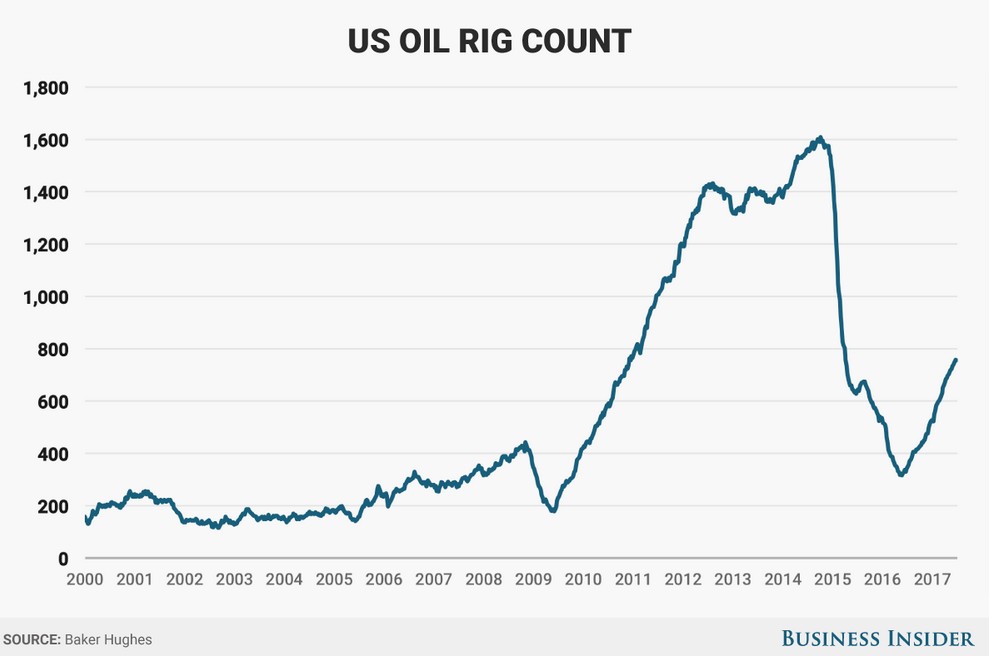
Did you see oil get crushed in recent weeks? Did you notice that rig count fell by 1 this week declining for the first time in a long while? With so many Energy stocks getting hammered in this tough operating environment, how is Tesoro doing so well?
The answer is why we picked the name for you. Tesoro is a refiner. It makes money off the spread between the price it pays to buy a barrel of oil and the price it receives after refining it into usable gasoline for your car. The dynamics of the all-important spread work like this: When oil prices fall, the price Tesoro can buy barrels of oil for falls faster than the retail price of gasoline. When oil prices rise, the opposite occurs. In other words, right now is the best environment for Tesoro as oil prices are falling. Profit margins at the business are exploding and so is the stock.
Adding fuel to the fire, Goldman Sachs came out just recently and added Tesoro to its conviction buy list and the CFO bought shares.
Tesoro is firing on all cylinders. Recall that the company also recently achieved an investment grade credit rating from S&P. And the big Western Refinery acquisition is on track for closing and integration.
BMR Take: We like to look at Tesoro’s value based on net asset value. NAV is $106 right now. So we are still at a big discount to NAV. In contrast, Warrant Buffet’s beloved Phillips 66 trades for a 20% premium to NAV. So we just see a ton of upside ahead still for Tesoro.
Google (GOOG: $909, down 6%)
It was a tough week to be a Google fan. The European Commission levied a huge fine on the company. The size of the fine the tech giant will have to pay for abusing its monopoly in online search, $2.7 billion, sets a record for European antitrust penalties. Yet more important than the amount is that the regulator provided a rough guide to how the European Commission plans to deal with Google and other online firms which not only dominate a market, but essentially are the market.
Google has $92 billion in cash, so $2.7 billion is just is 3% of its cash. The company made $6.8 billion last quarter before taxes, so $2.7 billion is just 40% of this, or 36 days’ worth of earnings. A pittance really. But there is much more to the story – keep reading.
In the 2000s Microsoft got into trouble because it had expanded its Windows monopoly by bundling it with its web browser. By comparison, Google’s infraction seems minor. In 2002 it launched a price-comparison service called Froogle, later renamed Google Shopping. In 2008 it changed how this service works. According to the commission, the new version systematically favored Google’s own comparison-shopping results by giving them prominent placement at the top of its generic search results and demoting links to rival offerings to pages further down in its results, where users hardly venture.
The prevailing wisdom, particularly in America, used to be that “super-platforms”, despite their size, do not unfairly use their market power and thrive because of their unceasing innovation.
But as digital platforms have grown ever bigger, that thinking has started to change, even in America. A growing number of antitrust experts now accept the European Commission’s view, that network effects create high barriers to entry in online markets. This means that Google, for instance, can in fact degrade its search results selectively (and disadvantageously to its direct competitors) without having to fear that its users will defect. But we need these super-platforms to adhere to a principle of neutrality for a fair marketplace to exist.
BMR Take: We at Bull Market Report always will tell it to you like it is. Google is in some trouble here and you could argue the antitrust issues probably extend to many other large cap tech names as well. We are going to monitor the situation for now as it would take a whole lot of things to happen for this regulatory risk to seriously impact the company and others in Tech. With the stock now trading at 27x this year’s EPS outlook of $34, the stock is cheaper here than last week. But if the US Government gets involved and starts investigating the company here in the US, things could get dicey. Search is 87% of Google’s profits. If outside influences affect this cash machine, there just might be trouble ahead for the stock. It is certainly a lot cheaper than its all-time high of $988 on June 6th, just three weeks ago, but as noted, there is risk here, like all stocks.
Government Properties Income Trust (GOV: $18, down 19%)
Don’t fall over in your chair! The stock got crushed this week, but it was because of an acquisition. Let us explain.
First Potomac Realty Trust (FPO) will be acquired by Government Properties. To finance the deal, the company sold 25 million shares in a secondary at $18.50, raising over $450 million. They had to knock the stock lower to get the funds they needed. This is typical. We believe the deal will work out well, and that we will see a full recovery and then some.
And the underwriters have been granted a 30-day option to purchase up to an additional 3,750,000 common shares. Two things: These overallotments are exercised about 99% of the time so expect to see another $65 million of cash in the bank. And expect to see the stock stay around this level for a month. Then there is a great likelihood that the stock will move back into the low 20s.
You should be excited. The acquisition of First Potomac Realty Trust enables Government Properties to expand its business strategy to include the acquisition, ownership and operation of office properties leased to both government and private sector tenants in the metropolitan Washington, D.C. market area. The metropolitan Washington market area is one of the largest office markets in the U.S. and the nation’s largest beneficiary of spending by the U.S. government. Outside of the metropolitan Washington market area, Government Properties will continue to focus on acquiring, owning and operating office properties that are majority leased to government tenants.
In addition to this transaction providing Government Properties with new potential growth opportunities, management expects to realize approximately $11 million of annual general and administrative expense savings compared to First Potomac Realty Trust on a standalone basis.
Management is very pleased that they were able to achieve an attractive per share purchase price. Their preliminary estimates call for meaningful accretion and more detail will be forthcoming.
BMR Take: NAV was $20.90 prior to raising some equity at $18.50. We don’t see any reason for the stock to trade at a discount to the lower level of $18.50. This is a buying opportunity for sure. Why do you think institutional investors just took down 25 million shares at $18.50? Get on board and put new money to work at a 9.4% yield right here in this name!
Upcoming Economic News
ISM Manufacturing
Monday, July 3, 10:00 AM
Period: June
Consensus: 55.1
Prior: 54.9
Note: The Manufacturing ISM Report on Business is based on data compiled from monthly replies to questions asked of purchasing and supply executives in over 400 industrial companies. An index reading above 50% indicates that economic activity is generally expanding; below 50%, that it is generally declining.
Factory Orders
Wednesday, July 5, 10:00 AM
Period: May
Consensus: -0.40%
Prior: -0.20%
Note: The Manufacturers' Shipments, Inventories, and Orders (M3) survey provides broad-based, monthly statistical data on economic conditions in the domestic manufacturing sector. The survey measures current industrial activity and provides an indication of future business trends.
Trade Balance
Thursday, July 6, 8:30 AM
Period: May
Consensus: -$46.1B
Prior: -$47.6B
Note: The monthly goods and services deficit is published by the U.S. Census Bureau and the U.S. Bureau of Economic Analysis. Trade statistics are estimates of transactions between foreign countries and the 50 states and our territories.
Nonfarm Payrolls
Friday, July 07, 8:30 AM
Period: June
Consensus: 175,000
Prior: 138,000
Note: Measures nonfarm payroll employment.
Twilio (TWLO: $29, down 2%) Makes the List
Oppenheimer is a leading investment bank and full-service investment firm that provides financial services and advice to high net worth investors, individuals, businesses and institutions, for over 130 years. They just came out with the “28 Best Ideas List” and we are glad to see that Twilio was on the list. They said: The cloud communications platform provider is poised to generate strong revenue growth for the foreseeable future and report upside metrics versus consensus estimates.
So there you have it. Short and sweet and another firm backing up what we have been saying here at The Bull Market Report. We were early, but we are going to be right in the long haul. This company is a factor in the growth of commerce on the internet. If revenues keep growing like they have been, the stock price will follow. Be patient.
Tesla Sales in China Are Big
Here are some snippets of what Tesla (TSLA: $381, down 6%) is doing in China. The sold 10,000 last year, which was triple what they sold in 2015. The produced $1.1 billion in revenues. For the first quarter of 2017, they are on pace to more than double 2016.
The Chinese love their SUVs and with taxes and fees, the prices are 25% higher in China. The love the Model X SUV.
BMR Take: We expect big things from Tesla in China.
An Update on Nutanix (NTNX: $20, Up 4%)
The stock had a good week, despite the nasty Nasdaq selloff. The company went public on September 30, 2016. It opened at $26.50 and hit $39 that day. The next trading day, October 3rdm it hit $46.78. A month later, by Nov 4th, the stock was at $24. On May 3, 2017 - $15.
Now, on May 24th of this year, we added Nutanix to our Special Opportunities portfolio at $17.45. We said at the time we thought the stock had great potential. Well, we did and we do still feel the same way. Revenues are the key. Last quarter they did $192 million, up from $115 million. We call that growth. Can they continue at this pace? We believe so.
We have a price target of $30 on the stock. Aggressive yes. We believe they can hit this later this year.
And Update on PayPal
PayPal (PYPL: $54, flat) has been strong and steady these past 2-3 months. Since April at $42, the stock is up almost 30%. We call that a nice return. Stick with us on this one. It is going places.
Venmo is a subsidiary of the company. It allows people to send money to friends and businesses at the touch of a button on their cell phone. Growth is off the charts. In 2015 they handled $7.5 billion in transactions. In 2016 the hit $18 billion. Wow. In the first quarter of 2017 they did $7 billion. As we said above for Nutanix, now that is growth.
At the moment Venmo is a small piece of the pie for PayPal, kind of like the iPhone for Apple 10 years ago. Tiny. But if they keep up this growth, in five years, they will be hitting $150 to $200 billion in transactions.
One forecast shows that volume of money transfers will reach $75 billion this year in the US. Volume is expected to pick up significantly by 2020, reaching $500 billion. This reflects a compound annual growth rate (CAGR) of 80% between 2015 and 2020.
PayPal itself is not a small company. The market cap is $65 billion and due to its potential, the PE is not small. It is listed at 45 and we feel it is worth every penny. As the world continues to move to mobile, PayPal is at the forefront on how to handle financial transactions simply and easily.
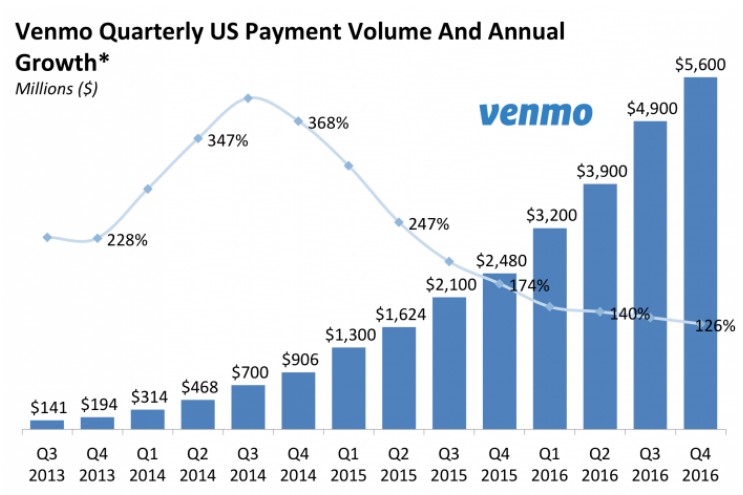
A Word from Gary Jefferson
Jefferson Financial Group
First Vice-President, Investments
UBS Financial Services
In ancient Roman religion and myth, Janus is the god of "duality". He is usually depicted as having two faces, since he looks to the future and to the past. What we are seeing today is a "Janus" market: One face is looking at a new era of higher earnings and economic growth while the other face is forecasting a dire end to the market based on past actions.
Two weeks ago, JP Morgan went on the record warning investors of an equity market collapse. The bank thinks that a number of factors will undermine stocks such as Fed rate hikes coupled with decreased easing from the European Central Bank and Bank of Japan. The bank further said it thinks the coming plunge in stocks will be steep, citing the possible emergence of “tail risks”, or seemingly unlikely scenarios which could have big negative effects on stocks. Bank of America also weighed in on the possibility of a coming fall, saying that “peak liquidity and peak profits mean a big top in autumn.” These warnings tie in to the core belief of this side of the Janus face which is forecasting imminent danger to the market; i.e., these experts, analysts and investors believe that the entire 2009-2017 stock rally is nothing more than the result of a historic, globally coordinated credit creation program from the world's major central banks, and this credit expansion is now unwinding.
While it is a fact that every major central bank in the world has done some qualitative easing over the past eight years, pumping the world full of cash, the other side of the Janus face is telling us that there is no hard proof that this global credit expansion is the sole reason behind stock prices moving higher.
We believe the Janus side which sees that market moves and valuations still come down to one single word – earnings, and which sees that future earning prospects are now rising, not falling. What we haven't heard from any of the doomsters is how far earnings are going to fall, or even that they are going to fall at all. Nor do we see a dotcom bubble with 100 PE multiples or a real estate bubble financed by NINJA loans*. A 10% correction is considered a "normal" market occurrence, so that possibility exists at any given point in any market's history. But a major crash is typically accompanied by a bubble or recession which collapses earnings, and we don't see clear cut warnings signs of either.
* A NINJA loan is a slang term for a loan extended to a borrower with "no income, no job and no assets"
All of which brings us to this point: the market has always loved "to climb a wall of worry".
[BMR thoughts: This dichotomy of half the folks thinking things will get worse while half the people think things will get better is nothing new. In fact, virtually every day for the past 100 years people have felt that way. That’s what makes a market. And we at The Bull Market Report are optimists and bullish on America. We along with Warren Buffett believe values will be higher a year from now and five years from now and we will continue to invest accordingly.
[With that said, if it’s too hot, get out of the kitchen and get into any or all of the stocks in the High Yield and REIT portfolios and sit back and collect the 6%, 8% and 10% dividends these stocks offer.]
More on Facebook and This Big Number: 2 Billion
Despite Facebook’s size and age, at 17% its user count is growing as fast or faster than any year since 2012. And people aren’t using it less either. In fact, 66% of Facebook’s monthly users return each day now compared to 55% when it hit 1 billion.
Two billion makes Facebook the largest social app. YouTube has 1.5 billion, WeChat’s has 900 million, Twitter’s has 330 million and Snapchat’s is around 250 million.
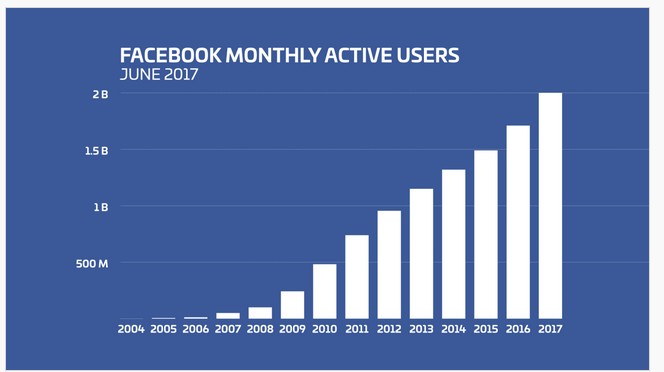
Facebook’s growth the last five years has been fueled by the developing world. It’s added 750 million users in Asia since hitting 1 billion users total. It’s only added 40 million in the U.S. and Canada. Facebook has set a goal to help 1 billion users become part of what Zuckerberg calls "meaningful groups," in a push to reverse what has become a pronounced decline in community membership around the world. Stronger community engagement on and offline will be key to solving critical global problems like climate change and public health issues, Zuckerberg said.
“A more connected world is going to be necessary to take on the greatest opportunities and challenges for the next generation, everything from stopping climate change, to stopping pandemics, to funding research,” Zuckerberg said. “These are not fundamentally national problems anymore. In order to get there, you need to build a world where every person has a sense of support and purpose in their life so they don’t just focus narrowly on what’s going on in their lives, but can think about these broader issues as well.”
Facebook now has 27% of the people on the planet on their platform. In August, 2015, the firm hit 1 billion users. It took the firm less than two years to double in size, adding another one billion users. Wow. That’s an average of 1.4 million users a day. Do you think this growth is going to stop? We say NO WAY. And with this young genius at the helm, we will follow him anywhere. $200 a share? Certainly a possibility. Any bets on WHEN this will happen?
Thoughts on UPS (UPS: $111, flat)
UPS has a $10 billion pension deficit. We are not happy they let themselves get into this predicament. They have said they will freeze its pension plan for nonunion workers and replace it with a 401k plan. The switch will affect 70,000 employees over five years.
BMR Take: We are not happy about this. The stock market has had no reaction to this news, as the stock was flat all last week. But we are here to look into the unknown future. Could it affect the stock? It sure could. It just might be time to take profits. We added the stock at $105 in April last year. It sure hasn’t done much these past 15 months. Yes, it pays a 3% dividend, but that’s really not much. Yes, we are up 5% plus the dividend, but that’s really not terribly exciting. It certainly is a solid company and stock. Amazon is changing the world and UPS is right there to deliver that change. But it may just be time to move on out and into something much more interesting. This $96 billion market cap company has some problems. So, if the stock drops to $106, we are out.
The High Yield Corner
By Michael Foster
We saw the market turn ugly on Thursday in the kind of selloff that investors should actually appreciate. This was largely concentrated in Tech stocks, with the Nasdaq falling a lot more than the S&P or Dow Jones, which meant that the more stable and less speculative asset classes were spared significant declines. Some, like a few high yield assets, actually went up as the Tech stocks went down. Is this a rotation from growth into value and income? One day does not a trend make, so we can’t say for sure. But it’s definitely something to look more closely at as we drill down into the most important moves in the high yield world for the week.
Bull Market Report pick the AllianzGI Equity and Convertible Income Fund (NIE: $19.75) was able to withstand Thursday’s selloff with marginal damage, closing the week flat. The fund’s net asset value also closed on a relatively strong point, resulting in the fund’s discount to remain at a solid 10%. We have seen that discount rapidly fall from the start of 2017. We’re now at one of the highest discounts to the fund’s NAV since 2014, which might encourage some investors to sell. And, indeed, if one wanted to take profits on this fund, now would be one of the better times to do so. However, investors should also consider that the fund is in a better position to cover its dividend than it has been in a long, long time. The fund’s NAV, at $21.88, has gotten to a point where the fund’s managers need to only get a 7% net rate of return to cover the fund’s dividend. Considering the fund’s holdings and its use of convertible bonds, as well as the broader trend towards higher interest rates thanks to the Federal Reserve, there’s a lot of justification for the view that the fund will continue to cover its dividend. That makes this as good of an income producing fund to hold than ever, so income-focused investors should consider holding the fund to continue to collect those dividends.
Of course, the biggest news of the week for the Bull Market Report’s High Yield portfolio was Government Properties Trust (GOV: $18.31), which announced its intention to purchase First Potomac (FPO: $11.10) for $11.15 per share in cash. The deal, announced on Wednesday, immediately caused Government Properties to fall. The selloff continued shortly thereafter when the REIT announced it would sell 25 million shares in a secondary offering, with shares priced at $18.50 - $1 below the stock’s price at the time of the announcement, but $4 below the price on Monday. All of this has hit the stock very hard, and it’s down 19% in a week’s time.
That also means Government Properties Trust is now just 2% higher than it was when we recommended the stock, erasing a year’s worth of solid capital gains overnight. While these kinds of moves are unfortunate, it’s important to remember that investors have earned about 12% in cash dividends over that period, so while the capital gains are gone, the income stream has already made this a positive-returning investment. The issue now is how investors should act given the recent acquisition.
Let’s take a look at the figures. First Potomac has 11 million square feet of office space in the Washington, D.C. area, which fits nicely with Government Properties’ own 95-building portfolio across 73 properties. While Government Properties has invested in D.C., it is much more widely diversified, which in the past was seen as a risk factor because the firm was seen as intensely exposed to cash-strapped municipalities and local governments who were cutting jobs and thus had a lower need for physical office space. Now that President Trump is in office and has promised budget cuts, does this mean that the D.C.-focused First Potomac is similarly at risk?
We say no. Since Trump’s election, the First Potomac has risen 26%. Part of the reason for this may indeed be Trump himself. Non-profit organizations, think tanks, lobby groups, and media companies have put more attention and focus on D.C. than we have seen for years, arguably decades; that means they need to rent offices. And that is a natural tailwind for First Potomac Realty because it drives demand for real estate in and around the Beltway.
Government Properties’ decision to buy into this newfound demand makes sense. Nonetheless, the deal is done and First Potomac has rising rents and high occupancy rates on its books when the deal closes. This is going to make Government Properties Trust’s dividend theoretically safer than it has been before.
For this reason, there is no reason to sell Government Properties stock right now - and perhaps more reason to buy as this temporary selloff due to the acquisition will not last forever.
Elsewhere in REITs, Bull Market Report’s recent pick Apollo Commercial Real Estate Finance (ARI: $18.55) was up 1% this week after the dividend payout on Wednesday of a 46 cent distribution in-line with the previous payout in March. Apollo Commercial continues to show incredible strength and remains one of the more reliable income generators in the mortgage REIT marketplace. The stock is up 15% from a year ago and we see more room for it to rise even further, bringing its current near-10% yield down a notch. Investors should consider buying now following the dividend payout and slight stock price decline to capture this great income payer at a low price.
Quote of the Day
Listen more than you talk. Nobody learned anything by hearing themselves speak.
Richard Branson,
Founder of Virgin Atlantic Airways and Virgin Group
Good Investing,
Todd Shaver
Founder, CEO and Editor in Chief
The Bull Market Report
Since 1998
June 19, 2017

by Todd Shaver | Jun 19, 2017 | Monthly Newsletter Daily 12pm if new
The Week Just Passed and the Week Ahead
Amazon set fire to the market on Friday as they announced a major deal to buy Whole Foods. Grocery stocks plunged as everybody wonders how much havoc Amazon will have in the new industry vertical. The M&A announcement re-energized the market that had been sagging due to FAAMG* stocks slowing down. But clearly there is a reason the FAAMG stocks are market leaders: they are the most innovative, the most savvy, and the most aggressive companies on the planet when it comes to raising the bar. The bull market in Technology that everybody was questioning just last week is alive and well!
* FAAMG – Facebook, Apple, Amazon, Microsoft and Google.
We are pleased to see the market come back strongly today, Monday, as we write this. The market is up 110 points on the Dow, with Apple, Facebook and Shopify making strong moves. And good old Amazon, which we profile below, just hit $1000 a share again. Go Bull Market.
There is always a bull market here at The Bull Market Report! This week we highlight the following stocks: Amazon, Apple, Facebook, Tesla, Annaly, and Google.
Highlights From The Past Week
Trump Says ‘Very Good’ GDP Numbers Are Coming. He May Be Right. President Donald Trump said Thursday that “some very good numbers” are coming out soon on U.S. economic growth. If he’s talking about the second quarter, he’s probably right, though the figures are about six weeks away from publication. While the White House didn’t immediately respond to a request to clarify Trump’s comments, there are wide expectations among researchers that the rate of expansion in the April-to- June period will rebound from a first-quarter slowdown. The pace of gross domestic product gains was dragged down earlier this year by temporary factors such as warm weather that resulted in lower utility bills. Seeing a pick-up in GDP growth is a major positive for the stock market.
The Sweetest Stretch of Bull Run Since 1995 is At Risk as Buy-The-Dip Strategy Fails. The sell-off in the Tech sector that started a week ago has erased $250 billion from the value of technology shares and is threatening to end the industry’s longest stretch of uptrend in more than two decades. Down around 4% since the decline started, this move has put the Tech sector on the edge of breaking its 50-day moving average. It’s stayed above the threshold for 131 consecutive days, the longest stretch since 1995. Are the good days ending? The last two times when the 50-day average was broken, Tech shares did poorly in the next few months. What do we make of this? Stocks can’t go up forever. We are seeing the Tech sector take a breather and would buy this weakness.
Don’t Be Tempted To Buy High-Flying Equities. Stick With Solid Stock Picks Recommended By The Bull Market Report. Bond investor Bill Gross warned on Tuesday that investors should reduce their risk appetite, given the U.S. growth rate is stunted by secular forces "which monetary and even future fiscal policies seem unable to reverse." In his June investment outlook letter, Gross of Janus Henderson said: "Strategies involving risk reduction should ultimately outperform 'faux' surefire winners generated by central bank printing of money.” He continued, "It’s the real economy that counts and global real economic growth is and should continue to be below par." Gross runs the $2.1 billion Janus Henderson Global Unconstrained Bond Fund.
BMR Companies & Commentary
Amazon (AMZN; $988, +1% for the week; up $23 on Friday)
Amazon is guided by four principles: customer obsession rather than competitor focus; passion for invention; commitment to operational excellence; and long-term thinking. Customer reviews, 1-Click shopping, personalized recommendations, Prime, Fulfillment by Amazon, Amazon Web Services - AWS, Kindle Direct Publishing, Kindle, Fire tablets, Fire TV, Amazon Echo, and Alexa are some of the products and services pioneered by Amazon.
Amazon and Whole Foods Market announced that they have entered into a definitive merger agreement under which Amazon will acquire Whole Foods Market for $42 per share in an all-cash transaction valued at $13.7 billion, including debt. This is Amazon’s biggest acquisition ever. Whole Foods will continue to operate stores under the Whole Foods Market brand and continue to buy from trusted vendors and partners around the world. John Mackey will remain as CEO of Whole Foods and the headquarters will stay in Austin. The deal is expected to close by the end of this year.
For Amazon, the deal marks an ambitious push into the mammoth grocery business, an industry that in the United States accounts for around $800 billion in annual sales. Amazon is also amplifying the competition with Walmart, which has been struggling to play catch-up to the online juggernaut. Amazon has designs on expanding beyond online retail into physical stores. The company is slowly building a fleet of outlets, and much attention has been focused on its supermarket dreams. It has already made an initial push through AmazonFresh, its grocery delivery service. Now, BANG, just like that, they will have 430 stores in place for delivery and warehousing. Is Bezos smart or is Bezos smart?
BMR Take: The current consensus EPS outlook calls for almost $7 this year going to $27 by 2020. That’s explosive growth and the innovation machine known as Amazon is far from done. Amazon remains one of our top favorites. And DO NOT be disconcerted by the price of the stock. If you want to buy $15,000 of Amazon, buy 15 shares. Don’t agonize over it. Just be invested in this great company.
Apple (AAPL; $142, down 4.5%)
After an action-packed world-wide developers conference (WWDC) with a plethora of new software and hardware announcements last week, the stock was under pressure all week. The sell-off in Apple represents yet another buying opportunity. With the expanding capabilities of Apple's network of hardware and software products, Apple is very well-positioned to capitalize on the trend toward more "things" becoming a computer. Last week, Apple filled key gaps in its portfolio with entry into the digital home assistant market with HomePod, combined with new AR and VR initiatives* to support these important trends. This further expands the breadth and depth of Planet Apple, making it more difficult for competitors to offer an experience at the same level of Apple.
* Augmented and Virtual Reality
BMR Take: Earnings are expected to be $9 this year and increasing toward $11 over the next 2 years. The business is steadily generating a massive amount of money – $800 million a week, totaling over $255 billion now. The naysayers will be proven wrong on Apple again – remember when it hit $91 exactly a year ago, after peaking at the $125 level in 2015? Well guess what – the new all-time high is $156 set just last month. That number is sitting there ready to be broken again
Facebook (FB; $151, up 1%)
Facebook is focused on building products that enable people (better yet – the world) to connect and share through mobile devices, personal computers and other surfaces. The company's products include Facebook, Instagram, Messenger, WhatsApp and Oculus.
Facebook has hired more than 150 counterterrorism experts and is increasingly using artificial intelligence that can understand language and analyze images to try to keep terrorists from using the social network for recruiting and propaganda. Facebook says, “We agree with those who say that social media should not be a place where terrorists have a voice.” The move comes as Facebook is being hounded by governments to do more to combat terrorism.
Mark Zuckerberg, Facebook’s co-founder and chief executive officer, has also been trying to position the company as a positive force for building communities both online and off. This new emphasis from Zuckerberg has followed discussion over Facebook’s role in the proliferation of false news accounts during the U.S. election campaign last year, as well as the spread of extreme content posted to Facebook.
Many of these new hires have backgrounds in law enforcement and they collectively speak almost 30 languages. In addition, Facebook has thousands of employees and contractors around the world that respond to reports of violations of its terms of service, whether that’s online bullying, posting inappropriate content or hate speech.
BMR Take: One of the major risks in front of Facebook is dealing with free speech rights versus meeting obligations to be a model corporate citizen. We are glad to see steps in the right direction. EPS is expected to go from almost $5 this year to $9.50 in 2020. This stock can go much higher if the company can avoid a few key risks.
Google (GOOG; $940, down 1%)
Google spans Internet products, such as Search, Ads, Commerce, Maps, YouTube, Google Cloud, Android, Chrome and Google Play, as well as its hardware initiatives. Google is engaged in advertising, sales of digital content, applications and cloud offerings, and sales of hardware products. This is a mouthful, so one other way of looking at Google is: Most of their revenue comes from search. Period.
This week Google launched a new cloud computing platform in Singapore that aims to reduce data transmission delays for its cloud customers here, as it seeks to gain ground against rivals Amazon and Microsoft globally. It has opened dedicated cloud platform servers - called a "Google Cloud Platform (GCP) region" - in Singapore and this is the group's first GCP region in South-east Asia.
The Singapore cloud platform is the company's third in Asia, after Taiwan and Tokyo, and it is looking to launch dedicated servers in Mumbai and Sydney as well, they added. The launch of the Singapore service has significantly reduced latency, which refers to delays in data transfer over a network connection, for Google's cloud platform customers and users in Singapore and South-east Asia. The platform offers products and services such as application hosting, security, language translation and analytics.
Businesses can save anywhere from 50-70% by using a cloud platform in general compared to other options such as hosting data storage themselves. The migration to the cloud is a mega-trend and Google is in the forefront of this new world.
We mention these new events to give you the scope of what this company is doing. While you and I worry about what’s happening here in our own little worlds, Google is out there setting the stage for controlling and profiting from places around the world this year, next and for decades to come.
BMR Take: EPS is on track for $34 this year going to $55 by 2020. We see a compelling opportunity in this large cap tech giant.
Upcoming Economic News
Current Account
Tuesday, June 20th, 8:30 AM
Period: Q1
Actual: N/A
Consensus: -$121B
Prior: -$112B
Notes: The international transactions accounts are a quarterly statistical summary of transactions between U.S. and foreign residents organized into three major categories: The current account, the capital account, and the financial account. The current account includes exports and imports of goods, services, income, and current transfers. The capital account includes capital transfers, such as debt forgiveness. The financial account includes transactions for official assets, for U.S. Government assets other than official reserve assets, for direct investment, for portfolio investment, and for other investment.
Existing Home Sales
Wednesday, June 21st 10:00 AM
Period: MAY
Actual: N/A
Consensus: 5,545,000
Prior: 5,570,000
Notes: Each month, the National Association of Realtors (NAR) collects data on existing single-family home sales from Boards or multiple listing services (MLS) nationwide. NAR estimates that it captures between 30-40% of all existing home sale transactions with its monthly survey. The data provide the total number of closed existing home sales in each area as well as total sales within price categories ranging from less than $30,000 at the bottom to more than $500,000 at the top.
Leading Indicators
Thursday, June 22nd,10:00 AM
Period: MAY
Actual: N/A
Consensus: 0.40%
Prior: 0.30%
Notes: Leading indicators are economic series that tend to change direction ahead of shifts in the business cycle. There are 10 components of the U.S. Leading Composite Indicator published by The Conference Board. The index is constructed by averaging the individual components in order to smooth out a good part of the volatility of the individual series. Historically, the cyclical turning points in the leading index have occurred before those in economic activity.
New Home Sales SAAR
Friday, June 23rd, 10:00 AM
Period: MAY
Actual: N/A
Consensus: 600,000
Prior: 569,000
Notes: The U.S. Census Bureau collects new home sales based upon the following definition: "A sale of the new house occurs with the signing of a sales contract or the acceptance of a deposit." The house can be in any stage of construction: not yet started, under construction, or already completed.
Tesla Week
Tesla (TSLA: $371, up 4%) had a great week, in spite of the Fed and the Tech sell-off and everything else. Up 4%. Huge. The stock was upgraded by Berenberg Bank from a "hold" rating to a "buy" rating. They now have a $464 price target on the stock, up previously from $193.
BMR Take: This is a car company and this is a Tech company, and it is run by a one of the smartest men on the planet.
Annaly Update
We love this stock. We have been following Annaly Capital Management (NLY: $12.36, up 2%) since 1997 when they first went public. They have survived thick and thin: bull markets and bear; high interest rates and low; recessions and boom. And they continue to give you a 10% dividend, year in and year out.
With that said however, it may be time to take some profits in the stock. We added the stock in early 2016 at $10 and it is now over $12, up 25%. The key is book value. It is currently at $11.23, thus trading at 10% over book. Annaly generally sells right at book, so it is getting ahead of itself. Our Target is $12, so one could certainly sell now and be happy campers. Or you could watch and wait. We are going to watch book like a hawk. If it keeps moving higher we are golden. But if it stalls, and the stock moves back towards $12, we will most likely be saying so long to a great company.
Letter to the Editor about Shopify (SHOP: $87, down 5%)
From: John Hoogerheide [mailto:johnhooger17@xxxx.net]
Sent: Thursday, June 15, 2017 11:23 AM
To: Todd at The Bull Market Report
Subject: SHOP
Todd - A while back you had suggested Shopify as a stock just to own and forget in your portfolio as it will have very large daily bounces. In your reports you indicated the stock COULD be a likely candidate for a buyout and that their fundamentals looked solid. Shopify had been on a tear but the Nasdaq fallout has killed the stock. I assume the Nasdaq fallout is only temporary and things will go back to normal. BUT has anything changed in your attitude towards Shopify? Thanks Todd
Hi John –
No. Just the price. And it is very frustrating. I’m trying to be patient and get through the Fed raise which is just about done. The bond market was WAY up yesterday (10-year Treasury down big to 2.13%. Up a tad today, but not much.) Then the question is – are we in a Tech AND overall stock selloff? If so, then we should move to high yield, like Apollo, Annaly, etc., and bide our time until things become normal in Washington. If not, then the bull market continues. Where ELSE can you put your money? And this is not an idle question. People have been say it for YEARS, with interest rates at historic lows. And they are STILL at historic lows, really. Thus, we have this amazing bull market since 2009.
Note that I don’t believe we ever said you could put it away and not look at it. But we certainly feel that it is a long term hold and the prospects look good.
Todd Shaver, Founder and Editor in Chief
And then on Friday we wrote to him:
Nice bounce-back yesterday and today, John, after hitting $81.50 at the low point yesterday.
This one is real.
The sell-off was not.
Let’s hope it holds.
Todd Shaver
[Note that the stock closed at $87 Friday. Our take? This is a volatile stock in a nervous Tech market right now. If it’s too hot for you get out of the kitchen. Again, we are trying to be patient here with this amazing company.]
More (Good) News on Shopify
Shopify sold 5.5 million shares at $91 on May 24th in a secondary, raising $500 million. Then just last week they completed the overallotment. Do you know what that is? It is an extra block of stock that can be sold as part of the original secondary if there is demand. Well, there was, and Shopify sold another 825,000 shares at the same price worth $75 million. Not bad. So now the company is sitting on a ton of cash (we believe the total to be close to $1 billion), they have no debt, and revenues are growing like a weed.
So here dear Bull Market Reader, are a few thoughts on Sell and Target prices:
When we add a stock to our portfolio we have a Target and a Sell Price. The Target is where we think it can go and the Sell Price is the price that if it hits, you have some thinking to do. The Sell Price is usually 10-15% below the price where we added the stock. Taking a 10-15% hit is a big deal, and some may even say that if a stock drops 5-7% you should get out. Everyone has their own rules to follow. However, there are companies that are young and unproven that we feel have the potential to be 2-baggers and 5-baggers and more. Cloudera, Twilio and Nutanix are three of these. What happens with these stocks is that the world as a whole doesn’t recognize their greatness yet, and aren’t willing to hold them through tough times. It’s called the Market. (There were times in Amazon’s young life when the market sold off the stock because of various reasons. The strong held on, the weak got out.)
The problem however, is that hindsight is 20-20 and we at The Bull Market Report a) might be wrong on a stock, or b) might be early. Both of these scenarios can cause a Cloudera to go from $23 on June 6th when we added it, to the level it is at today. Not pretty, but this is the life we lead when we invest.
Now, with that said, what do we mean with the Sell Price? The answer actually is not what do WE do, it is what YOU do. The Bull Market Report very rarely tells you to SELL a stock. We SUGGEST things to you based on FACTS. We leave it up to you to decide as intelligent human beings. In this case we believed in Cloudera at $23, and now at $17.40 we believe in it more. Why? The only thing that has changed is the PRICE. It is less expensive than it was. We still think it can go to $28, and $40 and beyond, and now it is cheaper. Yea! BUT – WHAT IF IT GOES LOWER FROM HERE? What if it goes to $14? What if it goes to $10? Then we have a big problem as you can see.
So the safest thing to do is to “Sell.”* We take a licking in our portfolio, and if you follow suit, you do too, and it prevents a disaster if it goes to $14 or $10. BUT, what if this recent Tech sell-off is over now. What if Apple and the rest of them start to shoot higher over the coming weeks, which we fully expect? And what if Cloudera heads back into the 20s like we believe it will do?
No guaranteed answers here as you can see. But plenty of food for thought. Speaking of thoughts, if you have a question about this or anything else, please write us at Info@BullMarket.com.
* No one at The Bull Market Report buys or owns the stocks in our portfolios. We don’t play that game.
The High Yield Corner
By Michael Foster
The biggest news of the week was the interest rate hike, but before we get to that, let’s talk a little bit about Digital Realty Trust (DLR: $117, up 4%, plus a 93 cent dividend paid on Tuesday.)
This data center REIT has been a Bull Market Report pick since March last year. Since then the stock has gone up 38% while paying 4% in dividends. A 42% return in a little over a year is breathtaking for any type of investment, but it’s relatively uncommon in the high yield world where you often sacrifice big short-term gains for cash flow. But Digital Realty is different.
The reason is simple: Digital Realty isn’t just a high yield stock; it’s also a Tech stock. Digital Realty has a very simple business model that positions it to benefit from the hypergrowth of tech companies: it rents out server space for firms that exist in the cloud. Any cloud computing startup depends on Digital Realty for the bare infrastructure that makes their product possible; and, unlike startups, Digital Realty’s revenue stream and profitability come first.
From that perspective, Digital Realty is a very attractive business; it’s part utility and part a hypergrowth tech stock. It’s rare to find a company that combines the two extremes of the finance world - dull safety with cutting-edge high-risk technological innovation - but Digital Realty has combined the best of both worlds for years. As a result, the company has attracted capital slowly over time, but the stock was limited until the middle of 2015 by one risk factor: competition from others in the space. At the end of 2015, Digital Realty initiated some expansion efforts that essentially gave the business a “moat” and protected it from competition. The firm very smartly placed facilities in ideal geographical positions to get the attention and demand from telecommunications giants and government agencies, putting the company at a distinct competitive advantage.
The stock market swiftly reacted, and the stock has doubled since the middle of 2015. Insiders have also taken notice, which is why DuPont Fabros Technology (DFT: $64) announced it would merge with Digital Realty in an all-stock transaction*. What exactly does this merger mean for Digital Realty shareholders? Well, the stock initially fell on the news but very swiftly recovered (it’s now up about 4% for the week following the initial decline). Apparently the market first thought the merger was a bad idea and then changed their minds. The market loved the news for DuPont, however; that stock is up 20% following the news.
* June 9, 2017 San Francisco's Digital Realty Trust has agreed to acquire Washington, D.C.-based data center developer Dupont Fabros Technology for $7.6 billion in stock, bolstering its reach in and around Silicon Valley. The companies operate as real estate investment trusts that rent out space to corporations to house their high-powered computer servers, used in cloud supercomputing, streaming video and data storage. Dupont Fabros has a dozen such complexes, including one in Santa Clara, two near Chicago and nine in Northern Virginia.
The merger is extremely good for Digital Realty shareholders for one simple reason: it adds a new dimension to the company’s incremental expansion efforts. Now with DuPont’s properties, Digital Realty will have 157 properties in 12 different countries added to its portfolio. The combined firm is going to have 26 data centers operating at 97% occupancy. Remember that Digital Realty had been mostly a U.S. focused REIT with most of its properties in Northern Virginia, Chicago, and Silicon Valley. The firm clearly saw an opportunity in providing for the government’s and tech startups’ growing digital footprint.
Note that the market cap of Digital Realty is $19 billion. After the merger it will be around the $25 billion mark.
But this also means buying and holding Digital Realty has become a very different game. When The Bull Market Report originally recommended the stock, it was yielding 4%; even with dividend hikes, the stock is now yielding a little more than 3%. The company will undoubtedly have enough funds from operations to keep growing payouts, but Digital Realty has become more of a tech growth stock than a high yielding stock. Holding it now is more a bet on capital gains appreciation than a way to capture a high stream of income.
The big news for the market last week was the Federal Reserve’s rate hike. Now for the first time in over a decade the Federal funds rate is over 1%. This sounds like big news, but the market shrugged. the S&P 500 was down slightly and the Dow and Nasdaq flat following the announcement, indicating the very risk-on and risk-averse equity investors agree that this isn’t important news.
What’s even more shocking is the bond market. With higher interest rates on the short end of the curve, you’d naturally expect higher interest rates on the long end of the curve. But interest rates barely budged following the announcement, and actually went down sharply shortly before the announcement. There are a lot of ways to interpret this, but each is a variation on a singular theme: the bond market is daring the Fed to raise rates further. Either the bond market isn’t expecting the Fed to keep raising rates (the next rate hike, Yellen pretty much said, is coming at the end of this year), or bond traders are waiting until the last possible moment to sell Treasuries, or there is too much demand for Treasuries and not enough supply. Each of these moves is either a bet on or a hope for the Federal Reserve to go more dovish in the future.
Personally, we disagree. We think the Fed will blink first and slow their rate hike plans. This is essential to avoiding an inverted yield curve, which generally portends a recession here in the United States. At the Fed’s currently stated rate of rate hikes, that inverted yield curve would likely come at the end of 2018 or the beginning of 2019, indicating a recession in the middle to end of 2019. A slower rate of increases would delay that eventuality to more like 2020 or 2021.
In either case, all indications suggest that we are nowhere near a market downturn or an economic contraction. While the interest rate hikes have been big financial news for years now, and many doomsayers have said this portends a sharp downturn soon, a more reasonable interpretation is that we still have at least two years before the first sign of trouble. So it isn’t time to sell yet, but vigilance will slowly become more and more important.
There is one more pressing issue, however, especially for the high yield world: Higher interest rates on the short end and lower interest rates on the long end cut the profitability of leverage. This makes it tougher for Mortgage REITs, although a few particularly well-managed and differently structured firms (such as Bull Market Report’s recent pick, Apollo Commercial Real Estate Finance (ARI: $18.92), and Annaly Capital Management (NLY: $12.36)) are exceptions to this rule. It’s also a concern for business development corporations, which have suffered “yield compression” for years and are now suffering higher borrowing costs on top of that.
The trend is also not good for junk bonds, although many junk bond funds have priced this in over the last two years, so it’s not a major issue. However, if the Federal Reserve continues on its promised rate hike path, high yield investors will need to get ready to rotate out of the most at-risk asset classes. We’re not quite at that point yet, but it is definitely visible on the horizon.
Good Investing,
Todd Shaver, CEO, Founder and Editor in Chief
The Bull Market Report
Since 1998
